

In the hyper-competitive world of eCommerce, a beautiful Shopify store and fantastic products are just the starting point. To truly scale and capture organic market share, you need authority, and authority in the digital world is built on links. These backlinks act as votes of confidence from other websites, telling search engines like Google that your store is a credible and valuable resource. Without them, even the best products can get lost in the noise, failing to rank for the keywords your customers are searching for.
This guide moves beyond the basics to provide actionable link building tips designed specifically for eCommerce businesses. Instead of vague advice, you will find detailed blueprints for each strategy, complete with outreach examples, priority levels based on effort vs. ROI, and KPIs to track your success. For a deep dive into building authority and driving traffic, explore this comprehensive guide on Mastering Link Building for Ecommerce Sites. The goal here is not just acquiring backlinks; it's about building a powerful, defensible moat around your brand that drives sustainable traffic and revenue.
We will cover ten distinct strategies, from guest posting on industry publications and executing broken link building campaigns to creating data-driven content that attracts links naturally. Whether you want to turn client success stories into powerful assets or secure features through strategic partnerships, this article gives you the exact steps needed. Prepare to transform your outreach efforts into a high-return engine for growth and secure the online visibility your brand deserves.
1. Guest Posting on eCommerce and Shopify Publications
Guest posting remains one of the most effective link building tips because it directly places your brand in front of a relevant, engaged audience. This strategy involves writing and publishing an article on another website or blog within your industry, earning a backlink to your site in return. For an eCommerce brand, this means contributing practical, high-value content to publications your ideal customers already read and trust.
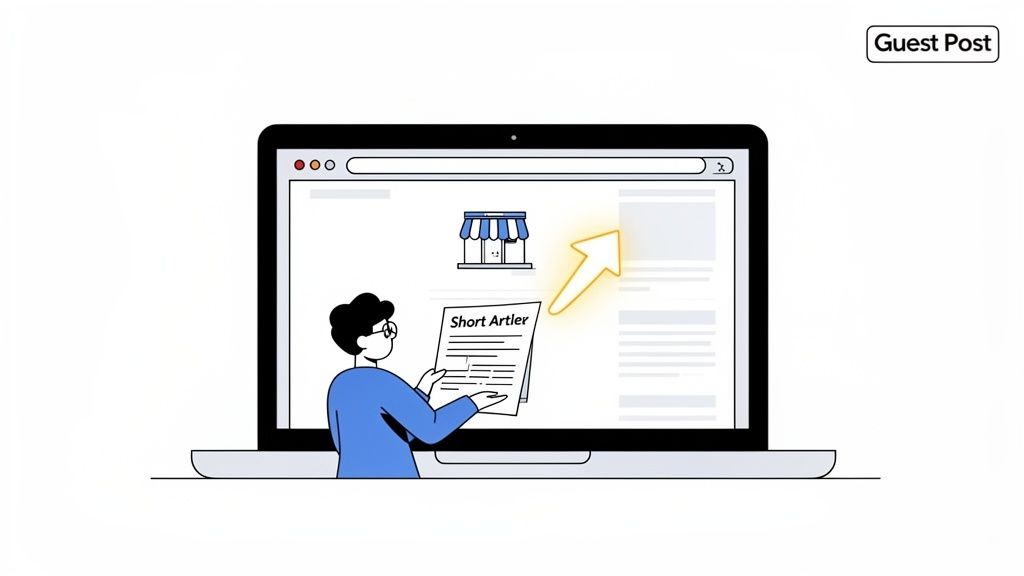
This approach delivers a dual benefit: a powerful, contextually relevant backlink that boosts your domain authority, and the opportunity to position your brand as a thought leader. By sharing genuine expertise, you build credibility and can drive referral traffic from an audience primed to be interested in your products or services.
How to Implement This Strategy
Successfully landing a guest post requires a methodical approach, not just a mass email blast. Start by identifying the right platforms. Target publications where your ideal customer profile spends their time.
- App & Tech Blogs: Publications like the official Shopify Blog, or blogs for major apps such as Klaviyo and Gorgias, are excellent targets.
- eCommerce News Sites: Well-respected sites like eCommerce Influence or Practical Ecommerce have large, dedicated readerships.
- Broader Marketing Publications: Sites such as Search Engine Journal often accept content with a specific eCommerce or Shopify angle.
Before pitching, thoroughly study the publication's content and submission guidelines. Editors receive countless generic pitches; a personalized email that demonstrates you understand their audience and content style will stand out. Propose specific, unique topics that fill a gap in their existing content, such as a deep dive into Shopify Plus migration challenges or a case study on improving conversion rates with a specific tactic.
Pro Tip: Your author bio is prime real estate. Don't just link to your homepage. Instead, link directly to a relevant service page, a high-value blog post, or a lead magnet to capture interest directly from your guest post. This small detail significantly improves the ROI of your guest posting efforts.
2. Broken Link Building and Resource Page Strategy
Broken link building is a clever technique that involves finding broken (or "dead") links on other websites and offering your own relevant content as a replacement. This approach provides direct value to webmasters by helping them fix an issue on their site, which improves their user experience and SEO. In return, you earn a high-quality, contextually relevant backlink.
For an eCommerce brand, this means targeting resource pages, guides, and blog posts where a competitor or a complementary tool once had a link that now leads to a 404 error. By suggesting your own superior resource, you not only help the site owner but also position your brand as a helpful and authoritative player in the space.
How to Implement This Strategy
This tactic, popularized by experts like Brian Dean of Backlinko, is more about precision and value than volume. It starts with identifying the right opportunities on pages your potential customers visit.
- Find High-Value Resource Pages: Use SEO tools like Ahrefs or SEMrush to find pages that list resources, tools, or guides relevant to your niche. Search for terms like "best Shopify apps," "eCommerce marketing tools," or "CRO resources."
- Identify Broken Links: Once you have a list of target pages, use a browser extension like Check My Links to quickly scan them for dead links.
- Create or Offer a Superior Replacement: If you don’t already have a piece of content that perfectly replaces the broken one, create it. Your replacement should be more up-to-date, comprehensive, or provide more value than the original dead resource. For example, if the broken link was to a 2019 guide on Shopify themes, offer your 2024 guide with fresh examples.
- Conduct Personalized Outreach: Craft a concise, friendly email to the site owner or editor. Clearly state where you found the broken link and politely suggest your content as a replacement, explaining why it's a good fit for their audience.
Pro Tip: When suggesting your replacement, briefly highlight what makes it better. Mention that it includes recent data, case studies, or a unique perspective (like AI integration). This gives the webmaster a compelling reason to choose your link over simply removing the dead one.
3. Skyscraper Technique - Content Upgrade Strategy
The Skyscraper Technique involves finding popular, link-worthy content in your niche, creating something significantly better, and then reaching out to those linking to the original piece. Instead of reinventing the wheel, you identify a proven concept and build a more valuable, comprehensive, and up-to-date version. For eCommerce brands, this means turning a competitor's "Top 10 Tips" list into an ultimate guide with 50 actionable strategies, case studies, and expert quotes.
This method is powerful because it's based on existing demand. You already know the topic attracts links; your job is to create the definitive resource that deserves them more. It’s one of the most reliable link building tips for earning high-authority backlinks because you’re providing a direct upgrade to webmasters who have already shown interest in the topic.
How to Implement This Strategy
A successful Skyscraper campaign is a three-step process: find content with a strong backlink profile, make it undeniably better, and then conduct strategic outreach.
- Find Link-Worthy Content: Use tools like Ahrefs or BuzzSumo to find articles in the eCommerce space with many referring domains. Look for topics like "Shopify optimization checklist" or "conversion rate optimization framework" that have high link counts but are outdated or incomplete.
- Make It Better: Your content needs a significant upgrade. This isn't about adding a few hundred words. Go deeper by making it longer, more current, and better designed. Add original research, data visualizations, expert interviews, or a downloadable resource to provide unique value. For instance, if the top article has 20 strategies, aim for 100+ and include real-world examples.
- Strategic Outreach: Export the list of sites linking to the original article. Reach out with a personalized email, pointing out that you saw they linked to the old resource. Briefly introduce your new, improved version and explain why it’s a better resource for their audience (e.g., "it includes 3x more strategies and recent case studies").
Pro Tip: When you publish your "skyscraper" content, don't just stop at outreach. Promote it heavily across your own channels, including your email list, social media, and paid ads. The initial traction and social proof you generate will make your outreach emails much more compelling and effective.
4. Strategic Partnership and Co-Marketing Linkage
Developing strategic partnerships is a powerful method for acquiring high-authority backlinks by collaborating with complementary brands. This tactic involves teaming up with non-competing businesses, such as Shopify app developers or marketing agencies, to create co-branded content, webinars, and resources. The result is a win-win scenario where both partners gain valuable links and exposure to each other's established audiences.
This strategy is one of the most effective link building tips because the links are naturally earned through a mutually beneficial relationship. For an eCommerce brand, partnering with a tool like Klaviyo to create a guide on email marketing or with Gorgias for a webinar on customer service optimization generates contextually rich backlinks. These partnerships build brand authority and drive highly qualified referral traffic.
How to Implement This Strategy
A successful co-marketing partnership is built on shared goals and clear value exchange. It begins with identifying the right collaborators who serve your target audience without being direct competitors.
- Shopify Ecosystem Partners: Connect with developers of popular Shopify apps, email marketing platforms (e.g., Klaviyo), customer service tools (e.g., Gorgias), or analytics software. These companies are often eager to showcase how their tools benefit real stores.
- Marketing Agencies & Consultants: Partner with agencies or Shopify Plus partners that specialize in areas you don't, such as SEO, paid ads, or enterprise strategy. A joint resource can serve as a lead magnet for both parties.
- Complementary Product Brands: If you sell high-end coffee beans, a partnership with a company that sells premium coffee grinders makes perfect sense for a co-branded "Ultimate Home Barista Guide."
When you reach out, present a clear proposal outlining the mutual benefits. Suggest a specific co-branded asset, such as a webinar, an in-depth guide, or a set of templates. Ensure both brands promote the final content on their websites, blogs, and social media channels to maximize reach and backlink opportunities. For more insights into creating these valuable connections, you can learn more about effective link building tactics for eCommerce brands.
Pro Tip: Document your successful partnerships. After a co-branded webinar or content launch, create a case study or a testimonial for your partner's website. This often results in an additional high-quality backlink and strengthens the relationship for future collaborations.
5. Case Study and Client Success Story Linking
Transforming your client successes into detailed case studies creates powerful, linkable assets that prove your expertise and value. This strategy involves documenting the impressive results you've achieved for a client-like boosting conversion rates or scaling revenue-and then promoting that story. The goal is to earn backlinks both from the featured client and from industry publications looking for credible success stories.

This method provides two key advantages. First, it generates a highly relevant backlink from a satisfied client who is proud to showcase their success. Second, it produces a piece of compelling content that other sites in your niche will want to reference, solidifying your reputation and attracting high-quality links that are difficult to acquire otherwise.
How to Implement This Strategy
A successful case study requires more than just stating a result; it needs to tell a compelling story backed by data. Start by identifying clients who have seen remarkable, quantifiable improvements from your work.
- Select Strong Results: Focus on stories with clear metrics, such as "How Brand X Increased Conversion Rate by 45% Through Shopify Optimization" or "From Struggling Store to $2M+ Revenue: A Multi-Storefronts Strategy."
- Document Everything: Detail the initial challenges, your methodology, the specific solutions you implemented, and the final outcomes. Use charts and graphs to visualize the data.
- Involve the Client: Include direct quotes and testimonials from key decision-makers. Once the case study is published, ask the client to add a link to it from their "About Us," "Press," or blog page.
- Promote Your Story: Pitch the finished case study to eCommerce and marketing publications as an exclusive success story. Anonymize sensitive data if needed, but keep the core results to maintain credibility.
Pro Tip: Create an executive summary or a one-page PDF of each case study. This makes it easy for your sales team to share with prospects and for journalists to quickly grasp the story's core value, increasing your chances of getting featured and earning a link.
6. Expert Roundup and Industry Authority Linking
An expert roundup post gathers insights from multiple industry authorities on a single, compelling topic, creating a valuable resource that is inherently shareable. This strategy involves reaching out to well-known eCommerce thought leaders, Shopify experts, and agency founders, asking for their opinion on a specific question, and compiling their answers into a single article. The experts who contribute are then naturally inclined to share the content with their own audiences, often linking to it from their websites or social profiles.
This method is one of the most effective link building tips because it builds relationships and creates high-authority content simultaneously. For an eCommerce brand, publishing a post like "12 Shopify Experts Share Their Top CRO Strategies" not only generates backlinks but also aligns your brand with respected names in the industry, boosting your credibility by association.
How to Implement This Strategy
A successful expert roundup depends on a well-organized outreach process and a genuine respect for the contributors' time. Your goal is to make it as easy as possible for them to participate and share. Start by identifying the right people and the right question.
- Identify Your Experts: Create a list of 15-20 relevant authorities. Look for Shopify agency founders, influential eCommerce marketers, and tech partners whose audience overlaps with yours.
- Craft a Compelling Question: The question should be specific, engaging, and answerable in 100-200 words. Good examples include, "What is the most overlooked tactic for scaling a Shopify store past $1M?" or "What is one AI tool you believe will change eCommerce marketing in the next year?"
- Personalize Your Outreach: Send a concise, personalized email to each expert. Emphasize the value for them, such as exposure to your audience and co-promotion alongside other industry leaders.
Once you publish the roundup, include a headshot, brief bio, and a link to each contributor's website and social media profiles. This professional courtesy is crucial. Your promotional work begins immediately after hitting publish.
Pro Tip: Don't just send a single "it's live" email to your contributors. Craft a pre-written social media post and a simple "click to tweet" link for them. Making it effortless to share dramatically increases the likelihood they will link to and promote the content, maximizing your backlink and traffic potential.
7. Data-Driven Content and Original Research Studies
Creating original, data-backed research is one of the most powerful link building tips for establishing authority and generating high-quality backlinks at scale. This strategy involves conducting surveys, analyzing proprietary data, or compiling industry benchmarks to produce a report that offers unique insights. Journalists, bloggers, and marketers are constantly searching for credible data to support their arguments, making your research a natural magnet for citations and links.
For an eCommerce brand, this could mean publishing an annual report on conversion rate benchmarks for Shopify stores or surveying 500+ brand owners about their adoption of AI in marketing. The goal is to become the primary source for a specific piece of industry knowledge, making your site the go-to destination for anyone discussing that topic.
This approach delivers an exceptional return by creating an asset that attracts passive links long after its publication. It positions your brand as a data-driven authority, builds immense credibility, and provides a cornerstone for your entire eCommerce content strategy.
How to Implement This Strategy
A successful research-based link building campaign requires a commitment to quality and a well-planned promotional strategy. Start by identifying a topic with broad industry appeal and a clear gap in existing public data.
- Choose Newsworthy Topics: Focus on trends that are relevant now, such as a 'Multi-Channel Selling Profitability Analysis' or a 'Shopify Store Scaling Study'.
- Ensure Credibility: For survey-based reports, aim for a minimum of 500 respondents to ensure statistical significance. Partnering with a research firm or academic institution can further boost credibility.
- Visualize the Data: Create compelling infographics, charts, and data visualizations that are easy to understand and share. This makes your report more appealing to journalists and easier to embed in their articles.
- Promote Heavily: Publish a comprehensive report with a detailed methodology, then create a press release summarizing the key findings. Actively pitch this story to industry journalists, publications, and influencers who cover your niche.
Pro Tip: When publishing your report, create a dedicated landing page that includes a summary, key findings, and an option to download the full report (often in exchange for an email). Make your charts and graphics easily embeddable with pre-formatted HTML snippets to encourage sharing and proper attribution with a backlink.
8. Infographics and Visual Content Distribution
Visual content, particularly data-rich infographics, offers a potent way to earn high-quality backlinks. People are naturally drawn to well-designed visuals that simplify complex topics. For an eCommerce brand, this means creating shareable assets that explain Shopify optimization strategies, detail conversion rate methodologies, or map out scaling frameworks. These are then distributed through visual content platforms and pitched to relevant blogs for easy embedding.
The power of this link building tip lies in its inherent shareability. A compelling infographic acts as a self-contained piece of value that other site owners want to share with their audience. By providing an embed code, you make it incredibly easy for them to do so, securing a backlink with minimal effort on their part. This strategy positions your brand as a data-driven authority and generates links from a wide variety of sources.
How to Implement This Strategy
A successful infographic campaign is more about the data and promotion than just the design. The visual element must be supported by a strong strategic foundation. Start by identifying topics with broad appeal that can be distilled into a clear visual narrative.
- eCommerce Process Guides: An infographic like 'The Complete Shopify Optimization Checklist' or a 'Conversion Rate Optimization Framework' visual guide is immediately useful.
- Industry Data & Trends: Create visuals based on original research or compiled data, such as 'AI Tools for eCommerce: Features, Pricing, and ROI Comparison'.
- Conceptual Roadmaps: Visualize complex journeys, like an 'eCommerce Scaling Roadmap: From Startup to Enterprise', which provides a high-level overview that other blogs would find valuable to reference.
Invest in professional design to ensure your data is presented clearly and attractively. Once created, publish the infographic within a comprehensive blog post on your own site that expands on each point. This post becomes the primary asset you link back to. From there, your focus shifts to outreach and distribution, contacting blogs, resource pages, and journalists who have covered similar topics and offering them the visual to enhance their content.
Pro Tip: Make your visual content 'embed-friendly' from the start. Include your brand logo and website URL directly within the design. More importantly, provide a pre-formatted HTML embed code directly below the infographic on your blog post. This small convenience removes friction and dramatically increases the likelihood that others will embed your content with the proper attribution link.
9. Podcast Appearances and Audio Content Backlinks
Securing guest spots on relevant podcasts is a powerful way to build both brand authority and high-quality backlinks. This strategy involves appearing as an expert on shows your target audience listens to, earning valuable links from show notes, episode pages, and podcast directories. For an eCommerce brand, this offers a direct line to the ears of potential customers and partners.
This method provides more than just a link; it allows you to connect with an audience through storytelling and genuine conversation. As listeners hear your insights on topics like conversion optimization or AI in eCommerce, you build trust and credibility. The resulting backlinks from respected podcast websites are contextually rich and signal to search engines that you are a key voice in the industry.
How to Implement This Strategy
A successful podcast outreach campaign is built on research and personalization, not volume. Your goal is to provide undeniable value to the host and their audience. Start by creating a target list of shows that align with your brand's expertise and customer profile.
- eCommerce & Shopify Shows: Podcasts like The Unofficial Shopify Podcast or eCommerce Influence speak directly to your core audience of merchants and marketers.
- Niche-Specific Podcasts: Look for shows that focus on a particular area where you excel, such as conversion rate optimization, enterprise eCommerce, or AI applications.
- Founder & Entrepreneur Shows: Broader business podcasts are also great targets if you can share compelling stories about your brand's journey and growth.
Before you pitch, listen to at least two or three recent episodes of each target podcast. Understand the show's format, tone, and the types of guests they feature. A personalized pitch that references specific episodes and explains how your expertise fills a content gap will be far more effective than a generic template.
Pro Tip: During the interview, mention specific resources on your site, such as a case study, a detailed guide, or a free tool. This gives the host a natural reason to link directly to these high-value pages in the show notes, driving both link equity and qualified traffic beyond your homepage.
10. Niche Forum Participation and Community Engagement
Authentic engagement in niche communities is one of the most underrated link building tips for establishing long-term authority. This strategy involves actively participating in online forums, social media groups, and community platforms where your target audience gathers. Instead of direct promotion, the goal is to become a recognized expert by consistently providing genuine help and valuable insights.
This approach builds trust and reputation, which naturally leads to link opportunities. As you become a go-to resource for advice on topics like CRO, development, or marketing, other members will begin to trust and reference your content. Your profile link gains authority, and your occasional, highly relevant links within discussions are seen as helpful resources rather than spam.
How to Implement This Strategy
Effective community engagement is a long-term play that requires patience and genuine helpfulness. The key is to give far more than you take. Start by identifying where your ideal customers, such as eCommerce founders and marketers, are asking questions.
- Reddit Communities: Subreddits like r/ecommerce, r/shopify, and r/PPC are active hubs for industry discussion and problem-solving.
- Official Forums: The Shopify Community forums are filled with merchants seeking technical and strategic advice. Answering questions here places you directly in front of potential clients.
- Q&A Sites: Platforms like Stack Exchange have dedicated sections for eCommerce where technical expertise is highly valued.
- Private Groups: Niche Facebook and Slack groups for eCommerce operators often have candid conversations where you can provide immense value.
Once you've joined these communities, focus on becoming a known entity. Create a complete profile with a link to your website. Then, spend time listening and answering questions thoroughly without any self-promotion. Your reputation as a helpful expert is the foundation for any links you eventually earn.
Pro Tip: Don't just answer with a short sentence. Provide detailed, actionable responses that solve the original poster's problem. When it genuinely adds value, you can say, "I wrote a detailed guide on this exact issue," and link to your resource. This positions your link as a solution, not an advertisement.
Top 10 Link-Building Tactics Comparison
From Tips to Traction: Implementing Your Link Building Plan
You've just explored a deep dive into ten powerful link building tips, each a potential engine for driving authority and traffic to your eCommerce store. We've moved beyond generic advice, covering everything from the strategic content plays of the Skyscraper Technique to the community-focused approach of niche forum engagement. The common thread is clear: successful link building is about creating and promoting genuine value, not just chasing metrics.
The journey from reading these tips to seeing real traction begins with a focused, deliberate plan. Instead of feeling overwhelmed by the ten options, view them as a menu of opportunities. Your next move isn't to do everything at once; it's to choose the right starting point for your brand.
Building Your Initial Link Building Roadmap
The most effective way to start is by selecting two or three strategies that align with your current resources and business strengths. Don't chase the most complex tactic first. Instead, build momentum with manageable wins.
Consider this framework for making your selection:
- Low-Hanging Fruit (Start Here): If you have strong client relationships, begin with Case Study Linking. If you've already built a network of industry peers, Strategic Partnerships offer a natural entry point. These methods use assets you already possess.
- Content-Driven Plays (Next Level): Once you have a small win, reinvest your energy into a content-focused strategy. This could be creating an in-depth Expert Roundup or using the Skyscraper Technique to improve upon a competitor's popular blog post.
- Resource-Intensive Campaigns (Advanced): Tactics like Original Research Studies and polished Infographics require a significant investment of time and often budget. Reserve these for when you have a well-oiled process and are ready to create a cornerstone asset that can attract links for years.
A Mindset for Long-Term Success
Remember, the goal of modern link building is to earn editorially given, contextually relevant mentions that drive real authority and referral traffic. This is a significant shift from older, anchor-text-heavy methods. As you execute your plan, keep in mind that the landscape of SEO is constantly evolving. Understanding how Link Building Shifts From Anchors To Authentic Mentions is vital for future success and ensuring your efforts remain effective.
Key Takeaway: Consistency will always outperform intensity. Executing one or two well-chosen link building tips with persistence over six months will yield far greater results than attempting all ten sporadically for a few weeks.
Each link you build is more than just a line in a spreadsheet; it's a vote of confidence from another corner of the internet. These votes accumulate, signaling to search engines that your brand is a trusted authority in its niche. This authority is what ultimately powers higher rankings, drives qualified organic traffic, and fuels sustainable growth for your eCommerce business. You now have the playbook. It's time to choose your first play and get in the game.
Ready to turn these link building tips into a powerful growth engine for your Shopify store? The team at ECORN specializes in implementing data-driven SEO and link acquisition strategies that build authority and drive revenue. Let us help you execute a plan with precision, so you can focus on running your business. Discover how ECORN can accelerate your growth.


Multi Store Inventory Management: A Practical Guide

SEO Consulting for Ecommerce: A Practical Guide
Shopify Theme Updater App: A Safe Update Playbook
Shopify Git Integration: A Developer's Guide to 2026
Headless Ecommerce Development Services Explained

How to Build a Shopify Clothing Website That Converts
How to Launch a Box Subscription Business in 2026

Luxury Skincare Branding Playbook That Converters
10 Best Podcast Ecommerce Shows for Store Growth in 2026
Shopify Developer Hourly Rate: What to Pay in 2026
Critical Shopify Setup Errors That Are Secretly Sabotaging Your Store
Ecommerce Conversion Tracking: The Complete How-To Guide
Shopify Design Agency: How to Pick the Right Partner
Mastering Multi Store Management on Shopify
Scale Shopify Store
10 Shopify App Ideas Worth Building in 2026
Conversion Rate Optimization for Landing Pages: The Playbook
Shopify Plus Automation: A Guide for 2026
10 Social Selling Platforms for Shopify Merchants

Shopify Website Design Examples: 7 Stores Worth Studying
7 Ecommerce Newsletter Examples for Shopify Brands
One Product Shopify Store: Build and Scale
Mobile Pop Up Strategy for Shopify Stores That Converts
Sitemap for Shopify: How to Find, Optimize, and Submit It
7 Single Product Websites Worth Emulating
Product Variants Shopify: The Complete 2026 Guide
Ecommerce Analytics Consulting for Growth
What Is AI Integration for eCommerce
How to Choose the Right eCommerce Website Development Firm
E Business Strategy Implementation
Conversion Tracking Setup for Shopify Stores
BigCommerce vs Shopify Plus Which Enterprise Wins in 2026
Shopify Theme Kit: Setup, Commands, and Migration Guide
Shopify Extension Development: A Practical 2026 Guide
Shopify Speed Score Explained and How to Improve It
Shopify Mobile Optimization: The 2026 Playbook
How to Add Subcategory in Shopify for Better UX
How to Implement Structured Data for Ecommerce in 2026
SEO App Mobile: Shopify Store Optimization Guide
Shopify Plus Support: What It Includes and How to Choose
Google Ads for Shopify: The Complete 2026 Playbook
Shopify New York: How to Find and Hire the Right Agency
Google Search Console for Shopify: The Complete Setup
First Party Data Collection for eCommerce Growth
FAQ Online Store Guide: Build and Measure It Right
Do FB Ads Work for eCommerce in 2026?
One Page Checkout for Shopify: Design and Implementation
Shopify GraphQL vs REST: The 2026 Developer Decision
Shopify Ecommerce Consulting: Strategy, Pricing &
Are Reddit Ads Worth It for eCommerce Brands
Shopify Title and Meta Description: A Practical 2026 Guide
Product Video Best Practices for Shopify Brands
Real-Time Inventory Management: A 2026 Guide
AI Chatbot Integration for Shopify Stores
Affiliate Program Management: A Shopify Guide
10 Best Performance Monitoring Tools for Shopify in 2026
Digital Asset Management for eCommerce Brands in 2026
Every Type of Facebook Ads Explained for eCommerce Growth
Product Information Management Explained for Shopify Brands
Support Ticket System: A Guide for Shopify Stores

10 Best Customer Service Tools for Shopify in 2026

Can I Start a Business with No Money? a 2026 Blueprint
What Sells Good on Etsy: Best Niches for 2026

Shopify Add to Cart Button: A Practical 2026 Guide

Customer Feedback Automation: A Practical eCommerce Guide
Critical Rendering Path: A Guide for Shopify Stores

How to Promote on TikTok for eCommerce in 2026

B2B eCommerce Consulting That Drives Real Revenue
10 Best Practices for Site Navigation in 2026
Return vs Refund for Shopify Stores: A Practical Guide

What Is Customer Lifetime Value and Why It Matters
What Is Voice of Customer Research for eCommerce

SMS Marketing for Ecommerce That Actually Converts

Master How to Improve Email Deliverability in 2026
Top 8 eCommerce Partners NYC for Shopify Brands in 2026
Machine Learning for Ecommerce: Boost Your Shopify Store

Beauty Market Research: Your 2026 Growth Guide

Shopify International Expansion: A 2026 Roadmap
What Does CRO Stand for in Business: Understanding CRO

Shopify Visual Merchandising: A Playbook for Higher Sales

Shopify Landing Page Design: Master Conversion in 2026
10 Best AI SEO Optimization Tools for Shopify in 2026

Agentic AI for Ecommerce: Boost Your Sales in 2026
Mastering Email Marketing Data for eCommerce Growth
Conversion Rate Optimisation Australia: Boost Your Sales
Conversion Rate Optimization AI: Your Shopify Store Guide

10 Product Bundling Strategies for Shopify in 2026
How to Increase Customer Lifetime Value: A Shopify Playbook
AI Customer Service Automation: Shopify Guide 2026
Clean Website Design: A Shopify Conversion Playbook

Omnichannel Retail Strategy: A Shopify Playbook
Product Data Enrichment: A Guide for Shopify Brands
Instagram Shopping Features a Guide for Shopify Stores
What Is Revenue Optimization: A Holistic RevOps Guide
Benefits of Conversion Rate Optimization: Boost Your
WordPress to Shopify Migration: Your 2026 Seamless Switch
Boost Sales: Ecommerce Payment Processing Guide 2026
Unified Commerce Platform: Benefits, KPIs & Shopify Guide
How to Reduce Bounce Rate eCommerce: Your 2026 Guide
Shopify API Integration: A Practical End-to-End Guide


newsletter in your inbox