

For most startups, picking the best ecommerce platform boils down to one name: Shopify. Its blend of incredible ease of use, lightning-fast setup, and a growth-ready infrastructure makes it the go-to choice for launching and scaling a new online store.
Choosing Your Startup’s Ecommerce Foundation
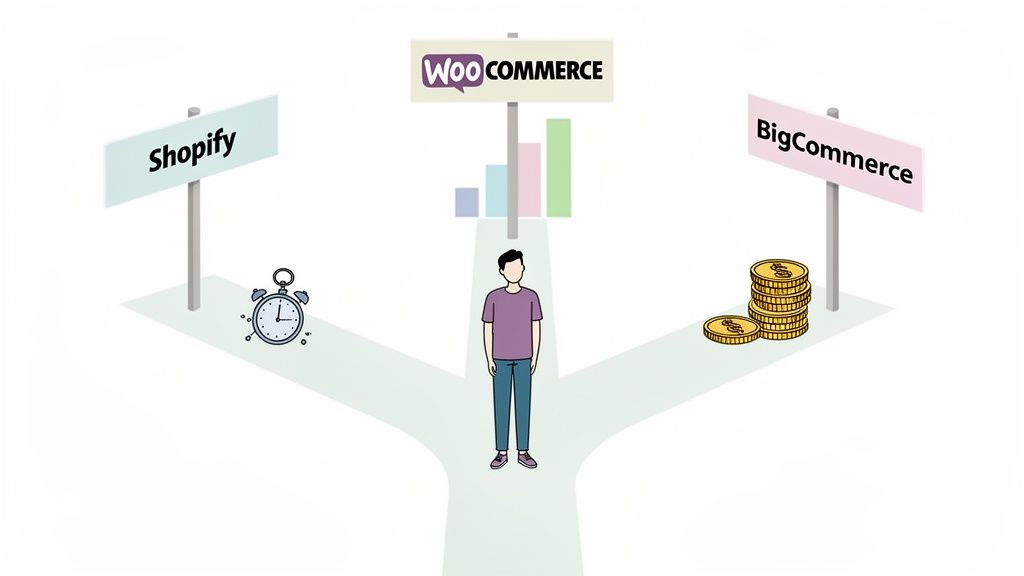
Choosing an ecommerce platform isn't just a technical detail—it's one of the first and most critical business decisions you'll make. It directly shapes your speed to market, your day-to-day operations, and how easily you can scale when things take off. This guide cuts through the noise of feature-for-feature comparisons to give you a strategic way to choose, built for the realities of a startup.
We're going to dive deep into the top players, mainly Shopify, WooCommerce, and BigCommerce, but we'll look at them through a startup's lens. That means weighing each option against the criteria that actually matter when every dollar and every hour counts.
Key Decision Criteria for Startups
Our analysis focuses on the handful of factors that truly make or break a new online business:
- Total Cost of Ownership: We'll look past the flashy monthly price to uncover the real cost, including transaction fees, essential app subscriptions, and hosting.
- Ease of Use: For founders who aren't developers, an intuitive platform means spending less time fighting with technology and more time marketing and selling.
- Scalability Potential: The platform you pick must carry your brand from its very first sale to thousands of orders a day without forcing a painful and expensive migration down the road.
- Customization and Flexibility: You need to build a unique brand experience, but that freedom has to be balanced against the technical know-how and resources it demands.
Before you dive deep into your platform, another crucial step for any new business is getting the legal structure right. Understanding the process of business Incorporation is fundamental for long-term growth and stability, much like your platform choice.
Your ecommerce platform isn't just a piece of software; it's the operational backbone of your business. The right choice empowers growth, while the wrong one creates friction at every step.
To give you a quick lay of the land, the table below offers a high-level snapshot.
Quick Answer Which Ecommerce Platform Is Best for Startups
While the best platform depends on your specific needs, Shopify is the top recommendation for most startups in 2026 due to its unmatched ease of use, rapid setup, and scalable infrastructure that supports growth from launch to enterprise-level.
| Platform | Best For | Pricing Model | Scalability Path |
|---|---|---|---|
| Shopify | Most startups, D2C brands, and founders prioritizing speed and ease of use. | Monthly Subscription + Transaction Fees | Excellent; from Basic Shopify to Shopify Plus for enterprise-level needs. |
| WooCommerce | Technically-savvy founders, businesses needing deep customization, and existing WordPress users. | "Free" Plugin + Hosting, Domain, and Extension Costs | High, but requires significant technical management and server upgrades. |
| BigCommerce | Startups planning for rapid growth, complex product catalogs, or B2B sales. | Monthly Subscription (No Transaction Fees) | Strong; built-in features support scaling without heavy reliance on apps. |
As you can see, there’s a clear trade-off. Shopify gives you a streamlined, all-in-one package. WooCommerce delivers ultimate control for those with the technical chops to handle it. And BigCommerce packs in powerful, built-in features for ambitious brands ready for complexity. This guide will help you figure out which path is the right one for your startup.
Why Shopify Is the Go-To Platform for Startups
There’s a reason so many startups end up on Shopify. It’s not an accident. The platform is engineered to solve the exact problems new businesses wrestle with: the need to launch fast, keep things simple, and have a clear runway for growth. Shopify’s all-in-one, managed setup is its biggest trump card.
For a founder, that means you can forget about wrestling with web hosting, installing security certificates, or managing software updates. Shopify takes care of all that technical heavy lifting. This gives you back your most precious resources—time and mental energy—to pour into what actually matters: your product, your brand, and landing those first crucial customers.
The Power of a Dominant Ecosystem
Shopify's dominance in the market creates a ripple effect that new businesses can plug into from day one. This isn't just a nice-to-have; it's a massive strategic advantage. The platform commands a staggering 26% of the global market share as of Q1 2026, and powers more than 2.8 million live stores across the world.
That explosive growth—a 278% increase in stores since 2019—reflects a compound annual growth rate of roughly 21%. As you can see from these findings about Shopify's market presence, this scale has cultivated an unmatched ecosystem.
This huge user base has created a buzzing community, which gives you access to:
- A deep talent pool: It’s far easier and more affordable to find skilled Shopify developers, designers, and marketers compared to almost any other platform.
- An extensive app marketplace: With over 8,000 apps, you can bolt on nearly any feature you can think of, from loyalty programs to sophisticated analytics, often in just a few clicks.
- Widespread support: The sheer volume of tutorials, forums, and expert guides means an answer to any problem is usually just a Google search away.
When a startup chooses a platform, they're really betting on its ecosystem. Shopify's scale takes a lot of the risk out of that bet, giving you the tools, talent, and support needed to grow.
Built for Scalability From Day One
One of the costliest mistakes a startup can make is picking a platform they’ll outgrow in a year or two. A full platform migration is expensive, drains your team's time, and can kill your momentum right when you need it most. Shopify was built to avoid this exact pitfall.
It gives you a clear and seamless growth path, all within its own ecosystem. You can get your store off the ground with the Basic Shopify plan, running a lean operation with a small team. As your revenue and order volume climb, you can simply upgrade your plan to access richer reporting, lower transaction fees, and more advanced tools.
The Clear Path to Enterprise Level
When your startup is ready to play in the big leagues, Shopify Plus is waiting. It provides an enterprise-level solution without forcing you to replatform. This is a huge differentiator and a key reason it's often the best ecommerce platform for startups with serious ambitions.
With Shopify Plus, you unlock:
- Much deeper customization of your checkout experience and storefront.
- A dedicated support team and account manager.
- The raw power to handle massive traffic surges, like the ones you see on Black Friday.
This built-in scalability ensures your platform grows right alongside your business, from that very first sale all the way to becoming a household name. It’s an investment that lets you build on solid ground, confident it can handle whatever success you throw at it.
Comparing the Top Ecommerce Platforms for Startups
So, we've touched on why Shopify is a powerhouse, but how does it really stack up against its main rivals? Choosing your first ecommerce platform is a massive decision for any startup. It's a careful balancing act between your initial budget, how fast you need to start selling, and whether your choice can grow with you down the road.
Let's break down how Shopify, WooCommerce, and BigCommerce compare on the things that actually matter when you're just getting off the ground. We're going beyond simple feature lists to get into the real-world trade-offs you'll be making.
True Cost of Ownership
That advertised monthly price? It's just the tip of the iceberg. To get a real sense of your total spend, you have to factor in transaction fees, app subscriptions, and hosting costs.
- Shopify: Offers incredibly transparent, all-in-one pricing. Your monthly plan covers hosting, security, and support. The big add-ons are transaction fees (around 2.9% + 30¢ on the basic plan if you don't use Shopify Payments) and apps, which can easily add $50 to $200+ per month for the functions you really need.
- WooCommerce: The main plugin is free, but don't let that fool you. You're on the hook for your own web hosting ($15-$50+/month for anything reliable), an SSL certificate, and often a handful of premium plugins to get features that Shopify includes right away. Your total bill can quickly eclipse a basic Shopify plan, and you're the one managing it all.
- BigCommerce: This is a major differentiator—BigCommerce charges zero transaction fees on any of its plans, no matter which payment gateway you choose. While its monthly subscription is similar to Shopify's, it packs in more powerful features from the start, which could mean you spend less on paid apps.
For a startup, unpredictable costs are a major risk. Shopify and BigCommerce give you a much clearer picture of your monthly expenses. WooCommerce's 'free' starting point can quickly spiral into unexpected bills and a higher total cost over time.
Speed to Market and Ease of Use
Time is your most precious asset as a founder. The real question is: how fast can you get a professional-looking store online and start making money? This is where a platform's user-friendliness becomes a massive business advantage.
Shopify is the undisputed king of speed. Its guided setup, clean dashboard, and simple drag-and-drop editor mean even a total beginner can launch a beautiful store over a weekend. The entire system is built to get you from zero to selling, fast.
WooCommerce, on the other hand, is a much steeper hill to climb. Since it's a WordPress plugin, you're responsible for everything: installation, setup, security, and updates. It demands a level of technical confidence that many founders just don't have, leading to launch delays and constant management headaches.
BigCommerce lands somewhere in the middle. The interface is definitely user-friendly, but the sheer volume of built-in features can feel a bit overwhelming when you're just starting out. It's more capable out of the box than Shopify, but that capability comes with a slightly more involved setup process.
Customization and App Ecosystems
Your store has to look and feel like your brand. But as a startup, you have to weigh the desire for deep customization against the technical skill (and cost) it takes to get there.
WooCommerce gives you the keys to the kingdom with nearly unlimited customization. Because it's open-source, you have full code access to build literally anything you can dream up. This total freedom is its greatest asset, but it’s also a huge liability for startups, as it almost always means hiring a developer.
Shopify operates in a more controlled, but powerful, environment. You can create a highly branded experience using its massive library of themes and the Shopify App Store, which features over 8,000 apps. You don't get the same deep code access as WooCommerce, but the app store makes it dead simple to add advanced functions without needing a developer. When you're looking at different platforms, it's vital to see what features they have that will directly help you increase online sales.
BigCommerce follows a hybrid model. It offers solid theme customization and powerful APIs for developers, but its app marketplace is smaller than Shopify's. Their philosophy is to build more essential features directly into the platform, so you're less reliant on third-party apps for things like multi-currency selling or advanced product options.
For a deeper dive into how these platforms compare across even more criteria, check out our complete ecommerce platform comparison.
Scalability and Growth Potential
The platform you pick today absolutely has to support the business you want to be tomorrow. Scalability isn't just about handling a flash sale; it’s about having the advanced features you'll need as you grow, all without being forced into a painful and expensive migration.
Shopify provides a crystal-clear growth path, from the basic plan all the way up to Shopify Plus for enterprise-level brands. Because Shopify manages all the infrastructure, you never have to lose sleep over your server crashing during a Black Friday traffic surge. That rock-solid reliability is a huge part of its value for ambitious startups.
BigCommerce is also engineered for growth. Its architecture is designed from the ground up to handle huge, complex product catalogs and high order volumes. The platform's powerful native features are a huge plus for B2B or international sellers, making it a fantastic option for startups with complex operational needs from day one.
WooCommerce can scale, but the burden is 100% on you. As your traffic increases, you'll need to continuously upgrade your hosting, optimize your database, and manage server performance. This DIY approach to scaling requires serious technical know-how and a growing financial investment in your infrastructure.
Startup Ecommerce Platform At-A-Glance Comparison
To make things even clearer, here’s a high-level look at how these platforms stack up for a typical startup. Think of this as your quick-reference guide to making that initial choice.
| Platform | Best For | Initial Cost | Scalability | Ease of Use |
|---|---|---|---|---|
| Shopify | Most startups and D2C brands prioritizing speed. | Low to Medium | Excellent | Very High |
| WooCommerce | Tech-savvy founders needing deep customization. | Low to High | High (with technical effort) | Low |
| BigCommerce | Growth-focused brands with complex catalogs or B2B needs. | Medium | Excellent | Medium |
Ultimately, there's no single "best" platform—only the one that's best for your specific needs, budget, and long-term vision.
Which Platform Is Right for Your Startup Profile
Figuring out the best ecommerce platform for your startup isn't about finding a single "right" answer. The truth is, the best choice is entirely dependent on your specific goals, budget, and technical comfort level. Let's get practical and move beyond generic lists to see which platform actually makes sense for different types of founders.
This decision tree helps visualize the paths you can take, mapping them directly to your budget, in-house skills, and how fast you need to get your store live.
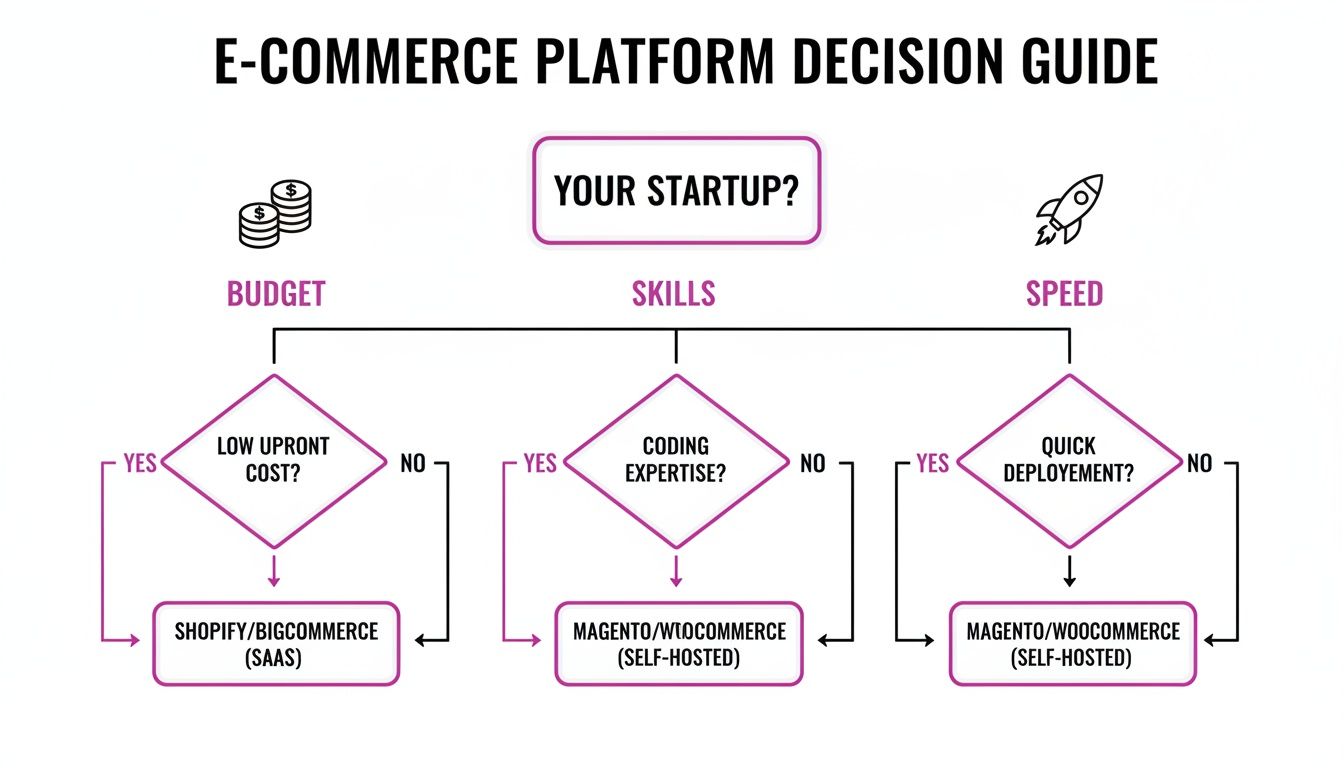
As you can see, your core priority—whether it's keeping initial costs down, having total control over customization, or just launching as quickly as humanly possible—points you toward a specific solution.
The Bootstrapped Solo Founder
You’re launching a direct-to-consumer brand, and you're wearing all the hats: CEO, marketer, and customer service rep. Your budget is tight, and your time is even tighter. The main goal here is simple: get your store online, see if the product has legs, and start making money without getting stuck in a technical swamp.
Recommendation: Shopify
Why It Works: Shopify was practically built for this exact scenario. Its dashboard is incredibly intuitive, and the guided setup means you can have a polished, working store live in days, not weeks. Because it’s an all-in-one solution that bundles hosting and security, you don't have to worry about the technical side of things. The predictable monthly cost is a lifesaver when you're managing a tight budget, freeing you up to focus on what really matters—marketing and sales.
The Technically-Savvy Maker or Creator
You're an artist, designer, or creator with an established audience, maybe from a popular WordPress blog or portfolio. You're comfortable tinkering with technology and have a very specific vision for your store. You're not afraid to get your hands dirty with plugins and settings because ultimate flexibility and brand control are what you value most.
Recommendation: WooCommerce
Why It Works: Since WooCommerce is a WordPress plugin, it slots right into your existing website, keeping your brand, content, and commerce seamlessly connected. Its open-source DNA gives you complete creative freedom. You can tweak every pixel and function to build a truly unique storefront. It definitely requires more hands-on management, but for founders who want to craft a bespoke digital experience, that's a trade-off they're happy to make.
The Venture-Backed Brand with High-Growth Ambitions
You’ve landed funding and your game plan is all about aggressive, rapid growth. We're talking a complex product catalog, plans for international expansion, and the need for a powerhouse platform that can manage serious operational scale. You're building a team and need an engine that can handle enterprise-level traffic right from the start.
Recommendation: BigCommerce or Shopify Plus
Why It Works: Both of these platforms are engineered for massive scale. BigCommerce often has an edge right out of the box because it includes a ton of advanced features natively—like complex product options and customer groups—which cuts down on your reliance on third-party apps. Its zero-transaction-fee model is also a huge plus for high-volume businesses.
Shopify Plus, on the other hand, offers an incredibly smooth upgrade path for businesses that started on the basic Shopify plan. It's known for its rock-solid reliability and an absolutely massive app ecosystem. For a funded startup, the choice often boils down to a preference for powerful built-in features (BigCommerce) versus the unparalleled flexibility of a vast app marketplace (Shopify Plus).
Your startup profile is your decision-making compass. A bootstrapped founder's need for speed and simplicity is entirely different from a funded brand's need for enterprise-grade power. Aligning the platform with your profile prevents costly mistakes and accelerates your path to growth.
Ultimately, by figuring out which of these profiles best fits your situation, you can cut through the noise. You’ll be able to select a platform that acts as a true partner to your business model, setting a strong foundation for a scalable and successful online brand.
When your startup is zeroing in on the American market, the platform you choose isn't just a piece of tech—it's a massive strategic decision. For any business targeting the United States, Shopify gives you more than a place to list products. It hands you a real competitive advantage, built on its incredible market penetration and US-focused infrastructure.
This isn't just about popularity; it’s about the network effect it creates. Shopify's dominance means there's a huge, ready-to-go ecosystem of experienced developers, marketers, and agency partners who know the platform inside and out. For a startup, that means hiring is faster, support is more reliable, and you get access to a goldmine of growth strategies that are proven to work with US shoppers.
Tapping Into a Mature Ecosystem
The sheer scale of Shopify's presence in the US is a huge deal for new businesses. Consider this: in the US market, 30% of ecommerce platforms are Shopify, and roughly 3 million websites are built on its tech. This leadership position is hard to ignore.
Shopify's dominance has translated into driving 11% of all US retail ecommerce sales, with the best-performing stores hitting conversion rates of 4.7%. You can dig into more of this data on how Shopify's market share impacts US startups on Mobiloud.com.
This kind of market share offers some very real benefits for a startup:
- Talent on Tap: Finding a great Shopify developer or a sharp performance marketer is just plain easier and often more affordable than for other platforms. This cuts down on the friction of hiring and helps you get projects off the ground faster.
- Proven App Integrations: The Shopify App Store is packed with solutions built for the US market, from tools that automate sales tax to direct integrations with major American shipping carriers.
- A Deep Well of Knowledge: With so many US-based merchants, there’s an enormous pool of shared wisdom on everything from navigating state-specific rules to optimizing your store for American holidays.
Optimized for US Consumer Behavior
Shopify gets how Americans shop online, especially on their phones. This is where native features like Shop Pay really shine, acting as a powerful tool to boost your revenue right from the start.
Shop Pay is much more than a convenience; it's a conversion engine. It pre-fills a customer's payment and shipping info, which slashes the friction at checkout—precisely where most people bail, especially on a small screen.
This is a critical advantage in a mobile-first market. Today, 79% of purchases happen on mobile, so a seamless checkout experience isn't a nice-to-have, it's a must-have. The data is clear: checkouts using Shop Pay can increase mobile conversion rates by as much as 91%. This isn't a small adjustment; it’s a fundamental edge that helps a new startup go head-to-head with established players who have much larger marketing budgets.
Cost Advantages That Directly Affect Your Bottom Line
For any startup, early-stage profitability is incredibly sensitive to operational costs. Because of its massive scale, Shopify can negotiate excellent terms that it then passes on to its merchants, which has a direct impact on your profit margins.
Shopify Shipping is a perfect example. Through its partnerships with carriers like USPS, UPS, and DHL Express, Shopify merchants get access to pre-negotiated, discounted shipping rates. A startup could never secure these rates on its own. These savings can be significant, letting you offer more competitive shipping prices to your customers or simply improve your own margin on every order.
Likewise, Shopify Payments provides competitive payment processing rates. When you use Shopify’s built-in gateway, you sidestep the extra transaction fees that other platforms often tack on. This simpler, more cost-effective structure helps you forecast your expenses more reliably and keep more of the revenue from every single sale—a vital factor for any new business trying to hit profitability and fund its own growth.
Working With An Agency To Fast-Track Your Launch
Picking a platform like Shopify is a huge decision, but what really separates a successful launch from a frustrating one is the execution. For any startup, time is the most valuable resource, and getting to market quickly and correctly is everything. This is where partnering with a specialized Shopify expert agency can completely change the game.
Instead of getting bogged down in a stressful, DIY launch filled with potential missteps, an agency handles all the heavy lifting. They bring a level of expertise that goes way beyond just picking a theme. We're talking about the time-sucking technical details: flawless theme customizations, getting complex apps to play nicely together, and securely migrating any existing data. It’s how you get a polished, high-performance store off the ground in a fraction of the time.
It's a Partnership, Not Just a Project
The real value of an expert agency kicks in long after your site goes live. That's when the focus shifts from building to growing.
Think of an experienced partner as an extension of your own team. They're dialed into the critical areas that actually make you money and bring a systematic approach to growing your store.
- Conversion Rate Optimization (CRO): Good agencies live and breathe data. They run tests to smooth out your user experience, from the homepage to the final checkout click, turning more of your hard-earned traffic into paying customers.
- Technical SEO: They make sure your store is built on a rock-solid foundation for search engines, helping you capture valuable organic traffic right from the start.
- Smarter Integrations: An agency can build the operational backbone of your business by connecting your store to essential systems like your inventory management platform, ERP, or marketing automation software.
Partnering with a Shopify agency isn't just another line item on your budget; it’s an investment in speed and immediate expertise. It takes the risk out of your launch and gives you a competitive edge by tapping into knowledge that helps you scale faster than you ever could on your own.
When you offload the technical side of things, you and your team are free to pour your energy into what you do best: building your brand, marketing your products, and talking to your customers. This focus is a massive accelerator for any new business.
If you're thinking about going this route, the next step is figuring out how to pick the right partner. Our guide on what to look for among the best Shopify agencies can help you find a team that truly gets your startup's vision.
A Few Final Questions About Picking Your Ecommerce Platform
Even after weighing all the options, a few critical questions always seem to pop up when you're about to choose an ecommerce platform for your startup. Getting straight answers to these is the final step before you can confidently build your business.
What’s the Real First-Year Cost for a Startup on Shopify?
That low monthly fee is just the starting line. For most startups, the realistic first-year cost to run a Shopify store lands somewhere between $1,500 and $5,000.
This budget covers your subscription, a professional premium theme (which can run $200-$350), a handful of essential apps for marketing and operations (another $50-$200/month), and transaction fees—typically around 2.9% + 30¢ for every sale. Thinking about these numbers from day one is just smart financial planning.
Can I Just Switch Platforms Later if My Startup Takes Off?
Technically, yes, you can always migrate platforms. But honestly, it's a massive headache. It's a complex, expensive, and seriously disruptive process that involves moving all your product, customer, and order data. You also have to meticulously manage your SEO to avoid tanking your search rankings.
Platform migration is a major operational distraction that drains time, focus, and money. The smarter move is to pick a platform from the start that can grow with you from your first sale to enterprise-level, without forcing a painful switch.
This is exactly why so many startups lean on scalable solutions like Shopify or BigCommerce. They are built to handle your growth, so you never have to worry about a risky migration down the line.
Is WooCommerce a Good “Free” Alternative to Shopify?
While the WooCommerce plugin itself is free, the total cost to run a store on it can quickly add up and even surpass a standard Shopify plan.
With WooCommerce, you're on the hook for your own web hosting, security (like SSL certificates), a domain, and any premium extensions you need for features that come standard on Shopify. It gives you incredible freedom to customize, but that freedom comes with a price: more technical know-how and a lot more hands-on management. For most startups who just want to get to market quickly and simply, Shopify usually offers a much smoother path.
Ready to stop wondering and start building? The team at ECORN specializes in creating high-performance Shopify stores that are built to scale. Let's discuss how we can accelerate your launch and set you up for long-term growth.


Why Is Conversion Rate Optimization Important
Ecommerce Loyalty Program Software How to Choose and Launch
Shopify Plans Comparison for Every Business Stage
How to Improve User Experience for eCommerce Growth
Shopify Checkout Optimization That Converts More
Shopify Inventory Sync: A Practical Setup Guide
Shopify App Integration Playbook That Scales
Shopify CMS Integration: Your 2026 Guide to Options
Shopify Store Audit: Find Hidden Conversion Leaks

Shopify Plus Experts: How to Hire the Right Team

Chargeback Protection Shopify: A Practical 2026 Guide
8 Examples of Conversion Rate Optimization
How to Conversion Rate Optimization for Shopify Stores
Shopify Design Essentials Every Store Owner Needs
Ecommerce Terms of Service: How to Draft and Implement
How to Implement Structured Data for Ecommerce in 2026
SEO App Mobile: Shopify Store Optimization Guide
Shopify Plus Support: What It Includes and How to Choose
Google Ads for Shopify: The Complete 2026 Playbook

Shopify New York: How to Find and Hire the Right Agency
Google Search Console for Shopify: The Complete Setup
First Party Data Collection for eCommerce Growth
FAQ Online Store Guide: Build and Measure It Right
Do FB Ads Work for eCommerce in 2026?
One Page Checkout for Shopify: Design and Implementation
Shopify GraphQL vs REST: The 2026 Developer Decision
Shopify Ecommerce Consulting: Strategy, Pricing &
Are Reddit Ads Worth It for eCommerce Brands

Shopify Title and Meta Description: A Practical 2026 Guide

Product Video Best Practices for Shopify Brands

Real-Time Inventory Management: A 2026 Guide
AI Chatbot Integration for Shopify Stores
Affiliate Program Management: A Shopify Guide
10 Best Performance Monitoring Tools for Shopify in 2026
Digital Asset Management for eCommerce Brands in 2026
Every Type of Facebook Ads Explained for eCommerce Growth
Product Information Management Explained for Shopify Brands
Support Ticket System: A Guide for Shopify Stores

10 Best Customer Service Tools for Shopify in 2026

Can I Start a Business with No Money? a 2026 Blueprint

What Sells Good on Etsy: Best Niches for 2026

Shopify Add to Cart Button: A Practical 2026 Guide

Customer Feedback Automation: A Practical eCommerce Guide
Critical Rendering Path: A Guide for Shopify Stores

How to Promote on TikTok for eCommerce in 2026

B2B eCommerce Consulting That Drives Real Revenue
10 Best Practices for Site Navigation in 2026
Return vs Refund for Shopify Stores: A Practical Guide
What Is Customer Lifetime Value and Why It Matters
What Is Voice of Customer Research for eCommerce

SMS Marketing for Ecommerce That Actually Converts

Master How to Improve Email Deliverability in 2026

Top 7 eCommerce Partners NYC for Shopify Brands in 2026
Machine Learning for Ecommerce: Boost Your Shopify Store

Beauty Market Research: Your 2026 Growth Guide

Shopify International Expansion: A 2026 Roadmap
What Does CRO Stand for in Business: Understanding CRO

Shopify Visual Merchandising: A Playbook for Higher Sales

Shopify Landing Page Design: Master Conversion in 2026
10 Best AI SEO Optimization Tools for Shopify in 2026

Agentic AI for Ecommerce: Boost Your Sales in 2026
Mastering Email Marketing Data for eCommerce Growth
Conversion Rate Optimisation Australia: Boost Your Sales
Conversion Rate Optimization AI: Your Shopify Store Guide

10 Product Bundling Strategies for Shopify in 2026
How to Increase Customer Lifetime Value: A Shopify Playbook
AI Customer Service Automation: Shopify Guide 2026
Clean Website Design: A Shopify Conversion Playbook

Omnichannel Retail Strategy: A Shopify Playbook
Product Data Enrichment: A Guide for Shopify Brands
Instagram Shopping Features a Guide for Shopify Stores
What Is Revenue Optimization: A Holistic RevOps Guide
Benefits of Conversion Rate Optimization: Boost Your
WordPress to Shopify Migration: Your 2026 Seamless Switch
Boost Sales: Ecommerce Payment Processing Guide 2026
Unified Commerce Platform: Benefits, KPIs & Shopify Guide
How to Reduce Bounce Rate eCommerce: Your 2026 Guide
Shopify API Integration: A Practical End-to-End Guide

How to Implement Data Governance: A 2026 Guide
Shopify Store Development Cost: A 2026 Breakdown
What Is Server Side Tracking: The Shopify Guide 2026
Marketing Automation Workflows: A Shopify Guide for 2026

Shopify: How to Reduce Technical Debt

Shopify UX Design Change: A Playbook for Growth
User Generated Content Strategy: Shopify Playbook

Shopify Pause and Build Plan Cost: A Complete 2026 Guide
Compare at Price on Shopify: A Complete Guide for 2026
Where Can I Sell My Prints? 10 Best Platforms for 2026
Shopify Order Management System: The Ultimate Guide 2026
What Is Marketing Attribution? an eCommerce Guide for 2026

10 Best Black Friday Sales Sheets for 2026

Discover the Top Social Media Marketing Agencies For
Consumer Confidence Definition for eCommerce in 2026
What Is Social Commerce? Your 2026 Guide to Boosting Sales
A Social Ad Campaign Playbook for eCommerce Growth
7 Best FAQ Page Examples for SaaS & eCommerce

Market Research in Fashion Industry: A Guide for Shopify
Shopify Migration Services: Expert Guide for 2026
Mastering FB Retargeting Ads for Shopify in 2026
What Is Omnichannel Ecommerce


newsletter in your inbox