

In eCommerce, sending paid traffic to a generic product page or homepage is a critical error. The most successful Shopify stores understand this; they direct potential customers to meticulously built landing pages designed for a single, focused objective: conversion. A great landing page isn't just about beautiful design; it’s a strategic asset built with purpose.
What truly separates a page that converts from one that costs you money? It’s a combination of proven persuasion principles. This guide moves beyond simple theory to dissect the anatomy of high-performing pages, from captivating headlines and strong offers to trust-building social proof and clear calls-to-action.
We will analyze an extensive collection of top-tier Shopify landing page examples, breaking down the specific strategies that make them effective. For each example, you’ll find:
- Annotated screenshots highlighting key conversion elements.
- A strategic breakdown of the page structure and psychological triggers.
- Actionable takeaways and A/B test ideas you can apply directly to your own Shopify store.
Whether you're launching a new product, scaling an ad campaign, or simply aiming to improve your store's conversion rate, this curated list provides a clear blueprint. You will learn the 'why' behind their success, giving you the tools and inspiration needed to transform more browsers into loyal buyers. Let's dive into the examples that set the standard.
1. Services - Shopify Development by ECORN Agency
Visit ECORN's Shopify Development Page
ECORN Agency’s Shopify Development service page serves as a masterclass in B2B landing page design, specifically for a high-consideration service. Instead of a hard-sell approach, the page functions as a clear, value-driven consultation, guiding potential clients from a point of need to a point of confidence. It's a prime example of how to structure a Shopify landing page to attract and convert a sophisticated audience of store owners and operators.
What makes this page a standout is its directness and focus on solving core business problems. It immediately addresses the pain points of scaling merchants: the need for both robust technical development and strategic, conversion-focused design. By merging these two concepts from the start, it positions the service not just as a cost, but as a direct driver of revenue.
Strategic Breakdown & Key Conversion Elements
The page’s architecture is intentionally built to earn trust and clarify a complex offering. It avoids jargon in favor of outcome-oriented language.
- Above the Fold: The hero section is clean and impactful. It combines a powerful headline, "Full-Spectrum Shopify Engineering," with a subtitle that explains the benefit: "Get stores live faster and earning more." This duality immediately connects the technical service (engineering) to the business goal (profit).
- Problem-Solution Framing: The page quickly identifies the audience’s challenges, such as slow development cycles or a disconnect between tech implementation and business growth. It then presents its service as the direct solution, using subheadings like "One Team for Development, Design & Growth" to reinforce this unified value proposition.
- Flexible Engagement Model: A significant friction point for B2B services is commitment and cost. ECORN addresses this head-on by clearly presenting two engagement options: a monthly subscription for ongoing needs and a single-project pilot to test the partnership. This transparency is a powerful conversion tool, reducing perceived risk for new clients.
Key Insight: The page excels by selling a partnership, not just a service. By highlighting its flexible engagement models and collaborative approach, it builds trust and positions itself as a long-term growth ally rather than a one-off vendor. This is crucial for attracting high-value, recurring clients.
Actionable Takeaways for Your Store
Merchants can borrow several strategies from this high-performing Shopify landing page example to improve their own product or service pages.
- Lead with the Outcome, Not Just the Feature: ECORN doesn't just list "Shopify Development." It frames the service as a way to "get live faster and earn more." Apply this to your products. Instead of just "Organic Cotton T-Shirt," try "All-Day Comfort That Breathes With You."
- Acknowledge and Solve for Friction: Identify the main reasons a customer might hesitate to buy from you (e.g., price, commitment, uncertainty). Address these points directly on the page. ECORN does this with its pricing model transparency; you could do it with a strong satisfaction guarantee, free returns, or a "try before you buy" program.
- Structure Content for Scannability: The page uses short paragraphs, clear headings, and icons to guide the user’s eye. This ensures that even visitors who are just skimming can absorb the most critical value points. Implement this on your Shopify landing pages by breaking up long product descriptions with bullet points, bold text, and benefit-focused subheadings.
By focusing on clarity, trust-building, and direct problem-solving, ECORN’s service page provides a robust blueprint for any brand looking to create a Shopify landing page that converts.
2. Shopify (Blog: What Is a Landing Page? How To Create Effective Landing Pages)
Before diving into a gallery of designs, it's often best to start with the fundamentals from an authoritative source. Shopify’s own guide to landing pages serves as the perfect foundational resource, offering a clear, strategic overview directly from the platform provider. It’s less of a visual inspiration gallery and more of an educational masterclass tailored specifically for Shopify merchants.
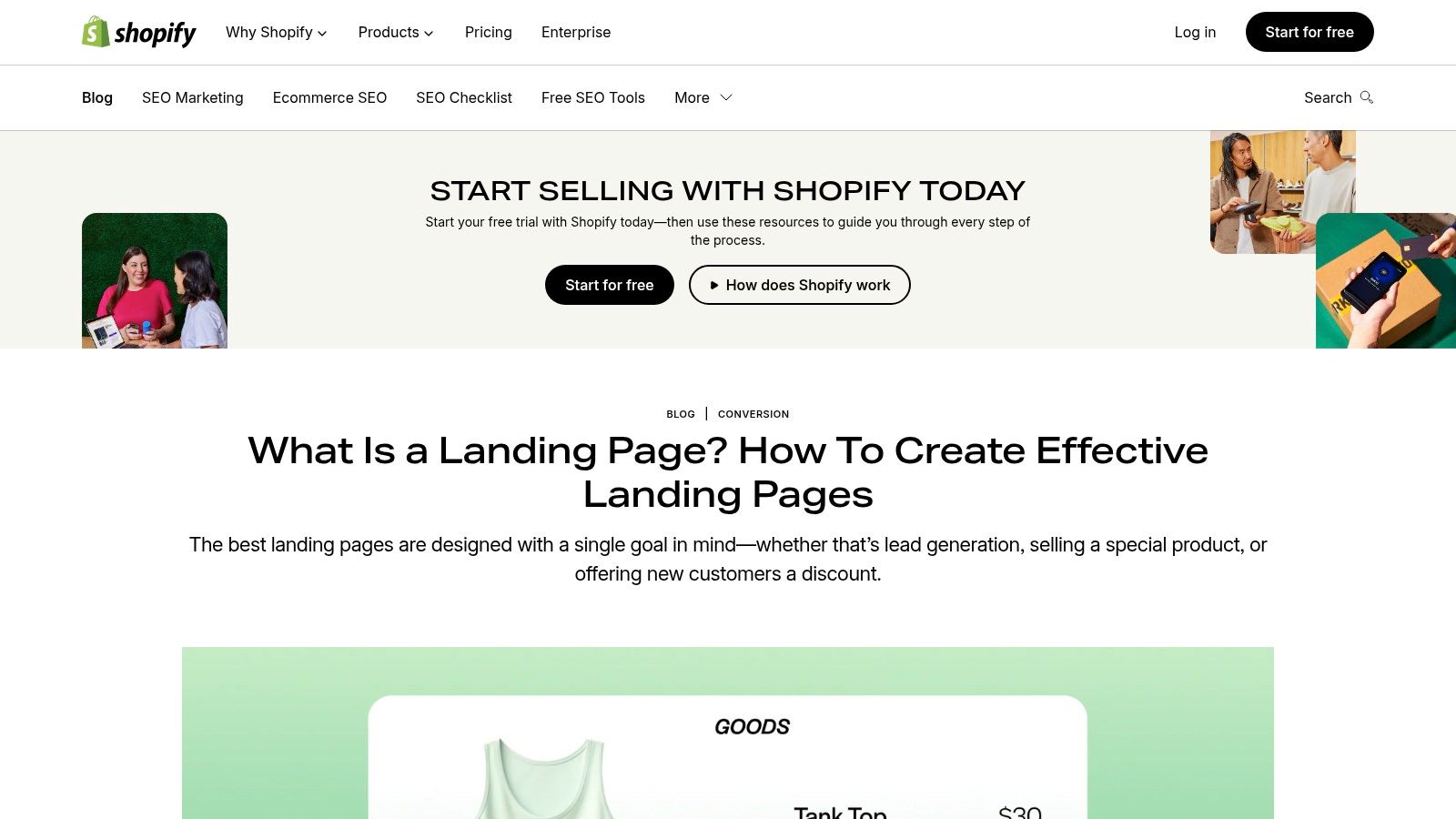
This guide excels at connecting theory to practice. It explains core concepts, such as the different types of ecommerce landing pages (e.g., lead capture, product detail, "coming soon"), and then reinforces them with real Shopify landing page examples from successful brands. This approach helps merchants understand not just what to build, but why a certain structure works for a specific goal.
Strategic Analysis and Key Insights
The article’s primary strength is its focus on message matching. It meticulously details how to align the ad copy and creative from your paid traffic sources (like Facebook Ads or Google Ads) with the headline and content on your landing page. This congruence is critical for reducing bounce rates and improving conversion rates, a point often overlooked in purely design-focused galleries.
Key Takeaway: The guide emphasizes that a landing page doesn't exist in a vacuum. Its success is directly tied to the user's journey before they arrive. By demonstrating this with examples from brands like Beardbrand, it provides a repeatable framework for campaign-specific pages.
Another key insight is the clear distinction it makes between a homepage and a landing page. For many new store owners, this is a point of confusion. Shopify’s guide explains that a landing page should be a focused, distraction-free environment designed for a single conversion action, a principle that underpins all high-performing pages.
Actionable Takeaways for Shopify Merchants
- Start with Strategy, Not Just Design: Before building a page in your Shopify theme editor or a page builder app, use this guide to define its purpose. Is it for lead generation? A specific product launch? A seasonal sale?
- Audit Your Ad-to-Page Funnel: Apply the message-matching principle immediately. Review your current ad campaigns and see if the landing page headline directly reflects the ad's promise.
- Understand Landing Page Types: Use the article's breakdown to identify which type of landing page your next campaign needs. This prevents you from using a generic template for a specialized goal.
Website: https://www.shopify.com/blog/landing-page
Pricing: Free to access.
3. Shogun (13 Shopify Landing Page Examples For Every Type of Campaign)
Shogun’s curated list of examples moves from theory to application by showcasing high-performing pages from well-known DTC brands. This resource is particularly useful because it segments its Shopify landing page examples by campaign type, making it easy to find inspiration that matches your specific marketing objective, whether it's a product launch, a seasonal sale, or a list-building effort.
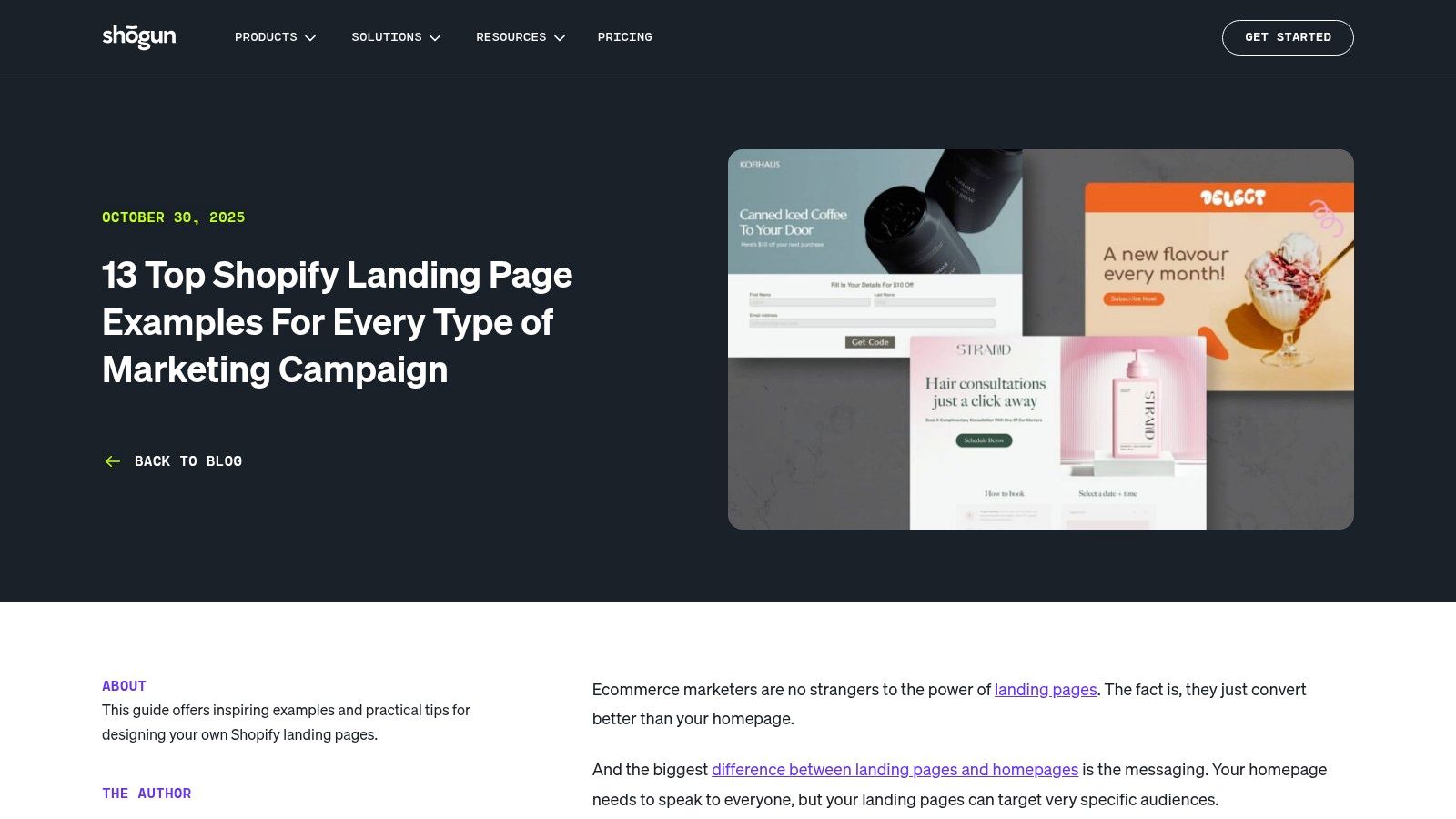
The collection stands out because it not only presents visually appealing designs from brands like Kodiak Cakes and TULA Skincare but also provides context on how these pages fit into the larger customer journey. It connects the dots between a paid ad, the landing page experience, and the final conversion goal. As a resource from a page builder company, it implicitly guides merchants on how to execute these strategies using a dedicated tool.
Strategic Analysis and Key Insights
The article’s main strength is its campaign-centric categorization. Instead of a random gallery, it organizes examples into buckets like "Product Launch," "Bundle Offer," and "Lead Generation." This structure helps merchants quickly find relevant designs that align with their immediate business goals, saving time and providing focused, practical ideas.
Key Takeaway: The connection to the Shogun Page Builder is a core insight. The examples aren't just for inspiration; they are presented as achievable outcomes using their tool. This makes the guide a powerful piece of content marketing, showing potential customers exactly what they can build.
Another significant point is the inclusion of modern, recognizable DTC brands. Seeing how successful companies structure their offers provides a credible blueprint for growing stores. The article also subtly introduces advanced page builder concepts like "Global Sections," which allow for rapid updates across multiple pages, a crucial feature for brands running numerous campaigns simultaneously. While the content is tool-centric, the underlying strategies are universal.
Actionable Takeaways for Shopify Merchants
- Match Examples to Your Campaign Type: Use the article's segmentation to find a direct model for your next marketing initiative. If you're creating a bundle, study their bundle page examples first.
- Analyze the Full Funnel Context: For each example you like, consider the ad or email that likely drove traffic to it. This helps you apply the principle of message matching to your own campaigns.
- Explore Advanced Building Features: The article is a gateway to understanding the benefits of a page builder with A/B testing and personalization. Consider if your current theme or setup limits your ability to create these types of focused experiences.
Website: https://getshogun.com/learn/shopify-landing-page-examples
Pricing: The article is free to access. The Shogun Page Builder has various pricing tiers, starting with a free plan.
4. PageFly (Top 25+ Converting Landing Page Examples)
While single-brand examples offer deep dives, sometimes what you need is a broad sweep of creative inspiration across multiple niches. PageFly, a leading Shopify page builder app, provides this with its extensive roundup of high-converting landing page examples. This resource is less about deconstructing a single strategy and more about serving as a visual mood board and idea generator for your next campaign.
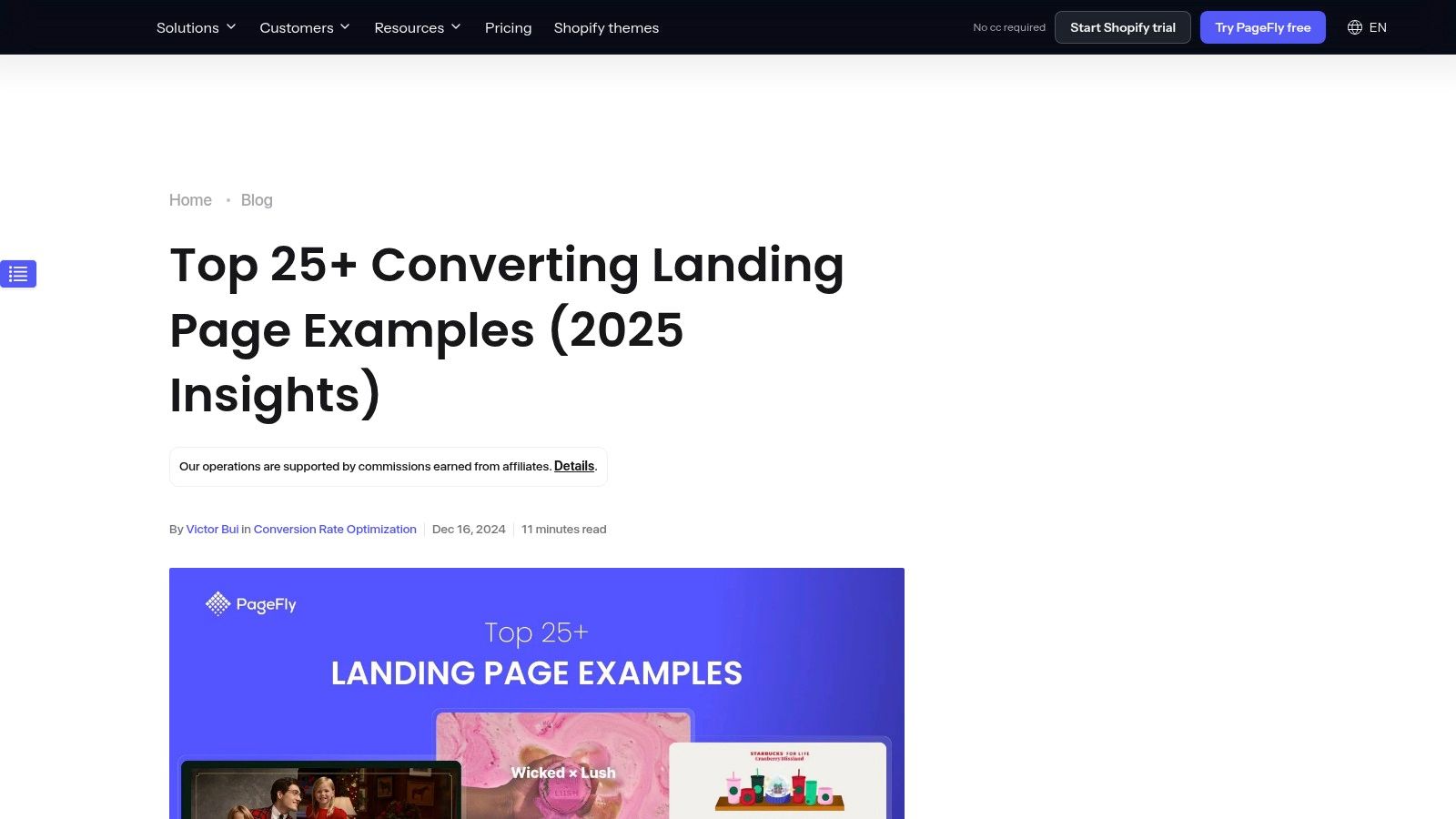
The collection showcases dozens of designs, complete with screenshots and light commentary on what makes each effective. It's especially useful for seeing how different brands tackle similar goals, from seasonal promotions like Black Friday to evergreen lead generation. The gallery connects inspiration directly to execution by linking to PageFly’s own template library, allowing you to find a design you like and quickly adapt it within their app.
Strategic Analysis and Key Insights
The gallery’s main value is its sheer volume and diversity. It gives merchants a panoramic view of current design trends and conversion tactics being used successfully on the Shopify platform. You can see various approaches to above-the-fold content, call-to-action button placement, and social proof integration, making it a powerful tool for creative brainstorming and getting stakeholder buy-in on a new design direction.
Key Takeaway: The connection between the example gallery and the PageFly template library is the most significant feature. It closes the gap between inspiration and implementation. Merchants can move from "I like that look" to "I can build that look" in a matter of minutes, a major advantage for time-strapped teams.
A notable insight from browsing the collection is the prevalence of campaign-specific pages. The examples demonstrate that successful brands don’t just rely on their standard product templates; they build unique, focused experiences for sales, product launches, and collaborations. This reinforces the idea that landing pages are dynamic marketing assets, not static site pages. However, since PageFly is a third-party builder, it’s critical to test the performance of any new page on mobile to ensure it doesn’t introduce bloat or slow down loading times.
Actionable Takeaways for Shopify Merchants
- Use as a Creative Swipe File: Before starting a new page design, browse this gallery to gather ideas for layout, color schemes, and content modules. Save your favorite Shopify landing page examples to a mood board.
- Bridge Inspiration and Action: If you see a design you admire, find a corresponding template in the PageFly library to use as a starting point. This dramatically speeds up the development process.
- Pilot with the Free Plan: PageFly offers a free plan, allowing you to test the builder and implement one of the inspired designs without financial commitment. Use this to run a small-scale A/B test against an existing page.
Website: https://pagefly.io/blogs/shopify/landing-page-examples
Pricing: Free plan available. Paid plans start from $24/month.
5. GemPages (Top 6 Best Shopify Landing Page Examples)
While many resources show you what a good landing page looks like, few connect inspiration directly to execution. The GemPages blog post bridges this gap perfectly. It presents a concise, quality-filtered list of high-performing Shopify landing pages and then provides actionable pathways to replicate those successful patterns within their own page builder ecosystem. This makes it an invaluable resource for merchants who want to move from idea to implementation quickly.
This article stands out by providing clear "why it works" commentary for each of its chosen Shopify landing page examples. It annotates key elements like compelling headlines, strategic social proof placement, and effective subscription angles. Crucially, it links these observations to its own help center content, showing merchants exactly how to build similar sections using the GemPages editor. This practical approach demystifies the design process.
Strategic Analysis and Key Insights
The core strength of the GemPages article is its emphasis on replicable patterns. Instead of just admiring a design, it dissects it into functional components that a merchant can build. For example, when analyzing a page's hero section, it doesn't just say "use a strong headline"; it explains the psychological trigger behind the headline and then links to a tutorial on how to configure that specific headline-and-button block in their app.
Key Takeaway: The guide’s true value is in its practicality. It operates on the principle that inspiration is useless without a clear path to execution. By connecting curated examples directly to step-by-step instructions, GemPages empowers even non-designers to create polished, conversion-focused pages.
Another significant insight is the focus on modern conversion tactics. The examples chosen highlight effective use of user-generated content (UGC), clear value propositions for subscription models, and minimalist designs that guide the user’s eye directly to the call-to-action. This ensures that the inspiration provided is current and relevant for today's ecommerce environment.
Actionable Takeaways for Shopify Merchants
- Connect Theory to Practice: Use this guide as a two-part tool. First, identify a landing page style that matches your campaign goal. Second, click the associated "how-to" links to immediately start building a similar structure in a page builder.
- Deconstruct Winning Pages: Learn to see other stores' landing pages as a collection of buildable blocks. Analyze their headlines, social proof sections, and forms, then find the corresponding elements in your page builder to replicate the effect.
- Prioritize a Clear 'Why': For every element you add to your page, ask "Why does this work?" The GemPages article provides excellent commentary on the strategic purpose of each component, a practice you should adopt for your own designs.
Website: https://gempages.net/blogs/shopify/best-shopify-landing-page-examples
Pricing: The blog content is free to access. The GemPages app has a free plan and paid tiers starting from $29/month.
6. OptiMonk (8 Shopify Landing Page Examples to Inspire Your Next Campaign)
OptiMonk’s roundup of landing page examples shifts the focus from pure aesthetics to measurable performance. This article is a must-read for direct-to-consumer (DTC) teams obsessed with conversion rate optimization (CRO), offering a campaign-centric look at how specific on-page elements drive action. It’s less of a design gallery and more of a strategic playbook for improving results from paid social and email marketing efforts.
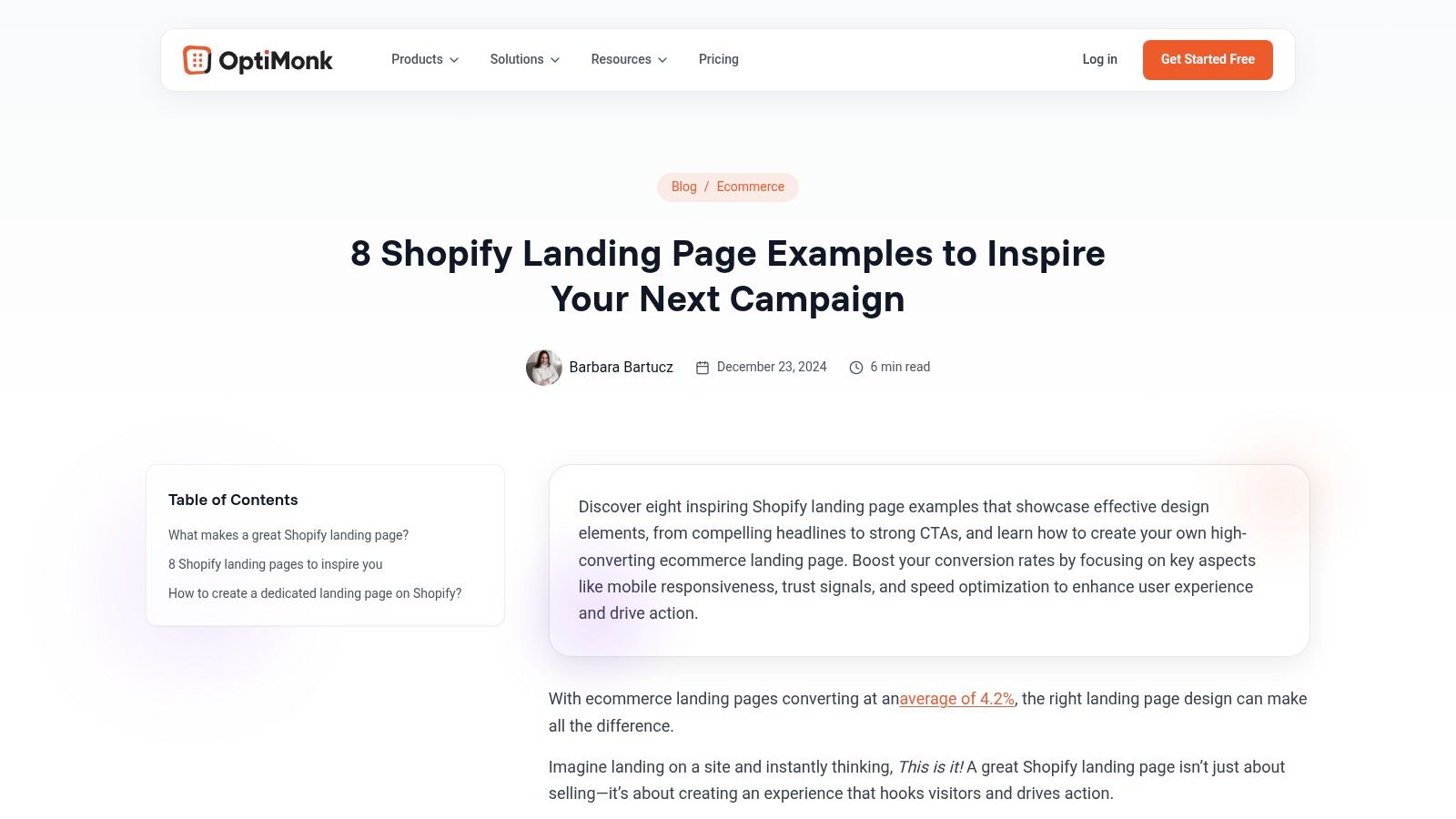
The collection excels by dissecting the anatomy of high-converting pages. Rather than just showing a screenshot, OptiMonk breaks down why certain components work. It highlights the effective use of comparison charts to overcome objections, the placement of user-generated content (UGC) to build social proof, and the strategic positioning of calls-to-action (CTAs). This granular analysis provides a clear roadmap of conversion elements to test and emulate.
Strategic Analysis and Key Insights
The article's main strength is its CRO-centric perspective. It doesn't just present pretty designs; it explains how those designs function as conversion machines. A standout element is its focus on on-page personalization and overlays. The guide explains how to use popups and embedded forms to supplement a landing page's primary goal, such as capturing an email before a user exits or offering a targeted discount.
Key Takeaway: The guide promotes the idea that a landing page isn't static. It can be layered with intelligent triggers and overlays to maximize every visit. It presents a strong case for using tools like OptiMonk to add a dynamic conversion layer on top of your existing Shopify landing page examples, turning potential bounces into leads or sales.
Another key insight is the emphasis on matching on-page elements to specific traffic sources. The article implicitly guides marketers to think about what a user coming from an email campaign needs to see versus a user from a top-of-funnel Facebook ad. This context-aware approach is central to building pages that resonate and convert effectively.
Actionable Takeaways for Shopify Merchants
- Audit Your Conversion Elements: Use the examples to audit your own landing pages. Are you using trust markers effectively? Could a comparison chart clarify your value proposition? Is your CTA above the fold on mobile?
- Experiment with Smart Overlays: Consider adding an exit-intent popup to your key landing pages to capture emails from visitors who are about to leave. Test different offers to see what works best for your audience.
- Prioritize a CRO-Focused View: Shift your perspective from just "making the page look good" to "making the page work better." Use OptiMonk's breakdowns as a checklist for potential A/B tests on your next campaign.
Website: https://www.optimonk.com/shopify-landing-page-examples/
Pricing: The article is free to access. OptiMonk’s toolset has various pricing tiers, including a free plan.
7. Landing.Gallery (Shopify Landing Pages)
For merchants who learn best through broad, rapid-fire visual scanning, Landing.Gallery offers a crucial resource. It acts as a pure, unfiltered inspiration engine, presenting a living gallery of more than 40 verified Shopify landing pages. This platform is not a tutorial or a builder; instead, its strength lies in providing a neutral, comprehensive view of what is currently live and working in the wild.
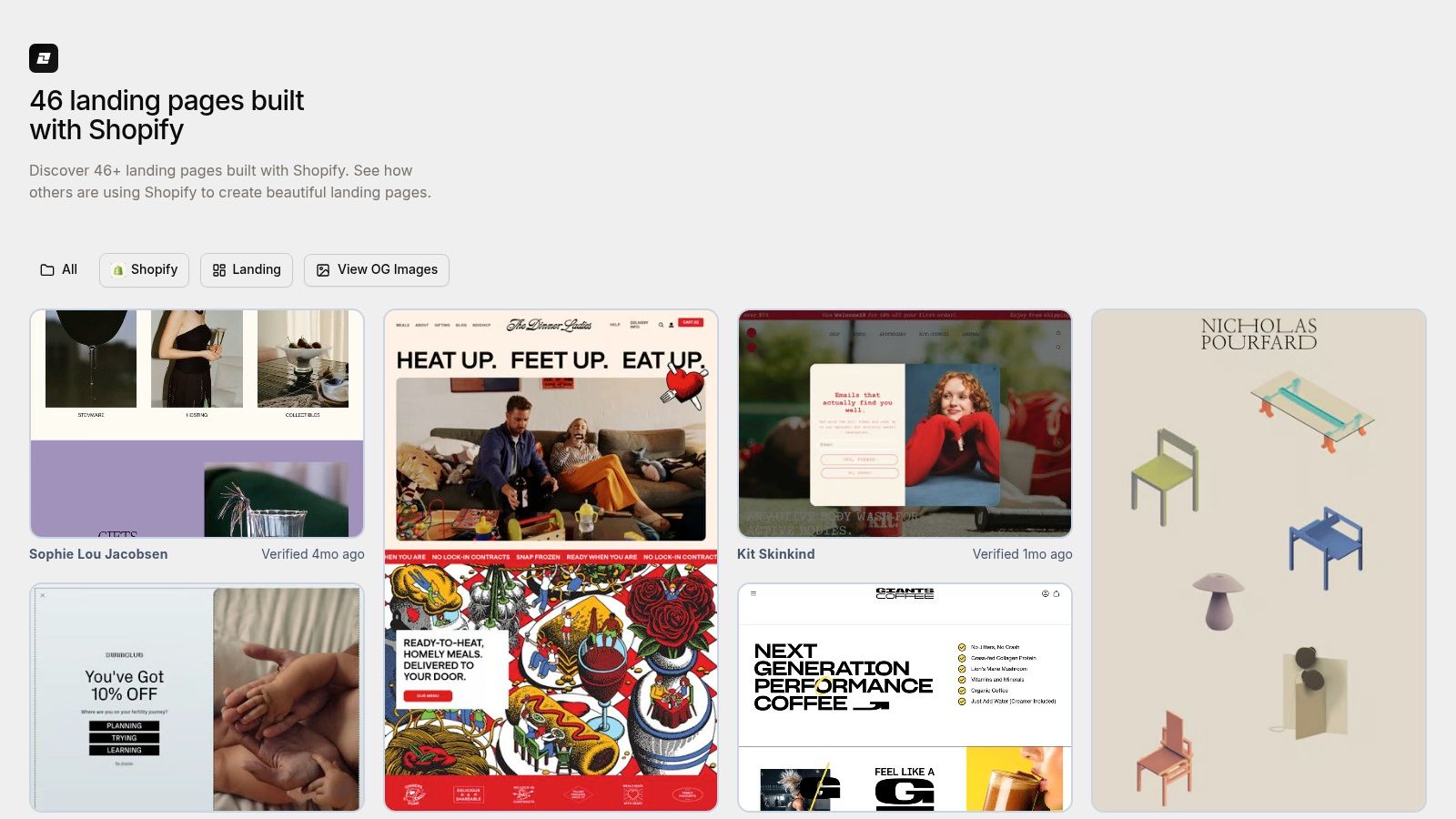
The site’s design is intentionally minimalist, focusing entirely on the examples themselves. By providing a filterable collection of screenshots, it saves countless hours of manual research. A standout feature is the recency stamp (e.g., 'Verified 1mo ago'), which confirms that you are viewing current designs, not outdated concepts. This makes it an ideal starting point for competitor analysis and identifying emergent design patterns across various industries.
Strategic Analysis and Key Insights
The primary strategic value of Landing.Gallery is its function as a pattern recognition tool. Unlike curated showcases that highlight exceptional one-offs, this gallery's breadth allows you to spot commonalities in structure, calls-to-action, and visual hierarchy among current Shopify landing page examples. You can quickly see how different brands are handling social proof, testimonials, or "above the fold" layouts for similar product types.
This volume of examples helps merchants move beyond their own industry bubble. By observing how a DTC mattress brand structures its value proposition, a supplement company might discover a new way to present its benefits. The platform encourages this cross-pollination of ideas by being completely tool-agnostic.
Key Takeaway: The gallery’s real power isn’t in any single example, but in the aggregate. It provides the raw visual data needed to infer strategy. By observing dozens of pages, you can deconstruct what is becoming a standard practice versus what is a unique, brand-specific tactic.
A useful secondary feature is the ability to perform tech reconnaissance. Using integrated tools like StackSee, you can often identify the page builder apps or Shopify themes behind the designs you admire. This insight moves you from inspiration to a concrete understanding of the technology required to execute a similar vision.
Actionable Takeaways for Shopify Merchants
- Conduct a Visual Audit: Before starting a new design, spend 30 minutes scrolling through the gallery. Look for 5-10 pages that resonate with your brand and screenshot them to create a mood board for your design team or developer.
- Identify Common Design Patterns: Instead of focusing on one page, analyze a dozen. Note recurring elements: Do most use a centered hero headline? Where is social proof typically placed? Use these findings to build a wireframe based on proven layouts.
- Perform Competitor Tech Recon: If you find a competitor’s landing page or a design you love, use the tech-detection feature to see what tools they are using. This can help you shortlist page builder apps for your own store.
Website: https://www.landing.gallery/website-builder/shopify/landing
Pricing: Free to access.
7-Way Comparison: Shopify Landing Page Examples
| Item | Implementation Complexity 🔄 | Resource Requirements ⚡ | Expected Outcomes ⭐📊 | Ideal Use Cases 💡 | Key Advantages |
|---|---|---|---|---|---|
| ECORN — Shopify Development | High — full‑stack dev, integrations & CRO | Medium–High — subscription or project fee; agency-managed team | High — faster time‑to‑market, higher conversion, multi‑store scale | Scalable merchants needing ongoing Shopify/Plus support and growth roadmaps | End‑to‑end Shopify+ expertise; flexible engagement; AI integrations; proven with 100+ brands |
| Shopify (Blog: What Is a Landing Page?) | Low — informational guidance only | Low — free to access; no tooling included | Moderate — clearer strategy and traffic‑to‑page alignment | Merchants seeking best practices before building or testing pages | Authoritative, vendor‑specific guidance with real Shopify examples |
| Shogun (13 Examples) | Medium — examples + page‑builder setup and testing | Medium — Shogun subscription for builder, testing & analytics | High — practical templates plus native A/B testing and personalization | Teams that want examples plus a direct execution path with testing | Campaign‑segmented examples; native testing; global sections for rapid scale |
| PageFly (Top 25+) | Medium — large example set; integration with page templates | Low–Medium — free plan available; paid tiers for scale | Moderate–High — rich inspiration with quick template execution | Creative direction, CRO ideation and low‑risk pilot implementations | Extensive example library; flexible pricing and free trial options |
| GemPages (Top 6) | Medium — focused examples with how‑to replication steps | Medium — editor access and defined pricing tiers | High — concise, high‑converting patterns plus execution guides | Teams wanting a short, quality‑filtered list and step‑by‑step replication | Practical how‑to content; modern editor; built‑in funnels and paid‑tier AI |
| OptiMonk (8 Examples) | Low–Medium — campaign and overlay integration focus | Low–Medium — tool for overlays/personalization; subscription likely | Moderate — conversion lift when using overlays/personalization correctly | DTC teams layering popups/overlays with paid social and email campaigns | Strong CRO emphasis; on‑page personalization and overlay playbooks |
| Landing.Gallery (Shopify Landing Pages) | Low — browseable visual gallery only | Low — research time; no tooling required | Low–Moderate — fast shortlist of current styles and competitor tech | Early‑stage design ideation, style shortlisting and tech reconnaissance | Neutral, tool‑agnostic gallery; filterable, verified recency and tech detection |
Transform Your Shopify Store from Inspiration to Implementation
We've journeyed through a diverse gallery of high-performing Shopify landing page examples, deconstructing the strategic thinking that powers their success. From the minimalist product focus of Allbirds to the vibrant, benefit-driven pages of subscription brands, a clear pattern emerges. The most effective landing pages are not born from guesswork; they are the result of a deliberate, data-informed process.
This process skillfully combines persuasive copy, psychology-driven design, and a relentless focus on the user's journey. Now, the challenge shifts from observation to execution. Your task is to translate this inspiration into tangible assets that drive conversions for your own Shopify store.
From Blueprint to Build: Your Actionable Next Steps
The idea of building a suite of custom landing pages can feel overwhelming, but progress starts with a single step. Don't try to overhaul your entire site at once. Instead, adopt an incremental approach focused on high-impact opportunities.
- Start Small, Win Big: Identify one of your top-performing ad campaigns or highest-traffic product collections. Create a single, dedicated landing page for that specific audience and offer. This isolates variables and makes it easier to measure impact.
- Apply Proven Frameworks: Revisit the structures we analyzed. Use the Problem-Agitate-Solve (PAS) formula for your copy, ensure a single, crystal-clear call-to-action (CTA), and integrate authentic social proof like customer reviews and testimonials.
- Embrace Continuous Testing: A landing page is never truly "finished." Start A/B testing crucial elements immediately. Pit two headlines against each other. Test a static hero image against a short video. Experiment with button colors and copy (e.g., "Shop Now" vs. "Get My Discount").
Choosing the Right Tools and Content
The Shopify ecosystem offers a rich selection of page builder apps like PageFly, Shogun, and GemPages. Your choice depends on your specific needs:
- For Beginners: Look for builders with a large template library and an intuitive drag-and-drop interface. PageFly and GemPages are excellent starting points.
- For Growing Brands: If you need advanced features like A/B testing, personalization, and detailed analytics, a more robust solution like Shogun might be the better fit.
- For Richer Content: To make your pages truly stand out, incorporating dynamic and authentic content is critical. Explore how you can use tools that generate high-quality user-generated content to populate your pages. For example, to effectively transform your Shopify store and boost conversion rates, integrating high-quality content is essential; explore innovative solutions like leveraging AI UGC for Shopify to enrich your landing pages and product descriptions.
The best landing pages we've seen are not just collections of stock photos and marketing copy; they are vibrant, living pages filled with genuine customer experiences.
The path from browsing Shopify landing page examples to building your own high-converting assets is a journey of continuous improvement. Each test provides valuable data, and each new page is an opportunity to better connect with your customers. The insights from this article provide the map; now it's time for you to take the first step. Build your next page with purpose, measure its performance, and iterate toward success.
Ready to move beyond templates and build truly optimized shopping experiences? The expert team at ECORN specializes in CRO-driven Shopify development, transforming insightful strategy into high-performing landing pages that convert. Explore their Shopify Plus development services to see how they can help you implement these advanced strategies at scale.


How to Add Subcategory in Shopify for Better UX
How to Implement Structured Data for Ecommerce in 2026
SEO App Mobile: Shopify Store Optimization Guide
Shopify Plus Support: What It Includes and How to Choose
Google Ads for Shopify: The Complete 2026 Playbook
Shopify New York: How to Find and Hire the Right Agency
Google Search Console for Shopify: The Complete Setup
First Party Data Collection for eCommerce Growth
FAQ Online Store Guide: Build and Measure It Right
Do FB Ads Work for eCommerce in 2026?
One Page Checkout for Shopify: Design and Implementation
Shopify GraphQL vs REST: The 2026 Developer Decision
Shopify Ecommerce Consulting: Strategy, Pricing &
Are Reddit Ads Worth It for eCommerce Brands
Shopify Title and Meta Description: A Practical 2026 Guide
Product Video Best Practices for Shopify Brands
Real-Time Inventory Management: A 2026 Guide
AI Chatbot Integration for Shopify Stores
Affiliate Program Management: A Shopify Guide
10 Best Performance Monitoring Tools for Shopify in 2026
Digital Asset Management for eCommerce Brands in 2026
Every Type of Facebook Ads Explained for eCommerce Growth
Product Information Management Explained for Shopify Brands
Support Ticket System: A Guide for Shopify Stores

10 Best Customer Service Tools for Shopify in 2026

Can I Start a Business with No Money? a 2026 Blueprint
What Sells Good on Etsy: Best Niches for 2026

Shopify Add to Cart Button: A Practical 2026 Guide

Customer Feedback Automation: A Practical eCommerce Guide
Critical Rendering Path: A Guide for Shopify Stores

How to Promote on TikTok for eCommerce in 2026

B2B eCommerce Consulting That Drives Real Revenue
10 Best Practices for Site Navigation in 2026
Return vs Refund for Shopify Stores: A Practical Guide
What Is Customer Lifetime Value and Why It Matters
What Is Voice of Customer Research for eCommerce

SMS Marketing for Ecommerce That Actually Converts

Master How to Improve Email Deliverability in 2026
Top 7 eCommerce Partners NYC for Shopify Brands in 2026
Machine Learning for Ecommerce: Boost Your Shopify Store
Beauty Market Research: Your 2026 Growth Guide
Shopify International Expansion: A 2026 Roadmap
What Does CRO Stand for in Business: Understanding CRO
Shopify Visual Merchandising: A Playbook for Higher Sales
Shopify Landing Page Design: Master Conversion in 2026
10 Best AI SEO Optimization Tools for Shopify in 2026

Agentic AI for Ecommerce: Boost Your Sales in 2026
Mastering Email Marketing Data for eCommerce Growth
Conversion Rate Optimisation Australia: Boost Your Sales
Conversion Rate Optimization AI: Your Shopify Store Guide

10 Product Bundling Strategies for Shopify in 2026
How to Increase Customer Lifetime Value: A Shopify Playbook
AI Customer Service Automation: Shopify Guide 2026
Clean Website Design: A Shopify Conversion Playbook

Omnichannel Retail Strategy: A Shopify Playbook
Product Data Enrichment: A Guide for Shopify Brands
Instagram Shopping Features a Guide for Shopify Stores
What Is Revenue Optimization: A Holistic RevOps Guide
Benefits of Conversion Rate Optimization: Boost Your
WordPress to Shopify Migration: Your 2026 Seamless Switch
Boost Sales: Ecommerce Payment Processing Guide 2026
Unified Commerce Platform: Benefits, KPIs & Shopify Guide
How to Reduce Bounce Rate eCommerce: Your 2026 Guide
Shopify API Integration: A Practical End-to-End Guide
How to Implement Data Governance: A 2026 Guide
Shopify Store Development Cost: A 2026 Breakdown
What Is Server Side Tracking: The Shopify Guide 2026
Marketing Automation Workflows: A Shopify Guide for 2026
Shopify: How to Reduce Technical Debt
Shopify UX Design Change: A Playbook for Growth
User Generated Content Strategy: Shopify Playbook
Shopify Pause and Build Plan Cost: A Complete 2026 Guide
Compare at Price on Shopify: A Complete Guide for 2026
Where Can I Sell My Prints? 10 Best Platforms for 2026
Shopify Order Management System: The Ultimate Guide 2026
What Is Marketing Attribution? an eCommerce Guide for 2026
10 Best Black Friday Sales Sheets for 2026

Discover the Top Social Media Marketing Agencies For
Consumer Confidence Definition for eCommerce in 2026
What Is Social Commerce? Your 2026 Guide to Boosting Sales
A Social Ad Campaign Playbook for eCommerce Growth
7 Best FAQ Page Examples for SaaS & eCommerce

Market Research in Fashion Industry: A Guide for Shopify
Shopify Migration Services: Expert Guide for 2026
Mastering FB Retargeting Ads for Shopify in 2026
What Is Omnichannel Ecommerce
Master Your Shopify Plus Migration: The 2026 Guide
Shopify Integration Services: A Merchant's 2026 Guide
Shopify Collection Description: A Guide to SEO & Sales
Shopify Plus Contact: Reach Sales & Support Effectively

Top Luxury Shopify Stores: Design & UX Strategies
How to Improve Customer Experience: A Shopify Roadmap
Creative Facebook Ads: 10 Examples for Shopify Brands

Remarketing with Facebook Ads: A Shopify Guide for 2026

SEO Linking Strategies for Shopify Stores
Top 7 Statistics YouTube Channels for eCommerce in 2026

Hiring Shopify Plus Designers: A Founder's Guide
Shopify Product Variation: Master Your Variants for 2026
Leverage Ai Solutions Brands: Your 2026 Shopify Growth Guide
Filters in Shopify: A Guide for Growing Brands


newsletter in your inbox