

So, what exactly is an ecommerce website design package? At its core, it's a bundled service that brings together design, development, and strategic planning to get a fully functional online store off the ground. Think of it as an all-in-one kit for building your digital storefront, with different options tailored to where your business is right now.
What Are Ecommerce Website Design Packages
Picking the right ecommerce design package is a lot like deciding how to build a physical shop. Are you just testing the waters with a pop-up to see if a product has legs? Or are you building a stylish boutique for a niche brand? Maybe you're going all-in on a flagship store to dominate your market. Each of those needs a completely different blueprint, budget, and feature set.
A design package isn't just another line item on your expense sheet; it’s a strategic investment in your brand’s online presence. These packages pull together everything you need to launch and scale an online sales channel. It’s about more than just a pretty design—it’s about combining all the crucial services to build a machine that actually sells. The whole point is to give you a complete solution that covers all the bases, from the first impression to the back-end tech that handles orders and tracks inventory.
The Foundation of Your Digital Storefront
Ultimately, a good ecommerce design package is all about creating a smooth and intuitive path for your customers. It makes sure your store isn't just nice to look at, but also easy to use, fast, and secure. A well-thought-out package takes care of the entire process, from getting a visitor to your site to turning them into a repeat buyer. Getting this foundation right is non-negotiable for long-term success.
The components are designed to work together from the very start:
- Strategic Planning: Nailing down your target audience, brand identity, and business goals to make sure the design hits the mark.
- User Experience (UX) Design: Building the site’s blueprint and user flows so that shopping feels natural, not frustrating.
- User Interface (UI) Design: Crafting all the visual parts—colors, fonts, buttons—to create an engaging look that is true to your brand.
- Development and Implementation: Actually building the site on a platform like Shopify, connecting payment systems, and setting up all the essential functions.
More Than Just a Website Build
A modern package isn’t a one-and-done project; it’s more like an ongoing partnership. You're investing in a platform that can grow and change right along with your business. This is more important than ever, with the market absolutely exploding. The global ecommerce design market is expected to jump from USD 10.42 billion in 2025 to USD 24.17 billion by 2034, as more businesses scramble to get their online stores in top shape. You can learn more about this market surge and what it means for your business.
Think of it this way: A basic website is like a simple cash register, but a comprehensive ecommerce package is an entire retail management system. It handles inventory, marketing, customer data, and sales, all in one integrated platform.
Once you understand what these packages really offer, you can stop seeing them as just a cost. Instead, they become a core part of your growth strategy. This is the foundation that lets you scale up, improve conversions, and build an online business that lasts.
Comparing The Tiers Of Design Packages
Choosing an ecommerce design package isn’t a one-size-fits-all decision. The best way to think about it is by comparing it to physical retail spaces. You wouldn't build a massive flagship store to test out a single product idea, right? You'd start with a pop-up stall. The same logic applies to your online store.
Getting a handle on the common tiered structure is key to matching your investment with your actual business goals. We'll break down each level, not just by listing features, but by explaining the "why" behind them. This will make it much easier to see which package genuinely fits where you are now and where you want to go.
The Starter Package: Your Brand Launchpad
The Starter Package is ground zero for new businesses, solo entrepreneurs testing a concept, or brands taking their first step online. The main goal here is getting to market quickly and affordably. It gives you a professional, working storefront without needing a huge upfront investment. This is your digital pop-up shop—built to get you selling fast and to validate your products.
A typical starter package bundles the absolute essentials you need to launch a credible online store. What’s usually inside?
- Theme-Based Design: Using a premium, pre-built template that gets customized with your brand’s logo, colors, and fonts.
- Essential Page Setup: Building out the core pages that every store needs, like the homepage, about us, contact, and product/collection pages.
- Basic Product Upload: Getting your initial catalog of up to 100 products loaded and ready to sell.
- Standard Payment Gateway Integration: Connecting major payment providers like Shopify Payments or PayPal so you can securely take customer payments from day one.
This tier is all about building momentum. You get a reliable, sharp-looking site that establishes your brand and starts bringing in revenue, all while keeping your initial risk low. It's the foundation you'll build your empire on.
This visual breaks down the progression perfectly, showing how an ecommerce business evolves from a simple stall to a major flagship store.
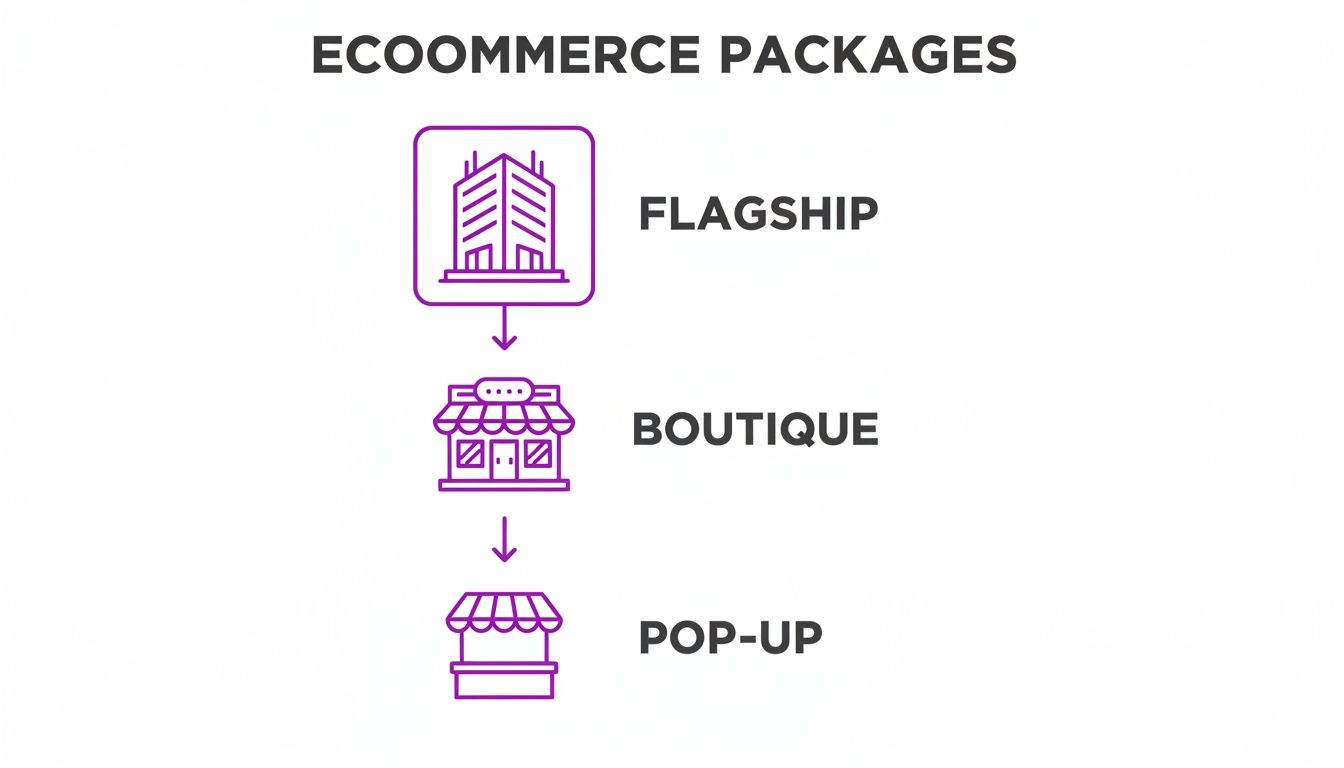
The flowchart makes it clear: as your business grows, your digital storefront has to evolve from a basic setup into a more substantial and sophisticated operation.
The Growth Package: Your Scaling Engine
Once you've proven your concept and have consistent revenue coming in, it’s time to level up. This is where the Growth Package comes in. It’s built for scaling businesses that are ready to move beyond a basic template and create a more unique, conversion-focused customer experience. Think of this as your boutique store—it has a distinct personality and is fine-tuned to turn visitors into loyal customers.
Here, you shift from a standard setup to a semi-custom or fully custom design. The focus is no longer just on being online; it's about actively driving sales and improving efficiency. A growth-focused ecommerce website design package will typically add:
- Custom UI/UX Design: Crafting a unique storefront design that truly reflects your brand and is built around your specific customer's journey.
- Conversion Rate Optimization (CRO): Implementing features proven to increase sales, like streamlined checkouts, persuasive call-to-action buttons, and trust-builders like customer reviews.
- Advanced App Integration: Connecting powerful marketing, analytics, and customer service tools to automate tasks and gather critical data.
- SEO Foundations: Making sure the site is structured properly for search engines, helping you pull in more organic traffic over time.
The Enterprise Package: Your Market Leader Platform
For established market leaders and high-volume merchants, the Enterprise Package delivers the muscle and flexibility needed for complex operations. This tier is almost always built on powerful platforms like Shopify Plus and is designed for businesses with big ambitions, like international expansion or handling massive traffic spikes during sales. This is your flagship store—a powerful, multi-faceted destination built for market dominance.
Enterprise solutions are all about unlimited potential. They can handle huge product catalogs, complex business rules, and sophisticated, custom integrations.
The key features often include:
- Headless Architecture: Decoupling the front-end (what customers see) from the back-end (the business logic) for total creative freedom and blazing-fast performance.
- Multi-Store and Internationalization: Managing multiple storefronts for different countries, languages, or brands all from a single back-end system.
- Custom Integrations: Connecting with complex systems like Enterprise Resource Planning (ERP) software, warehouse management systems (WMS), and custom CRMs.
- Dedicated Support and Strategy: A true partnership with your agency that includes ongoing strategic guidance, performance monitoring, and proactive development to keep you ahead of the competition.
To give you a clearer side-by-side view, let's break down how these packages stack up against each other.
Ecommerce Design Package Tiers Compared
The table below provides a quick, comparative snapshot of what you can typically expect from each package tier, helping you align features with your business's current stage.
By understanding these distinct tiers, you can make a smarter choice. You're not just buying a website; you're investing in a platform that solves today’s problems while paving a clear path for tomorrow’s growth.
Must-Have Features For a High-Converting Store in 2026
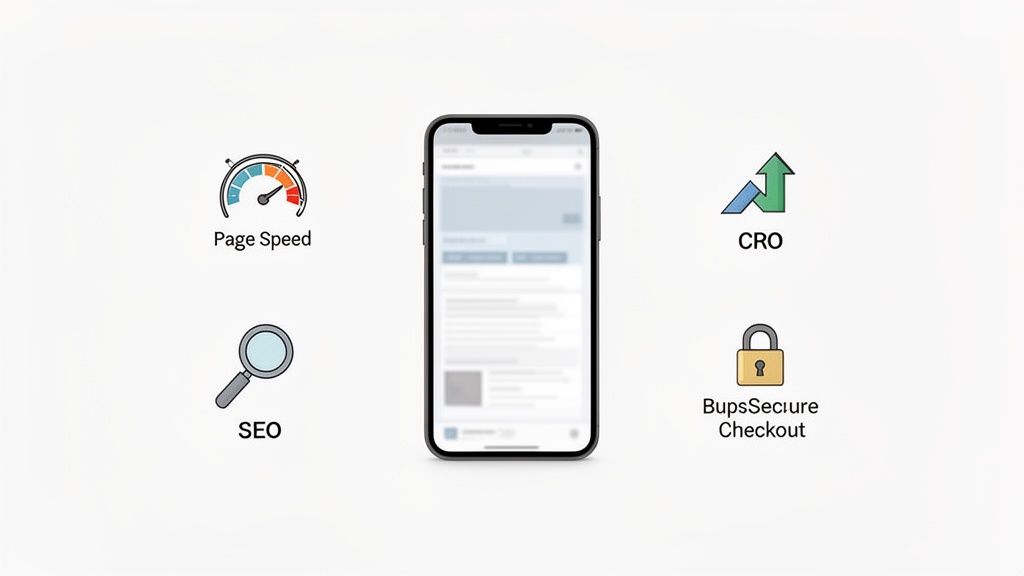
A good-looking website that doesn't sell is just an expensive digital brochure. When you’re looking at ecommerce website design packages, you have to think beyond aesthetics and zero in on the features that actually drive revenue. These aren't just trendy add-ons; they're the core of a store that pulls in customers, earns their trust, and keeps them coming back.
By 2026, your store's fate will be decided on a small screen. Mobile-first design isn't a "best practice" anymore—it's the only way to operate. With smartphones predicted to handle 71.8% of US ecommerce checkouts in 2025, a clunky mobile experience is a guaranteed way to lose sales. The huge gap between mobile traffic and desktop conversions tells you everything you need to know: mobile UX is critical.
This means any package you consider has to deliver a flawless, intuitive, and fast mobile journey from the very first tap. If a shopper has to pinch, zoom, or hunt for the "Add to Cart" button, you’ve already lost them.
The Unbreakable Link Between Speed and Sales
Online, every single second matters. Slow-loading pages are absolute conversion killers. Google’s Core Web Vitals aren't just technical jargon; they’re a direct measure of user experience and, by extension, how well your site will rank. A modern ecommerce design package must be built for ruthless performance optimization right from the start.
And this isn't just about making Google happy. A mere one-second delay in page load time can cause a 7% drop in conversions. For a store pulling in $100,000 in daily revenue, that single second costs you over $2.5 million in lost sales every year.
Make sure your package covers these essentials:
- Image Optimization: Compressing images without losing quality so they load instantly.
- Lazy Loading: Loading images and videos only when a user scrolls to them, not all at once.
- Code Minification: Cleaning up the site's code to make it leaner and faster.
Conversion Rate Optimization (CRO) at the Core
Conversion Rate Optimization (CRO) is the art and science of turning your visitors into paying customers. It can't be an afterthought—it has to be woven into the very fabric of the design process.
CRO is all about removing friction. Think of your customer's journey as a waterslide. Any bump, crack, or dry spot slows them down or makes them want to get off. A great design package makes sure the entire slide is smooth, fast, and fun, from top to bottom.
Key CRO elements to look for in any package include:
- High-Quality Visuals: Professional product photos and videos are non-negotiable. For apparel brands, tools like an AI ghost mannequin generator can be a game-changer for creating consistent, high-quality imagery.
- Social Proof: You need to show off customer reviews, ratings, and user-generated content to build trust right away.
- Simplified Checkout: A one-page or streamlined multi-step checkout with guest options is a must. Don't make people jump through hoops to give you money.
- Clear Calls-to-Action (CTAs): Buttons need to stand out visually and use compelling text that tells users exactly what to do next.
A Solid SEO Foundation from Day One
What good is an amazing store if nobody can find it? A top-tier design package builds Search Engine Optimization (SEO) into the site's architecture from the ground up. This is far more powerful than trying to bolt on SEO after you've already launched. If you want to go deeper, check out our guide on ecommerce website design best practices.
This foundational SEO means creating a logical site structure, using clean URLs, implementing proper heading tags, and making sure search engines can easily crawl your site. These pieces work together to give your store the best shot at ranking for your target keywords and attracting organic traffic that's ready to buy. Without them, even the most expensive marketing campaigns will be an uphill battle.
Why Platform-Specific Expertise Matters For Shopify
Would you hire a general family doctor to perform open-heart surgery? Of course not. You’d want a specialist. The exact same thinking applies when you're looking for someone to handle your ecommerce website design packages.
While plenty of web designers can put together a decent-looking website, a true Shopify specialist works on a completely different level. This is especially true if your sights are set on real growth and scaling your business.
Putting a generic web designer on a Shopify project is a bit like bringing a regular car mechanic to a Formula 1 race. They know the basics of how an engine works, sure, but they’re completely lost when it comes to the high-performance, specialized systems that actually win the race. A Shopify expert, on the other hand, lives and breathes the platform’s unique ecosystem.
Beyond The Theme Customizer
A generalist is usually pretty good at customizing a pre-built Shopify theme, which might be all you need for a simple, starter store. But a real specialist goes much, much deeper. They have a masterful understanding of Shopify’s own templating language, Liquid.
This knowledge allows them to break free from the built-in limits of a theme. They can build genuinely custom features and create user experiences that a general designer wouldn't even know are possible. This expertise shows up directly in your store's performance—they can fine-tune your site’s code for speed, add unique functions that solve your specific customer problems, and make sure your site is a true reflection of your brand, not just a slightly tweaked template.
Tapping Into The Full Shopify Ecosystem
The real power of Shopify isn't just the core platform itself, but the massive ecosystem of apps and integrations built around it. A specialist agency knows this landscape inside and out. They can tell you which apps are solid and reliable versus which ones are bloated and will just slow your site to a crawl.
This insight is absolutely critical for building a smooth, seamless operation. Just think about these specialist-driven advantages:
- Shopify Flow Automations: For Shopify Plus merchants, experts can build out complex automated workflows. Imagine automatically tagging your VIP customers, flagging potentially fraudulent orders for a manual review, or sending out re-order reminders—all without your team lifting a finger.
- Strategic App Stacks: They don't just pile on apps. They build a curated "app stack" where every single tool works together in harmony. This is key to preventing app conflicts, cutting down on code bloat, and making sure your marketing, loyalty, and subscription tools are all talking to each other perfectly.
- Headless Commerce Builds: For truly ambitious brands, a specialist can pull off a headless build on Shopify. This decouples the front-end (the "head") from the back-end commerce engine, giving you total design freedom and blistering-fast performance that market leaders depend on.
A general agency sees a problem and immediately looks for a generic plugin to fix it. A Shopify-focused agency understands what the platform can do natively first, and only then strategically picks the right tools to extend its power without hurting performance or security.
The Competitive Edge of Specialization
The ecommerce world is incredibly competitive. Shopify's market position is clear—it holds 27.79% of the US ecommerce CMS market. That's a huge number, and with the total number of global sites projected to hit 30.7 million by 2026, specialization isn't just a nice-to-have anymore. It's how you stand out.
The agencies that are really helping brands win are the ones blending deep development expertise with conversion rate optimization (CRO) and AI. A bad user experience can be a death sentence for a brand; studies show that 52% of consumers will leave a brand after just one poor interaction. You can discover more web design statistics that really drive home how important expert execution is.
At the end of the day, picking a Shopify specialist is about reducing your risk and getting the best possible return on your investment. You get a faster launch because they aren't learning the ropes on your project. You get a more stable, scalable site because they know how to build on the platform the right way from the start. This deep knowledge is a core part of effective Shopify web design services that deliver actual results. It ensures your ecommerce website design package is a powerful asset built for long-term growth, not just another business expense.
How To Choose The Right Ecommerce Design Package
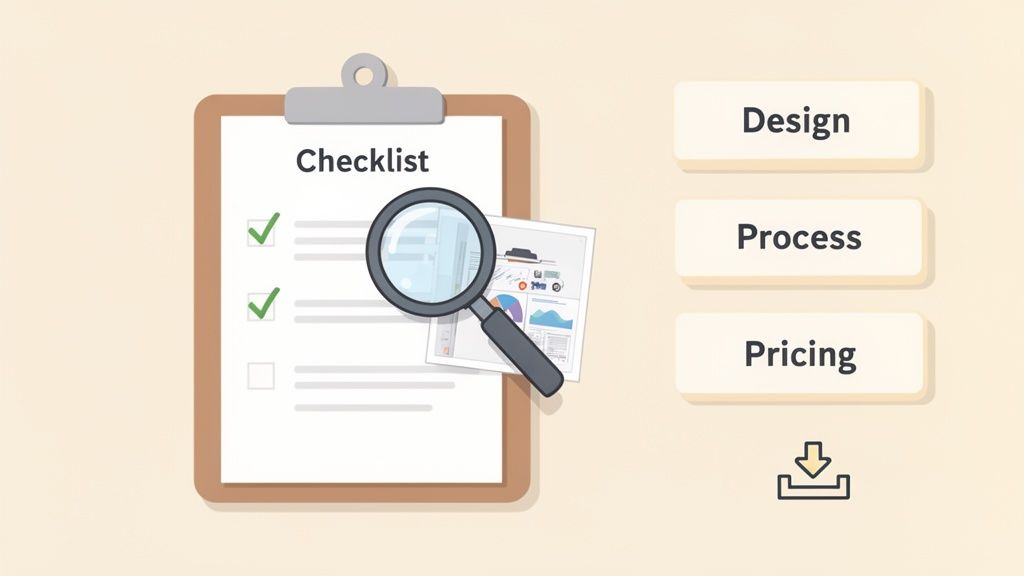
Picking the right ecommerce website design package feels like a massive decision, but it doesn’t need to be so stressful. Let's create an action plan to cut through the noise and help you choose with confidence. This is about looking way past the price tag to figure out what your business actually needs to win in the long run.
Think of it like hiring a contractor to build your dream storefront. You wouldn't just glance at the final bill; you'd want to walk through their past projects, understand how they build, and check their references. We'll use that same practical approach to turn this big choice into a simple, step-by-step evaluation.
Analyze The Portfolio For Results
Every agency has a portfolio filled with pretty websites. Your job is to dig deeper and look for real, measurable results—not just slick visuals. A beautiful site that doesn’t sell is a business expense, not an investment.
When you're looking at an agency's past work, ask these critical questions:
- Is there a clear improvement? If they provide a before-and-after, can you spot how the new design is objectively better for a customer? Is the navigation simpler? Is the path to checkout less confusing?
- Do their sites load fast? Pull up a few of their portfolio sites on your phone and click around. If they feel slow or clunky, that's a huge red flag for poor performance optimization.
- Do they have case studies with actual data? The best agencies prove their worth with numbers. Hunt for case studies that mention specific lifts in conversion rate, average order value (AOV), or organic traffic after their redesign went live.
Understand Their Design and Development Process
A clear, well-documented process is the sign of a true professional. It means they have a system to deliver projects on time and on budget, which saves you from nasty surprises down the road. If an agency is vague about how they get from A to B, walk away.
A rock-solid process will always have distinct, logical phases:
- Discovery and Strategy: This is where they should be asking you a ton of questions about your business goals, your ideal customer, and who you're up against.
- UX/UI Design: This stage moves from wireframes (the basic blueprint) to the final visual design (the look and feel), with checkpoints for your feedback along the way.
- Development: The actual coding and assembly of your store on the chosen platform.
- Testing and QA: A non-negotiable quality assurance phase where they rigorously test the site on different devices and browsers to squash any bugs.
- Launch and Training: A smooth deployment to your live domain, followed by a handover session where they teach you how to manage your new store.
A predictable process is your best insurance against project chaos. It forces alignment, manages expectations, and ensures the final product actually solves the business problems you defined at the start.
Demystify The Pricing Models
Finally, you need to pick a pricing model that fits your budget and your ambitions. For ecommerce website design packages, it usually boils down to two main options: a one-time project fee or an ongoing subscription.
A one-time project is ideal for a goal with a clear finish line, like launching a new brand or a complete site overhaul. You pay a fixed cost for a very specific scope of work. It’s straightforward and easy to budget for.
An ongoing subscription or retainer, on the other hand, is built for continuous evolution. Instead of one big bang, you pay a monthly fee for a dedicated team that consistently works on optimizing your site. This is the model for ambitious brands that need to run A/B tests, roll out new features, and adapt quickly to stay ahead of the competition. It’s a shift from a one-and-done launch to a strategy of perpetual growth.
The Future of Ecommerce Design and Proving ROI
The world of ecommerce has moved far beyond just having a pretty storefront. The future is all about building intelligent sales engines, and modern ecommerce website design packages are finally making this kind of powerful tech accessible to everyone, not just the retail juggernauts. Features that were once the exclusive domain of giants like Amazon are quickly becoming standard.
The engine driving these changes is Artificial Intelligence (AI). Think of AI-powered personalization, where your store's layout and product suggestions dynamically change for each visitor, showing them exactly what they're most likely to buy. It's also behind intelligent search that understands what a customer means, not just the keywords they typed, and content that adapts on the fly.
Connecting Innovation to Your Bottom Line
These advanced features are exciting, no doubt, but they don't mean a thing if they aren't making you money. The real measure of a great design package is how it directly fattens your bottom line. This requires a mental shift: stop seeing your website as a business expense and start treating it as your number one growth driver. Proving it just comes down to tracking the right numbers.
Your design and all its bells and whistles should be directly tied to key performance indicators (KPIs) that spell out a clear Return on Investment (ROI).
An ecommerce site isn't a digital catalog anymore; it's a living, breathing, data-driven system. Measuring its ROI isn't guesswork—it's about drawing a straight line from specific design choices to real financial results, like better conversion rates and customers who keep coming back.
Key Metrics for Measuring Design ROI
To justify the investment in your site, you have to focus on how design tweaks and new features move your core business metrics. When you're figuring out if your package is actually working, these are the three KPIs to live by:
- Conversion Rate: This is the most direct report card for your design. A smooth user experience, from the moment someone lands on a product page all the way through checkout, should make it incredibly easy to buy. When it does, this percentage goes up. It's that simple.
- Average Order Value (AOV): Smart features like AI-powered product bundles ("customers also bought...") are designed specifically to increase your AOV. A solid design package will have built-in strategies to gently nudge customers into adding just one more item to their cart.
- Customer Lifetime Value (LTV): A truly great design builds loyalty. When a store is simple to navigate, feels personal, and looks trustworthy, people are far more likely to become repeat customers. Tracking LTV reveals the long-term financial payoff of investing in a top-notch user experience.
Ultimately, your website has to work hand-in-glove with your marketing. A well-designed site, for instance, gives you a much stronger foundation for paid campaigns, which means you'll see a higher return from programmatic display and E-commerce advertising. By keeping a close eye on these metrics, you can prove with confidence that your ecommerce design package isn’t a cost—it’s your most powerful tool for building sustainable, profitable growth.
Frequently Asked Questions About Ecommerce Design Packages
It's natural to have questions when you're trying to make sense of ecommerce design packages. We've put together some clear, straightforward answers to the most common ones we hear, so you can make a decision you feel good about.
How Much Should an Ecommerce Website Design Package Cost?
This is the big one, and the honest answer is: it varies a lot. The cost really depends on how complex your project is. For a straightforward theme setup, you can expect to start in the low thousands.
If you're a growing business needing a fully custom design, the typical range is $15,000 to $50,000. For large-scale, enterprise-level projects on platforms like Shopify Plus, it's not uncommon for costs to push past $100,000.
A subscription model offers a strategic alternative. It aligns your costs directly with your growth, allowing features to scale as your revenue does, turning a large one-time expense into a predictable operational investment.
How Long Does a Website Redesign Take?
Just like cost, the timeline is tied directly to the project's scope. A simple theme customization can often be turned around in as little as 4-6 weeks.
On the other hand, a full-blown custom design and development project is a bigger undertaking. You should plan for 3-5 months from the initial discovery conversations to the final launch. A subscription package works differently, though—it’s built around continuous monthly improvements and feature rollouts, not a single project deadline.
Should I Choose a One-Time Project or a Subscription?
The best choice here comes down to your business goals. A one-time project is a perfect fit when you have a specific goal with a clear beginning and end, like launching a brand-new store or doing a complete site overhaul.
A subscription package, however, is all about ongoing partnership. It gives you continuous access to design, development, and CRO expertise. This model is a much better match for ambitious, growing brands that need to constantly test new features, adapt the site, and optimize for conversions to stay ahead. It's a relationship built for sustained growth.
Ready to stop guessing and start growing? ECORN offers flexible subscription packages that combine Shopify expertise with conversion-focused design. Let’s build a store that not only looks great but also sells. Explore our packages and see how we can help you scale.


Ecommerce Loyalty Program Software How to Choose and Launch
Shopify Plans Comparison for Every Business Stage
How to Improve User Experience for eCommerce Growth
Shopify Checkout Optimization That Converts More
Shopify Inventory Sync: A Practical Setup Guide
Shopify App Integration Playbook That Scales
Shopify CMS Integration: Your 2026 Guide to Options
Shopify Store Audit: Find Hidden Conversion Leaks
Shopify Plus Experts: How to Hire the Right Team
Chargeback Protection Shopify: A Practical 2026 Guide
8 Examples of Conversion Rate Optimization
How to Conversion Rate Optimization for Shopify Stores
Shopify Design Essentials Every Store Owner Needs
Ecommerce Terms of Service: How to Draft and Implement
How to Implement Structured Data for Ecommerce in 2026
SEO App Mobile: Shopify Store Optimization Guide
Shopify Plus Support: What It Includes and How to Choose
Google Ads for Shopify: The Complete 2026 Playbook
Shopify New York: How to Find and Hire the Right Agency
Google Search Console for Shopify: The Complete Setup
First Party Data Collection for eCommerce Growth
FAQ Online Store Guide: Build and Measure It Right
Do FB Ads Work for eCommerce in 2026?
One Page Checkout for Shopify: Design and Implementation
Shopify GraphQL vs REST: The 2026 Developer Decision
Shopify Ecommerce Consulting: Strategy, Pricing &
Are Reddit Ads Worth It for eCommerce Brands
Shopify Title and Meta Description: A Practical 2026 Guide
Product Video Best Practices for Shopify Brands
Real-Time Inventory Management: A 2026 Guide
AI Chatbot Integration for Shopify Stores
Affiliate Program Management: A Shopify Guide
10 Best Performance Monitoring Tools for Shopify in 2026
Digital Asset Management for eCommerce Brands in 2026
Every Type of Facebook Ads Explained for eCommerce Growth
Product Information Management Explained for Shopify Brands
Support Ticket System: A Guide for Shopify Stores

10 Best Customer Service Tools for Shopify in 2026

Can I Start a Business with No Money? a 2026 Blueprint
What Sells Good on Etsy: Best Niches for 2026

Shopify Add to Cart Button: A Practical 2026 Guide

Customer Feedback Automation: A Practical eCommerce Guide
Critical Rendering Path: A Guide for Shopify Stores

How to Promote on TikTok for eCommerce in 2026

B2B eCommerce Consulting That Drives Real Revenue
10 Best Practices for Site Navigation in 2026
Return vs Refund for Shopify Stores: A Practical Guide
What Is Customer Lifetime Value and Why It Matters
What Is Voice of Customer Research for eCommerce

SMS Marketing for Ecommerce That Actually Converts

Master How to Improve Email Deliverability in 2026
Top 7 eCommerce Partners NYC for Shopify Brands in 2026
Machine Learning for Ecommerce: Boost Your Shopify Store

Beauty Market Research: Your 2026 Growth Guide
Shopify International Expansion: A 2026 Roadmap
What Does CRO Stand for in Business: Understanding CRO
Shopify Visual Merchandising: A Playbook for Higher Sales
Shopify Landing Page Design: Master Conversion in 2026
10 Best AI SEO Optimization Tools for Shopify in 2026

Agentic AI for Ecommerce: Boost Your Sales in 2026
Mastering Email Marketing Data for eCommerce Growth
Conversion Rate Optimisation Australia: Boost Your Sales
Conversion Rate Optimization AI: Your Shopify Store Guide

10 Product Bundling Strategies for Shopify in 2026
How to Increase Customer Lifetime Value: A Shopify Playbook
AI Customer Service Automation: Shopify Guide 2026
Clean Website Design: A Shopify Conversion Playbook

Omnichannel Retail Strategy: A Shopify Playbook
Product Data Enrichment: A Guide for Shopify Brands
Instagram Shopping Features a Guide for Shopify Stores
What Is Revenue Optimization: A Holistic RevOps Guide
Benefits of Conversion Rate Optimization: Boost Your
WordPress to Shopify Migration: Your 2026 Seamless Switch
Boost Sales: Ecommerce Payment Processing Guide 2026
Unified Commerce Platform: Benefits, KPIs & Shopify Guide
How to Reduce Bounce Rate eCommerce: Your 2026 Guide
Shopify API Integration: A Practical End-to-End Guide
How to Implement Data Governance: A 2026 Guide
Shopify Store Development Cost: A 2026 Breakdown
What Is Server Side Tracking: The Shopify Guide 2026
Marketing Automation Workflows: A Shopify Guide for 2026
Shopify: How to Reduce Technical Debt
Shopify UX Design Change: A Playbook for Growth
User Generated Content Strategy: Shopify Playbook
Shopify Pause and Build Plan Cost: A Complete 2026 Guide
Compare at Price on Shopify: A Complete Guide for 2026
Where Can I Sell My Prints? 10 Best Platforms for 2026
Shopify Order Management System: The Ultimate Guide 2026
What Is Marketing Attribution? an eCommerce Guide for 2026
10 Best Black Friday Sales Sheets for 2026

Discover the Top Social Media Marketing Agencies For
Consumer Confidence Definition for eCommerce in 2026
What Is Social Commerce? Your 2026 Guide to Boosting Sales
A Social Ad Campaign Playbook for eCommerce Growth
7 Best FAQ Page Examples for SaaS & eCommerce

Market Research in Fashion Industry: A Guide for Shopify
Shopify Migration Services: Expert Guide for 2026
Mastering FB Retargeting Ads for Shopify in 2026
What Is Omnichannel Ecommerce
Master Your Shopify Plus Migration: The 2026 Guide


newsletter in your inbox