

To really create urgency in sales, you have to tap into a few core psychological triggers. I'm talking about things like scarcity, loss aversion, and good old FOMO (Fear Of Missing Out). We've found the most powerful approach combines time-based limits (like countdown timers) with quantity-based limits (like low-stock alerts) to get shoppers to act now, not later.
The Real Impact of Urgency on Shopify Sales
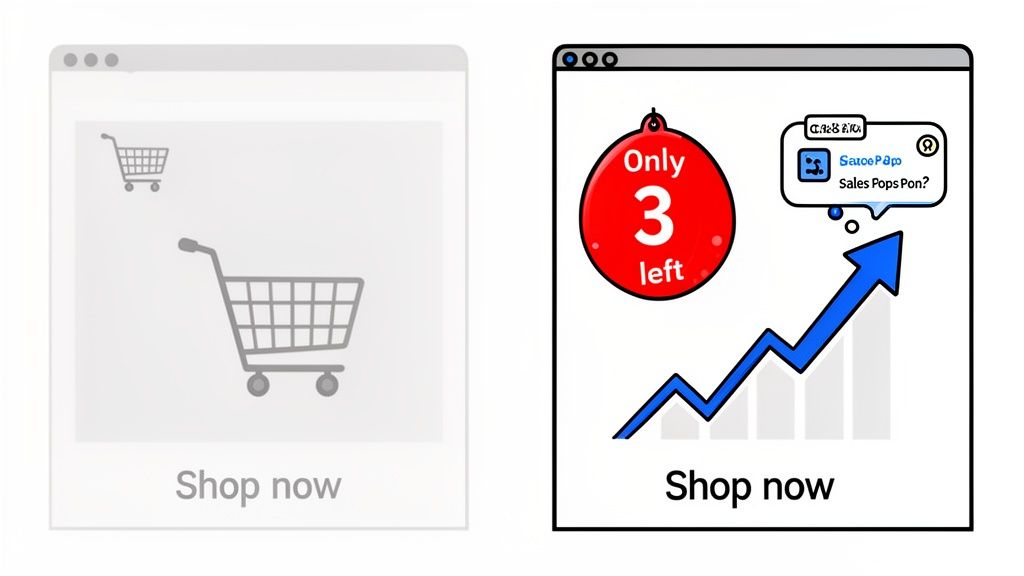
Let's cut straight to it: creating urgency is one of the biggest levers you can pull to boost sales on your Shopify store. It works by giving shoppers a compelling reason to stop hesitating and just make a decision. Picture one store with static product pages versus another with dynamic stock counters and checkout timers—the conversion lift can be absolutely massive.
This guide isn't about using cheesy, high-pressure tricks. It’s a playbook based on real data for turning casual window shoppers into decisive buyers. We’ll show you exactly how to implement these strategies authentically, shifting your store from a passive catalog into an active, engaging marketplace where customers feel smart for acting quickly.
Why Urgency Is a Conversion Multiplier
At its core, urgency just shortens the customer's decision-making cycle. By introducing a limitation, whether it's real or just perceived, you give them a powerful reason to stop procrastinating. Without that nudge, a potential customer might save an item for later, shop around for competitors, or worse, completely forget about it.
Think about the huge sales events that define eCommerce. During Black Friday, for example, online stores see conversion rates jump by a staggering 131% compared to their early November numbers. This isn't just random luck—it's the direct result of urgency from limited-time deals, countdown clocks, and "stock running low" alerts that trigger shoppers' FOMO.
For growing Shopify brands, replicating this effect all year long can be the difference-maker that pushes an average 2-3% conversion rate into the top-tier, over 4% bracket. You can dive deeper into these eCommerce conversion trends and their drivers to get the full picture.
The goal is to make your customers feel like they've stumbled upon a great opportunity, not that they're being pressured into a sale. Authentic urgency builds excitement and trust.
Key Urgency Tactics and Their Purpose
Learning how to create urgency in sales is all about knowing which tactic to use and when. Each one hits a different psychological button and works best in specific scenarios.
To give you a quick overview, we've put together a table that breaks down the core tactics we'll be covering. Think of this as your cheat sheet for matching the right strategy to the right psychological trigger.
Core Urgency Tactics and Their Psychological Triggers
| Urgency Tactic | Psychological Principle | Best Use Case |
|---|---|---|
| Time-Based Urgency | Loss Aversion & FOMO | Flash sales, holiday promotions, or next-day shipping cutoffs. |
| Quantity-Based Urgency | Scarcity & Exclusivity | Limited-edition items, low inventory alerts, or unique collabs. |
| Social Proof Urgency | Social Validation & Competition | Live sales notifications, "people viewing" counters, or best-seller badges. |
This table maps out the "what" and the "why." Now, let's get into the "how" for each of these powerful tactics.
Here are the fundamental tactics we will be digging into:
Time-Based Urgency: This is all about setting a clear deadline. Think flash sales, holiday promos, or a "deal of the day." It’s incredibly effective because it creates a definite endpoint for the opportunity, forcing a decision.
Quantity-Based Urgency: This tactic leans hard on scarcity. Messages like "Only 3 left in stock!" or "Limited edition run" make the product feel more valuable and exclusive simply because its availability is finite.
Social Proof Urgency: This is where you show that other people are buying the product right now. Small pop-ups saying "Someone in New York just bought this" or a counter showing "25 people are viewing this item" creates a subtle sense of competition and validates the shopper's interest.
Tapping Into the Psychology of a Shopper
If you want to create real urgency, you have to get inside your customer's head. It’s not about just slapping a timer on a page and hoping for the best. True urgency is about understanding the why behind a purchase.
Effective urgency isn't about being pushy. It’s about tapping into the powerful psychological drivers that snap a casual browser out of their indecision and turn them into a buyer. Getting this right is the difference between a cheap gimmick and an irresistible offer.
When a customer is on the fence, it's usually because of decision paralysis. They're weighing their options, second-guessing themselves, or just assuming your product will be there tomorrow. Urgency works by introducing a clear consequence for waiting, triggering hardwired cognitive biases that push them to act now.
The Power of Scarcity
Let's start with a basic human truth: when something is limited, we want it more. This isn't just some marketing trick; it's how our brains are wired. An item that’s always available feels ordinary, but one that’s about to sell out suddenly feels special and far more valuable.
Put yourself in the shopper's shoes. A message like "Only 3 left in stock!" isn't just an inventory update. It flips a switch. It creates a sense of competition and a fear of missing out. The customer is no longer just deciding if they want the product; they’re now competing against other invisible shoppers for a limited resource. That mental shift is everything.
Here’s how you can put scarcity to work in your store:
- Quantity-based scarcity: This is the most direct approach. Think "Low Stock" messages or showing the exact number of items left.
- Limited editions: A single product run or a small, exclusive batch creates a huge sense of "get it before it's gone forever."
- Variant scarcity: Show that specific sizes or colors are selling out fast (e.g., "Only 2 left in Medium"). This feels more authentic and makes the urgency personal to their preference.
This tactic reframes the purchase. It's no longer an expense; it’s about securing a rare opportunity before someone else does.
Riding the Wave of FOMO
Fear of Missing Out, or FOMO, is that nagging social anxiety you get when you think you might miss a great experience that others are enjoying. For eCommerce, FOMO is all about time. A ticking countdown timer isn't just a clock; it's a visual representation of a closing window of opportunity.
One study actually found that adding a countdown timer to an offer can seriously boost conversions. Why? Because it makes the consequence of waiting real and tangible. A shopper can literally see the deal slipping away, which is often enough to override the natural impulse to put it off.
FOMO is especially powerful because it plays on loss aversion—the psychological fact that the pain of losing something feels twice as bad as the pleasure of gaining something of equal value. A customer is more motivated by the fear of losing a 20% discount than they are by the idea of gaining it in the first place.
This is exactly why flash sales and "deal of the day" campaigns kill it. They create an event—a specific moment where taking action gets you a reward. Messages like "Deal ends in 02:14:55" or "Last day for free 24-hour shipping" force an immediate choice, turning "I'll think about it" into "I need to do this now."
The Bandwagon Effect of Social Proof
At our core, we're social animals. We constantly look to others for cues on how to act, especially when we're unsure about something. This is the very essence of social proof. When we see other people buying a product, it validates our own interest and tells us, "This is a safe bet; other people like it, too."
Social proof creates a more subtle, but equally powerful, type of urgency. Seeing a little notification pop up that says "20 people have this in their carts" or "Just sold! Someone in Austin, TX just bought this" accomplishes two key things:
- It confirms the product is desirable. It’s no longer just a static item on a page; it's a popular product that other real people want.
- It implies scarcity. If that many people are interested, this thing might sell out soon.
This one-two punch of validation and implied scarcity creates a powerful urge to join the group of buyers before it’s too late. It helps the customer feel confident in their choice, making that final click to purchase feel both smart and urgent.
Alright, let's move from the 'why' to the 'how'. Theory is great, but sales happen when you put proven tactics into action. This is your playbook for doing just that.
Think of this as a menu of field-tested strategies you can run on your Shopify store right away. We're taking the core psychological drivers—scarcity, FOMO, and social proof—and turning them into tangible sales.
This is where the rubber meets the road.
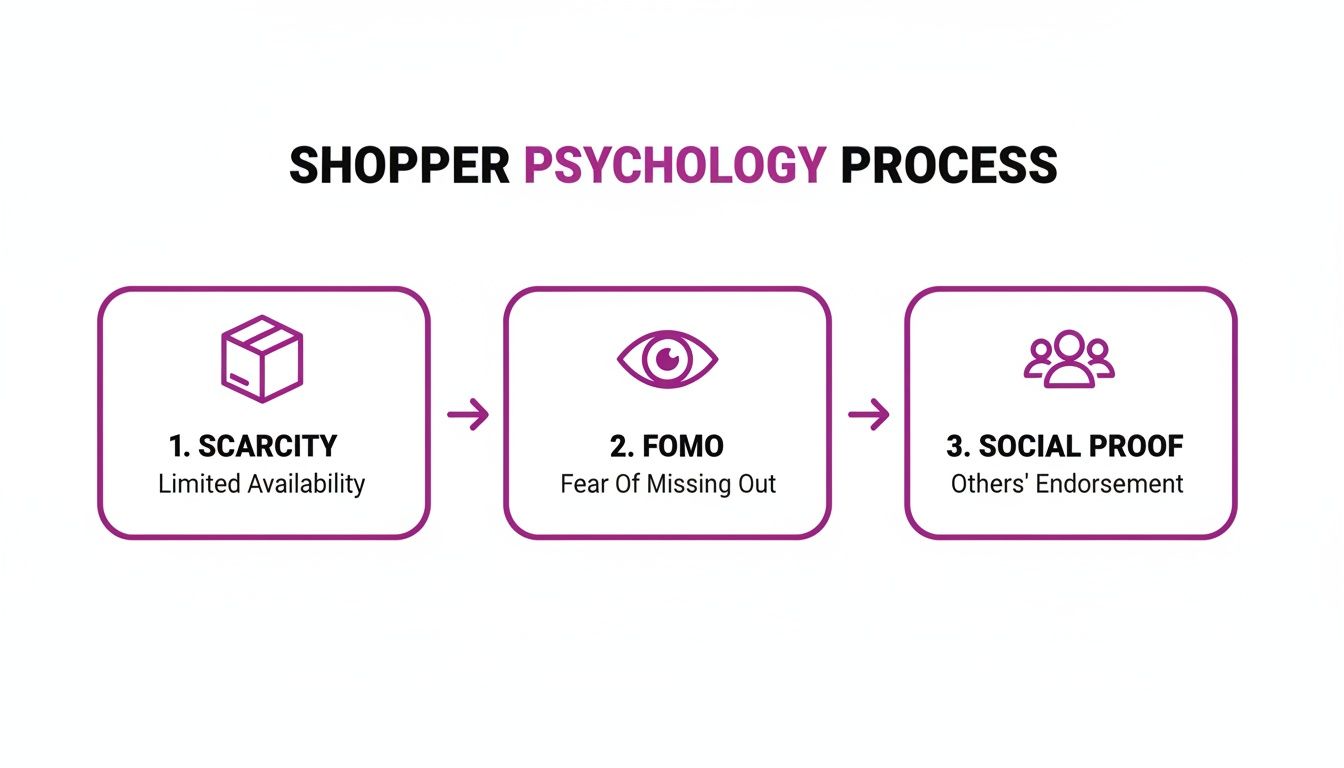
The visual above really breaks down how these triggers guide a shopper from just browsing to hitting "buy now." By layering these tactics, you create a path that naturally leads customers to a purchasing decision.
Launch a Time-Bound Flash Sale
The flash sale is the classic time-based urgency play for a reason: it works. It’s a short, intense promotion—usually 24 to 72 hours—built around a hard deadline that shoppers can't ignore.
But a successful flash sale is more than just a discount. You have to build an event around it.
- Build Anticipation: Start teasing the sale a few days early with emails and social media posts. Let people know something big is coming.
- Show the Clock: A prominent countdown timer on your homepage banner and product pages is non-negotiable. That visual of time slipping away is a huge psychological push.
- Keep it Simple: Avoid complex tiered offers. A clean, powerful message like "30% Off Everything - 48 Hours Only" cuts through the noise and is easy to act on.
A well-run flash sale does more than just move inventory. It injects a burst of energy into your brand, brings back old customers, and shows everyone that your store is a place for can't-miss deals.
Display Dynamic Low-Stock Messages
This is where you bring the scarcity principle to life. Instead of a generic "Low Stock" badge, you need to show real, dynamic inventory numbers. It’s transparent, and it's incredibly effective.
A vague warning is easy to ignore. A message like "Only 4 left in stock" creates a real, believable sense of competition. It tells the shopper, "If you want this, you need to grab it before someone else does."
This is a game-changer for products with sizes or color variants. Seeing "Only 2 left in Medium" hits home because it’s hyper-relevant to what that specific shopper wants. Just make sure it’s 100% authentic and tied directly to your inventory system. Fake scarcity will kill your credibility.
Leverage Cart Expiration Timers
Even interested shoppers get distracted. We all know cart abandonment is a massive hurdle—the global average sits at a staggering 69.8%. Urgency is your single best weapon against it.
An urgency-based abandoned cart email sent within the first hour can hit 40-50% open rates. But you can also tackle this right in the checkout flow.
Adding a simple timer with a message like "Your cart is reserved for 15:00" taps into loss aversion. The customer has already put in the work to find and add their items. The timer gives them that final nudge to finish the job instead of letting their curated cart disappear. These kinds of nudges are a core part of effective conversion rate optimization strategies that turn browsers into buyers.
Create Exclusivity with VIP Access
Urgency isn't just about deadlines and inventory counts. It can also be about status and exclusivity. Giving your email subscribers or loyalty members early access to a new product drop or sale creates a powerful feeling of being an insider.
This tactic pulls double duty:
- It Ignites Sales: Your most loyal fans get first dibs, which often kicks off a new launch with a strong wave of initial sales.
- It Grows Your List: It gives casual site visitors a very compelling reason to sign up. You’re not just asking for their email; you’re offering them a key to an exclusive club.
Your copy should reflect this. Something like, "Shop the new collection 24 hours before anyone else. Sign up now for exclusive access," works wonders. This approach is also perfect for building hype around upcoming products, a strategy we cover in detail in our guide on how to set up pre-orders on Shopify.
Alright, knowing the psychology behind urgency is one thing, but actually building it into your Shopify store is where the magic happens. Let's get our hands dirty and turn those principles into real, conversion-boosting features.
The great thing about Shopify is its flexibility. Between its massive app store and customizable themes, you can bring just about any urgency tactic to life. We’ll cover the most effective ways to get this done, from quick app installs to a few simple theme tweaks.
Choosing the Right Shopify Apps for Urgency
For most store owners, Shopify apps are the path of least resistance. They’re fast, don’t require you to touch any code, and can be up and running in minutes. The only problem? The App Store has a dizzying number of options.
Here’s how to cut through the noise and find what you need:
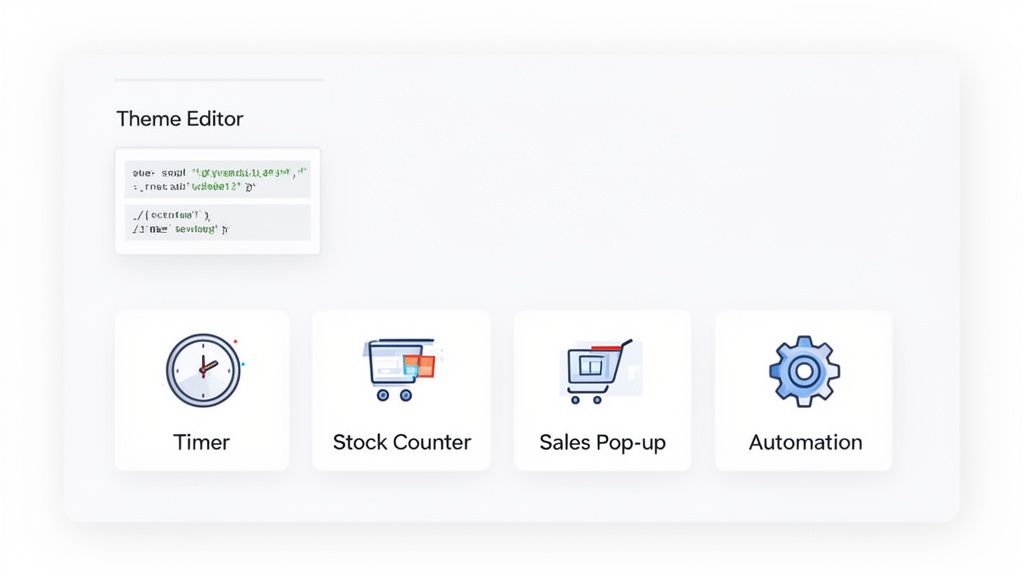
Countdown Timer Apps: An absolute must for flash sales or limited-time deals. You’ll want an app that lets you easily place timers on product pages, in announcement bars, or even at checkout. The best ones will let you customize the timer to match your store’s branding perfectly.
Stock Counter Apps: These are your go-to for creating scarcity by showing real-time inventory levels. Make sure any app you choose syncs directly with your Shopify inventory. Faking these numbers is a surefire way to break customer trust, so accuracy is non-negotiable.
Social Proof & Sales Pop-ups: These little notifications show off recent purchases or how many people are looking at a product. It creates that “busy high street shop” vibe, building social proof and a bit of FOMO. If you want to go deeper on this, our guide on the best sales pop-up apps is a great place to start.
Pro Tip: Try to find one app that handles multiple jobs instead of installing three separate ones. All-in-one "conversion" apps often bundle timers, stock levels, and more. This keeps your monthly subscription costs down and helps prevent site speed issues caused by too many conflicting scripts.
To make the choice a bit easier, here are a few popular apps and what they do best.
Shopify Urgency App Comparison
Picking the right tool from the Shopify App Store can feel like a chore. This table breaks down a few solid options to help you see which one fits your specific needs, whether you want an all-in-one tool or something more specialized.
| App Name | Primary Function | Key Feature | Best For |
|---|---|---|---|
| Urgency Pack Ultimate | All-in-One Urgency | Combines countdown timers, stock counters, and "get it by" messaging. | Merchants who want a single, unified solution for multiple urgency tactics. |
| Nudgify | Social Proof & Sales Pops | Real-time notifications of recent sales and live visitor counts. | Stores looking to build a busy, high-traffic feel and social validation. |
| Countdown Timer Bar | Time-Based Urgency | Simple, clean countdown timers for announcement bars and product pages. | Running straightforward flash sales and event-based promotions. |
Ultimately, the best app is the one that integrates smoothly and helps you execute your strategy without adding a ton of complexity to your workflow.
Manual Implementation for More Control
If you're not afraid of making a few small tweaks to your theme, you can get a lot done without adding another monthly app subscription. This route gives you total control over the look and feel and avoids adding extra code that can slow your site down.
Adding a Simple Announcement Banner
Most modern Shopify themes come with a built-in announcement bar. You can usually find it in your theme customizer under Online Store > Themes > Customize. This is the perfect spot for a flash sale announcement or a shipping deadline reminder.
Keep your copy punchy and clear. Something like: "Flash Sale Ends Tonight! 30% Off Everything." gets the job done.
Custom Checkout Messaging
Adding a quick message in the checkout can be that final nudge a customer needs to complete their purchase. For instance, you can remind them about the limited-time discount they're about to lock in. This typically requires a small code snippet added to your checkout.liquid file (if you're on Shopify Plus) or can be done with a dedicated checkout app.
Automating Urgency with Shopify Flow
If your store is on the Shopify, Advanced, or Plus plan, you have access to a secret weapon: Shopify Flow. This tool is fantastic for building automated "if-this-then-that" workflows based on what your customers do.
Here are a couple of powerful ways you can use it:
Low-Stock Customer Tag: Set up a workflow that automatically tags any customer who buys a product that's low in stock. Later, you can use that tag to send them an exclusive "back in stock" email before you announce it to everyone else.
VIP Early Access: Create a flow that tags your biggest spenders (e.g., customers who spend over $500) as "VIPs." You can then grant this segment early access to your big sales, creating an irresistible sense of exclusivity and urgency.
By blending the right apps, a few smart theme customizations, and some clever automation, you can weave a powerful urgency strategy right into the fabric of your Shopify store—one that feels authentic and gets results.
Measuring Results and Avoiding Urgency Fatigue
Throwing urgency tactics at your store can feel like a shot of adrenaline for your sales. But like any powerful tool, its real value comes from how you use it. Just flipping on a few timers and low-stock alerts and calling it a day won't cut it for long-term growth. To make urgency work for you, you have to measure its impact and, just as crucially, know when to pull back before your audience tunes you out.
This is all about finding the right balance. You're aiming to build excitement and drive action, not create anxiety or burn out your customer base with constant, high-pressure messages. The line between effective and annoying is finer than you might think, and crossing it can shatter the trust you’ve worked so hard to build.
Key Metrics to Track Your Urgency Efforts
To really get a grip on how your urgency plays are performing, you need to look beyond the top-line revenue number. Data is your best friend here, helping you fine-tune your entire approach. By keeping an eye on a few key performance indicators (KPIs), you can see what’s landing, what’s falling flat, and when you need to ease off the gas.
Start by tracking these essentials:
- Conversion Rate: This is your most direct feedback. Are more visitors actually turning into buyers when you run an urgency campaign? A clear lift here is proof your tactics are working.
- Average Order Value (AOV): Sometimes, a little urgency encourages shoppers to add more to their cart, maybe to hit a free shipping threshold or snag a deal. A rising AOV is a fantastic side effect.
- Cart Abandonment Rate: Pay close attention to this one. While a well-placed cart expiration timer can slash abandonment rates, overly aggressive popups might just frustrate shoppers into leaving. A sudden spike is a major red flag.
- Time to Purchase: How quickly do customers go from landing on your site to completing a checkout? Your urgency tactics should be shortening this sales cycle.
A critical mistake is thinking all urgency is about timers and stock counts. True urgency often comes from pure responsiveness. For example, responding to a sales inquiry within one minute can skyrocket conversions by 391%. It works because 78% of customers buy from the first responder—your speed shows you're ready to solve their problem right now. You can dig into more insights on the impact of sales response times from Setter.
Running A/B Tests to Optimize Your Messaging
Your audience is unique. What works for one brand might completely flop for yours. Instead of throwing things at the wall and hoping they stick, let your customers show you what they want through simple A/B testing. This is just a straightforward way to compare two versions of an urgency message to see which one performs better.
You can test almost any part of your strategy. Here are a few ideas to get you started:
- Copy Variations: Does "Low Stock" get more clicks than "Only 3 Left"? Does "Deal Ends Tonight" create more sales than a specific countdown timer?
- Timer Placement: Test a timer in a sitewide banner against one placed directly on the product page, right next to the "Add to Cart" button.
- Offer Type: Pit a percentage-off discount against a free gift with purchase, both using the same deadline.
Many Shopify apps have A/B testing features built right in, making this incredibly easy to get started. The goal here is to make small, iterative improvements that compound over time, leading to a highly optimized urgency strategy.
How to Avoid Urgency Fatigue
If every single product is "almost gone" and every offer is "ending soon," your messages will quickly lose all their power. This is urgency fatigue, and it’s a total credibility killer. To stop it from happening, you have to treat urgency like a scalpel, not a sledgehammer.
- Vary Your Promotions: Don't run the same 24-hour flash sale every single month. Mix it up. Try limited stock alerts on a few bestsellers, offer exclusive early access for your email list, or create a hard cutoff for next-day shipping.
- Reserve Power Plays for Key Moments: Save your most aggressive, site-wide urgency campaigns for huge sales events like Black Friday or your brand's anniversary. This makes them feel like a genuine event customers don't want to miss.
- Be 100% Authentic: This is completely non-negotiable. Never, ever use fake timers that just reset on a page refresh or lie about stock levels. Customers are smart and will see right through it, and you'll lose their trust for good.
By diligently measuring your results, testing your assumptions, and using urgency with strategic restraint, you can transform it from a cheap sales gimmick into a sustainable, long-term driver for growth and customer engagement.
Frequently Asked Questions About Creating Urgency
Even with a great game plan, you're bound to have questions when you start weaving urgency into your sales strategy. We get it. Over the years, we've heard them all.
Let's walk through some of the most common concerns we hear from Shopify owners. Think of this as getting the expert advice you need to use urgency with confidence—and without crossing any lines.
Can Using Urgency Tactics Hurt My Brand Reputation?
The short answer is yes, but only if you’re being dishonest. The difference between a smart tactic and a brand-damaging gimmick all comes down to authenticity.
Urgency based on reality—real stock levels, genuine limited-time sales, or actual shipping deadlines—creates excitement and signals value. It’s a helpful nudge for the customer. The trouble starts when you fake it. Customers are smart; they'll spot a countdown timer that resets with every refresh or a "Only 2 left!" banner when you've got a warehouse full of product. Break that trust, and it's nearly impossible to earn back.
The golden rule is simple: Frame urgency as a friendly heads-up, not a high-pressure tactic. Use it to provide real information, not to mislead.
What Is the Most Effective Urgency Tactic for a New Store?
When you're just starting out, time-based urgency is your best friend. Why? Because it doesn't depend on social proof or sales history you haven't built yet.
You can't exactly flash a "50+ sold today!" message when you're still waiting for your first sale. But what you can do is create an event around a deadline.
- Launch Offer: Kick things off with a "Grand Opening" sale. A 48-hour countdown creates a powerful incentive for those first visitors to become your first customers.
- New Customer Discount: Try a welcome discount for new email subscribers that expires in 24 hours. It’s a classic for a reason and works wonders for turning initial interest into that crucial first purchase.
Strategies like these make your early shoppers feel like they're getting in on the ground floor of something special.
How Often Should I Run Promotions with Urgency?
This is a delicate balance. If you scream "urgent!" all the time, the word loses its meaning. Customers quickly develop "banner blindness" and your promotions will fall flat. The key is to be strategic and selective.
Here's a rhythm that works well for many brands:
- One major urgency-driven event per quarter: This is for your big campaigns like a Summer Sale or Black Friday. Go all-out here.
- Smaller, targeted promotions monthly: Think of things like a weekend flash sale for your email list or a low-stock alert on a handful of products.
By mixing up the frequency and the audience, you keep things fresh. When you do signal urgency, it feels important because it is important.
Should I Put a Countdown Timer on Every Product Page?
Absolutely not. That's a textbook example of overkill, and it completely drains the power from the tactic. A countdown timer is a high-impact tool, and it should be saved for situations where the deadline is both real and significant.
When a customer rarely sees a timer, they pay attention when one does pop up. It immediately tells them this is a real, time-sensitive opportunity.
Reserve timers for these moments:
- Sitewide Flash Sales: Use a prominent banner timer that counts down a sale applying to the entire store.
- Specific Product Promotions: A "Deal of the Day" or a special feature with its own dedicated timer can be incredibly effective.
- Abandoned Cart Recovery: A timer in your recovery email ("Your cart and 20% discount expire in...") can be the final push someone needs to complete their purchase.
Use timers with a light touch, and you'll train your customers to act when they see one.
Ready to move beyond theory and implement these strategies with expert precision? The team at ECORN specializes in Shopify development and conversion rate optimization. We help brands build authentic, high-converting experiences that drive real growth.


How to Implement Structured Data for Ecommerce in 2026
SEO App Mobile: Shopify Store Optimization Guide
Shopify Plus Support: What It Includes and How to Choose
Google Ads for Shopify: The Complete 2026 Playbook
Shopify New York: How to Find and Hire the Right Agency
Google Search Console for Shopify: The Complete Setup
First Party Data Collection for eCommerce Growth
FAQ Online Store Guide: Build and Measure It Right
Do FB Ads Work for eCommerce in 2026?
One Page Checkout for Shopify: Design and Implementation
Shopify GraphQL vs REST: The 2026 Developer Decision
Shopify Ecommerce Consulting: Strategy, Pricing &
Are Reddit Ads Worth It for eCommerce Brands
Shopify Title and Meta Description: A Practical 2026 Guide
Product Video Best Practices for Shopify Brands
Real-Time Inventory Management: A 2026 Guide
AI Chatbot Integration for Shopify Stores
Affiliate Program Management: A Shopify Guide
10 Best Performance Monitoring Tools for Shopify in 2026
Digital Asset Management for eCommerce Brands in 2026
Every Type of Facebook Ads Explained for eCommerce Growth
Product Information Management Explained for Shopify Brands
Support Ticket System: A Guide for Shopify Stores

10 Best Customer Service Tools for Shopify in 2026

Can I Start a Business with No Money? a 2026 Blueprint
What Sells Good on Etsy: Best Niches for 2026

Shopify Add to Cart Button: A Practical 2026 Guide

Customer Feedback Automation: A Practical eCommerce Guide
Critical Rendering Path: A Guide for Shopify Stores

How to Promote on TikTok for eCommerce in 2026

B2B eCommerce Consulting That Drives Real Revenue
10 Best Practices for Site Navigation in 2026
Return vs Refund for Shopify Stores: A Practical Guide
What Is Customer Lifetime Value and Why It Matters
What Is Voice of Customer Research for eCommerce

SMS Marketing for Ecommerce That Actually Converts

Master How to Improve Email Deliverability in 2026

Top 7 eCommerce Partners NYC for Shopify Brands in 2026
Machine Learning for Ecommerce: Boost Your Shopify Store

Beauty Market Research: Your 2026 Growth Guide
Shopify International Expansion: A 2026 Roadmap
What Does CRO Stand for in Business: Understanding CRO
Shopify Visual Merchandising: A Playbook for Higher Sales

Shopify Landing Page Design: Master Conversion in 2026
10 Best AI SEO Optimization Tools for Shopify in 2026

Agentic AI for Ecommerce: Boost Your Sales in 2026
Mastering Email Marketing Data for eCommerce Growth
Conversion Rate Optimisation Australia: Boost Your Sales
Conversion Rate Optimization AI: Your Shopify Store Guide

10 Product Bundling Strategies for Shopify in 2026
How to Increase Customer Lifetime Value: A Shopify Playbook
AI Customer Service Automation: Shopify Guide 2026
Clean Website Design: A Shopify Conversion Playbook

Omnichannel Retail Strategy: A Shopify Playbook
Product Data Enrichment: A Guide for Shopify Brands
Instagram Shopping Features a Guide for Shopify Stores
What Is Revenue Optimization: A Holistic RevOps Guide
Benefits of Conversion Rate Optimization: Boost Your
WordPress to Shopify Migration: Your 2026 Seamless Switch
Boost Sales: Ecommerce Payment Processing Guide 2026
Unified Commerce Platform: Benefits, KPIs & Shopify Guide
How to Reduce Bounce Rate eCommerce: Your 2026 Guide
Shopify API Integration: A Practical End-to-End Guide
How to Implement Data Governance: A 2026 Guide
Shopify Store Development Cost: A 2026 Breakdown
What Is Server Side Tracking: The Shopify Guide 2026
Marketing Automation Workflows: A Shopify Guide for 2026
Shopify: How to Reduce Technical Debt

Shopify UX Design Change: A Playbook for Growth
User Generated Content Strategy: Shopify Playbook
Shopify Pause and Build Plan Cost: A Complete 2026 Guide
Compare at Price on Shopify: A Complete Guide for 2026
Where Can I Sell My Prints? 10 Best Platforms for 2026
Shopify Order Management System: The Ultimate Guide 2026
What Is Marketing Attribution? an eCommerce Guide for 2026
10 Best Black Friday Sales Sheets for 2026

Discover the Top Social Media Marketing Agencies For
Consumer Confidence Definition for eCommerce in 2026
What Is Social Commerce? Your 2026 Guide to Boosting Sales
A Social Ad Campaign Playbook for eCommerce Growth

7 Best FAQ Page Examples for SaaS & eCommerce

Market Research in Fashion Industry: A Guide for Shopify
Shopify Migration Services: Expert Guide for 2026
Mastering FB Retargeting Ads for Shopify in 2026
What Is Omnichannel Ecommerce
Master Your Shopify Plus Migration: The 2026 Guide
Shopify Integration Services: A Merchant's 2026 Guide
Shopify Collection Description: A Guide to SEO & Sales
Shopify Plus Contact: Reach Sales & Support Effectively

Top Luxury Shopify Stores: Design & UX Strategies
How to Improve Customer Experience: A Shopify Roadmap
Creative Facebook Ads: 10 Examples for Shopify Brands

Remarketing with Facebook Ads: A Shopify Guide for 2026

SEO Linking Strategies for Shopify Stores
Top 7 Statistics YouTube Channels for eCommerce in 2026

Hiring Shopify Plus Designers: A Founder's Guide
Shopify Product Variation: Master Your Variants for 2026

Leverage Ai Solutions Brands: Your 2026 Shopify Growth Guide
Filters in Shopify: A Guide for Growing Brands
Shopify Plus Developer: A Guide for Growing Brands


newsletter in your inbox