


If you're running a growing Shopify brand, you've probably lived this version of the story already. One person is managing Meta ads, building Klaviyo flows, briefing creatives, updating landing pages, pulling reports, and answering Slack messages about why revenue dipped yesterday. It works for a while, until it doesn't.
Then the cracks show up fast. Paid traffic keeps spending, but conversion rate work stalls. Email campaigns go out, but nobody owns segmentation. Product launches happen, but merchandising, creative, and acquisition aren't aligned. The issue usually isn't effort. It's structure.
A good marketing organization structure isn't an HR exercise. It's a revenue system. It decides who owns demand, who owns retention, who translates product value into offers, and who keeps the whole machine running without constant founder intervention. For eCommerce brands, especially on Shopify, that matters more than is generally understood because channel execution is tightly connected. Ads, PDPs, offers, bundles, lifecycle, analytics, and CRO don't work as isolated jobs.
Why Your Marketing Org Structure Is a Growth Engine
Early on, most brands run marketing like a pile of tasks. Someone handles ads because they know Ads Manager. Someone else sends emails because they can use Klaviyo. A founder reviews creative, approves discount strategy, and jumps into analytics when performance slips. That isn't a structure. That's survival mode.
The issue with survival mode is that it obscures the true bottleneck. Many organizations assume the problem is channel performance. In practice, the challenge is usually unclear ownership. If nobody clearly owns acquisition efficiency, retention, merchandising communication, and reporting discipline, you do not achieve scale. You get busy people and inconsistent output.
Structure creates accountability
When marketing is organized well, each part of the funnel has an owner. Paid media owns traffic quality and spend efficiency. Lifecycle owns retention and repeat purchase communication. Content and creative support acquisition, merchandising, and brand consistency. Operations keeps attribution, dashboards, briefs, and workflows from breaking.
That's why structure has a direct relationship to revenue quality, not just revenue volume. A team can drive sales and still be inefficient. If you're trying to understand whether marketing is producing healthy output, metrics like marketing efficiency ratio become much more useful when each function has a real owner.
Practical rule: if two people both think they own a result, nobody really owns it.
Shopify brands feel this sooner than other businesses
On Shopify, the feedback loop is short. You can launch a new offer in the morning and see signal by the afternoon. That speed is useful, but it also exposes weak structure quickly. If your paid team, CRO work, merchandising, and CRM aren't coordinated, performance drifts.
Strong brands eventually stop asking, “Who can help with this task?” and start asking, “Which role should own this outcome?” That shift is what turns marketing from a reactive service function into a growth engine.
Three Core Marketing Organization Models
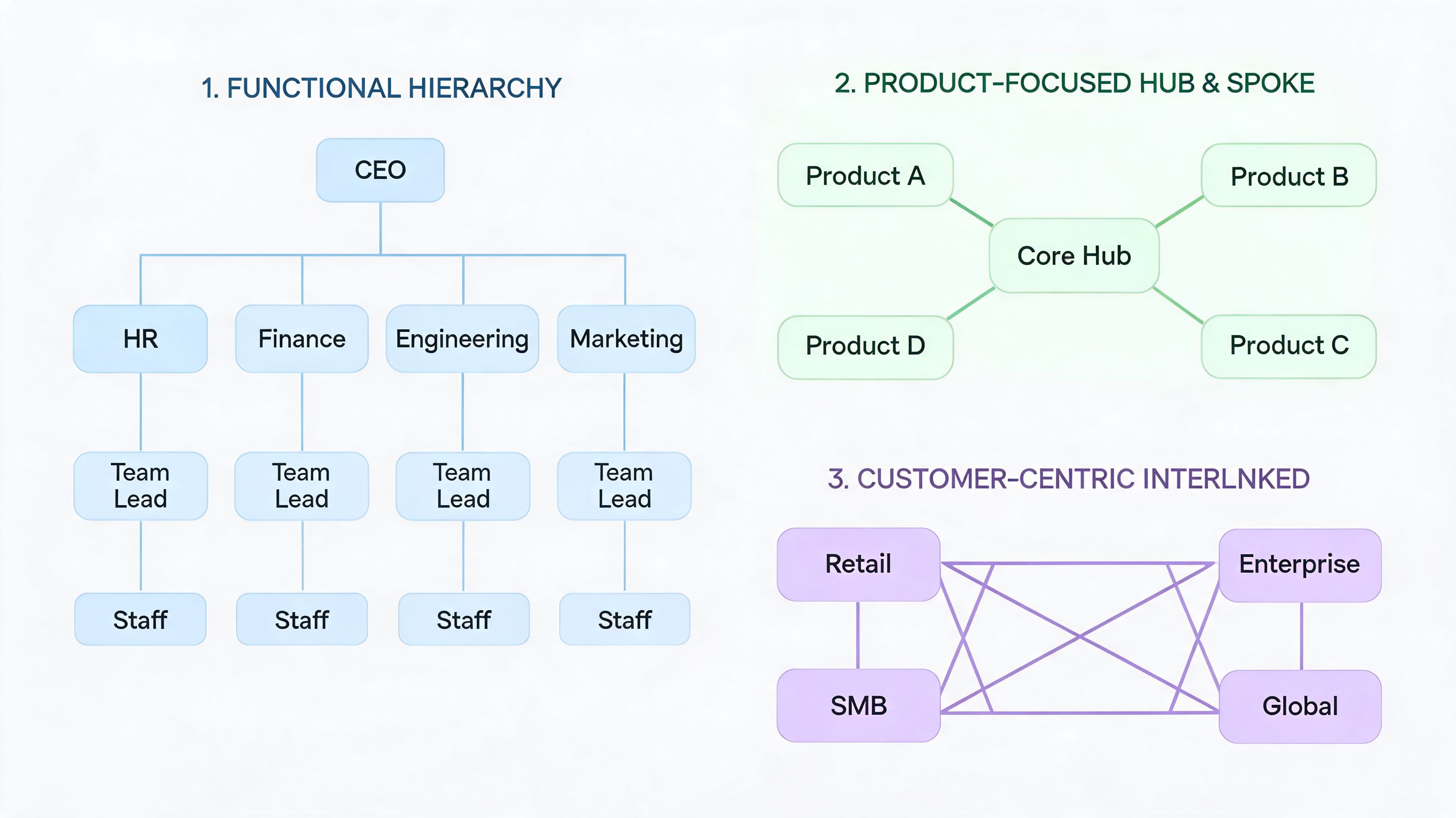
Most eCommerce teams end up using one of three models. The names vary, but the logic is consistent. I like to explain them like a professional kitchen.
In one kitchen, every station has a specialty. Grill handles grill. Pastry handles pastry. Expediting keeps timing tight. In another, each team is assigned to a product line or category. In a third, people keep their specialty but also work in cross-functional pods.
Functional structure
A functional marketing organization structure groups people by discipline. Paid media sits together. Email and CRM sit together. Content sits together. Design sits together. Analytics or ops supports the system.
This is the cleanest model for many Shopify brands because it builds specialist depth. If your Meta buyer, Google specialist, CRM manager, and CRO lead all focus on their craft, quality tends to improve faster than in a generalist team.
It also matches how many larger teams naturally evolve. In a 2026 benchmark summary of marketing team headcount and role mix, companies in the $1–10M revenue band reportedly operate with a median of 3 marketers, $10–50M firms average 11, and once revenue crosses $50M, the median jumps to 26 marketers. The same summary says mature teams often settle into a more specialized role mix, with roughly 25% demand generation, 20% content, 15% operations, 15% brand, 15% product marketing, and 10% leadership.
For Shopify brands, that usually translates into dedicated ownership for paid acquisition, CRM, content or creative, and marketing ops as the business gets more complex.
Product or category-focused structure
A product-focused structure organizes people around categories, collections, or business units. If a brand sells skincare, haircare, and supplements, each category may have its own mini-team or category lead.
This model works when categories behave differently. Different customer objections, launch calendars, repeat cycles, and merchandising logic often justify tighter ownership by product line. A skincare launch may need educational content and lifecycle support, while accessories may rely more on impulse purchase behavior and paid social velocity.
The upside is closeness to the product. The downside is duplication. Teams can end up creating separate reporting habits, separate creative standards, and overlapping channel work.
Matrix or hybrid structure
The hybrid model combines specialist depth with business-unit accountability. Your paid media specialist still belongs to a central performance team, but they may support a specific product line, region, or pod.
This is often where scaling brands land because it reflects reality. The team needs deep expertise, but it also needs coordination around launches, offers, and customer segments. A 2022 study on marketing decision control and organization types identified three distinct marketing organization types: “Growth Champions” at 17%, “Service Providers” at 43%, and “Marcom Leaders” at 40%. That matters because structure isn't only about reporting lines. It's also about how much authority marketing holds over strategic decisions.
If your Shopify marketing lead has responsibility but not decision rights, the org chart may look fine while execution stays slow.
The real question isn't just how your team is grouped. It's who has the authority to make trade-offs quickly.
Choosing Your Model A Pros and Cons Comparison
There isn't one correct model. There's only the model that fits your current product complexity, team maturity, and pace of change.

Functional model
A functional model is usually the best starting point for a scaling Shopify brand. It creates clear craft ownership and helps the team build repeatable operating rhythms.
Biggest advantage: deep specialist execution.
Biggest disadvantage: channel silos show up fast if nobody owns cross-functional coordination.
A useful perspective on this is:
| Criteria | Functional model |
|---|---|
| Speed and agility | Fast inside each discipline, slower across disciplines |
| Cost efficiency | Strong, because tools and skills are centralized |
| Scalability | Good for adding specialist depth |
| Specialist development | Very strong |
| Brand consistency | Good if creative direction is centralized |
A recent analysis of modern marketing organizational structures puts the core trade-off clearly. Functional teams centralize specialist skills and reduce redundant tooling, but they can create silos. That's exactly the pain point many eCommerce teams hit when paid media, content, and lifecycle all optimize locally but not together.
Product-focused model
This model gets closer to the customer and the merch calendar. It works well when each category behaves almost like its own business.
What it tends to do well:
- Launch ownership: A category lead can move faster because they don't need to negotiate every decision across a central team.
- Message fit: Teams stay close to customer objections, product education needs, and merchandising context.
- Category focus: It's easier to prioritize winners and fix weak product lines.
What usually breaks:
- Duplicate work: Multiple teams may build similar briefs, dashboards, or ad testing processes.
- Inconsistent standards: Creative and measurement can drift.
- Resource strain: Small brands often can't afford a full stack for each category.
For most Shopify brands, this model works better after the business has enough product breadth to justify separate ownership.
Hybrid model
Hybrid structures are usually the most realistic answer once the brand has multiple growth motions running at the same time. They preserve specialist depth while creating pods or business owners around launches, markets, or customer segments.
Use it when:
- You sell across categories or regions
- Your retention and acquisition motions need tighter coordination
- You want specialist quality without forcing all decisions through one manager
The trade-off is management complexity. Hybrid structures need clean planning, documented ownership, and disciplined reporting. Without that, people end up in too many meetings and still miss deadlines.
Key Marketing Roles for a Growing Shopify Brand
Most founders don't need a perfect org chart first. They need the next right hire. That means defining roles by business outcomes, not by trendy titles.
Head of marketing or eCommerce lead
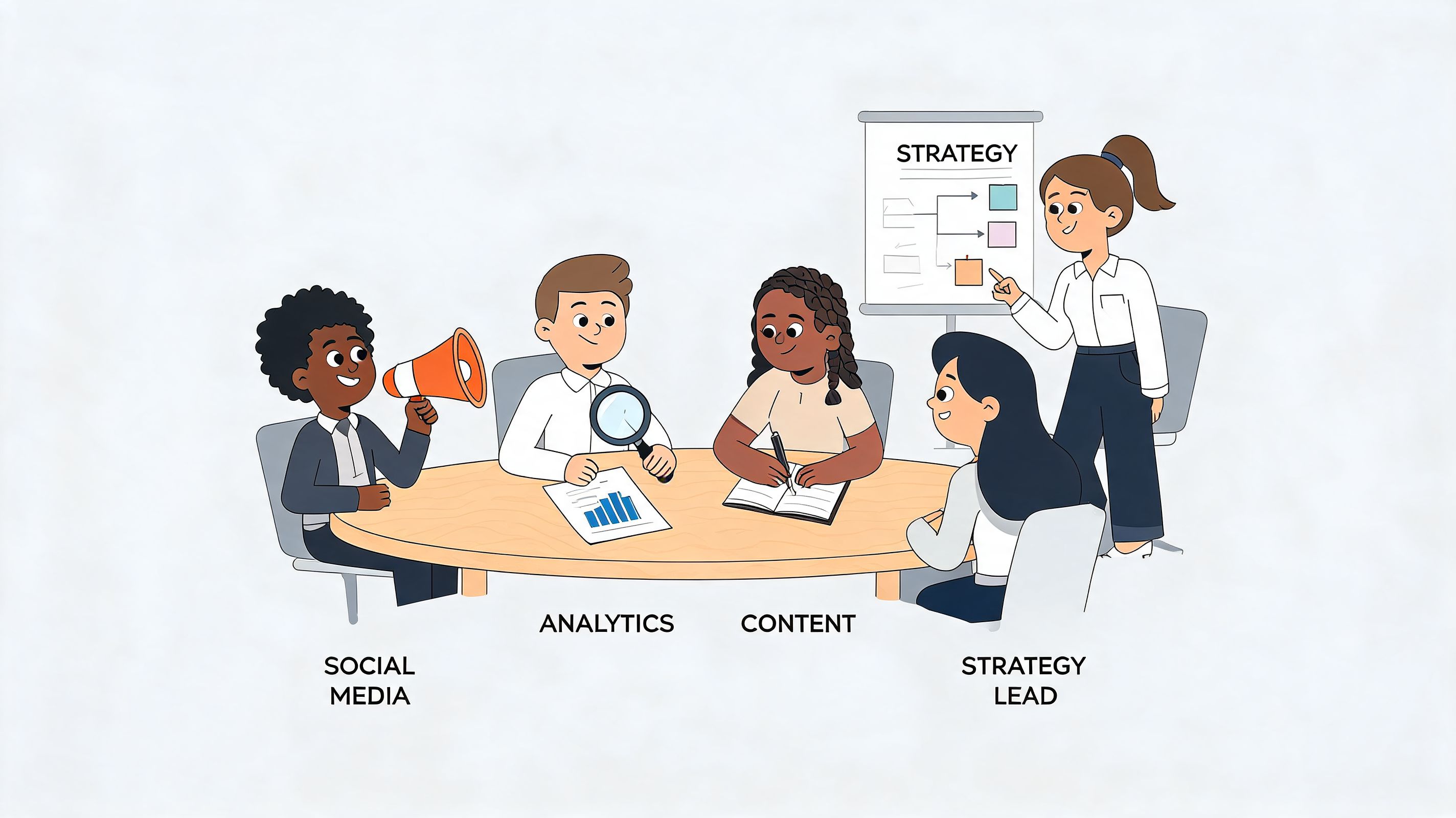
This person translates business goals into channel priorities. On a Shopify brand, they usually sit between founder vision and daily execution. They're responsible for making acquisition, merchandising, retention, and reporting work together.
Core responsibilities:
- Set growth priorities across paid, CRM, merchandising, and content
- Run planning cadences for launches, promotions, and testing
- Own channel trade-offs when budget, creative, or inventory constraints show up
Primary KPI:
- Blended revenue performance and contribution by channel
If you're defining this role, it helps to review what strong operators need. This breakdown of essential ecommerce manager skills is useful because it gets into the practical mix of commercial, technical, and coordination skills the role demands.
Performance marketing specialist
This role owns paid acquisition. On Shopify, that usually means Meta, Google, and sometimes TikTok, Pinterest, or affiliate support depending on the brand. Their job isn't just buying traffic. It's managing spend against margin reality, offer fit, landing page quality, and creative feedback loops.
Key responsibilities:
- Manage campaign structure and budget allocation
- Brief creative needs based on audience and offer performance
- Report on traffic quality and signal where funnel conversion is weak
Primary KPI:
- Efficient revenue generation from paid channels
A weak hire here often hides behind platform tactics. A strong one understands the whole buying journey, including PDP friction, landing page match, and new customer economics.
CRM and lifecycle marketer
This is one of the most under-hired roles in eCommerce. Brands obsess over acquisition and leave retention on the side until growth gets expensive.
This role should own:
- Flows and campaigns in Klaviyo or similar platforms
- Segmentation logic based on purchase behavior, category affinity, and engagement
- Retention strategy tied to replenishment, cross-sell, upsell, and win-back
Primary KPI:
- Customer repeat purchase performance and lifecycle revenue quality
Many Shopify teams wait too long to hire this role, then wonder why they need ever more paid spend to keep revenue moving.
A good team setup also depends on how all these roles fit together. This guide to ecommerce team structure is helpful if you're mapping marketing into the broader commercial and operational team.
Content and SEO specialist
For Shopify brands, content usually does more than blog traffic. It supports PDP clarity, collection page intent, launch storytelling, educational content, retention messaging, and creative testing themes.
Typical responsibilities:
- Build content briefs for organic search and on-site education
- Support product launches with messaging and landing page copy
- Turn customer insight into assets that paid, CRM, and merch teams can reuse
Primary KPI:
- Content-driven visibility, engagement, and conversion support
Here's a useful walkthrough on role expectations and team setup:
Marketing operations or analytics owner
Once the team starts adding tools, this role becomes critical. Someone has to own attribution sanity, dashboard logic, UTM discipline, reporting consistency, and workflow reliability.
They usually handle:
- Tracking and reporting hygiene
- Dashboard ownership across Shopify, GA4, ad platforms, and CRM
- Process design for briefs, QA, launches, and experiment tracking
Primary KPI:
- Decision speed and reporting accuracy
Without this role, teams start making expensive decisions off partial data and Slack screenshots.
Your Marketing Team Scaling Roadmap
A Shopify founder hits $2M, and marketing starts breaking in familiar ways. Meta spend climbs, email campaigns go out late, product launches depend on whoever is available, and reporting turns into a debate instead of a decision. The fix is rarely “hire more marketers.” The fix is hiring the next role that removes the current revenue bottleneck.

Stage one under $1M
At this stage, the founder usually owns too many decisions, and that slows everything down. The right first hire is usually a strong generalist eCommerce marketer or eCommerce manager who can run the calendar, coordinate campaigns, brief creatives, and keep Shopify promos, email sends, and ad inputs on schedule.
Breadth matters more than channel depth here. A single operator who can spot problems across merchandising, conversion, retention, and acquisition usually creates more value than stacking several narrow freelancers with no clear owner.
Use fractional support for work that needs specialist skill but not full-time volume:
- Paid media freelancer if ad buying is inconsistent or outside the team's skill set
- Designer or creative support if campaign ideas are bottlenecked by asset production
- Developer support for landing pages, theme edits, app setup, and QA before launches
Stage two from $1M to $5M
This is the point where “good enough” marketing starts getting expensive. One weak function can drag down the rest of the system. Strong paid traffic with weak lifecycle means you overpay for every first order. Solid retention with weak acquisition means growth stalls because new customer flow is too unpredictable.
The next dedicated hire is usually either performance marketing or CRM/lifecycle. Choose based on where margin is leaking.
Hire lifecycle first if:
- traffic is healthy but repeat purchase is weak
- campaigns go out inconsistently
- flows are basic, outdated, or missing
- launches create a spike in sales but little post-purchase follow-up
Hire performance first if:
- paid spend is growing without clear account control
- creative testing is irregular
- CAC swings too much week to week
- there is no clear owner for Meta, Google, or acquisition reporting
Before adding more headcount, systemize what should not depend on a person doing manual work every week. The SelfServe guide to Shopify marketing automation is useful for mapping which retention and campaign tasks should be automated before you hire around broken processes.
Stage three from $5M to $20M
At this stage, the team needs clearer ownership by function. Revenue is now exposed to handoff problems. Paid drives traffic, email supports launches, creative feeds both, and nobody owns the gaps between them unless you assign them directly.
A common structure here is:
- Head of marketing or senior marketing lead
- Performance marketer
- CRM or lifecycle manager
- Creative or content support
- Ops or analytics ownership, full-time or fractional
This is also where hybrid resourcing starts to make sense. Keep roles in-house when they require daily context, fast decisions, and close coordination with merchandising, inventory, and product launches. Use agencies or fractional specialists for areas with uneven workload, temporary expertise needs, or channel-specific depth the business is not ready to hire full-time.
The trade-off is straightforward. In-house teams usually move faster on brand context and cross-functional execution. External specialists can add depth quickly, but they need stronger briefs, tighter review cycles, and a clear internal owner.
Stage four at $20M and beyond
Larger Shopify brands usually need team structure around business units, regions, or major functions. A simple “everyone reports into one marketing lead” model starts to strain once the brand is managing wholesale support, international stores, complex launch calendars, retail tie-ins, or a larger SKU catalog.
At this point, brands often build a core internal group around leadership, retention, merchandising alignment, and analytics. They then add specialist support where full-time hiring is either too slow or too rigid. Common examples include CRO programs, advanced paid social creative production, Shopify development support, and temporary launch capacity during peak periods.
The practical rule is simple. Keep customer insight, offer strategy, and revenue ownership inside the business. Buy external help for execution layers that fluctuate or require niche expertise.
How to Implement Your New Marketing Structure
A new structure fails when leadership announces titles but doesn't change how work gets done. The org chart looks cleaner, but the same confusion stays underneath.
Audit skills and hidden ownership
Start by mapping who currently owns each major outcome. Not tasks. Outcomes.
That includes:
- Acquisition efficiency
- Lifecycle revenue
- Launch execution
- Content production
- Analytics and reporting
- Creative briefing
- Site conversion work
You'll usually find overlap, gaps, and a lot of unofficial ownership. One person knows how reporting works. Another person remembers how launch QA gets done. That's risky.
A useful outside perspective can come from adjacent industries too. This B2B marketing team structure guide is worth reading because the governance problems are often similar even when the channel mix differs.
Define decision rights before changing titles
Matrix and hybrid teams break when authority is vague. Someone needs to know who decides budget allocation, who approves campaign messaging, who signs off on launch calendars, and who owns reporting truth.
A common failure point in matrix organizations is that knowledge stays trapped with individuals and customer information gets scattered across teams, as discussed in this piece on matrix organization challenges and governance. That's why role clarity alone isn't enough. You need governance and analytics ownership.
If your reporting logic lives in one person's head, you don't have a system. You have a dependency.
Build workflows that force coordination
Once roles are defined, create recurring operating routines. For Shopify teams, that usually means:
- Weekly channel review with paid, CRM, content, and merchandising leads
- Launch planning cadence with briefs, owners, deadlines, and QA checkpoints
- Shared dashboard ownership so everyone works from the same definitions
- Creative and testing loop connecting ad performance, customer feedback, and site updates
At this point, many reorgs either work or collapse. If people still run separate spreadsheets, separate naming systems, and separate interpretations of performance, the structure won't hold.
Communicate the why
People resist reorgs when they sound like management theater. They usually support them when the reason is obvious. Explain which problems the new structure fixes. Say what changes, what doesn't, and how success will be measured.
Clear communication matters more than fancy diagrams. Teams don't need complexity. They need clarity.
Structure Your Marketing for Future Growth
The right marketing organization structure is the one that matches your current stage without blocking the next one. Early on, that usually means simple ownership and a few strong generalists. As the brand grows, specialist depth starts paying off. After that, hybrid structures become necessary because launches, channels, product lines, and analytics all need tighter coordination.
What works is rarely static. A Shopify brand that keeps the same team design for too long usually ends up with one of two problems. Either everyone stays too broad and quality drops, or the team adds specialists without changing decision rights and coordination, so work slows down.
The practical answer is to build around outcomes. Who owns efficient acquisition. Who owns retention. Who owns product story and content. Who owns the numbers. Who keeps launches moving. Once those answers are clear, the org chart gets easier.
The brands that scale cleanly usually do one thing well. They redesign structure before the old one fully breaks.
If your Shopify team is hitting the point where roles are blurry, launches feel messy, or growth depends on too many workarounds, ECORN can help you map the right operating model, clarify ownership, and support the execution layers that keep revenue moving.



Product Variants Shopify: The Complete 2026 Guide

Ecommerce Analytics Consulting for Growth

What Is AI Integration for eCommerce

How to Choose the Right eCommerce Website Development Firm

E Business Strategy Implementation
Conversion Tracking Setup for Shopify Stores
BigCommerce vs Shopify Plus Which Enterprise Wins in 2026
Shopify Theme Kit: Setup, Commands, and Migration Guide

Shopify Extension Development: A Practical 2026 Guide

Shopify Speed Score Explained and How to Improve It

Shopify Mobile Optimization: The 2026 Playbook

How to Add Subcategory in Shopify for Better UX
How to Implement Structured Data for Ecommerce in 2026

SEO App Mobile: Shopify Store Optimization Guide

Shopify Plus Support: What It Includes and How to Choose

Google Ads for Shopify: The Complete 2026 Playbook

Shopify New York: How to Find and Hire the Right Agency

Google Search Console for Shopify: The Complete Setup

First Party Data Collection for eCommerce Growth

FAQ Online Store Guide: Build and Measure It Right
Do FB Ads Work for eCommerce in 2026?

One Page Checkout for Shopify: Design and Implementation
Shopify GraphQL vs REST: The 2026 Developer Decision
Shopify Ecommerce Consulting: Strategy, Pricing &

Are Reddit Ads Worth It for eCommerce Brands

Shopify Title and Meta Description: A Practical 2026 Guide

Product Video Best Practices for Shopify Brands
Real-Time Inventory Management: A 2026 Guide

AI Chatbot Integration for Shopify Stores

Affiliate Program Management: A Shopify Guide
10 Best Performance Monitoring Tools for Shopify in 2026

Digital Asset Management for eCommerce Brands in 2026
Every Type of Facebook Ads Explained for eCommerce Growth
Product Information Management Explained for Shopify Brands

Support Ticket System: A Guide for Shopify Stores

10 Best Customer Service Tools for Shopify in 2026

Can I Start a Business with No Money? a 2026 Blueprint

What Sells Good on Etsy: Best Niches for 2026

Shopify Add to Cart Button: A Practical 2026 Guide

Customer Feedback Automation: A Practical eCommerce Guide

Critical Rendering Path: A Guide for Shopify Stores

How to Promote on TikTok for eCommerce in 2026

B2B eCommerce Consulting That Drives Real Revenue

10 Best Practices for Site Navigation in 2026

Return vs Refund for Shopify Stores: A Practical Guide

What Is Customer Lifetime Value and Why It Matters
What Is Voice of Customer Research for eCommerce

SMS Marketing for Ecommerce That Actually Converts

Master How to Improve Email Deliverability in 2026

Top 7 eCommerce Partners NYC for Shopify Brands in 2026

Machine Learning for Ecommerce: Boost Your Shopify Store

Beauty Market Research: Your 2026 Growth Guide

Shopify International Expansion: A 2026 Roadmap

What Does CRO Stand for in Business: Understanding CRO

Shopify Visual Merchandising: A Playbook for Higher Sales

Shopify Landing Page Design: Master Conversion in 2026

10 Best AI SEO Optimization Tools for Shopify in 2026

Agentic AI for Ecommerce: Boost Your Sales in 2026
Mastering Email Marketing Data for eCommerce Growth

Conversion Rate Optimisation Australia: Boost Your Sales

Conversion Rate Optimization AI: Your Shopify Store Guide

10 Product Bundling Strategies for Shopify in 2026

How to Increase Customer Lifetime Value: A Shopify Playbook

AI Customer Service Automation: Shopify Guide 2026

Clean Website Design: A Shopify Conversion Playbook

Omnichannel Retail Strategy: A Shopify Playbook

Product Data Enrichment: A Guide for Shopify Brands

Instagram Shopping Features a Guide for Shopify Stores

What Is Revenue Optimization: A Holistic RevOps Guide

Benefits of Conversion Rate Optimization: Boost Your

WordPress to Shopify Migration: Your 2026 Seamless Switch
Boost Sales: Ecommerce Payment Processing Guide 2026
Unified Commerce Platform: Benefits, KPIs & Shopify Guide

How to Reduce Bounce Rate eCommerce: Your 2026 Guide
Shopify API Integration: A Practical End-to-End Guide

How to Implement Data Governance: A 2026 Guide

Shopify Store Development Cost: A 2026 Breakdown
What Is Server Side Tracking: The Shopify Guide 2026
Marketing Automation Workflows: A Shopify Guide for 2026

Shopify: How to Reduce Technical Debt

Shopify UX Design Change: A Playbook for Growth

User Generated Content Strategy: Shopify Playbook

Shopify Pause and Build Plan Cost: A Complete 2026 Guide

Compare at Price on Shopify: A Complete Guide for 2026

Where Can I Sell My Prints? 10 Best Platforms for 2026
Shopify Order Management System: The Ultimate Guide 2026
What Is Marketing Attribution? an eCommerce Guide for 2026

10 Best Black Friday Sales Sheets for 2026

Discover the Top Social Media Marketing Agencies For

Consumer Confidence Definition for eCommerce in 2026

What Is Social Commerce? Your 2026 Guide to Boosting Sales

A Social Ad Campaign Playbook for eCommerce Growth

7 Best FAQ Page Examples for SaaS & eCommerce

Market Research in Fashion Industry: A Guide for Shopify

Shopify Migration Services: Expert Guide for 2026

Mastering FB Retargeting Ads for Shopify in 2026
What Is Omnichannel Ecommerce

Master Your Shopify Plus Migration: The 2026 Guide
Shopify Integration Services: A Merchant's 2026 Guide

Shopify Collection Description: A Guide to SEO & Sales


newsletter in your inbox