

Picture your store for a moment. Right now, it might feel like you're hunting for every single sale. You pour resources into getting a customer, they buy something, and then the hunt starts all over again the next day. A subscription model completely changes that game.
This is the power of Shopify subscription services. It’s about transforming your business from a series of one-time transactions into a predictable, sustainable operation that builds real brand loyalty.
Why Recurring Revenue Is a Game Changer for Shopify Stores
Instead of just hunting, think of it like cultivating a farm. You're creating a system that provides a consistent, reliable harvest, season after season. Your focus shifts from chasing the next transaction to nurturing long-term customer relationships.
This move from one-off sales to recurring revenue brings stability to your finances. When you have a clear idea of the money coming in each month, you can budget with confidence, make smarter inventory decisions, and plan for growth without the constant stress of unpredictable sales cycles.
The Power of Predictable Growth
The biggest win from adopting Shopify subscription services is trading volatile sales for a steady stream of monthly recurring revenue (MRR). This consistency is a massive asset and opens up some serious advantages for your business.
- Smarter Cash Flow Forecasting: With a reliable revenue base, you can make data-driven decisions on everything from your marketing budget to hiring your next team member. No more guessing games.
- Higher Customer Lifetime Value (CLV): A subscriber paying you $30 every month is far more valuable over a year than a customer who makes a single $50 purchase. Subscriptions are designed to multiply the value of every customer you bring in.
- Deeper Brand Loyalty: Subscriptions create an ongoing dialogue with your customers. They aren't just buying a product; they're joining a community and investing in your brand, which naturally leads to stronger loyalty and word-of-mouth marketing.
This isn't just a niche trend; it's a huge economic driver. You can see it in Shopify’s own numbers. In the third quarter of 2025, Shopify’s subscription revenue hit $699 million, marking a 17% jump from the previous year and making up almost a quarter of their total revenue. You can dig into more details in these key Shopify statistics.
The real magic of a subscription model isn't just the recurring payment. It's the recurring relationship. Each delivery, each email, and each interaction is another opportunity to reinforce your brand's value and turn a customer into a lifelong advocate.
With this foundational understanding of why recurring revenue is so important, we can start diving into the practical side of building, managing, and scaling your own subscription program. The goal is to move past simply selling products and start building a business that thrives on lasting customer value.
Choosing Your Foundation: Subscription Apps vs. Custom APIs
The very first fork in the road on your subscription journey is deciding on the right technical backbone. Think of it like building a house. Are you going to use a high-quality prefab kit that gets you moved in fast, or will you hire an architect to design a completely custom home from the ground up?
Both routes get you a roof over your head—a functioning subscription business—but they cater to wildly different needs when it comes to budget, speed, and what you plan to do with the space long-term. This choice will define your capabilities, customer experience, and operational costs for years.
The decision tree below maps out the initial split between one-off sales and a recurring revenue model.
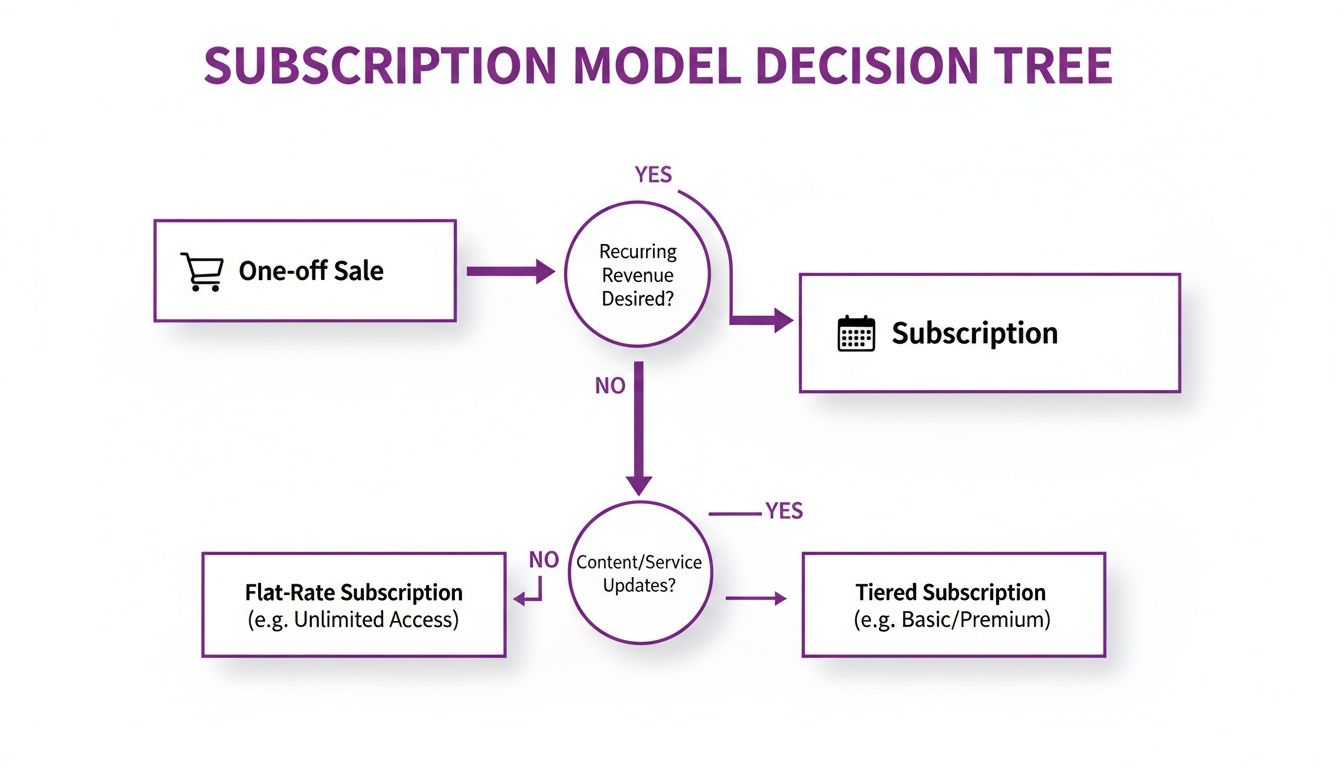
Once you're committed to subscriptions, the real technical choice emerges: plug-and-play app or a custom-built solution.
The Plug-and-Play Path with Third-Party Apps
For most businesses just dipping their toes into subscriptions, third-party apps are the quickest and most budget-friendly way to get started. Apps like Recharge, Appstle, and Bold Subscriptions are essentially pre-built subscription engines that plug right into your Shopify store.
This is your prefab house kit. It comes with all the core components you need, ready for assembly.
- Speed to Market: You can get a subscription program live in a matter of days, not months. The setup is usually a guided process that doesn't require deep technical knowledge.
- Lower Upfront Cost: Instead of a hefty development bill, you’ll typically pay a monthly fee plus a small percentage of every transaction.
- Essential Features Included: These apps handle the must-haves—recurring billing, customer portals for self-management, and basic dunning (the process of retrying failed payments)—right out of the box.
Of course, this convenience has its trade-offs. You're building within someone else's walls, which can limit just how unique your customer experience can be. Those transaction fees, while small at first, can also start to feel pretty significant as your subscriber base grows.
The Custom-Built Path with Shopify's APIs
For established brands or businesses with truly unique subscription logic, a custom solution built on Shopify’s APIs offers total control. This is the architect-designed home—it demands more time and a bigger upfront investment, but the result is a perfect, bespoke fit for your brand. This path is almost exclusively for merchants on Shopify Plus.
A custom API solution allows you to build a subscription experience that is a true extension of your brand, not just a feature bolted onto your store. You control every pixel of the user interface and every step of the customer journey.
Building with the Shopify Billing API means your team—or an agency partner—constructs the entire subscription engine from scratch. For businesses operating at scale, this approach unlocks some serious advantages.
Key Benefits of a Custom Build:
- Total Customization: You can design a completely unique customer portal, create complex billing models (like usage-based or tiered pricing), and craft an experience that is seamless with your brand’s look and feel.
- No Transaction Fees: While the upfront development cost is substantial, you completely eliminate the per-transaction fees charged by third-party apps. At high volume, this becomes a major cost-saver.
- Deeper Integration: A custom build can talk directly to your ERP, CRM, or other backend systems, creating a perfectly synchronized workflow across your entire business.
This route obviously requires serious technical muscle. For complex integrations and a truly tailored solution, you may need to hire dedicated Shopify developers. It’s a significant investment, but it gives you the freedom to build a subscription service that can scale without hitting a ceiling.
Subscription Apps vs Custom Shopify Billing API
So, how do you pick a lane? The best way is to look honestly at where your business is today and where you want it to be in a few years. This side-by-side comparison should help make the decision clearer.
Ultimately, there's no single "best" answer—only the one that's right for your business. An app gets you in the game quickly, while a custom build lets you write the rules of the game yourself.
Designing Subscription Models That Actually Retain Customers
Once you’ve settled on the tech, the real fun begins. A successful subscription isn't just about setting up recurring payments; it’s about crafting an experience built on undeniable value. This is where you pivot from technology to strategy, designing offers that customers actually get excited about and want to keep long-term.
Think of it like this: you can have a top-of-the-line oven (your app or API), but if the recipe (your subscription model) is bland, nobody is coming back for seconds. The goal is to create a value proposition so strong it weaves itself into your customer's daily or weekly routine.
Core Subscription Model Archetypes
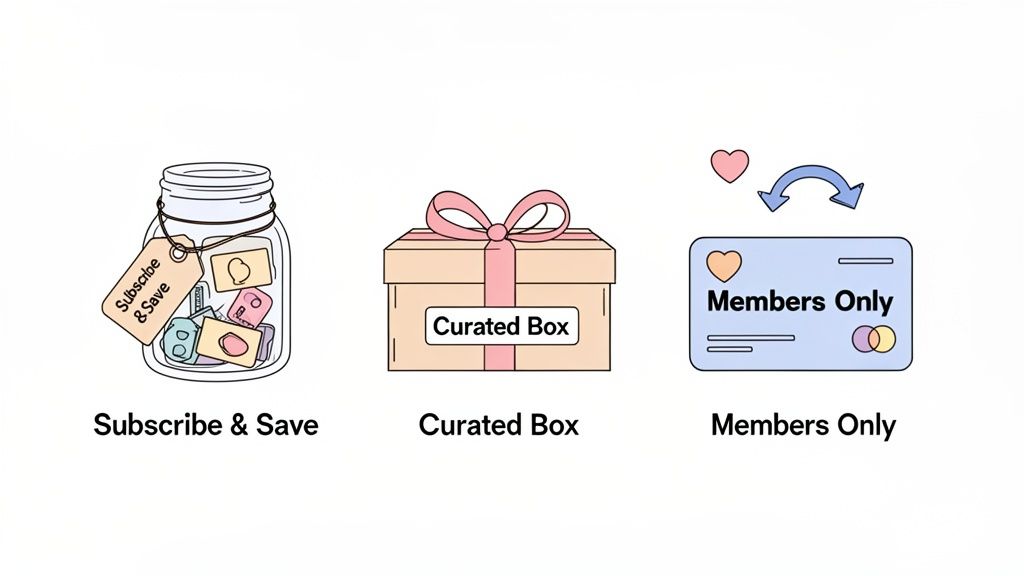
Most winning Shopify subscription services are built on one of three foundational models. Each one plays on a different customer motivation and is better suited for certain products.
Subscribe & Save (Replenishment): This is the workhorse of the subscription world. It’s a perfect fit for consumables—think coffee, vitamins, pet food, or skincare. The value here is pure convenience and savings. Customers get what they already need on autopilot, usually with a nice discount. It’s a low-effort decision that quickly builds powerful habits.
Curated Box (Discovery): This model is all about the thrill of surprise and delight. Customers subscribe to get a hand-picked selection of items each month, which is ideal for industries like beauty, gourmet snacks, or apparel. The real value is in the expert curation and the joy of discovering new products they wouldn't have found on their own.
Members-Only Access (Exclusivity): Here, the subscription fee is a "key to the kingdom." This model works by offering exclusive perks like members-only products, deeper discounts, free shipping, or access to a private community. It shifts the dynamic from a simple transaction to a privileged relationship, making your customers feel like true VIPs.
The most powerful subscription offers don't just sell a product; they solve a recurring problem. Whether it's the problem of "I keep running out of razors" or "I'm bored with my current snacks," your model must be the clear solution.
The global subscription eCommerce market is absolutely exploding, on track to blow past $450 billion by 2026 as shoppers demand more convenience and personalized experiences. For Shopify merchants, subscriptions are a proven path to much better retention and higher average order values than one-off sales. You can find more data on this trend and its impact by exploring these insights on Shopify subscriptions.
Crafting a Compelling Pricing Strategy
Your pricing is just as critical as the type of subscription you offer. Get it wrong, and you can either scare away potential subscribers or, just as bad, leave a ton of money on the table.
Popular Pricing Approaches:
- Tiered Pricing: Offer multiple subscription levels (e.g., Basic, Pro, Premium) with escalating benefits. This lets customers pick the plan that fits their budget and needs, while also giving you a clear path to upsell them later.
- Usage-Based Billing: Customers pay based on how much they use a product or service. While common for services, this can also work for physical goods, like paying per a certain quantity of items consumed.
- Flat-Rate Pricing: One simple price for a specific set of benefits. It’s incredibly easy for customers to understand and makes a great starting point for many businesses.
To really nail your strategy, looking at what works for others is invaluable. Exploring 10 powerful subscription business model examples can give you some fantastic insights into both pricing and key metrics.
Ultimately, the best Shopify subscription services are the ones that blend product, model, and pricing into a single, cohesive experience packed with value. Before you launch, ask yourself one simple question: "Is this offer so good that I would subscribe to it myself?" If the answer isn't a resounding "yes," it's time to head back to the drawing board. You can dive deeper into this topic by reading our guide on the most effective eCommerce subscription models.
The Key Metrics That Measure Subscription Health
Think of your subscription service as a high-performance engine. MRR is your speedometer—it shows how fast you’re going right now. But to know if that engine is efficient, built to last, and not on the verge of a breakdown, you need to check the oil pressure, fuel economy, and engine temperature. These are your key performance indicators (KPIs).
Here’s our guide to the metrics that reveal the true health and long-term profitability of your Shopify subscription services.
Core Health and Growth Indicators
MRR is the headline number, but the metrics below tell you if your growth is sustainable or just built on a shaky foundation. They show whether you're bringing in the right kind of customers and, more importantly, keeping them happy.
- Average Revenue Per User (ARPU): This is the average revenue you earn from each subscriber in a given period, usually a month. It helps you understand the real value of a typical customer and see the direct impact of things like upselling or pricing adjustments.
- Monthly Recurring Revenue (MRR): This one is the lifeblood of your business. It’s the predictable, recurring revenue you can expect from all your active subscribers every single month and your top-line indicator of growth.
- Customer Lifetime Value (CLV): CLV is a projection of the total revenue your business can expect from a single customer over their entire time with you. A high CLV is a fantastic sign of a sticky product and powerful brand loyalty.
These three numbers work hand-in-hand to paint a clear picture of where you stand. A rising MRR is always good news, but if that growth comes from low-value customers (low ARPU) who churn out quickly (low CLV), you have a leaky bucket problem on your hands.
The Profitability Power Duo
Getting customers costs money. The real question is, are you spending that money effectively? The relationship between how much it costs to get a customer and how much they're worth is arguably the single most important calculation for any subscription business.
If you don’t know your Customer Acquisition Cost (CAC), you’re flying blind. You can't know if your marketing is profitable, which channels are working, or how much you can afford to spend to get a new subscriber.
Customer Acquisition Cost (CAC) is the total sales and marketing spend it takes to acquire one new subscriber. The formula is refreshingly simple:
(Total Sales & Marketing Spend for a Period) / (Number of New Customers Acquired in that Period)
Once you nail down your CAC, you can measure it against your CLV to get the CLV-to-CAC Ratio. This ratio tells you exactly how much value you're creating for every dollar you spend on acquisition. For most subscription businesses, a healthy ratio is 3:1 or higher. This means for every $1 you spend to get a customer, you're generating $3 in lifetime value.
Measuring Customer Loyalty and Churn
Finally, you have to measure how well you’re holding onto the customers you worked so hard (and paid so much) to get. Churn Rate is the percentage of subscribers who cancel their subscription over a set period. It's the direct enemy of MRR growth.
There are two kinds of churn you absolutely need to track:
- Voluntary Churn: This happens when a customer makes the conscious choice to cancel their subscription.
- Involuntary Churn: This is when a cancellation happens because of a failed payment, often from an expired credit card. If you don't manage it, this can account for a staggering 20-40% of your total churn.
Keeping your churn rate low is non-negotiable for sustainable growth. By getting a firm handle on these key metrics, you can shift from just running a subscription service to strategically managing a profitable, long-term asset for your brand.
Building an Integrated Subscription Ecosystem
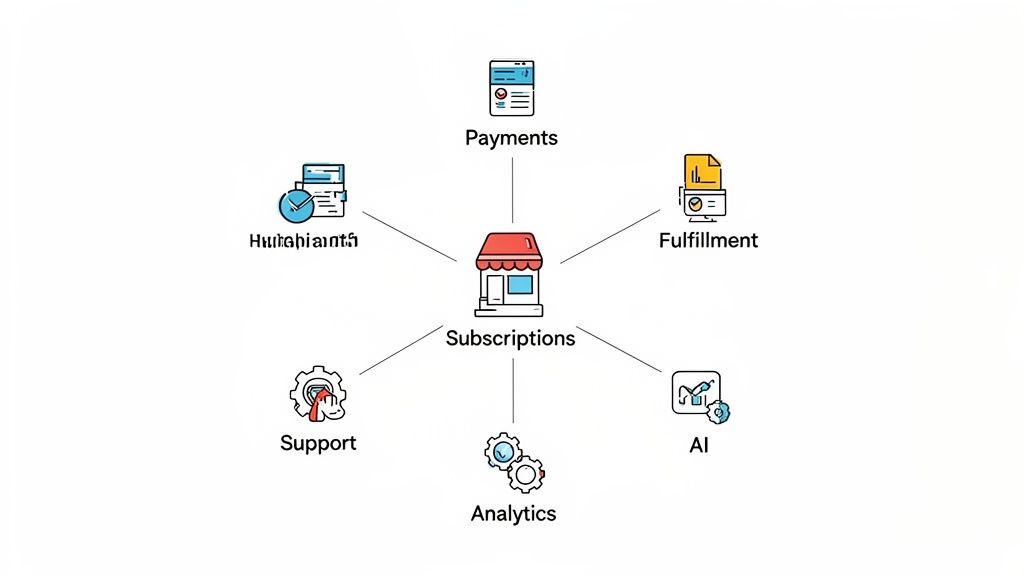
Your subscription service shouldn't be a lonely island. For it to truly work, it needs to be the central hub of your business, deeply connected to every other moving part. A disconnected setup is a recipe for manual data entry, fulfillment headaches, and frustrated customers—all things that quietly eat away at your bottom line.
Building an integrated ecosystem simply means your Shopify subscription services platform can talk to all your other tools without a hitch. This creates a smooth, automated workflow that makes life easier for your team and, more importantly, your subscribers. When data flows freely, you cut out costly mistakes and give your team the breathing room to focus on growing the business.
Core System Integrations
Let's start with the basics. There are a few non-negotiable connections every subscription business needs to have locked down. These are the foundations of an operation that can actually scale.
- Payment Gateways: This one’s the most obvious. Your subscription app or custom API has to securely talk to processors like Shopify Payments to handle recurring payments on Shopify. A seamless connection here is also crucial for dunning management, which is how you recover revenue from failed payments.
- Fulfillment and Shipping: Your subscription tool needs to instantly signal your fulfillment partner or 3PL about what to ship, who gets it, and when. This automation stops delays dead in their tracks and ensures subscribers get their orders like clockwork—a massive part of a positive customer experience.
- Customer Support Platforms: When you link your subscription data to a helpdesk like Gorgias or Zendesk, your support team gets the full picture. They can instantly see order history, manage a customer's subscription, and solve problems without juggling a dozen different tabs.
The sheer scale of Shopify’s platform—which saw $292 billion in GMV in 2024—shows just how critical this level of integration is. With mobile commerce accounting for 79% of traffic, a frictionless, connected experience is no longer a nice-to-have; it's essential for keeping customers in this massive market.
Future-Proofing with Advanced Integrations
Once you've nailed the fundamentals, it's time to look ahead. The most innovative brands are already connecting their subscription services to more advanced tools. This is where you can carve out a real competitive edge.
An integrated ecosystem doesn't just manage your current operations; it unlocks future growth by turning data into actionable intelligence. Every connected tool adds another layer of insight you can use to improve your service.
Think about plugging in AI-powered tools for things like:
- Predictive Churn Analysis: These tools can analyze subscriber behavior to flag customers who are about to cancel. This gives you a chance to step in with a special offer or a personal check-in to win them back.
- Hyper-Personalization: By integrating with your CRM and email platform, you can use subscription data to send incredibly targeted offers, product recommendations, and content that builds genuine loyalty.
- Automated Support: AI-driven chatbots can handle the common questions that flood your inbox, like "How do I skip my next order?", freeing up your human agents to tackle more complex issues.
Creating this interconnected web of tools transforms your subscription service from a simple billing engine into a powerful, data-rich growth platform that can scale right alongside your business.
How ECORN Delivers High-Growth Shopify Subscription Solutions
Getting a subscription service off the ground is a massive undertaking for any brand. It's easy to get bogged down wondering which app to pick, how to design a compelling offer, or how to move your existing subscribers without causing a complete meltdown. This is exactly where having a strategic partner makes all the difference, turning what feels like a complex mess into a clear road map for growth.
At ECORN, we don't just set up subscription features—we build out entire recurring revenue engines. Think of us as an extension of your team, bringing our expertise in Shopify development, design, and conversion rate optimization (CRO) to the table to build Shopify subscription services that actually hit your goals and resonate with your customers.
Our Flexible Partnership Model
We get that every brand is in a different place. Some are just starting out, others are scaling fast. That’s why we ditched the rigid, one-size-fits-all retainers. Our flexible subscription packages mean you get exactly the help you need, whether it's a one-off project to launch your program or ongoing monthly support to fine-tune and scale it.
This approach gives you a dedicated team of Shopify specialists on tap, without the cost and commitment of hiring an in-house team. It's like having a world-class subscription department ready to go whenever you need them.
Partnering with a specialized agency isn't just about getting it done faster. It’s about having a strategic ally who knows the market, sees roadblocks before you do, and gives you the guidance to stay ahead of the curve.
From Strategy to Scale: A Proven Process
Our process is all about delivering real, tangible results. We don't do guesswork. We use data and proven methods to build, launch, and grow your subscription program, covering every single touchpoint that matters.
How We Drive Growth:
- Deep Discovery and Strategy: We kick things off by digging into your products, your customers, and your business goals. This helps us nail down a subscription model and pricing strategy that makes sense and offers real value.
- Expert Development and Implementation: Whether you need a slick app configuration or a completely custom build using the Shopify Billing API on Shopify Plus, our developers make sure your technical setup is solid, scalable, and totally seamless for your customers.
- Targeted Conversion Rate Optimization: A successful launch is only the first step. We keep a close eye on user behavior, running targeted A/B tests on your subscription funnel to get more people signing up and to remove any friction in the process.
- Ongoing Optimization and Support: We monitor your key metrics, handle integrations, and offer strategic advice to bring down churn, boost customer lifetime value, and make sure your program stays healthy for the long haul.
Real-World Results
Our approach gets results you can measure. For one wellness brand, we completely overhauled their subscription portal and ran a few A/B tests on their offer. The outcome? A 40% jump in new subscription sign-ups in just three months.
Another client, a fast-growing CPG company, was getting crushed by high app fees and clunky operations. We managed their migration to a custom Shopify Billing API solution. Not only did this give them total control over their design, but it also slashed their operational costs by 25% by getting rid of transaction fees and automating fulfillment.
If these challenges sound familiar and you're ready to build up your recurring revenue, our partnership model might be the perfect fit. We bring the expertise, tools, and strategic eye to help you build one of the top Shopify subscription services in your niche.
Your Top Shopify Subscription Questions, Answered
Once you've wrapped your head around the strategy and technical side of things, the practical questions start popping up. We get it. Putting theory into practice brings up a whole new set of challenges. Here are some of the most common questions we hear from brands getting ready to launch or level up their subscription program.
Can I Migrate My Existing Subscribers to Shopify?
Absolutely, but this isn't something to rush. Migrating your subscribers requires careful planning and a steady hand. The basic process involves exporting all your subscriber data—and most importantly, their payment tokens—from your current platform. That data then gets imported into your new Shopify subscription app or custom API setup.
Most of the big-name apps, like Recharge, have dedicated tools and support teams to help you with this. If you've gone the custom route, this will be a job for your developers.
The single most critical piece of the puzzle is working with your payment gateway to transfer those payment tokens securely. Get this wrong, and you'll face a wave of failed payments, disrupted billing, and a catastrophic loss of subscribers.
What Are the Most Common Reasons for High Subscription Churn?
When you see a high churn rate, the causes almost always fall into two buckets. You need to understand both to keep your subscribers happy and your revenue predictable.
- Involuntary Churn: This is the churn that sneaks up on you. It’s caused by failed payments, usually from something as simple as an expired credit card or insufficient funds. Your best defense is a solid dunning management system that automatically retries payments and sends out smart notifications to customers.
- Voluntary Churn: This is when a customer makes the conscious decision to cancel. The biggest culprits are a perceived lack of value, a clunky customer portal that’s a pain to manage, or just plain old product fatigue. We also see churn spike from inflexible delivery options (like not being able to skip a shipment) or a cancellation process that feels like a trap.
There's no shortcut here. Regularly digging into why customers are leaving is the only real way to patch the leaks and reduce voluntary churn.
How Much Does It Cost to Set Up Subscriptions on Shopify?
The investment needed to get Shopify subscription services running can vary wildly depending on which path you take.
For most businesses, using a third-party app is the quickest and most affordable entry point. You're typically looking at a monthly fee, often between $50-$100, plus a small transaction fee on each subscription order, which usually hovers around 1-2%.
On the other hand, building a custom solution on Shopify Plus with the Shopify Billing API comes with a significant upfront development cost. This can range anywhere from $15,000 to over $50,000, based on how complex your needs are. The big trade-off? It completely eliminates those app-related transaction fees, making it a much more cost-effective model for brands doing serious volume.
Ready to build a high-growth subscription program without the guesswork? ECORN offers flexible subscription packages blending expert design, development, and CRO to scale your recurring revenue. Explore our Shopify solutions and see how we can help your brand grow.


How to Launch a Box Subscription Business in 2026

Luxury Skincare Branding Playbook That Converters
10 Best Podcast Ecommerce Shows for Store Growth in 2026
Shopify Developer Hourly Rate: What to Pay in 2026
Critical Shopify Setup Errors That Are Secretly Sabotaging Your Store
Ecommerce Conversion Tracking: The Complete How-To Guide

Shopify Design Agency: How to Pick the Right Partner
Mastering Multi Store Management on Shopify
Scale Shopify Store
10 Shopify App Ideas Worth Building in 2026
Conversion Rate Optimization for Landing Pages: The Playbook
Shopify Plus Automation: A Guide for 2026
10 Social Selling Platforms for Shopify Merchants

Shopify Website Design Examples: 7 Stores Worth Studying
7 Ecommerce Newsletter Examples for Shopify Brands
One Product Shopify Store: Build and Scale
Mobile Pop Up Strategy for Shopify Stores That Converts

Sitemap for Shopify: How to Find, Optimize, and Submit It

7 Single Product Websites Worth Emulating
Product Variants Shopify: The Complete 2026 Guide
Ecommerce Analytics Consulting for Growth
What Is AI Integration for eCommerce
How to Choose the Right eCommerce Website Development Firm
E Business Strategy Implementation
Conversion Tracking Setup for Shopify Stores
BigCommerce vs Shopify Plus Which Enterprise Wins in 2026
Shopify Theme Kit: Setup, Commands, and Migration Guide
Shopify Extension Development: A Practical 2026 Guide
Shopify Speed Score Explained and How to Improve It
Shopify Mobile Optimization: The 2026 Playbook
How to Add Subcategory in Shopify for Better UX
How to Implement Structured Data for Ecommerce in 2026
SEO App Mobile: Shopify Store Optimization Guide

Shopify Plus Support: What It Includes and How to Choose

Google Ads for Shopify: The Complete 2026 Playbook

Shopify New York: How to Find and Hire the Right Agency

Google Search Console for Shopify: The Complete Setup
First Party Data Collection for eCommerce Growth
FAQ Online Store Guide: Build and Measure It Right
Do FB Ads Work for eCommerce in 2026?

One Page Checkout for Shopify: Design and Implementation
Shopify GraphQL vs REST: The 2026 Developer Decision
Shopify Ecommerce Consulting: Strategy, Pricing &

Are Reddit Ads Worth It for eCommerce Brands

Shopify Title and Meta Description: A Practical 2026 Guide

Product Video Best Practices for Shopify Brands
Real-Time Inventory Management: A 2026 Guide
AI Chatbot Integration for Shopify Stores
Affiliate Program Management: A Shopify Guide
10 Best Performance Monitoring Tools for Shopify in 2026
Digital Asset Management for eCommerce Brands in 2026
Every Type of Facebook Ads Explained for eCommerce Growth
Product Information Management Explained for Shopify Brands
Support Ticket System: A Guide for Shopify Stores

10 Best Customer Service Tools for Shopify in 2026

Can I Start a Business with No Money? a 2026 Blueprint

What Sells Good on Etsy: Best Niches for 2026

Shopify Add to Cart Button: A Practical 2026 Guide

Customer Feedback Automation: A Practical eCommerce Guide
Critical Rendering Path: A Guide for Shopify Stores

How to Promote on TikTok for eCommerce in 2026

B2B eCommerce Consulting That Drives Real Revenue
10 Best Practices for Site Navigation in 2026
Return vs Refund for Shopify Stores: A Practical Guide
What Is Customer Lifetime Value and Why It Matters
What Is Voice of Customer Research for eCommerce

SMS Marketing for Ecommerce That Actually Converts

Master How to Improve Email Deliverability in 2026

Top 8 eCommerce Partners NYC for Shopify Brands in 2026
Machine Learning for Ecommerce: Boost Your Shopify Store

Beauty Market Research: Your 2026 Growth Guide

Shopify International Expansion: A 2026 Roadmap

What Does CRO Stand for in Business: Understanding CRO

Shopify Visual Merchandising: A Playbook for Higher Sales

Shopify Landing Page Design: Master Conversion in 2026
10 Best AI SEO Optimization Tools for Shopify in 2026

Agentic AI for Ecommerce: Boost Your Sales in 2026
Mastering Email Marketing Data for eCommerce Growth

Conversion Rate Optimisation Australia: Boost Your Sales
Conversion Rate Optimization AI: Your Shopify Store Guide

10 Product Bundling Strategies for Shopify in 2026
How to Increase Customer Lifetime Value: A Shopify Playbook
AI Customer Service Automation: Shopify Guide 2026

Clean Website Design: A Shopify Conversion Playbook

Omnichannel Retail Strategy: A Shopify Playbook
Product Data Enrichment: A Guide for Shopify Brands
Instagram Shopping Features a Guide for Shopify Stores
What Is Revenue Optimization: A Holistic RevOps Guide

Benefits of Conversion Rate Optimization: Boost Your
WordPress to Shopify Migration: Your 2026 Seamless Switch
Boost Sales: Ecommerce Payment Processing Guide 2026
Unified Commerce Platform: Benefits, KPIs & Shopify Guide
How to Reduce Bounce Rate eCommerce: Your 2026 Guide
Shopify API Integration: A Practical End-to-End Guide

How to Implement Data Governance: A 2026 Guide
Shopify Store Development Cost: A 2026 Breakdown
What Is Server Side Tracking: The Shopify Guide 2026
Marketing Automation Workflows: A Shopify Guide for 2026

Shopify: How to Reduce Technical Debt

Shopify UX Design Change: A Playbook for Growth


newsletter in your inbox