


Navigating social media advertising can feel like shouting into a void. Hitting the "boost post" button and hoping for the best is a common, yet often ineffective, strategy that burns through budgets with little to show for it. True growth requires a more deliberate approach, one that connects with customers, builds brand loyalty, and directly drives sales. This guide is your playbook for exactly that. We've compiled a definitive list of social media advertising ideas specifically curated for ambitious eCommerce brands ready to move beyond basic tactics and achieve meaningful results.
Forget generic advice and surface-level tips. Here, you'll find ten actionable blueprints designed to turn your ad spend into a powerful growth engine. Each strategy is broken down into a practical framework, covering everything from creative direction and platform-specific setups to precise audience targeting. We’ll explore how to turn customer content into your most convincing ads, use AI for sharp personalization, and craft offers that create genuine urgency.
This isn't just a list of what's possible; it's a step-by-step manual for implementation. For each idea, you’ll get:
- Platform-specific recommendations for Facebook, Instagram, TikTok, and more.
- Targeting suggestions to reach high-intent shoppers.
- Key Performance Indicator (KPI) targets to measure success accurately.
- Creative examples and A/B testing ideas to continuously optimize your campaigns.
The goal is simple: to provide you with a strategic arsenal of proven social media advertising ideas that you can deploy immediately. Let's get started.
1. Shoppable Posts and In-Feed Shopping
One of the most effective social media advertising ideas for eCommerce brands is collapsing the path to purchase with shoppable posts. This feature allows customers to browse and buy products directly within their social media feed on platforms like Instagram, Facebook, Pinterest, and TikTok, eliminating the need to click away to a separate website. This seamless experience drastically reduces friction, capturing impulse buys and leading to higher conversion rates.

By transforming your social feed into a direct sales channel, you meet customers where they are already spending their time. This is particularly powerful for visually driven products. For example, D2C fashion brands often see a 3-5x ROI from Instagram Shopping, while home goods retailers on Pinterest have driven over 40% of their website traffic from shoppable pins. The rise of TikTok Shop has also opened new avenues for viral product launches, creating a direct link between entertainment and commerce. To get started with this format, you can find a comprehensive guide on integrating TikTok Shop with Shopify.
How to Implement Shoppable Posts Effectively
- Prioritize Visual Quality: Use high-resolution, lifestyle photos that show your product in action. To truly make your shoppable posts stand out and drive conversions, compelling visual content is key. For apparel, tools like an AI ghost mannequin generator can help create professional, consistent product imagery efficiently.
- Maximize Product Tagging: Don't just tag one item. Create a mini-catalog within a single post by tagging multiple products (up to 20 on some platforms) to encourage broader discovery.
- Use User-Generated Content (UGC): Feature photos from real customers in your shoppable posts. This builds authenticity and social proof, making potential buyers more confident in their purchase.
- A/B Test Your Creatives: Experiment with different product image styles, captions, and the placement of product tags within an image. Monitor which products get the most taps and sales to inform your future content strategy.
2. Performance-Based Dynamic Retargeting Ads
One of the most powerful social media advertising ideas for recovering lost sales is performance-based dynamic retargeting. This strategy uses pixel data from your Shopify store to automatically show personalized ads to users who have already visited your site. The ads are dynamically populated with the exact products a user viewed, added to their cart, or engaged with, creating a highly relevant and timely reminder that encourages them to complete their purchase.
This approach is extremely effective because it targets warm audiences who have already shown interest in your brand. By serving them an ad for a product they recognize, you dramatically increase the likelihood of conversion. For example, many Shopify Plus brands see a 4-6x ROAS just from retargeting cart abandoners. Even smaller brands can often recover $0.30-$0.40 for every dollar of ad spend on these campaigns. By using sequential messaging (e.g., showing a product view ad, then a cart abandonment ad, followed by a small discount), fashion retailers have achieved recovery rates as high as 25%.
How to Implement Dynamic Retargeting Ads Effectively
- Ensure Proper Pixel Setup: Before launching any retargeting ads, confirm your Meta Pixel (for Facebook/Instagram) or TikTok Pixel is correctly installed on your Shopify store and tracking key events like
ViewContent,AddToCart, andPurchase. - Segment Your Audiences: Don't treat all visitors the same. Create distinct audience segments based on behavior, such as "viewed a product but didn't add to cart," "abandoned cart," and "past purchasers" (for cross-selling).
- Cap Ad Frequency: To avoid annoying potential customers, use frequency capping. Showing the same ad too many times leads to ad fatigue and negative brand perception. A good starting point is a cap of 3-5 impressions per user over a 7-day period.
- A/B Test Your Offer: Experiment with different ad copy and incentives. Test a direct discount offer ("10% off to complete your order!") against messaging that uses social proof ("This is a customer favorite! Don't miss out.").
- Monitor Platform Performance: Pay close attention to conversion rates on iOS versus Android. Due to privacy changes, performance can differ significantly, so you may need to adjust your budget allocation accordingly.
- Create a Multi-Channel Approach: Combine your social media retargeting ads with an email retargeting sequence. This integrated strategy reaches users on multiple fronts and reinforces your message, significantly improving recovery rates.
3. User-Generated Content (UGC) Campaigns
One of the most powerful social media advertising ideas involves turning your customers into your best marketers. User-Generated Content (UGC) campaigns encourage your audience to create and share content featuring your products, which you can then repurpose in paid advertising. Ads that feature real customers are often perceived as more authentic and trustworthy, leading to significantly higher engagement and conversion rates compared to polished, brand-created content.

By amplifying genuine customer voices, you build a powerful layer of social proof directly into your ad strategy. Brands like Glossier have perfected this with their #GlossierIRL campaign, generating thousands of user posts monthly. Similarly, athletic apparel brand Gymshark’s community-driven content now makes up over 60% of its paid ad library. Footwear company Allbirds saw a 40% higher conversion rate by using customer unboxing videos in their ads. To fully amplify your campaign's reach, understanding the many User Generated Content Benefits is crucial for building a successful strategy around these authentic recommendations.
How to Implement UGC Campaigns Effectively
- Create a Clear Hashtag and Promotion: Develop a simple, memorable hashtag for your campaign. Clearly communicate the rules for participation and promote the campaign across all your channels, including your email list and website.
- Incentivize Participation: Encourage submissions by offering rewards. This could be anything from a discount code, a chance to be featured on your page, or entry into a contest for a larger prize.
- Obtain Proper Usage Rights: Before using a customer's content in a paid ad, you must get their explicit permission. A simple direct message asking for consent and outlining how you'll use the content is often sufficient, but for larger campaigns, a formal rights agreement is best.
- Test Different UGC Formats: Don't limit yourself to just photos. Experiment with video testimonials, unboxing clips, and "how-to" style content from customers in your ad creatives. A/B test these different formats to see which one resonates most with your target audience and drives the best results.
4. Influencer and Micro-Influencer Partnerships
Collaborating with influencers gives brands direct access to established, engaged, and niche audiences. This social media advertising idea moves beyond traditional ads by using the voice of a trusted creator to build brand credibility and drive sales. Partnerships can be arranged as sponsored posts, affiliate marketing programs, or by providing exclusive discount codes for clear, trackable attribution. This strategy is about borrowing trust from creators who have already earned it.
By aligning with the right creators, brands can achieve incredible results. Fashion Nova famously generates an estimated 70% of its revenue through influencer partnerships, while Skims has leveraged major celebrity collaborations to reach a valuation of over $2 billion. For emerging brands, the success of Halo Beauty's launch, which involved over 200 micro-influencers, demonstrates the power of a scaled, niche-focused approach.
How to Implement Influencer Partnerships Effectively
- Prioritize Micro-Influencers: For many brands, especially those just starting out, micro-influencers (5K-50K followers) offer a better return on investment. They typically have higher engagement rates and a more dedicated, niche following at a more accessible cost.
- Use Unique Discount Codes: Provide each influencer with a unique, trackable discount code or affiliate link. This is the simplest way to measure direct sales and calculate the ROI of each individual partnership.
- Allow Creative Freedom: While you should provide clear brand guidelines and key messaging points, give influencers the creative freedom to produce content that feels authentic to their audience. Forced, overly-scripted content often performs poorly.
- Audit Follower Authenticity: Before committing to a partnership, use tools like HypeAuditor to check for fake followers and engagement. A high follower count is meaningless if the audience isn't real.
- Negotiate Long-Term Relationships: Building long-term relationships with a select group of creators is often more effective than one-off sponsored posts. This builds deeper brand association and allows for more authentic storytelling over time.
5. Video Ads and Short-Form Content Strategy
Video advertising, particularly short-form content between 15 and 60 seconds, consistently produces higher engagement than static images. For eCommerce brands, video is an excellent medium to showcase product benefits, demonstrate practical use cases, and build a stronger emotional connection with an audience. This format moves beyond simple product features to tell a story, making it one of the most powerful social media advertising ideas available.
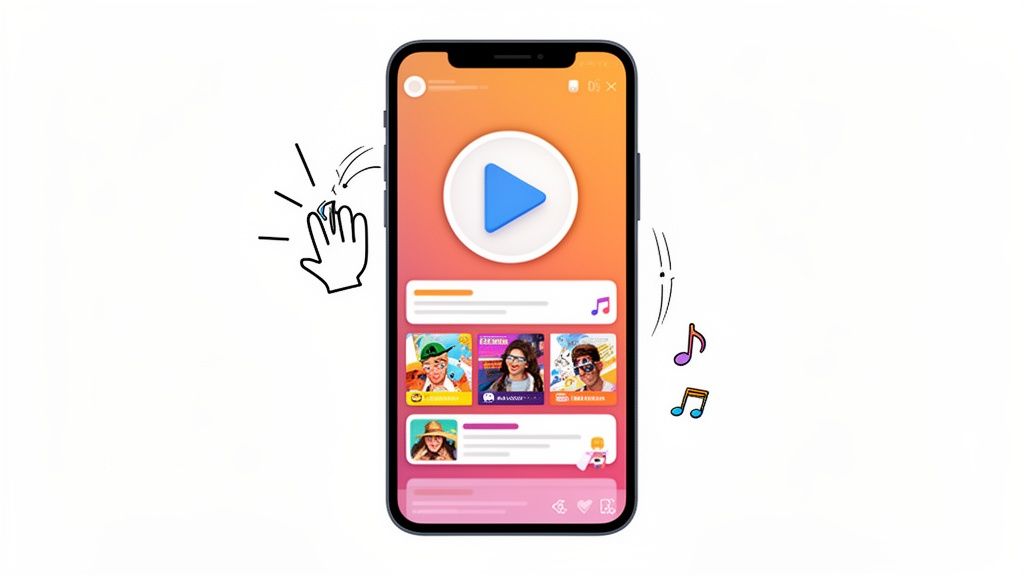
The impact of a strong video strategy is undeniable. For instance, Dollar Shave Club's original viral video kickstarted its entire brand, gaining over 12 million views and proving that creative video can launch a business. More recently, TikTok Shop sellers regularly report a 5-10x ROI on well-executed video ads, while brands like Liquid Death have built a cult following using witty, short-form content. These examples show how video can drive direct sales and build long-term brand equity simultaneously.
How to Implement Video Ads Effectively
- Hook Viewers Immediately: The first three seconds are critical. Start with a compelling visual, a surprising statement, or a relatable problem to stop the scroll and capture attention.
- Shoot for Vertical: Always create content in a 9:16 aspect ratio. This native format is essential for platforms like TikTok, Instagram Reels, and YouTube Shorts, where it fills the entire screen for an immersive experience.
- Design for Sound-Off Viewing: A large percentage of users watch videos without sound. Include clear, concise captions and text overlays to ensure your message is understood even when muted.
- Focus on Benefits, Not Just Features: Instead of listing specs, show how your product solves a problem or improves a customer's life. A demonstration is far more persuasive than a description.
- Use Trending Sounds: Incorporate trending audio and music to increase your video's visibility. The algorithms on platforms like TikTok and Reels often prioritize content that uses popular sounds.
- Embrace Authentic Content: Don't overthink production quality. Often, authentic, lower-production-value videos shot on a smartphone can feel more genuine and achieve higher engagement than polished, corporate-style ads.
6. Community Building and Social Commerce Groups
Moving beyond one-off transactions, another powerful social media advertising idea is to foster a dedicated brand community. Creating or engaging with private groups on platforms like Facebook or Geneva allows you to build a loyal audience that generates significantly higher lifetime value. These communities act as a direct channel for customer feedback, peer-to-peer recommendations, and authentic brand advocacy, turning customers into passionate ambassadors.
This strategy transforms marketing from a monologue into a dialogue. Instead of just pushing ads, you create a space where your most engaged customers can connect, share experiences, and feel a sense of belonging. For example, Peloton's community-driven engagement creates fierce loyalty, while The Sill's plant-loving community members show a 3x higher repeat purchase rate. These groups aren't just for support; they are engines for social commerce, driving organic sales through trust and shared enthusiasm.
How to Implement Community Building Effectively
- Offer Exclusive Benefits: Seed your community by providing members-only perks like early access to new products, exclusive discounts, or behind-the-scenes content. This initial value exchange incentivizes sign-ups.
- Encourage Peer-to-Peer Interaction: Design prompts and activities that encourage members to talk to each other, not just to your brand. Feature member stories, testimonials, and user-generated content to make them the heroes.
- Host Valuable Live Events: Go beyond product pitches. Host live Q&As with your team, educational workshops related to your niche, or interactive "ask me anything" sessions to provide real, tangible value.
- Maintain Clear Guidelines and Moderation: A safe and positive environment is essential. Establish clear community rules from the start and actively moderate conversations to prevent spam and negativity, ensuring the space remains welcoming.
- Segment for Targeted Offers: As your community grows, segment members based on their interests, purchase history, or engagement level. This allows you to create highly targeted offers and content that resonates more deeply.
7. AI-Powered Personalization and Smart Bidding
Moving beyond manual campaign management, one of the most potent social media advertising ideas involves using AI and machine learning for real-time personalization and automated bid optimization. This approach allows advertising platforms to analyze vast amounts of user behavior and contextual data, delivering individualized messaging and adjusting ad spend automatically. The result is improved efficiency, lower costs, and a higher return on investment (ROI) by letting algorithms make thousands of micro-decisions per second.
This method shifts the advertiser's role from a hands-on tactician to a strategic overseer. Instead of constantly tweaking bids and audiences, you feed the AI the right creative assets, conversion goals, and budget, then let it find the most profitable path to your customers. Brands using Meta's Advantage+ campaigns, for example, often report a 30-40% lower cost per conversion, while Google Performance Max campaigns can generate 15-25% more conversions at the same ROAS. For more in-depth strategies, explore these real-world AI personalization examples in eCommerce.
How to Implement AI-Powered Advertising Effectively
- Ensure Clean Data Inputs: Before activating AI features, confirm your tracking pixels (like the Meta Pixel) and conversion events are set up correctly. The algorithm's performance is entirely dependent on the quality and volume of the data it receives. Aim for at least 50 conversions per month to give the system enough data to learn effectively.
- Let the Algorithm Learn: Resist the urge to make major changes in the first two to three weeks after launching an AI-driven campaign. These systems need time to exit the "learning phase" and gather enough data to stabilize and optimize performance.
- Combine AI with Strategic Insights: Don't treat AI optimization as a complete replacement for human strategy. Use the performance insights from your AI campaigns to inform your creative direction and messaging. If the algorithm favors a specific ad angle or image, double down on that theme in your next creative refresh.
- Monitor for Algorithm Drift: Periodically check your campaign performance to ensure it still aligns with your core business goals. If performance starts to decline or shift in an undesirable direction, it might be time to reset the campaign or adjust your conversion goals to re-calibrate the algorithm.
8. Carousel and Collection Ads with Multiple Product Storytelling
Carousel and collection ads are powerful social media advertising ideas that allow brands to display multiple products or tell a sequential story within a single, interactive unit. Instead of relying on one static image, you can guide users through a series of cards, each with its own image, headline, and link. This format is excellent for increasing engagement and enabling multi-product discovery before users even reach your store.
This approach moves beyond a single product focus, letting you cross-sell, bundle items, or detail multiple features of a hero product. For example, Everlane's multi-product carousel ads have been shown to drive a 40% higher Average Order Value (AOV) by showcasing complementary items. Similarly, ASOS used collection ads to increase their browse-to-purchase conversion by 35%, creating a mini-storefront experience directly in the feed. Many Shopify stores have reported achieving a 50% lower Customer Acquisition Cost (CAC) by using carousels to tell a compelling brand or product story.
How to Implement Carousel and Collection Ads Effectively
- Lead with Your Best Performer: Place your most popular or visually striking product in the first card. This initial impression is crucial for stopping the scroll and encouraging users to swipe through the rest of the ad.
- Tell a Cohesive Story: Use the cards sequentially to narrate a story. This could be a problem-solution-result arc, a step-by-step "how-to" guide, or a showcase of different product use cases. Ensure a consistent aesthetic and branding across all cards.
- Write Compelling Copy for Each Card: Don't just rely on the images. Each carousel card is an opportunity to highlight a unique benefit, feature, or call-to-action. Treat each card as a mini-ad.
- Test Your Sequencing: Experiment with the order of your cards. A/B test a sequence that starts with your best-seller against one that builds curiosity by saving the main product for a later card.
- Optimize Card by Card: Monitor the performance of each card position. Platforms like Facebook Ads Manager provide breakdowns of clicks and engagement per card, allowing you to remove underperformers and refine your sequence.
9. Lookalike and Custom Audience Targeting Strategies
Moving beyond broad demographic targeting is one of the most powerful social media advertising ideas for scaling your brand profitably. Advanced audience strategies, specifically Lookalike and Custom Audiences, allow you to reach high-intent prospects who mirror the behavior and characteristics of your most valuable existing customers. A Custom Audience lets you retarget people who have already interacted with your brand, while a Lookalike Audience finds new people who are statistically similar to a source audience you provide.
This method moves your advertising from guesswork to data-driven precision. Instead of hoping your ads find the right people, you're using your own customer data to build a roadmap for platforms like Meta and TikTok to follow. Luxury brands often see impressive results by creating 1% Lookalike Audiences based on their high-AOV customer profiles, achieving a 2-3x return on ad spend. Emerging brands can confidently scale their ad spend, sometimes dedicating up to 40% of their budget to Lookalike campaigns once they find a winning formula.
How to Implement Lookalike and Custom Audiences Effectively
- Build from Your Best Customers: Don't create Lookalikes from your entire customer list. Instead, build your source audience from a segment of high-LTV (lifetime value) or repeat purchasers. This focuses the algorithm on finding prospects who are more likely to become loyal, high-value customers.
- Test Different Similarity Levels: Start by testing 1%, 2%, and 5% Lookalike audiences in separate ad sets. A 1% Lookalike is the most similar to your source audience and is best for maximizing efficiency and ROAS. A 5% Lookalike is a broader audience, which is useful for scaling campaigns and increasing reach once you have proven the concept.
- Refresh Audiences Regularly: Your customer base is always changing. Refresh your source lists and rebuild your Lookalike audiences at least monthly to ensure your targeting remains accurate and incorporates your newest, most relevant customer data.
- Use Strategic Exclusions: Always exclude your existing customer lists and email subscribers from your Lookalike prospecting campaigns. This prevents you from wasting ad spend on people who have already converted and avoids showing acquisition-focused ads to your loyal customers.
10. Limited-Time Offer and Urgency-Driven Campaigns
One of the most powerful social media advertising ideas for generating immediate sales is creating a sense of urgency. Limited-time offers (LTOs) and flash sales tap into the psychological principle of scarcity and Fear Of Missing Out (FOMO), compelling customers to act now rather than later. By setting a clear deadline or quantity limit, you shorten the consideration phase and push shoppers to make a decision, which is ideal for boosting short-term revenue.
This tactic works because it interrupts passive scrolling with a compelling, time-sensitive reason to engage. For example, a 24-hour flash sale can generate a 50% lift in conversion rates compared to standard promotions. Brands often see their highest revenue days during planned urgency events like Black Friday and Cyber Monday, where campaigns can produce 3-5x their normal daily sales. These campaigns create a direct path from discovery to purchase by removing the "I'll think about it" option.
How to Implement Urgency-Driven Campaigns Effectively
- Time Promotions Strategically: Align your offers with natural buying cycles such as holidays, back-to-school season, or even paydays. This ensures your message reaches an audience that is already in a buying mindset.
- Use Visible Countdown Timers: Integrate countdown timers directly into your social media ad creative (e.g., in Instagram Stories) and on the corresponding landing page. This visual cue constantly reinforces the urgency.
- Communicate Limitations Clearly: Be explicit about the offer's constraints. State the exact end date and time, mention if stock is limited, and list any product exclusions. Vague terms like "for a limited time" are less effective than "ends at midnight."
- Create Dedicated Landing Pages: Send traffic from your ads to a specific landing page that features the sale items, the offer details, and the countdown timer. Directing users to a generic homepage adds friction and dilutes the campaign's impact.
- Segment Your Offers: Test different promotions for different audience segments. For instance, offer a "15% Off Your First Order" deal to new customers and a "Free Gift with Purchase" incentive to loyal, previous buyers.
10-Point Comparison of Social Media Advertising Ideas
From Ideas to Implementation: Your Next Steps to Advertising Mastery
You now have a powerful arsenal of social media advertising ideas, each with the potential to significantly boost your brand's performance. The journey from simply knowing these strategies to seeing them drive real-world results, however, depends entirely on disciplined execution. This guide was built to be more than just inspiration; it's a practical blueprint for action.
We've covered a wide spectrum of approaches, from the foundational power of Dynamic Retargeting to recapture lost sales, to the community-centric pull of UGC Campaigns and Social Commerce Groups. You've seen how to craft compelling narratives with Carousel Ads and how to use the precision of Lookalike Audiences to find new customers who mirror your best ones. The key takeaway is that a one-size-fits-all ad strategy no longer cuts it. Success lies in a blended, intentional approach that matches the right tactic to the right business goal.
Bridging the Gap Between Concept and Conversion
The most common point of failure for growing brands isn't a lack of ideas, but a paralysis of choice. Staring at ten distinct strategies can be overwhelming. The secret is to start small and build momentum. Don't attempt to launch everything at once. Instead, adopt a methodical, data-driven mindset.
Here is your immediate action plan:
Identify Your Primary Goal: What is the single most important objective for your business right now? Is it driving top-of-funnel awareness, increasing customer lifetime value (LTV), or simply boosting your return on ad spend (ROAS)? Your answer will point you to the most relevant ideas from this list.
- For Acquisition: Focus on Lookalike Audiences and Influencer Partnerships.
- For Retargeting & ROI: Prioritize Dynamic Retargeting and Limited-Time Offers.
- For Brand Building & Engagement: Start with UGC Campaigns and Video Ads.
Select Your First Test: Choose just one or two strategies that directly align with your primary goal. For instance, if your abandoned cart rate is high, implementing a performance-based dynamic retargeting campaign is a logical first step. If your creative feels stale, a UGC campaign could provide a fresh injection of authentic content.
Define and Measure Success: Before you spend a single dollar, establish what success looks like. What Key Performance Indicators (KPIs) matter most for this specific campaign? For a video ad, it might be View-Through Rate (VTR). For a collection ad, it's Click-Through Rate (CTR) and Add-to-Carts. Set clear targets and use platform-native analytics and your own reporting tools to track performance meticulously.
Iterate Relentlessly: Your first attempt will rarely be your best. The core of mastering these social media advertising ideas is continuous A/B testing. Test different ad copy, swap out creative assets, adjust your audience targeting, and experiment with calls to action. Let the data guide your every move, turning each campaign into a learning opportunity that sharpens your next one.
The path to advertising mastery is not a sprint; it's a series of well-planned experiments. By systematically testing, measuring, and refining your approach, you move from guessing what works to knowing what works. This iterative process is what separates stagnant brands from market leaders. The concepts are here. The examples are clear. Your next step is to pick a starting point and begin the work.
Ready to turn these ideas into a high-performing advertising machine but need an expert partner to accelerate the process? ECORN specializes in implementing these exact strategies for Shopify brands, pairing deep platform expertise with data-driven creative to deliver scalable growth. Book a free discovery call with ECORN today to see how we can help you execute flawlessly and maximize your return on ad spend.


Shopify Git Integration: A Developer's Guide to 2026
Headless Ecommerce Development Services Explained

How to Build a Shopify Clothing Website That Converts
How to Launch a Box Subscription Business in 2026

Luxury Skincare Branding Playbook That Converters
10 Best Podcast Ecommerce Shows for Store Growth in 2026
Shopify Developer Hourly Rate: What to Pay in 2026
Critical Shopify Setup Errors That Are Secretly Sabotaging Your Store
Ecommerce Conversion Tracking: The Complete How-To Guide
Shopify Design Agency: How to Pick the Right Partner
Mastering Multi Store Management on Shopify
Scale Shopify Store
10 Shopify App Ideas Worth Building in 2026
Conversion Rate Optimization for Landing Pages: The Playbook
Shopify Plus Automation: A Guide for 2026
10 Social Selling Platforms for Shopify Merchants

Shopify Website Design Examples: 7 Stores Worth Studying
7 Ecommerce Newsletter Examples for Shopify Brands
One Product Shopify Store: Build and Scale
Mobile Pop Up Strategy for Shopify Stores That Converts
Sitemap for Shopify: How to Find, Optimize, and Submit It

7 Single Product Websites Worth Emulating
Product Variants Shopify: The Complete 2026 Guide
Ecommerce Analytics Consulting for Growth
What Is AI Integration for eCommerce
How to Choose the Right eCommerce Website Development Firm
E Business Strategy Implementation
Conversion Tracking Setup for Shopify Stores
BigCommerce vs Shopify Plus Which Enterprise Wins in 2026
Shopify Theme Kit: Setup, Commands, and Migration Guide
Shopify Extension Development: A Practical 2026 Guide
Shopify Speed Score Explained and How to Improve It
Shopify Mobile Optimization: The 2026 Playbook
How to Add Subcategory in Shopify for Better UX
How to Implement Structured Data for Ecommerce in 2026
SEO App Mobile: Shopify Store Optimization Guide
Shopify Plus Support: What It Includes and How to Choose
Google Ads for Shopify: The Complete 2026 Playbook
Shopify New York: How to Find and Hire the Right Agency
Google Search Console for Shopify: The Complete Setup
First Party Data Collection for eCommerce Growth
FAQ Online Store Guide: Build and Measure It Right
Do FB Ads Work for eCommerce in 2026?

One Page Checkout for Shopify: Design and Implementation
Shopify GraphQL vs REST: The 2026 Developer Decision
Shopify Ecommerce Consulting: Strategy, Pricing &
Are Reddit Ads Worth It for eCommerce Brands
Shopify Title and Meta Description: A Practical 2026 Guide
Product Video Best Practices for Shopify Brands
Real-Time Inventory Management: A 2026 Guide
AI Chatbot Integration for Shopify Stores
Affiliate Program Management: A Shopify Guide
10 Best Performance Monitoring Tools for Shopify in 2026
Digital Asset Management for eCommerce Brands in 2026
Every Type of Facebook Ads Explained for eCommerce Growth
Product Information Management Explained for Shopify Brands
Support Ticket System: A Guide for Shopify Stores

10 Best Customer Service Tools for Shopify in 2026

Can I Start a Business with No Money? a 2026 Blueprint

What Sells Good on Etsy: Best Niches for 2026

Shopify Add to Cart Button: A Practical 2026 Guide

Customer Feedback Automation: A Practical eCommerce Guide
Critical Rendering Path: A Guide for Shopify Stores

How to Promote on TikTok for eCommerce in 2026

B2B eCommerce Consulting That Drives Real Revenue
10 Best Practices for Site Navigation in 2026
Return vs Refund for Shopify Stores: A Practical Guide

What Is Customer Lifetime Value and Why It Matters
What Is Voice of Customer Research for eCommerce

SMS Marketing for Ecommerce That Actually Converts

Master How to Improve Email Deliverability in 2026
Top 8 eCommerce Partners NYC for Shopify Brands in 2026
Machine Learning for Ecommerce: Boost Your Shopify Store

Beauty Market Research: Your 2026 Growth Guide

Shopify International Expansion: A 2026 Roadmap

What Does CRO Stand for in Business: Understanding CRO

Shopify Visual Merchandising: A Playbook for Higher Sales

Shopify Landing Page Design: Master Conversion in 2026
10 Best AI SEO Optimization Tools for Shopify in 2026

Agentic AI for Ecommerce: Boost Your Sales in 2026
Mastering Email Marketing Data for eCommerce Growth

Conversion Rate Optimisation Australia: Boost Your Sales
Conversion Rate Optimization AI: Your Shopify Store Guide

10 Product Bundling Strategies for Shopify in 2026
How to Increase Customer Lifetime Value: A Shopify Playbook
AI Customer Service Automation: Shopify Guide 2026

Clean Website Design: A Shopify Conversion Playbook

Omnichannel Retail Strategy: A Shopify Playbook
Product Data Enrichment: A Guide for Shopify Brands
Instagram Shopping Features a Guide for Shopify Stores
What Is Revenue Optimization: A Holistic RevOps Guide
Benefits of Conversion Rate Optimization: Boost Your
WordPress to Shopify Migration: Your 2026 Seamless Switch
Boost Sales: Ecommerce Payment Processing Guide 2026
Unified Commerce Platform: Benefits, KPIs & Shopify Guide
How to Reduce Bounce Rate eCommerce: Your 2026 Guide
Shopify API Integration: A Practical End-to-End Guide
How to Implement Data Governance: A 2026 Guide
Shopify Store Development Cost: A 2026 Breakdown
What Is Server Side Tracking: The Shopify Guide 2026


newsletter in your inbox