


For any eCommerce brand, a smart backlinks SEO strategy is the engine that truly drives organic growth. It’s what separates the stores people find and love from the ones that get lost in the digital shuffle. Think of it as earning "votes of confidence" from other websites, each one telling Google your store is a credible, authoritative voice in your niche.
Why Your Backlink Strategy Matters More Than Ever
In the cut-throat world of eCommerce, just having amazing products on your Shopify store isn't enough to get seen. Your backlink strategy is what gets you to the top of Google, right where your customers are searching. Every high-quality link is an endorsement that directly boosts your rankings, traffic, and—most importantly—your sales.
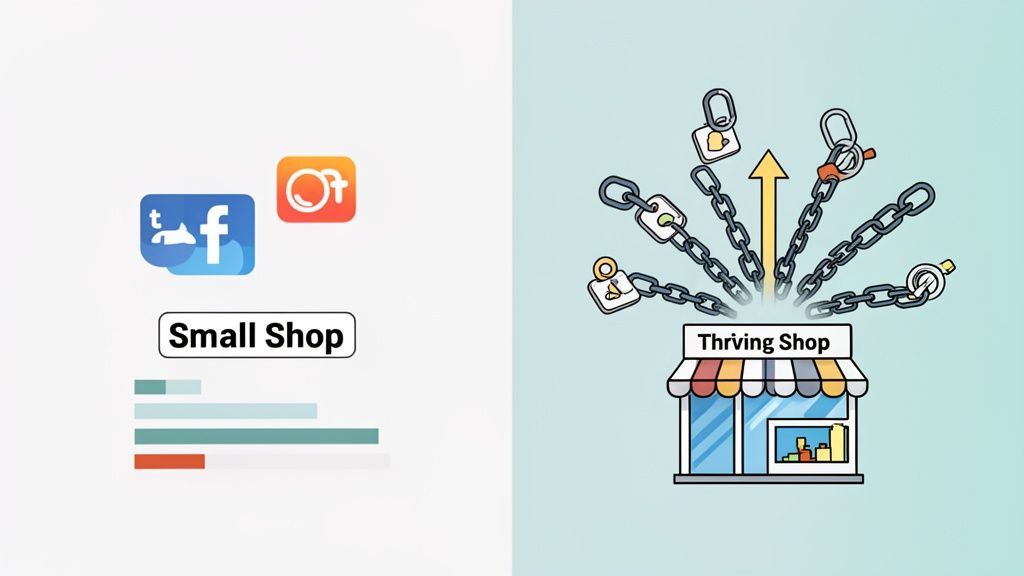
Let’s look at a real-world scenario. Picture two Shopify stores selling in the crowded skincare space.
- Store A throws all its money at paid ads and hopes for some social media buzz. Their organic traffic is totally flat, and they're invisible for money-making keywords like "vegan retinol serum."
- Store B, on the other hand, is strategic about building links. They get their products into the hands of beauty bloggers for reviews, create in-depth skincare guides that health sites start referencing, and team up with complementary wellness brands.
The outcome is predictable. Store B's organic traffic climbs steadily. They start owning the top spots for their most profitable keywords and build a level of brand authority that Store A just can't compete with. This isn't just theory; it's how you build a sustainable business. To get a better handle on where this fits into the bigger picture, it's worth understanding the difference between on-page vs off-page SEO.
The Undeniable Impact of a Strong Backlink Profile
The gap between having a link-building plan and not having one is staggering. The data is clear: backlinks aren't just one piece of the SEO puzzle; they're a cornerstone.
The #1 result in Google has an average of 3.8x more backlinks than the results in positions #2 through #10. This stat alone shows that both the quality and sheer number of links are still absolutely critical for getting to the top.
The flow is simple: good links lead to good outcomes. The difference between a store that actively builds links and one that doesn't is night and day.
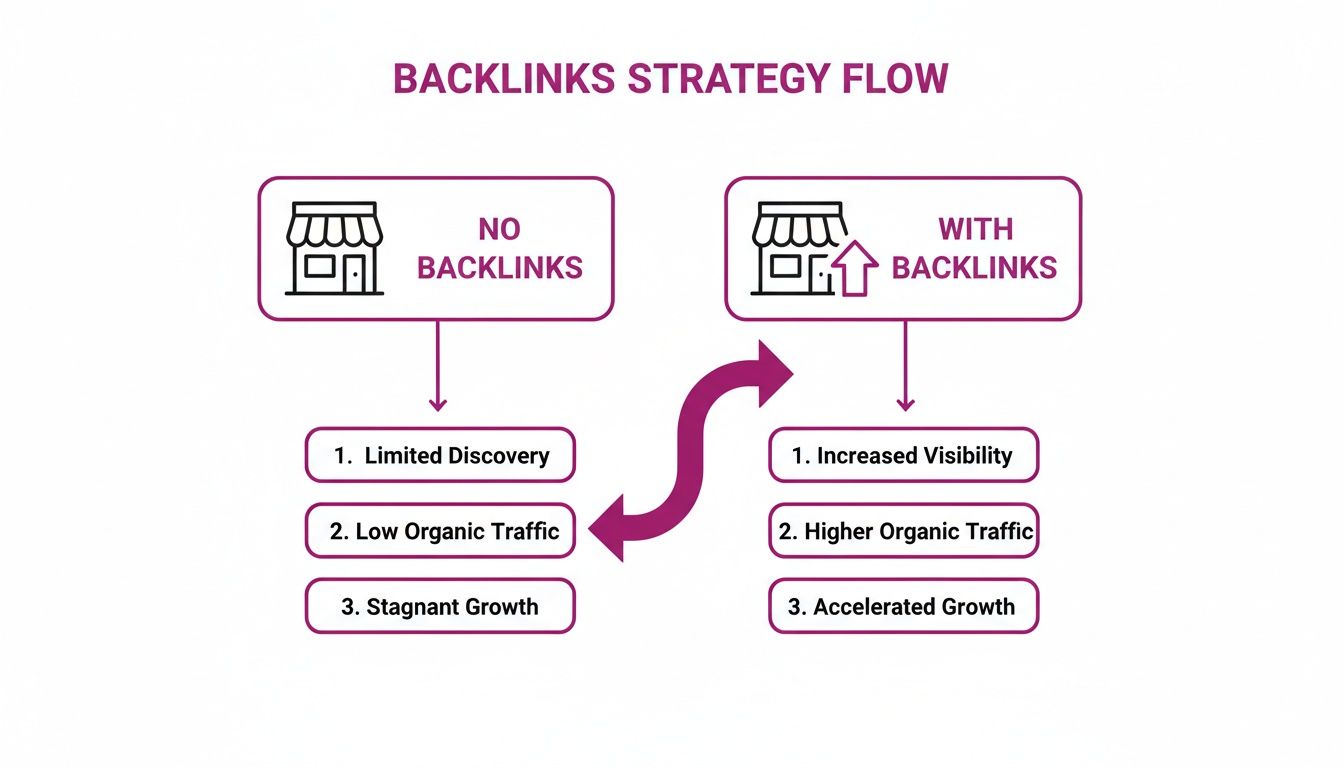
As the visual shows, a deliberate backlink strategy is a direct path to greater authority, more traffic, and real, measurable growth.
A Modern Approach for 2026 and Beyond
Here's the good news: most of your competitors are terrible at this. An incredible 94% of all content online gets zero external links. That means even a handful of genuinely good backlinks can put your Shopify store miles ahead of everyone else.
This guide is all about a modern approach. We're skipping the old, risky tactics and focusing on building real relationships and creating valuable assets that people want to link to. This is how you build a resilient, authoritative brand that doesn't just survive, but thrives for years to come.
Reviewing Your Current Backlink Profile
Before you can build a killer backlink strategy for your Shopify store, you need to know exactly where you stand today. Jumping straight into outreach without this first step is like trying to navigate a new city without a map—you'll be moving, but probably in circles. This initial analysis is all about building that map.
A deep dive into your backlink profile shows you what’s working, what’s not, and what’s secretly hurting you. You’ll uncover powerful links you didn’t know you had and toxic ones that could be holding your rankings back. It’s the difference between guessing and making smart, data-driven decisions.
To get started, you're going to need a professional-grade SEO tool. We live and breathe this stuff, and for our money, you can't go wrong with platforms like Ahrefs or SEMrush. They give you the complete picture of who's linking to you and how much that link is actually worth.
Gathering Your Backlink Data
Once you’re logged into your tool of choice, pop your Shopify store’s URL into its backlink checker. You'll see a dashboard loaded with metrics. It can feel like a lot at first, but we’re just going to focus on a few key areas.
The first thing to look at is the Referring Domains report. Don't get distracted by the total number of backlinks. A thousand links from one spammy site are practically worthless compared to one link each from a dozen high-quality, relevant websites. What you're looking for is a diverse, natural-looking profile.
Pro Tip: Keep an eye on the "New" and "Lost" referring domains reports. A sudden flood of new, junk domains could be a negative SEO attack. A slow, steady bleed of your best links is a fire you need to put out, fast.
Evaluating Link Quality and Relevance
Now for the real work: figuring out which of your links are actually moving the needle. A single mention in a top industry blog can send more SEO value and referral traffic than a hundred links from low-quality directories. It’s about quality, not quantity.
Here’s the checklist we use to vet every referring domain:
- Relevance: Is the linking site in your niche? For an apparel brand, a link from a major fashion publication is pure gold. A link from a site about car parts? Not so much.
- Authority and Traffic: Does the site have a high Domain Rating (DR) or Authority Score (AS)? Even more important: does it get real traffic from real people? A high-DR site that's a ghost town won't help you much.
- Link Placement: Where is the link on the page? Links placed naturally within the main body of an article carry far more weight than those stuffed in a footer or buried in a long list.
- Anchor Text: What words are linking to you? You want a healthy mix. Too many "exact match" keyword anchors can look unnatural and trigger Google's spam filters. A good profile has brand names, product keywords, and generic phrases like "click here."
This entire process is a core part of any good eCommerce SEO audit. It's essential for spotting both your biggest opportunities and your most significant threats.
Uncovering Competitor Strategies
Here’s where it gets fun. One of the most powerful things you can do with a backlink audit is spy on your competition. By seeing exactly where their best links come from, you can essentially reverse-engineer their success and find your next big outreach targets.
Take your top 3-5 competitors and run them through the same backlink analysis you just did for your own site. You’re looking for patterns.
- Do they keep getting featured in the same types of blogs or online magazines?
- Are they landing links in holiday gift guides or "best of" roundups?
- Is there a lot of guest posting on industry-specific websites?
This analysis hands you a proven, pre-vetted list of websites that are already linking to brands just like yours. These sites should be at the top of your outreach list. It’s the ultimate shortcut—using your competitors' hard work to fuel your own backlinks SEO strategy.
How to Create Assets That Earn Links on Autopilot
Let’s get one thing straight. The old way of building backlinks—sending out hundreds of cold emails begging for a link—is a waste of time. A sustainable backlink strategy isn't about mastering the perfect outreach email. It's about creating assets so genuinely valuable that people want to link to them.
When you shift your focus from chasing links to creating magnetic content, the entire game changes. You stop being a pest in someone's inbox and start becoming the go-to authority that journalists, bloggers, and industry peers reference without you even having to ask.
This is how you build real authority and attract the kind of high-quality backlinks that Google rewards.
Go Evergreen or Go Home
The most powerful linkable assets are evergreen. These are resources that stay relevant and useful long after you hit publish, unlike a blog post about a passing trend. For a Shopify store, these are a perfect fit because they pull double duty: educating potential customers and building link equity at the same time.
It's not just a theory. Consistently updated evergreen assets like in-depth guides, original research, and interactive tools get more than 200% more backlinks than standard blog posts in their first year. You can dig into more of the data on how evergreen content can transform your backlink building results on Ranko Media.
Think of these not as one-off blog posts, but as long-term investments in your brand's foundation.
High-Impact Asset Ideas That Actually Work
Forget about churning out another generic "Top 10" list. That won't move the needle. You need to create something with real utility, something that solves a genuine problem for your audience and is hard for your competitors to copy.
Here are a few battle-tested ideas that we've seen work wonders for eCommerce brands:
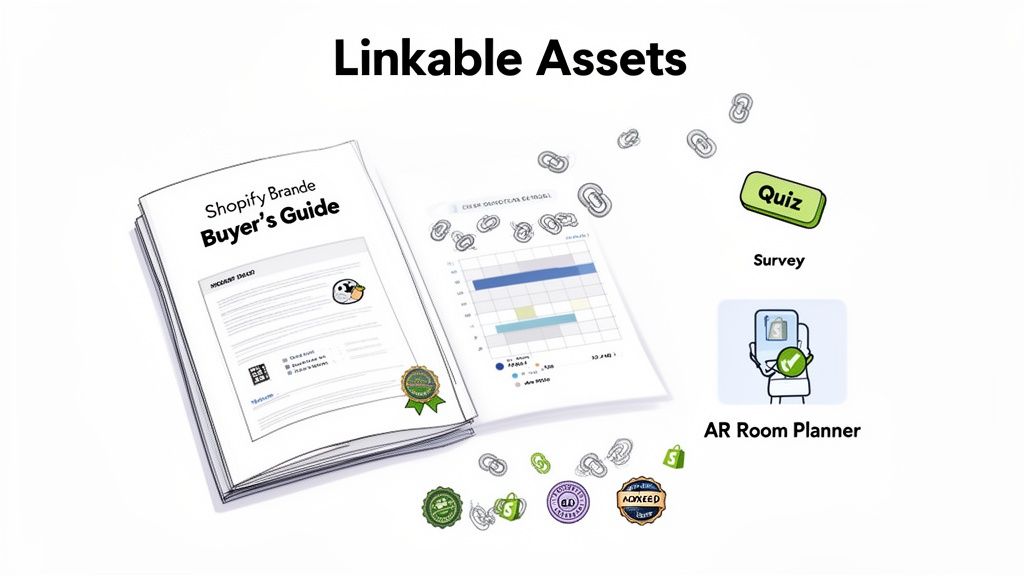
- The Ultimate Buyer's Guide: Selling something complex or expensive? A detailed buyer's guide can be a goldmine. If you sell high-end cameras, create a definitive guide explaining sensor sizes, lens types, and manual settings for beginners. This not only warms up potential buyers but also becomes a go-to resource for photography blogs to link to.
- Original Data & Surveys: Journalists and bloggers love data, but they rarely have the resources to gather it themselves. Survey your customers about their habits or pain points. A pet supply store could publish "The State of Pet Nutrition in 2026," packed with citable stats that vets and pet publications will reference for months.
- Free Interactive Tools: Nothing earns links and shares quite like a tool that solves a problem. A coffee brand could build a "Find Your Perfect Grind" quiz that recommends a grinder setting and bean type based on the user's brew method. It’s a sales tool and a link magnet all in one.
Real-World Example: We worked with a Shopify furniture store that struggled to sell large sectionals online. The cost and size made customers hesitate. We helped them develop a free, web-based AR room planner. Customers could just upload a photo of their living room and virtually "place" the sectional to see how it fits. It solved a huge pain point and became an asset that interior design bloggers and home decor magazines were genuinely excited to share with their audiences.
Creating Your Linkable Asset Plan
You don't need to do all of this at once. Start by brainstorming the biggest questions or problems your customers have. Where is the information gap that your brand is uniquely positioned to fill? A great linkable asset sits right at the intersection of your brand's expertise and your customer's needs.
Here's a quick look at how different asset types can serve your store.
High-Impact Linkable Asset Ideas for Shopify Stores
| Asset Type | Primary Goal | Shopify Store Example |
|---|---|---|
| Comprehensive Guides | Establish topic authority and educate buyers. | A skincare brand's guide to building a routine for different skin types. |
| Original Research | Generate unique, citable data points. | An athletic wear brand's report on home workout trends. |
| Interactive Tools | Solve a problem and provide direct utility. | A paint store's "Color Visualizer" tool for home interiors. |
| Calculators | Help users make quantitative decisions. | A nutrition supplement brand's macronutrient calculator. |
Once you've landed on an idea, your mission is to create the absolute best resource on that topic anywhere on the internet. This "10x content" mindset is what turns a simple piece of content into a true linkable asset—the foundation of a powerful backlinks SEO strategy.
Building Relationships Through Strategic Outreach
So you've created a genuinely fantastic linkable asset. That's a huge win, but let's be real—it's only half the job. That amazing buyer’s guide or eye-opening industry survey won’t earn a single link just sitting on your Shopify store collecting digital dust.
Now comes the human part of your backlinks seo strategy: smart, strategic outreach.
Forget the old-school mass email blasts and robotic templates. That's not link building; it's just spam. Effective outreach in 2026 is all about building real relationships. It’s about giving value before you ask for anything, turning a cold request into a warm collaboration. Your goal is to connect with actual people—journalists, bloggers, and industry leaders—who will see your asset as a genuine gift to their audience.
This isn't about pulling a fast one. It's about finding that perfect sweet spot where your incredible content meets a publisher's need for great resources.
The Art of the Personalized Pitch
The line between an email that gets instantly deleted and one that sparks a valuable partnership is personalization. A "Hey, check out my content" pitch is dead on arrival. You have to prove you’ve done your homework and have a thoughtful reason for showing up in their inbox.
First, you need to identify the right people. Forget just sorting a list by Domain Authority. Ask the important questions:
- Does this site or person actually cover topics relevant to my asset?
- Have they linked out to similar guides, studies, or tools before?
- Is my content a clear upgrade, a fresh take, or a missing piece for something they've already published?
Once you've built a curated list of prospects, it's time to craft your outreach. Mention a recent article they published, a point they made on a podcast, or even just a project they worked on that you admired. Show them you're a real person who appreciates their work, not a bot scraping for email addresses.
We’ve seen it time and again: a personalized email outreach campaign can have response rates that are 50% higher than a generic, non-personalized one. This isn't just about being polite; it’s a massive strategic advantage that saves time and builds exponentially better links.
Battle-Tested Outreach Scenarios
Your approach needs to adapt based on your asset and your goal. Let's walk through a few common situations for a Shopify brand and how to tackle them with a value-first mindset.
1. The Asset Promotion Pitch
This is your bread and butter—promoting that new guide, report, or tool. The key here is to be brief and immediately highlight what’s in it for them. Don't just say your guide is "the best." Point out a unique statistic or a specific, actionable tip they can easily share with their audience.
Example Pitch Angle:
"Hi [Name], I was just reading your article on sustainable fabrics and really enjoyed your analysis of bamboo textiles. I noticed you pointed out the lack of hard data on water usage in the industry. My team just published a study on this and found that [Specific Stat]. Thought it might be a valuable resource to add for your readers."
2. Broken Link Building
This is one of the most effective tactics out there because you're genuinely helping someone improve their site. Using a tool like Ahrefs, you can find relevant sites in your niche linking to pages that no longer exist (404 errors). You then reach out, give them a friendly heads-up about the dead link, and suggest your own (highly relevant) asset as the perfect replacement. You're solving a problem for them, which makes the ask feel like a natural, helpful suggestion. For more tactical deep dives, you can explore other effective link-building tactics for eCommerce brands to expand your toolkit.
Beyond the Email Pitch
A truly successful backlinks seo strategy means looking for partnerships that go beyond a simple link request. A lot of eCommerce brands miss out on huge opportunities by thinking too narrowly.
Start thinking about these collaborative approaches:
- Supplier & Vendor Features: The companies that supply your raw materials or components often have "Our Partners" or "Featured Clients" sections on their websites. A quick email to your account rep can often score an easy, highly relevant link.
- Co-Hosted Webinars: Find a complementary, non-competing brand and host a webinar together. A Shopify store selling high-end running shoes could partner with a brand selling athletic supplements. You both promote the event to your audiences and link to each other’s sites. It's a win-win.
- Guest Posting with a Purpose: Don't guest post just for a link in your bio. Find blogs where you can offer genuine expertise that solves a real problem for their readers. The authority and referral traffic you build are the real prizes; the link is the bonus.
Ultimately, successful outreach is a long game. It's about planting seeds. By focusing on building real connections and consistently providing value, you'll create a network of allies who are happy to link to your content, turning your outreach efforts into a sustainable engine for growth.
Optimizing Your Site to Maximize Link Value
Landing a fantastic backlink feels like a major win, but it's only half the story. All that hard-earned authority is practically worthless if your Shopify store is a technical mess.
You can point a firehose of authority at your site, but if the pipes are leaky, all that valuable “link juice” just spills out. It never reaches the pages that actually drive your revenue. For any serious backlinks seo strategy to work, a solid technical and on-site foundation is absolutely mandatory.
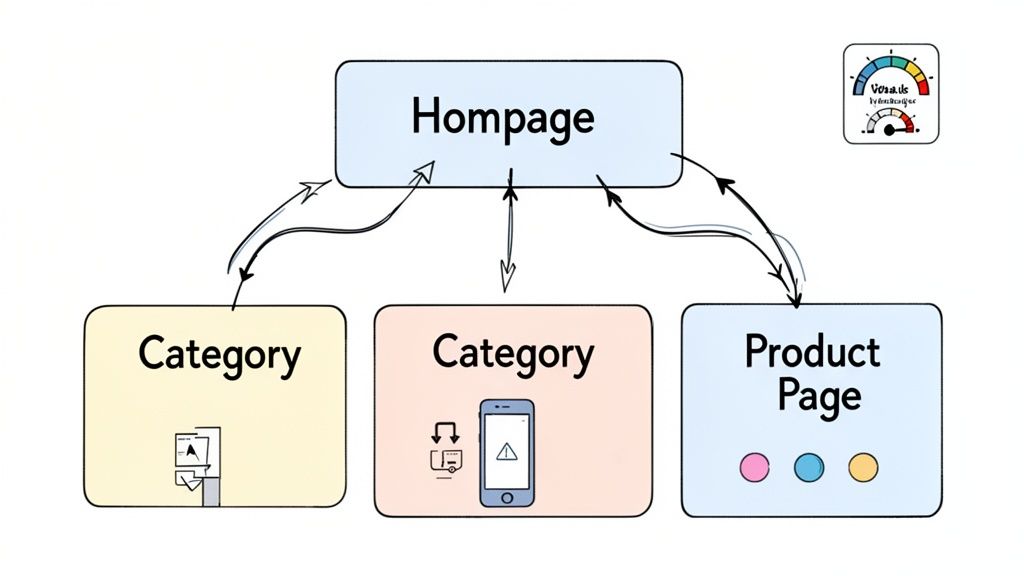
Think about it. A powerful link pointing to your homepage is a great start. But without clean site architecture and smart internal linking, that authority gets stuck. It never flows down to your category and product pages—the ones that actually make you money. This isn't just some abstract SEO concept; it directly hits your bottom line.
Your On-Site Technical Checklist
Before you even think about sending your first outreach email, you need to get your house in order. Running through this checklist ensures your Shopify store is ready to soak up every drop of value from the links you build.
Page Speed and Core Web Vitals: Google is obsessed with user experience, and nothing kills UX faster than a slow website. A site that takes forever to load doesn't just annoy visitors; it actively tanks your rankings. Use Google's PageSpeed Insights to get a baseline on your Core Web Vitals. For Shopify stores, this usually means compressing your images, cleaning up your apps, and making sure your theme isn't bloated and slow.
Mobile-First Experience: The majority of your customers are shopping on their phones. Your mobile site isn't just a smaller version of your desktop site—it is your site. The experience has to be flawless. Navigation needs to be dead simple, buttons have to be easy to tap, and the checkout process must be frictionless. Google indexes the mobile version of your site first, so what they see there is what counts.
Backlinks are a top-three ranking factor for Google, but they work in concert with on-page signals. A technically sound, fast-loading, mobile-friendly site amplifies the power of every link you earn, while a poor user experience can negate it.
Consolidating Your Link Equity
Technical SEO can sound complicated, but a few concepts are absolutely critical for getting the most out of your backlinks. One of the biggest is the canonical tag. It’s a simple line of code that tells Google which version of a page is the "official" one.
This is a huge deal on Shopify. The platform is notorious for creating multiple URLs for the same product, especially if it lives in different collections. Without a proper canonical tag pointing to the one "master" URL, you end up splitting your authority across a bunch of duplicate pages. You're literally competing with yourself.
Fixing your canonical tags is a quick win. It funnels all that link equity into a single, powerful URL, giving it a much better chance to rank. It ensures your backlinks seo strategy delivers a punch exactly where you need it.
Tracking Your Success and Protecting Your Store
So, how do you actually know if all this hard work is paying off? A successful backlinks seo strategy isn't just about collecting links; it's about seeing real, measurable results for your Shopify store. To get a clear picture, you have to look past the simple tally of new backlinks and zero in on the metrics that actually move the needle.
The first big mindset shift is to stop counting total backlinks and start tracking the growth of referring domains. Think about it: 100 links from one sketchy website are worth far less than one link each from ten reputable, on-topic sites. What Google wants to see—and what signals a healthy, natural link profile—is steady growth in the number of unique, quality websites linking to you.
Measuring What Actually Matters
Your real goal here is to connect your link-building activities to tangible business outcomes. This means keeping a close eye on the right key performance indicators (KPIs) that prove your time and money are delivering a return.
Here are the core metrics you should be watching:
- Keyword Ranking Improvements: Track how your most valuable commercial keywords are performing in search. These are the terms that bring traffic to your money-making product and category pages. As you build relevant links to these pages, you should see them climb the search rankings.
- Organic Traffic Growth: Jump into Google Analytics and watch the organic traffic going to the pages you're building links for. A well-executed campaign will show a clear connection between new, high-quality backlinks and a lift in non-paid visitors.
- Referral Traffic: Never underestimate the direct traffic a great backlink can generate. A single, well-placed link on a popular blog or in a buzzy gift guide can send a steady stream of high-intent, ready-to-buy customers straight to your store.
Safeguarding Your Store from Toxic Links
While earning good links is the goal, protecting your store from bad ones is just as critical. Not all backlinks are created equal, and some can actively damage your store’s standing with Google. It’s vital to recognize the red flags of a risky link.
Key Takeaway: Penalties for bad links are actually quite rare. Google's algorithms are now sophisticated enough to simply ignore most low-quality or spammy links, making them worthless. The real risk comes from clear patterns of manipulative linking—like large-scale paid schemes or too much exact-match anchor text—which can trigger a manual action from Google.
Identifying a "toxic" link means looking for some obvious warning signs. Is the link from a website completely unrelated to your niche? Is the site plastered with ads and has almost no real content? Is the anchor text spammy or over-optimized? These are all clear signals that a link could do more harm than good.
The Cautious Use of the Disavow Tool
If you do find a pattern of toxic links aimed at your site—maybe from a questionable SEO agency you hired in the past or even a negative SEO attack—Google offers a way to deal with them. It’s called the Disavow Tool, located within Google Search Console.
However, you should treat this tool like a surgeon's scalpel, not a sledgehammer.
Disavowing a link tells Google to completely ignore it when evaluating your site. It's a powerful feature intended for advanced users who are absolutely certain the links are causing harm. For the vast majority of stores, Google is already smart enough to ignore the spam.
Only use the disavow tool when you have a significant number of artificial, spammy links that you’re confident are causing a serious problem. Always proceed with extreme caution. A well-managed backlinks seo strategy focuses on building quality links from the start, which makes the need to disavow a very rare event.
Your Backlinking and SEO Questions, Answered
Even the most straightforward backlink strategy can leave you with a few lingering questions. It’s completely normal. We hear them all the time from Shopify owners who are ready to get serious about their SEO.
Let's cut through the noise and tackle some of the most common questions head-on.
One of the first things everyone wants to know is about timing. It’s the million-dollar question: "How long until I see results?" Let's be real—SEO isn't an overnight miracle. While a single, well-placed link can start sending you referral traffic almost immediately, the real magic happens over time.
You can typically expect to see a meaningful shift in your organic rankings after 3 to 6 months of consistent, focused effort. Google needs that time to find your new links, process what they mean, and ultimately re-calculate your store's authority in the search results.
How Much Should My Budget Be?
This is another big one, and the honest answer is: it depends. The cost of a backlink campaign can swing wildly. You could be looking at a few hundred dollars a month for some basic outreach or upwards of several thousand for a full-blown campaign with high-end digital PR and custom content.
But thinking about it as a fixed cost is the wrong way to look at it. Focus on value instead. A single, powerful link from a major publication might have a high price tag, but the authority, traffic, and revenue it drives can deliver a massive return on investment.
For a growing Shopify store, a smarter approach is to start with a modest but consistent budget. Something in the $1,000 to $2,500 per month range is a great starting point. That’s enough to focus on creating one fantastic linkable asset and promoting it properly. It lets you build momentum and reinvest your profits as the results start rolling in.
What’s the Difference Between Link Types?
You'll hear a lot of jargon around links, but there are really only two main types you need to understand to get started. Not all links are created equal, and knowing the difference is key to a solid strategy.
- Nofollow Links: These links contain a special attribute that tells search engines like Google not to pass any authority or "link juice." You'll find them all over social media, in forum comments, and on many user-generated content sites. While they don't give you a direct SEO boost, they're far from worthless. They can still drive a ton of valuable referral traffic and are great for brand visibility.
- Dofollow Links: This is the default, standard link type. These are the ones that pass authority and act as a vote of confidence for your site. They are the primary focus of most SEO link-building campaigns because they have a direct and significant impact on your search rankings.
Ultimately, a healthy, natural-looking backlink profile will have a mix of both. Your main goal should be earning high-quality, relevant dofollow links, but never underestimate the brand-building power that a nofollow link from the right source can deliver.
Ready to build a backlink strategy that drives real growth for your Shopify store? The team at ECORN specializes in creating data-driven SEO campaigns that deliver measurable results. Get in touch with us today to see how we can help you climb the rankings.


7 Single Product Websites Worth Emulating
Product Variants Shopify: The Complete 2026 Guide
Ecommerce Analytics Consulting for Growth
What Is AI Integration for eCommerce
How to Choose the Right eCommerce Website Development Firm
E Business Strategy Implementation
Conversion Tracking Setup for Shopify Stores
BigCommerce vs Shopify Plus Which Enterprise Wins in 2026
Shopify Theme Kit: Setup, Commands, and Migration Guide
Shopify Extension Development: A Practical 2026 Guide
Shopify Speed Score Explained and How to Improve It
Shopify Mobile Optimization: The 2026 Playbook
How to Add Subcategory in Shopify for Better UX
How to Implement Structured Data for Ecommerce in 2026
SEO App Mobile: Shopify Store Optimization Guide
Shopify Plus Support: What It Includes and How to Choose
Google Ads for Shopify: The Complete 2026 Playbook
Shopify New York: How to Find and Hire the Right Agency
Google Search Console for Shopify: The Complete Setup
First Party Data Collection for eCommerce Growth
FAQ Online Store Guide: Build and Measure It Right
Do FB Ads Work for eCommerce in 2026?
One Page Checkout for Shopify: Design and Implementation
Shopify GraphQL vs REST: The 2026 Developer Decision
Shopify Ecommerce Consulting: Strategy, Pricing &
Are Reddit Ads Worth It for eCommerce Brands
Shopify Title and Meta Description: A Practical 2026 Guide
Product Video Best Practices for Shopify Brands
Real-Time Inventory Management: A 2026 Guide
AI Chatbot Integration for Shopify Stores
Affiliate Program Management: A Shopify Guide
10 Best Performance Monitoring Tools for Shopify in 2026
Digital Asset Management for eCommerce Brands in 2026
Every Type of Facebook Ads Explained for eCommerce Growth
Product Information Management Explained for Shopify Brands
Support Ticket System: A Guide for Shopify Stores

10 Best Customer Service Tools for Shopify in 2026

Can I Start a Business with No Money? a 2026 Blueprint
What Sells Good on Etsy: Best Niches for 2026

Shopify Add to Cart Button: A Practical 2026 Guide

Customer Feedback Automation: A Practical eCommerce Guide
Critical Rendering Path: A Guide for Shopify Stores

How to Promote on TikTok for eCommerce in 2026

B2B eCommerce Consulting That Drives Real Revenue
10 Best Practices for Site Navigation in 2026
Return vs Refund for Shopify Stores: A Practical Guide
What Is Customer Lifetime Value and Why It Matters
What Is Voice of Customer Research for eCommerce

SMS Marketing for Ecommerce That Actually Converts

Master How to Improve Email Deliverability in 2026
Top 7 eCommerce Partners NYC for Shopify Brands in 2026
Machine Learning for Ecommerce: Boost Your Shopify Store
Beauty Market Research: Your 2026 Growth Guide

Shopify International Expansion: A 2026 Roadmap
What Does CRO Stand for in Business: Understanding CRO
Shopify Visual Merchandising: A Playbook for Higher Sales

Shopify Landing Page Design: Master Conversion in 2026
10 Best AI SEO Optimization Tools for Shopify in 2026

Agentic AI for Ecommerce: Boost Your Sales in 2026
Mastering Email Marketing Data for eCommerce Growth
Conversion Rate Optimisation Australia: Boost Your Sales
Conversion Rate Optimization AI: Your Shopify Store Guide

10 Product Bundling Strategies for Shopify in 2026
How to Increase Customer Lifetime Value: A Shopify Playbook
AI Customer Service Automation: Shopify Guide 2026
Clean Website Design: A Shopify Conversion Playbook

Omnichannel Retail Strategy: A Shopify Playbook
Product Data Enrichment: A Guide for Shopify Brands
Instagram Shopping Features a Guide for Shopify Stores
What Is Revenue Optimization: A Holistic RevOps Guide
Benefits of Conversion Rate Optimization: Boost Your
WordPress to Shopify Migration: Your 2026 Seamless Switch
Boost Sales: Ecommerce Payment Processing Guide 2026
Unified Commerce Platform: Benefits, KPIs & Shopify Guide
How to Reduce Bounce Rate eCommerce: Your 2026 Guide
Shopify API Integration: A Practical End-to-End Guide
How to Implement Data Governance: A 2026 Guide
Shopify Store Development Cost: A 2026 Breakdown
What Is Server Side Tracking: The Shopify Guide 2026
Marketing Automation Workflows: A Shopify Guide for 2026
Shopify: How to Reduce Technical Debt

Shopify UX Design Change: A Playbook for Growth
User Generated Content Strategy: Shopify Playbook
Shopify Pause and Build Plan Cost: A Complete 2026 Guide
Compare at Price on Shopify: A Complete Guide for 2026
Where Can I Sell My Prints? 10 Best Platforms for 2026
Shopify Order Management System: The Ultimate Guide 2026
What Is Marketing Attribution? an eCommerce Guide for 2026
10 Best Black Friday Sales Sheets for 2026

Discover the Top Social Media Marketing Agencies For
Consumer Confidence Definition for eCommerce in 2026
What Is Social Commerce? Your 2026 Guide to Boosting Sales
A Social Ad Campaign Playbook for eCommerce Growth
7 Best FAQ Page Examples for SaaS & eCommerce

Market Research in Fashion Industry: A Guide for Shopify
Shopify Migration Services: Expert Guide for 2026
Mastering FB Retargeting Ads for Shopify in 2026
What Is Omnichannel Ecommerce
Master Your Shopify Plus Migration: The 2026 Guide
Shopify Integration Services: A Merchant's 2026 Guide


newsletter in your inbox