


Typing "ecommerce agency near me" into a search bar is more than a hunt for convenience. It's a strategic decision for brands that are serious about growth. A local partner brings on-the-ground market knowledge and the kind of agility you only get from face-to-face collaboration, giving you a real advantage in a packed market.
Why a Local Ecommerce Partner Is Your Competitive Edge
Even though e-commerce feels like a borderless world, the perks of having a partner in your own backyard are very real. Choosing a local agency isn't just about logistics; it’s about building a responsive, aligned, and powerful extension of your own team.
The first thing you'll notice is how much smoother collaboration becomes. When your agency is in the same time zone, communication just flows. No more waiting overnight for an email response or trying to find a meeting time that works for everyone. You get problems solved in real-time and projects turned around faster, which is exactly what you need to stay ahead.
Deeper Market Understanding
A local partner doesn't just get to know your business; they already get the world you operate in. They're part of the same community, see the same local trends, and understand the subtle details of your regional customer base. You can't put a price on that shared context.
This built-in knowledge leads directly to better marketing and smarter development. A team down the road can offer insights a remote agency would completely miss, helping you connect with your audience in a more genuine way. For example, their expertise in geo optimization for e-commerce can make a huge difference in how you pull in and convert local shoppers.
The power of proximity lies in shared context. A local agency intuitively grasps your market's culture, competition, and customer behavior, leading to strategies that resonate more deeply and drive better results.
The Value of In-Person Collaboration
Never underestimate what you can accomplish in a face-to-face brainstorming session. Figuring out complex strategies, reviewing designs, and planning for growth are just more effective when everyone’s in the same room. Whiteboard sessions can spark creative fixes that a video call often can't.
This personal connection also builds a stronger, more trusting relationship. Your agency stops feeling like a vendor and starts feeling like a true partner who's genuinely invested in seeing you succeed. They can see your operation with their own eyes, understand your struggles on a deeper level, and feel a real sense of accountability.
This is especially vital in a market that's growing like crazy. The global e-commerce market is set to hit US$3.87 trillion in 2026, with online sales expected to account for 21.1% of all retail. To grab your slice of that pie, you need a partner specializing in platforms like Shopify and Conversion Rate Optimization (CRO) to scale effectively. You can discover more about the state of global ecommerce and get the full insights from Statista's market outlook.
Defining Your Goals Before Starting Your Search

Before you even type "ecommerce agency near me" into Google, you need a clear roadmap of what you're trying to achieve. Flying blind is a surefire way to burn through cash and end up with a partner who isn’t truly aligned with your vision. This prep work is the single most important thing you can do to find a team that gets your business.
It’s time to move past fuzzy goals like "increase sales." You have to get specific. A goal like "Increase our sitewide conversion rate from 1.5% to 2.5% within six months" is something an agency can actually work with.
This kind of detail gives a potential partner a concrete target. It immediately shifts the conversation from vague promises to measurable outcomes, which is exactly where you want to be.
Pinpoint Your Exact Needs
Take a hard look at your biggest headaches and opportunities right now. Are you wrestling with a clunky, outdated theme? Is your average order value flatlining? Or are you finally ready to push into international markets? The answers will tell you exactly what kind of expertise you need.
Here are a few common goals we see from brands to get your wheels turning:
- Growth and Revenue: Define precise targets like increasing monthly recurring revenue by 20% or boosting customer lifetime value (CLV) by 15%.
- Conversion Rate Optimization (CRO): Get granular. Aim to decrease cart abandonment rates by 10% or overhaul the mobile checkout experience for better flow.
- Technical Development: This could be anything from a full-scale migration to Shopify Plus to building a custom app or integrating a new ERP.
- International Expansion: Set a clear objective, such as launching two new international storefronts complete with localized pricing and language support.
Having specific, data-backed goals is your greatest asset. It transforms your search from "finding an agency" to "finding a partner to help us achieve a 2.5% conversion rate." This simple shift in mindset focuses every subsequent conversation on tangible results.
Set a Realistic Budget and Understand Pricing Models
Let’s talk money. It can be an awkward topic, but you absolutely have to sort it out internally before you start talking to agencies. A clear budget saves everyone a ton of time and helps you immediately filter out partners who are out of your price range.
Don't just pull a number out of thin air. A solid starting point is to allocate 5-10% of your online revenue to agency fees and related marketing efforts. Once you have a range, you can start looking at how different agencies structure their pricing.
Common Agency Pricing Models
| Model | How It Works | Best For |
|---|---|---|
| Monthly Retainer | You pay a fixed fee each month for an agreed-upon scope of work and access to the agency's team. | Ongoing needs like CRO, SEO, and continuous site improvements. |
| Project-Based Fee | A one-time, fixed price for a specific, well-defined project, such as a website redesign or a platform migration. | One-off initiatives with a clear start and end date. |
| Performance-Driven | A portion of the agency's fee is tied directly to achieving pre-defined performance metrics, like revenue growth or lead generation. | Businesses that want to directly link agency cost to ROI and are willing to share in the upside. |
A project-based fee is great for cost certainty on something like a new site build. On the other hand, a monthly retainer is perfect for a brand that needs consistent optimization and strategic guidance to grow month after month.
Many of the best agencies will offer a hybrid approach, letting you kick things off with a project and then move to a retainer once you've built a solid relationship. Getting this clarity around your goals and budget will make your search for a local ecommerce agency far more targeted and, ultimately, successful.
Alright, you've got your goals locked in. Now comes the fun part: the hunt for the right local agency. Finding a great "ecommerce agency near me" isn't about casting a wide net. It's about precision. You’re not just looking for any agency; you're looking for the partner who gets your vision.
This means you'll need to do more than a quick search. It's time to dig in and use a few smart tactics to uncover the real talent in your area. Think of it as going from a generic query to a surgical strike.
Go Beyond Basic Search
A simple Google search is a decent start, but it's only that—a start. To find the agencies that are true specialists, you have to get more specific with your search terms. Instead of typing something broad, try using more detailed, long-tail keywords that match your exact needs.
Here are a few examples to get your wheels turning:
"Shopify Plus partners in [Your City]""ecommerce CRO agency [Your State]""B2B ecommerce development [Your Neighborhood]""Magento to Shopify migration services near me"
Using more detailed searches like these instantly filters out the generalists and pushes the specialists right to the top. This simple change in how you search can save you hours of vetting time later on.
This is especially true in fast-growing sectors. For instance, B2B e-commerce is expected to hit a massive USD$36 trillion market by 2026. This is happening because nearly 90% of B2B companies shifted to virtual sales after 2020. An agency that has real, strategic experience here is an incredible asset. You can dig into the numbers yourself by checking out the latest global ecommerce sales forecasts.
Use Curated Agency Marketplaces
While Google is a great tool, don't just stop there. There are several reputable platforms built specifically to help you find and vet agencies. These marketplaces are like a pre-screened pool of talent, complete with reviews, project examples, and real client feedback.
They’re an invaluable resource for anyone looking to hire a local partner.
Key Platforms to Check Out:
- Shopify Experts Marketplace: If you're on Shopify or Shopify Plus, this should be your first destination. You can filter potential partners by the services they offer, their location, budget range, and industry focus. These are agencies that Shopify has officially vetted, which adds a huge layer of trust. For a deeper look at this process, see our guide on how to find the right top Shopify development companies.
- Clutch: This is a top-tier B2B ratings and reviews platform. Here, you'll find detailed, verified client reviews, project summaries, and even cost breakdowns. Its location-based filtering is fantastic for homing in on agencies in your city or state.
- UpCity: Much like Clutch, UpCity provides in-depth profiles and reviews for marketing and development agencies. It gives each provider a credibility score, helping you quickly get a sense of their reputation and standing in the market.
When you're on these platforms, pay attention to the little things. Don't just glance at the overall star rating. Read the actual reviews to understand the scope of the projects and the dynamic of the client-agency relationship.
A 5-star review for a simple theme update is worlds apart from a 5-star review for a complex, multi-store international launch. The details in the review tell you what an agency is truly capable of.
Keep Your Findings Organized
As you start to find potential partners, you'll quickly have a lot of information to manage. This is where a simple tracking system becomes your best friend. Don't try to rely on your memory or a messy folder of bookmarks.
Just create a basic spreadsheet to keep everything straight. This tracker will become the foundation for your shortlisting process, letting you compare your options objectively.
Here’s a quick-and-dirty evaluation checklist you can use to systematically compare each agency on your shortlist. This helps you move from a gut feeling to a data-informed decision.
Agency Evaluation Checklist
| Evaluation Criteria | Agency A | Agency B | Agency C | Notes/Red Flags |
|---|---|---|---|---|
| Location | Chicago, IL | Evanston, IL | Chicago, IL | Agency B is a bit far for in-person meetings. |
| Key Services | CRO, Shopify Plus | Design, Development | Full-Service Digital | Agency C seems more focused on lead gen than ecom. |
| Shopify Partner? | Yes, Plus Partner | Yes, Experts | No | Agency A's Plus Partner status is a big plus. |
| Relevant Case Studies | Yes (3) | Yes (1) | No | Agency A has strong case studies with real data. |
| Initial Impression | Strong fit | Good, but maybe too design-focused | Not a specialist | Agency B's portfolio is beautiful, but lacks CRO focus. |
| AI/Automation? | Yes | No | No | Agency A mentions AI-powered personalization. |
| Multi-Store Experience? | Yes | No | No | This is critical for our future plans. |
This simple step turns a chaotic search into a structured evaluation. By the end of this process, your goal is to have a solid shortlist of 3-5 top-tier local agencies. These are the contenders you'll invite to the next stage: the deep-dive vetting process.
How to Properly Vet Your Agency Shortlist
You’ve done the legwork, sifting through search results to create a solid shortlist of 3-5 potential partners. Now comes the real work. Vetting an "ecommerce agency near me" isn't about picking the slickest website; it's about systematically confirming their skills, digging into their track record, and making sure they have the technical chops to deliver on their promises.
This is where you move from first impressions to hard evidence. Your job is to score each agency on your list to find the one that’s truly the right fit for your brand's future.
Think of it as a simple, three-part process.
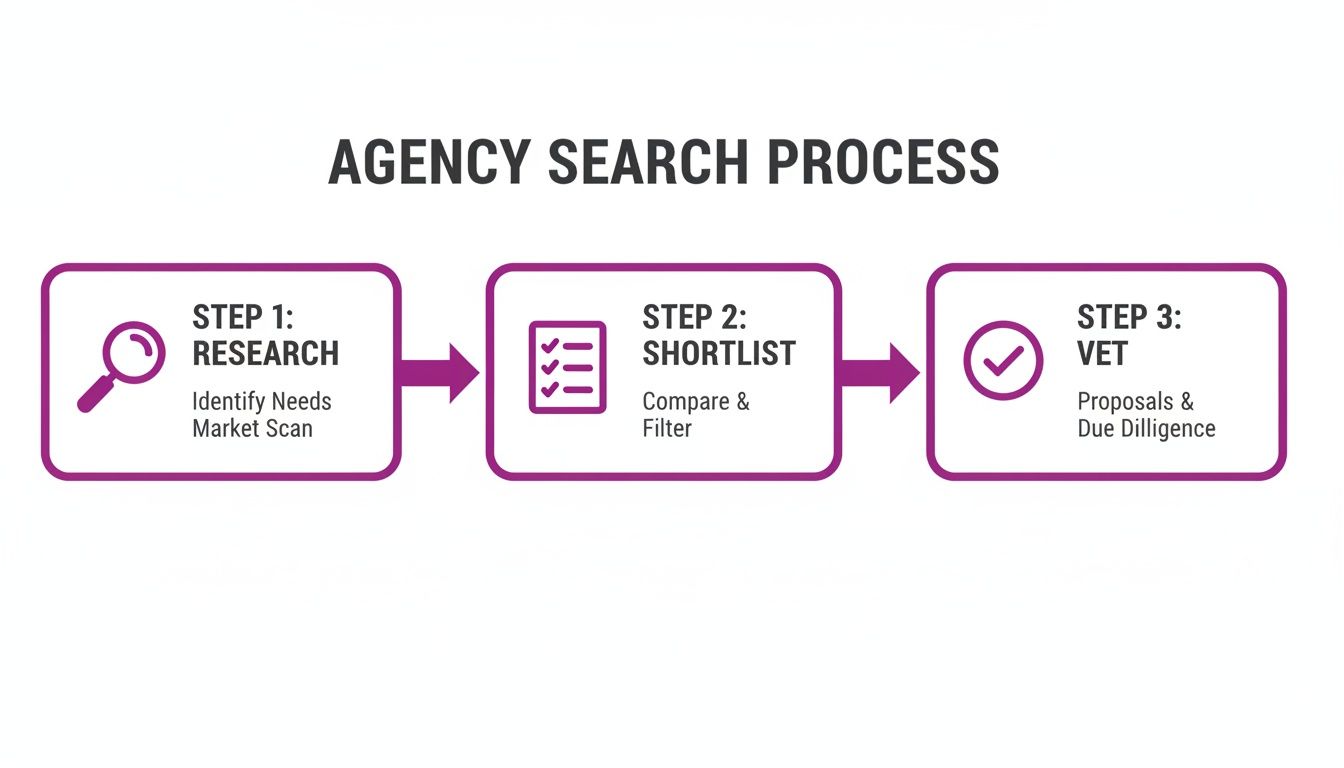
As you can see, this final vetting stage is what turns all your research into a confident decision.
Dig Deeper Than the Portfolio
Let’s be honest: every agency’s portfolio is built to impress. Your job is to see past the beautiful designs and find proof of actual performance. Don’t get distracted by big-name client logos—focus on the results.
Look for case studies with verifiable data. A statement like, "We redesigned their website" is just fluff. What you want to see is something like, "We increased their average order value by 15% and boosted their conversion rate by 22% in six months." That’s the signal of a results-driven partner.
When you’re looking at their past work, ask yourself:
- Does the agency show clear before-and-after metrics?
- Do they explain the specific strategies they used to get those results?
- Have they worked with businesses similar to yours in industry or scale?
An agency that’s open with its data is confident in its ability to deliver. A portfolio without any numbers is a major red flag.
Assess Their Technical Expertise with Shopify
You don’t just need a team that makes things look pretty. You need a partner that understands the deep, technical guts of your platform. If you're on Shopify or Shopify Plus, this is absolutely non-negotiable. Their skill here directly impacts your store’s speed, scalability, and ability to handle the custom features that set you apart.
This is especially true given how fast ecommerce technology is evolving. The global e-commerce platform market is projected to explode from USD 13.92 billion in 2026 to an incredible USD 61.83 billion by 2034. This kind of growth demands specialist agency help just to keep up with platform updates and performance optimization. You can dig into the numbers in this e-commerce platform market analysis.
A legitimate Shopify development agency will have real, provable experience in a few key areas.
Key Technical Capabilities to Verify
| Technical Skill | Why It Matters | How to Vet It |
|---|---|---|
| Shopify Plus | Shows they can handle high-volume, complex stores needing features like Shopify Scripts, Flow automation, and Launchpad. | Ask for examples of Shopify Plus clients they currently manage and specific advanced features they've implemented. |
| Multi-Store Management | Essential if you're expanding internationally or running multiple brands from a single backend. | Inquire about their experience with Shopify Markets or custom multi-store setups, and how they handle inventory and localization. |
| Headless Commerce | Demonstrates advanced skill in building lightning-fast, custom front-end experiences. | Ask if they’ve built any headless projects and what front-end frameworks (like React or Vue.js) they used. |
| App Integration & Custom Apps | Proves they can extend your store's functionality beyond what off-the-shelf apps can do. | Bring up a specific pain point you have and ask how they would solve it—with an existing app or a custom solution. |
A top-tier agency won't just talk about these skills; they will be eager to show you. They'll walk you through client examples and explain the "how" and "why" behind their technical choices.
Evaluate Their Philosophy on CRO and AI
A modern ecommerce agency should be obsessed with two things: Conversion Rate Optimization (CRO) and the smart use of new technology like AI. These aren't just buzzwords anymore; they are fundamental to driving real growth.
First, ask about their CRO process. A vague answer won’t cut it. You’re listening for a clear, repeatable methodology.
- Data Analysis: They should be talking about tools like Google Analytics, heatmaps, and session recordings to find opportunities.
- Hypothesis and Testing: They need to explain how they form a data-backed hypothesis (e.g., "We believe changing the checkout button color will increase clicks") and then A/B test it to prove it.
- Reporting and Iteration: Ask how they measure the impact of their tests and use what they learn to inform the next round of optimizations.
Next, probe their experience with AI. Are they already using AI-powered tools for things like product recommendations, customer segmentation, or personalized marketing campaigns? An agency that is already weaving these tools into their workflow is focused on the future and can give you a competitive edge. An agency that dismisses AI or has no experience with it is already playing catch-up.
Mastering the Interview and Trial Project
Alright, you’ve done the legwork. You've sorted through the contenders and have your shortlist. This is where the rubber meets the road—the final stage before you ink a deal and start a long-term partnership. The interview, and maybe even a trial project, are your best shots at seeing past the polished sales pitch and getting a real feel for how an agency actually works.
The interview isn’t just a formality. It's your chance to dig deep with tough, scenario-based questions that show how an agency thinks on its feet. Generic questions will only get you generic, rehearsed answers. You need to push for specifics that reveal how they truly operate, especially when things don't go as planned.
Asking Questions That Reveal True Character
The goal here is to get past the canned responses and into the heart of their process and philosophy. Stop focusing on what they do, and start asking how and why they do it. This is how you separate the agencies that just talk a good game from the ones that can actually deliver.
Here are a few questions I’ve found to be incredibly revealing:
- "Walk me through a time a major ecommerce project went completely off the rails. What happened, how did your team get it back on track, and what was the biggest lesson you learned from the experience?"
- "How do you measure and report on the ROI of your conversion rate optimization efforts? Could you show me a sanitized example of a report you’ve shared with another client?"
- "Describe your day-to-day process for client communication and project management. Who will be my main point of contact, and what's their typical response time for an email or call?"
- "Let's say our site goes down on a Saturday morning during a big sale. What's your emergency protocol?"
These aren't simple "yes" or "no" questions. They force the agency to tell a story and show you how they handle both triumphs and failures. Pay close attention to their answer on the 'project gone wrong' question. You're looking for accountability and problem-solving, not finger-pointing.
The most insightful conversations happen when you ask about challenges, not just successes. An agency that is transparent about past mistakes and can articulate what they learned is one you can trust to navigate future obstacles with honesty and skill.
The Power of a Paid Trial Project
Even after a great interview, you might have a lingering doubt. To get that final piece of confidence, I always recommend proposing a small, paid trial project. Think of it as a test drive. It is, without a doubt, the best way to see their workflow, communication style, and quality of work up close with minimal risk. This is a standard move when evaluating a top "ecommerce agency near me" before making a big commitment.
A solid trial project is a self-contained task with a crystal-clear deliverable and a firm timeline. It lets you judge them by their actions, not just their words.
Ideas for Effective Trial Projects:
- A Technical SEO Audit: Ask for a focused audit on a specific section of your site, like your collection pages or overall site speed. The deliverable should be a prioritized list of actionable fixes.
- A Landing Page Audit and Mockup: Have them analyze one of your key landing pages and deliver a detailed critique along with a wireframe or mockup of a new, conversion-focused version.
- A Small Development Task: Got a nagging bug or a minor feature you’ve been meaning to add? Hiring them to tackle it is a fantastic way to gauge their technical skills and coding standards.
Structuring the Trial for Maximum Insight
To make the trial a real litmus test, you have to structure it properly. You're not just evaluating the final PDF they send over; you’re evaluating the entire journey.
- Define a Clear Scope: Be incredibly specific about the deliverable, the timeline (e.g., two weeks), and the budget. Get it all in writing.
- Set a Fair Price: This is not a request for free work. Offer their standard hourly rate or a fair, fixed fee for the project. This signals that you respect their expertise and are a serious potential partner.
- Evaluate the Process, Not Just the Result: This is the most important part. Pay close attention to their communication. Were they proactive? Did they ask smart, clarifying questions? Was their project manager organized and on top of things? The final report is valuable, but how you got there tells you even more about what it's like to work with them.
By the end of the trial, you'll have a clear, gut-level feeling about the partnership. You’ll know if their communication cadence fits yours and if their work truly meets your standards. This small upfront investment can save you from a very expensive and frustrating mismatch later on, making sure the local agency you pick is the right one to help you grow.
Common Questions About Hiring an Ecommerce Agency
You've done the hard work of research and vetting, but a few nagging questions always seem to surface right before you're ready to make a choice. It's completely normal.
Getting straight answers to these last-minute concerns is what gives you the confidence to pick the right "ecommerce agency near me" and kick off a partnership you can feel good about. Let's tackle those final doubts so you can sign on the dotted line, knowing you’ve found a team that’s truly ready to help you grow.
What Is a Realistic Budget for My Business?
This is the big one, and the honest answer is: it varies wildly. We see budgets range from a few thousand dollars for a specific, one-off project to $5,000-$25,000+ per month for a full-blown retainer.
The key is to match your spend to your goals. If all you need is some basic site maintenance and a few theme tweaks, a smaller package is probably all you need. But if you're chasing aggressive growth with in-depth CRO, continuous development, and a strategic marketing push, you’ll need to invest more.
A good starting point is to set aside 5-10% of your monthly online revenue for your agency partnership. Look for agencies that offer flexible models, so you can ramp up your investment as your sales climb.
Should I Choose a Niche Specialist or a Full-Service Agency?
This really comes down to your single biggest pain point right now. If your traffic is solid but your conversion rate has hit a wall, a specialized CRO agency is your best bet. Their laser focus can uncover opportunities a generalist might completely overlook.
On the flip side, if you're looking for a top-to-bottom transformation—new design, development, and ongoing marketing—a full-service agency offers a cohesive, all-in-one approach. Many modern agencies now hit a sweet spot by specializing in a platform like Shopify while still offering a core suite of services like design, development, and CRO. This hybrid model often gives you deep platform expertise with the comprehensive support you need to scale.
The biggest red flags are vague promises and a one-size-fits-all approach. A great partner invests time in understanding your unique brand, challenges, and goals before presenting a solution. An agency that guarantees specific results, like a #1 Google ranking, should be avoided.
What Are the Biggest Red Flags to Watch For?
Besides impossible guarantees, be very skeptical of any agency whose portfolio is just pretty pictures without hard data or specific metrics. If they’re cagey, pushy, or just poor communicators during the sales process, that’s a preview of what the partnership will feel like.
Another huge red flag is a flat-out refusal to provide client references. A confident agency with a history of success will be more than happy to connect you with their clients. It's also smart to ask about their experience with modern tools. For example, knowing how they implement things like AI Chatbots for Ecommerce can tell you a lot about how forward-thinking they really are.
How Long Should an Initial Contract Be?
It’s always wise to be cautious about long-term commitments right away. An initial contract of 3-6 months is a pretty standard and fair starting point. This gives the agency enough time to get their strategies in place and start delivering results you can actually see.
Try to avoid getting locked into a 12-month contract from day one, especially if you haven’t done a paid trial project first. The best agencies are confident they can prove their worth and will often suggest a 90-day engagement to do just that. If everything clicks and the results are there, moving to a 6 or 12-month agreement with clear performance reviews is the logical next step.
Ready to partner with a Shopify agency that's as focused on your growth as you are? ECORN offers flexible subscription packages for design, development, and CRO, helping over 100 brands scale their success. Whether you need a single project or ongoing optimization, our team is ready to deliver. Get started with ECORN today.


Conversion Tracking Setup for Shopify Stores
BigCommerce vs Shopify Plus Which Enterprise Wins in 2026
Shopify Theme Kit: Setup, Commands, and Migration Guide
Shopify Extension Development: A Practical 2026 Guide
Shopify Speed Score Explained and How to Improve It
Shopify Mobile Optimization: The 2026 Playbook
How to Add Subcategory in Shopify for Better UX
How to Implement Structured Data for Ecommerce in 2026
SEO App Mobile: Shopify Store Optimization Guide
Shopify Plus Support: What It Includes and How to Choose
Google Ads for Shopify: The Complete 2026 Playbook
Shopify New York: How to Find and Hire the Right Agency
Google Search Console for Shopify: The Complete Setup
First Party Data Collection for eCommerce Growth
FAQ Online Store Guide: Build and Measure It Right
Do FB Ads Work for eCommerce in 2026?
One Page Checkout for Shopify: Design and Implementation
Shopify GraphQL vs REST: The 2026 Developer Decision
Shopify Ecommerce Consulting: Strategy, Pricing &
Are Reddit Ads Worth It for eCommerce Brands
Shopify Title and Meta Description: A Practical 2026 Guide
Product Video Best Practices for Shopify Brands
Real-Time Inventory Management: A 2026 Guide
AI Chatbot Integration for Shopify Stores
Affiliate Program Management: A Shopify Guide
10 Best Performance Monitoring Tools for Shopify in 2026
Digital Asset Management for eCommerce Brands in 2026
Every Type of Facebook Ads Explained for eCommerce Growth
Product Information Management Explained for Shopify Brands
Support Ticket System: A Guide for Shopify Stores

10 Best Customer Service Tools for Shopify in 2026

Can I Start a Business with No Money? a 2026 Blueprint
What Sells Good on Etsy: Best Niches for 2026

Shopify Add to Cart Button: A Practical 2026 Guide

Customer Feedback Automation: A Practical eCommerce Guide
Critical Rendering Path: A Guide for Shopify Stores

How to Promote on TikTok for eCommerce in 2026

B2B eCommerce Consulting That Drives Real Revenue
10 Best Practices for Site Navigation in 2026
Return vs Refund for Shopify Stores: A Practical Guide
What Is Customer Lifetime Value and Why It Matters
What Is Voice of Customer Research for eCommerce

SMS Marketing for Ecommerce That Actually Converts

Master How to Improve Email Deliverability in 2026
Top 7 eCommerce Partners NYC for Shopify Brands in 2026
Machine Learning for Ecommerce: Boost Your Shopify Store

Beauty Market Research: Your 2026 Growth Guide
Shopify International Expansion: A 2026 Roadmap
What Does CRO Stand for in Business: Understanding CRO

Shopify Visual Merchandising: A Playbook for Higher Sales
Shopify Landing Page Design: Master Conversion in 2026
10 Best AI SEO Optimization Tools for Shopify in 2026

Agentic AI for Ecommerce: Boost Your Sales in 2026
Mastering Email Marketing Data for eCommerce Growth
Conversion Rate Optimisation Australia: Boost Your Sales
Conversion Rate Optimization AI: Your Shopify Store Guide

10 Product Bundling Strategies for Shopify in 2026
How to Increase Customer Lifetime Value: A Shopify Playbook
AI Customer Service Automation: Shopify Guide 2026
Clean Website Design: A Shopify Conversion Playbook

Omnichannel Retail Strategy: A Shopify Playbook
Product Data Enrichment: A Guide for Shopify Brands
Instagram Shopping Features a Guide for Shopify Stores
What Is Revenue Optimization: A Holistic RevOps Guide
Benefits of Conversion Rate Optimization: Boost Your
WordPress to Shopify Migration: Your 2026 Seamless Switch
Boost Sales: Ecommerce Payment Processing Guide 2026
Unified Commerce Platform: Benefits, KPIs & Shopify Guide
How to Reduce Bounce Rate eCommerce: Your 2026 Guide
Shopify API Integration: A Practical End-to-End Guide
How to Implement Data Governance: A 2026 Guide
Shopify Store Development Cost: A 2026 Breakdown
What Is Server Side Tracking: The Shopify Guide 2026
Marketing Automation Workflows: A Shopify Guide for 2026
Shopify: How to Reduce Technical Debt

Shopify UX Design Change: A Playbook for Growth
User Generated Content Strategy: Shopify Playbook

Shopify Pause and Build Plan Cost: A Complete 2026 Guide
Compare at Price on Shopify: A Complete Guide for 2026
Where Can I Sell My Prints? 10 Best Platforms for 2026
Shopify Order Management System: The Ultimate Guide 2026
What Is Marketing Attribution? an eCommerce Guide for 2026

10 Best Black Friday Sales Sheets for 2026

Discover the Top Social Media Marketing Agencies For
Consumer Confidence Definition for eCommerce in 2026
What Is Social Commerce? Your 2026 Guide to Boosting Sales
A Social Ad Campaign Playbook for eCommerce Growth
7 Best FAQ Page Examples for SaaS & eCommerce

Market Research in Fashion Industry: A Guide for Shopify
Shopify Migration Services: Expert Guide for 2026
Mastering FB Retargeting Ads for Shopify in 2026
What Is Omnichannel Ecommerce
Master Your Shopify Plus Migration: The 2026 Guide
Shopify Integration Services: A Merchant's 2026 Guide
Shopify Collection Description: A Guide to SEO & Sales
Shopify Plus Contact: Reach Sales & Support Effectively

Top Luxury Shopify Stores: Design & UX Strategies
How to Improve Customer Experience: A Shopify Roadmap
Creative Facebook Ads: 10 Examples for Shopify Brands

Remarketing with Facebook Ads: A Shopify Guide for 2026


newsletter in your inbox