


A lot of Shopify stores hit the same wall. You start with a simple flat rate because it gets the store live fast. Then a few months later, lighter orders look overpriced at checkout, heavier orders cut into margin, and international shipments create support tickets your team can't answer cleanly.
That tension is where a shipping shopify app stops being a nice add-on and starts becoming an operating system for profitability. Shipping affects conversion, margin, customer trust, warehouse flow, and how confidently you can scale into new markets. If the logic behind your rates is too blunt, you pay for it twice. First in abandoned carts, then again in fulfillment mistakes.
The mistake I see most often is treating shipping as a back-office setting instead of a growth lever. Brands obsess over product pages, paid traffic, and retention flows, but let checkout rely on fragile shipping rules that no longer match the catalog or the business model. Once order volume rises, that approach breaks.
Beyond the Box Why Your Shipping Strategy Needs an Upgrade
A common scenario looks like this. A brand launches with a flat shipping fee, keeps things moving, and feels fine for a while. Then the catalog expands. Bundles, bulky items, subscriptions, local delivery, and international orders all start flowing through the same simplistic rule set.

At that point, shipping stops being a line item and becomes a conversion risk. Unexpectedly high shipping costs drive 48% of cart abandonments, and shoppers are willing to pay only $5.99 on average for shipping, down from $8.50 according to ShipperHQ's analysis of checkout conversion and shipping expectations.
The business impact shows up in ways founders usually feel before they measure. Customer support gets more "why is shipping so high?" messages. Finance sees margin leakage on oversized or multi-item carts. Ops starts making manual exceptions because the system can't reflect reality.
Practical rule: If your team is editing shipping settings reactively after complaints, your setup is already too limited for your current stage.
A good shipping shopify app fixes more than price display. It helps you match rates to product mix, fulfillment method, destination, and customer expectation without forcing staff to patch problems manually. It also gives you room to make shipping a commercial tool instead of a damage-control exercise.
Three signs you need that upgrade now:
- Your cart mix has changed: Bundles, heavy products, fragile items, or mixed carts make flat rates unreliable.
- Your fulfillment setup isn't simple anymore: Multiple locations, local delivery, or third-party logistics add rules native settings don't handle elegantly.
- Your checkout experience feels inconsistent: Customers see rates that don't line up with what they bought or where they live.
When shipping logic gets more complex, basic settings don't fail dramatically. They fail subtly. That's why so many growing brands miss the problem until profit and conversion are both under pressure.
The Role of a Shipping App in Your Shopify Ecosystem
Shopify's native shipping tools are useful. They cover the basics well enough for many early-stage stores. But once your shipping rules need nuance, a shipping app becomes the layer that adds intelligence on top of Shopify's infrastructure.
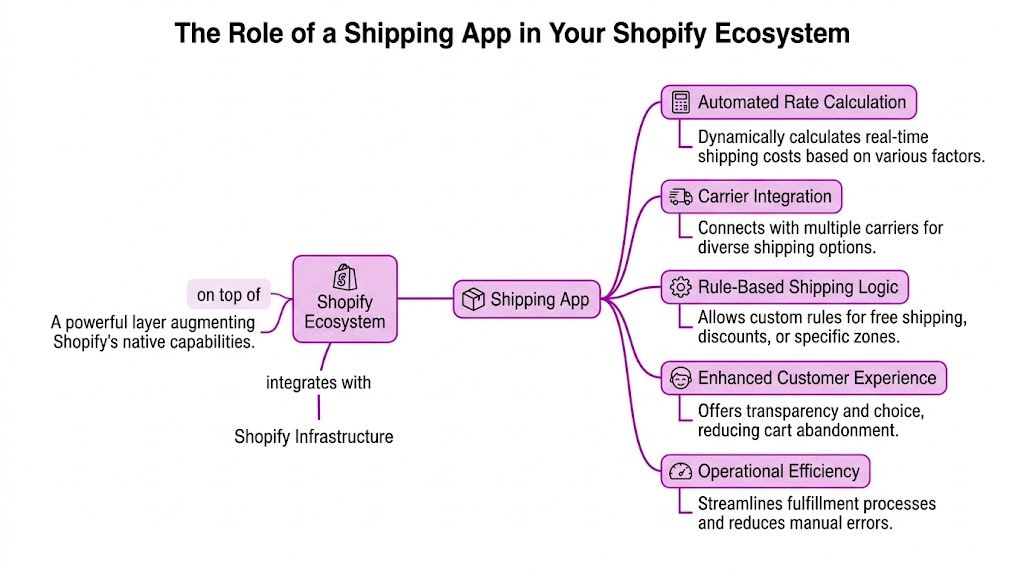
The easiest analogy is navigation. Native settings are the standard map that gets you from point A to point B. A shipping app is the live routing layer that reacts to traffic, road closures, and the route you need. It doesn't replace the road network. It makes the road network usable under real conditions.
That matters in an ecosystem this app-driven. Shopify has over 11,905 apps, and approximately 87% of merchants rely on apps to enhance store operations, including logistics and shipping, as noted in Shopify's shipping rates app category.
Where the app sits in practice
A shipping app usually acts as the decision engine between several moving parts:
- The storefront: It determines what shipping options the customer sees.
- The checkout logic: It decides which rules apply to the cart.
- Carriers and services: It pulls or structures rates based on service levels and destinations.
- Fulfillment operations: It supports label creation, routing, and downstream warehouse decisions.
If you're comparing options, this guide to Shopify Shipping Apps is useful as a category overview. For a more curated angle on specific solutions and use cases, this roundup of top shipping apps for Shopify helps frame the trade-offs.
What native shipping handles well and where apps take over
Native Shopify tools are often enough when your business looks like this:
- One warehouse
- A straightforward domestic strategy
- Similar-sized products
- Minimal exceptions
Apps take over when the business stops being uniform.
A shipping app earns its keep when your rates need to reflect reality, not averages.
That usually includes scenarios such as product-specific rules, zip-code restrictions, dimensional pricing, multi-location fulfillment, local delivery logic, and customer-facing delivery estimates. It also includes situations where finance wants tighter control over margin and operations wants fewer manual fixes.
The strategic shift
The right shipping app isn't just an operations add-on. It becomes part of how you merchandise. You can use it to support threshold offers, market-specific checkout experiences, and more predictable fulfillment workflows.
The wrong app does the opposite. It adds rule sprawl, overlap, and hidden failure points. That's why selection matters as much as functionality. The app has to fit the business model you have now and the one you're about to grow into.
Core Features That Drive Efficiency and Sales
Features only matter if they solve expensive problems. The strongest shipping apps do that by removing guesswork from pricing, reducing manual work in fulfillment, and making checkout feel more credible to the customer.
Advanced rate calculation
This is usually the first reason a brand installs a shipping shopify app. Basic shipping logic breaks when rates need to account for weight, product type, destination, box size, local delivery zones, or mixed carts.
Strong rate engines let you build rule layers instead of one-size-fits-all pricing. That means you can:
- Charge more accurately: Match the shipping fee to what the order costs to send.
- Protect margin on edge cases: Bulky items, remote zones, and multi-item carts stop slipping through underpriced.
- Reduce checkout friction: Customers see options that feel plausible for their basket and location.
If your store uses custom shipping logic, Shopify's CarrierService API allows developers to compute real-time rates at checkout through a callback flow described in this technical guide to custom shipping modules in Shopify. That matters most when off-the-shelf rules aren't enough and you need custom pricing behavior.
Automated label printing
The cost of manual label work isn't just staff time. It's also delay, typo risk, and inconsistency across channels or locations.
A good app shortens the path from paid order to packed shipment. Teams can create labels inside a cleaner workflow, avoid repetitive data entry, and standardize service selection. For stores shipping daily volume, that kind of operational compression matters more than flashy features.
The best implementations make label generation part of a repeatable system, not a task someone remembers to do.
Carrier integration
Not every order should move through the same carrier or service level. Domestic parcels, oversized items, local delivery, and cross-border shipments all need different logic.
Carrier integrations help you compare and structure choices around business priorities:
- Cost control: Useful when margin is thin or order values vary widely.
- Delivery speed: Important when customer expectation is time-sensitive.
- Service fit: Some carriers are better for certain package profiles or destinations.
More choice isn't automatically better. Stores get into trouble when they expose too many options to customers or route everything through the cheapest service without considering reliability.
Better carrier logic usually comes from fewer, better-defined options. Not a cluttered checkout.
Fulfillment and order routing
Once a brand adds multiple shipping locations or third-party partners, routing becomes as important as rate display. The app should help determine where an order should ship from and under what rules.
That can include:
- Location-based logic: Ship from the nearest or most suitable warehouse.
- Product-based splits: Route certain SKUs to specific fulfillment partners.
- Market handling: Keep domestic and international workflows separate where needed.
Without routing discipline, ops teams patch orders manually and customer promises become inconsistent.
Branded tracking experiences
Tracking pages don't get enough attention. Customers visit them at a high-intent moment, right after purchase, when they're engaged and looking for reassurance.
A useful shipping app can keep that experience inside your brand rather than handing it off to a generic carrier page. Done well, branded tracking reduces "where is my order?" support volume and gives your store another customer touchpoint that feels polished.
This matters less for a tiny store shipping low volume. It matters a lot once support cost and repeat purchase behavior are under scrutiny.
Returns management
Returns are part shipping workflow, part retention strategy. If the process is clumsy, customers remember the pain longer than the purchase.
Good shipping apps support cleaner returns operations by helping teams issue return labels, apply rules by product or region, and reduce ad hoc exceptions. The upside isn't only efficiency. A more controlled return flow also helps customer service respond with confidence instead of improvising.
What works and what doesn't
What works:
- Apps with clear rule hierarchy
- Tools that make testing easy before launch
- Setups that align checkout logic with fulfillment reality
- Interfaces your ops team will use daily
What doesn't:
- Rule stacks nobody documents
- Apps chosen only for a low entry price
- Over-customized setups with no audit process
- Carrier logic built around assumptions instead of package data
The practical standard is simple. If the app helps finance trust the margin, ops trust fulfillment, and customers trust checkout, it's doing its job.
Choosing the Right Shipping App for Your Business Stage
Most merchants choose a shipping app by scanning ratings and feature lists. That's not enough. The better approach is to choose based on the stage of complexity your business has already reached.
A startup can overbuy and end up paying for workflows it won't use. A scaling brand can underbuy and create a hidden tax on operations. The right decision starts with the business model, not the marketplace ranking.
Emerging brands
An emerging brand usually needs control before sophistication. The catalog may still be manageable, the warehouse setup is often simple, and the team wants fewer manual steps without introducing complexity it can't maintain.
At this stage, the best app does a few things well:
- makes shipping charges more predictable
- reduces manual label or rule work
- supports basic conditional logic without a technical project
- leaves room for growth
The trap here is installing an enterprise-grade app too early. If your team doesn't need layered conditions, routing logic, or complex international workflows yet, the app becomes shelfware. You pay for options instead of outcomes.
Scaling businesses
Shipping operations often incur significant expense. The product catalog broadens. Promotions interact with shipping thresholds. Multiple package profiles appear. Customer complaints become harder to trace back to a single setting.
A major issue at this stage is chronic undercharging caused by conflicting rate rules or misconfigured apps, a problem repeatedly raised in Shopify Community discussions about shipping undercharges. This is why scaling brands need apps with stronger auditing, diagnostics, and rule visibility.
The app isn't advanced because it has more toggles. It's advanced because your team can tell why a rate appeared and where it came from.
What matters now is control with clarity. You need logic that handles exceptions without hiding them.
Shopify Plus enterprises
Plus stores usually need shipping systems that reflect organizational complexity, not just store complexity. Multiple storefronts, regional policies, specialized fulfillment partners, and market-specific promises all influence app selection.
At this level, a shipping app should support:
- multi-location and multi-market workflows
- more flexible international handling
- custom integration paths where app defaults aren't enough
- stronger operational governance
The biggest mistake here is trying to force a mid-market app to behave like custom infrastructure. Sometimes that works for a while. Then the business adds more storefronts, more rules, and more exceptions, and the setup becomes fragile.
Shipping app needs by business stage
| Business Stage | Primary Focus | Essential App Capabilities |
|---|---|---|
| Emerging Brand | Stop margin leakage and replace manual work | Clear rate rules, easy setup, label support, simple conditional shipping logic |
| Scaling Business | Manage complexity without undercharging | Advanced rules, diagnostics, auditing tools, carrier flexibility, better rule visibility |
| Shopify Plus Enterprise | Coordinate shipping across complex operations | Multi-location support, international logic, integration flexibility, stronger governance and customization paths |
A practical decision filter
When comparing apps, ask these questions in order:
What shipping mistakes cost us money today?
Start with undercharging, overcharging, manual intervention, and support burden.What complexity is coming in the next year?
New markets, new fulfillment partners, or larger catalogs change what "fit" means.Who will own the app internally?
If ops owns it, the interface and rule visibility matter a lot. If development owns it, API flexibility matters more.Can we test and audit rules easily?
If the answer is no, expect hidden errors later.Will this app simplify the business or mirror its chaos?
Some tools allow every possible rule. That isn't always a strength.
The best shipping shopify app is rarely the one with the longest feature list. It's the one that fits your current stage cleanly, surfaces conflicts early, and doesn't need to be replaced the moment your business gets more demanding.
Your Implementation and Performance Checklist
Choosing the app is only half the job. A weak implementation can make a good app look unreliable, especially when rates conflict, carriers are mapped incorrectly, or no one has tested mixed-cart edge cases.
Before you install anything
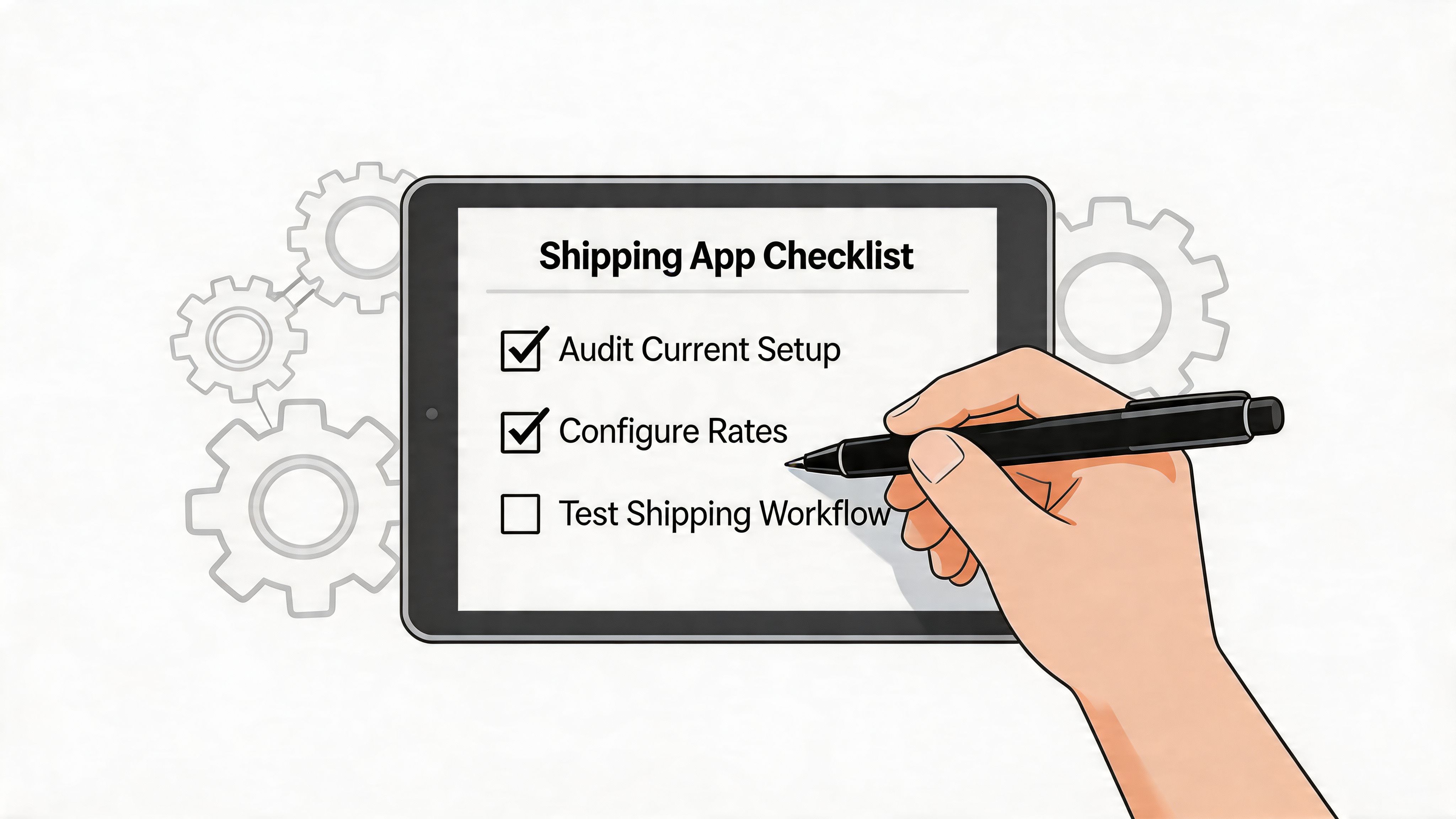
Start with an audit of your current shipping setup. Document every active profile, shipping zone, carrier service, discount interaction, and exception rule. If nobody can explain the current logic in plain language, don't layer a new app on top of it.
A practical reference point is this guide to Shopify shipping rates strategies, especially if you're cleaning up old settings before introducing a new app.
Use this pre-install checklist:
- Map your current state: List native rates, app-based rules, and any manual workarounds staff use.
- Review product data: Shipping weight, dimensions, and product-specific exceptions need to be trustworthy.
- Define your essentials: Decide what must work on day one, such as local delivery, free shipping thresholds, or international options.
During setup
Most problems happen because merchants try to build every scenario at once. Start with the smallest reliable ruleset that covers your highest-volume shipping cases. Then layer complexity carefully.
A cleaner setup process looks like this:
Connect the core carriers or services first
Don't activate every possible option. Build around the services you intend to offer.Create rule hierarchy deliberately
General rules should sit beneath product-specific or zone-specific exceptions. If the hierarchy is messy, rates will be too.Test mixed carts aggressively
Single-product tests rarely expose underlying issues. Mixed carts, edge destinations, and promo interactions are where failures show up.
Launching without mixed-cart tests is how brands discover shipping bugs through customer complaints instead of QA.
Migration tips when switching apps
Moving from one shipping app to another needs a short overlap period. Don't uninstall the old app before you've recreated its live logic and validated output.
Focus on these safeguards:
- Replicate before replacing: Rebuild essential rules in the new app first.
- Test customer-facing outputs: Confirm the same cart doesn't produce unexpected rate changes unless that change is intentional.
- Schedule the cutover carefully: Avoid switching during peak campaign periods or major promotional pushes.
Performance and technical quality
Shipping logic also affects site performance, especially when checkout depends on live rate calculations. If you're using a more custom architecture, Shopify's engineering approach emphasizes GraphQL-driven architecture, Remix-based checkout extensions, and separation between UI rendering and backend logic in Shopify Engineering's discussion of server-driven UI.
You don't need to build the app yourself to care about this. You do need to ask vendors or developers smart questions:
- How are rates calculated at peak traffic?
- What happens when a rate request fails?
- Can the logic be monitored and debugged without guesswork?
Fast, reliable shipping logic feels invisible to the shopper. Slow or inconsistent logic feels like checkout uncertainty, which is one of the quickest ways to lose intent.
Maximizing ROI and Conversions with Your Shipping App
Most merchants justify shipping apps on operational grounds. That's fine, but incomplete. A well-chosen shipping shopify app can also improve how customers evaluate your offer at the exact moment they're deciding whether to buy.
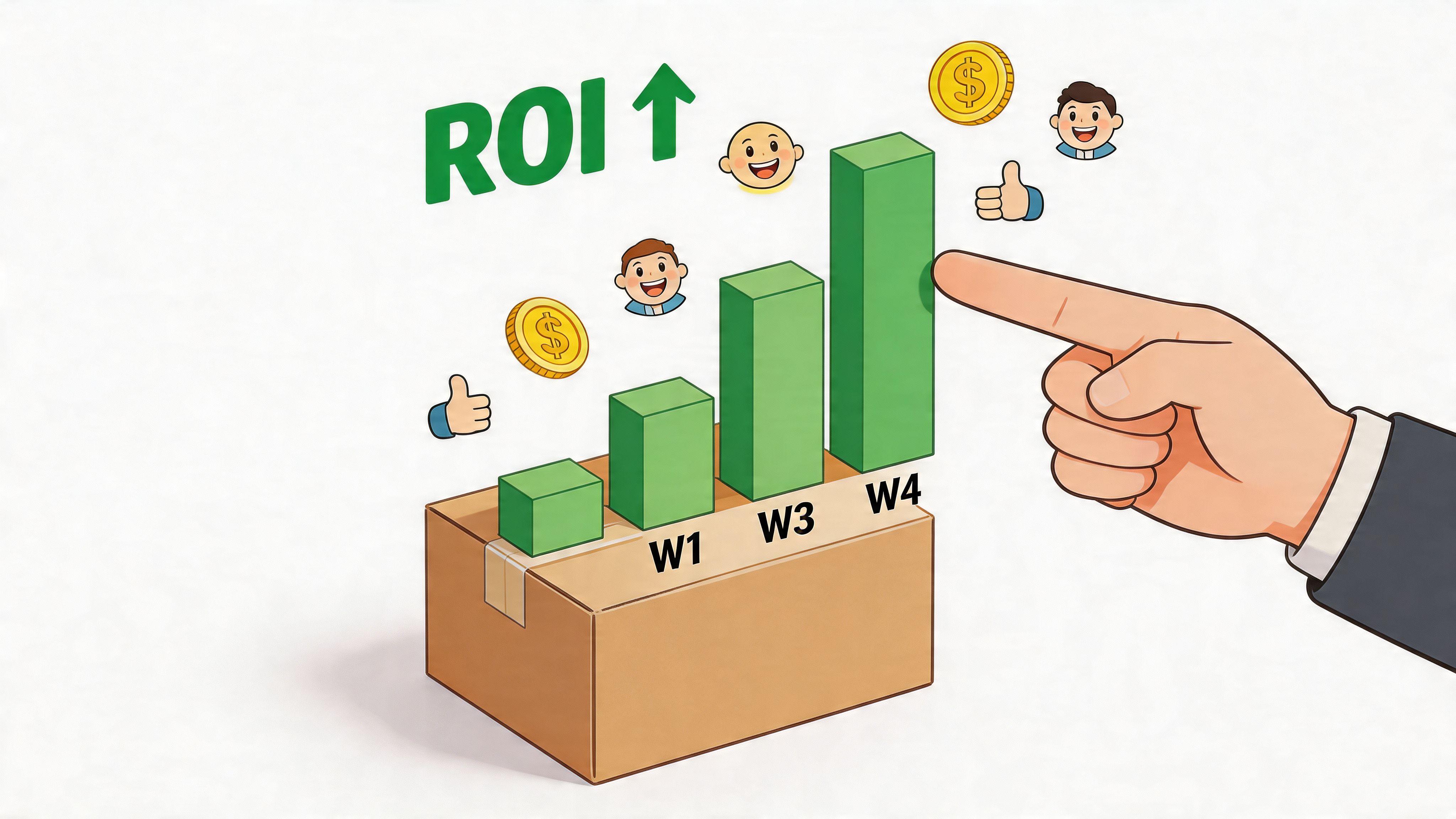
The commercial case is straightforward. Apps like Easyship claim users save 20-30% on shipping costs, and precise real-time rates plus international duties transparency can boost checkout completion by 15-25% in key markets according to Easyship's Shopify App Store listing.
Use shipping to remove doubt
Customers don't abandon because shipping exists. They abandon when shipping feels arbitrary, late, or unclear.
A strong app lets you reduce those moments of doubt by making rate presentation more believable and more transparent. That can mean showing better-calculated options, surfacing clearer delivery expectations, or handling cross-border charges in a way that doesn't surprise the buyer at the last step.
One of the cleanest wins here is international transparency. If a customer can't tell whether duties are covered, they often delay the purchase or walk away entirely.
Design offers around margin, not hope
Shipping promotions work when the economics are controlled. They fail when brands offer broad incentives without understanding product mix or fulfillment cost.
Use the app to create offers with boundaries:
- Threshold-based free shipping: Useful when you want to encourage larger baskets without offering blanket free delivery.
- Tiered service levels: Let customers choose between lower-cost slower options and faster delivery where it makes sense.
- Market-specific logic: Different regions often need different rules, especially when customs or delivery expectations vary.
The key is to use shipping incentives selectively. Don't assume the most generous option is the most profitable one.
Turn checkout from a negotiation into a decision
Shipping becomes a conversion tool when it helps the customer make a clear choice. Too many brands treat checkout as the place where cost gets revealed. Better brands use it as the place where confidence gets reinforced.
Customers tolerate shipping costs more easily when the logic is clear, the options are relevant, and the final landed price doesn't feel like a surprise.
A few practical plays work well:
- Show the right set of options: Not every customer needs every service level.
- Align promises with operations: Don't present delivery choices your team can't fulfill consistently.
- Reduce surprise for international buyers: Clear duties handling often matters as much as the rate itself.
Measure the right outcomes
If you only look at shipping spend, you'll miss the upside. Review shipping changes against business outcomes such as:
- checkout completion quality
- average order patterns after threshold changes
- support volume tied to shipping confusion
- margin consistency across common cart types
A shipping app offers strategic value. It doesn't just lower friction. It gives you a tighter commercial system where pricing, fulfillment, and customer expectation line up more consistently.
Top Shipping Shopify App Examples for 2026
The right app depends on the problem you're solving. Some brands need cleaner conditional logic. Others need better international handling. Others need box-level pricing accuracy that native settings won't deliver.
ShipEZ for accessible rule-based control
ShipEZ is a useful example of an app for merchants who need more flexibility without jumping straight into a highly customized setup. It holds a 4.8/5 star rating and offers a free starting plan, based on the Shopify app category information cited earlier.
That profile makes it worth considering for brands that are moving out of flat-rate simplicity and need more structured shipping logic. It fits best when the business wants to add nuance without creating a full technical project around shipping.
Parcelify for complex rate calculators
Parcelify stands out for merchants that need shipping logic tied closely to precise box sizes and carrier quotes, which is where many stores start to outgrow simpler tools. It's a better fit when dimensional realities matter and when a catalog includes products that don't ship well under generic rate assumptions.
This type of app tends to suit stores with varied package profiles, bundled orders, or products where carton logic changes the economics of fulfillment.
International and hybrid stacks
Some businesses won't solve shipping with one app alone. International checkout, duties visibility, local rules, and carrier comparisons can push merchants toward a hybrid stack, especially once they operate in more than one region.
If you're broadening your research beyond Shopify-native options, this roundup of the best shipping software for ecommerce is helpful for comparing how different shipping platforms approach broader fulfillment needs.
How to think about examples
Use named apps as reference points, not shortcuts.
- Choose ShipEZ-type apps when your problem is rule flexibility and easier operational control.
- Choose Parcelify-type apps when the problem is dimensional pricing and package accuracy.
- Choose international-focused tools such as Easyship-style platforms when duties transparency and cross-border clarity matter most.
The better question isn't "what's the best shipping app?" It's "which app matches the failure point in our current shipping model?" Once you answer that clearly, the shortlist gets much smaller and much more useful.
Transform Your Shipping from a Cost to a Competitive Edge
A shipping shopify app matters because shipping sits at the intersection of profit, conversion, and execution. When rates are inaccurate, customers hesitate and margins slip. When fulfillment logic is brittle, your team compensates with manual work. When international checkout lacks clarity, expansion gets harder than it should be.
The strongest brands don't treat shipping as a settings page they update occasionally. They treat it as a strategic system. That means choosing an app that matches the business stage, implementing it with disciplined testing, and using it to shape customer experience as much as operational efficiency.
If you're early, the right app helps you stop basic leakage. If you're scaling, it helps you control complexity before it becomes expensive. If you're on Shopify Plus, it becomes part of the infrastructure that supports multi-market growth.
The payoff isn't just lower friction in the warehouse. It's a cleaner checkout, more defendable margin, and a shipping experience that supports the brand instead of undermining it. That's where shipping stops being a cost center and starts becoming a competitive advantage.
If your brand needs help choosing, implementing, or optimizing a Shopify shipping setup, ECORN can support the full process from strategy and app selection to technical rollout and conversion-focused refinement.



Shopify Git Integration: A Developer's Guide to 2026
Headless Ecommerce Development Services Explained

How to Build a Shopify Clothing Website That Converts

How to Launch a Box Subscription Business in 2026

Luxury Skincare Branding Playbook That Converters

10 Best Podcast Ecommerce Shows for Store Growth in 2026

Shopify Developer Hourly Rate: What to Pay in 2026
Critical Shopify Setup Errors That Are Secretly Sabotaging Your Store
Ecommerce Conversion Tracking: The Complete How-To Guide

Shopify Design Agency: How to Pick the Right Partner
Mastering Multi Store Management on Shopify

Scale Shopify Store

10 Shopify App Ideas Worth Building in 2026
Conversion Rate Optimization for Landing Pages: The Playbook
Shopify Plus Automation: A Guide for 2026
10 Social Selling Platforms for Shopify Merchants

Shopify Website Design Examples: 7 Stores Worth Studying

7 Ecommerce Newsletter Examples for Shopify Brands
One Product Shopify Store: Build and Scale

Mobile Pop Up Strategy for Shopify Stores That Converts

Sitemap for Shopify: How to Find, Optimize, and Submit It

7 Single Product Websites Worth Emulating

Product Variants Shopify: The Complete 2026 Guide
Ecommerce Analytics Consulting for Growth
What Is AI Integration for eCommerce

How to Choose the Right eCommerce Website Development Firm

E Business Strategy Implementation
Conversion Tracking Setup for Shopify Stores
BigCommerce vs Shopify Plus Which Enterprise Wins in 2026
Shopify Theme Kit: Setup, Commands, and Migration Guide

Shopify Extension Development: A Practical 2026 Guide

Shopify Speed Score Explained and How to Improve It

Shopify Mobile Optimization: The 2026 Playbook

How to Add Subcategory in Shopify for Better UX
How to Implement Structured Data for Ecommerce in 2026

SEO App Mobile: Shopify Store Optimization Guide

Shopify Plus Support: What It Includes and How to Choose

Google Ads for Shopify: The Complete 2026 Playbook

Shopify New York: How to Find and Hire the Right Agency

Google Search Console for Shopify: The Complete Setup

First Party Data Collection for eCommerce Growth

FAQ Online Store Guide: Build and Measure It Right
Do FB Ads Work for eCommerce in 2026?

One Page Checkout for Shopify: Design and Implementation

Shopify GraphQL vs REST: The 2026 Developer Decision
Shopify Ecommerce Consulting: Strategy, Pricing &

Are Reddit Ads Worth It for eCommerce Brands

Shopify Title and Meta Description: A Practical 2026 Guide

Product Video Best Practices for Shopify Brands

Real-Time Inventory Management: A 2026 Guide

AI Chatbot Integration for Shopify Stores

Affiliate Program Management: A Shopify Guide
10 Best Performance Monitoring Tools for Shopify in 2026

Digital Asset Management for eCommerce Brands in 2026

Every Type of Facebook Ads Explained for eCommerce Growth
Product Information Management Explained for Shopify Brands
Support Ticket System: A Guide for Shopify Stores

10 Best Customer Service Tools for Shopify in 2026

Can I Start a Business with No Money? a 2026 Blueprint

What Sells Good on Etsy: Best Niches for 2026

Shopify Add to Cart Button: A Practical 2026 Guide

Customer Feedback Automation: A Practical eCommerce Guide

Critical Rendering Path: A Guide for Shopify Stores

How to Promote on TikTok for eCommerce in 2026

B2B eCommerce Consulting That Drives Real Revenue

10 Best Practices for Site Navigation in 2026
Return vs Refund for Shopify Stores: A Practical Guide

What Is Customer Lifetime Value and Why It Matters

What Is Voice of Customer Research for eCommerce

SMS Marketing for Ecommerce That Actually Converts

Master How to Improve Email Deliverability in 2026

Top 8 eCommerce Partners NYC for Shopify Brands in 2026

Machine Learning for Ecommerce: Boost Your Shopify Store

Beauty Market Research: Your 2026 Growth Guide

Shopify International Expansion: A 2026 Roadmap

What Does CRO Stand for in Business: Understanding CRO

Shopify Visual Merchandising: A Playbook for Higher Sales

Shopify Landing Page Design: Master Conversion in 2026

10 Best AI SEO Optimization Tools for Shopify in 2026

Agentic AI for Ecommerce: Boost Your Sales in 2026
Mastering Email Marketing Data for eCommerce Growth

Conversion Rate Optimisation Australia: Boost Your Sales
Conversion Rate Optimization AI: Your Shopify Store Guide

10 Product Bundling Strategies for Shopify in 2026

How to Increase Customer Lifetime Value: A Shopify Playbook

AI Customer Service Automation: Shopify Guide 2026

Clean Website Design: A Shopify Conversion Playbook

Omnichannel Retail Strategy: A Shopify Playbook

Product Data Enrichment: A Guide for Shopify Brands

Instagram Shopping Features a Guide for Shopify Stores

What Is Revenue Optimization: A Holistic RevOps Guide

Benefits of Conversion Rate Optimization: Boost Your
WordPress to Shopify Migration: Your 2026 Seamless Switch
Boost Sales: Ecommerce Payment Processing Guide 2026
Unified Commerce Platform: Benefits, KPIs & Shopify Guide

How to Reduce Bounce Rate eCommerce: Your 2026 Guide
Shopify API Integration: A Practical End-to-End Guide

How to Implement Data Governance: A 2026 Guide

Shopify Store Development Cost: A 2026 Breakdown
What Is Server Side Tracking: The Shopify Guide 2026


newsletter in your inbox