

So you want to launch a beauty products ecommerce brand. It’s tempting to jump straight into the fun stuff—picking a Shopify theme, designing a gorgeous logo, and imagining the sales notifications rolling in.
But the brands that actually make it? The ones that stick around and build a loyal following? They don’t start there. They start with the hard, unglamorous work of building a strategic foundation long before a single product goes live.
Building Your Brand Before You Build Your Store
I’ve seen too many aspiring entrepreneurs fall into this trap. They get fixated on logos and color palettes, only to realize months later that they don’t have a clear audience, a unique reason to exist, or a viable financial model.
Think of it this way: building a brand without a strategy is like building a house without a foundation. It might look impressive for a hot minute, but it’s only a matter of time before serious cracks start to show. This early phase is where you do the deep thinking that separates a flash-in-the-pan trend from a sustainable business.
Finding Your Niche in a Crowded Market
Let's be real: the beauty industry is massive. It's on track to be worth over $750 billion by 2026, which means it’s both incredibly lucrative and brutally competitive. You can't just launch another generic "skincare" brand and expect to stand out. You have to find your corner of the market.
Your first job is to pinpoint a real, underserved need. Instead of going broad, drill down. Look at the trends that have genuine staying power and a passionate, built-in audience.
- Neurocosmetics: Think products targeting the skin’s response to stress.
- Waterless Formulas: Highly concentrated, eco-friendly products that resonate with sustainable shoppers.
- Microbiome-Friendly Skincare: Formulations that work with the skin's natural ecosystem, not against it.
- Truly Inclusive Shade Ranges: Going far beyond the token offerings to authentically serve every skin tone.
When you focus on a specific niche, you aren't just selling a product; you're telling a specific group of people, "I see you." This makes your marketing infinitely more effective and helps you cultivate a community from day one. You can learn more about how to do this effectively by exploring how to create a brand identity that truly resonates.
Sourcing and Compliance: The Non-Negotiables
Once you’ve locked in your niche, the focus shifts to the product itself. Whether you’re cooking up your own formulas or partnering with a private-label manufacturer, compliance is everything. In the U.S., the Food and Drug Administration (FDA) calls the shots, and your products must play by their rules.
The biggest legal hurdles for any new beauty brand are almost always product safety and labeling. You have to ensure your products are safe, don’t contain prohibited ingredients, and are labeled correctly under regulations like the Fair Packaging and Labeling Act (FPLA). Getting this wrong can lead to crippling fines or recalls.
This simple flowchart breaks down the foundational process: identify a market gap, source your product correctly, and then build a financial plan around it.

Notice how financial planning and product sourcing are outcomes of finding your market opportunity—they aren’t just random tasks on a to-do list. To get this right, it helps to see how others have done it. This detailed checklist to launch a hair brand is a great resource, as many of the principles apply universally.
Your financial forecast is your dose of reality. It needs to cover everything from your first batch of inventory and packaging to what you’ll spend on marketing for the first three months. Don't skip this.
Designing a High-Converting Shopify Experience
Think of your Shopify store as your digital flagship. It’s the first handshake, the place you tell your story, and ultimately, where customers decide to buy from you. In the cutthroat world of beauty products ecommerce, a generic, clunky template just won't fly. You need a deliberate mix of brand personality, blazing-fast speed, and a user experience that feels completely intuitive.
And this digital storefront has never been more critical. The shift to online beauty is staggering—online sales are climbing nine times faster than traditional retail in key markets. Just last year, we saw North American online beauty sales jump by +21%, with the Asia Pacific region close behind at +20%. Even the more established European markets saw a solid +10% growth.
Much of this boom is fueled by platforms like TikTok Shop, which has exploded as a go-to spot for cosmetics and fragrances. The numbers don't lie; you can dig deeper into this trend in the full state of beauty report for 2025.
Choosing a Theme That Performs
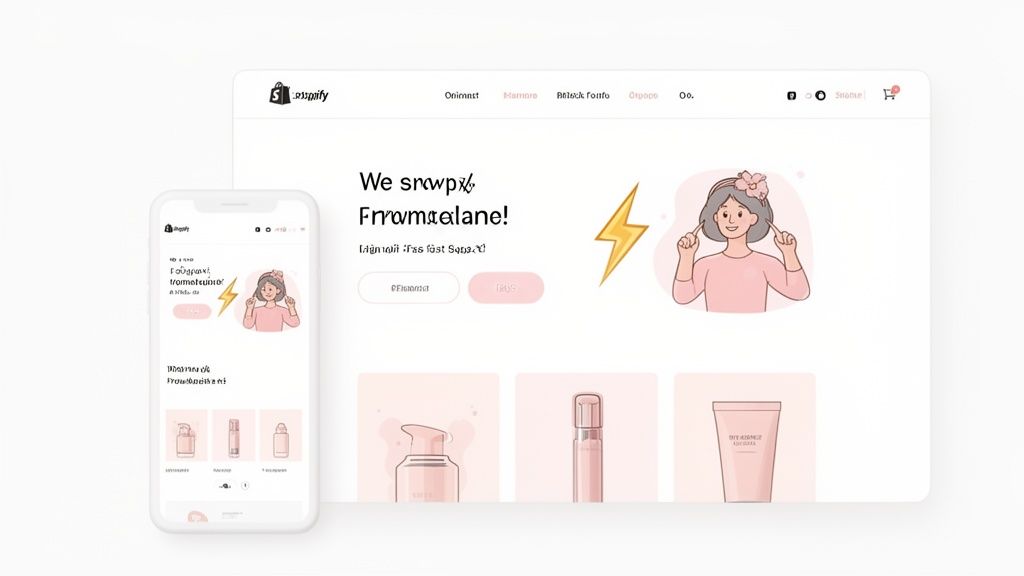
Your Shopify theme is the skeleton of your entire store. While looks are important, the two things you absolutely must filter for are speed and a mobile-first design. With over 70% of ecommerce traffic coming from phones, a theme that looks clunky or loads slowly on mobile is a non-starter.
When you're shopping for a theme, here’s what to zero in on:
- Lightweight Code: Bloated themes packed with features you’ll never use will drag your site down. This hurts your SEO and kills conversions.
- Mobile Responsiveness: Pull up the theme demo on your own phone. Does it load in a snap? Can you easily navigate with one thumb? Is everything clear and readable?
- Customization Flexibility: You need a theme that lets your brand’s unique voice shine through without having to call a developer for every tiny tweak. Look for flexible color palettes, font options, and layout controls.
A fast, mobile-ready theme isn't a "nice-to-have." It’s the cost of doing business online in 2026. A slow site is a frustrating site, and frustrated visitors don't become customers.
Crafting a Frictionless Customer Journey
Once you’ve got a solid theme in place, the real work starts. The goal is simple: get people from the homepage to the checkout page with zero hassle. Every single click needs to feel natural and logical, guiding them smoothly toward making a purchase.
Map out the typical path someone takes. They land, browse, filter, look at a product, add it to their cart, and pay. You have to optimize every single one of those touchpoints.
I see this mistake all the time: over-complicated navigation. If a customer can't figure out where to find what they want in a few seconds, they're gone. Your main menu should be clean, simple, and reflect how your customers think—not how you organize your warehouse.
For a beauty store, this means getting granular with your filtering. You need to let customers shop in a way that mirrors their real-life thought process.
Advanced Filtering Options to Implement:
- Filter by Concern: Let them shop for solutions to problems like acne, dryness, fine lines, or hyperpigmentation.
- Filter by Ingredient: Your most informed customers are looking for (or avoiding) specific ingredients like retinol, hyaluronic acid, or parabens. Make it easy for them.
- Filter by Skin Type: This is table stakes. You must have options for oily, dry, combination, and sensitive skin.
This kind of detailed filtering makes the experience feel genuinely helpful and personal. It builds trust and points customers directly to the products that are right for them.
Building Community with Essential Apps
The best stores do more than just sell stuff; they build a community around the brand. The Shopify App Store is a goldmine for tools that can help you do this, but you have to be strategic. Piling on too many apps will slow your site to a crawl.
Instead, pick a handful of key integrations that add real, tangible value:
- Product Reviews: Apps like Judge.me or Loox are non-negotiable for social proof. Nothing sells a product better than authentic reviews and photos from real customers.
- Loyalty and Rewards: A simple points-based loyalty program gives people a reason to come back and makes them feel like valued members of your brand's world.
- Wishlists: This feature is a win-win. It lets customers save items for later, which cuts down on abandoned carts, and it gives you priceless data on what products are in high demand.
By picking a high-performance theme, obsessing over a frictionless customer journey, and adding a few smart apps, you can turn a basic Shopify store into a true conversion engine. This is the foundation you need to build a powerhouse beauty brand.
Winning Over Customers Who Truly Love Your Brand
Alright, your Shopify store is live, your products look fantastic, and your brand story is ready to go. Now for the real challenge: getting a steady stream of the right kind of customers. Just flipping the switch and opening your digital doors isn't going to cut it. You need a smart, multi-channel marketing plan that draws in visitors who will actually connect with and buy what you're selling.
Forget the old "spray and pray" method of casting a wide, expensive net. In beauty products ecommerce, success comes from targeted, authentic marketing that builds real trust and delivers a clear return on your investment. This means moving beyond a simple ad budget and building an entire marketing ecosystem where every channel works together.

The online beauty space isn't just growing; it's changing how people shop. By 2030, ecommerce is on track to grab about 33% of the entire global beauty market. The industry itself is projected to hit a staggering $677 billion, largely powered by online-first brands.
What's really interesting is that only 14% of U.S. buyers believe high price equals high quality. They care more about value and results they can see. This is a massive opportunity for brands that can prove their products work. You can get a clearer picture of this shift by exploring the latest beauty industry's e-commerce statistics.
To give you a better sense of where to focus your efforts, here’s a breakdown of the most effective channels we see working for beauty brands in 2026.
Effective Marketing Channels For Beauty Ecommerce
| Channel | Primary Use Case | Key KPIs | Best For |
|---|---|---|---|
| Content Marketing/SEO | Building authority, solving problems, and attracting organic traffic. | Organic Traffic, Keyword Rankings, Time on Page, Leads Generated | Early-stage brands building a foundation; mature brands reinforcing expertise. |
| Social Commerce | Driving impulse buys and building community through visual storytelling. | Conversion Rate (from social), Engagement Rate, Reach | Brands with visually appealing products and a clear target demographic on platforms like TikTok and Instagram. |
| Influencer Marketing | Generating authentic social proof and reaching niche audiences. | ROAS (from affiliate codes), CPE (Cost Per Engagement), Traffic from Links | New brands needing quick credibility; established brands launching new products. |
| Email & SMS Marketing | Nurturing leads, driving repeat purchases, and recovering abandoned carts. | Open Rate, Click-Through Rate, Conversion Rate, Customer Lifetime Value (CLV) | All stages, but especially crucial for building loyalty and maximizing revenue from existing customers. |
| Paid Social Ads | Targeting specific demographics with visual ads to drive top-of-funnel awareness and direct sales. | ROAS, CPA (Cost Per Acquisition), CTR (Click-Through Rate) | Brands ready to scale and with a validated product-market fit. |
Choosing the right mix depends on your budget and stage of growth, but a combination of these channels creates a powerful engine for acquiring and keeping customers.
Become an Authority with Content Marketing
One of the best ways to attract your ideal customer is by solving their problems before you ever ask them to buy something. Content marketing makes you a trusted expert, not just another store. This is where you can really set your brand apart.
Don't just churn out generic posts. Create content that delivers real value to your specific audience.
- Ingredient Deep-Dives: Create blog posts or short videos explaining the science behind popular ingredients like niacinamide or bakuchiol.
- Routine Tutorials: Show people exactly how to layer your products for the best results, with specific guides for different skin types or concerns.
- Busting Beauty Myths: Tackle common industry misinformation. This builds incredible credibility and trust.
This educational-first mindset is the backbone of a modern strategy. You can find more practical ideas in our complete guide to marketing for beauty brands.
Your content's goal shouldn't be to go viral. It should be to become the go-to resource for a very specific person with a very specific problem that your product solves. That is how you build a loyal following.
When someone searches "serums for hormonal acne" and your in-depth guide pops up, you've already won half the battle. They now see you as a helpful authority, which makes them far more likely to trust—and purchase—your product recommendation.
Master Social Commerce and Influencer Partnerships
Social media isn't just for discovery anymore; it's a full-blown point of sale. Platforms like Instagram and TikTok have built-in shopping features that let a user go from watching a routine video to checking out in just a few taps.
For a new beauty brand, teaming up with influencers is one of the fastest routes to getting authentic social proof. The trick is to look past follower counts and zero in on genuine engagement.
Focus on Micro-Influencers (10k-100k followers): These creators typically have a much more dedicated and trusting audience. A recommendation from them feels less like a paid ad and more like a tip from a friend, which is gold for beauty products.
Make sure your partnerships are structured for a clear ROI. Give influencers unique discount codes or affiliate links so you can track the sales they drive directly. And don't just pay for a single post—negotiate a package that includes stories, videos, and high-quality photos you can repurpose on your own channels and website.
Nurture and Convert with Email Marketing
Even in 2026, email marketing delivers one of the highest ROIs of any channel. It's your direct line to your most engaged leads and loyal customers. A well-designed email strategy can guide potential buyers, win back lost sales, and build serious long-term loyalty.
Go beyond the standard weekly newsletter and set up automated email flows that trigger based on what a user does.
- Welcome Series: This is your first impression. Introduce new subscribers to your brand story, show off your best-sellers, and maybe offer a small incentive for their first order.
- Abandoned Cart Flow: A simple sequence of 2-3 emails reminding a customer about the items they left behind can recover a huge chunk of otherwise lost revenue. Personalize it with images of the exact products in their cart for extra impact.
- Post-Purchase Follow-Up: Check in after the order arrives. Offer tips on how to use the product and, crucially, ask for a review to build up that all-important social proof.
By weaving together authoritative content, smart social commerce, and targeted email marketing, you build a powerful customer acquisition machine that not only brings the right people to your brand but keeps them coming back for more.
Turning Visitors Into Lifelong Customers
Getting people to your beauty products ecommerce store is one thing. But turning those first-time visitors into paying customers—and then into loyal fans who come back again and again—is a whole different ballgame. This is where the truly sustainable brands are built.
It’s a mix of art and science, really. You have to create a shopping experience that’s both effortless and trustworthy. Just having amazing products won't cut it anymore; the path to purchase has to be completely seamless.
The numbers don't lie. The global beauty eCommerce market is exploding, on track to hit a staggering $257.5 billion by the end of 2025. E-commerce now drives over 35% of all beauty sales, with the skincare category alone projected to become a $177 billion powerhouse. Nailing your digital experience isn't just a nice-to-have, it's essential for survival. You can read more about this massive market shift and what it means for brands like yours in these insights on beauty ecommerce sales growth.

Building Unshakeable Trust with Social Proof
In the beauty world, trust is your most valuable currency. Customers are putting these products on their skin and hair, so they need to feel completely confident before they click "buy." This is where social proof becomes your most powerful salesperson.
Authentic customer reviews are an absolute must. Using a Shopify app like Judge.me or Loox is a great start. Don’t just collect star ratings; actively prompt customers to upload photos of themselves using the products. Seeing a serum or foundation on real people with different skin types and tones is incredibly convincing.
I always tell my clients to put user-generated content (UGC) front and center on their product pages and homepage. A single glowing review with a customer’s photo is worth more than a dozen polished ad campaigns. It immediately signals to new visitors, "Hey, people just like you already love this."
And don't just let those reviews sit there. Make a point to engage with them. Thank people for the positive feedback and, more importantly, publicly address any negative experiences with a helpful solution. This shows everyone you're a brand that listens and genuinely cares.
Using AI To Create Personalized Experiences
The days of one-size-fits-all shopping are over. Today's beauty customer expects a personal touch. They want to feel like you get them—whether they're searching for the perfect foundation shade or a serum for their tricky combination skin.
This is where AI-driven tools can make a huge difference for your Shopify store.
- Virtual Try-On (VTO): For makeup like lipstick and eyeshadow, VTO is a game-changer. It lets customers use their phone's camera to see what a shade looks like on them in real time. This seriously cuts down on purchase anxiety and gives conversion rates a nice bump.
- AI-Powered Quizzes: A "Find Your Routine" quiz is a fantastic way to engage shoppers. Ask a few questions about their skin type, concerns, and goals. The quiz can then serve up a curated set of product recommendations, making the customer feel seen and understood.
- Personalized Recommendations: Go beyond the basic "Customers also bought" widgets. More advanced AI can look at a user's browsing patterns, past purchases, and even quiz answers to suggest other products they’re genuinely likely to love.
These tools turn a passive browsing session into an interactive consultation, guiding customers to the right products and building their confidence in your brand.
Boosting Lifetime Value with Subscriptions
Here’s a stat every store owner should know: acquiring a new customer can cost up to five times more than keeping an existing one. This is why a solid retention strategy is the key to long-term profitability. For consumable beauty products, subscriptions are a goldmine for boosting Customer Lifetime Value (CLV).
Simply offering a "Subscribe & Save" option on essentials like cleansers, moisturizers, or serums creates a predictable, recurring revenue stream. A 10-15% discount is a common and highly effective incentive to get customers to sign up.
The trick is to make your subscription program incredibly flexible. Customers should be able to easily:
- Change their delivery frequency
- Swap out products in their next shipment
- Skip a delivery or pause their subscription
You want the program to feel like a convenience, not a commitment they're trapped in. When done right, a subscription model turns one-off buyers into a reliable source of income for your business.
Finally, a well-designed loyalty program is the glue that can hold your customer community together. Take a look at highly successful examples like the Starbucks Rewards program for inspiration on how to build a truly dedicated following. By rewarding customers for repeat purchases, reviews, and social shares, you give them every reason to stick with you for the long haul.
Scaling Your Operations and Tech Stack
Rapid growth is what every beauty products ecommerce brand dreams of. But that dream can turn into a logistical nightmare if your backend systems can’t keep up. When a flood of orders overwhelms your operations, you get shipping delays, stockouts, and unhappy customers—the very things that can kill a growing brand.
Scaling isn't just about getting bigger; it's about getting smarter. You need an operational framework and tech stack that can grow with you, not hold you back. The real goal is to build a system so efficient that your customers only ever see a flawless experience, completely unaware of the complex machinery humming behind the scenes.
Mastering Your Inventory and Fulfillment
When you're starting out on a single Shopify store, managing inventory is pretty straightforward. The real trouble begins when you expand. Add channels like TikTok Shop, Amazon, or a retail partner into the mix, and inventory management becomes a massive headache. Overselling a product on one channel because your systems didn't sync fast enough is a classic—and costly—scaling mistake.
This is exactly why a centralized inventory management system is non-negotiable. You need a tool that syncs your stock levels in real-time across every single sales channel. This is the only way to prevent stockouts and confidently sell your products wherever your customers are.
Just as critical is your fulfillment strategy. A customer's experience with your brand doesn't end when they click "buy." It ends when the product is in their hands. A slow or sloppy shipping process can completely undermine an otherwise perfect brand experience.
Choosing your fulfillment partner is one of the most critical decisions you'll make as you scale. Your brand's reputation for quality and care is literally in their hands. A premium unboxing experience can turn a one-time buyer into a lifelong advocate.
As you grow, you'll likely evaluate these fulfillment options:
- In-House Fulfillment: This gives you total control over the packaging and customer experience, which is great early on. But it quickly becomes a bottleneck and a major resource drain at high volumes.
- Third-Party Logistics (3PL): Outsourcing to a 3PL frees up your time and lets you tap into their ability to handle massive order volumes. Just be sure to vet them carefully. They need to meet your standards for packaging, quality control, and shipping speed.
Knowing When to Upgrade to Shopify Plus
The standard Shopify plans are fantastic for launching and getting your brand off the ground. But there will come a point where high order volume and the need for more sophisticated customization will have you eyeing its enterprise solution, Shopify Plus.
So, how do you know when it’s time to make the jump? Look for these signs:
- High-Volume Sales: You're consistently processing thousands of orders, especially during peak seasons like Black Friday. You simply can't afford downtime and need a platform that guarantees performance under pressure.
- Need for Customization: You're hitting the limits of what you can do. You want to deeply customize your checkout or automate complex business rules that standard Shopify can't handle.
- International Expansion: You're selling in multiple countries and need separate storefronts for different languages, currencies, and product catalogs—all managed from a single, unified dashboard.
Shopify Plus is a serious investment, but for a fast-scaling beauty brand, it provides the bulletproof infrastructure needed for enterprise-level traffic and sales. It also unlocks powerful tools like Shopify Flow for task automation and Launchpad for scheduling sales and product drops.
Building a Scalable and Integrated Tech Stack
Your tech stack is simply the collection of software you use to run your business. A good stack makes data flow seamlessly between your key functions—marketing, customer service, and finance. A bad one creates data silos and endless manual work, slowing you down right when you need to be moving fastest.
Think of it like this: your tools need to talk to each other. Your customer service platform should instantly pull up order history from Shopify. Your marketing tool should use that same customer data to create hyper-personal campaigns.
Here’s what a core stack for a scaling beauty brand often looks like:
| Business Function | Tool Category | Example |
|---|---|---|
| Customer Service | Help Desk Software | Gorgias, Zendesk |
| Marketing | Email & SMS Automation | Klaviyo, Attentive |
| Finance | Accounting & Reporting | QuickBooks, Xero |
| Analytics | Data Visualization | Glew.io, Looker Studio |
Integration is the magic word here. When all your tools are connected, you create a powerful, unified system that supports your growth instead of getting in the way. This is the operational backbone that allows you to keep your promises to customers as you scale.
Common Questions About Selling Beauty Online
When you’re diving into the world of beauty ecommerce, the questions can feel endless. It's an exciting path, but let's be real—it's also packed with industry-specific hurdles. Over the years, I've seen founders grapple with the same core challenges.
Here are the straight answers to the questions I hear most often, designed to help you sidestep common mistakes and build your brand the smart way from day one.
What Are The Biggest Legal Hurdles?
Without a doubt, the biggest legal headaches for new beauty brands come down to product safety and labeling. In the US, for example, the FDA doesn't mess around, and you have to play by their rules.
You are 100% responsible for making sure your products are safe, don't contain any prohibited ingredients, and are labeled correctly under the Fair Packaging and Labeling Act (FPLA). That means every single ingredient needs to be listed in order of concentration, and the net quantity of your product has to be spot-on.
A rookie mistake that can sink a brand before it even gets started? Making unproven medical claims. Saying your cream "treats eczema" or "cures acne" turns your cosmetic into a drug in the eyes of regulators. That triggers an entirely different—and much more expensive—approval process.
Make it a non-negotiable to only work with manufacturers who follow Good Manufacturing Practices (GMP). I also can't stress this enough: talk to a lawyer who specializes in consumer product law before you launch. That upfront investment can save you from crippling fines or a forced recall later.
How Much Capital Do I Realistically Need To Start?
This is the million-dollar question, and the answer varies wildly. You could technically get a dropshipping brand off the ground for a few thousand dollars. Or, you could need north of $50,000 if you’re creating a completely custom-formulated line from scratch.
For most small, private-label brands I see, a realistic starting budget lands somewhere in the $15,000 to $30,000 range. This covers the essentials and leaves you a little breathing room.
So, where does that cash actually go?
- Product Development & Sourcing: This will be your biggest line item, typically running from $5,000 to $25,000+.
- Branding & Packaging Design: For a polished, professional look, plan on spending $2,000 to $10,000.
- Shopify Store & Theme: This can be as low as $200 for a great premium theme or climb to $5,000+ for custom development work.
- Product Photography & Videography: Don't skimp here. Budget at least $1,000 to $7,000 for visuals that sell.
- Initial Marketing Budget: You need fuel to launch. Set aside $3,000 to $15,000 for your first 3 months of promotion.
To make those upfront costs more manageable, a lot of brands find success by starting lean. Launch with a single, incredible "hero" product. Prove the concept, get revenue flowing, and then expand your collection.
Should I Use Influencer Marketing For My New Brand?
Yes, but you have to be smart about it. For a new beauty brand, there's almost no faster way to generate social proof and get in front of the right people. The secret, though, is to chase authenticity, not just a massive follower count.
Forget about trying to land a mega-influencer right out of the gate. Your energy and budget are much better spent on micro-influencers (think 10k-100k followers). These creators have built incredibly engaged niche audiences who trust their recommendations implicitly. An endorsement from them feels less like an ad and more like a genuine tip from a friend.
When you set up these campaigns, be crystal clear about your goals. Define the deliverables you expect—like a specific number of posts, stories, or high-quality user-generated content (UGC) that you can then use in your own ads and social feeds.
A great way to test the waters is by simply gifting your product for review. Many micro-influencers are open to this, and it’s a low-cost way to start building relationships. Just make sure you track everything with unique discount codes or affiliate links so you can see exactly what's working.
At ECORN, we specialize in transforming ambitious beauty brands into high-growth Shopify powerhouses. Whether you need expert CRO, scalable development, or strategic consulting, our team is ready to help you navigate every stage of your journey. Discover how our flexible subscription packages can elevate your brand.


10 Social Selling Platforms for Shopify Merchants
Shopify Website Design Examples: 7 Stores Worth Studying
7 Ecommerce Newsletter Examples for Shopify Brands
One Product Shopify Store: Build and Scale
Mobile Pop Up Strategy for Shopify Stores That Converts
Sitemap for Shopify: How to Find, Optimize, and Submit It
7 Single Product Websites Worth Emulating
Product Variants Shopify: The Complete 2026 Guide
Ecommerce Analytics Consulting for Growth
What Is AI Integration for eCommerce
How to Choose the Right eCommerce Website Development Firm
E Business Strategy Implementation
Conversion Tracking Setup for Shopify Stores
BigCommerce vs Shopify Plus Which Enterprise Wins in 2026
Shopify Theme Kit: Setup, Commands, and Migration Guide
Shopify Extension Development: A Practical 2026 Guide
Shopify Speed Score Explained and How to Improve It
Shopify Mobile Optimization: The 2026 Playbook
How to Add Subcategory in Shopify for Better UX
How to Implement Structured Data for Ecommerce in 2026
SEO App Mobile: Shopify Store Optimization Guide
Shopify Plus Support: What It Includes and How to Choose
Google Ads for Shopify: The Complete 2026 Playbook
Shopify New York: How to Find and Hire the Right Agency
Google Search Console for Shopify: The Complete Setup
First Party Data Collection for eCommerce Growth
FAQ Online Store Guide: Build and Measure It Right
Do FB Ads Work for eCommerce in 2026?
One Page Checkout for Shopify: Design and Implementation
Shopify GraphQL vs REST: The 2026 Developer Decision
Shopify Ecommerce Consulting: Strategy, Pricing &
Are Reddit Ads Worth It for eCommerce Brands
Shopify Title and Meta Description: A Practical 2026 Guide
Product Video Best Practices for Shopify Brands
Real-Time Inventory Management: A 2026 Guide
AI Chatbot Integration for Shopify Stores
Affiliate Program Management: A Shopify Guide
10 Best Performance Monitoring Tools for Shopify in 2026
Digital Asset Management for eCommerce Brands in 2026
Every Type of Facebook Ads Explained for eCommerce Growth
Product Information Management Explained for Shopify Brands
Support Ticket System: A Guide for Shopify Stores

10 Best Customer Service Tools for Shopify in 2026

Can I Start a Business with No Money? a 2026 Blueprint
What Sells Good on Etsy: Best Niches for 2026

Shopify Add to Cart Button: A Practical 2026 Guide

Customer Feedback Automation: A Practical eCommerce Guide
Critical Rendering Path: A Guide for Shopify Stores

How to Promote on TikTok for eCommerce in 2026

B2B eCommerce Consulting That Drives Real Revenue
10 Best Practices for Site Navigation in 2026
Return vs Refund for Shopify Stores: A Practical Guide
What Is Customer Lifetime Value and Why It Matters
What Is Voice of Customer Research for eCommerce

SMS Marketing for Ecommerce That Actually Converts

Master How to Improve Email Deliverability in 2026
Top 7 eCommerce Partners NYC for Shopify Brands in 2026
Machine Learning for Ecommerce: Boost Your Shopify Store
Beauty Market Research: Your 2026 Growth Guide

Shopify International Expansion: A 2026 Roadmap
What Does CRO Stand for in Business: Understanding CRO
Shopify Visual Merchandising: A Playbook for Higher Sales

Shopify Landing Page Design: Master Conversion in 2026
10 Best AI SEO Optimization Tools for Shopify in 2026

Agentic AI for Ecommerce: Boost Your Sales in 2026
Mastering Email Marketing Data for eCommerce Growth
Conversion Rate Optimisation Australia: Boost Your Sales
Conversion Rate Optimization AI: Your Shopify Store Guide

10 Product Bundling Strategies for Shopify in 2026
How to Increase Customer Lifetime Value: A Shopify Playbook
AI Customer Service Automation: Shopify Guide 2026
Clean Website Design: A Shopify Conversion Playbook

Omnichannel Retail Strategy: A Shopify Playbook
Product Data Enrichment: A Guide for Shopify Brands
Instagram Shopping Features a Guide for Shopify Stores
What Is Revenue Optimization: A Holistic RevOps Guide
Benefits of Conversion Rate Optimization: Boost Your
WordPress to Shopify Migration: Your 2026 Seamless Switch
Boost Sales: Ecommerce Payment Processing Guide 2026
Unified Commerce Platform: Benefits, KPIs & Shopify Guide
How to Reduce Bounce Rate eCommerce: Your 2026 Guide
Shopify API Integration: A Practical End-to-End Guide

How to Implement Data Governance: A 2026 Guide
Shopify Store Development Cost: A 2026 Breakdown
What Is Server Side Tracking: The Shopify Guide 2026
Marketing Automation Workflows: A Shopify Guide for 2026
Shopify: How to Reduce Technical Debt

Shopify UX Design Change: A Playbook for Growth
User Generated Content Strategy: Shopify Playbook
Shopify Pause and Build Plan Cost: A Complete 2026 Guide
Compare at Price on Shopify: A Complete Guide for 2026
Where Can I Sell My Prints? 10 Best Platforms for 2026
Shopify Order Management System: The Ultimate Guide 2026
What Is Marketing Attribution? an eCommerce Guide for 2026
10 Best Black Friday Sales Sheets for 2026

Discover the Top Social Media Marketing Agencies For
Consumer Confidence Definition for eCommerce in 2026
What Is Social Commerce? Your 2026 Guide to Boosting Sales
A Social Ad Campaign Playbook for eCommerce Growth
7 Best FAQ Page Examples for SaaS & eCommerce


newsletter in your inbox