


Your Shopify store is live. Orders come in. The brand looks decent enough. Then growth slows, and the problems stop being obvious.
You start noticing friction everywhere. Mobile pages feel heavy. Merchandising takes too many clicks. A simple landing page request turns into a workaround. Apps pile up, but the storefront doesn’t feel sharper. It feels patched together.
That’s usually the moment founders start looking at shopify design and development services differently. Not as a cosmetic redesign, but as a way to remove technical drag, improve conversion paths, and build a store that can keep evolving after launch. The initial build matters, but long-term performance usually comes down to two things most agencies underplay: continuous optimization and clear ROI measurement.
When to Invest in Shopify Services
A lot of founders wait too long.
They assume they should hire a Shopify agency only when they’re ready for a full rebrand or a large migration. In practice, the right time is often earlier. It’s when the store starts resisting growth.
The plateau usually shows up in operations first
You don’t need a dramatic failure to justify outside help. More often, the signs are operational:
- Your team can’t move fast: merchandising updates, landing pages, or campaign changes keep getting delayed.
- The theme is fragile: one new app or custom section creates layout issues or performance problems.
- Mobile feels compromised: the store works, but key journeys feel slower or harder than they should.
- Marketing and storefront are disconnected: paid traffic lands on pages that weren’t built for conversion intent.
- You’ve outgrown DIY decisions: your store reflects what was easiest to launch, not what’s best for the business now.
That’s when a professional partner starts providing an advantage.
Practical rule: If every new growth idea requires a workaround, you don’t just have a design issue. You have a systems issue.
The broader market reflects that shift. The Shopify Designer Services market is projected to grow at a 27% CAGR, a signal that more merchants now treat professional design and development as a competitive investment tied to conversion and retention, not a nice-to-have add-on, according to HTF Market Insights on the Shopify Designer Services market.
The decision is rarely just design versus no design
For many brands, the choice is this:
- Keep layering fixes onto a store that was built for an earlier stage.
- Rebuild the foundation so campaigns, merchandising, SEO, and experimentation become easier.
If you’re still deciding whether Shopify is the right long-term platform, Ecommerce Boost's guide for DTC brands is a useful reality check because it frames Shopify against Magento in practical operational terms, not just feature lists.
A good agency becomes valuable when the store stops being a template and starts becoming infrastructure.
Core Shopify Design and Development Services
The foundational work should look boring on paper and powerful in practice. That’s a good sign. Reliable Shopify work is usually less about flashy custom effects and more about building a storefront your team can scale without breaking it.
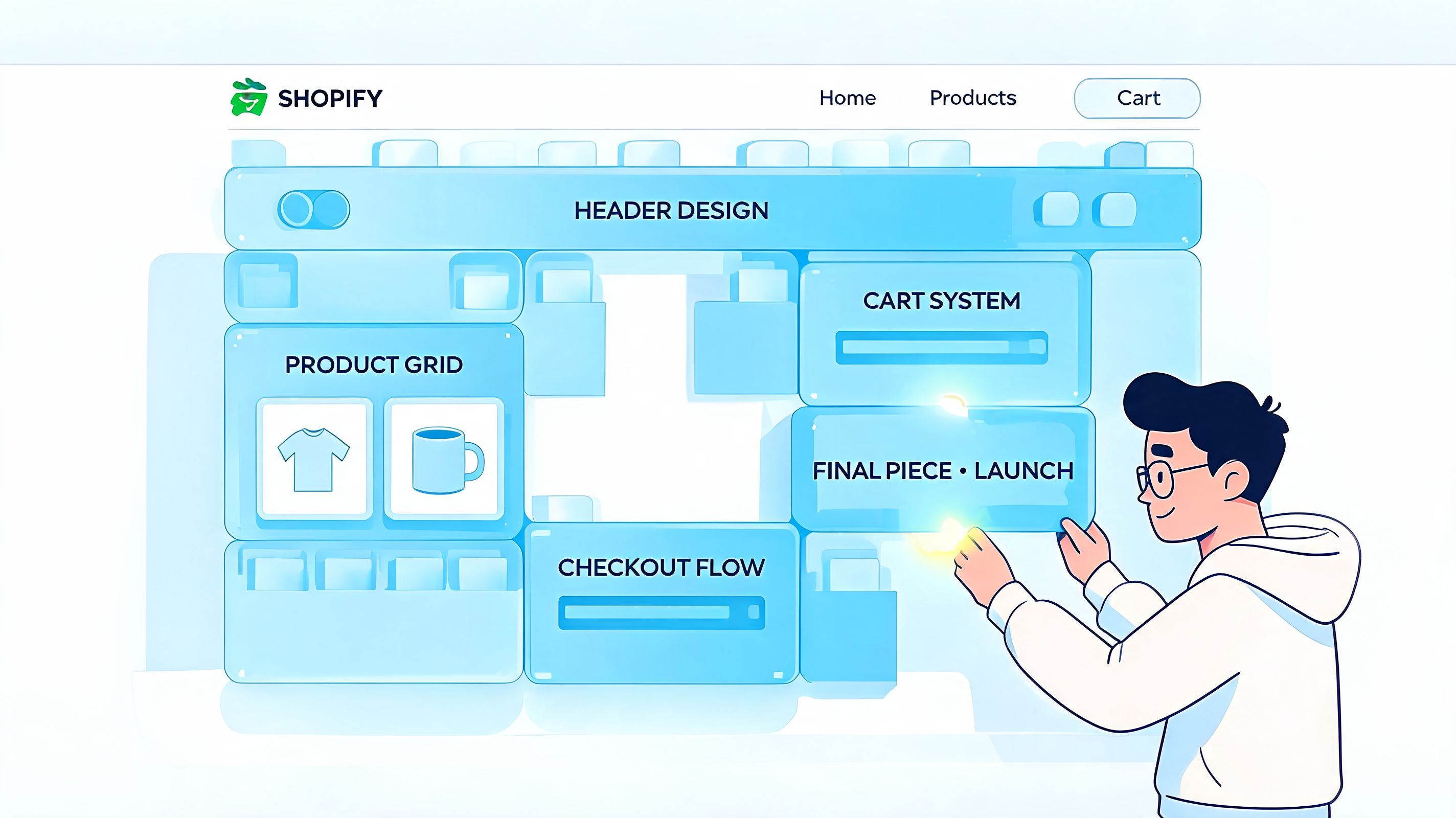
Theme design that supports merchandising
A professional agency doesn’t just “make the site look better.” It creates a theme structure that supports how you sell.
That usually includes collection templates, product page hierarchy, section-based landing pages, navigation logic, metafield usage, and reusable content blocks that marketing teams can manage without developer involvement every week. The best builds are opinionated where they need to be, but not rigid.
According to Shopify’s 2025 merchant survey, stores built by experienced developers convert 37% better on average than DIY builds, largely because they account for platform limitations and page-load latency from the start, as noted in this breakdown of expert Shopify developers.
Mobile-first development, not desktop designs shrunk down
A lot of weak Shopify projects fail here. The desktop mockups look polished, but mobile gets treated like a responsive afterthought.
That’s a mistake because mobile commerce problems are usually structural. Sticky add-to-cart behavior, image sequencing, variant selection, accordions, trust elements, shipping clarity, and thumb-friendly spacing all affect how the store performs. A capable team designs these interactions intentionally.
If you want a broader reference point on how interface choices shape revenue, Quikly’s piece on web design strategies for revenue is worth reading alongside any agency proposal.
App integration with restraint
Apps are where many first-time Shopify builds get messy. Founders add tools for reviews, subscriptions, bundles, upsells, search, email capture, loyalty, and analytics. Soon the theme is carrying extra scripts, overlapping functionality, and inconsistent front-end behavior.
A disciplined agency will usually do three things:
- Audit overlap: remove duplicate capabilities across apps.
- Protect performance: load scripts only where needed and avoid unnecessary front-end weight.
- Plan for maintainability: choose integrations your team can manage after launch.
A good Shopify build should be easier to update six months from now than it is on launch day.
Technical architecture that survives updates
This is the piece clients often don’t ask about, but should. Shopify development isn’t just about getting custom code live. It’s about keeping the store compatible with future theme updates and minimizing technical debt.
The strongest teams use modular section-based patterns, clean Liquid implementation, and thoughtful use of Shopify APIs so customizations don’t become fragile. That’s the difference between building a storefront and building a dependency.
Advanced Capabilities That Drive Exponential Growth
Once the core storefront is stable, the next gains usually come from deeper technical and operational work. At this point, advanced shopify design and development services stop looking like implementation support and start acting like growth infrastructure.

Performance and SEO at the theme level
Many brands try to solve visibility and conversion with more media spend. Sometimes the better move is cleaning up the storefront itself.
Experienced Shopify developers tune theme code, app integrations, and script loading to improve Core Web Vitals. In benchmark cases, that work can reduce page-load time by 30 to 50%, which improves search rankings and user engagement, according to Fulminous Software’s overview of Shopify development services.
That matters because technical SEO on Shopify is rarely just metadata. It’s URL hygiene, semantic markup, schema handling, image delivery, lazy loading, collection structure, and reducing JavaScript friction on important templates.
Custom integrations and operational fit
Growth introduces complexity. Catalogs expand. Channels multiply. Teams need cleaner data.
At that stage, advanced services often include:
- ERP and PIM integrations: useful when catalog accuracy, inventory syncing, and operational consistency matter more than speed of manual updates.
- Custom app development: the right choice when your process is unique and no app handles it cleanly.
- Multi-storefront architecture: relevant for brands managing regions, business units, or different customer groups.
- Shopify Plus work: typically tied to more complex checkout, automation, B2B requirements, or international operations.
The trade-off is simple. Custom work gives you control, but it also creates responsibility. Every custom integration should solve a real workflow problem, not just satisfy a preference.
Advanced development creates value when it removes recurring operational friction. If it only adds novelty, it usually isn’t worth the maintenance.
A lot of teams also pair technical improvements with assisted selling tools, especially when support and conversion overlap. For example, proactive sales support from Carti is relevant if you’re thinking about AI-guided product discovery rather than relying only on static merchandising.
CRO after launch is where the real gains compound
This is the gap I see most often. Agencies deliver the redesign, hand over the store, and move on. But the strongest returns usually come after launch, when real user behavior starts exposing friction points.
That phase should include structured testing around product pages, collection logic, merchandising order, search behavior, promotion placement, and checkout-path clarity. It should also include disciplined analysis of what changed, why it mattered, and whether the gain held over time.
Here’s a useful primer before you evaluate that kind of roadmap:
Without post-launch iteration, even a strong build becomes stale faster than most founders expect.
Understanding Agency Pricing Models
Most Shopify agencies sell one of two things. A single project or an ongoing retainer. Neither is automatically better. The right model depends on the kind of problem you’re trying to solve.
Single-project fees work when the deliverable is clear
If you need a redesign, migration, theme rebuild, or a defined technical scope, a project model is often the cleanest choice. It gives both sides a start point, an end point, and a fixed definition of done.
That structure helps when your internal team already knows what it wants. It’s less helpful when the need is ongoing experimentation, iterative CRO, support across channels, or a rolling queue of improvements that will change month to month.
Retainers work when growth is the product
A subscription or retainer model fits stores that don’t just need a launch. They need continuous prioritization.
That can include landing pages for campaigns, merchandising support, speed fixes, app cleanup, testing plans, analytics setup, and design updates tied to commercial priorities. For operators comparing budget scenarios, this guide to eCommerce website development cost helps frame what usually sits inside project scope versus ongoing execution.
Pricing isn’t just about spend. It’s about whether the commercial model matches how your business changes.
Pricing Models Compared
| Factor | Single-Project Model | Subscription (Retainer) Model |
|---|---|---|
| Best fit | Defined redesigns, migrations, one-off builds | Ongoing optimization, CRO, support, iterative improvements |
| Budget shape | More predictable for a fixed scope | More predictable for monthly operating planning |
| Scope flexibility | Lower once the project is approved | Higher, because priorities can shift over time |
| Speed for ad hoc requests | Often slower, requires new scoping | Usually better for rolling requests |
| Strategic continuity | Can drop after launch | Stronger if the agency stays close to performance data |
| Risk | You may finish with a good build but no optimization plan | You need clear prioritization so the retainer doesn’t become vague |
The cheapest proposal often becomes the most expensive one if it ends at launch and leaves your team holding all post-launch decisions.
What to ask before signing
Use these questions to pressure-test pricing logic:
- What happens after launch: is support included, limited, or separately scoped?
- How are changes handled: ticket queue, sprint planning, or ad hoc estimates?
- Who owns prioritization: your team, the agency, or a shared roadmap?
- What is measured: design output, development output, or business impact?
If the pricing model doesn’t match the way your business grows, the relationship will feel misaligned fast.
How to Choose the Right Shopify Partner
A polished portfolio can hide a weak operating model.
That’s why choosing a Shopify partner shouldn’t stop at visual taste or brand-name clients. You’re not hiring a gallery. You’re hiring a team that will touch conversion paths, theme architecture, data quality, and day-to-day execution.

Look past the homepage mockups
Start with the portfolio, but don’t stop there. Ask how the team approached navigation, merchandising, mobile behavior, app load, and maintainability. Good agencies can explain the reasoning behind the work, not just show polished screenshots.
For a broader benchmark on what a capable partner should do, this overview of a Shopify development agency gives a useful checklist of service depth beyond design alone.
The process matters more than most founders expect
An average creative team with a disciplined process will often outperform a visually stronger team with weak execution habits.
Ask direct questions like:
- Who is doing the work: senior developers, juniors, freelancers, or a rotating bench?
- How are requirements translated: written specs, Figma handoff, sprint planning, or informal Slack threads?
- How are trade-offs explained: speed versus flexibility, apps versus custom code, launch date versus QA depth?
- What happens when priorities change: change requests, monthly planning, or backlog management?
If they can’t explain their workflow clearly, expect confusion during build and silence after launch.
Choose the agency that can explain constraints plainly. Clear trade-off thinking is usually a better predictor of results than visual flair.
Ask how they measure ROI across channels
This is the most overlooked question, especially for brands selling across Shopify, marketplaces, social platforms, and email.
A key gap in the market is transparent ROI measurement for multi-channel operations, and a real differentiator is whether an agency can implement cross-channel attribution models and first-party data strategies, as discussed in this analysis of Shopify development service gaps.
That question changes the conversation immediately. Instead of hearing “we improve performance,” you get to ask how they’ll connect design changes, landing pages, campaigns, and channels to commercial outcomes.
A short vetting framework
Use this simple filter before you sign:
- They diagnose before prescribing. If they recommend a rebuild on the first call, be careful.
- They can talk through technical debt. Not every problem needs custom code.
- They have a post-launch operating model. Support shouldn’t be an afterthought.
- They report in business language. Founders need impact, not just completed tickets.
That’s usually enough to separate a production vendor from a real partner.
Real Results From Strategic Shopify Development
The strongest Shopify work usually follows the same pattern. A business problem shows up first. Design and development solve it second. The gain comes from removing friction, not from making the store look more expensive.

A store redesign that fixed merchandising confusion
One founder came in asking for a homepage refresh. The core issue was deeper. Collections were hard to browse, product pages buried key information, and mobile shoppers had to work too hard to compare options.
The solution wasn’t a dramatic rebrand. It was a cleaner collection structure, stronger product-page hierarchy, clearer variant presentation, and section-based landing pages the marketing team could reuse. The store became easier to shop, and internal teams could launch campaigns without waiting on custom page builds every time.
A migration that reduced platform drag
Another common case is the brand that stayed too long on a legacy stack. The issue isn’t always that the old platform is unusable. It’s that every change takes too much time, too many developers, and too much coordination between teams.
A well-run migration to Shopify or Shopify Plus typically works when the agency treats it as an operational reset. Data structure, redirects, merchandising logic, app replacement, and admin usability matter just as much as front-end design. If those pieces are handled well, the business ends up with a platform the marketing and eCommerce teams can run without constant technical dependency.
A migration succeeds when your team can operate the new store confidently on Monday morning, not when the launch announcement looks polished on Friday.
A CRO engagement that continued after launch
The most valuable engagements often begin after the new store is live. One pattern I’ve seen repeatedly is this: the redesign launches well, then real user behavior exposes new bottlenecks within weeks.
That’s where an ongoing optimization model earns its keep. Product templates get tested, app conflicts get cleaned up, campaign landing pages improve, and user recordings or analytics patterns shape the next changes. In these situations, a flexible partner model can be particularly valuable. For example, ECORN offers Shopify design, development, and CRO support through both project work and subscription packages, which fits teams that need continued iteration rather than a one-time handoff.
These aren’t dramatic “overnight success” stories. They’re examples of what usually works in practice. The store gets easier to run, easier to improve, and easier for customers to buy from.
Your Next Steps Based on Business Stage
The right service mix depends less on ambition and more on current complexity.
Early-stage brands
Keep the scope tight. Focus on a solid theme setup, product page clarity, collection structure, mobile usability, and only the apps you need. At this stage, too much customization can create overhead before the business has earned it.
Growing brands
Priorities then shift. The store is already functioning, so the work becomes sharper. You’ll usually get more value from CRO, speed improvements, merchandising refinement, analytics clarity, and integrations that remove team friction.
Most development content focuses on the build, but a critical gap for growing brands is post-launch optimization, and a flexible subscription model is often better suited for ongoing CRO, A/B testing, and data-driven iteration, as noted in this guide to Shopify development services.
Enterprise and Shopify Plus teams
Larger brands usually need architectural decisions, not just execution capacity. That can mean multi-storefront planning, more advanced integrations, custom workflows, headless considerations, or channel-level attribution work.
The common mistake at this stage is hiring for design taste when systems thinking is the critical need. The storefront still matters, but governance, data flow, and operational visibility matter just as much.
The best partner model is the one that can start with a project and expand into ongoing optimization without forcing a reset in team, tooling, or process.
If your store is live but growth feels harder than it should, ECORN is one option to evaluate for Shopify design, development, and CRO support. Their model includes both one-off projects and ongoing subscription work, which is useful if you want to improve the store after launch instead of treating launch as the finish line.


Ecommerce Loyalty Program Software How to Choose and Launch
Shopify Plans Comparison for Every Business Stage
How to Improve User Experience for eCommerce Growth

Shopify Checkout Optimization That Converts More
Shopify Inventory Sync: A Practical Setup Guide
Shopify App Integration Playbook That Scales
Shopify CMS Integration: Your 2026 Guide to Options

Shopify Store Audit: Find Hidden Conversion Leaks

Shopify Plus Experts: How to Hire the Right Team

Chargeback Protection Shopify: A Practical 2026 Guide
8 Examples of Conversion Rate Optimization
How to Conversion Rate Optimization for Shopify Stores
Shopify Design Essentials Every Store Owner Needs
Ecommerce Terms of Service: How to Draft and Implement
How to Implement Structured Data for Ecommerce in 2026
SEO App Mobile: Shopify Store Optimization Guide

Shopify Plus Support: What It Includes and How to Choose

Google Ads for Shopify: The Complete 2026 Playbook

Shopify New York: How to Find and Hire the Right Agency
Google Search Console for Shopify: The Complete Setup
First Party Data Collection for eCommerce Growth
FAQ Online Store Guide: Build and Measure It Right
Do FB Ads Work for eCommerce in 2026?
One Page Checkout for Shopify: Design and Implementation
Shopify GraphQL vs REST: The 2026 Developer Decision
Shopify Ecommerce Consulting: Strategy, Pricing &

Are Reddit Ads Worth It for eCommerce Brands

Shopify Title and Meta Description: A Practical 2026 Guide

Product Video Best Practices for Shopify Brands
Real-Time Inventory Management: A 2026 Guide
AI Chatbot Integration for Shopify Stores
Affiliate Program Management: A Shopify Guide
10 Best Performance Monitoring Tools for Shopify in 2026
Digital Asset Management for eCommerce Brands in 2026
Every Type of Facebook Ads Explained for eCommerce Growth
Product Information Management Explained for Shopify Brands
Support Ticket System: A Guide for Shopify Stores

10 Best Customer Service Tools for Shopify in 2026

Can I Start a Business with No Money? a 2026 Blueprint

What Sells Good on Etsy: Best Niches for 2026

Shopify Add to Cart Button: A Practical 2026 Guide

Customer Feedback Automation: A Practical eCommerce Guide

Critical Rendering Path: A Guide for Shopify Stores

How to Promote on TikTok for eCommerce in 2026

B2B eCommerce Consulting That Drives Real Revenue
10 Best Practices for Site Navigation in 2026
Return vs Refund for Shopify Stores: A Practical Guide

What Is Customer Lifetime Value and Why It Matters
What Is Voice of Customer Research for eCommerce

SMS Marketing for Ecommerce That Actually Converts

Master How to Improve Email Deliverability in 2026

Top 7 eCommerce Partners NYC for Shopify Brands in 2026

Machine Learning for Ecommerce: Boost Your Shopify Store

Beauty Market Research: Your 2026 Growth Guide
Shopify International Expansion: A 2026 Roadmap

What Does CRO Stand for in Business: Understanding CRO

Shopify Visual Merchandising: A Playbook for Higher Sales
Shopify Landing Page Design: Master Conversion in 2026
10 Best AI SEO Optimization Tools for Shopify in 2026

Agentic AI for Ecommerce: Boost Your Sales in 2026
Mastering Email Marketing Data for eCommerce Growth

Conversion Rate Optimisation Australia: Boost Your Sales
Conversion Rate Optimization AI: Your Shopify Store Guide

10 Product Bundling Strategies for Shopify in 2026

How to Increase Customer Lifetime Value: A Shopify Playbook
AI Customer Service Automation: Shopify Guide 2026

Clean Website Design: A Shopify Conversion Playbook

Omnichannel Retail Strategy: A Shopify Playbook
Product Data Enrichment: A Guide for Shopify Brands

Instagram Shopping Features a Guide for Shopify Stores
What Is Revenue Optimization: A Holistic RevOps Guide

Benefits of Conversion Rate Optimization: Boost Your
WordPress to Shopify Migration: Your 2026 Seamless Switch
Boost Sales: Ecommerce Payment Processing Guide 2026
Unified Commerce Platform: Benefits, KPIs & Shopify Guide

How to Reduce Bounce Rate eCommerce: Your 2026 Guide
Shopify API Integration: A Practical End-to-End Guide

How to Implement Data Governance: A 2026 Guide
Shopify Store Development Cost: A 2026 Breakdown
What Is Server Side Tracking: The Shopify Guide 2026
Marketing Automation Workflows: A Shopify Guide for 2026

Shopify: How to Reduce Technical Debt

Shopify UX Design Change: A Playbook for Growth
User Generated Content Strategy: Shopify Playbook

Shopify Pause and Build Plan Cost: A Complete 2026 Guide
Compare at Price on Shopify: A Complete Guide for 2026

Where Can I Sell My Prints? 10 Best Platforms for 2026
Shopify Order Management System: The Ultimate Guide 2026
What Is Marketing Attribution? an eCommerce Guide for 2026

10 Best Black Friday Sales Sheets for 2026

Discover the Top Social Media Marketing Agencies For
Consumer Confidence Definition for eCommerce in 2026

What Is Social Commerce? Your 2026 Guide to Boosting Sales
A Social Ad Campaign Playbook for eCommerce Growth

7 Best FAQ Page Examples for SaaS & eCommerce

Market Research in Fashion Industry: A Guide for Shopify
Shopify Migration Services: Expert Guide for 2026
Mastering FB Retargeting Ads for Shopify in 2026
What Is Omnichannel Ecommerce

Master Your Shopify Plus Migration: The 2026 Guide


newsletter in your inbox