


You’re probably looking at two paths right now.
Path one is building from zero. You source a product, fight through branding decisions, set up a theme, install apps, guess at pricing, buy traffic, and hope customers care. Months later, you might have a business. You might also have a store with no traction, weak margins, and a long list of subscriptions draining cash.
Path two is buying Shopify store assets that already have demand, operating history, and customers. That route isn’t easier in every respect, but it is usually clearer. You’re not paying to discover whether a market exists. You’re paying to take control of something the market has already validated.
That distinction matters. A good acquisition gives you data, supplier relationships, customer behavior, repeat purchase patterns, and a baseline you can improve. A bad acquisition gives you a polished storefront hiding operational messes. The spread between those outcomes is where most buyers either make money or learn an expensive lesson.
I’ve seen buyers focus too much on headline revenue and not enough on what happens after the password handoff. The essential work in buying shopify store deals starts before closing and accelerates right after. Hidden app costs, weak mobile performance, sloppy theme code, and channel dependency can turn a promising listing into a money pit. On the other hand, a store with clean economics and neglected optimization can become a strong asset fast.
Why Buying a Shopify Store Is Your Fastest Path to Profit
Starting from scratch still appeals to founders who want complete control. I understand that. But control without proof usually means you’re funding your own learning curve.
Buying an existing store changes the starting line. You inherit a business with products, order flow, operating patterns, and customer data. That doesn’t remove risk. It removes a large part of the uncertainty.

You’re buying validation, not just a website
A Shopify store with real trading history gives you immediate answers to the hardest early-stage questions:
- Product demand exists: Customers have already purchased.
- Checkout works: The store has processed orders in actual operation.
- Offer-market fit is visible: Reviews, support tickets, and repeat buyers tell you what resonates.
- Customer acquisition has a track record: You can see which channels produce sales.
- Operations are testable: Suppliers, fulfillment, and returns aren’t theoretical anymore.
That’s why buying shopify store opportunities can be the fastest route to profit. You’re not guessing whether people will buy. You’re determining whether the existing economics are solid enough to scale.
Shopify is a serious acquisition market
This strategy only works if the platform itself is stable and deep enough to produce quality assets. Shopify clears that bar. It powers over 4.82 million active stores worldwide as of 2026, and 675 million people shopped via the platform in 2023, according to Red Stag Fulfillment’s Shopify statistics roundup. The same source notes that for every $1 Shopify earns, merchants generate $40.82 in revenue.
Those numbers matter less as bragging rights and more as context. They tell you the platform isn’t niche, fragile, or short-lived. You’re operating inside a large commercial ecosystem with proven buyer demand, broad app support, established payment rails, and a deep talent pool.
Practical rule: Buy a business because it works, not because the niche sounds exciting.
Speed through strategic advantage
A strong acquisition shortens time to decision-making. Instead of asking, “Will this business model work?” you ask better questions:
- Which traffic source deserves more budget?
- Where is margin leaking?
- What part of checkout is underperforming?
- Which SKUs deserve more prominence?
- What can mobile users not do cleanly today?
That’s a more complex problem set. It’s also a more profitable one.
The buyers who win usually don’t treat acquisitions as shortcuts. They treat them as a strategic advantage. They buy a functioning system, tighten what’s loose, remove what’s wasteful, and scale what already converts.
Where to Find Stores and How to Value Them Accurately
The market for buying shopify store assets is broad enough that where you shop affects what you’ll find. Some venues are full of entry-level deals and noisy listings. Others are curated, broker-led, and more expensive. Neither is automatically better. The right venue depends on your budget, your operating ability, and how much cleanup you’re willing to do.
Where serious buyers usually look
You’ll see stores offered through direct founder outreach, private broker networks, and public marketplaces. Each has trade-offs.
| Channel | What it’s good for | What to watch for |
|---|---|---|
| Public marketplaces | Broad deal flow, easy browsing, lower barrier to entry | More low-quality listings, more seller spin, less context |
| Brokered deals | Better screening, cleaner documentation, guided process | Higher competition, stronger pricing, less room for bargain hunting |
| Direct outreach | Off-market opportunities, less bidding pressure | Harder diligence process, inconsistent seller preparedness |
Public marketplaces are useful when you want pattern recognition. After reviewing enough listings, you get faster at spotting weak business models, vague financials, and inflated asking prices.
Brokered deals are useful when you value process. Sellers tend to present cleaner financial packages, and the transfer process is usually more organized. You still need to verify everything yourself.
Direct outreach can produce attractive deals, especially when an operator is tired, distracted, or focused on another venture. But these deals often require more buyer leadership. You may need to shape the diligence list, push for records, and structure the transaction from scratch.
Your first filter should be monthly revenue
First-time buyers need a simple screen that removes fragile businesses early. Use monthly revenue as that screen.
According to Easy Apps Ecom’s guide to buying a Shopify store, first-time Shopify store buyers should target acquisitions in the $5,000-$20,000 monthly revenue range, and stores below $5,000 per month are often considered too fragile to survive an ownership transition.
That range is practical because ownership changes disrupt operations. Even a clean handover creates friction. Ad accounts need access changes. Suppliers need introducing. Customer support tone may shift. Promotions can stall for a week. A store already operating near the edge usually doesn’t absorb that disruption well.
Stores don’t fail after transfer only because revenue is low. They fail because low revenue leaves no room for mistakes, delays, or learning.
Don’t use a lazy multiple
Many buyers want a simple rule like “pay x times monthly profit.” That shortcut causes bad deals.
A valuation is a judgment about quality of earnings. Two stores with similar top-line revenue can deserve very different prices because the underlying business is different.
Factors that usually deserve a higher valuation:
- Brand strength: Repeat customers, defensible positioning, recognizable product line.
- Traffic mix: Healthy organic, email, and direct traffic instead of one paid channel doing all the work.
- Operational simplicity: Stable suppliers, low refund friction, predictable fulfillment.
- Conversion quality: A store that converts well is easier to scale than one surviving on aggressive discounting.
- Average order value: Better basket economics usually give you more room to acquire customers profitably.
Factors that usually compress valuation:
- Single-channel dependence
- Thin margins
- Messy SKU catalog
- Owner-dependent operations
- Unclear financial adjustments
- Heavy discount dependence
Use store metrics to justify your price
You don’t need to argue emotionally. You need to point to economics.
A store with strong customer value can justify a better multiple than one with weaker customer value. If you want a grounded way to think about that, this guide on how to calculate customer lifetime value for data-driven growth is useful because it helps frame what recurring demand is worth.
Here’s a simple way to think about offers during buying shopify store negotiations:
- Start with normalized earnings. Remove one-off expenses and challenge every add-back.
- Discount for fragility. If revenue dips when ads pause, that’s not stable earnings.
- Price transition risk. Owner-run stores deserve caution if key tasks aren’t documented.
- Price upside separately. Don’t pay today for improvements you still need to execute.
Buyers get into trouble when they pay a premium for “potential.” Potential is real, but it belongs to the operator who captures it. Until then, it’s a possibility, not an asset.
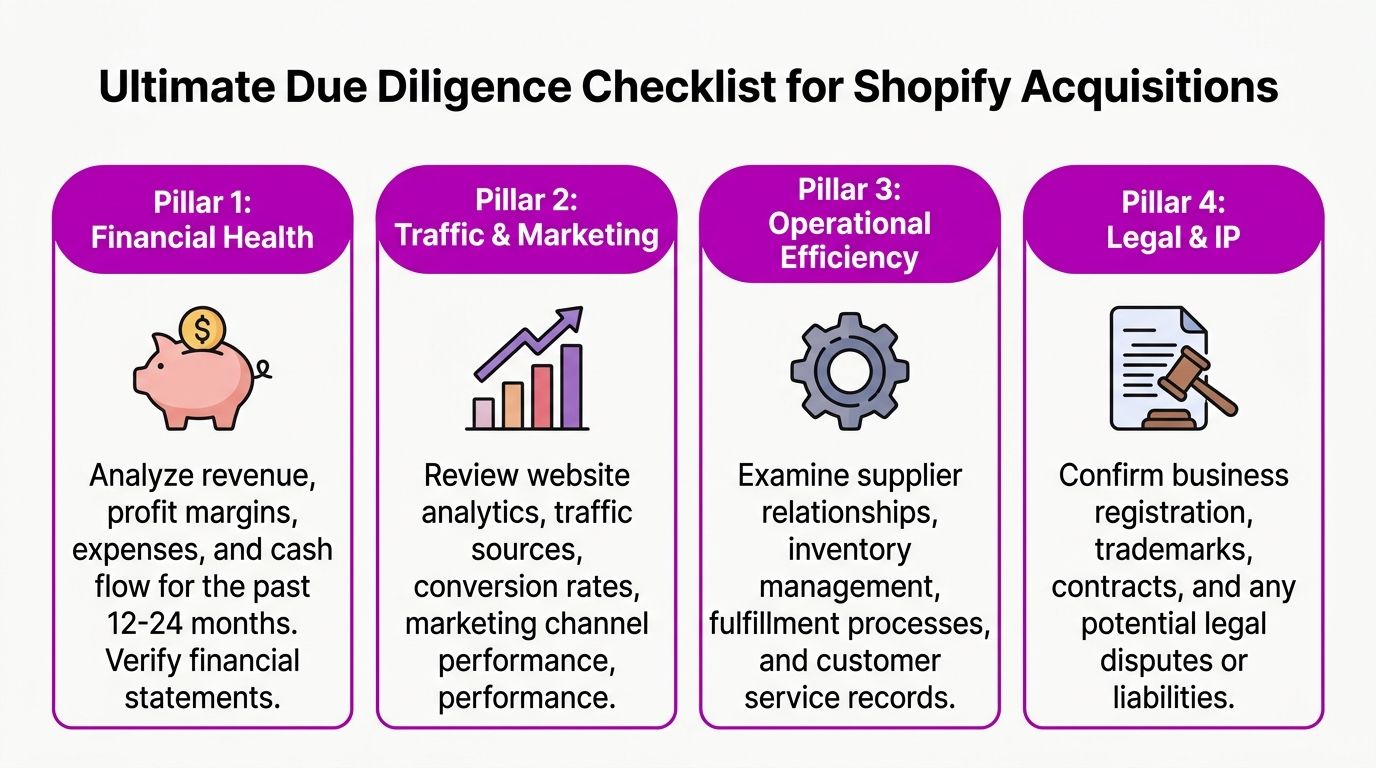
Your Ultimate Due Diligence Checklist for Shopify Acquisitions
Most buyers ask for revenue screenshots, check the product catalog, skim traffic, and move on. That isn’t due diligence. That’s browsing with false confidence.
The best acquisition work is boring, repetitive, and detailed. You verify what the seller says. Then you verify what they forgot to mention. In buying shopify store deals, the hidden damage is usually in expenses, channel dependence, and technical debt.
Financial diligence
Start with raw records, not summary claims. Ask for direct evidence from Shopify admin, Shopify Payments, Stripe, PayPal, tax filings, and bank statements. You’re trying to reconcile reality across systems.
The key question isn’t whether the store generated sales. It’s whether the reported profit survives scrutiny.
A major blind spot is hidden software and platform cost. According to Ecommerce Brokers’ resource on buying dropshipping stores, recurring Shopify app fees, theme customizations, and CRO tool subscriptions can erode reported profits by 20-50%, and 40% of acquired stores face profit drops due to unverified tech stack costs.
That’s exactly why profit screenshots are not enough.
What to check in the numbers
- Revenue consistency: Match platform sales to payment processor deposits and bank receipts.
- Refund behavior: Look for refund spikes, chargebacks, and heavy post-purchase dissatisfaction.
- App spending: Export every paid app and note monthly cost, annual renewals, and usage dependency.
- Theme and dev costs: Identify whether the store relies on a freelancer, agency, or custom code the seller hasn’t priced correctly.
- Inventory liabilities: Confirm what stock exists, what’s aging, and what’s unsellable.
- Owner add-backs: Challenge every claimed discretionary expense. Many are not discretionary for the next owner.
A clean P&L with weak source records is not clean. It’s just formatted.
Traffic and marketing diligence
Traffic quality matters more than traffic volume. A store can look lively in analytics and still be commercially weak.
Open Shopify analytics and GA4. Review source mix, landing pages, conversion paths, and channel dependency. Then compare what you see with ad account data, email platform performance, and campaign history.
I care less about “how much traffic” than “which traffic buys without drama.”
Review the channel risk this way
| Area | Healthy sign | Red flag |
|---|---|---|
| Paid search or social | Stable structure, understandable offers, consistent creative testing | Sales collapse when one campaign pauses |
| Active flows, list hygiene, meaningful campaigns | Big list, weak engagement, no segmentation | |
| Organic | Product and collection pages attracting qualified sessions | Thin traffic with no commercial intent |
| Direct traffic | Brand familiarity and repeat behavior | Inflated attribution masking poor tagging |
If you need a broader technical and content lens during review, a structured resource like this ultimate website audit checklist helps buyers avoid stopping at analytics alone. It’s useful for thinking through site quality in a more disciplined way.
If a seller can’t explain where profitable customers come from, assume the business is less stable than the listing suggests.
Operational diligence
A Shopify store isn’t only a storefront. It’s a chain of relationships and routines.
This part of diligence usually reveals whether the business can survive your ownership. I want to know who fulfills orders, who handles customer service, who updates the catalog, who negotiates with suppliers, and what breaks when that person disappears.
Ask for proof of operational continuity
- Supplier agreements: Confirm terms, lead times, exclusivity claims, and whether suppliers will continue after the sale.
- Fulfillment setup: Review SOPs, warehouse relationships, shipping workflows, and exception handling.
- Customer support patterns: Read tickets. They expose product issues faster than sales reports do.
- Returns process: Understand who pays, who authorizes, and which SKUs create friction.
- Team dependency: Clarify whether the owner is doing invisible daily work that hasn’t been documented.
Many “passive” stores fail inspection at this point. They aren’t passive. They’re just operated by someone who has memorized the business.
Legal and asset diligence
You’re not just buying a Shopify login. You’re buying a package of assets and obligations.
Check what transfers:
- Domain names
- Creative files
- Product images and videos
- Trademark ownership
- Email lists
- Klaviyo or equivalent marketing assets
- Meta ad account access
- Google Ads account access
- Supplier contacts
- Any content licenses or contractor agreements
If the seller uses licensed photography, custom software, or third-party creative under a limited agreement, confirm that the rights transfer. If they don’t, your “asset purchase” may include a future replacement bill.
Technical diligence
Technical review is where buyers either preserve margin or lose it slowly over months.
A store can look polished and still be unstable underneath. Bloated themes, unused apps, duplicate tracking scripts, broken sections, and patchwork code all create drag. The buyer inherits every shortcut the previous operator took.
Technical diligence should include:
App stack audit
List every installed app, what it does, what it costs, and whether removing it breaks revenue-critical functions.Theme review
Check whether the store runs a standard theme, a heavily customized one, or a fragile fork with undocumented edits.Checkout and cart testing
Run through the buying path on mobile and desktop. Test errors, shipping calculations, discount logic, and payment options.Tracking integrity
Review Meta Pixel, GA4, Google Ads tagging, and any server-side or app-based tracking setup for duplication or gaps.Speed and mobile usability
Don’t accept “it loads fine for me.” Test key templates and key devices.
Buy the business you can operate on Monday, not the one you hope to rebuild by Friday.
A disciplined due diligence process doesn’t kill good deals. It protects them. If the store is strong, diligence gives you confidence. If it’s weak, diligence gives you negotiating power or a reason to walk.
Negotiating the Deal and Securing the Transfer
Negotiation gets easier when your diligence is specific. Sellers argue with vague opinions. They have a harder time arguing with a line-by-line list of unresolved issues, missing records, unstable margins, and transfer risks.
That’s how serious buying shopify store deals get done. Not with theatrics. With documentation.

Negotiate from defects, not hopes
A strong offer explains itself. If your review uncovered inventory exposure, undocumented processes, ad account instability, or technical cleanup work, tie each issue to price, holdback terms, or transition support.
Good buyers don’t just bid lower. They structure better.
You can negotiate around:
- Price reduction: Best when issues are clear and measurable.
- Seller training period: Useful if operations live in the seller’s head.
- Holdback or staged release: Helpful when transfer risk is meaningful.
- Inventory adjustment: Necessary if stock is part of the transaction.
- Non-compete and non-solicit terms: Important when brand continuity matters.
Sometimes the right move is to keep the price intact but improve the terms. A seller who resists every reasonable protection usually tells you something useful about the deal.
Use a proper purchase agreement
Even for modest acquisitions, put the transaction into an asset purchase agreement. The agreement should identify what transfers, what doesn’t, what the seller represents as true, and what happens if something material is false.
At minimum, the agreement should address:
- Store assets included in the sale
- Domains and related accounts
- Customer data and email platforms
- Inventory treatment
- Intellectual property rights
- Access to ad accounts and analytics
- Transition support period
- Seller warranties and disclosures
If the seller says “we can keep it simple” and means “let’s skip documentation,” that’s not simplicity. That’s risk shifting.
Escrow protects both sides
Use an escrow service so funds aren’t released until the agreed assets transfer. This keeps the process balanced. The seller knows the money is committed. The buyer knows the assets must arrive before funds are released.
Escrow also forces clarity. You need a transfer checklist, an inspection window, and a defined completion standard. That discipline is healthy.
A simple transfer checklist often includes:
- Shopify admin ownership transfer
- Domain transfer
- Payment gateway handoff where applicable
- Meta and Google asset access
- Email platform transfer
- Creative and SOP delivery
- Supplier introduction
- Final confirmation of asset receipt
This walkthrough is worth watching before you finalize your handoff process:
Handle the Shopify transfer in sequence
The transfer itself should be controlled. Don’t rush because everyone is eager to “close.”
A practical order looks like this:
- Confirm the final asset list in writing.
- Lock in escrow terms and inspection period.
- Receive collaborator or staff access first for verification, where appropriate.
- Confirm key settings, apps, products, and theme files are present.
- Transfer ownership only when the checklist is ready to complete end-to-end.
- Change passwords, permissions, and recovery methods immediately after completion.
The buyer who feels awkward asking for process usually ends up cleaning up preventable mistakes. Be methodical. A smooth transfer isn’t about trust alone. It’s about sequencing.
A 90-Day Plan to Optimize and Scale Your New Store
Most acquisition guides stop at closing. That’s where the easy part ends.
The first ninety days determine whether you bought a stable cash-flowing asset or inherited a business that only worked for the previous owner. This stage is where buying shopify store deals become operating wins.

Days 1 to 30 stabilize the asset
Your first job is control, not creativity.
Secure every account. Audit permissions. Confirm payment settings, domain control, DNS access, backups, apps, shipping profiles, tax settings, and customer communication tools. Then verify that tracking still works after transfer.
This is also when you preserve continuity. Don’t redesign the store in week one unless something is clearly broken. You need a stable baseline before changing the buying journey.
Immediate priorities
- Lock down access: Update passwords, recovery emails, staff permissions, and third-party logins.
- Verify conversion path: Test product pages, cart, checkout, transactional emails, and mobile UX.
- Map the stack: Document apps, scripts, themes, automations, subscriptions, and dependencies.
- Read customer signals: Reviews, support tickets, returns, and on-site search queries reveal what matters fastest.
One of the most useful things you can request before closing is prior experimentation history. According to Convert’s article on Shopify selling angles and A/B testing, buyers often miss A/B testing histories and Voice of Customer data, and with 80% of traffic coming from mobile, a speed audit targeting under 3s load and theme optimization can prevent 30-50% revenue leaks post-buy. The same source notes that stores with integrated AI apps, present in only 25% of listings, offer an arbitrage opportunity to boost conversions by 20-35%.
That’s the kind of post-acquisition upside many sellers leave behind.
Days 31 to 60 improve conversion first
Don’t chase more traffic before the store earns it.
The cleanest gains usually come from fixing friction on high-intent pages. Start with mobile product pages, cart behavior, and checkout clarity. Review message match between ad creative or email promise and landing page experience. Then use customer language to sharpen merchandising.
Focus on these CRO levers
| Area | What to examine | Why it matters |
|---|---|---|
| Product pages | Headline clarity, image order, social proof, shipping info | Buyers decide here whether to continue |
| Mobile layout | Sticky add-to-cart, spacing, tap targets, speed | Mobile friction kills intent quickly |
| Cart | Surprise fees, discount confusion, drawer behavior | Cart friction creates avoidable exits |
| Offer presentation | Bundles, quantity cues, guarantees, objections | Better framing often lifts conversion without more traffic |
VoC data matters here. Review what customers say in support tickets, product reviews, survey responses, and chat transcripts. Their language usually beats whatever copy the old owner wrote.
Your first optimization sprint should remove friction customers already complained about, not launch ideas no one asked for.
If your new store uses subscriptions, prepaid plans, or complex recurring billing logic, it also helps to understand how billing architecture affects user experience and operations. A practical primer on a cloud billing platform can help operators think more clearly about recurring revenue infrastructure when they expand beyond simple one-time purchase models.
Days 61 to 90 scale what proved itself
Once the store is stable and obvious friction is gone, then scale.
This is when you increase budget behind the channels that hold margin, expand winning creatives, deepen lifecycle email, and test merchandising improvements across more templates. If the store has wholesale or trade demand, explore whether the setup can support a more formal B2B motion. If order volume and complexity justify it, assess whether more advanced Shopify architecture is needed.
What usually works in this phase
- Expand winning traffic sources: Put more budget into channels that already convert cleanly.
- Tighten lifecycle marketing: Welcome, browse abandon, cart, post-purchase, and win-back flows should all earn scrutiny.
- Install smarter testing discipline: Keep a testing log. Record what changed, why, and what happened.
- Reduce theme debt: Remove dead apps, duplicate scripts, and unnecessary sections that slow the storefront.
- Introduce AI carefully: Use AI-supported merchandising, support, search, or experimentation where it solves a real bottleneck.
What doesn’t work is changing everything at once. New theme, new offer, new agency, new ad strategy, new email design, and a catalog reshuffle in the same month usually creates confusion. Buyers then can’t tell whether performance changed because of the business they bought or the chaos they introduced.
A good acquisition deserves a measured operating hand. The upside in the first ninety days comes from intelligent restraint, then sharp execution.
When to Partner with a Shopify Agency Like ECORN
Some buyers should run the post-acquisition plan themselves. Others shouldn’t.
If you bought a straightforward store, understand the stack, and have internal design, development, analytics, and CRO capability, you can keep a lot in-house. If not, trying to learn every layer while protecting cash flow is where new owners often stall.
The gap between an average Shopify store and a top-performing one is not small. According to EcommerceTrix’s Shopify statistics roundup, the top 10% of Shopify stores convert at 4.7% versus a 1.4% average, and the top 20% reach Average Order Value benchmarks of $192+. The same source notes that agencies like ECORN have supported over 100 brands through subscription-based CRO and development.
The right time to bring in specialists
External help makes sense when the store has potential but the work required is technical, cross-functional, or speed-sensitive.
That usually includes situations like:
- You inherited a messy theme: The storefront looks fine on the surface but needs code cleanup, speed work, and section rationalization.
- Mobile conversion is underperforming: You need structured testing, not random redesign.
- You’re preparing for Shopify Plus complexity: Multiple storefronts, custom flows, and operational scale increase execution risk.
- Your team lacks bandwidth: Internal teams often know what to fix but can’t ship fast enough.
- You need a tighter growth system: Design, development, analytics, and CRO have to move together.
A strong partner doesn’t just make the store prettier. They help the asset perform better. That means fewer technical bottlenecks, cleaner experiments, and better prioritization.
If you’re weighing what that kind of partnership should look like, this guide to Shopify agency partners and success factors is a useful reference point.
The key point is simple. Buying the store is only the first investment decision. Building the operating environment that turns it into a stronger asset is the second.
If you’re buying shopify store assets and want expert help with CRO, Shopify development, design, or post-acquisition scaling, ECORN is built for that work. Their team supports brands with flexible Shopify-focused execution, from one-off projects to ongoing subscription support, so you can turn a decent acquisition into a high-performing store faster.


Mastering Multi Store Management on Shopify

Scale Shopify Store

10 Shopify App Ideas Worth Building in 2026
Conversion Rate Optimization for Landing Pages: The Playbook
Shopify Plus Automation: A Guide for 2026
10 Social Selling Platforms for Shopify Merchants

Shopify Website Design Examples: 7 Stores Worth Studying
7 Ecommerce Newsletter Examples for Shopify Brands
One Product Shopify Store: Build and Scale

Mobile Pop Up Strategy for Shopify Stores That Converts
Sitemap for Shopify: How to Find, Optimize, and Submit It
7 Single Product Websites Worth Emulating

Product Variants Shopify: The Complete 2026 Guide
Ecommerce Analytics Consulting for Growth
What Is AI Integration for eCommerce
How to Choose the Right eCommerce Website Development Firm
E Business Strategy Implementation
Conversion Tracking Setup for Shopify Stores
BigCommerce vs Shopify Plus Which Enterprise Wins in 2026
Shopify Theme Kit: Setup, Commands, and Migration Guide

Shopify Extension Development: A Practical 2026 Guide
Shopify Speed Score Explained and How to Improve It

Shopify Mobile Optimization: The 2026 Playbook
How to Add Subcategory in Shopify for Better UX
How to Implement Structured Data for Ecommerce in 2026

SEO App Mobile: Shopify Store Optimization Guide

Shopify Plus Support: What It Includes and How to Choose

Google Ads for Shopify: The Complete 2026 Playbook

Shopify New York: How to Find and Hire the Right Agency
Google Search Console for Shopify: The Complete Setup
First Party Data Collection for eCommerce Growth
FAQ Online Store Guide: Build and Measure It Right
Do FB Ads Work for eCommerce in 2026?
One Page Checkout for Shopify: Design and Implementation
Shopify GraphQL vs REST: The 2026 Developer Decision
Shopify Ecommerce Consulting: Strategy, Pricing &

Are Reddit Ads Worth It for eCommerce Brands
Shopify Title and Meta Description: A Practical 2026 Guide

Product Video Best Practices for Shopify Brands
Real-Time Inventory Management: A 2026 Guide

AI Chatbot Integration for Shopify Stores
Affiliate Program Management: A Shopify Guide
10 Best Performance Monitoring Tools for Shopify in 2026

Digital Asset Management for eCommerce Brands in 2026
Every Type of Facebook Ads Explained for eCommerce Growth
Product Information Management Explained for Shopify Brands
Support Ticket System: A Guide for Shopify Stores

10 Best Customer Service Tools for Shopify in 2026

Can I Start a Business with No Money? a 2026 Blueprint

What Sells Good on Etsy: Best Niches for 2026

Shopify Add to Cart Button: A Practical 2026 Guide

Customer Feedback Automation: A Practical eCommerce Guide
Critical Rendering Path: A Guide for Shopify Stores

How to Promote on TikTok for eCommerce in 2026

B2B eCommerce Consulting That Drives Real Revenue
10 Best Practices for Site Navigation in 2026
Return vs Refund for Shopify Stores: A Practical Guide

What Is Customer Lifetime Value and Why It Matters
What Is Voice of Customer Research for eCommerce

SMS Marketing for Ecommerce That Actually Converts

Master How to Improve Email Deliverability in 2026

Top 7 eCommerce Partners NYC for Shopify Brands in 2026

Machine Learning for Ecommerce: Boost Your Shopify Store

Beauty Market Research: Your 2026 Growth Guide

Shopify International Expansion: A 2026 Roadmap
What Does CRO Stand for in Business: Understanding CRO

Shopify Visual Merchandising: A Playbook for Higher Sales

Shopify Landing Page Design: Master Conversion in 2026

10 Best AI SEO Optimization Tools for Shopify in 2026

Agentic AI for Ecommerce: Boost Your Sales in 2026
Mastering Email Marketing Data for eCommerce Growth

Conversion Rate Optimisation Australia: Boost Your Sales
Conversion Rate Optimization AI: Your Shopify Store Guide

10 Product Bundling Strategies for Shopify in 2026

How to Increase Customer Lifetime Value: A Shopify Playbook
AI Customer Service Automation: Shopify Guide 2026

Clean Website Design: A Shopify Conversion Playbook

Omnichannel Retail Strategy: A Shopify Playbook
Product Data Enrichment: A Guide for Shopify Brands

Instagram Shopping Features a Guide for Shopify Stores
What Is Revenue Optimization: A Holistic RevOps Guide

Benefits of Conversion Rate Optimization: Boost Your
WordPress to Shopify Migration: Your 2026 Seamless Switch
Boost Sales: Ecommerce Payment Processing Guide 2026
Unified Commerce Platform: Benefits, KPIs & Shopify Guide

How to Reduce Bounce Rate eCommerce: Your 2026 Guide
Shopify API Integration: A Practical End-to-End Guide

How to Implement Data Governance: A 2026 Guide
Shopify Store Development Cost: A 2026 Breakdown
What Is Server Side Tracking: The Shopify Guide 2026
Marketing Automation Workflows: A Shopify Guide for 2026

Shopify: How to Reduce Technical Debt

Shopify UX Design Change: A Playbook for Growth
User Generated Content Strategy: Shopify Playbook

Shopify Pause and Build Plan Cost: A Complete 2026 Guide

Compare at Price on Shopify: A Complete Guide for 2026

Where Can I Sell My Prints? 10 Best Platforms for 2026
Shopify Order Management System: The Ultimate Guide 2026
What Is Marketing Attribution? an eCommerce Guide for 2026

10 Best Black Friday Sales Sheets for 2026


newsletter in your inbox