

When you get down to it, the choice between selling on Etsy vs. eBay comes down to a simple, but crucial, difference. Etsy is a curated haven for artisans, crafters, and vintage sellers who connect with a specific audience that prizes creativity and unique items. eBay, on the other hand, is a sprawling global bazaar for just about everything imaginable—from secondhand electronics and collectibles to brand-new, mass-produced goods—that attracts buyers hunting for deals and sheer variety.
Etsy vs eBay: A High-Level Comparison for Sellers
Picking between Etsy and eBay is a foundational decision for any online seller in 2026. These two giants cater to completely different customer mindsets and product catalogs. Getting this choice right from the start will shape everything that follows, from your fee structure and marketing spend to your long-term growth potential.
The real question isn't "Which platform is better?" It's "Which platform is the right fit for my products, my business model, and my ambitions?" This initial overview will help you frame the key pillars of that decision.
Key Differentiators at a Glance
Let's start with a bird's-eye view of the two marketplaces. While both connect you with millions of buyers, their core philosophy and how they operate couldn't be more different. This table sets the stage for the deeper dive we'll take later.
This table gives you a quick snapshot, but the real magic (and the money) is in the details. For example, a creator selling handcrafted leather wallets might find a perfect home on Etsy, where the story behind their craft resonates deeply with shoppers.
The crucial takeaway is this: Etsy sells the maker as much as the product, while eBay sells the deal. Understanding this psychological split is essential for aligning your business with the right audience and maximizing your sales potential.
But what if that same seller also wants to offload a batch of bulk-produced wallet chains they sourced? For that inventory, eBay would be the obvious, more effective channel. In the sections that follow, we'll break down these nuances—covering everything from fees and SEO to customer acquisition and scaling—to help you make an informed choice that serves both your immediate sales goals and your future brand vision.
Decoding Your Target Audience and Product Fit
Before you list a single item, you need to get inside the heads of Etsy and eBay shoppers. They're two completely different worlds, and understanding who buys what—and why—is the first real step in deciding where your products belong. This isn't just about comparing user stats; it's about matching your product to the right customer mindset.
Think of Etsy as a bustling, high-end craft fair, but online. People don't just land there by accident. They show up with a specific intent: to find something with a story, a soul, and a real person behind it. The craftsmanship and originality are the main event.
eBay, on the other hand, is the world’s biggest digital flea market and department store rolled into one. The audience is massive and diverse, full of bargain hunters, serious collectors on the prowl for a rare find, and everyday shoppers who just need a specific new or used item at a good price. Here, it’s all about value, selection, and getting your hands on exactly what you’re looking for.
The Etsy Buyer: A Search for Authenticity
The average Etsy shopper isn't hunting for the cheapest deal. They're on a quest for something unique—an item that says something about their own personality or will make the perfect, thoughtful gift.
This audience is looking for:
- Handmade Quality: They genuinely appreciate the time, skill, and passion poured into a handcrafted product.
- Vintage Charm: There's a dedicated, savvy market for items with a history, which on Etsy means they must be at least 20 years old.
- Unique Customization: The option to personalize a product is a huge selling point and creates a one-of-a-kind buying experience.
- Creative Supplies: A huge segment of Etsy's audience are makers themselves, searching for unique materials to fuel their own creative projects.
If you’re making hand-poured candles, designing custom jewelry, or selling unique digital prints, the Etsy crowd is already looking for you. The entire platform is built to highlight the maker’s story, and customers are willing to pay a premium for that connection.
The eBay Buyer: A Quest for Value and Variety
The eBay buyer thinks differently. While some are definitely hunting for collectibles, the dominant mindset is about finding the right product at the right price. Their search is practical and laser-focused on the item itself, not necessarily the person selling it.
This audience is primarily driven by:
- Competitive Pricing: eBay shoppers are masters at comparing prices. A great deal, whether it’s through an auction or a "Buy It Now" listing, is a powerful motivator.
- Specific Items: People often turn to eBay to find an exact model of a smartphone, a hard-to-find replacement part, or a specific comic book from their childhood.
- New and Used Goods: Unlike Etsy, which has strict rules, eBay is an open field. You can sell anything from brand-new, factory-sealed products to well-loved, secondhand treasures.
This flowchart breaks down the core decision based on what you sell.
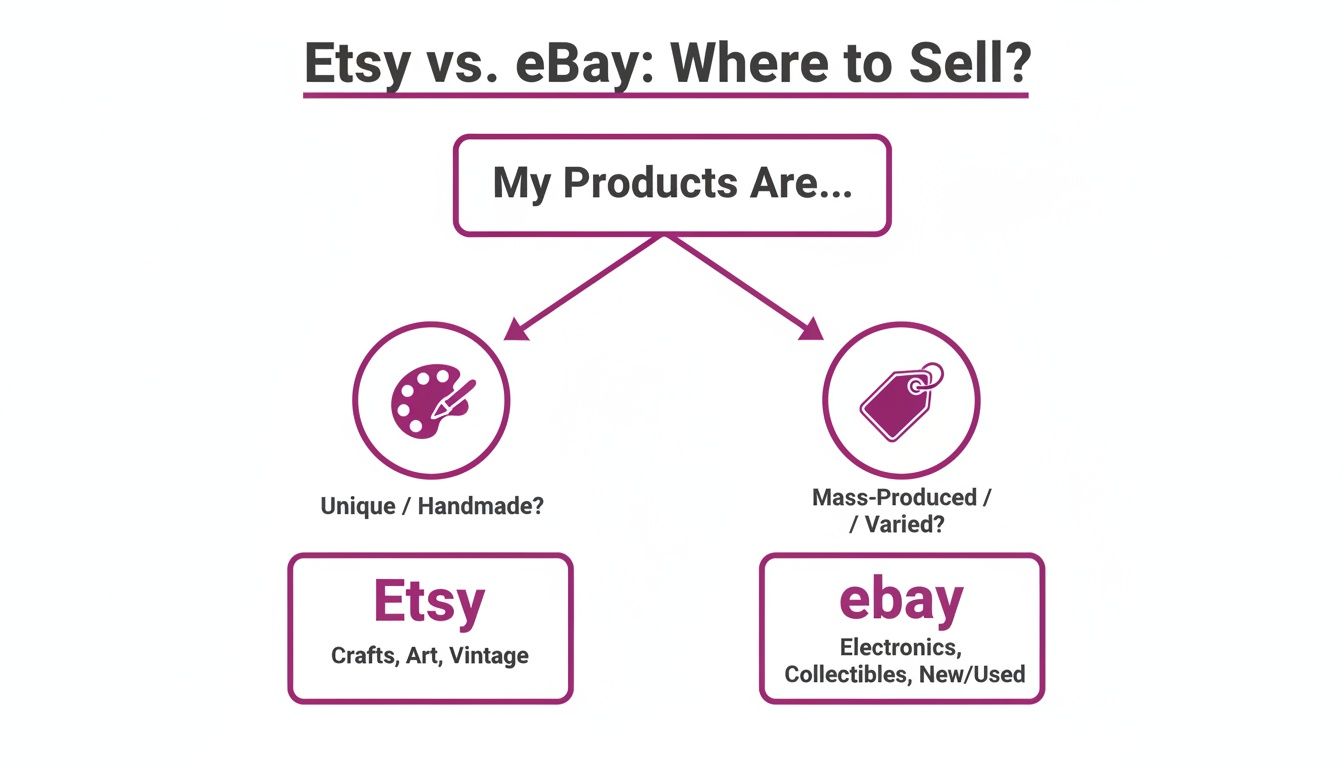
As you can see, if your business is built on unique, handmade, or vintage items, Etsy is your home turf. But if you’re dealing in a wide range of new and used goods, eBay gives you a much better shot.
For example, a custom-engraved wooden watch box is a perfect fit for Etsy. The craftsmanship and personalization are exactly what shoppers there celebrate. But a refurbished laptop or a bulk lot of vintage comic books? That's eBay's bread and butter. You'll find more buyers actively searching for those categories and ready to jump on a good deal.
The numbers back this up. Etsy attracts roughly 96 million active buyers who are drawn to the authenticity and creativity of its 8 million sellers. In contrast, eBay serves a much larger pool of 133 million active buyers from 17.6 million sellers, but their primary motivation is finding the best deal, not necessarily supporting an individual creator. You can dive deeper into these audience differences on Printful's blog. Winning the Etsy vs. eBay debate starts with knowing which of these two distinct worlds your products will thrive in.
Comparing Fee Structures for Maximum Profitability

When you’re weighing selling on Etsy vs eBay, profitability boils down to one thing: fees. These costs, both the obvious and the not-so-obvious, can seriously eat into your revenue if you aren't paying close attention. Before you even think about listing your first product, you need a clear-eyed analysis of how each platform will take its cut.
Etsy and eBay have completely different philosophies on fees. Etsy’s model is generally simpler, which tends to work better for lower-priced items. eBay, on the other hand, has a more complex, variable structure that changes based on what you’re selling and for how much.
Dissecting Etsy’s Fee Model
Etsy keeps its cost structure relatively straightforward, which is a huge plus for new sellers and those who value predictability. The fees break down into just a few key pieces.
- Listing Fee: You'll pay a flat $0.20 USD for every item you list. This keeps your listing active for four months or until it sells.
- Transaction Fee: Etsy takes a 6.5% cut of the total order amount. This includes the item price, shipping, and any gift wrapping charges.
- Payment Processing Fee: This changes depending on your country. For US sellers, it’s typically 3% + $0.25 of the final sale price.
- Offsite Ads Fee: This is a mandatory advertising fee for high-volume sellers. If your store makes over $10,000 in a 12-month period, you’ll pay a 12% fee on sales that come directly from these ads. If you're under that sales threshold, the fee is 15%, but you have the option to opt out.
These fees add up to a clear cost for every single sale. For anyone selling handmade goods or unique items, that predictability is a massive advantage. To really get a handle on your numbers, it's critical to calculate profit margins for your jewelry & accessories business so your pricing strategy is built on a solid foundation.
Unpacking eBay's Variable Fees
eBay’s fee structure is a different beast entirely. It’s far more intricate, with costs that shift depending on multiple factors. While this gives some sellers more flexibility, it demands that you pay much closer attention to the details for every item you list.
The two main costs on eBay are insertion fees (their term for listing fees) and final value fees. Most sellers get a good number of free listings each month—often up to 250. After you use those up, you’ll pay an insertion fee, usually $0.35 per listing.
The final value fee is where things get complicated. It's a percentage of the total amount of the sale (which includes the item price, shipping, and sales tax) and it varies wildly from one category to another. This is the number you really need to watch.
Let’s look at how these different fee structures play out in a real-world scenario. The table below breaks down the costs for a hypothetical $100 sale on both platforms, showing just how differently your net profit can be affected.
Etsy vs eBay Fee Breakdown on a $100 Sale
As you can see, the final profit from the same $100 sale is noticeably different. While a few dollars might not seem like much on a single sale, this gap widens significantly as your sales volume grows, making it a critical factor in your decision. eBay’s higher fees are often justified by its massive audience and potential for faster sales, but you need to be sure that trade-off works for your specific products and profit goals.
Evaluating Operational Features and Seller Tools
Beyond just the fees and audience, your day-to-day life as a seller is really defined by the platform’s operational tools. This is where the experience of selling on Etsy versus eBay couldn't be more different, as each is built for a very specific type of seller and business. The choice you make here will shape your entire workflow.
Etsy is all about simplicity and a quick start. You can get a basic shop up and running in under 30 minutes, thanks to a guided process that’s incredibly intuitive. This ease of use is a huge draw for artists and makers who would rather spend their time creating than getting lost in a complicated backend.
eBay, on the other hand, gives you a much more powerful—and, yes, more complex—set of tools. While getting started might take a bit longer, it offers a level of control over your listings and store policies that Etsy simply doesn't. This depth is essential for a platform that has to support such a massive variety of products and selling strategies.
Comparing Listing Formats and Product Guidelines
A huge difference between the two is what you can sell and how you can sell it. Etsy runs a tight ship, with strict product guidelines that protect the marketplace's unique, curated feel.
Etsy’s Product and Listing Model:
- Strict Categories: You're limited to handmade goods, vintage items (which must be at least 20 years old), and craft supplies. Mass-produced goods are a definite no-go.
- Fixed-Price Listings: The main way to sell is with a straightforward fixed price. This "Buy it Now" approach keeps pricing stable and easy for everyone to understand.
eBay is the polar opposite, offering almost complete freedom in what you list and how you list it.
eBay’s Product and Listing Model:
- Open Categories: You can sell pretty much anything—new, used, refurbished, and mass-produced items all live alongside collectibles and even handmade products.
- Flexible Formats: Sellers can opt for the classic auction-style listing, a fixed-price "Buy It Now" option, or even add a "Best Offer" feature to invite negotiation.
Etsy's strict rules foster a brand-focused environment where your story sells the product. eBay's flexibility creates a dynamic, price-driven marketplace where auctions can drive urgency and fast sales for popular items.
Analyzing Seller Tools and Store Customization
The tools each platform offers for managing and growing your store are another reflection of their core philosophies. Etsy's tools are built for accessibility, while eBay's are geared toward data-driven power sellers.
Etsy offers basic analytics in its "Stats" dashboard, which tracks views, visits, orders, and revenue. You also get some light customization options, like a shop banner and an "About" section, to help tell your brand's story. The whole system is designed to make inventory and order management as painless as possible for smaller operations. For sellers managing inventory on multiple channels, understanding the mechanics of an eBay and Shopify integration offers great insights into building a more unified system.
Because it caters to a much wider range of seller volumes, eBay provides far more granular data through its Seller Hub. Here, you can dig into detailed traffic reports, sales trends, and performance metrics. It also offers advanced listing tools for managing bulk uploads and large inventories, which are absolutely critical for high-volume retailers.
These differences in platform tools and product categories really show how Etsy and eBay serve two very different business models. Many savvy sellers use both, listing their handmade items on Etsy while using eBay for used goods or bulk inventory. This lets you play to each platform’s strengths. To see more strategies like this, you can check out other detailed platform comparisons at Bettamax.com. In the end, whether you choose Etsy’s simplicity or eBay’s power comes down to what you sell and how you want to run your business.
Optimizing Your Marketing and SEO Strategy
If buyers can't find your products, you simply don't have a business. When you look at selling on Etsy vs. eBay, you'll see that how you get seen on each platform is worlds apart. They're built on completely different ideas about how people shop, and you have to master both to drive traffic and sales.
Think of Etsy's search as being geared toward discovery and inspiration. It functions less like a classic search engine and more like a massive, curated art gallery. The algorithm is fine-tuned to connect shoppers with items that feel unique, personal, and special.
eBay, on the other hand, runs its search engine, Cassini, a lot more like Google. It’s a powerful, data-heavy system that rewards relevance, value, and your reputation as a seller. Success on eBay comes from a much more traditional approach to SEO, where specific keywords and hard metrics are king.
Driving Visibility on Etsy
To get traction on Etsy, you need to get inside the head of a buyer who is looking for something unique. They often search with descriptive, emotional phrases like "rustic farmhouse wall decor" or "minimalist gold stacking rings." Etsy’s algorithm leans heavily on a few factors to connect these creative searches with your products.
- Titles and Tags: Your product titles should be long and descriptive, packed with different ways a buyer might look for your item. You have 13 tags for each listing; you absolutely must use all of them with a mix of broad and specific long-tail keywords.
- Attributes: These are the specific details you select when you list an item, like its color, material, and style. The more of these you fill out, the more information Etsy has to surface your product in filtered searches.
- Listing Quality Score: Etsy gives each listing an internal score based on how well it converts, its customer reviews, and its general appeal. Listings that perform well get shown more often. It’s a virtuous cycle.
Etsy also has a powerful advertising tool that’s a bit of a hot topic among sellers.
The Offsite Ads program automatically promotes your listings on sites like Google, Facebook, and Instagram. If you make over $10,000 in a year, participation is mandatory, and you'll pay a 12% fee on any sale that comes from one of those ads. It definitely expands your reach, but you have to bake that potential fee into your pricing from day one.
Mastering Search on eBay
Winning at eBay search is a game of precision and outmaneuvering the competition. Your main goal is to convince eBay's algorithm that your listing is the absolute best match for a given search. This demands a sharp, tactical focus on classic SEO principles and performance metrics.
The heart of eBay SEO is its "Best Match" algorithm, which pushes listings it thinks are most likely to sell. Several key things will directly influence your ranking.
Key eBay SEO Factors:
- Keyword Optimization: Use exact keywords in your title that match what buyers are actually typing into the search bar. Unlike Etsy’s flowery, descriptive style, eBay titles are direct and to the point, like "Apple iPhone 14 Pro 256GB Unlocked - Excellent Condition."
- Item Specifics: This is eBay’s version of attributes, and filling them out is non-negotiable. They power the filtered search results and give buyers the critical details they need to make a decision.
- Seller Ratings: How you perform as a seller—your shipping speed, communication, and how accurately you describe your items—has a direct line to your search visibility. Earning "Top Rated Seller" status gives you a serious advantage.
To really get an edge, many sellers use eBay's own advertising platform. With Promoted Listings, you can pay a percentage of the final sale price to get your item featured in more prominent spots. It's a fantastic tool for getting eyeballs on your products, especially in crowded categories, since you only pay the ad fee if the item actually sells from that promotion. The trick is to bid just enough to get seen without completely wiping out your profit margin.
Scaling Your Brand with Shopify Integration

While hashing out Etsy vs. eBay is a great starting point, banking your entire future on either platform is a gamble. Let's be real: on a marketplace, you're just a tenant. They own the customer relationship, they make the rules, and they can jack up fees or tweak the algorithm whenever they feel like it.
Smart scaling is all about building an asset you actually own—your eCommerce store.
The best play here is to treat Etsy and eBay as powerful customer acquisition channels, not your forever home. Think of them as the "spokes" that funnel traffic and new buyers to your central "hub"—an independent store, which for most growing brands is built on Shopify. This sets you up with a resilient, multi-channel business that isn't dangerously dependent on one source of traffic.
Creating Your Hub and Spoke Model
This strategy is the turning point where you go from being a marketplace renter to a true brand owner. When you integrate Etsy and eBay with a Shopify store, you’re creating a central command center for your entire operation. The payoff is immediate and huge.
- Centralized Inventory Management: Syncing your product stock across all channels is a game-changer. It automatically prevents you from overselling. An item sells on Etsy? The stock count is instantly updated on eBay and your Shopify site. No more manual updates.
- Unified Order Fulfillment: All your orders, whether from eBay, Etsy, or your own site, funnel into one clean dashboard. This massively streamlines your shipping process, saves a ton of time, and cuts down on costly errors.
- Customer Data Ownership: This is the big one. When someone buys from your Shopify store, you own that customer's data. You can add them to your email list, see what they buy, and market to them directly. That’s how you build long-term loyalty, something that's nearly impossible on Etsy or eBay.
This integration lets you tap into the massive built-in audiences of marketplaces while methodically moving your best customers over to your own branded experience.
The end game is always to convert marketplace buyers into direct, loyal customers. Use Etsy's brand-friendly vibe to tell your story and eBay's huge reach to find deal-seekers, but always, always slip marketing inserts into your packages. Guide them back to your Shopify store with a special offer or a sneak peek at new products.
Integrating Your Sales Channels
Connecting your sales channels is a lot more straightforward than you might think. For brands ready to expand, exploring an eBay Shopify integration is a smart move to get sales and inventory under control.
Likewise, there are fantastic apps to link up your Etsy shop. You might find our own guide useful, where we break down how a solid Shopify and Etsy integration can become the backbone of your growth. Making this move from marketplace dependency to brand ownership is exactly how you build a sustainable, valuable eCommerce business.
Frequently Asked Questions
When you're weighing Etsy against eBay, a lot of practical questions come to mind. We get it. Let's break down some of the most common ones we hear from brands, whether they're just starting out or already established.
Is Etsy or eBay Better for a Beginner Seller?
For most new sellers with handmade goods, vintage finds, or unique craft supplies, Etsy is almost always the better starting point. The setup is quicker and far more intuitive; it’s built for creators who want to get their shop live without a ton of technical headaches. The audience is also a huge plus—people show up to Etsy looking for the exact kinds of products you’re selling, which can really shorten the time it takes to get your first sales.
But if your business is all about reselling used items, flipping products for a profit, or you just have a wide mix of inventory, eBay is a strong contender. Just be ready for a bit of a learning curve. You’ll need to get your head around its more complicated fee structure and figure out the difference between auction-style listings and fixed-price sales.
Can I Sell the Same Products on Both Etsy and eBay?
Yes, you absolutely can, and many successful sellers do. The key is having a rock-solid, organized system. Running a multi-channel business is a great strategy, but you can't afford to mess up your inventory. Overselling and having to cancel orders is a fast way to get bad reviews.
Using a central hub like Shopify to sync inventory across both platforms is the gold standard here. It prevents those costly mistakes.
A smart strategy we see work time and again is listing your core handmade or vintage collections on Etsy to hit that brand-focused audience. Then, you can use eBay to liquidate older stock, sell related but mass-produced accessories, or even offload B-grade items that don't quite meet the quality standard for your main Etsy shop.
Which Platform Makes Shipping Easier: Etsy or eBay?
Both Etsy and eBay have built-in shipping label services that give you discounted rates from major carriers. Honestly, which one is "easier" comes down to your specific shipping needs and how many orders you're sending out.
Etsy's shipping tools are widely considered more user-friendly and straightforward, especially if you're mostly shipping domestically. The interface is clean and gets the job done without much fuss.
eBay, on the other hand, gives you more powerful and flexible shipping options. Its eBay International Shipping program is a game-changer, taking a lot of the complexity out of selling to a global audience. The choice boils down to this: go with Etsy for simplicity and eBay for powerful international reach.
Ready to build a scalable eCommerce brand that leverages the best of every channel? ECORN specializes in Shopify development and conversion rate optimization to create a powerful central hub for your business. Let's build your brand's future together.


Shopify Themes Retina: How to Serve 2x Images

How to Cross Sell on Shopify Without Friction
Best Shopify Theme for Custom Products Compared
Multi Store Inventory Management: A Practical Guide

SEO Consulting for Ecommerce: A Practical Guide
Shopify Theme Updater App: A Safe Update Playbook
Shopify Git Integration: A Developer's Guide to 2026
Headless Ecommerce Development Services Explained

How to Build a Shopify Clothing Website That Converts
How to Launch a Box Subscription Business in 2026

Luxury Skincare Branding Playbook That Converters
10 Best Podcast Ecommerce Shows for Store Growth in 2026
Shopify Developer Hourly Rate: What to Pay in 2026
Critical Shopify Setup Errors That Are Secretly Sabotaging Your Store
Ecommerce Conversion Tracking: The Complete How-To Guide
Shopify Design Agency: How to Pick the Right Partner
Mastering Multi Store Management on Shopify
Scale Shopify Store
10 Shopify App Ideas Worth Building in 2026
Conversion Rate Optimization for Landing Pages: The Playbook
Shopify Plus Automation: A Guide for 2026
10 Social Selling Platforms for Shopify Merchants
Shopify Website Design Examples: 7 Stores Worth Studying
7 Ecommerce Newsletter Examples for Shopify Brands
One Product Shopify Store: Build and Scale
Mobile Pop Up Strategy for Shopify Stores That Converts
Sitemap for Shopify: How to Find, Optimize, and Submit It
7 Single Product Websites Worth Emulating
Product Variants Shopify: The Complete 2026 Guide
Ecommerce Analytics Consulting for Growth
What Is AI Integration for eCommerce
How to Choose the Right eCommerce Website Development Firm
E Business Strategy Implementation
Conversion Tracking Setup for Shopify Stores
BigCommerce vs Shopify Plus Which Enterprise Wins in 2026
Shopify Theme Kit: Setup, Commands, and Migration Guide
Shopify Extension Development: A Practical 2026 Guide
Shopify Speed Score Explained and How to Improve It
Shopify Mobile Optimization: The 2026 Playbook
How to Add Subcategory in Shopify for Better UX
How to Implement Structured Data for Ecommerce in 2026
SEO App Mobile: Shopify Store Optimization Guide
Shopify Plus Support: What It Includes and How to Choose
Google Ads for Shopify: The Complete 2026 Playbook
Shopify New York: How to Find and Hire the Right Agency
Google Search Console for Shopify: The Complete Setup
First Party Data Collection for eCommerce Growth
FAQ Online Store Guide: Build and Measure It Right
Do FB Ads Work for eCommerce in 2026?
One Page Checkout for Shopify: Design and Implementation
Shopify GraphQL vs REST: The 2026 Developer Decision
Shopify Ecommerce Consulting: Strategy, Pricing &
Are Reddit Ads Worth It for eCommerce Brands
Shopify Title and Meta Description: A Practical 2026 Guide

Product Video Best Practices for Shopify Brands
Real-Time Inventory Management: A 2026 Guide

AI Chatbot Integration for Shopify Stores
Affiliate Program Management: A Shopify Guide
10 Best Performance Monitoring Tools for Shopify in 2026
Digital Asset Management for eCommerce Brands in 2026
Every Type of Facebook Ads Explained for eCommerce Growth
Product Information Management Explained for Shopify Brands
Support Ticket System: A Guide for Shopify Stores

10 Best Customer Service Tools for Shopify in 2026

Can I Start a Business with No Money? a 2026 Blueprint
What Sells Good on Etsy: Best Niches for 2026

Shopify Add to Cart Button: A Practical 2026 Guide

Customer Feedback Automation: A Practical eCommerce Guide
Critical Rendering Path: A Guide for Shopify Stores

How to Promote on TikTok for eCommerce in 2026

B2B eCommerce Consulting That Drives Real Revenue

10 Best Practices for Site Navigation in 2026
Return vs Refund for Shopify Stores: A Practical Guide
What Is Customer Lifetime Value and Why It Matters
What Is Voice of Customer Research for eCommerce

SMS Marketing for Ecommerce That Actually Converts

Master How to Improve Email Deliverability in 2026

Top 8 eCommerce Partners NYC for Shopify Brands in 2026
Machine Learning for Ecommerce: Boost Your Shopify Store

Beauty Market Research: Your 2026 Growth Guide

Shopify International Expansion: A 2026 Roadmap
What Does CRO Stand for in Business: Understanding CRO
Shopify Visual Merchandising: A Playbook for Higher Sales
Shopify Landing Page Design: Master Conversion in 2026

10 Best AI SEO Optimization Tools for Shopify in 2026

Agentic AI for Ecommerce: Boost Your Sales in 2026
Mastering Email Marketing Data for eCommerce Growth
Conversion Rate Optimisation Australia: Boost Your Sales
Conversion Rate Optimization AI: Your Shopify Store Guide

10 Product Bundling Strategies for Shopify in 2026
How to Increase Customer Lifetime Value: A Shopify Playbook
AI Customer Service Automation: Shopify Guide 2026
Clean Website Design: A Shopify Conversion Playbook

Omnichannel Retail Strategy: A Shopify Playbook
Product Data Enrichment: A Guide for Shopify Brands
Instagram Shopping Features a Guide for Shopify Stores

What Is Revenue Optimization: A Holistic RevOps Guide
Benefits of Conversion Rate Optimization: Boost Your
WordPress to Shopify Migration: Your 2026 Seamless Switch
Boost Sales: Ecommerce Payment Processing Guide 2026


newsletter in your inbox