


Great marketing in the beauty world isn't just about a fantastic product. It's about creating a brand that people connect with on a deeper level. It’s how you take someone casually scrolling and turn them into a devoted fan.
Building Your Modern Beauty Marketing Foundation

The beauty industry is a digital-first world now. To win, you need more than just a breakthrough formula; you need a rock-solid digital strategy. Think of this as your playbook for turning the often-overwhelming world of beauty marketing into something you can tackle from day one.
The numbers don't lie. The global beauty market hit an incredible USD 639.5 billion in 2025, and a huge chunk of that—USD 257.5 billion—came from online sales. Even more telling, online sales penetration for beauty shot up from just 14% in 2015 to 26% by 2024. Your customer is online; you need to be there, too.
To really get things moving, every beauty brand's marketing strategy should be built on a few core pillars. We've summarized them below to give you a clear, at-a-glance roadmap.
Core Pillars of a Beauty Marketing Strategy
| Pillar | Objective | Key Actions |
|---|---|---|
| Brand & Audience | Define who you are and who you're for. | Develop a unique brand story. Identify a specific niche audience. |
| Creative & Content | Capture attention and tell your story visually. | Create a distinct visual identity. Plan a multi-format content calendar. |
| Acquisition | Drive targeted traffic and new customers. | Run paid social/search ads. Build an influencer & UGC program. |
| Retention | Turn one-time buyers into loyal advocates. | Implement email/SMS flows. Launch a loyalty program. |
| Measurement | Track performance and optimize for growth. | Set up analytics. Define KPIs. Allocate budget based on data. |
These pillars are the essential building blocks. Get these right, and you'll have a strong foundation to build a lasting, profitable brand.
Define Your Brand and Audience
Before you even think about a TikTok video or a Facebook ad, you have to nail down two things: "Who are we?" and "Who are we for?" Getting this right is everything. It's the compass that guides every single marketing decision you'll make from here on out.
Start with your brand's core. What's your unique take on beauty? Maybe you're a "cleanical" brand that merges safe ingredients with proven science. Or perhaps your mission is radical inclusivity, offering a shade range that finally serves an overlooked community.
A brand's story is its most powerful asset. Emily Weiss, founder of Glossier, started with a blog, Into the Gloss, that focused on real conversations with women about their beauty routines. This community-first approach created a mountain of market research that later fueled Glossier's product development and marketing, proving that listening to your audience is the ultimate strategy.
This identity has to resonate with a specific group of people. Don't try to be for everyone. Instead, find your tribe. A few examples:
- Eco-conscious millennials who get excited about zero-waste packaging and waterless formulas.
- Women over 50 who are looking for pro-aging skincare that celebrates their skin, not hides it.
- Gen Z gamers who need long-wear, sweat-proof makeup that lasts through a marathon streaming session.
When you focus on a niche like this, your message hits differently. It speaks directly to their problems, their values, and what they want to see in the world. That creates a bond a generic message never could.
Crafting a Compelling Narrative
Once you've figured out who you are and who you're talking to, it's time to tell your story. This isn't just for your "About Us" page—it needs to be in your Instagram captions, your email subject lines, and the copy on your product pages.
Of course, building a brand from scratch involves more than just storytelling. You have to navigate the entire product lifecycle, from concept to checkout. For a deeper dive into that world, the Swiss Guide to Sourcing, Certifying, and Marketing Brands is a solid resource that sheds light on these complex processes.
Your story should feel real and be easy to grasp instantly. Look at Glossier's "skin first, makeup second" philosophy. It's simple and powerful. You see it in their product names ("Milky Jelly" cleanser), you see it in their dewy, natural product photography, and you see it in all the user-generated content they feature. That kind of consistency builds a brand people trust and recognize in a heartbeat.
Mastering Social and Influencer Marketing

In the beauty industry, social media isn't just another marketing channel. It's the new town square, the main stage where brands are born and trends ignite overnight. The entire conversation is happening on platforms like TikTok and Instagram, and if you want to win, you need more than just pretty pictures. You need a real, authentic presence that starts conversations and, most importantly, drives sales.
The numbers don't lie. Social media is now the dominant force in beauty, with data showing that around 70% of all purchases are influenced by what consumers see on TikTok and Instagram. In the U.S. alone, TikTok Shop drove nearly $1 billion in beauty sales. But there's a big shift happening. We saw a 28% drop in Instagram's earned media value for beauty in early 2025, which tells a clear story: brands are moving away from stale influencer deals and embracing authentic user-generated content.
This pivot from big-name celebrity endorsements is absolutely critical. Today’s beauty consumers are smart. They can spot an overly polished, scripted ad from a mile away. What works now is marketing that centers on real people sharing real results and genuine excitement for a product.
The New Era of Influencer Collaboration
Let's be honest: the old influencer playbook is on its last legs. Paying a mega-influencer a fortune for a single, staged post just doesn't deliver the same punch it used to. Consumers are looking for authenticity, which is why the real action has moved to micro-influencers and true brand advocates. These are the creators with smaller, yet incredibly loyal and engaged followings who have built a real foundation of trust.
Their recommendations don't feel like ads; they feel like getting advice from a friend who really knows their stuff. This shift gives you some serious advantages:
- Sky-High Engagement: Micro-influencers see much better engagement because their communities are smaller, more responsive, and feel more personal.
- Hyper-Focused Targeting: You can partner with creators who live and breathe specific niches, like "acne-prone skincare" or "vegan makeup," to reach an audience that is a perfect match for your product.
- Smarter Spending: Spreading your budget across several micro-influencers often costs less and generates a much better ROI than blowing it all on one macro-influencer campaign.
The goal is no longer just to get a product feature. It's about cultivating a network of real fans who will talk about your brand because they genuinely love it. You're building a community, not just buying ad space. This is a fundamental change in how you should think about your influencer ROI.
For a deeper dive on how to measure what truly matters, check out our guide on the https://www.ecorn.agency/blog/ultimate-guide-influencer-marketing-ecommerce-roi-strategies. It's packed with practical steps for tracking success beyond just likes and comments.
Fueling Your Brand with User-Generated Content
User-Generated Content (UGC) is the ultimate form of social proof. Nothing is more authentic, trustworthy, or powerful. When a customer is so thrilled with your product that they create content about it, that endorsement is worth more than any ad you could ever run. Your job is to actively encourage and curate this goldmine of content.
Start a campaign that inspires your audience to share. A simple hashtag challenge, like #My[BrandName]Glow, can get your customers posting their own photos and videos. Make a point to feature the best UGC across your own channels—on your social feeds, your product pages, and even in your email marketing. This gives you an endless supply of authentic content and makes your customers feel like they're part of the brand.
If you're looking to build this kind of program from the ground up, you might also consider bringing in some experts. Partnering with one of the Top Influencer Marketing Agencies can help you tap into the power of social proof and reach your target audience effectively.
Platforms and Tactics That Drive Sales
You have to tailor your strategy for each platform. While Instagram is perfect for building a beautifully polished brand aesthetic, TikTok is the raw, unfiltered engine of discovery and sales.
TikTok for Business has become an indispensable tool for beauty brands, allowing them to connect with audiences and drive purchases directly within the app.
The platform is built entirely around trends, creators, and commerce, making it a non-negotiable part of any modern beauty marketing strategy.
Here’s a quick breakdown of how to approach each platform:
- On TikTok: This is the place for short-form video that educates and entertains. Think "Get Ready With Me" (GRWM) videos, quick tutorials, and satisfying before-and-afters. You absolutely need to be using TikTok Shop to make the journey from discovery to checkout as seamless as possible.
- On Instagram: Use Reels for the same kind of engaging video content you'd post on TikTok. Use Stories for a more behind-the-scenes, unpolished look at your brand and to engage your community with polls and Q&As. Your main feed should serve as your brand's visual identity, mixing high-quality product shots with authentic UGC to create a compelling story.
Mastering Search: Capturing Intent with SEO & PPC
While your social media feeds are busy creating desire, search marketing is all about capturing intent. It’s how you get in front of customers who are actively looking for a solution right now. A truly effective marketing engine for any beauty brand needs this two-pronged attack: the long-term asset building of organic search (SEO) combined with the immediate punch of paid search (PPC).
When you get these two channels humming in harmony, they create a powerful feedback loop. Your organic SEO insights will fuel smarter paid campaigns. In turn, your paid search data will quickly show you which keywords and messages are actually hitting the mark, feeding right back into your overall content strategy.
This synergy isn't just a nice-to-have; it's how you dominate the search results page and drive a steady stream of qualified traffic straight to your Shopify store.
Winning the Long Game with Beauty-Focused SEO
Search Engine Optimization in the beauty space isn’t about chasing algorithms or stuffing keywords. It's much simpler: answer your customers' real-world questions better than anyone else.
People are turning to Google for everything from ingredient deep-dives to finding the perfect dupe. Your goal is to be the top result that gives them that answer, building trust along the way.
The entire foundation of a solid beauty SEO strategy is understanding what your audience is actually typing into that search bar. They aren't just searching for generic terms like "skincare." They're asking specific, problem-focused questions.
Think about the real-world queries your customers have:
- "Best lightweight foundation for oily skin"
- "How to use vitamin C serum in the morning"
- "Is niacinamide good for redness?"
- "Cruelty-free alternative to [popular expensive product]"
These long-tail keywords are your content goldmine. They signal high purchase intent and give you a clear roadmap for creating valuable, educational content that positions your brand as an authority. Every blog post or guide you write around these topics becomes a long-term asset, pulling in new potential customers for months—and even years—to come.
Structuring Your Paid Search Campaigns for Immediate Impact
While SEO builds your brand's authority over time, paid search delivers traffic today. For beauty brands, Google Ads are a direct line to shoppers at the precise moment they're ready to buy. A well-structured campaign is the difference between burning cash and achieving a profitable return on ad spend (ROAS).
Your campaigns should mirror your customer's journey. One of the biggest mistakes we see is lumping all keywords into one giant ad group. Instead, you need to segment them logically to make sure your ad copy and landing pages are hyper-relevant to every single search.
Your ad copy needs to do more than just announce a product. It has to speak directly to the searcher's desire or problem. If someone searches for "hydrating concealer for dry undereyes," your ad's headline should echo that exact need, promising a solution that is "creamy," "non-caking," and "ultra-hydrating."
Here’s a practical way to structure your campaigns:
- Brand Campaigns: This is non-negotiable. Target your own brand and product names. Think of it as your defensive line, ensuring competitors can’t poach customers who are already looking for you.
- Problem/Solution Campaigns: Focus on keywords tied to specific beauty concerns, like "acne spot treatment" or "anti-frizz hair serum." These ads should point to curated category pages or blog posts that offer the solution.
- Competitor Campaigns: Go on the offensive by targeting the names of your direct competitors. This is a savvy way to capture market share from shoppers who are weighing their options.
- Shopping Campaigns: Use Google Shopping to get your products displayed visually at the very top of the search results. For most beauty brands, this is where you'll find your highest ROAS.
Designing Landing Pages That Actually Convert
Driving traffic—whether it’s organic or paid—is only half the battle. If your landing page doesn't convert, all that effort and ad spend is wasted. Every important search term deserves a dedicated, optimized landing page that makes it incredibly easy for a visitor to take that next step.
For an SEO-focused blog post like "The Beginner's Guide to Retinol," the landing page is the article itself. It needs to be packed with valuable info, answer every related question, and strategically feature your retinol products with clear calls-to-action to "Shop Now."
For a paid ad targeting "vegan lipstick," the landing page must be a beautifully designed collection page showing off all your vegan lipsticks. It needs high-quality imagery, clear pricing, customer reviews, and a simple "Add to Cart" button. The key is to eliminate friction and guide the user seamlessly from their search to your checkout.
Optimizing Your Shopify Store for Conversions
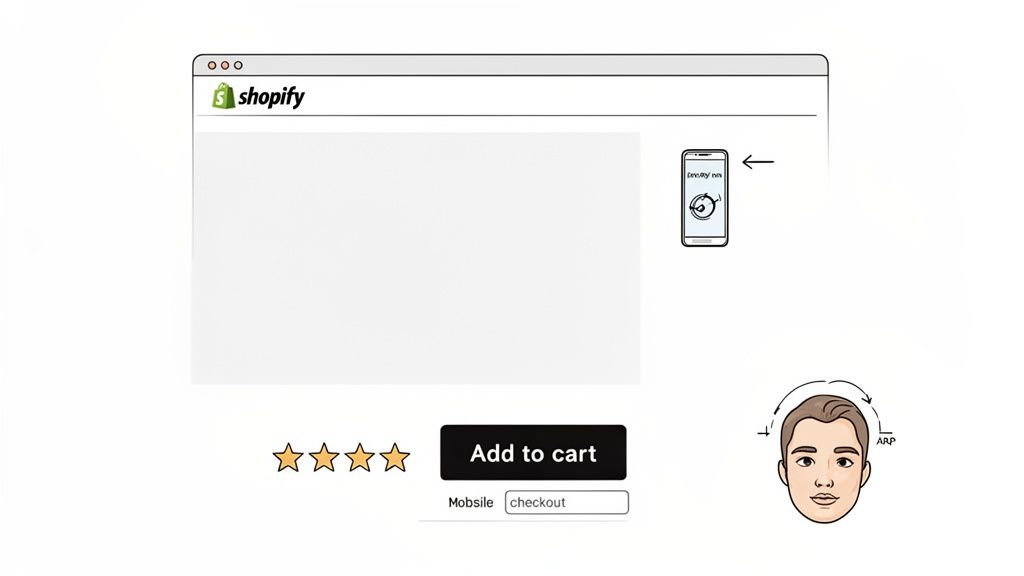
Driving traffic to your store is a great start, but it’s only half the battle. The real challenge—and where the money is made—is turning those visitors into paying customers. This is the world of Conversion Rate Optimization (CRO), and for beauty brands on Shopify, it's the critical link between your marketing spend and your revenue.
A high-converting store is no accident. It’s the product of intentionally designing a customer journey that’s smooth, trustworthy, and compelling from the first click to the final purchase confirmation. The idea is to eliminate every bit of friction and build confidence along the way.
Crafting Product Pages That Sell
Think of your product page as your digital beauty counter. This is your single biggest opportunity to convince a shopper that your serum or lipstick is the one they've been looking for. In the crowded beauty space, generic descriptions and a couple of photos just won’t do the job.
Your pages need to be irresistible. Here’s how to get there:
- Show, Don't Just Tell: Go beyond basic product shots. Use high-resolution images to show off texture, swatch the product on multiple skin tones, and present the packaging in a beautiful way. Short videos showing how to apply the product or its finish in different lighting are pure gold.
- Focus on the Transformation: Don't just list your ingredients; sell the benefit. Instead of "Contains Hyaluronic Acid," try "Floods your skin with hydration for a plump, dewy glow." Speak to their desires, not your spec sheet.
- Leverage Powerful Social Proof: Your product page is the ultimate destination for your user-generated content (UGC). Displaying a gallery of real people wearing your foundation or lipstick builds incredible trust. And of course, prominent star ratings and detailed reviews are non-negotiable.
A well-optimized product page doesn't just list facts. It builds desire and tells a compelling story. It’s your most effective salesperson, working 24/7 to make a case for why your product deserves a spot in your customer's cart.
Implementing Advanced Conversion Tactics
Once your product pages are solid, it's time to layer in more advanced strategies to really push your conversion rate higher. The beauty industry is perfect for tech-forward features that close the gap between browsing online and trying products in-store.
Augmented Reality (AR) is a game-changer. By integrating a virtual "try-on" tool, you let shoppers see exactly how a foundation shade or eyeshadow palette looks on their own face, right through their phone. This one feature can slash purchase anxiety and give conversion rates a serious lift.
Smart product bundles are another powerful move. Don't just throw random products together; curate bundles that solve a clear problem, like "The 3-Step Glass Skin Routine" or "The Ultimate Smoky Eye Kit." This not only boosts your Average Order Value (AOV) but also simplifies the buying decision for your customers.
For a comprehensive dive into CRO strategies, check out our full guide to conversion optimization best practices for e-commerce stores.
To help you get started, we've put together a prioritized checklist of the most impactful CRO actions you can take on your Shopify store.
Shopify CRO Checklist for Beauty Brands
| Optimization Area | Action Item | Expected Impact |
|---|---|---|
| Product Pages | Integrate high-quality UGC & review galleries (e.g., Loox, Yotpo) | High |
| Product Pages | Add video demonstrations for application and texture | High |
| Checkout | Enable one-click checkouts (Shop Pay, Apple Pay, Google Pay) | High |
| Homepage/PDP | Create curated bundles or "kits" to increase AOV | Medium |
| Store-Wide | Implement a "free shipping over $X" threshold bar | Medium |
| Product Pages | Implement an AR "Virtual Try-On" feature for color cosmetics | High |
| Checkout | Ensure all shipping costs and taxes are displayed upfront | High |
| Store-Wide | Optimize mobile site speed to load under 3 seconds | High |
| Cart/Checkout | Add trust badges (payment options, security seals) | Medium |
Focusing on the high-impact items first will give you the quickest wins, but working through this entire list will systematically improve your store's performance.
Designing a Frictionless Checkout
You could have the best product pages in the world, but if your checkout is clunky or slow, you'll watch abandoned carts pile up. The checkout is the final step, and you need to make it as effortless as possible—especially on mobile, where the vast majority of beauty shoppers are.
A few quick wins here can make a massive difference:
- Offer Express Payments: Make sure you have one-click options like Shop Pay, Apple Pay, and Google Pay enabled. The fewer forms a customer has to fill out, the higher your conversion rate.
- Be Upfront About Costs: Surprise shipping fees are the #1 killer of conversions. Show all costs, including taxes and shipping, as early and clearly as you can.
- Prioritize Speed: Every single second counts. Your pages must load instantly, and the flow between checkout steps should feel seamless. A slow checkout feels untrustworthy and frustrating.
By systematically improving your product pages, adding smart conversion features, and streamlining your checkout, you’ll transform your Shopify store from a simple online catalog into a powerful sales engine.
Your 90 Day Beauty Marketing Launch Plan
Alright, let's talk about turning that big, ambitious marketing strategy into something you can actually do. It's easy to get overwhelmed by all the moving parts. The best way I’ve found to tackle a launch is to think of it as a 90-day sprint, broken down into three manageable 30-day chunks.
This approach forces you to build a solid foundation before you even think about spending money on ads. It's a method that helps you launch with real momentum and a clear path forward, avoiding the common mistake of trying to do everything at once and ending up doing nothing well. We'll turn those abstract concepts into a concrete to-do list.
Days 1-30: The Foundational Groundwork
The first month is all about getting your house in order. Seriously. Before you can dream of attracting hordes of new customers, you need a brand that’s rock-solid and a digital storefront that’s actually built to convert. I've seen too many brands with amazing products fail because they rushed this part.
Your focus here is almost entirely internal. This is when you nail down your brand voice, finalize your messaging, and get laser-focused on your ideal customer. You'll be digging deep into audience research to build out personas that will inform every single thing you do from here on out.
Here are your key priorities for the first 30 days:
- Brand & Audience Finalization: Lock in your unique selling proposition. Who are you, really? What do you stand for? And who, specifically, are you talking to? Get those detailed customer personas written down.
- Shopify Store Optimization: Conduct a full-blown audit of your e-commerce site. Your main targets are improving site speed, ensuring it looks and works great on mobile, and smoothing out the overall user experience.
- CRO Basics Implementation: Install the essential conversion-focused tools. This means getting a customer review app like Loox or Yotpo set up, rewriting your product page copy to be relentlessly benefit-driven, and making sure your product photography and swatches are top-notch.
By the end of this month, you need to have a crystal-clear brand identity and a Shopify store that doesn't just look professional but is technically sound and ready to turn visitors into buyers. It might not be the most glamorous work, but it’s the most important.
Days 31-60: Content Creation & Audience Building
With a solid foundation in place, month two is all about creating content and starting to build your community. This is where you put your brand out into the world and begin executing the public-facing side of your strategy. The goal is to generate some organic buzz and gather early feedback before you start throwing money at ads.
Now you get to put all that brand and audience work into practice. You’ll start creating the content that fuels your social media and blog, and you'll kick off your initial outreach efforts.
Here’s your checklist for the second month:
- Launch Organic Social Channels: Start posting consistently on your chosen platforms (likely Instagram and TikTok). Focus on a healthy mix: educational tutorials, behind-the-scenes content that shows your personality, and posts that simply showcase your brand's vibe.
- Publish Foundational Blog Content: Write and publish your first 3-5 SEO-optimized blog posts. Go after those long-tail keywords you found earlier, addressing the real problems and questions your core audience has.
- Start Influencer & UGC Outreach: Begin identifying and reaching out to a small, carefully curated list of micro-influencers. Start with simple product seeding or initial collaborations. At the same time, launch a simple campaign to encourage your very first customers to create and share user-generated content (UGC).
You’re planting seeds this month. Your social following will be small, and blog traffic takes time to grow, but you're creating the assets and building the relationships that will supercharge your efforts in the final phase.
Days 61-90: Scaling & Optimization
The final 30 days are all about hitting the accelerator. Now that you have an optimized store, a growing library of content, and some initial social proof, it's time to pour some gasoline on the fire with paid advertising. This is where you start to scale what's working and gather the data you need to make even smarter decisions.
Your focus shifts from creation to promotion and analysis. You’ll launch your first paid campaigns, watch their performance like a hawk, and use the data to optimize your strategy in real-time.
Your key actions for scaling up:
- Launch Paid Ad Campaigns: Start with a modest budget for paid social ads on Instagram and TikTok. Use your best-performing organic content as a starting point and target the customer personas you defined back in month one.
- Roll Out Retargeting Ads: Set up campaigns to win back website visitors, cart abandoners, and people who have engaged with your social profiles. Don't let that warm traffic go to waste.
- Analyze & Optimize: Get comfortable inside your Shopify analytics, Google Analytics, and social media dashboards. You need to be tracking your key metrics like Customer Acquisition Cost (CAC), Conversion Rate, and Return on Ad Spend (ROAS).
- Refine Your Strategy: Based on the data, double down on what’s working and cut what isn’t. Is a specific ad creative blowing the others out of the water? Are customers responding better to one influencer over another? Use these insights to adjust your budget and creative strategy for the next 90 days.
This 90-day plan gives you a repeatable framework for launching or relaunching your beauty brand's marketing. By tackling it in these focused sprints, you'll build a powerful, data-driven marketing engine that’s truly set up for long-term success.
Frequently Asked Questions About Beauty Marketing
Even the most well-thought-out marketing plan can leave you with questions. It's natural. The beauty space moves fast, and it's full of nuances.
Let's cut through the noise and tackle some of the most common questions I hear from beauty founders and marketers. Getting straight answers here will give you the confidence you need to move forward and execute your strategy.
How Much Should a New Beauty Brand Spend on Marketing?
This is the million-dollar question, isn't it? While there’s no single magic number, a solid starting point for new consumer brands is to earmark 20-30% of your projected revenue for marketing during your first one to two years.
This isn't a hard-and-fast rule, but it’s a realistic budget that signals you're serious about growth.
In the beginning, most of this cash will—and should—go toward performance marketing channels. We're talking paid social ads on platforms like TikTok and Instagram. Your goal is immediate action: getting that first wave of traffic to your site, making those initial sales, and, most importantly, gathering precious customer data.
Once your brand starts to get some traction and revenue is flowing, you can begin to rebalance that spend. This is when you start shifting a portion of your budget to longer-term, brand-building plays. Think content for your blog (SEO), PR, and deeper community management to build loyalty and spark that priceless word-of-mouth growth.
Which Social Media Platform Is Best for Beauty Brands?
For almost any beauty brand launching today, you need to be on Instagram and TikTok. It's not about choosing one over the other; it’s about understanding how to play to each platform's strengths. You have to become fluent in both.
TikTok is your discovery engine. Nothing else comes close to its power for sparking viral trends through authentic, short-form video. This is where you grab the attention of new audiences by entertaining and educating them.
Instagram acts as your brand's polished home base. It’s where you build a beautiful brand aesthetic, nurture your community with interactive Stories, and drive sales directly through Instagram Shopping and product tags.
The biggest mistake I see brands make is simply cross-posting the same exact creative everywhere. Don’t do it. You have to adapt your content to fit the native feel of each platform. A raw, unfiltered "Get Ready With Me" video that crushes it on TikTok might need to be a more polished, aesthetic Reel to work on Instagram.
How Can I Compete with Larger Established Beauty Brands?
You can't outspend them, so don't even try. The secret is to out-niche them. The big, established brands have to appeal to a massive, broad audience. This creates huge opportunities for smaller, more focused brands to find a foothold and thrive.
Zero in on a specific audience, a unique problem you can solve, or a compelling ingredient story that bigger brands are too slow or too big to notice. Your agility is your greatest asset. You can jump on a new trend or respond to customer DMs in a way a massive corporation simply can't.
Don't underestimate the power of your personal connection. Build a fanatical community by engaging directly with your followers, celebrating their content, and showing the real people behind the brand. Your authentic founder story is an advantage that big, faceless corporations simply cannot replicate.
What Are the Most Important Metrics to Track?
When you're just starting out, it's easy to get overwhelmed by data. Your focus should be on a handful of core metrics that give you a clear picture of your customer acquisition funnel's health.
Here are the first three you need to obsess over:
- Customer Acquisition Cost (CAC): How much are you actually paying in marketing dollars to get one new customer?
- Conversion Rate: Of all the people who land on your website, what percentage actually buy something?
- Average Order Value (AOV): How much does the average customer spend in a single purchase?
As your brand matures and you start seeing those repeat purchases roll in, a new metric becomes absolutely critical: Lifetime Value (LTV). This tells you the total amount of revenue you can expect from a single customer over their entire relationship with your brand.
The real goal? Get your LTV to CAC ratio to at least 3:1. This means for every dollar you spend to acquire a customer, you're making at least three dollars back over time. That's the sign of a sustainable, profitable business.
Ready to build a brand that captivates and converts? ECORN specializes in creating high-performance Shopify stores for ambitious beauty brands like yours. From expert development and CRO to strategic eCommerce consulting, we have the tools to help you scale. Explore our services and start your growth journey today.



Shopify Website Design Examples: 7 Stores Worth Studying
7 Ecommerce Newsletter Examples for Shopify Brands
One Product Shopify Store: Build and Scale
Mobile Pop Up Strategy for Shopify Stores That Converts
Sitemap for Shopify: How to Find, Optimize, and Submit It
7 Single Product Websites Worth Emulating
Product Variants Shopify: The Complete 2026 Guide
Ecommerce Analytics Consulting for Growth
What Is AI Integration for eCommerce
How to Choose the Right eCommerce Website Development Firm
E Business Strategy Implementation
Conversion Tracking Setup for Shopify Stores
BigCommerce vs Shopify Plus Which Enterprise Wins in 2026
Shopify Theme Kit: Setup, Commands, and Migration Guide
Shopify Extension Development: A Practical 2026 Guide
Shopify Speed Score Explained and How to Improve It
Shopify Mobile Optimization: The 2026 Playbook
How to Add Subcategory in Shopify for Better UX
How to Implement Structured Data for Ecommerce in 2026
SEO App Mobile: Shopify Store Optimization Guide
Shopify Plus Support: What It Includes and How to Choose
Google Ads for Shopify: The Complete 2026 Playbook
Shopify New York: How to Find and Hire the Right Agency
Google Search Console for Shopify: The Complete Setup
First Party Data Collection for eCommerce Growth
FAQ Online Store Guide: Build and Measure It Right
Do FB Ads Work for eCommerce in 2026?
One Page Checkout for Shopify: Design and Implementation
Shopify GraphQL vs REST: The 2026 Developer Decision
Shopify Ecommerce Consulting: Strategy, Pricing &
Are Reddit Ads Worth It for eCommerce Brands
Shopify Title and Meta Description: A Practical 2026 Guide
Product Video Best Practices for Shopify Brands

Real-Time Inventory Management: A 2026 Guide

AI Chatbot Integration for Shopify Stores
Affiliate Program Management: A Shopify Guide
10 Best Performance Monitoring Tools for Shopify in 2026
Digital Asset Management for eCommerce Brands in 2026
Every Type of Facebook Ads Explained for eCommerce Growth
Product Information Management Explained for Shopify Brands
Support Ticket System: A Guide for Shopify Stores

10 Best Customer Service Tools for Shopify in 2026

Can I Start a Business with No Money? a 2026 Blueprint
What Sells Good on Etsy: Best Niches for 2026

Shopify Add to Cart Button: A Practical 2026 Guide

Customer Feedback Automation: A Practical eCommerce Guide
Critical Rendering Path: A Guide for Shopify Stores

How to Promote on TikTok for eCommerce in 2026

B2B eCommerce Consulting That Drives Real Revenue
10 Best Practices for Site Navigation in 2026
Return vs Refund for Shopify Stores: A Practical Guide
What Is Customer Lifetime Value and Why It Matters
What Is Voice of Customer Research for eCommerce

SMS Marketing for Ecommerce That Actually Converts

Master How to Improve Email Deliverability in 2026
Top 7 eCommerce Partners NYC for Shopify Brands in 2026
Machine Learning for Ecommerce: Boost Your Shopify Store
Beauty Market Research: Your 2026 Growth Guide

Shopify International Expansion: A 2026 Roadmap
What Does CRO Stand for in Business: Understanding CRO
Shopify Visual Merchandising: A Playbook for Higher Sales

Shopify Landing Page Design: Master Conversion in 2026
10 Best AI SEO Optimization Tools for Shopify in 2026

Agentic AI for Ecommerce: Boost Your Sales in 2026
Mastering Email Marketing Data for eCommerce Growth
Conversion Rate Optimisation Australia: Boost Your Sales
Conversion Rate Optimization AI: Your Shopify Store Guide

10 Product Bundling Strategies for Shopify in 2026
How to Increase Customer Lifetime Value: A Shopify Playbook
AI Customer Service Automation: Shopify Guide 2026
Clean Website Design: A Shopify Conversion Playbook

Omnichannel Retail Strategy: A Shopify Playbook
Product Data Enrichment: A Guide for Shopify Brands
Instagram Shopping Features a Guide for Shopify Stores
What Is Revenue Optimization: A Holistic RevOps Guide
Benefits of Conversion Rate Optimization: Boost Your
WordPress to Shopify Migration: Your 2026 Seamless Switch
Boost Sales: Ecommerce Payment Processing Guide 2026
Unified Commerce Platform: Benefits, KPIs & Shopify Guide
How to Reduce Bounce Rate eCommerce: Your 2026 Guide
Shopify API Integration: A Practical End-to-End Guide

How to Implement Data Governance: A 2026 Guide
Shopify Store Development Cost: A 2026 Breakdown
What Is Server Side Tracking: The Shopify Guide 2026
Marketing Automation Workflows: A Shopify Guide for 2026
Shopify: How to Reduce Technical Debt

Shopify UX Design Change: A Playbook for Growth
User Generated Content Strategy: Shopify Playbook
Shopify Pause and Build Plan Cost: A Complete 2026 Guide
Compare at Price on Shopify: A Complete Guide for 2026
Where Can I Sell My Prints? 10 Best Platforms for 2026
Shopify Order Management System: The Ultimate Guide 2026
What Is Marketing Attribution? an eCommerce Guide for 2026
10 Best Black Friday Sales Sheets for 2026

Discover the Top Social Media Marketing Agencies For
Consumer Confidence Definition for eCommerce in 2026
What Is Social Commerce? Your 2026 Guide to Boosting Sales
A Social Ad Campaign Playbook for eCommerce Growth
7 Best FAQ Page Examples for SaaS & eCommerce

Market Research in Fashion Industry: A Guide for Shopify


newsletter in your inbox