


You’ve sourced the products, opened the Shopify admin, tested a theme, and maybe even shot the first product photos. Then you hit the field that looks deceptively simple: store name.
That empty box stalls a lot of founders.
It stalls them because they know the name will end up everywhere. In the URL, on packaging, inside paid ads, in Instagram bios, in customer referrals, in trademark filings, and in the first impression a stranger forms before they’ve seen a single product detail. When you’re naming a clothing store, you’re not picking decoration. You’re choosing operating infrastructure.
I’ve seen founders treat naming like a final polish step. That’s backwards. The name shapes how easily people remember you, search for you, trust you, and talk about you. It affects what happens when someone hears your brand once on TikTok and tries to type it into a browser later. It affects whether your domain is available. It affects whether your business can grow past one product category or one city.
A strong name won’t rescue a weak offer. But a weak name can absolutely slow down a strong one.
If you’re stuck between twenty tabs, half a notebook page of ideas, and a domain registrar telling you your best options are gone, the answer isn’t waiting for inspiration. The answer is using a tighter process.
The Name Is Your First Product
You can be ready to launch and still lose a week here.
Inventory is ordered. Product pages are nearly done. The Shopify theme works. Then the name starts holding up the whole business because every option creates a different problem. One is memorable but boxed into a single product type. One sounds polished but the domain is gone. One looks good on a moodboard and weak in a search bar. One gets compliments from friends and falls apart when spoken aloud.
That friction matters because the name reaches customers before the product does. It shapes the first click, the first impression, and the ease of the second visit when someone tries to remember what they saw on Instagram or TikTok. In apparel, where many stores sell comparable products at comparable price points, the name often carries more weight than founders expect.
A strong name helps conversion earlier than many founders realize. It can improve ad recall, reduce hesitation on a first visit, and make branded search easier to recover later. A weak one creates drag across the funnel. Clicks cost the same either way, but generic or confusing names usually make every downstream job harder, from word of mouth to repeat traffic.
That is why I treat naming as a commercial decision first and a creative decision second.
The job is not to find the cleverest phrase in a brainstorm. The job is to choose a name that fits the brand, clears technical checks, and still works when the catalog grows, the ad budget rises, and the business moves into new channels. AI can help here, but not only by generating options. Used properly, it can help predict which names are likely to be confused, forgotten, misspelled, or mistrusted before you spend money driving traffic to them.
If the visual side of the brand is still unsettled, clarify the broader brand system your store name needs to fit into.
A good clothing brand name has to work in four places at once: in memory, in search, on a label, and inside a growth plan.
Founders who get this right stop judging names by taste alone. They judge them by recall, flexibility, availability, and how efficiently the brand can scale behind them.
Build Your Naming Strategy on a Solid Foundation
A founder settles on a name in an afternoon, buys the domain, mocks up the logo, and starts building the Shopify store. Two weeks later, the problems show up. The name sounds like five competitors, the Instagram handle needs extra characters, paid traffic converts poorly because the brand feels generic, and the catalog roadmap no longer fits the label.
That failure usually starts upstream. Weak naming comes from weak strategy, not weak creativity.
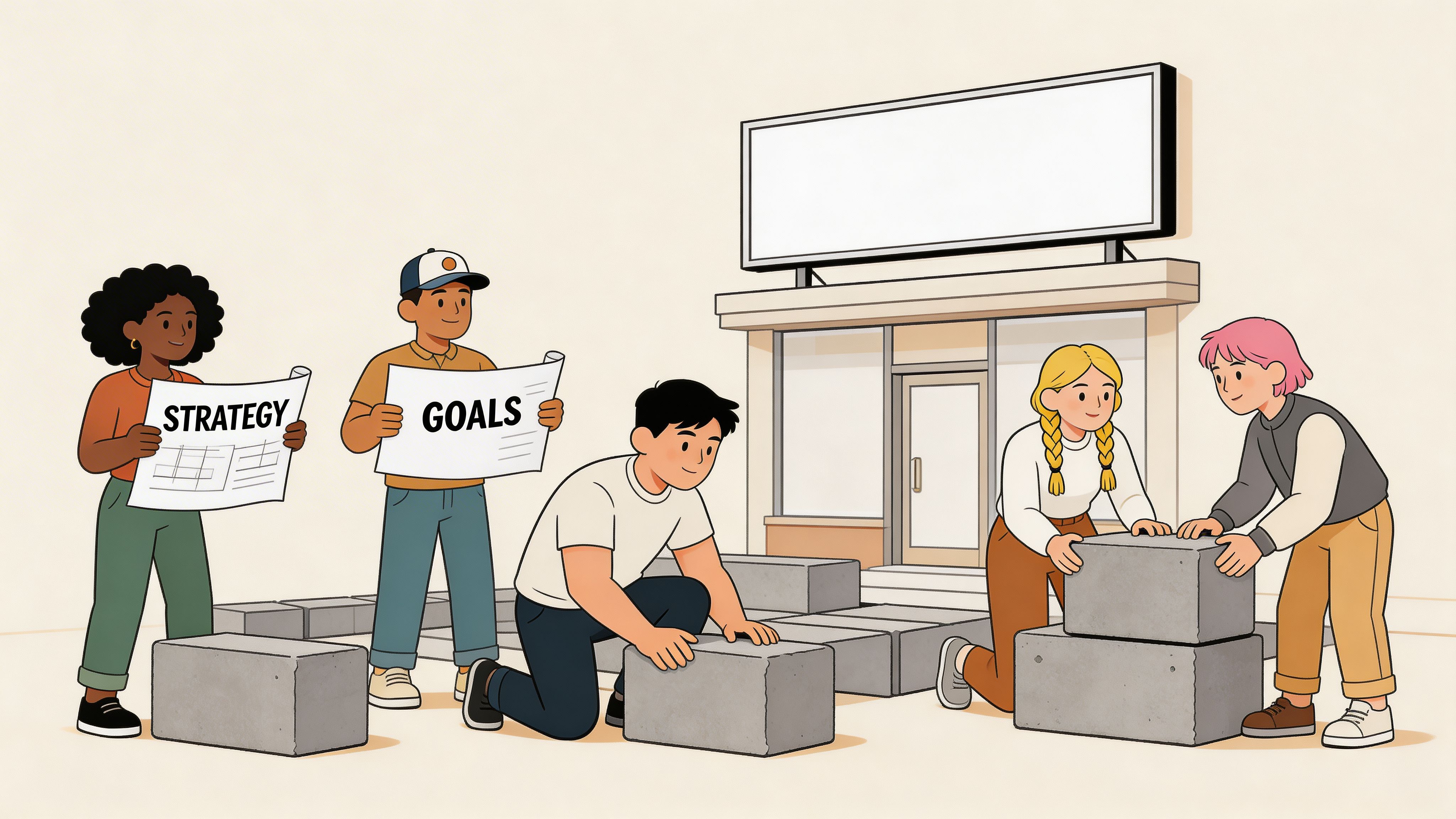
Start with what the brand must signal
Before generating names, define the job the name has to do in the market.
Keep it operational:
What are you selling
Minimal wardrobe staples, trend-led womenswear, premium streetwear, size-inclusive basics, performance apparel, occasionwear, or something else.Who needs to trust this brand
Get specific enough to reject names that would feel wrong to the buyer, even if you personally like them.What should the brand feel like
Quiet luxury, playful, rebellious, grounded, technical, romantic, heritage-led, culturally sharp.Where does the business need room to grow
If dresses are the entry point but accessories, footwear, or menswear are likely later, the name cannot lock you into a narrow lane.
This is also where AI becomes more useful than a simple idea generator. Once these inputs are clear, you can use AI tools for fashion brands to pressure-test tone, likely associations, and confusion risk before you spend on design or traffic. That matters because naming is tied to conversion and scale much earlier than many Shopify founders expect.
A sustainable minimalist label and a hype-driven streetwear store should not produce similar name lists. If they do, the strategy is still blurry.
Define the audience beyond demographics
Age, gender, and income are a starting point. They are not enough to guide naming.
Clothing purchases sit close to identity. People use fashion to signal taste, status, belonging, restraint, rebellion, professionalism, or practicality. A name has to match the language your buyer already trusts, or it will add friction before the product page has a chance to do its job.
Build a quick audience profile around these points:
| Audience input | Questions to answer |
|---|---|
| Demographics | How old are they, and what price point feels normal to them? |
| Lifestyle | Are they dressing for office life, nightlife, gym routines, travel, parenting, or creator culture? |
| Values | Do they care about sustainability, exclusivity, practicality, trend relevance, craftsmanship? |
| Shopping behavior | Do they browse slowly, buy on impulse, shop collections, or search by problem? |
| Brand language | Do they respond to polish, edge, warmth, wit, simplicity, or authority? |
I have seen founders choose names that felt refined in a brainstorm but came off distant and overpriced to the actual customer. I have also seen the reverse. Names meant to sound edgy ended up reading cheap in categories where shoppers were looking for quality signals.
Know the market you’re entering
Naming in isolation is expensive.
Search competitors across Shopify, Instagram, TikTok, Google Shopping, and marketplaces. Look for repeated words, repeated tones, and repeated structures. Then decide whether your advantage comes from fitting the category cleanly or standing apart from it.
Some broad patterns show up often:
- Streetwear can tolerate abstraction, inside-language, and cultural references.
- Premium womenswear often rewards restraint, clarity, and editorial tone.
- Family or basics brands usually benefit from warmth and clarity over clever phrasing.
- Boutique-style multi-brand stores often need broader names than a single-product DTC label.
A practical rule helps here. If your category already overuses words like “thread,” “label,” “wear,” “collective,” or “atelier,” another slight variation rarely helps. The bar for distinction is higher than founders think.
As noted earlier, analysts at Capital One Shopping found that many small companies rank naming among the top branding priorities for a new brand. Emerging stores can’t rely on awareness to compensate for an unclear name.
Write the brief before the brainstorm
A naming brief does not need to be long. It needs to be sharp.
Use five lines:
- Brand promise
- Ideal customer
- Desired tone
- Words to avoid
- Expansion plans
That fifth line saves people from expensive mistakes. A name like “Denver Women’s Dresses” may feel practical at launch, but it becomes a constraint once the assortment broadens, paid acquisition expands, or wholesale enters the plan.
Good names leave room for growth while still giving customers a clear signal. That balance is harder than it looks, which is why I treat the brief as a filter, not paperwork. It helps you eliminate weak options fast, spot names that will age badly, and build a shortlist that can survive validation later.
Ideation From Classic Techniques to AI Assistants
Once the foundation is clear, volume matters.
You need more options than your first five instincts. Most founders fall in love too early with a decent name and never generate enough serious alternatives. That usually leads to compromise later when the domain is gone, the trademark looks risky, or the name feels thin in real use.
Start wide. Then narrow hard.
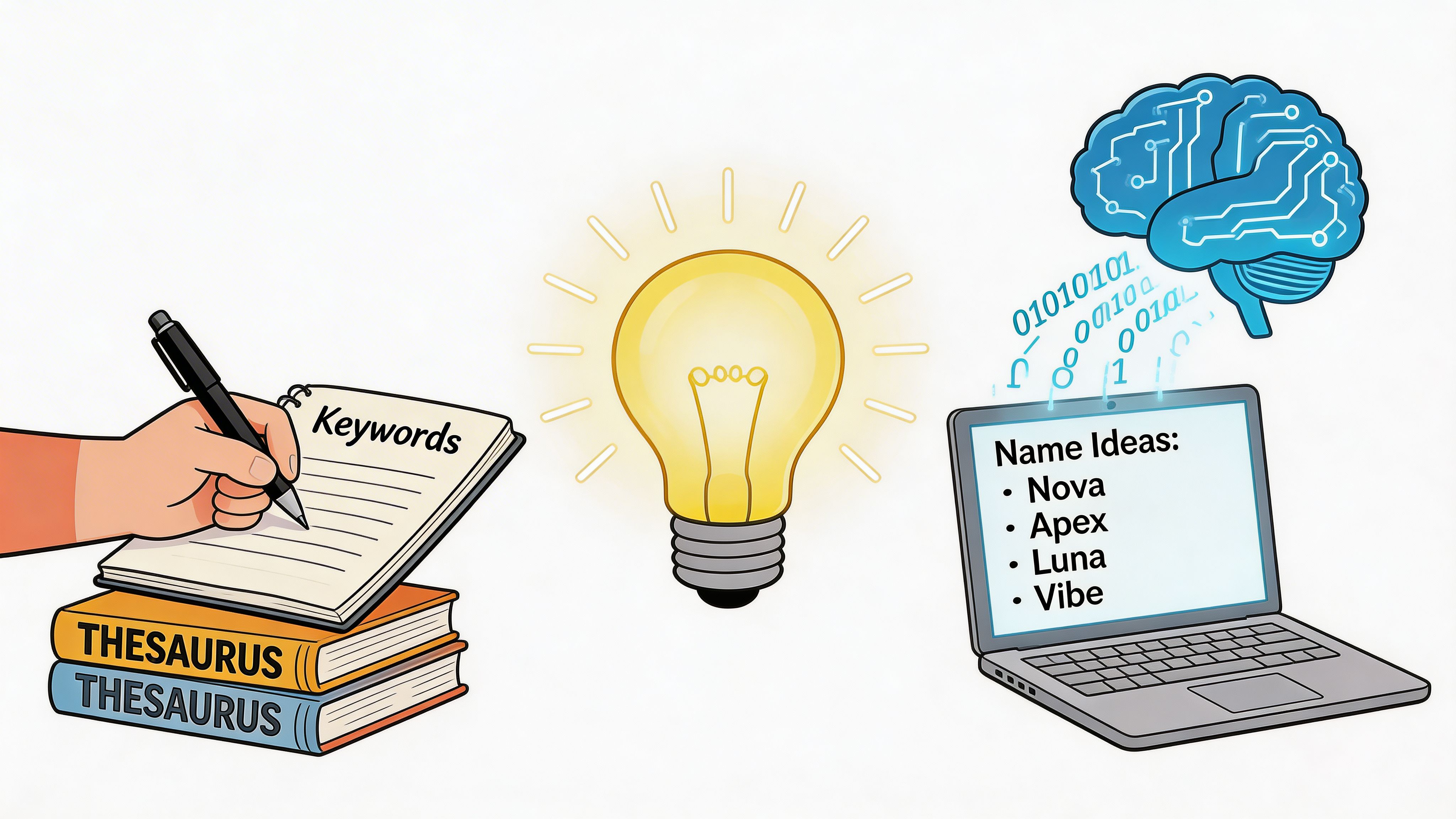
Use classic naming routes first
The best brainstorming still starts with language, not software.
Here are the main routes I’d use when naming a clothing store:
Descriptive names
These tell customers roughly what you are.
They’re easy to understand and often weak at distinction if handled lazily. “Modern Muse Apparel” or “Urban Style Boutique” may feel serviceable, but they rarely create much ownable memory.
Use descriptive naming only if the phrasing is unusually clean or the brand benefit is specific.
Evocative names
These suggest a mood, image, or world.
This route is often stronger for fashion because clothing is emotional. A name can imply sophistication, movement, restraint, rebellion, softness, heat, or precision without explicitly describing garments.
Done well, evocative names carry more stretch.
Invented names
These can be powerful because they’re easier to own if they sound natural and look clean in print.
The risk is sounding artificial or awkward. If an invented name needs too much explanation, it starts with friction.
Personal or heritage-led names
Fashion has a long history of eponymous naming. That can work when the founder identity is central to the brand or when the name already carries aesthetic weight.
It works less well when the personal name is difficult to spell, hard to pronounce in your target markets, or disconnected from the customer promise.
Build with word banks, not isolated ideas
Don’t jump straight into full names. Build raw material first.
Create separate lists for:
- Brand traits such as refined, loud, clean, sensual, sharp, grounded
- Category language such as layer, line, form, fold, stitch, drape
- Cultural references that fit your brand world
- Sensory words tied to texture, movement, light, shape, or mood
- Founder or origin words if there’s a meaningful story worth using
Then start combining. Often, good names emerge from this process. Not from genius. From structured collision.
Bring AI in as a naming partner
Most guides mention AI like it’s a novelty. It’s more useful than that if you use it correctly.
AI is good at expanding a naming field fast. It can surface associations, patterns, sound combinations, and variants you wouldn’t produce in one sitting. It can also help you validate names against practical constraints before you get emotionally attached.
That matters because AI tools can improve domain acquisition rates by 40% for fashion startups and boost initial search visibility by 28% via predictive keyword matching, according to Site Builder Report’s overview of clothing store name ideas.
The mistake is asking for “clothing brand name ideas” and accepting a bland list.
Use prompts with constraints. For example:
- Give me 50 name ideas for a women’s clothing brand positioned as minimalist, refined, wearable, and modern. Avoid the words boutique, fashion, style, luxe, label, and wear.
- Generate names that are one or two words, easy to pronounce in English, not tied to one product category, and suitable for a .com domain check.
- Create 30 names that feel premium and restrained, with subtle references to tailoring, form, and movement.
- Suggest invented names built from short syllables that look clean on packaging and don’t resemble common marketplace sellers.
That kind of prompting gets far better output.
If you’re building a broader workflow, this roundup of AI tools for fashion brands is useful because it helps founders think beyond simple name generators.
AI is best at scale and pattern recognition. Founders are best at taste, positioning, and rejection. Use both.
Ask AI to validate, not just generate
This is the part most founders miss.
After you’ve generated names, run each one back through AI for pressure testing:
- Is it easy to pronounce from text alone?
- Could it be misread as another word?
- Does it suggest the wrong category or audience?
- Does it carry obvious negative connotations in major languages you care about?
- Does it feel trend-bound?
- Does it sound premium, accessible, editorial, playful, or technical?
You’re not asking AI for the final answer. You’re using it to surface risks faster.
A simple validation prompt might be:
“Evaluate these ten clothing brand names against memorability, phonetic clarity, category flexibility, premium perception, and likelihood of confusion.”
That gives you a more useful shortlist.
Here’s a good walkthrough to pair with your own brainstorming session:
Cut ruthlessly
Once you have a long list, the next step is subtraction.
Move from maybe 100 names to 15. Then from 15 to 5. Don’t preserve weak options just because you spent time generating them.
A shortlist survives only if the name does at least three things well:
| Keep it if it... | Cut it if it... |
|---|---|
| Sounds distinct aloud | Needs explanation |
| Looks clean in text | Looks cluttered or awkward |
| Can stretch across categories | Locks you into one item or audience |
| Feels on-brand instantly | Feels generic or borrowed |
This stage should feel slightly brutal. That’s a good sign.
The founders who end up with strong final names usually don’t find one magical idea. They generate a large field, then use positioning, language, and AI-assisted validation to narrow it down until only the commercially viable options remain.
Run Your Shortlist Through the Validation Gauntlet
A founder picks a name, orders sample packaging, mocks up the Shopify theme, and starts planning ads. Then the problems show up. The .com is taken, TikTok requires extra characters, Google surfaces three unrelated brands, and half the people who hear the name spell it wrong. That is expensive rework.
Validation is where naming turns from taste into commercial judgment. A strong candidate has to survive technical checks, channel constraints, and customer behavior before it earns a place on the final list.
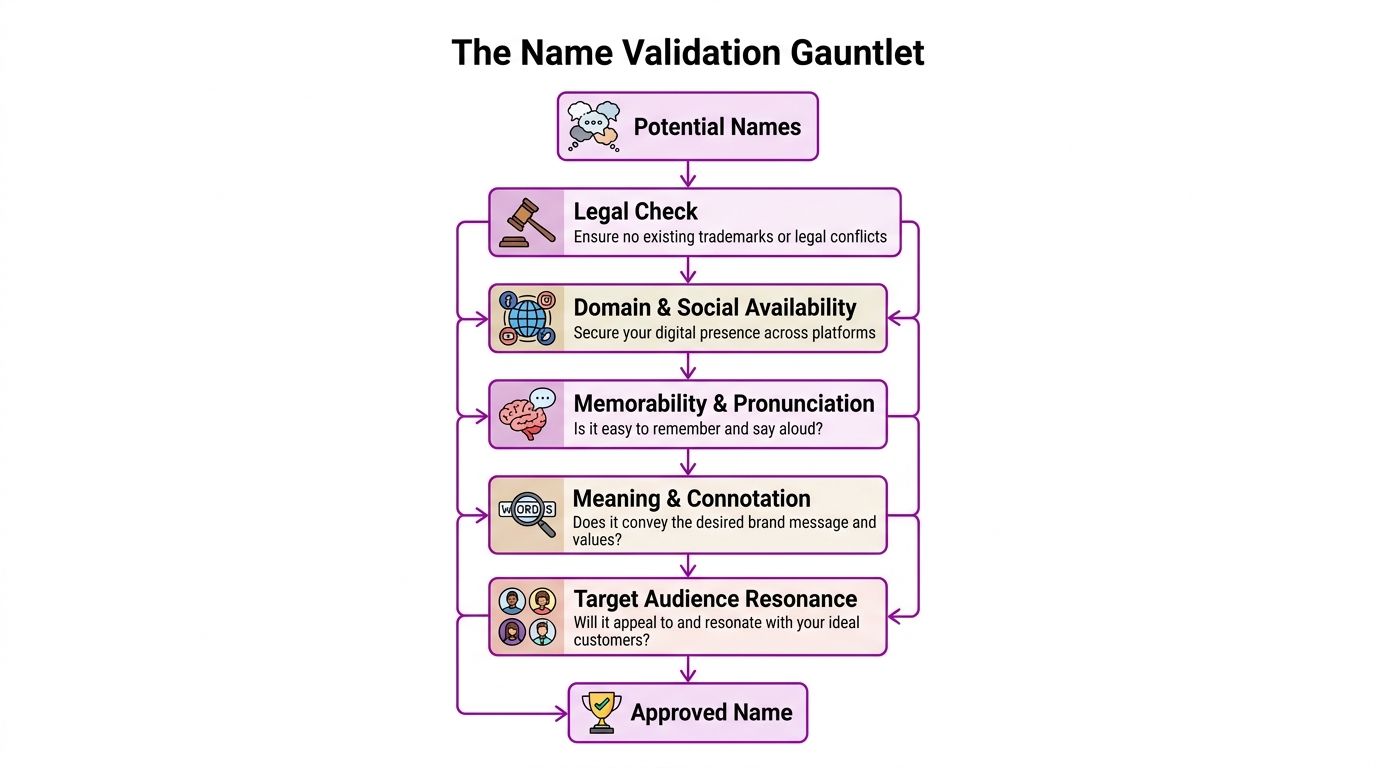
Start with digital availability
Check the assets you will need to operate.
Can you get the domain in a clean format? Are the primary social handles available without awkward prefixes, suffixes, or punctuation? Will customers guess the right URL and handle on the first try?
Small compromises here create real drag later. If your brand name only works with added words or unusual spelling, direct traffic drops, tagged posts get missed, and word of mouth loses efficiency.
Review each finalist for:
A clean domain path
The brand name should be available in a straightforward format, without forced modifiers.Consistent social naming
Instagram, TikTok, Pinterest, and the channels that matter to your buyer should line up as closely as possible.Low ambiguity
If customers can type it several different ways, some of them will never find you.
Check search viability before you get attached
A clothing brand does not need a keyword-stuffed name. It does need a name that can earn branded search without fighting noise from day one.
Search every finalist in Google, social platforms, marketplaces, and basic domain lookup tools. Look for conflicts, clutter, and near matches in adjacent categories. Generic names often feel safe in a brainstorm and weak in actual discovery because they are hard to own in search, hard to remember, and hard to defend in paid acquisition.
Arcus AG notes that differentiated, audience-aligned fashion names outperform generic ones on retention over time in its review of common naming mistakes in the category, and the same analysis supports using a quantitative scoring approach during evaluation: Arcus AG’s analysis of naming pitfalls in fashion.
I also use AI here for predictive validation, not just idea generation. Feed your shortlist into a model and ask it to score likely confusion risk, search distinctiveness, premium perception, and category flexibility. Then compare that output against what you see manually in search results. It will not replace judgment, but it will surface weak signals faster, especially before you spend on creative or traffic.
Test pronunciation and recall
A name has to work in the mouth, on the screen, and in memory.
Say each finalist out loud. Ask someone to spell it after hearing it once. Then reverse the test. Show them the word and ask them to say it. If performance breaks in either direction, expect friction in referrals, direct visits, and branded search.
Use these checks:
- Can someone spell it after hearing it once?
- Can they pronounce it confidently when reading it?
- Does it blur visually with another common word?
- Does it still look good on a label, hangtag, and mobile header?
I treat repeated founder explanations as a warning sign. If early conversations keep turning into pronunciation lessons, the name is asking too much from the market.
Examine meaning, tone, and range
Some names are available, pronounceable, and still wrong for the business.
A name can sound premium when spoken internally and read cheap to shoppers. It can feel sharp for a DTC womenswear launch and become restrictive when the brand expands into menswear, accessories, or wholesale. It can also carry unintended connotations across regions or languages.
Run each finalist through a short review:
- What emotional signal does this name send?
- What price point does it imply?
- Which customer does it seem to welcome, and which one does it exclude?
- Will it still fit if the catalog broadens in two years?
Considering commercial scalability is essential in the naming process. Founders often treat scale as a later problem. It is a naming problem too.
Do a preliminary legal screen
This step is basic risk control.
Search trademark databases in the markets you plan to sell into. Look for obvious conflicts in related apparel and retail classes. If a similar brand already operates close to your category, move on before you invest more time.
Legal review at this stage will not give final clearance. It will help you avoid names that are already heading toward friction, opposition, or a forced rename.
Score the shortlist so preference does not take over
Founders usually have a favorite by this point. Favorites are fine. Unchecked bias is not.
A simple scoring matrix gives you a way to compare creative strength against operational reality. It also makes AI validation more useful, because you can feed model outputs into the same framework instead of treating them as vague opinions. I like this because it links naming to the metrics that matter later, especially branded search efficiency, click-through rate on prospecting ads, and conversion lift from stronger recall.
Clothing Store Name Scoring Matrix
| Criteria (Max Score) | Name 1 Score | Name 2 Score | Name 3 Score |
|---|---|---|---|
| Uniqueness (20) | |||
| Pronounceability (25) | |||
| Relevance to audience (20) | |||
| Domain and social availability (15) | |||
| Trademark clearance potential (10) | |||
| Scalability (10) | |||
| Total (100) |
The exact threshold matters less than consistency. If one name wins on style but loses on availability, clarity, and flexibility, it is not your best option. It is your most seductive mistake.
Use pass-fail rules
Do not keep a name alive because you spent hours generating it.
Reject finalists that are distinctive but technically messy. Reject finalists that are easy to secure but flat, forgettable, or too narrow for the brand you want to build. The names worth testing with customers are the ones that hold up across recall, search, legal risk, asset availability, and future expansion.
That is a much smaller list. Good.
Test Your Finalists with Real Customers
A technically clean name can still miss with buyers.
That’s why customer testing matters. Not because customers should name your brand for you, but because they reveal whether your finalists create the right assumptions. That’s the part founders are too close to see.
When people hear a name for the first time, they instantly build a mental model. They decide who it’s for, what it costs, what it looks like, and whether they trust it. If that model is wrong, you start the relationship with friction.
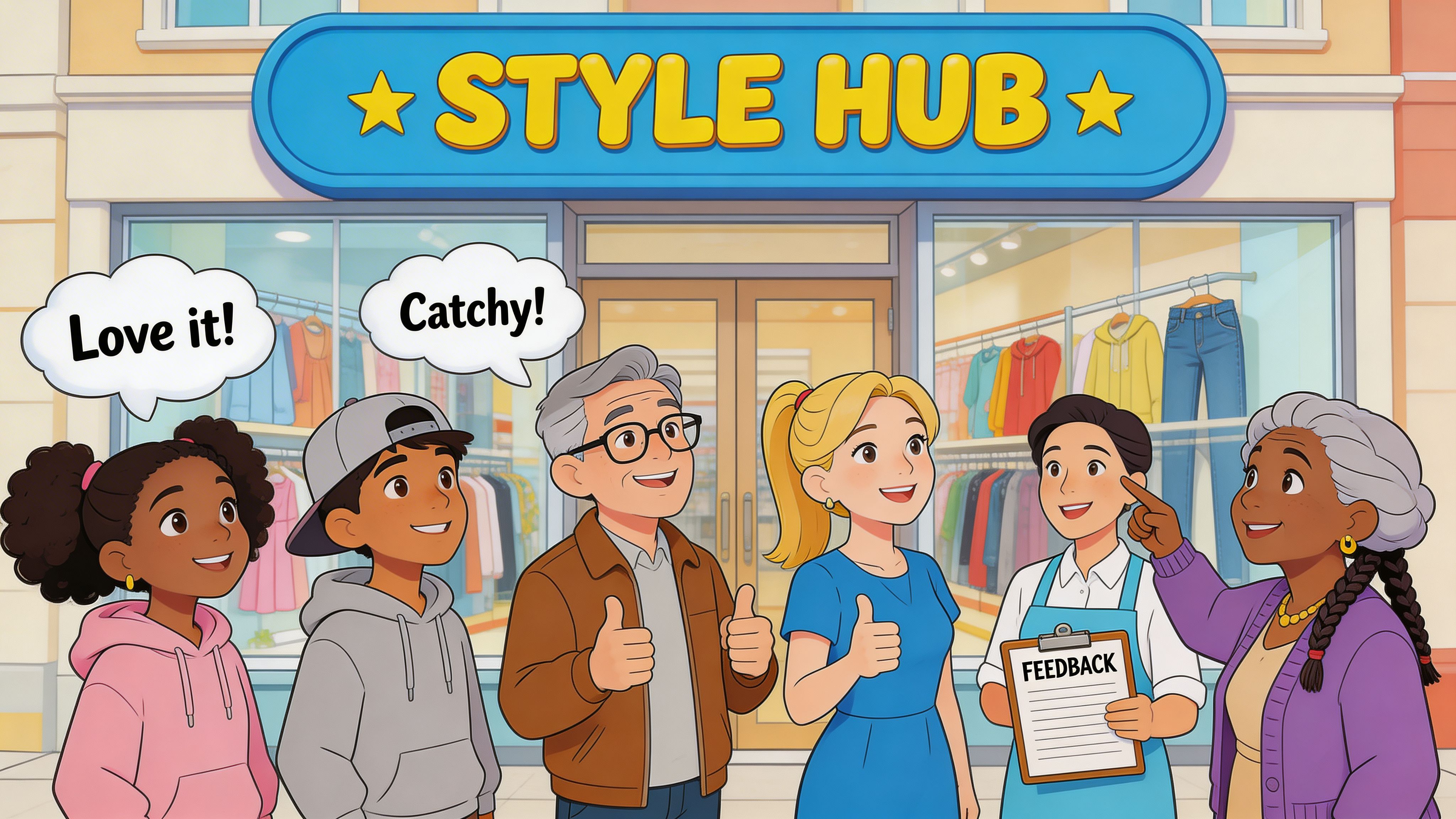
Don’t ask whether people like the name
That question produces weak feedback.
People often say they “like” names that are familiar, generic, or non-threatening. That doesn’t mean the name is commercially strong. It just means it didn’t bother them.
Ask better questions:
- What kind of store do you think this is?
- What price point do you expect from a brand with this name?
- What kind of person shops here?
- What products would you expect to find?
- Which of these names feels easiest to remember after one read?
Those answers show whether the name is doing the job.
Use low-cost testing methods
You don’t need a large research budget to get directional feedback.
Try a mix of these:
Simple surveys
Send a short form to people who match your audience profile. Keep it focused and comparative.Organic social polls
Useful if you already have an audience that resembles your future customer.Paid ad smoke tests
Run small creative variations with identical products and different brand names to see which version earns better early engagement signals.Informal interviews
A short call with a handful of ideal customers can reveal confusion faster than a large spreadsheet.
One real-world reason this matters is that memorable names directly impact sales. The fragrance name “Hot Cakes” generated 10 million organic social media impressions in a month, as noted by Business of Fashion’s discussion of product naming. That example is product naming, not store naming, but the principle carries over. A name people remember and repeat has a commercial advantage.
That same source also notes that 88% of consumers state they will buy again from a brand they trust. A name doesn’t create trust alone, but it absolutely shapes the first layer of it.
If a name creates the wrong expectation, every landing page, product description, and ad has to spend energy correcting the mismatch.
Watch what people remember later
Immediate reaction is useful. Delayed recall is better.
After a day or two, ask testers which names they still remember without prompting. You’ll usually get a sharper signal than you do in the moment.
Bland names fade at this point. They may feel safe during testing and disappear from memory almost immediately. Stronger names create cleaner mental hooks.
Protect the founder’s role in the decision
Customer feedback is an input, not a vote.
If one name performs well but pushes the brand toward the wrong long-term perception, don’t outsource your judgment. Your job is to combine feedback with strategy. Customers tell you how the name lands. They don’t decide the business you’re building.
The strongest final choices usually sit at the intersection of three things:
| What matters | What you’re looking for |
|---|---|
| Customer reaction | Clear fit, strong recall, right emotional tone |
| Technical strength | Good availability, low confusion, brand safety |
| Strategic stretch | Room to expand without re-explaining the brand |
Skip this step and you’re naming in a vacuum. That’s rarely where durable retail brands come from.
Secure Your Assets and Launch Your Brand
Once the decision is made, move fast.
A lot of founders relax after choosing the name. That’s when avoidable problems show up. The window between selecting the name and securing the assets should be as short as possible.
Lock down the domain first
Your domain is the first priority.
For a Shopify apparel brand, the cleanest path is usually the strongest. Generic workarounds weaken direct traffic, brand recall, and trust. That’s one reason a technical audit matters so much. Securing a .com domain is critical, as the success rate for finding an available .com for generic terms is only 15%, and unavailable domains correlate with 35% lower organic traffic in a brand’s first year, according to Business.com’s guide to starting a clothing store.
If you’ve landed on a strong name, don’t wait.
Claim the handle set, not just one channel
Even if you only plan to use Instagram and TikTok right away, secure your name across the major platforms relevant to fashion and commerce.
That gives you consistency later and prevents someone else from creating confusion around your brand. Use the same version wherever possible. If a compromise is necessary, make it minor and readable.
Set up the Shopify structure properly
Once the assets are secured, connect the brand inside Shopify without delay.
Use the selected name consistently in:
- Your store name settings
- Primary domain connection
- Email sender name
- Meta titles and descriptions
- Social profile bios
- Packaging and insert drafts
- On-site navigation labels where relevant
If you want examples of how successful brands structure apparel experiences on Shopify, this gallery of Shopify apparel stores is a good reference point.
Handle legal protection early
You don’t need to become a legal expert, but you do need to treat the name as an asset worth protecting.
If you’re unsure what falls under brand ownership and legal rights, this primer on what is intellectual property protection is a useful starting point. It helps frame why names, logos, and creative assets need formal attention once the brand starts moving.
At minimum, keep records of:
- When you selected and began using the name
- Your domain registrations
- Your handle registrations
- Any design files tied to the brand identity
- Trademark filings or legal correspondence if you proceed
Build a minimal brand system around the name
Don’t jump straight from “name chosen” to “logo ordered” without checking the fit.
The name should influence the visual system. A restrained name may call for cleaner typography. A more expressive name may support a bolder identity. The point is alignment.
Your first practical brand kit should include:
- Primary wordmark or logo
- Type choices
- Core color palette
- Voice notes for product copy and social captions
- Usage rules for the name in headers, packaging, and creative
Keep it simple. Consistency matters more than complexity at launch.
Launch rule: If the name, URL, logo, bio, and packaging language don’t feel like they belong to the same brand, customers notice the mismatch even if they can’t explain it.
Launch with a name that can carry the next stage
A store name isn’t finished because you published it. It proves itself in use.
You’ll hear it in creator mentions, see it in search terms, print it on inserts, pitch it to collaborators, and watch customers repeat it back in reviews, DMs, and support requests. That’s when you find out whether the naming work was shallow or solid.
A strong name won’t do everything. It won’t fix weak offers or poor merchandising. But it gives the business a cleaner path from first impression to remembered brand.
That’s what you want. Not a name that felt exciting in a brainstorming session. A name that keeps working after launch.
If you’re building or scaling a Shopify apparel brand and want expert support across branding execution, CRO, UX, and development, ECORN helps eCommerce teams turn strong brand decisions into storefronts that convert.


Shopify Design Agency: How to Pick the Right Partner
Mastering Multi Store Management on Shopify
Scale Shopify Store
10 Shopify App Ideas Worth Building in 2026
Conversion Rate Optimization for Landing Pages: The Playbook
Shopify Plus Automation: A Guide for 2026
10 Social Selling Platforms for Shopify Merchants

Shopify Website Design Examples: 7 Stores Worth Studying
7 Ecommerce Newsletter Examples for Shopify Brands
One Product Shopify Store: Build and Scale
Mobile Pop Up Strategy for Shopify Stores That Converts
Sitemap for Shopify: How to Find, Optimize, and Submit It
7 Single Product Websites Worth Emulating
Product Variants Shopify: The Complete 2026 Guide
Ecommerce Analytics Consulting for Growth
What Is AI Integration for eCommerce
How to Choose the Right eCommerce Website Development Firm
E Business Strategy Implementation
Conversion Tracking Setup for Shopify Stores
BigCommerce vs Shopify Plus Which Enterprise Wins in 2026
Shopify Theme Kit: Setup, Commands, and Migration Guide
Shopify Extension Development: A Practical 2026 Guide
Shopify Speed Score Explained and How to Improve It
Shopify Mobile Optimization: The 2026 Playbook
How to Add Subcategory in Shopify for Better UX
How to Implement Structured Data for Ecommerce in 2026
SEO App Mobile: Shopify Store Optimization Guide
Shopify Plus Support: What It Includes and How to Choose
Google Ads for Shopify: The Complete 2026 Playbook
Shopify New York: How to Find and Hire the Right Agency
Google Search Console for Shopify: The Complete Setup
First Party Data Collection for eCommerce Growth
FAQ Online Store Guide: Build and Measure It Right
Do FB Ads Work for eCommerce in 2026?
One Page Checkout for Shopify: Design and Implementation
Shopify GraphQL vs REST: The 2026 Developer Decision
Shopify Ecommerce Consulting: Strategy, Pricing &
Are Reddit Ads Worth It for eCommerce Brands
Shopify Title and Meta Description: A Practical 2026 Guide
Product Video Best Practices for Shopify Brands

Real-Time Inventory Management: A 2026 Guide
AI Chatbot Integration for Shopify Stores
Affiliate Program Management: A Shopify Guide
10 Best Performance Monitoring Tools for Shopify in 2026

Digital Asset Management for eCommerce Brands in 2026
Every Type of Facebook Ads Explained for eCommerce Growth
Product Information Management Explained for Shopify Brands
Support Ticket System: A Guide for Shopify Stores

10 Best Customer Service Tools for Shopify in 2026

Can I Start a Business with No Money? a 2026 Blueprint
What Sells Good on Etsy: Best Niches for 2026

Shopify Add to Cart Button: A Practical 2026 Guide

Customer Feedback Automation: A Practical eCommerce Guide
Critical Rendering Path: A Guide for Shopify Stores

How to Promote on TikTok for eCommerce in 2026

B2B eCommerce Consulting That Drives Real Revenue
10 Best Practices for Site Navigation in 2026
Return vs Refund for Shopify Stores: A Practical Guide
What Is Customer Lifetime Value and Why It Matters
What Is Voice of Customer Research for eCommerce

SMS Marketing for Ecommerce That Actually Converts

Master How to Improve Email Deliverability in 2026
Top 7 eCommerce Partners NYC for Shopify Brands in 2026
Machine Learning for Ecommerce: Boost Your Shopify Store
Beauty Market Research: Your 2026 Growth Guide

Shopify International Expansion: A 2026 Roadmap
What Does CRO Stand for in Business: Understanding CRO
Shopify Visual Merchandising: A Playbook for Higher Sales
Shopify Landing Page Design: Master Conversion in 2026
10 Best AI SEO Optimization Tools for Shopify in 2026

Agentic AI for Ecommerce: Boost Your Sales in 2026
Mastering Email Marketing Data for eCommerce Growth

Conversion Rate Optimisation Australia: Boost Your Sales
Conversion Rate Optimization AI: Your Shopify Store Guide

10 Product Bundling Strategies for Shopify in 2026

How to Increase Customer Lifetime Value: A Shopify Playbook
AI Customer Service Automation: Shopify Guide 2026
Clean Website Design: A Shopify Conversion Playbook

Omnichannel Retail Strategy: A Shopify Playbook
Product Data Enrichment: A Guide for Shopify Brands
Instagram Shopping Features a Guide for Shopify Stores
What Is Revenue Optimization: A Holistic RevOps Guide

Benefits of Conversion Rate Optimization: Boost Your
WordPress to Shopify Migration: Your 2026 Seamless Switch
Boost Sales: Ecommerce Payment Processing Guide 2026
Unified Commerce Platform: Benefits, KPIs & Shopify Guide
How to Reduce Bounce Rate eCommerce: Your 2026 Guide
Shopify API Integration: A Practical End-to-End Guide

How to Implement Data Governance: A 2026 Guide
Shopify Store Development Cost: A 2026 Breakdown
What Is Server Side Tracking: The Shopify Guide 2026

Marketing Automation Workflows: A Shopify Guide for 2026
Shopify: How to Reduce Technical Debt

Shopify UX Design Change: A Playbook for Growth
User Generated Content Strategy: Shopify Playbook
Shopify Pause and Build Plan Cost: A Complete 2026 Guide
Compare at Price on Shopify: A Complete Guide for 2026
Where Can I Sell My Prints? 10 Best Platforms for 2026
Shopify Order Management System: The Ultimate Guide 2026
What Is Marketing Attribution? an eCommerce Guide for 2026


newsletter in your inbox