


The beauty category no longer behaves like a slow-moving consumer goods market. It behaves like a digitally accelerated product ecosystem. The global beauty industry reached approximately $677 billion by 2025, and online channels are growing 9 times faster than in-store sales, while U.S. beauty revenue hit $105 billion in 2025 according to McKinsey’s look at the global beauty industry.
That changes how Shopify brands should think about growth. Trends in cosmetic industry coverage often stays at the macro level. Founders hear about clean beauty, AI, biotech, and social commerce, but they don’t get the operating plan. The question isn’t whether these shifts matter. It’s where they should show up in your storefront, your PDPs, your bundle strategy, your retention flows, and your paid media briefs.
Beauty brands that win in 2026 won’t win because they chased every trend. They’ll win because they translated the right trends into better merchandising, sharper positioning, cleaner UX, and faster testing cycles. That also includes channel diversification. For brands expanding partner-driven acquisition alongside DTC, this roundup of cosmetics affiliate programs is useful because affiliate can complement creator and paid social without forcing the same CAC economics.
The Billion-Dollar Transformation in Beauty
Beauty is large enough to reward focus and crowded enough to punish lazy execution. A category can be booming while individual brands stall out. That’s what many operators miss when they read trend roundups.
The market scale matters because it creates room for specialists. You don’t need to be everything to everyone. You need a tighter offer, a clearer promise, and a better buying experience than the next ten brands in your niche. In practical terms, that means most Shopify beauty stores should stop trying to look broad and start trying to look inevitable.
What changed in how brands grow
A few years ago, a beauty brand could get traction with packaging, a hero product, and a decent paid social account. That still helps, but it’s not enough now. Buyers expect proof, education, convenience, and personalization before they trust a formulation claim.
Three shifts drive most of the opportunity:
- Digital discovery moved earlier: People form opinions before they ever hit your site.
- Purchase decisions got more layered: Ingredients, values, fit, reviews, and usability all affect conversion.
- Retention became operational: Replenishment, regimen logic, and post-purchase education matter as much as first-click acquisition.
Practical rule: In beauty, your store isn’t a brochure. It’s your evidence layer.
What works on Shopify now
Brands usually grow faster when they align trend adoption with conversion fundamentals. That means:
| Priority | What works | What underperforms |
|---|---|---|
| Product pages | Ingredient education, use-case clarity, application guidance | Vague claims and aesthetic-only copy |
| Merchandising | Routine bundles, concern-based navigation, quiz-led paths | Large undifferentiated catalogs |
| Acquisition | Creator proof, UGC, educational hooks | Overproduced ads with weak product logic |
| Retention | Refill reminders, replenishment flows, regimen sequencing | Generic discount blasts |
The best-performing stores don’t just look premium. They remove uncertainty. In beauty, uncertainty kills conversion faster than almost anything else.
The Modern Beauty Shopper Decoded
Beauty shoppers don’t buy on aspiration alone anymore. They buy through a mix of values, identity, and practical decision-making. If your brand message still starts and ends with “results,” you’re probably missing how modern buyers evaluate products.
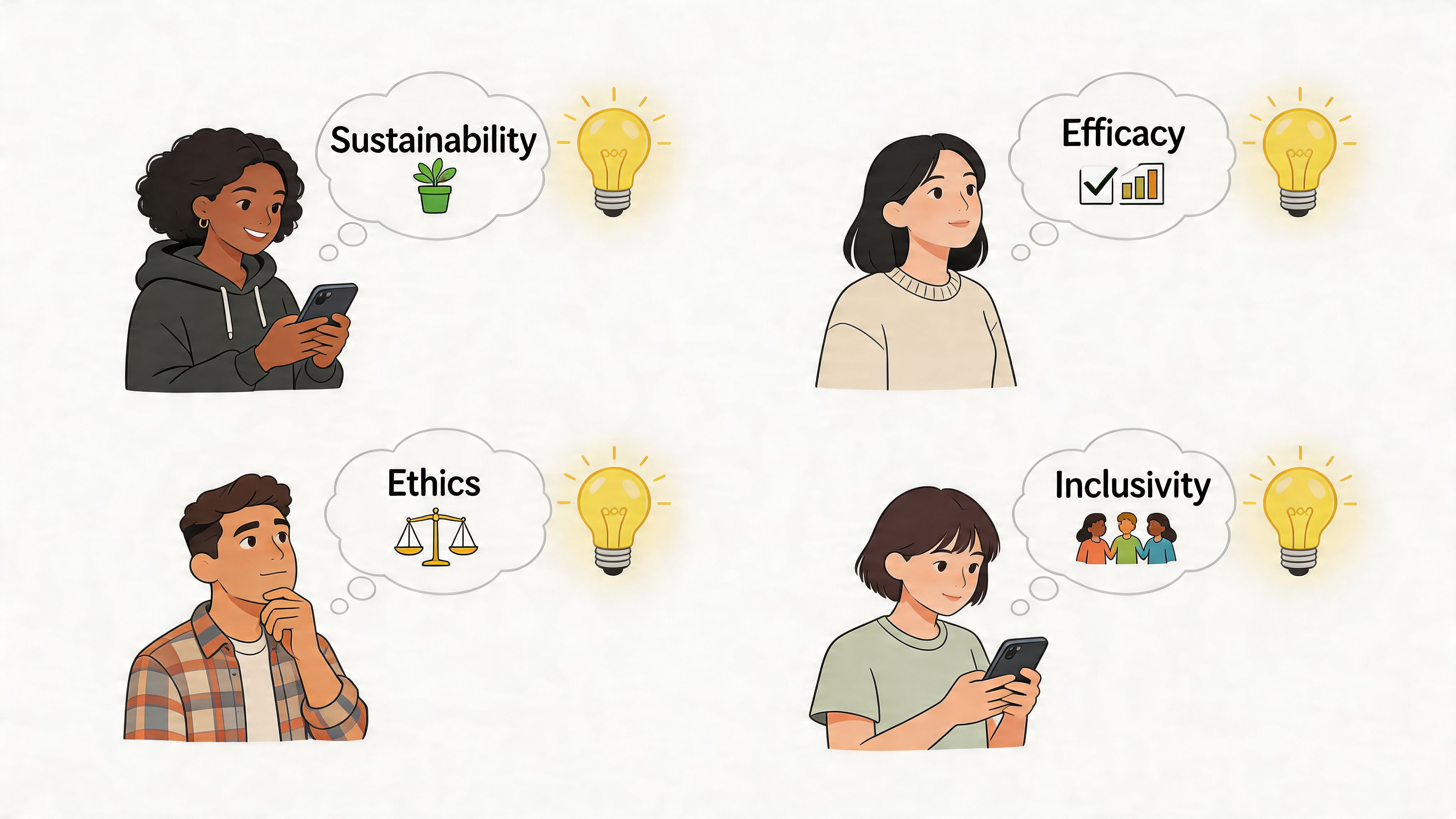
Clean beauty products generate around $400 million in annual U.S. sales, and paraben-free formulations are growing 80% faster than the broader market. The same dataset notes that over half of American consumers seek eco-friendly labels and 33% of shoppers rely on social media for brand discovery, based on beauty industry data compiled by Keywords Everywhere.
Conscious buying changes the PDP
Many founders treat sustainability like a brand story page issue. It usually belongs much closer to the add-to-cart decision.
If a customer cares about ingredient philosophy, packaging choices, or sourcing standards, don’t force them to hunt for that information. Put it inside the buying path. On Shopify, that often means adding structured PDP content blocks for ingredient exclusions, packaging notes, and formulation standards. It also means saying what the product is for in plain language, not hiding behind abstract wellness branding.
A weak version sounds like this: clean, conscious, elevated, intentional.
A stronger version sounds like this:
- Ingredient stance: what’s included, what’s excluded, and why
- Packaging choice: recycled, refillable, or low-waste, explained plainly
- Use outcome: who it’s for and where it fits in a routine
Wellness isn’t a trend label
Beauty has merged with self-care in how shoppers think and shop. That doesn’t mean every brand should suddenly talk about rituals in a vague way. It means the purchase context changed.
People often want products that fit into routines, not isolated one-off items. A cleanser isn’t only a cleanser. It’s step one of a calming evening routine. A tinted serum isn’t only coverage. It’s a faster morning decision. A scalp treatment isn’t only functional. It’s part of a weekly reset.
That changes merchandising.
Products sell better when the store presents them as part of a believable routine, not a disconnected SKU list.
Create collection pages by concern, occasion, and regimen stage. “Barrier support,” “five-minute morning,” and “post-workout reset” usually outperform generic category labels because they map to intent.
Inclusivity has to be visible
Inclusivity fails when brands relegate it to campaign language. Shoppers need to see it in shade presentation, model diversity, copy tone, and product recommendations.
A few practical fixes matter more than a long manifesto:
- Show range clearly: If shade breadth is part of the offer, make comparison easy.
- Use varied models: Customers should recognize themselves quickly.
- Avoid coded copy: Don’t write as if the customer is only one age, gender expression, or skin profile.
- Build filtering around real needs: Sensitive skin, mature skin, melanin-rich skin, fragrance-free, and finish preferences all belong in navigation.
Social discovery compounds this. Since social drives a meaningful share of brand discovery, your top-of-funnel creative and your storefront must match. If your TikTok or Instagram ad shows broad inclusion but your PDP feels narrow, trust drops fast.
What brands get wrong
The common mistakes are predictable.
- Overclaiming values: If you can’t support a sustainability or clean-positioning claim with visible product-page proof, soften the language.
- Copying category clichés: “Non-toxic,” “botanical,” and “wellness” don’t convert on their own.
- Treating social proof as decoration: Reviews, creator content, and before-and-after context should answer objections, not just fill space.
The modern beauty shopper isn’t asking for perfect brands. They’re asking for clarity, consistency, and proof.
From Skinification to Biotech Breakthroughs
The most useful product trend in beauty isn’t a color story or a format. It’s skinification. That shift has changed how customers interpret value across makeup, haircare, and treatment products.

The skincare segment held nearly a 40% market share in 2024 and is projected to generate $236 billion by 2030. That same industry view highlights regenerative ingredients like PDRN as the #1 choice among Korean dermatologists, with market growth twice that of traditional cosmetics, according to Statista’s cosmetics industry overview.
What skinification actually means
The easiest analogy is apparel. Athletic wear didn’t stay confined to the gym. It became athleisure and changed expectations across the entire wardrobe. Beauty is going through the same shift. Makeup, haircare, and hybrid products increasingly need to deliver skincare logic.
Customers now ask questions like:
- Will this foundation support my skin barrier?
- Does this scalp product behave like skincare for the head?
- Is this lip product treatment-first or only cosmetic?
That means your catalog architecture should reflect benefits and treatment logic, not just format. A “tinted serum” should not sit on the site like a standard complexion product with prettier copy. It needs regimen placement, ingredient explanation, and comparison against adjacent choices.
How to merchandise biotech without sounding like a lab report
Biotech ingredients create interest, but they also create friction when the copy gets too technical. Most brands either oversimplify or drown the shopper in terminology.
A better approach is a three-layer explanation model on Shopify PDPs:
Plain-language promise
Explain what the ingredient is meant to help with in customer language.Mechanism summary
Add a short explanation of how it works, without turning the page into a white paper.Routine fit
Show where it belongs, when to use it, and what it pairs with.
For ingredients like PDRN, that often means balancing scientific credibility with readability. Curiosity converts when the page makes the science understandable.
If the customer needs a chemistry degree to understand your PDP, you’ve already lost the sale.
Practical catalog moves
This trend becomes useful only when it changes how you sell.
- Build hybrid collections: Group products by treatment outcome, not only by category.
- Bundle by concern: Pair a treatment serum with complementary hydration or recovery products.
- Create education modules: Use accordion sections for ingredient detail, application order, and compatibility.
- Add comparison tables: Help shoppers choose between classic formulas and biotech-forward alternatives.
Here’s a simple structure many beauty brands can apply:
| Product type | Old positioning | Better positioning |
|---|---|---|
| Foundation | Coverage and finish | Coverage plus skincare benefit |
| Hair serum | Shine and frizz control | Scalp or strand treatment plus styling support |
| Sheet mask | Pampering add-on | Recovery step with targeted active story |
What not to do
Don’t add biotech ingredients just because they’re trending. If your creative team can’t explain why the ingredient matters, the launch will feel borrowed.
Don’t force a pseudo-clinical aesthetic either. Some brands overcorrect and make the store feel sterile. Beauty still needs desire, texture, and emotional pull. The strongest operators pair scientific trust with excellent merchandising.
How AI and AR Drive Conversions on Shopify
AI and AR matter in beauty because they reduce uncertainty at the exact moment a customer hesitates. That’s the commercial reason to invest, not novelty.
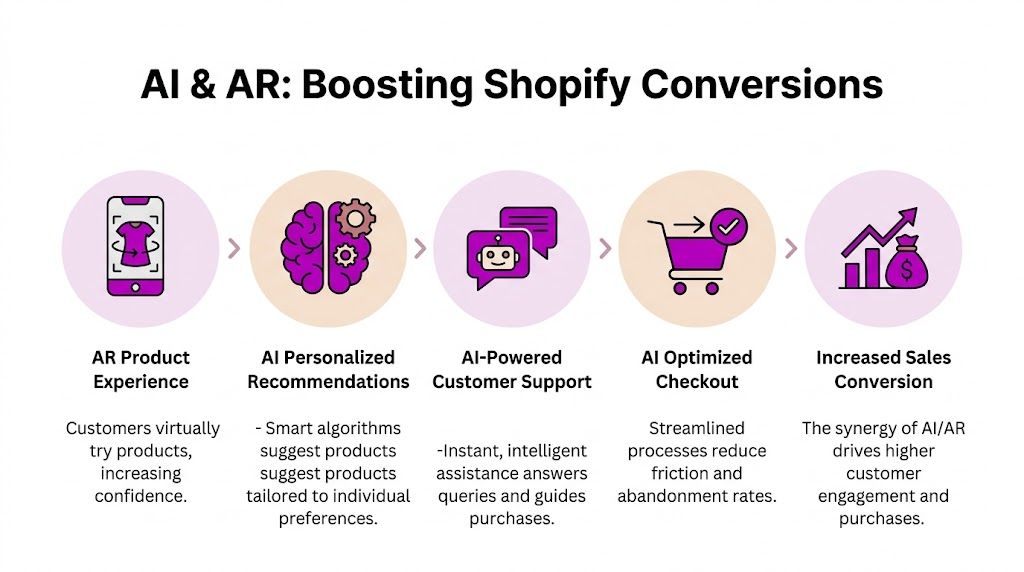
The beauty tech market is projected to grow from $66.16 billion in 2024 to $172.99 billion by 2030, and AR and AI tools can boost AOV by 15% to 30% through personalized bundles and virtual analysis, according to Grand View Research’s beauty tech market report.
Start with the friction, not the tool
Most brands begin with the software demo. That’s backwards. Start with the conversion problem.
For beauty stores, the common friction points are easy to spot:
- “I’m not sure this shade is right.”
- “I don’t know which routine fits me.”
- “I’m afraid this won’t work with my skin concerns.”
- “I don’t want to buy three products when I only need one.”
- “I have a question and don’t want to wait for support.”
Each of those maps to a different implementation path. AR helps with visual confidence. AI quizzes help with regimen logic. AI support layers help with pre-purchase objections. Predictive merchandising helps with bundling and replenishment.
Where AR has the clearest ROI
AR is strongest when product selection depends on seeing the result. That usually means complexion, lip, brow, and try-on-led categories.
For Shopify merchants, that should affect page design. Place the virtual try-on entry point above the fold or close to shade selectors. Don’t bury it beneath long-form brand storytelling. The user who wants to test a shade doesn’t want to read your origin story first.
A few execution rules matter:
- Keep it tied to SKU logic: The try-on experience should map directly to purchasable variants.
- Shorten the path to purchase: Let users add the tested shade straight to cart.
- Support with social proof: Pair try-on interfaces with reviews that mention tone, finish, and wear.
Where AI drives the most value
AI is most useful when your catalog is broad enough to create choice paralysis or nuanced enough to require guidance. Skincare, haircare, and hybrid routine brands usually benefit the most.
The highest-value applications tend to be:
| Use case | Best placement | Why it works |
|---|---|---|
| Shade or regimen quiz | Homepage, collection pages, PDP entry points | Matches users to a narrower product set |
| AI support assistant | PDPs, cart, help center | Handles objections before abandonment |
| Personalized bundles | Quiz results, cart, post-purchase | Raises basket size with contextual logic |
| Demand forecasting insights | Back office and merchandising | Improves stock planning and launch timing |
One practical move is connecting a quiz output to a dedicated landing page rather than a generic results screen. The best version feels like a curated consultation, not a widget.
The point of AI on Shopify isn’t to look advanced. It’s to help the customer decide faster with less doubt.
Creative and content need to match the on-site experience
A common mistake is running highly personalized ads into a generic storefront. If your paid creative promises skin analysis, custom matching, or routine guidance, the landing page has to continue that journey immediately.
For teams producing ad variations at speed, tools like the ShortGenius AI UGC ad platform can help create and iterate beauty-style creative concepts faster, especially when you need multiple hooks, creators, and product angles across campaigns. That kind of workflow matters because beauty customers respond differently to tutorial-style creative, testimonial framing, and ingredient-led messaging.
If your team is mapping use cases more broadly, ECORN’s guide to AI applications in ecommerce is a solid reference for thinking about personalization, automation, and operations together instead of treating them as isolated features.
Implementation order that usually works
Not every brand should launch every AI or AR feature at once. The better sequence is:
Fix basic product data first
Titles, variant labels, ingredient fields, concern tags, and media organization need to be clean.Launch one guided-selling layer
Usually a quiz or recommendation engine.Add AR where visual certainty matters most
Focus on high-return or high-consideration products.Improve support response paths
AI support works best after your FAQs and objection handling are already strong.Use data from these tools to refine merchandising
Value often shows up in what you learn about customer intent.
What doesn’t work is bolting on three flashy tools that don’t share logic. Beauty tech should feel like one coherent shopping experience.
Mastering DTC and Social Commerce
The old beauty model centered on shelf placement, retail counters, and wholesale gatekeepers. The current model rewards brands that own the relationship from discovery to reorder. That’s why direct-to-consumer has become the control center, not just another channel.

For Shopify beauty merchants, social commerce works when the storefront and the content ecosystem speak the same language. If the content feels candid but the site feels corporate, conversion drops. If the content feels premium but the site feels cluttered, trust drops.
DTC wins when the site tells a tighter story
A strong DTC beauty site doesn’t need more pages. It needs clearer pathways.
The homepage should answer four questions quickly:
- what the brand stands for
- who it’s for
- what problem it solves
- where a new customer should start
That last point matters most. New visitors shouldn’t have to decode your assortment. A “start here” path, concern-based merchandising, and visible bestsellers reduce cognitive load. Beauty buyers often arrive from a single piece of content, not from a broad intent search. Your site needs to catch them with context.
Social content that actually converts
A lot of beauty brands confuse social reach with social commerce. Reach creates awareness. Commerce needs buying intent, trust, and continuity.
The strongest social assets usually do one of three jobs:
- Demonstrate application: show texture, finish, wear, or routine use
- Answer an objection: shade fit, ingredient confusion, or skin concern match
- Create identity alignment: help the customer feel “this brand gets me”
Short-form content works best when each asset has one commercial purpose. Trying to educate, entertain, inspire, and close the sale in the same video usually leads to muddy creative.
For a broader playbook on acquisition and retention strategy, this resource on marketing for beauty is worth reviewing.
A useful benchmark for how social-native beauty storytelling is evolving:
Influencer strategy needs tighter selection
Many brands still overvalue follower count and undervalue fit. In beauty, creator alignment matters more than broad audience size. The creator’s skin type, tone, age range, aesthetic, and credibility with a specific routine often matter more than reach alone.
A better evaluation framework looks like this:
| Creator factor | Why it matters |
|---|---|
| Product fit | Their audience has to plausibly want the SKU |
| Demonstration quality | Can they show texture, use, and outcome clearly |
| Trust style | Reviews, tutorials, and casual use all convert differently |
| Reusability | Can the content work on paid, PDPs, email, and landing pages |
Good beauty UGC looks like help, not advertising.
What breaks social commerce momentum
Three things usually undercut performance.
First, delayed landing-page continuity. A creator talks about sensitive skin, but the landing page opens with broad luxury messaging. Second, weak product education. The ad sparks interest, but the PDP doesn’t finish the argument. Third, no post-click path. A customer lands, scrolls, gets curious, and still doesn’t know which SKU to buy.
The social channel gets attention. The Shopify experience closes the sale.
Navigating Sustainable Packaging and New Regulations
Packaging decisions in beauty are no longer just brand decisions. They’re commercial, operational, and regulatory decisions at the same time. That’s why many founders get stuck. They try to solve for aesthetics, sustainability, shipping durability, and compliance in one move.
The right answer usually isn’t the most impressive packaging concept. It’s the one your operations team can source consistently, your fulfillment partner can ship safely, and your customers can understand immediately.
Sustainable packaging has trade-offs
Shoppers often respond well to refillable systems, lower-waste formats, and simpler packaging stories. But not every format suits every SKU.
Glass can look premium and align with a treatment-led brand position, but it creates weight and breakage concerns. Refill systems can improve repeat behavior when the economics and user flow make sense, but they add operational complexity. Minimal packaging can support a cleaner brand message, though it can also reduce shelf impact and unboxing drama if executed poorly.
A practical evaluation framework helps:
- Material suitability: Does it protect the formula during storage and transit?
- Fulfillment impact: Can your current packing process handle it without friction?
- Customer clarity: Will buyers understand how to recycle, refill, or reuse it?
- Brand fit: Does it support your positioning, or just follow a trend?
Compliance needs plain systems
Beauty regulation often becomes a scramble because product data lives in too many places. Claims sit in design files, ingredient records sit with suppliers, and product-page language gets written by marketing without a compliance review loop.
That setup breaks quickly.
If your brand operates in the U.S., recent regulatory changes such as MoCRA make disciplined product records more important. Even if you’re not building enterprise-grade systems, you still need a basic operational structure that connects formulation data, label copy, claims language, and product-page content.
A simple internal checklist goes a long way:
Centralize ingredient documentation
Keep approved ingredient records and supplier files in one controlled location.Review claims before publishing
Make sure PDPs, ads, packaging, and email all use the same approved wording.Audit labels against site content
Mismatches create avoidable risk and customer confusion.Track packaging revisions carefully
Every change affects inventory, fulfillment instructions, and potentially product information.
Compliance problems often start as workflow problems.
Where brands usually slip
The most common mistakes aren’t dramatic. They’re boring. Teams change a package size but forget to update PDP images. Marketing writes ingredient-adjacent claims that the ops team never reviews. A refill concept launches without clear customer instructions. None of that feels major in the moment, but it chips away at trust.
The brands that handle sustainability and regulation well tend to do two things consistently. They choose simpler systems than they’re tempted to choose, and they document more than they think they need.
That discipline matters in beauty because a beautiful frontend can’t compensate for messy backend operations.
Actionable Strategies for Underserved Demographics
One of the biggest mistakes in trends in cosmetic industry planning is assuming growth comes mainly from the next product feature or the next paid channel. In many cases, growth comes from serving customers your competitors still talk around instead of talking to.
A key growth vector is underserved audiences. Nearly 25% of non-white beauty shoppers seek a stronger sense of belonging from brands, and Gen X and Boomers hold $50 trillion in buying power in North America, according to Coresight’s analysis of underserved U.S. beauty segments.
Belonging is a conversion lever
“Belonging” sounds like a brand concept. It’s also a storefront concept.
When a customer from an underserved segment lands on your site, they start scanning for evidence fast. They look at models, shades, copy assumptions, navigation labels, routine guidance, and even review content. If the store signals “not really for you,” they leave before your product quality matters.
That means inclusion needs to show up in specific places:
- Collection filters that match real customer needs
- Model selection that reflects the actual market
- Review seeding from varied customer profiles
- Quiz logic that doesn’t default to a narrow user type
Segment-specific playbooks
Different groups need different treatment. A broad message about inclusivity won’t do the work on its own.
Multi-ethnic and non-white shoppers
This group often notices weak execution immediately. Broad shade claims, limited visual representation, or generic copy can make the brand feel performative.
What works better:
- show shades on varied skin tones in consistent lighting
- use routine examples that reflect different concerns and outcomes
- avoid burying inclusive imagery in campaign pages while leaving PDPs generic
Customers over 50
Many beauty brands still market aging with either fear or denial. Both approaches wear thin.
A more effective approach uses respectful language, strong usability, and product guidance that assumes confidence rather than insecurity. Think easier navigation, larger swatches, less jargon, and messaging centered on comfort, radiance, texture, and support instead of “correction” language.
Men and adjacent grooming buyers
Men’s beauty often gets mishandled in two ways. Brands either over-masculinize the presentation or hide the category under neutral language so thoroughly that the shopper doesn’t know where to start.
Clear use-case merchandising tends to work better than identity-heavy labeling. “Post-shave recovery,” “easy morning routine,” and “shine-free daily SPF” often guide decisions more effectively than broad category names.
Store decisions that help all segments
Some improvements are segment-specific. Others help nearly everyone.
| Store element | Better execution |
|---|---|
| Navigation | Concern-based paths in addition to category paths |
| Product page copy | Plain language first, technical detail second |
| Visual merchandising | Consistent representation across homepage, PDPs, and ads |
| Recommendation flows | Quiz or guided selling that reflects varied skin profiles and routines |
Brands don’t need to speak to everyone. They do need to stop accidentally excluding high-value buyers.
Where growth gets missed
Founders often assume underserved demographics require entirely separate brands, separate stores, or separate campaigns. Usually they require more precise merchandising, better representation, and smarter audience-specific landing pages.
That’s a more manageable shift than commonly believed. And it’s often more profitable than launching another me-too product into the same crowded demand pool.
Building Your Future-Proof Beauty Brand
The beauty brands best positioned for 2026 won’t be the ones chasing every trend headline. They’ll be the ones building systems around the right ones.
That starts with values that show up in execution. If your brand stands for clean formulation, sustainability, inclusivity, or wellness, those ideas need to appear in product pages, packaging choices, merchandising paths, and creative briefs. Not just in brand copy.
It also requires sharper use of technology. AI and AR are worthwhile when they reduce hesitation, guide product selection, and raise basket size through better relevance. They’re a waste when they act like isolated add-ons. The same standard applies to social commerce. Good content gets attention, but the site has to finish the sale with clarity and confidence.
The final piece is agility. Beauty changes fast, but most stores don’t fail because trends moved. They fail because the team couldn’t operationalize what mattered. The future-proof brand tests faster, documents better, merchandises more clearly, and listens closely to how different customer groups shop.
If you’re leading a Shopify beauty brand right now, the play is straightforward. Tighten your assortment story. Remove friction from the path to purchase. Make your values visible. Build for the customer segments others overlook. Then use data from your storefront, campaigns, and retention flows to keep refining the machine.
That’s how you turn trends in cosmetic industry shifts into durable growth instead of short-lived excitement.
If your beauty brand needs sharper Shopify design, development, or CRO support to put these strategies into practice, ECORN can help you turn trend signals into a higher-converting storefront, cleaner merchandising, and a stronger growth system.



How to Launch a Box Subscription Business in 2026

Luxury Skincare Branding Playbook That Converters
10 Best Podcast Ecommerce Shows for Store Growth in 2026
Shopify Developer Hourly Rate: What to Pay in 2026
Critical Shopify Setup Errors That Are Secretly Sabotaging Your Store
Ecommerce Conversion Tracking: The Complete How-To Guide
Shopify Design Agency: How to Pick the Right Partner
Mastering Multi Store Management on Shopify
Scale Shopify Store
10 Shopify App Ideas Worth Building in 2026
Conversion Rate Optimization for Landing Pages: The Playbook
Shopify Plus Automation: A Guide for 2026
10 Social Selling Platforms for Shopify Merchants

Shopify Website Design Examples: 7 Stores Worth Studying
7 Ecommerce Newsletter Examples for Shopify Brands
One Product Shopify Store: Build and Scale
Mobile Pop Up Strategy for Shopify Stores That Converts
Sitemap for Shopify: How to Find, Optimize, and Submit It
7 Single Product Websites Worth Emulating
Product Variants Shopify: The Complete 2026 Guide
Ecommerce Analytics Consulting for Growth
What Is AI Integration for eCommerce
How to Choose the Right eCommerce Website Development Firm

E Business Strategy Implementation
Conversion Tracking Setup for Shopify Stores
BigCommerce vs Shopify Plus Which Enterprise Wins in 2026
Shopify Theme Kit: Setup, Commands, and Migration Guide
Shopify Extension Development: A Practical 2026 Guide
Shopify Speed Score Explained and How to Improve It
Shopify Mobile Optimization: The 2026 Playbook
How to Add Subcategory in Shopify for Better UX
How to Implement Structured Data for Ecommerce in 2026
SEO App Mobile: Shopify Store Optimization Guide
Shopify Plus Support: What It Includes and How to Choose
Google Ads for Shopify: The Complete 2026 Playbook
Shopify New York: How to Find and Hire the Right Agency
Google Search Console for Shopify: The Complete Setup
First Party Data Collection for eCommerce Growth
FAQ Online Store Guide: Build and Measure It Right
Do FB Ads Work for eCommerce in 2026?
One Page Checkout for Shopify: Design and Implementation
Shopify GraphQL vs REST: The 2026 Developer Decision
Shopify Ecommerce Consulting: Strategy, Pricing &

Are Reddit Ads Worth It for eCommerce Brands
Shopify Title and Meta Description: A Practical 2026 Guide
Product Video Best Practices for Shopify Brands

Real-Time Inventory Management: A 2026 Guide

AI Chatbot Integration for Shopify Stores
Affiliate Program Management: A Shopify Guide
10 Best Performance Monitoring Tools for Shopify in 2026

Digital Asset Management for eCommerce Brands in 2026
Every Type of Facebook Ads Explained for eCommerce Growth
Product Information Management Explained for Shopify Brands
Support Ticket System: A Guide for Shopify Stores

10 Best Customer Service Tools for Shopify in 2026

Can I Start a Business with No Money? a 2026 Blueprint
What Sells Good on Etsy: Best Niches for 2026

Shopify Add to Cart Button: A Practical 2026 Guide

Customer Feedback Automation: A Practical eCommerce Guide
Critical Rendering Path: A Guide for Shopify Stores

How to Promote on TikTok for eCommerce in 2026

B2B eCommerce Consulting That Drives Real Revenue
10 Best Practices for Site Navigation in 2026
Return vs Refund for Shopify Stores: A Practical Guide
What Is Customer Lifetime Value and Why It Matters
What Is Voice of Customer Research for eCommerce

SMS Marketing for Ecommerce That Actually Converts

Master How to Improve Email Deliverability in 2026
Top 8 eCommerce Partners NYC for Shopify Brands in 2026

Machine Learning for Ecommerce: Boost Your Shopify Store
Beauty Market Research: Your 2026 Growth Guide

Shopify International Expansion: A 2026 Roadmap
What Does CRO Stand for in Business: Understanding CRO

Shopify Visual Merchandising: A Playbook for Higher Sales

Shopify Landing Page Design: Master Conversion in 2026
10 Best AI SEO Optimization Tools for Shopify in 2026

Agentic AI for Ecommerce: Boost Your Sales in 2026
Mastering Email Marketing Data for eCommerce Growth
Conversion Rate Optimisation Australia: Boost Your Sales
Conversion Rate Optimization AI: Your Shopify Store Guide

10 Product Bundling Strategies for Shopify in 2026
How to Increase Customer Lifetime Value: A Shopify Playbook
AI Customer Service Automation: Shopify Guide 2026
Clean Website Design: A Shopify Conversion Playbook

Omnichannel Retail Strategy: A Shopify Playbook
Product Data Enrichment: A Guide for Shopify Brands
Instagram Shopping Features a Guide for Shopify Stores
What Is Revenue Optimization: A Holistic RevOps Guide
Benefits of Conversion Rate Optimization: Boost Your
WordPress to Shopify Migration: Your 2026 Seamless Switch
Boost Sales: Ecommerce Payment Processing Guide 2026
Unified Commerce Platform: Benefits, KPIs & Shopify Guide
How to Reduce Bounce Rate eCommerce: Your 2026 Guide
Shopify API Integration: A Practical End-to-End Guide

How to Implement Data Governance: A 2026 Guide
Shopify Store Development Cost: A 2026 Breakdown
What Is Server Side Tracking: The Shopify Guide 2026
Marketing Automation Workflows: A Shopify Guide for 2026
Shopify: How to Reduce Technical Debt

Shopify UX Design Change: A Playbook for Growth


newsletter in your inbox