


A digital content marketing strategy is your playbook for creating and sharing valuable online content that pulls in the right audience. For an eCommerce brand, it’s about more than just pushing products. It’s about becoming the go-to resource in your niche, which ultimately drives sales and creates die-hard fans. The whole idea is to offer value upfront to earn your customer's trust.
Why Content Is Your eCommerce Growth Engine
In the cutthroat world of eCommerce, just having amazing products on your Shopify store won't cut it anymore. Today's shoppers are sick of interruptive ads. They’re actively looking for genuine, helpful information before they even think about buying. This major shift in customer behavior is exactly why a solid digital content marketing strategy is the real engine for sustainable growth.
Content lets you connect with potential customers where they are and on their own terms. Instead of just yelling "buy now," you're answering their questions, solving their problems, and building a real relationship long before they ever add an item to their cart.
The Shift from Ads to Assets
Think about it this way: traditional advertising is like renting attention. The second you stop paying for those ads, your visibility vanishes. Content is completely different—it's an asset you own. A single, well-optimized blog post, a useful how-to video, or an insightful guide can pull in organic traffic and generate leads for years.
Over time, this approach delivers a much better return on investment. While paid ads can give you a quick traffic boost, content builds an audience and establishes you as an authority. For any eCommerce brand aiming for long-term stability and profit—not just short-term sales spikes—that distinction is everything.
The data backs this up in a big way. The global content marketing industry has exploded, rocketing from $36.8 billion in 2018 to over $413 billion by 2022. Projections show the market hitting a mind-boggling $1.95 trillion by 2032, signaling a massive global shift toward content-first growth. You can explore more about these industry trends and what they mean for your business.
Content is the only marketing that’s left. It's the art of communicating with your customers and prospects without selling. It is non-interruption marketing. Instead of pitching your products or services, you are delivering information that makes your buyer more intelligent.
Building Trust and Brand Loyalty
For any eCommerce business, trust is your most valuable currency. A smart digital content marketing strategy is hands-down the most effective way to build that trust at scale.
When you consistently put out valuable content, you position your brand as the expert. This creates a loyal community that doesn't just buy from you but actively tells their friends about you. This kind of loyalty has a direct impact on your bottom line.
- Higher Customer Lifetime Value (CLV): Customers who trust you come back for more. It's that simple.
- Increased Word-of-Mouth Referrals: A happy, engaged audience becomes your best (and cheapest) sales team.
- Improved Conversion Rates: It's always easier to sell to a warm audience that knows and trusts you than to cold traffic from an ad.
Understanding Your Audience and Auditing Your Assets
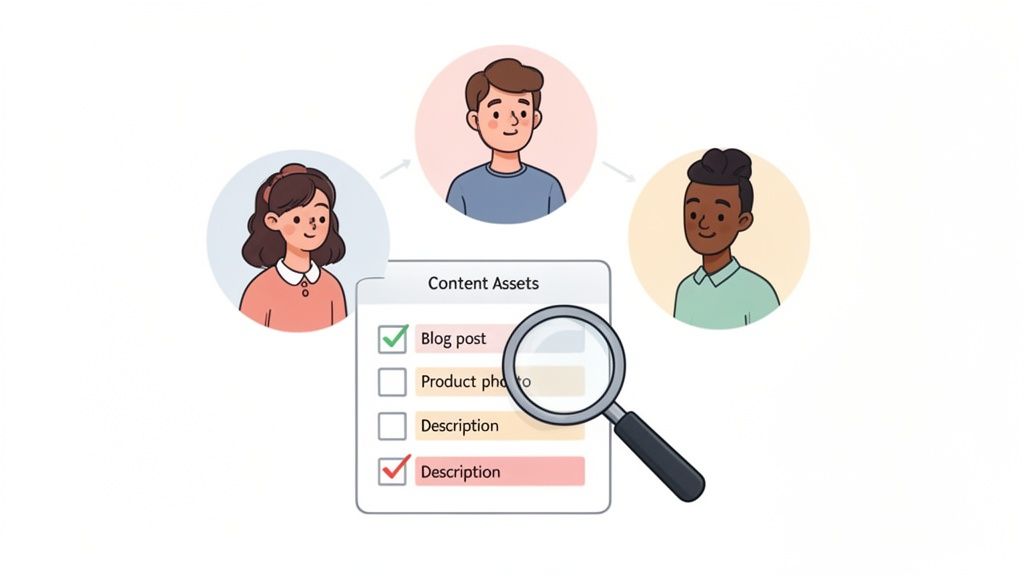
Before you write a single word or map out any part of your content strategy, you have to nail down two things: Who are you really talking to, and what do you already have in your arsenal?
Jumping straight into content creation without this groundwork is a classic rookie mistake. You'll stay busy, sure, but you'll be spinning your wheels without getting any meaningful traction.
Every great strategy I've seen starts with an almost obsessive focus on the audience. For an eCommerce brand, this goes way beyond basic demographics. You need to build out rich customer personas that feel like actual people with real problems your products solve.
Crafting Your Ideal Customer Persona
A persona is essentially a character sketch of your perfect customer, built from a mix of market research and hard data on your existing buyers. To genuinely connect with your audience and make your content hit home, knowing how to create buyer personas that get results is non-negotiable.
Start by digging into the data you already own. Your Shopify dashboard, Google Analytics, and social media insights are goldmines. Look for patterns in customer behavior, purchase history, and feedback. Then, you'll want to layer in some qualitative insights to bring the numbers to life.
- Interview Your Customers: Seriously, just talk to them. Get your best customers on a quick call and ask them what they love about your products, what problems they had before they found you, and what other brands they follow.
- Survey Your Audience: Use simple surveys to ask about their lifestyle, hobbies, and how they like to consume content. Are they video watchers, blog readers, or podcast listeners?
- Analyze Reviews and Support Tickets: Your customer service inbox is a treasure trove. It's packed with your customers' exact pain points, common questions, and the language they use to describe their needs.
Let's say you run a store selling sustainable home goods. A persona might be "Eco-Conscious Chloe," a 32-year-old urban professional who cares deeply about ethical production and minimalist design. Her problem isn't just that she needs new towels; it's finding towels that align with her values without sacrificing quality. This detailed picture immediately tells you what kind of content will grab her attention.
A well-defined persona is the cornerstone of your entire digital content marketing strategy. It transforms your content from a generic broadcast into a one-on-one conversation, making every blog post, email, and social update feel personal and relevant.
Conducting a Practical Content Audit
Once you know who you’re talking to, it’s time to take stock of what you’ve already created. A content audit is just a systematic review of all your existing content—blog posts, product descriptions, videos, even old social campaigns. This isn't just digital spring cleaning; it’s a strategic analysis to find what’s working, what's falling flat, and where your biggest opportunities are hiding.
The goal is to size up each piece of content against your business goals and what your personas actually need. This process stops you from reinventing the wheel and helps you squeeze more value out of the work you've already put in.
To keep it from getting overwhelming, assign every piece of content to one of three buckets:
- Keep: This content is a winner. It's evergreen, ranks for good keywords, or drives a lot of engagement. Don't touch it.
- Refresh: The content has potential but it's outdated or just not performing. It might need a new intro, updated stats, better SEO, or some fresh images to give it a second life.
- Remove (or Redirect): This stuff is irrelevant, low-quality, and gets almost no traffic. It might even be hurting your brand's authority or SEO. Get rid of it and redirect the URL to a relevant, high-performing page.
This audit gives you a clear baseline. You’ll see the gaps in your content where you’re failing to connect with customers at different stages of their journey. You'll also spot your "greatest hits"—content you can easily repurpose into new formats. With a sharp view of your audience and your existing assets, you're finally ready to build a content plan that actually works.
Alright, you've figured out who you're talking to and what content you already have. Now for the million-dollar question: where do you actually publish this stuff, and what should it look like?
Your ideal customers are out there, but they’re not all in one place. Your budget and your sanity, however, are finite. The goal here is to be a surgeon, not to blast a shotgun and hope something hits.
Instead of jumping on every shiny new platform, you need to zero in on where your customer personas actually live online. It’s all about putting your energy where it counts and using content formats that really connect with eCommerce buyers. Trying to be everywhere is a fast track to burnout and a lot of mediocre content.
Aligning Channels With Your Personas
Let's go back to our "Eco-Conscious Chloe" persona. Is she scrolling through LinkedIn during her lunch break? Probably not. She’s far more likely to be on Instagram looking for sustainable home decor, watching YouTube tutorials on upcycling furniture, or reading blogs that review ethical brands.
Your mission is to show up in those places. This means using a smart mix of channels you own and channels you borrow.
- Owned Channels (Your Home Base): We're talking about your Shopify blog and your email list. You have 100% control here. Use the blog for those deep, SEO-rich articles like buying guides and brand stories. Your email list is for nurturing relationships, announcing products, and giving your biggest fans exclusive access.
- Social Channels (Your Outposts): Think Instagram, TikTok, Pinterest, and YouTube. These are your discovery engines. Their job is to grab attention and pull interested people back to your website, where you can turn them from browsers into buyers.
For any eCommerce brand, the game is almost always won on visual channels. That’s where your customers are making their buying decisions.
The biggest mistake I see brands make is posting the same exact content everywhere. A TikTok video needs to feel like a TikTok, not a polished TV ad. An email should feel personal and packed with value, not like another junk mail flyer. You have to match the message to the medium.
Prioritizing High-ROI Content Formats
Not all content formats are created equal, especially when you’re selling products online. A B2B software company might get massive value from a 50-page whitepaper, but your Shopify store needs content that shows your products in the real world and helps customers imagine using them.
Visuals aren't just a "nice-to-have" anymore; they're the main event. A massive 95% of marketers now say video is a non-negotiable part of their strategy. Short-form video, in particular, has exploded, now leading the pack for the highest ROI, with marketer adoption jumping by 104%. This is especially true for Shopify brands that see real conversion lifts from product videos on platforms like Instagram Reels, which now accounts for half the time users spend on a platform with over 2 billion users. You can discover more insights about these content marketing statistics to see the full picture.
So, what should you actually be creating? Here are the must-have formats for any modern eCommerce brand.
- Short-Form Video: This is your number one priority. We’re talking Instagram Reels, TikToks, and YouTube Shorts. Use them for behind-the-scenes content, quick tutorials, showcasing customer videos, and jumping on trends that put your products into a cultural conversation.
- High-Quality Product and Lifestyle Photography: Move past the boring, white-background product shot. You need photos that show your products being used by real people in authentic settings. This creates an emotional connection and helps customers see the real-world value.
- In-Depth Buying Guides: These are absolute gold for SEO. Think about creating the ultimate resource that answers every single question a customer could have. A blog post titled "The Complete Guide to Choosing a Sustainable Yoga Mat," for example, can pull in highly-motivated search traffic for years to come.
- User-Generated Content (UGC): Get your customers involved! Encourage them to share photos and videos of themselves using your products. There is no content more authentic or trustworthy than UGC. Repost it on social media, feature it on your product pages, and sprinkle it into your emails to build undeniable social proof.
Choosing the right format can feel overwhelming, so it helps to think about the primary goal of each piece of content and what kind of return you can realistically expect.
Content Format ROI for eCommerce
This table breaks down the most common content types for Shopify brands, helping you decide where to invest your time and creative energy for the best results.
Ultimately, the best content strategy is one that's focused. By understanding where your audience spends their time and which formats resonate most, you can stop guessing and start creating content that genuinely moves the needle for your brand.
Building Your Editorial Workflow and Calendar
A great content strategy is worthless without a system to bring it to life. This is where the real work begins—turning all that research and planning into a consistent flow of high-quality content that actually gets published. What you need is a repeatable process that keeps your team on the same page and your content pipeline humming.
We call this an editorial workflow. Think of it as the journey a piece of content takes, from a spark of an idea all the way to publication and promotion. It maps out who’s responsible for what, when it’s due, and which tools you’ll use. Without this structure, chaos takes over, deadlines get missed, and the quality of your work suffers.
A solid workflow takes the guesswork out of content production. It’s your quality control, ensuring every blog post, video, or social update meets the same standards for brand voice, accuracy, and SEO before it ever sees the light of day.
Designing Your Content Production Stages
Your workflow doesn't need to be some convoluted, 50-step process. In fact, simpler is often better. Just think of it as a content assembly line, with each stop adding a bit more polish and value. For most eCommerce brands, a handful of core stages will do the trick.
- Ideation & Keyword Research: This is where you brainstorm new topics, check them against your customer personas, and match them up with valuable keywords.
- Content Briefing: Once an idea gets the green light, the writer gets a detailed brief. It should cover the target keyword, the intended audience, key talking points, internal linking opportunities, and a clear call-to-action.
- Drafting & Creation: The writer gets to writing, the videographer starts shooting, or the designer fires up Figma. This is the core creation phase.
- Editing & Review: A crucial step. The draft gets a second (and maybe third) pair of eyes to check for grammar, style, factual accuracy, and SEO optimization.
- Final Approval & Scheduling: The finished piece gets a final sign-off from the project owner and is scheduled in your CMS or social media platform.
- Promotion: Publishing isn't the last step. Once a piece is live, it’s time to push it out across your channels—email, social media, and anywhere else your audience hangs out.
This flow is all about getting the most out of every single piece of content you create. You start with a pillar piece, like a blog post, and then slice it and dice it for other channels.
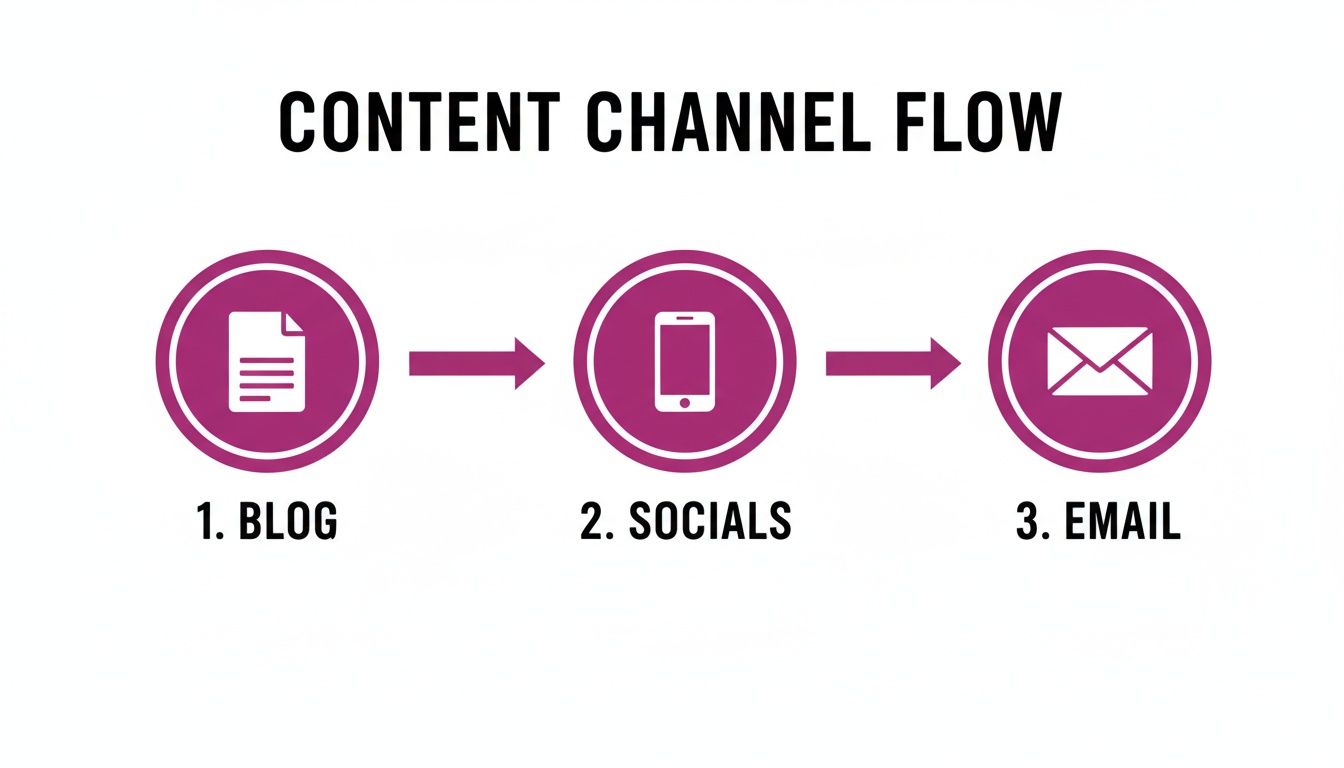
The path is pretty straightforward: a central blog post can be broken down into social media updates and featured in an email newsletter. This "atomization" ensures you're maximizing your investment. To help speed this up and keep things consistent, a lot of teams are now using AI-powered blog generating tools as part of their workflow.
Creating a Practical Editorial Calendar
Your editorial calendar is your command center. It’s the single source of truth for your entire content operation, showing what you're publishing, where, and when. For any eCommerce brand, this calendar is absolutely critical for lining up your content with your business goals.
Your editorial calendar should be more than a list of blog post titles. It's a strategic document that maps your content directly to product launches, seasonal promotions, and industry events, ensuring your content supports your revenue goals.
A well-kept calendar gives the whole team visibility into what’s been published, what’s in progress, and what’s coming down the pike. This transparency is key for keeping everyone accountable and working together smoothly. If you want to go deeper on this, check out our complete guide on how to create a content calendar that keeps your team in perfect sync.
So, what should you actually track in this calendar? For every piece of content, make sure you have these fields:
- Publish Date: The day it’s scheduled to go live.
- Content Title/Topic: A clear, working title.
- Content Owner: The single person responsible for getting this piece over the finish line.
- Content Format: Is it a blog post, a TikTok video, an Instagram Reel, or something else?
- Target Keywords: The main SEO keyword you're targeting, plus any secondary ones.
- Status: Where the content is in your workflow (e.g., “Briefing,” “In Review,” “Scheduled”).
- Key Campaign/Theme: Connect the content to a larger marketing push, like your "Black Friday Sale" or "Summer Collection Launch."
When you map all this out, you’re not just planning content—you’re building a reliable system. You're bringing order to a creative process, which frees up your team to do what they do best: create amazing content that your customers will love.
Optimizing Shopify Content for SEO and Conversions
Creating brilliant content is just the first act. The real win for any eCommerce brand is getting that content in front of the right people and then turning that attention into actual sales. This is where we fuse the art of content with the science of optimization, focusing specifically on the Shopify platform.
Getting your content to rank on search engines isn't some dark art; it’s a repeatable process. But it's also about more than just traffic. Your digital content marketing strategy has to create a clear path from reader to buyer, and that’s where Conversion Rate Optimization (CRO) comes in.
Let’s break down how to make your content work harder for both search engines and your bottom line.
Nailing On-Page SEO for Shopify
Shopify is a fantastic platform, but it doesn't automatically handle all of your SEO. To get your product pages, collection pages, and blog posts climbing the search rankings, you have to be deliberate with your on-page SEO. It’s all about giving search engines like Google clear signals about what your page is about and why it’s valuable.
Here are the core elements to get right for every piece of content you publish:
- Keyword-Rich Titles & Meta Descriptions: Your page title is the single most important on-page SEO factor. Weave your primary keyword in naturally and write something compelling enough to earn that click from the search results. Your meta description won't directly affect rankings, but it's your sales pitch to the user—make it count.
- Clean and Descriptive URLs: Shopify makes this easy. Instead of a messy URL like
/products/item-8675309, customize it to be/products/organic-cotton-tote-bag. It’s far better for users and search engines alike. - Strategic Keyword Placement: Your target keyword should show up in your title, within the first 100 words of your content, and in at least one subheading (H2 or H3). The key is relevance, not repetition. Don't force it.
- Image Alt Text: Every single image on your site needs descriptive alt text. This is crucial for visually impaired users and also tells Google what your images are about, opening up another opportunity to rank in image search. Think "Woman carrying a beige organic cotton tote bag at a farmers market" instead of "tote-bag.jpg."
The biggest SEO mistake we see on Shopify is neglecting collection pages. These pages are goldmines for ranking for broader, high-volume terms like "women's summer dresses" or "vegan leather bags." You must optimize their titles, write unique descriptive content for them, and build internal links pointing to them.
Turning Readers Into Buyers with CRO
Traffic that doesn't convert is just a number on a dashboard. The whole point of attracting an audience with your content is to gently guide them toward making a purchase. This is the heart of Conversion Rate Optimization (CRO).
It’s all about making the next step obvious and irresistible. Every blog post, every guide, every piece of content should have a clear job to do.
A simple but powerful method is strategic internal linking. If you write a blog post on "How to Style a Scarf," it’s a huge missed opportunity if you don't link directly to the scarf product pages you feature. For a much deeper look at this, our guide on mastering SEO for Shopify stores covers these techniques from top to bottom.
Practical CRO Tactics for Your Content
Here are a few actionable CRO tactics you can put into practice today to start seeing more conversions from your content:
- Embed Products Directly in Blog Posts: Don't just link to products—show them. Shopify lets you embed product cards right into your blog content. This shortens the path to purchase dramatically.
- Showcase User-Generated Content (UGC): Social proof is arguably the most powerful conversion tool in your arsenal. Sprinkle customer photos and glowing reviews throughout your blog posts and on your product pages. Seeing real people enjoying your product melts away purchase anxiety.
- Use Crystal-Clear Calls-to-Action (CTAs): Tell your readers exactly what you want them to do next. Don't be shy. Use clear, action-oriented language like "Shop the Look," "Find Your Perfect Shade," or "Join Our Community."
Let's imagine a real-world example. A skincare brand writes a blog post titled "The Best Morning Skincare Routine for Oily Skin."
- Bad CRO: The article explains all the steps but only has a generic link to the homepage at the very end. The reader is left to go search for the products themselves. Most won't bother.
- Good CRO: The article explains each step and embeds the specific cleanser, toner, and moisturizer products directly below each section. It even includes a quote from a customer review and ends with a CTA to "Shop the Oily Skin Essentials Kit" for a nice bundled discount.
This approach transforms a helpful article into a powerful sales tool without ever feeling pushy. By combining a strong SEO foundation with smart CRO, you ensure your digital content marketing strategy doesn't just attract eyeballs—it drives revenue.
Measuring Your Success and Scaling the Strategy
Let's be honest: a brilliant content strategy is just a collection of nice ideas if you can’t prove it’s actually working. Measurement is the critical step where you transform your content efforts from a cost center into a predictable growth engine for your store.
This means getting past vanity metrics like social media likes and zeroing in on the numbers that directly impact your bottom line.
The ultimate goal here is to draw a straight line from your content to your revenue. When you can confidently say, "This blog post generated $X in sales," you have all the ammo you need to justify your budget and make smart calls on where to invest your time and money next.
Defining Your Core eCommerce KPIs
To track your success, you need to be ruthlessly clear about what you’re measuring. For any eCommerce brand, especially one on Shopify, your Key Performance Indicators (KPIs) must be tied directly to traffic, conversions, and customer value. It's time to ignore the noise and focus on what truly matters.
These are the non-negotiable KPIs for your eCommerce content strategy:
- Content-Assisted Conversions: This is a big one. It tracks every customer who viewed a piece of content at any point before making a purchase. It reveals the true influence of your content, even when it wasn't the final click that sealed the deal.
- Organic Traffic Growth: A steady climb in non-paid visitors to your blog and product pages is the clearest sign your SEO work is paying off.
- Conversion Rate from Organic Traffic: Are the people finding you through a Google search actually buying anything? This KPI tells you if your content is attracting the right kind of high-intent audience or just window shoppers.
- Customer Lifetime Value (CLV): Does your content help create loyal, repeat buyers? By tracking the CLV of customers who regularly engage with your articles and videos, you can uncover the long-term, compounding value of your work.
The most powerful data shows how your content influences the entire customer journey, not just the final sale. A customer might read three blog posts and an email newsletter over two weeks before buying. Your analytics should tell this story, proving the cumulative value of your strategy.
Building Simple Tracking Dashboards
You don’t need a data science degree or an overly complex system to monitor your progress. By tapping into Google Analytics 4 (GA4) and the built-in Shopify analytics, you can create a straightforward dashboard that gives you a clear, at-a-glance view of your content's performance.
Focus on building reports that answer simple, powerful questions. Think: "Which blog posts are driving the most revenue?" or "What's our conversion rate for traffic from Pinterest versus Google?" This data becomes your roadmap for what to create next.
Using Data to Scale and Refine Your Strategy
Once you have reliable data coming in, you can start making truly informed decisions to scale your content production. Your analytics will scream at you when it's time to double down on a winning format or when a specific channel just isn't delivering the ROI you need.
Use this data to constantly test and iterate. For example, if you notice short-form videos are sending tons of traffic but few of those visitors convert, you can run a test. Maybe you add a stronger call-to-action or link to a specific product landing page instead of your homepage. Then, you measure the results and see what worked.
As your Shopify brand grows, you can also bring in automation and AI to scale your output without killing quality. AI tools can dramatically speed up keyword research, generate outlines for new articles, and even draft initial social media posts. This frees up your team to focus on what humans do best: the high-level creative and strategic work that builds a sustainable content machine and drives real growth for your business.
Your Top Shopify Content Strategy Questions, Answered
Even the most buttoned-up content plan runs into real-world questions. It's only natural. After launching dozens of content programs for eCommerce brands, I’ve found the same handful of questions pop up every single time.
Let's get right to them.
"How Long Until I Actually See Results?"
This is always the first question, and it’s a fair one. While you can spin up a paid ad and see traffic tomorrow, content marketing is a different beast entirely. It’s about building a long-term asset, not just renting attention.
You should start seeing some early signs of life within 3 to 6 months of consistent publishing. We’re not talking about a flood of sales just yet. Think more along the lines of your first few keywords climbing the Google ranks, a noticeable uptick in social media engagement, and a handful of leads trickling in from your blog posts.
For brands in a really crowded space, getting to a point where content is a major revenue driver can take closer to 9 to 12 months. It’s a marathon, not a sprint, but the prize is growth that you own—it doesn't disappear the second you turn off your ad spend.
"What’s a Realistic Content Budget?"
There isn’t a one-size-fits-all answer here, but a solid rule of thumb is to set aside 10-25% of your total marketing budget for content. If you're just starting out with a new Shopify store, that might mean going all-in on a great SEO-focused blog and getting really good at one social media channel before expanding.
A typical starting budget we see for new brands is anywhere from $2,000 to $5,000 per month. This generally covers high-quality content creation, the must-have software tools, and a bit of a budget for promotion. The most critical part isn't the exact dollar amount—it's the consistency.
"How Can AI Actually Help My Strategy?"
AI isn't here to take over your marketing team; it's here to give them superpowers. Think of it as a ridiculously efficient assistant.
It’s incredible for smashing through creative blocks. AI can analyze competitor content and customer reviews to spit out dozens of new blog post ideas in minutes. It can also handle the tedious parts of keyword research and even write a solid first draft of a blog post or social media update. Your team’s job is then to come in, add their expertise, inject your brand’s personality, and make it human.
Beyond that, AI tools are great for A/B testing headlines to find what gets clicked or even personalizing the content shoppers see on your site. It’s a tool for acceleration, letting your team focus on strategy and creativity instead of getting bogged down in the small stuff.
Ready to stop guessing and start growing? The team at ECORN builds high-performance Shopify stores and executes content strategies that drive real revenue. Let's build your growth engine together.


Best Shopify Theme for Custom Products Compared
Multi Store Inventory Management: A Practical Guide

SEO Consulting for Ecommerce: A Practical Guide
Shopify Theme Updater App: A Safe Update Playbook
Shopify Git Integration: A Developer's Guide to 2026
Headless Ecommerce Development Services Explained

How to Build a Shopify Clothing Website That Converts
How to Launch a Box Subscription Business in 2026

Luxury Skincare Branding Playbook That Converters
10 Best Podcast Ecommerce Shows for Store Growth in 2026
Shopify Developer Hourly Rate: What to Pay in 2026
Critical Shopify Setup Errors That Are Secretly Sabotaging Your Store
Ecommerce Conversion Tracking: The Complete How-To Guide

Shopify Design Agency: How to Pick the Right Partner
Mastering Multi Store Management on Shopify
Scale Shopify Store
10 Shopify App Ideas Worth Building in 2026
Conversion Rate Optimization for Landing Pages: The Playbook
Shopify Plus Automation: A Guide for 2026
10 Social Selling Platforms for Shopify Merchants

Shopify Website Design Examples: 7 Stores Worth Studying
7 Ecommerce Newsletter Examples for Shopify Brands
One Product Shopify Store: Build and Scale
Mobile Pop Up Strategy for Shopify Stores That Converts
Sitemap for Shopify: How to Find, Optimize, and Submit It
7 Single Product Websites Worth Emulating
Product Variants Shopify: The Complete 2026 Guide
Ecommerce Analytics Consulting for Growth
What Is AI Integration for eCommerce
How to Choose the Right eCommerce Website Development Firm
E Business Strategy Implementation
Conversion Tracking Setup for Shopify Stores
BigCommerce vs Shopify Plus Which Enterprise Wins in 2026
Shopify Theme Kit: Setup, Commands, and Migration Guide
Shopify Extension Development: A Practical 2026 Guide
Shopify Speed Score Explained and How to Improve It
Shopify Mobile Optimization: The 2026 Playbook
How to Add Subcategory in Shopify for Better UX
How to Implement Structured Data for Ecommerce in 2026
SEO App Mobile: Shopify Store Optimization Guide
Shopify Plus Support: What It Includes and How to Choose
Google Ads for Shopify: The Complete 2026 Playbook

Shopify New York: How to Find and Hire the Right Agency
Google Search Console for Shopify: The Complete Setup
First Party Data Collection for eCommerce Growth
FAQ Online Store Guide: Build and Measure It Right
Do FB Ads Work for eCommerce in 2026?
One Page Checkout for Shopify: Design and Implementation
Shopify GraphQL vs REST: The 2026 Developer Decision
Shopify Ecommerce Consulting: Strategy, Pricing &
Are Reddit Ads Worth It for eCommerce Brands
Shopify Title and Meta Description: A Practical 2026 Guide

Product Video Best Practices for Shopify Brands
Real-Time Inventory Management: A 2026 Guide
AI Chatbot Integration for Shopify Stores
Affiliate Program Management: A Shopify Guide
10 Best Performance Monitoring Tools for Shopify in 2026
Digital Asset Management for eCommerce Brands in 2026
Every Type of Facebook Ads Explained for eCommerce Growth
Product Information Management Explained for Shopify Brands
Support Ticket System: A Guide for Shopify Stores

10 Best Customer Service Tools for Shopify in 2026

Can I Start a Business with No Money? a 2026 Blueprint
What Sells Good on Etsy: Best Niches for 2026

Shopify Add to Cart Button: A Practical 2026 Guide

Customer Feedback Automation: A Practical eCommerce Guide
Critical Rendering Path: A Guide for Shopify Stores

How to Promote on TikTok for eCommerce in 2026

B2B eCommerce Consulting That Drives Real Revenue
10 Best Practices for Site Navigation in 2026
Return vs Refund for Shopify Stores: A Practical Guide
What Is Customer Lifetime Value and Why It Matters
What Is Voice of Customer Research for eCommerce

SMS Marketing for Ecommerce That Actually Converts

Master How to Improve Email Deliverability in 2026

Top 8 eCommerce Partners NYC for Shopify Brands in 2026
Machine Learning for Ecommerce: Boost Your Shopify Store

Beauty Market Research: Your 2026 Growth Guide

Shopify International Expansion: A 2026 Roadmap
What Does CRO Stand for in Business: Understanding CRO

Shopify Visual Merchandising: A Playbook for Higher Sales

Shopify Landing Page Design: Master Conversion in 2026
10 Best AI SEO Optimization Tools for Shopify in 2026

Agentic AI for Ecommerce: Boost Your Sales in 2026
Mastering Email Marketing Data for eCommerce Growth

Conversion Rate Optimisation Australia: Boost Your Sales
Conversion Rate Optimization AI: Your Shopify Store Guide

10 Product Bundling Strategies for Shopify in 2026
How to Increase Customer Lifetime Value: A Shopify Playbook
AI Customer Service Automation: Shopify Guide 2026
Clean Website Design: A Shopify Conversion Playbook

Omnichannel Retail Strategy: A Shopify Playbook
Product Data Enrichment: A Guide for Shopify Brands

Instagram Shopping Features a Guide for Shopify Stores
What Is Revenue Optimization: A Holistic RevOps Guide

Benefits of Conversion Rate Optimization: Boost Your
WordPress to Shopify Migration: Your 2026 Seamless Switch
Boost Sales: Ecommerce Payment Processing Guide 2026
Unified Commerce Platform: Benefits, KPIs & Shopify Guide
How to Reduce Bounce Rate eCommerce: Your 2026 Guide


newsletter in your inbox