


You’re probably in one of two spots right now.
Either you’ve looked at building a Shopify business from scratch and realized the hard part isn’t setting up a theme. It’s finding a product, getting consistent traffic, making paid acquisition work, and surviving long enough to build repeat customers.
Or you’ve seen listings for existing stores and you’re wondering whether buying shopify store assets is smarter than rolling the dice on a fresh launch.
In practice, buying a Shopify store isn’t a shortcut around work. It’s a choice about where the work happens. Instead of spending your first year searching for product-market fit, you spend it tightening operations, fixing conversion leaks, and scaling what already works. That’s usually the better bet for first-time buyers, especially if your skill set is marketing, operations, product, or CRO rather than brand-new venture creation.
Why Buy an Existing Shopify Store
The strongest reason to buy isn’t speed. It’s risk selection.
New ecommerce businesses fail for familiar reasons. Weak demand, unstable margins, poor retention, ad dependency, and operational sloppiness. Buying an existing store doesn’t remove those risks, but it lets you inspect them before you commit capital.

That matters because Shopify is not a small niche platform. Shopify powers over 4.82 million active stores worldwide as of 2025, processes an average of 199 million orders per month in 2023, and has facilitated approximately $1 trillion in global online sales, according to Red Stag Fulfillment’s roundup of Shopify statistics. When you buy into that ecosystem, you’re stepping into a mature operating environment with established consumer behavior, payment infrastructure, apps, and benchmarks.
What you buy
A decent acquisition gives you more than a storefront.
You’re buying some mix of:
- Demand history through past orders, repeat customers, and product-level sales data
- Traffic assets like SEO rankings, email lists, direct visits, and social proof
- Operational infrastructure including supplier relationships, apps, workflows, and fulfillment habits
- Decision data that shows what customers respond to and what they ignore
That’s the difference between theory and evidence.
Why this works for operators
If you know how to improve pages, simplify checkout, tighten ad spend, negotiate suppliers, or build retention systems, buying is often the cleaner play.
Buy a store for its proven demand. Increase returns through better execution.
A lot of first-time buyers make one mistake early. They treat the purchase like the finish line. It’s not. Significant upside appears after closing, when a competent operator starts fixing the parts the seller tolerated.
Finding and Valuing a Shopify Store for Sale
A buyer usually starts in marketplaces, broker networks, or private outreach. Each path attracts a different quality of seller, and that affects both the deal process and the work required after the purchase.
Where to look
Marketplaces are broad and fast. You’ll see more listings, more variation in quality, and more noise. They’re useful if you want deal flow and you know how to screen aggressively.
Brokered listings are usually tighter. Sellers tend to provide cleaner documentation, and the broker often organizes financials, traffic summaries, and transfer details. You’ll usually face less chaos, but also less pricing flexibility.
Private deals can be excellent if you already operate in a niche and know brands that are stagnating. They can also become messy because there’s no standard process unless you impose one.
Here’s the practical comparison.
| Valuation Method | Calculation Formula | Best For |
|---|---|---|
| SDE multiple | Seller’s Discretionary Earnings x multiple | Owner-operated small to mid-sized stores |
| EBITDA multiple | EBITDA x multiple | Larger businesses with clearer management separation |
| Asset-based valuation | Net asset value of inventory, brand assets, and transferable business assets | Distressed deals, inventory-heavy deals, or businesses with weak earnings quality |
Which valuation method fits the store
For many first-time acquisitions, SDE is the most useful framework. It works when the seller still runs the business closely and mixes owner compensation with operating profit.
EBITDA becomes more useful when the business has a real team, documented processes, and less dependence on the founder’s daily involvement.
Asset-based valuation is the fallback when earnings are unreliable, inventory dominates the economics, or you suspect the business is worth more in parts than as an operating company.
Multiples are not value by themselves
Multiples can save time, but they also create lazy buyers.
A seller may quote a profit multiple as if that alone settles price. It doesn’t. A multiple is just a shorthand for the buyer’s belief about durability. If traffic is diversified, margins are healthy, and operations are stable, the multiple can hold. If the business depends on one paid channel, one supplier, or one hero product, the multiple should compress.
One useful benchmark from the buying side is this: merchants earn $40.82 for every $1 of Shopify revenue, and Shopify’s own 2024 revenue reached $8.88 billion with 26% year-over-year growth, according to EcommerceTrix’s Shopify statistics compilation. That tells you the platform itself remains commercially attractive. It does not tell you a specific store deserves a premium. The store still has to prove resilience.
What pushes a valuation up or down
A higher asking price is easier to defend when the store has:
- Balanced acquisition channels instead of one fragile traffic source
- Clean financial records that match platform and bank data
- Healthy merchandising with room for bundles, upsells, and retention work
- Low founder dependence so the business survives the handoff
A lower price is justified when you see the opposite:
- Thin documentation
- Bloated app stack
- Volatile recent performance
- Weak mobile experience
- Customer concentration around one product or one offer angle
A simple buyer shortcut
If you can’t quickly explain why the next owner can grow the business, you probably can’t value it correctly.
That’s why I treat valuation and post-acquisition planning as one exercise. If the only argument for the purchase is “the numbers look okay,” walk slower. If you can point to obvious fixes in conversion, merchandising, retention, or technical cleanup, then you’re looking at value creation, not just asset transfer.
If you want a practical look at build-versus-buy economics on the platform side, this breakdown of the cost of a Shopify store helps frame what you’re really paying for when you acquire rather than build.
The best acquisitions are rarely the prettiest listings. They’re the businesses where the fundamentals are sound and the execution is unfinished.
Your Essential Due Diligence Checklist
Most first-time buyers protect themselves or get into trouble at this stage.
A seller’s dashboard screenshots, summarized P&Ls, and tidy listing copy aren’t enough. You need to verify the business from four angles: financial truth, traffic quality, operational reality, and legal ownership.
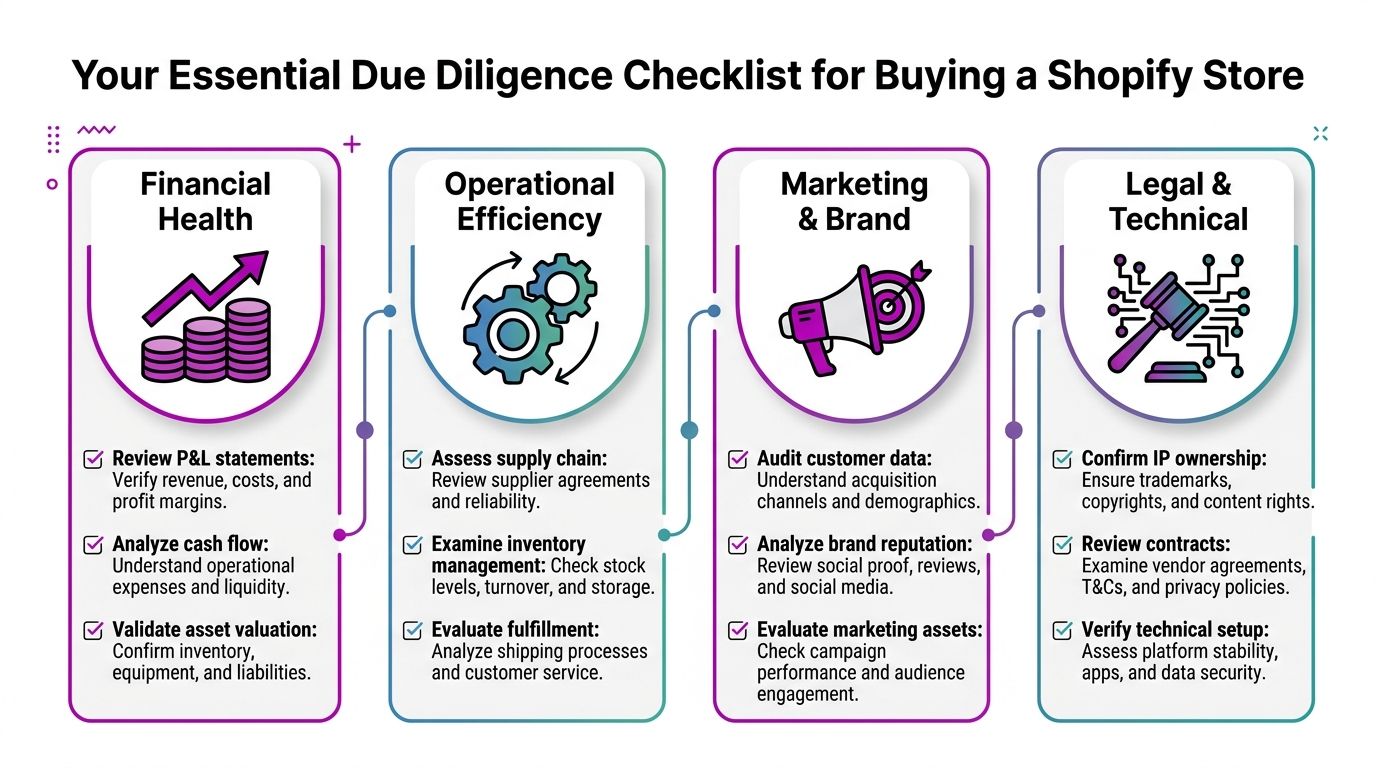
Financial diligence
Start with source-of-truth systems, not spreadsheets.
The key benchmark from a buyer’s perspective is that expert diligence is meant to reduce the 80 to 95 percent failure rate of new organic stores, and one core step is reviewing 6 to 12 months of verified Shopify data, confirming gross margins of at least 40% and positive net profit. Just as important, 70% of “profitable” listings fail post-acquisition because of unreported ad dependency, according to Branvas on why most new Shopify stores fail.
That single point changes how you investigate the deal.
What to request
Ask for access or recorded walkthroughs for:
- Shopify Analytics with order trends, product mix, returns, and customer cohorts
- Payment processor statements so sales can be matched to deposits
- Bank statements to verify cash movement
- Ad account exports to compare spend with claimed profitability
- Accounting reports from the system the seller uses
Don’t accept “our accountant handles that” as an answer.
What to check first
Look for consistency between platforms.
If revenue in Shopify doesn’t roughly line up with payment and banking records, stop and reconcile it before discussing price. If ad spend appears lower in the P&L than in Meta Ads Manager or Google Ads, assume the profit number is unreliable until proven otherwise.
A serious buyer should also think like an auditor. If you need a practical outside reference for how professionals examine records, controls, and evidence trails, this overview of an audit is useful because it reinforces the right mindset: verify from underlying records, not management summaries.
Traffic and SEO diligence
A store can look healthy while standing on one weak leg.
You need to know where visitors come from, what they do, and whether the business still works if one channel underperforms after transfer.
Questions that expose fragility
- How much traffic is direct, organic, paid, email, and referral
- Which products attract the highest-intent visitors
- Whether branded search is carrying the store
- How mobile visitors behave compared with desktop
- Whether returns or refunds spike after promotions
If the seller can only talk about top-line traffic, they probably haven’t managed quality.
What good traffic looks like
Good traffic is diversified and understandable. You can trace why customers arrive and why they convert.
Bad traffic is noisy. It depends on constant ad pressure, one viral asset, one creator relationship, or one promotional rhythm that may not survive ownership change.
If traffic quality is unclear, value the store as if the paid engine will get weaker after closing.
For SEO, check the pages that attract search demand, the intent behind those rankings, and whether those pages sell. Some stores have solid search visibility but weak commercial intent. Others rank for useful buying queries and generate revenue. The difference matters more than raw session volume.
Operational and technical diligence
Post-purchase headaches usually start here.
A seller can run a business successfully while leaving behind messy workflows, brittle app dependencies, and undocumented workarounds. You’re the one who inherits that mess.
What to inspect inside the store
Look at the stack, not just the surface.
- Theme quality matters because future changes will either be easy or expensive.
- App sprawl often slows the site and creates hidden subscription waste.
- Product data hygiene affects filtering, merchandising, feeds, and reporting.
- Discount logic can become unmanageable when legacy promotions pile up.
- Email and SMS flows may exist, but still be half-finished or outdated.
Also review how the business handles fulfillment, returns, customer service, and supplier communication. Ask how stockouts are managed. Ask what happens when a key supplier misses a deadline. Ask where product knowledge lives if the seller disappears the day after close.
Technical red flags
A store deserves more skepticism if you find:
- Custom code with no documentation
- Apps solving the same problem in overlapping ways
- Slow product pages on mobile
- Broken analytics or duplicate tracking
- Manual processes hidden behind “it only takes a minute” explanations
That last line is common in smaller deals. It never takes a minute once the founder leaves.
Legal and ownership diligence
A clean storefront does not equal clean ownership.
You need to confirm that the seller owns what they’re selling and has the right to transfer it.
Verify transferability of these assets
- Domain names
- Brand name and trademark filings
- Creative assets such as product photos, videos, and copy
- Email lists and customer databases, subject to compliance obligations
- Supplier agreements and private-label arrangements
- Social media handles
- Ad accounts and business manager access
- Apps, licenses, and any custom development agreements
If product images were shot by a freelancer, confirm the rights were assigned. If the brand uses licensed content, confirm the license survives transfer. If there are trademarks, verify which entity owns them.
A store transfer is only complete when the buyer controls the revenue channels, the traffic channels, and the legal rights behind the brand.
A final diligence habit
Don’t rush to “one more question.” Build a red-flag register.
List every unresolved issue. Mark each one as pricing issue, legal issue, operational issue, or deal-breaker. That turns diligence from a vague feeling into a decision tool.
Negotiating the Deal and Ensuring a Secure Transfer
Good negotiation starts before the first price discussion.
If your diligence uncovered weak channel mix, poor documentation, founder dependence, or technical debt, those points should change structure, not just headline price. A first-time buyer often focuses too much on winning a discount and not enough on protecting downside.
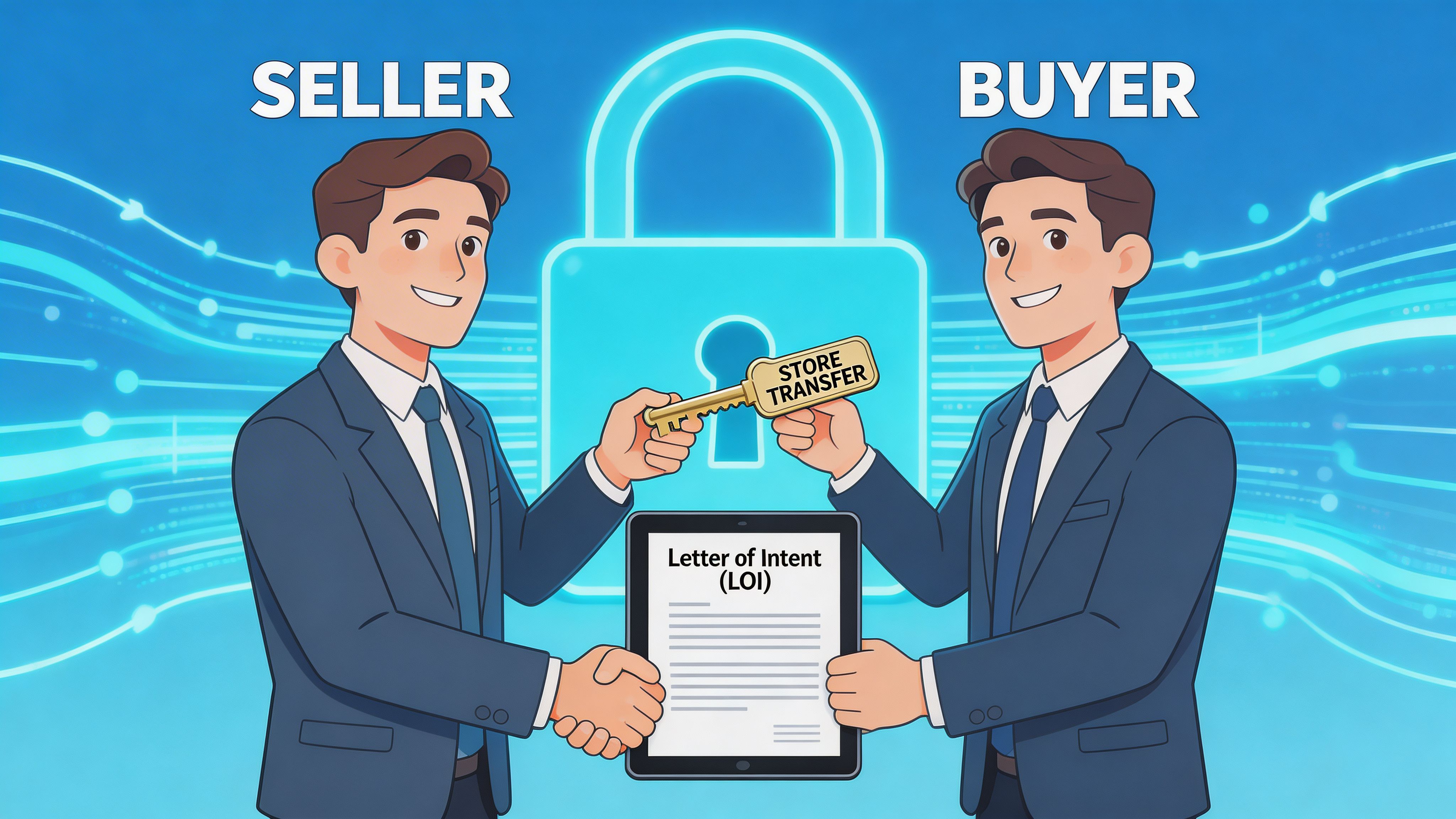
What to put in the LOI
A useful LOI sets expectations early and prevents drift.
Include the purchase structure, exclusivity period, diligence window, transfer scope, training period, and any holdback or earn-out mechanics. If you want a practical legal primer, this strategic guide on a Letter of Intent for Business Acquisition is a solid reference for the clauses that deserve attention before definitive documents are drafted.
Use findings to change terms
Not every issue should reduce price directly.
Sometimes the better answer is:
- A holdback if financial quality is uncertain
- An earn-out if recent performance looks unstable
- A longer transition period if the seller still holds key relationships
- A detailed asset schedule if ownership boundaries are blurry
This is usually smarter than arguing over a single number and ignoring execution risk.
Escrow is not optional
Use a real escrow process for the money movement and the transfer sequence. The point isn’t distrust. It’s procedure.
A clean transfer usually follows this order:
- Purchase agreement is signed
- Funds are deposited into escrow
- Seller transfers store assets according to a checklist
- Buyer verifies access and control
- Escrow releases funds after acceptance conditions are met
That sequence protects both sides. The seller knows the money is there. The buyer doesn’t release funds before control is real.
Don’t forget the non-Shopify assets
The store admin is only part of the business.
Make the transfer list explicit. That includes the domain registrar, social accounts, Meta Business Manager, Google Ads, Klaviyo or email platform access, creative files, supplier contacts, customer support inboxes, and any recurring software tied to the brand.
One operational detail matters more than buyers expect. Keep the seller available for a short handover window after closing. Not because you need hand-holding, but because small issues always surface once the new owner starts touching live systems.
The First 90 Days A Post-Purchase Optimization Plan
Most buyers spend too much time getting the deal done and not enough time deciding what happens immediately after.
That’s backwards. The acquisition only pays off if the first three months are disciplined.
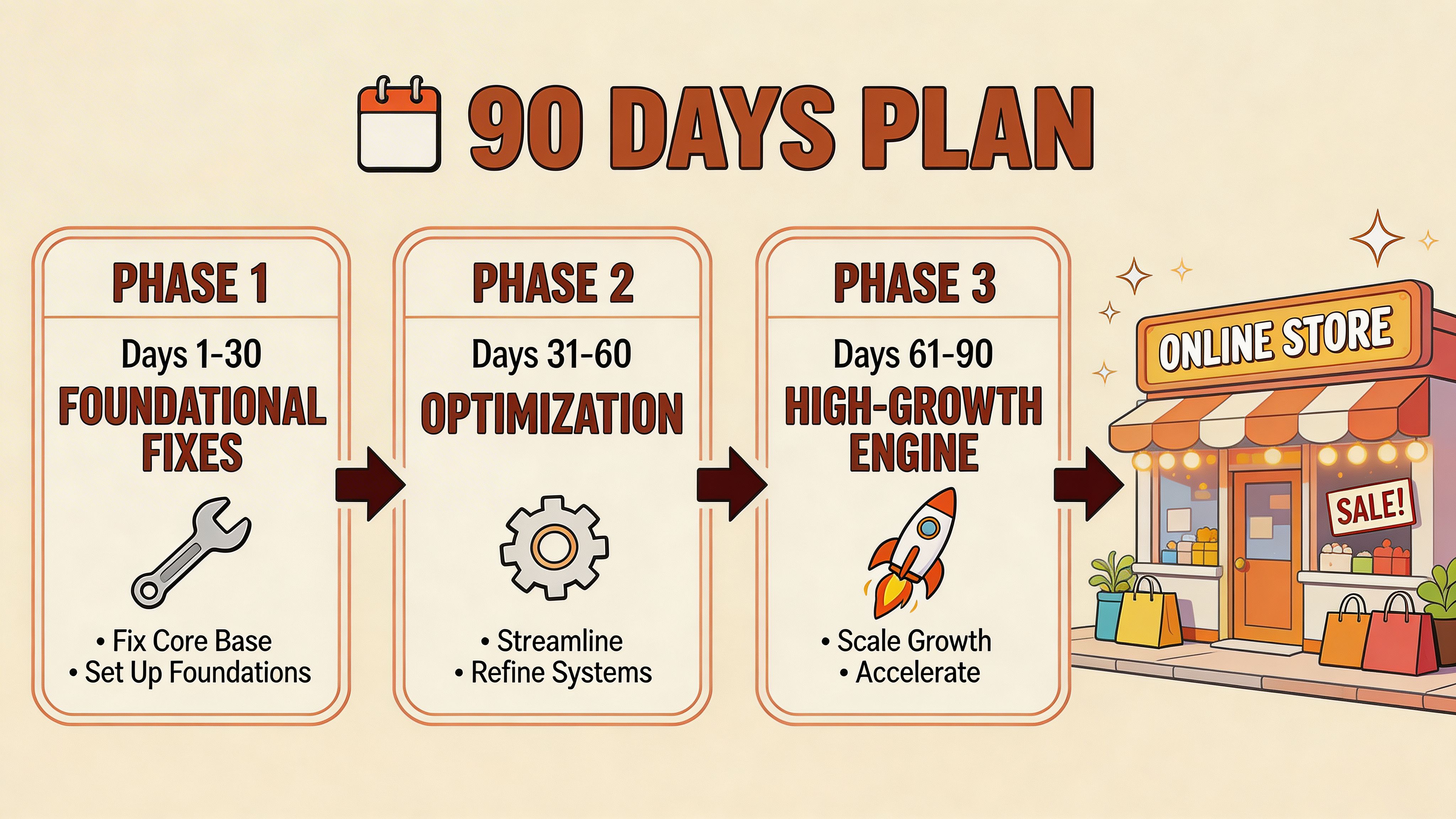
The reason this matters is simple. Post-acquisition optimization is critical because 95% of unoptimized bought stores never hit $100K ARR. A structured approach includes a KPI audit, a CRO overhaul with upsells and cross-sells that can boost sales 20%, and unit-economics refinement. Optimized bought stores can scale 3x faster than new builds, according to SpeedBoostr’s guide to Shopify growth.
Days 1 to 30
Your first month is for stabilization and fast fixes.
Don’t redesign the brand on day three. Don’t launch new channels before you trust the numbers. Start by building a clean baseline.
Get the reporting right
Set up one performance view that combines Shopify, analytics, ad platforms, and accounting.
You want to see conversion rate, average order value, refund patterns, gross margin by product, channel contribution, and customer repeat behavior in one place. If the seller’s reporting was messy, fix that before making budget decisions.
Clean the biggest conversion leaks
Review the product page and checkout flow as a buyer, not as an owner.
Look for:
- Weak product messaging that explains features but not purchase reasons
- Thin trust signals such as unclear shipping, returns, or review placement
- Mobile friction in image galleries, sticky add-to-cart behavior, and variant selection
- Checkout friction from unnecessary fields or confusing payment presentation
Many acquisitions hide upside here. The store may already have demand, but the pages aren’t helping that demand convert.
In the first month, protect revenue first. Improve elegance later.
Audit lifecycle marketing
Check the flows already in place.
Abandoned cart, browse abandonment, welcome, post-purchase, and win-back sequences often exist in name only. They may fire at odd times, contain outdated discounts, or send traffic to stale pages. Tightening these systems often improves performance without changing the traffic mix.
Days 31 to 60
Month two is where you decide what deserves more investment.
By now, you should know which channels attract profitable customers and which ones only create top-line noise.
Keep what works and cut what doesn’t
Look at channel behavior through contribution, not vanity metrics.
A traffic source that looks efficient in-platform may still fail once you include discounts, refunds, and fulfillment realities. On the other hand, email, direct, and organic traffic often deserve more attention because they compound through better merchandising and retention work.
Improve merchandising
Most bought stores have basic merchandising when they need intentional merchandising.
Focus on:
- Collections that reflect how customers shop
- Bundles that increase cart value without feeling forced
- Cross-sells tied to real product compatibility
- Product recommendations that support discovery, not distraction
Upsells and cross-sells work best when they solve an obvious adjacent need. Generic recommendation blocks don’t do much. Relevant offers do.
Trim the tech stack
Sellers accumulate apps the way garages collect boxes.
Month two is the right time to identify which apps drive revenue, which apps create friction, and which apps are leftovers from old experiments. Simplifying the stack reduces cost, lowers complexity, and often improves site speed.
Days 61 to 90
The third month is for controlled scaling.
At this point, you should understand the business well enough to test expansion without guessing.
Build around what customers already buy
Seek advantages in the current catalog before adding new products.
That may mean:
- Turning single products into bundles
- Creating clearer product ladders
- Refining pricing architecture
- Testing subscription or replenishment logic where it fits
- Using personalization tools to surface more relevant offers
This is also the stage where AI-driven experiences can help if the fundamentals are already clean. Personalization, smarter search, and recommendation tools work best after the store has accurate data, consistent merchandising, and a checkout that doesn’t leak intent.
Protect the operator’s calendar
The first 90 days can disappear into reactive work.
Block time each week for a short operating review. Focus on what changed, why it changed, and what you’ll test next. That habit matters more than any single app or theme tweak because bought stores improve through iteration, not one-time overhauls.
The new owner who wins is usually not the one with the most ideas. It’s the one who keeps turning observations into small, disciplined improvements.
When to Partner with a Shopify Agency
A lot of buyers want to keep everything in-house at first. That instinct makes sense. You’ve just spent money acquiring the asset, so every outside cost feels suspect.
But there’s a point where DIY stops being lean and starts becoming expensive.
The strongest signal is technical debt. If the previous owner left behind a tangled theme, overlapping apps, broken tracking, and inconsistent UX, you can waste months patching symptoms instead of improving performance. Another trigger is when the store has traffic and demand, but conversion still stalls after the obvious fixes.
That’s where specialist support can pay for itself. A meaningful post-purchase gap often sits in optimization. According to Convert’s article on finding selling angles with A/B testing, 70% to 80% of buyer hesitations stem from unoptimized pages, and marketplaces don’t provide CRO audits, leaving buyers to manage 20% to 30% potential revenue leaks after purchase.
Good reasons to bring in help
An agency tends to make sense when:
- You inherited serious store complexity and need cleanup without breaking revenue
- You’re considering Shopify Plus or multi-storefront expansion and don’t want to learn through mistakes
- Your team can manage marketing but not development-heavy CRO work
- You’ve hit a plateau where simple copy and offer tests aren’t enough
What to expect from the right partner
The right partner shouldn’t just “make the site look better.” They should help you prioritize.
That means sequencing the work. Fixing analytics before testing pages. Cleaning the theme before layering apps. Improving product detail pages before scaling acquisition. If you’re evaluating that route, this overview of a Shopify development agency is useful for understanding what specialist support covers beyond surface-level design.
A buyer shouldn’t outsource judgment. But it’s often smart to outsource specialist execution when speed, technical quality, and testing discipline matter.
Frequently Asked Questions About Buying a Shopify Store
Should I buy the assets or the whole company
Most first-time buyers prefer an asset purchase.
That usually gives you cleaner control over what you’re taking on: the Shopify store, domain, customer lists, brand assets, supplier relationships, and marketing accounts. It can also reduce the risk of inheriting obligations that sit inside the seller’s legal entity. Still, this is a legal and tax question, so your lawyer and accountant should review the structure before you sign.
What if the Shopify store is owned by an LLC
That doesn’t change the need for a transfer checklist.
You need to know whether you’re purchasing the business entity itself or only the store-related assets from that entity. If the LLC owns the trademark, the domain, ad accounts, and contracts, your purchase documents need to address each item clearly. Don’t assume “store sale” automatically means everything moves with it.
How do I handle niche or regulated categories
Move slower and get category-specific advice.
If the business sells products in a regulated area, your diligence needs to include payment processing rules, ad policy risk, supplier compliance, labeling, and any restrictions on customer acquisition channels. The store may be profitable and still be a bad acquisition if the compliance burden is outside your operating skill set.
Is dropshipping automatically a bad acquisition
No, but it raises the bar for diligence.
A dropshipping store can still be worth buying if customer demand is proven, fulfillment is reliable, margins are acceptable, and the brand isn’t fully interchangeable with dozens of competitors. The weak version is a store built on commodity products, ad dependence, and fragile supplier execution. The strong version has real positioning and an operator who understands merchandising and retention.
What if the seller refuses deep access before payment
That’s normal up to a point.
A seller may limit direct access early for privacy and security reasons. But before closing, you still need enough visibility to validate the business. That often means live walkthroughs, exports, redacted statements, and staged access under an NDA. If the seller won’t provide verifiable evidence, treat that as a serious warning sign.
How much of the seller’s involvement should continue after close
Enough to prevent operational confusion.
You want a defined transition period with clear expectations around training, supplier introductions, account handoffs, and issue escalation. A clean handover doesn’t require the seller forever. It does require them long enough to transfer context, not just credentials.
If you’re evaluating a Shopify acquisition or trying to turn a recent purchase into a stronger operating business, ECORN can help with the work that changes ROI after closing. That includes Shopify development, CRO, design improvements, and practical support for brands that need to clean up technical debt, improve conversion, and scale with more confidence.


Mastering Multi Store Management on Shopify
Scale Shopify Store

10 Shopify App Ideas Worth Building in 2026
Conversion Rate Optimization for Landing Pages: The Playbook
Shopify Plus Automation: A Guide for 2026
10 Social Selling Platforms for Shopify Merchants

Shopify Website Design Examples: 7 Stores Worth Studying
7 Ecommerce Newsletter Examples for Shopify Brands
One Product Shopify Store: Build and Scale
Mobile Pop Up Strategy for Shopify Stores That Converts
Sitemap for Shopify: How to Find, Optimize, and Submit It
7 Single Product Websites Worth Emulating
Product Variants Shopify: The Complete 2026 Guide
Ecommerce Analytics Consulting for Growth
What Is AI Integration for eCommerce
How to Choose the Right eCommerce Website Development Firm
E Business Strategy Implementation
Conversion Tracking Setup for Shopify Stores
BigCommerce vs Shopify Plus Which Enterprise Wins in 2026
Shopify Theme Kit: Setup, Commands, and Migration Guide

Shopify Extension Development: A Practical 2026 Guide
Shopify Speed Score Explained and How to Improve It

Shopify Mobile Optimization: The 2026 Playbook
How to Add Subcategory in Shopify for Better UX
How to Implement Structured Data for Ecommerce in 2026
SEO App Mobile: Shopify Store Optimization Guide
Shopify Plus Support: What It Includes and How to Choose

Google Ads for Shopify: The Complete 2026 Playbook

Shopify New York: How to Find and Hire the Right Agency
Google Search Console for Shopify: The Complete Setup
First Party Data Collection for eCommerce Growth
FAQ Online Store Guide: Build and Measure It Right
Do FB Ads Work for eCommerce in 2026?
One Page Checkout for Shopify: Design and Implementation
Shopify GraphQL vs REST: The 2026 Developer Decision
Shopify Ecommerce Consulting: Strategy, Pricing &

Are Reddit Ads Worth It for eCommerce Brands
Shopify Title and Meta Description: A Practical 2026 Guide

Product Video Best Practices for Shopify Brands
Real-Time Inventory Management: A 2026 Guide

AI Chatbot Integration for Shopify Stores
Affiliate Program Management: A Shopify Guide
10 Best Performance Monitoring Tools for Shopify in 2026
Digital Asset Management for eCommerce Brands in 2026
Every Type of Facebook Ads Explained for eCommerce Growth
Product Information Management Explained for Shopify Brands
Support Ticket System: A Guide for Shopify Stores

10 Best Customer Service Tools for Shopify in 2026

Can I Start a Business with No Money? a 2026 Blueprint

What Sells Good on Etsy: Best Niches for 2026

Shopify Add to Cart Button: A Practical 2026 Guide

Customer Feedback Automation: A Practical eCommerce Guide
Critical Rendering Path: A Guide for Shopify Stores

How to Promote on TikTok for eCommerce in 2026

B2B eCommerce Consulting That Drives Real Revenue
10 Best Practices for Site Navigation in 2026
Return vs Refund for Shopify Stores: A Practical Guide
What Is Customer Lifetime Value and Why It Matters
What Is Voice of Customer Research for eCommerce

SMS Marketing for Ecommerce That Actually Converts

Master How to Improve Email Deliverability in 2026

Top 7 eCommerce Partners NYC for Shopify Brands in 2026
Machine Learning for Ecommerce: Boost Your Shopify Store

Beauty Market Research: Your 2026 Growth Guide

Shopify International Expansion: A 2026 Roadmap
What Does CRO Stand for in Business: Understanding CRO

Shopify Visual Merchandising: A Playbook for Higher Sales

Shopify Landing Page Design: Master Conversion in 2026

10 Best AI SEO Optimization Tools for Shopify in 2026

Agentic AI for Ecommerce: Boost Your Sales in 2026
Mastering Email Marketing Data for eCommerce Growth

Conversion Rate Optimisation Australia: Boost Your Sales
Conversion Rate Optimization AI: Your Shopify Store Guide

10 Product Bundling Strategies for Shopify in 2026
How to Increase Customer Lifetime Value: A Shopify Playbook
AI Customer Service Automation: Shopify Guide 2026

Clean Website Design: A Shopify Conversion Playbook

Omnichannel Retail Strategy: A Shopify Playbook
Product Data Enrichment: A Guide for Shopify Brands
Instagram Shopping Features a Guide for Shopify Stores
What Is Revenue Optimization: A Holistic RevOps Guide

Benefits of Conversion Rate Optimization: Boost Your
WordPress to Shopify Migration: Your 2026 Seamless Switch
Boost Sales: Ecommerce Payment Processing Guide 2026
Unified Commerce Platform: Benefits, KPIs & Shopify Guide
How to Reduce Bounce Rate eCommerce: Your 2026 Guide
Shopify API Integration: A Practical End-to-End Guide
How to Implement Data Governance: A 2026 Guide
Shopify Store Development Cost: A 2026 Breakdown
What Is Server Side Tracking: The Shopify Guide 2026
Marketing Automation Workflows: A Shopify Guide for 2026
Shopify: How to Reduce Technical Debt

Shopify UX Design Change: A Playbook for Growth
User Generated Content Strategy: Shopify Playbook
Shopify Pause and Build Plan Cost: A Complete 2026 Guide
Compare at Price on Shopify: A Complete Guide for 2026

Where Can I Sell My Prints? 10 Best Platforms for 2026
Shopify Order Management System: The Ultimate Guide 2026
What Is Marketing Attribution? an eCommerce Guide for 2026

10 Best Black Friday Sales Sheets for 2026


newsletter in your inbox