


You’re probably in a familiar spot. Your store has traction, customers trust the brand, and you can see obvious ways to raise average order value with complementary products. The problem is inventory.
Buying new stock ties up cash. Warehousing adds complexity. Forecasting goes wrong. One slow-moving line can sit on shelves and drag margin down for months.
That’s where what is shopify collective becomes more than a simple feature question. For a growing brand, it’s really a growth-strategy question. Can you expand the catalog, test adjacent demand, and create new revenue without taking on inventory risk?
An Introduction to Shopify Collective
A growing brand often hits the same wall. Customers want more from the store, but expanding the catalog with owned inventory means tying up cash, adding operational overhead, and accepting the risk of dead stock.
Shopify Collective gives Shopify merchants a way to expand assortment through approved brand partnerships inside the Shopify ecosystem. A retailer can list products from another Shopify merchant, keep an agreed retail margin, and let the supplier own and ship the inventory. The business value is straightforward. You can add relevant products, test adjacent demand, and create new revenue streams without making the usual inventory bet upfront.

That distinction matters because Collective works best as a merchandising and partnership channel, not as a volume play. Brands that win with it usually have a clear point of view on what belongs in their store and what would dilute it. A premium brand can use Collective to round out the customer journey with complementary products. A weaker operator uses it to add random catalog depth and usually creates a cluttered storefront with inconsistent shipping expectations.
The 2026 reality check is geographic. Collective can be useful, but it is still not universally practical for every brand, supplier, or customer base. Availability and partner fit are shaped by market coverage, fulfillment setup, and whether your target customers sit in regions where Collective partnerships make commercial sense. That means the question is not just "what is Shopify Collective?" The better question is whether it can support your growth plan without creating customer experience problems you then have to explain away.
Why growing brands pay attention to it
Collective is strongest when there is a clear adjacency between what you already sell and what your customers are likely to buy next.
A skincare brand might add tools, accessories, or complementary wellness products. A travel brand might add organizers, comfort items, or mobility accessories. In both cases, the goal is not to become a bigger store. The goal is to increase average order value, improve customer retention, and make the store more useful without taking on the full risk of stocking every new line yourself.
Used well, Collective can also help brands validate demand before they commit to wholesale buys or private label development. That is where I see the biggest strategic upside.
What Collective does, and what it does not do
Collective supports merchant-to-merchant selling inside Shopify with native product syncing, order routing, and margin-based partnerships. It gives brands a cleaner operating model than trying to piece together supplier relationships manually.
It does not replace merchandising judgment, partner vetting, or margin analysis. It also does not remove the operational realities around shipping speed, returns, brand presentation, and regional limitations. If you need a refresher on the platform underneath all of this, this guide on how Shopify works gives useful context.
A simple rule helps here. Use Collective to extend a strong brand with carefully chosen partner products. Do not use it to patch a weak assortment strategy.
How Shopify Collective Actually Works
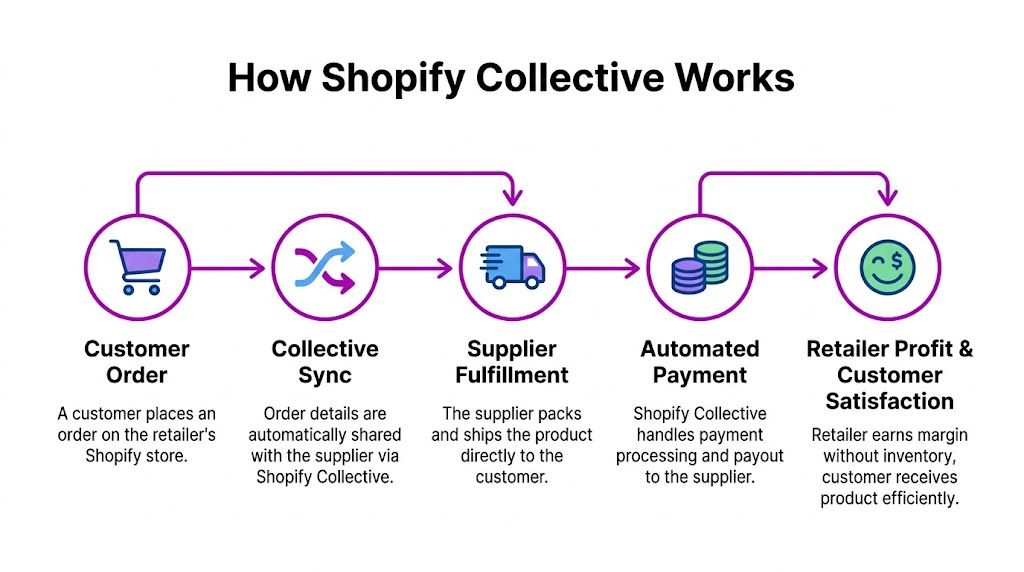
The easiest analogy is a digital consignment shop. You present the product to your audience. Your partner owns the stock and fulfills the order. Shopify handles the plumbing in the middle.
The supplier side
A supplier creates price lists. Those are curated product selections made available to approved retail partners.
This matters more than most merchants realize. Suppliers aren’t just dumping their full catalog into a network. They can choose which products fit which partners, keep control over pricing structure, and shape how their brand appears through other stores.
The retailer then sees supplier details through Collective’s discovery flow, including product data and store context, before importing items.
The retailer side
For the retailer, the workflow is straightforward:
Find a partner
You either discover a supplier inside Collective or build a direct partnership with a brand you already know.Review the product set
Don’t import on margin alone. Check fit, shipping origin, product storytelling, and whether the item complements your existing purchase paths.Import products into your store
Product information syncs over, which removes a lot of manual catalog work.Merchandise them properly
Proper merchandising distinguishes real operators. Imported products still need good collection placement, bundling logic, and on-site context.
What happens after the customer buys
When the order is placed, Shopify doesn’t leave you to email a supplier and chase status updates. The backend handles the order flow.
According to Shopify’s developer documentation for Collective, Shopify uses an automated splitting and routing mechanism. It parses line items, sends fulfillment requests to the correct suppliers, and syncs tracking data back automatically. That system reduces transaction friction by 40 to 60% compared with manual invoicing in legacy dropshipping.
That’s the operational difference many merchants miss. Collective isn’t just “someone else ships it.” It’s native order orchestration.
Why inventory sync matters
Inventory syncing is one of the biggest reasons Collective works better than improvised partnership models.
If a supplier’s available quantity changes, the retailer’s storefront reflects that through real-time synchronization. That sharply reduces the classic headache of selling an item that looked available when the customer checked out but was not in stock when the supplier reviewed the order.
When this setup is healthy, the retailer focuses on merchandising and customer acquisition, and the supplier focuses on inventory and fulfillment. Each side stays in its lane.
Where the process can still break
The mechanics are elegant, but they don’t remove the need for operational discipline.
Watch for these pressure points:
- Shipping logic: If the supplier’s shipping profile clashes with your storefront promise, margin can shrink fast.
- Product page mismatch: Supplier assets may be accurate but still feel off-brand on your store.
- Returns expectations: If the customer bought from you, they’ll hold you responsible, even when the supplier shipped the item.
- Partner quality: A technically connected supplier can still be a poor brand fit.
Collective works best when the automation handles the transaction and the merchants actively manage the relationship.
Strategic Advantages for Growing Brands
The biggest mistake I see is treating Collective as a fulfillment trick. It’s better used as a growth lever.

A growing store usually has one of two problems. It either has demand but not enough relevant products to increase basket size, or it has products but no low-risk way to test adjacent categories. Collective helps with both.
It lets you test demand without buying stock
That changes the economics of experimentation.
Instead of placing a purchase order and hoping the category works, you can introduce a curated set of products and watch what customers do. Which collection pages get traction? Which bundles attract clicks? Which accessory gets added to cart next to your hero SKU?
That gives you cleaner merchandising signals than internal brainstorming ever will.
It can expand your audience through better partnerships
Shopify’s scale matters here. As of 2024, Shopify powers 5.7 million active stores and 675 million buyers making purchases, according to Codeyard’s roundup of Shopify statistics. Collective gives merchants a way to connect with vetted suppliers inside that larger ecosystem without upfront inventory cost.
For a brand owner, the key insight isn’t the platform size by itself. It’s that the audience graph already exists. The right partner can expose your products to customers who are highly relevant but expensive to acquire through paid media alone.
It strengthens average order value when used with restraint
The best Collective assortments feel obvious in hindsight.
A skincare brand can add a complementary beauty tool. A coffee brand can add brewing accessories. A travel brand can add packing complements. These aren’t random catalog extensions. They’re basket builders.
One useful parallel is how brands structure a top ecommerce referral program. The smartest programs don’t just chase reach. They create tightly aligned incentives around an audience that already fits. Collective should be approached the same way. Alignment first, expansion second.
Here’s a short video that gives more visual context to the concept and why merchants are paying attention:
What works and what doesn’t
What works
- Complementary categories: Products that make the original purchase more useful.
- Brand adjacency: Similar tone, positioning, and customer expectation.
- Focused launches: A small, intentional product set often beats a broad import.
What doesn’t
- Catalog stuffing: More SKUs don’t automatically create more value.
- Margin-first decisions: A high-margin item that confuses the storefront usually costs more than it earns.
- Set-and-forget merchandising: Imported products still need CRO work, merchandising logic, and campaign support.
The strategic value of Collective is optionality. You get to test, learn, and expand without betting cash on inventory before demand is proven.
Shopify Collective vs Traditional Dropshipping
If you already understand traditional dropshipping, the fastest way to understand Collective is to compare the customer experience and operating risk.
Traditional dropshipping can work for certain models. But brand-conscious stores usually run into the same problems: weak supplier accountability, stock mismatches, slow delivery, and a customer experience that feels borrowed instead of owned.
Side by side comparison
| Feature | Shopify Collective | Traditional Dropshipping |
|---|---|---|
| Supplier relationship | Built around vetted Shopify merchant partnerships | Often sourced from broad supplier networks with mixed quality |
| Inventory sync | Real-time API sync | Lagged sync is common |
| Oversell risk | Mitigated to near-zero | Oversell incidents can run 15 to 25% |
| Shipping experience | US/CA-based shipping averages 3 to 7 days | Many global dropshippers average 14 to 21 days |
| Brand control | Curated assortments with closer fit to store identity | Huge generic catalogs often weaken merchandising |
| Payments and order flow | Native Shopify workflow with platform automation | Often involves external tools, manual reconciliation, or app-layer complexity |
Those inventory and shipping comparisons come from MMSHopyDevs’ Shopify Collective analysis, which notes that traditional dropshipping faces 15 to 25% oversell incidents from lagged sync, while Collective’s real-time API sync mitigates that to near-zero. The same source cites 3 to 7 day shipping for US/CA-based Collective orders versus 14 to 21 days for many global dropshippers.
Where Collective wins
The biggest advantage is control.
Not full control, because you still rely on another merchant to fulfill. But enough control to protect the brand. You know who the supplier is, what they sell, how the products fit your store, and how the order flow is managed.
That’s a different posture from importing commodity products from a vast external marketplace and hoping quality and delivery line up with your promise.
Where traditional dropshipping can still appeal
It usually offers broader sourcing and fewer curation constraints.
If your goal is pure product experimentation across a very wide set of categories, traditional dropshipping may feel more flexible. The trade-off is that you often absorb more operational risk, and your customers feel that first.
The practical decision
Use Collective if your store depends on brand trust, cleaner operations, and tighter assortment logic.
Use traditional dropshipping only if you accept the customer-experience compromise and have a model built around aggressive testing rather than careful curation.
How to Join and Get Started on Collective
A lot of brands get interested in Collective for the right reason. They want new revenue without taking on more inventory. Then they hit the first real filter. Eligibility.
That filter matters more than many founders expect, especially in 2026. Collective is still geographically narrow, so it works best as a focused growth channel for the right merchant, not a universal expansion play.
Retailer requirements
On the retailer side, the main gates are straightforward. Your store needs to be based in the U.S. or Canada, be on a paid Shopify plan, use Shopify Payments, and operate in USD or CAD, as noted earlier.
The practical takeaway is simple. Retailers do not usually get blocked because they are too small. They get blocked because their entity, payment setup, or store currency does not match Collective’s current rules.
For a growing brand, that changes how you evaluate the opportunity. The first question is not, “Are we big enough?” It is, “Does our store structure qualify, and does Collective fit our market plan?”
Supplier requirements
Suppliers face a higher bar.
In practice, Shopify is more selective here because the supplier carries the fulfillment burden and affects another merchant’s customer experience. Suppliers generally need to be U.S.-based, use Shopify Payments, sell in USD, and show an established sales history before they are approved.
That tighter screening is useful if you are a retailer. It reduces the odds of building your assortment around a partner that cannot keep up operationally.
The setup flow
If your store qualifies, get the basics right before you start pitching partners or importing products.
Install the Collective sales channel
Add Shopify Collective in your admin and complete the onboarding for your role.Choose how you will participate
Some brands join as retailers. Others join as suppliers. A few do both, but that only works well when the catalog, margins, and operations are already disciplined.Clean up the operational details
Confirm your payment setup, currency, shipping settings, returns policy, and support ownership. Small gaps here turn into customer-facing problems fast.Build a short partner list
Retailers can invite brands directly or review available partners. Suppliers should prepare clear pricing, product access rules, and fulfillment expectations before approving anyone.Launch with a narrow assortment
Start with a few products that already make sense for your audience. A small test is easier to merchandise, easier to support, and easier to judge objectively.
Best first move
Choose your first partner conservatively.
The best early Collective launches usually come from brands with obvious audience overlap, predictable shipping, and low return complexity. Apparel basics, replenishable goods, and lightweight accessories are often easier first tests than fragile, oversized, or highly variable products.
I usually advise brands to treat the first 30 to 60 days as an operating test, not a scale exercise. Watch margin after shipping, conversion on imported products, support tickets, and return patterns. If those numbers hold up, then expand the relationship.
That is how Collective starts paying off as a growth lever. Not by importing a giant catalog on day one, but by adding the right partner, in the right market, with the right operating discipline.
Best Practices and Known Limitations in 2026
Collective is often described as effortless. That’s partly true. It’s effortless when the partnership is well matched, the storefront presentation is intentional, and the operational details are sorted before launch.
It is not straightforward by default.

Best practices that usually improve results
Start with brand fit, not catalog opportunity.
If the products don’t belong together, customers notice. The strongest Collective assortments feel like a natural extension of the original store, not a side business.
Then tighten the execution:
- Rewrite imported product pages: Keep the facts accurate, but adapt positioning to your store voice and on-site buying journey.
- Merchandise by use case: Put Collective products into bundles, routines, kits, and contextual collections.
- Check shipping economics early: Heavy, fragile, or awkwardly priced items can create margin surprises.
- Align support and returns: Make sure both merchants know who handles what before the first sale.
- Promote intentionally: Email, collection pages, and post-purchase cross-sells usually outperform passive catalog placement.
Where merchants get tripped up
A common mistake is assuming that if the tech syncs, the business model is solved.
It isn’t. The software can route an order perfectly and you can still have a bad partnership. A weak unboxing experience, late fulfillment, poor packaging, or sloppy communication still hits your brand first because the customer bought from you.
Good Collective setups are operationally boring. The assortment makes sense, shipping is predictable, and no one on the customer side has to think about who fulfilled what.
The 2026 reality check
The biggest overlooked limitation is geography.
As of early 2026, Shopify Collective remains restricted to U.S. and Canadian merchants, with no confirmed timeline for expansion into major markets like the EU, UK, or Australia, according to Craftybase’s Shopify Collective guide.
That changes the conversation significantly.
If you run an international brand, Collective is not yet the broad global collaboration layer many people assume it is. For stores outside those supported markets, this isn’t a minor footnote. It’s the central constraint.
What that means in practice
If you’re in the U.S. or Canada, the opportunity is real, but you still need disciplined execution.
If you’re outside those regions, don’t build your 2026 assortment strategy around Collective availability. Plan around other methods for product expansion and partnership selling, then revisit Collective if Shopify expands eligibility.
That honesty matters because too many guides describe the feature as if rollout is universal. It isn’t.
Optimizing Collective with an Expert Partner
Collective looks simple from the outside because the transaction flow is clean. The harder part is deciding what to import, how to position it, and how to make the expanded catalog convert without diluting the brand.
That’s where expert support becomes valuable.
A good partner helps with three things first. Partner selection, merchandising, and conversion work.
Where outside expertise changes outcomes
An experienced Shopify team doesn’t just ask whether a supplier is available. They ask whether the products support your price architecture, your collections logic, your post-purchase flows, and your support model.
They also tighten the pages themselves. Imported products often need stronger copy hierarchy, cleaner bundle context, and better placement inside the storefront. That’s especially important when a product is new to your audience and doesn’t have the same built-in trust as your hero SKUs.
For larger brands, the challenge expands into systems. Multi-store setups, separate regional storefronts, and broader product governance create more moving parts. If you’re evaluating implementation help, this overview of Shopify Plus partners is a useful place to understand what strategic support should cover.
The real goal
The goal isn’t to “turn on Collective.”
The goal is to make Collective behave like a coherent extension of your merchandising strategy. When that happens, customers don’t experience it as a partnership tool. They experience it as a better store.
Frequently Asked Questions About Shopify Collective
Can you be both a retailer and a supplier
Yes. A merchant can participate in both roles if the store setup and eligibility support it.
That can work well for brands that want to sell their own products through partner stores while also curating complementary products on their own storefront.
Is Shopify Collective free to use
The verified material provided for this article doesn’t confirm a detailed fee structure beyond Shopify’s native handling of orders and payments, so it’s safer to say this qualitatively: merchants typically evaluate Collective as a built-in Shopify channel rather than a separate heavy app stack.
You should still review your current Shopify plan, payment setup, and any role-specific requirements before launch.
Who handles customer service
In practice, the retailer owns the customer relationship because the customer bought from the retailer’s storefront.
That means you should define support expectations with the supplier before going live. If a shipment is delayed or an item arrives damaged, customers will come to your support team first.
How do returns usually work
Return handling depends on the agreement between the retailer and supplier.
Don’t assume alignment. Set return windows, restocking expectations, refund responsibility, and shipping steps before you import products. This is one of the areas where loose setup creates expensive confusion.
What’s the best first product to test
Start with a complementary product that is easy to explain, easy to ship, and naturally tied to an existing bestseller.
Avoid products that create sizing complexity, fragile fulfillment, or unclear ownership of the customer experience.
Is Shopify Collective a replacement for wholesale or owned inventory
No. It’s best used as a complement.
It helps you test categories, expand assortment, and build partnerships without inventory exposure. If a product line proves demand consistently, you may still decide that owned inventory or a formal wholesale arrangement is the better long-term model.
If you want help turning Shopify Collective into a real growth channel instead of a messy catalog experiment, ECORN can help with strategy, CRO, Shopify development, and multi-store execution. The right setup protects your brand, sharpens merchandising, and makes every new product earn its place.



How to Launch a Box Subscription Business in 2026

Luxury Skincare Branding Playbook That Converters
10 Best Podcast Ecommerce Shows for Store Growth in 2026

Shopify Developer Hourly Rate: What to Pay in 2026
Critical Shopify Setup Errors That Are Secretly Sabotaging Your Store
Ecommerce Conversion Tracking: The Complete How-To Guide

Shopify Design Agency: How to Pick the Right Partner
Mastering Multi Store Management on Shopify
Scale Shopify Store

10 Shopify App Ideas Worth Building in 2026
Conversion Rate Optimization for Landing Pages: The Playbook
Shopify Plus Automation: A Guide for 2026
10 Social Selling Platforms for Shopify Merchants

Shopify Website Design Examples: 7 Stores Worth Studying
7 Ecommerce Newsletter Examples for Shopify Brands
One Product Shopify Store: Build and Scale
Mobile Pop Up Strategy for Shopify Stores That Converts
Sitemap for Shopify: How to Find, Optimize, and Submit It

7 Single Product Websites Worth Emulating
Product Variants Shopify: The Complete 2026 Guide
Ecommerce Analytics Consulting for Growth

What Is AI Integration for eCommerce
How to Choose the Right eCommerce Website Development Firm
E Business Strategy Implementation
Conversion Tracking Setup for Shopify Stores
BigCommerce vs Shopify Plus Which Enterprise Wins in 2026
Shopify Theme Kit: Setup, Commands, and Migration Guide
Shopify Extension Development: A Practical 2026 Guide

Shopify Speed Score Explained and How to Improve It
Shopify Mobile Optimization: The 2026 Playbook
How to Add Subcategory in Shopify for Better UX
How to Implement Structured Data for Ecommerce in 2026
SEO App Mobile: Shopify Store Optimization Guide
Shopify Plus Support: What It Includes and How to Choose

Google Ads for Shopify: The Complete 2026 Playbook

Shopify New York: How to Find and Hire the Right Agency

Google Search Console for Shopify: The Complete Setup
First Party Data Collection for eCommerce Growth
FAQ Online Store Guide: Build and Measure It Right
Do FB Ads Work for eCommerce in 2026?
One Page Checkout for Shopify: Design and Implementation
Shopify GraphQL vs REST: The 2026 Developer Decision
Shopify Ecommerce Consulting: Strategy, Pricing &

Are Reddit Ads Worth It for eCommerce Brands
Shopify Title and Meta Description: A Practical 2026 Guide

Product Video Best Practices for Shopify Brands
Real-Time Inventory Management: A 2026 Guide
AI Chatbot Integration for Shopify Stores
Affiliate Program Management: A Shopify Guide
10 Best Performance Monitoring Tools for Shopify in 2026
Digital Asset Management for eCommerce Brands in 2026
Every Type of Facebook Ads Explained for eCommerce Growth
Product Information Management Explained for Shopify Brands
Support Ticket System: A Guide for Shopify Stores

10 Best Customer Service Tools for Shopify in 2026

Can I Start a Business with No Money? a 2026 Blueprint

What Sells Good on Etsy: Best Niches for 2026

Shopify Add to Cart Button: A Practical 2026 Guide

Customer Feedback Automation: A Practical eCommerce Guide
Critical Rendering Path: A Guide for Shopify Stores

How to Promote on TikTok for eCommerce in 2026

B2B eCommerce Consulting That Drives Real Revenue
10 Best Practices for Site Navigation in 2026
Return vs Refund for Shopify Stores: A Practical Guide

What Is Customer Lifetime Value and Why It Matters
What Is Voice of Customer Research for eCommerce

SMS Marketing for Ecommerce That Actually Converts

Master How to Improve Email Deliverability in 2026

Top 8 eCommerce Partners NYC for Shopify Brands in 2026

Machine Learning for Ecommerce: Boost Your Shopify Store

Beauty Market Research: Your 2026 Growth Guide

Shopify International Expansion: A 2026 Roadmap

What Does CRO Stand for in Business: Understanding CRO

Shopify Visual Merchandising: A Playbook for Higher Sales

Shopify Landing Page Design: Master Conversion in 2026
10 Best AI SEO Optimization Tools for Shopify in 2026

Agentic AI for Ecommerce: Boost Your Sales in 2026
Mastering Email Marketing Data for eCommerce Growth

Conversion Rate Optimisation Australia: Boost Your Sales
Conversion Rate Optimization AI: Your Shopify Store Guide

10 Product Bundling Strategies for Shopify in 2026
How to Increase Customer Lifetime Value: A Shopify Playbook
AI Customer Service Automation: Shopify Guide 2026

Clean Website Design: A Shopify Conversion Playbook

Omnichannel Retail Strategy: A Shopify Playbook
Product Data Enrichment: A Guide for Shopify Brands
Instagram Shopping Features a Guide for Shopify Stores

What Is Revenue Optimization: A Holistic RevOps Guide

Benefits of Conversion Rate Optimization: Boost Your
WordPress to Shopify Migration: Your 2026 Seamless Switch
Boost Sales: Ecommerce Payment Processing Guide 2026
Unified Commerce Platform: Benefits, KPIs & Shopify Guide
How to Reduce Bounce Rate eCommerce: Your 2026 Guide
Shopify API Integration: A Practical End-to-End Guide

How to Implement Data Governance: A 2026 Guide
Shopify Store Development Cost: A 2026 Breakdown
What Is Server Side Tracking: The Shopify Guide 2026
Marketing Automation Workflows: A Shopify Guide for 2026

Shopify: How to Reduce Technical Debt

Shopify UX Design Change: A Playbook for Growth


newsletter in your inbox