

eCommerce personalization is all about creating a uniquely individual shopping experience for every person who visits your site. Instead of showing everyone the same generic website, it uses customer data and behavior to change the content, products, and offers they see. The goal is to make shopping online feel as welcoming and intuitive as visiting a favorite neighborhood store.
What Is Ecommerce Personalization Really
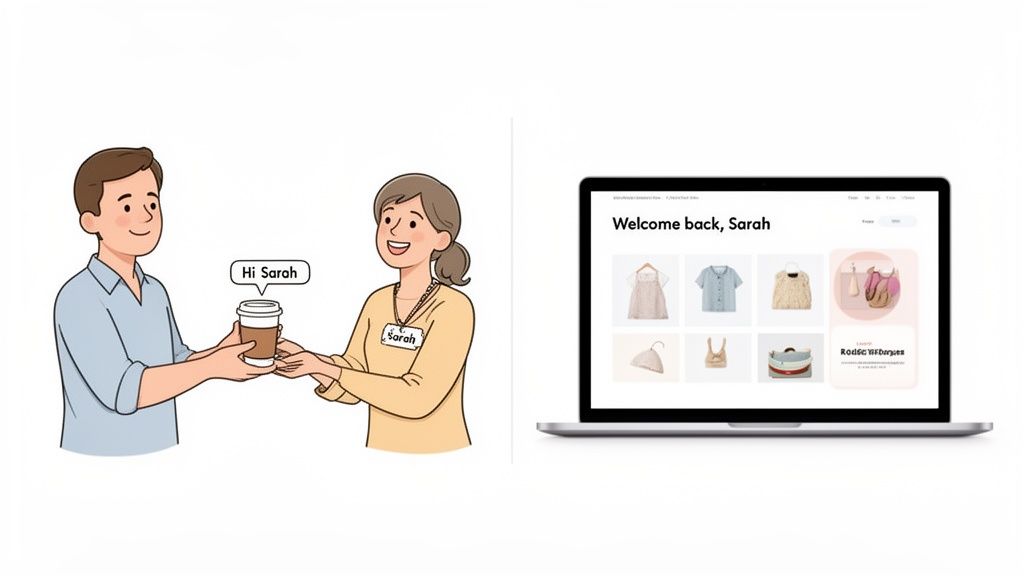
Imagine walking into a small local shop where the owner greets you by name, remembers what you bought last time, and points you toward a new arrival they know you'll love. That's the gold standard. The real challenge is figuring out how to recreate that exact feeling online, and that's precisely what ecommerce personalization sets out to do.
This strategy goes way beyond just plugging a first name into an email. It’s about using customer data—past purchases, browsing history, items left in a cart, or even answers from an on-site quiz—to build a shopping experience that feels like it was designed just for them. For a comprehensive look at this strategy, check out The Ultimate Guide to Ecommerce Personalization.
From Generic to Genuine
Without personalization, every visitor sees the same homepage, the same promotions, and the same product grid. It’s like a massive department store where the layout is identical for everyone, whether they're looking for running shoes or kitchen gadgets. It’s functional, but it’s not smart.
eCommerce personalization turns a static, one-size-fits-all storefront into a dynamic, responsive shopping assistant. It anticipates what the shopper wants—sometimes before they even realize it themselves—and makes finding it effortless.
This shift happens at every single touchpoint. A returning customer might land on a homepage banner that highlights the category they browsed last. A shopper from a cold climate could be shown winter coats first, while someone in a warmer region sees swimwear. It’s about making thousands of tiny, smart adjustments that add up to a brilliant customer experience.
But here’s the reality check: while 92% of retailers believe they’re delivering personalized experiences, only 48% of consumers actually agree. That's a massive disconnect, especially when 71% of consumers now expect it. The upside? Companies that get it right generate 40% more revenue from their personalization efforts than the average brand.
The Four Pillars of Ecommerce Personalization
To really get a grip on what personalization entails, it helps to break it down into four core components. These pillars work together to turn raw data into relevant, revenue-driving experiences.
The data fueling these pillars often comes from first-party and zero-party sources. If you're not familiar with the second term, we have a whole guide explaining https://www.ecorn.agency/blog/what-is-zero-party-data.
Here’s a quick summary of how it all fits together.
The Four Pillars of Ecommerce Personalization
| Pillar | Description | Example |
|---|---|---|
| Data Collection | Gathering information on user behavior, preferences, and demographics across every touchpoint. | Tracking which products a visitor clicks on, their purchase history, and their geographic location. |
| Segmentation | Grouping users into distinct audiences based on shared characteristics or actions. | Creating a segment for "first-time visitors" or "VIP customers who purchase monthly." |
| Targeting | Delivering specific content, offers, or experiences to a defined audience segment. | Showing a 10% welcome discount pop-up only to the "first-time visitors" segment. |
| Analysis & Optimization | Measuring the performance of personalization efforts and using those insights to refine the strategy. | A/B testing a personalized homepage banner against a generic one to see which drives more clicks and sales. |
By building your strategy on these four pillars, you can stop shouting at the crowd and start having meaningful, one-to-one conversations with your customers—at scale.
Why a Personalized Experience Drives Business Growth
In a market flooded with options, personalization isn't just a buzzword—it's your key to real growth. It's the difference between a potential customer bouncing off your site and one who feels like you've rolled out the red carpet just for them. Every time you remove a bit of friction—like making a customer search for a product you already know they’ll love—you're paving a smoother path straight to checkout.
This isn’t just about tweaking your storefront. It's about transforming a generic, one-size-fits-all experience into a personal shopping appointment. This shift doesn't just drive immediate sales; it builds the kind of loyalty that turns first-time buyers into lifelong fans of your brand.
Boost Your Conversion Rate
The most direct impact you'll see from a solid personalization strategy is a jump in your conversion rate. When shoppers feel understood, they're simply more confident in their decision to buy. In fact, research consistently shows that marketers see an average increase of 20% in sales after implementing personalized experiences.
Think about it from the customer's perspective. Instead of hitting a generic homepage, a returning visitor is greeted with products related to their last browsing session. That small, relevant touch instantly cuts down the effort needed to find what they want, shortening the journey from discovery to "Add to Cart."
By anticipating what a customer needs and showing them a tailored path forward, personalization removes the barriers that often kill a sale. This creates a much more engaging and intuitive shopping experience that encourages them to pull the trigger.
This targeted approach flips the script. It moves a customer from just "looking around" to thinking, "This is exactly what I was looking for."
Increase Average Order Value
Personalization isn't just about getting more people to buy; it's also a powerful way to increase how much they spend in a single transaction. By intelligently showing shoppers relevant add-ons and items that go well together, you can significantly lift your Average Order Value (AOV).
This is where AI-powered recommendation engines really shine. They look at a user's cart, browsing history, and what similar shoppers have bought to suggest products that genuinely make sense for their purchase.
- "You Might Also Like" Sections: These are perfect for product pages, suggesting alternatives or similar items to keep shoppers engaged if the current one isn't quite right.
- "Frequently Bought Together" Bundles: A classic checkout tactic that encourages adding complementary items to the cart, often with a small bundle discount.
- Post-Purchase Upsells: Offering a relevant product right after a purchase is a great way to capture an effective impulse buy.
When these suggestions are driven by data, they feel less like a hard sell and more like a helpful tip from a store expert. This strategy commonly results in a 10-15% improvement in AOV, adding directly to your revenue without the cost of acquiring a new customer.
Cultivate Lasting Customer Loyalty
While quick wins are great, the real foundation of long-term growth is repeat business. Personalization is absolutely fundamental to fostering the kind of loyalty that increases Customer Lifetime Value (CLV). A staggering 60% of consumers say they are likely to become repeat buyers after a shopping experience felt personalized to them.
When your brand consistently shows it understands a customer's tastes and needs as they change over time, you build a powerful emotional connection. This moves the relationship beyond just transactions and creates true brand affinity. Customers who feel seen and valued are far less likely to be tempted by a competitor's discount and far more likely to come back.
Ultimately, companies that get personalization right generate 40% more revenue from these activities than their peers, proving that investing in the customer experience pays dividends for years to come.
Actionable Personalization Tactics for Every Customer Touchpoint
Alright, you get the why behind personalization. Now for the fun part: putting it all into practice where the real growth happens. This is your playbook for weaving personalization into the entire customer journey, from that very first click all the way to their tenth purchase.
Think of it less like shouting at a crowd and more like having a series of helpful, one-on-one conversations.
The image below lays it out perfectly. It shows the straight line from a smart personalization strategy to hitting your core business goals—more sales and customers who stick around.
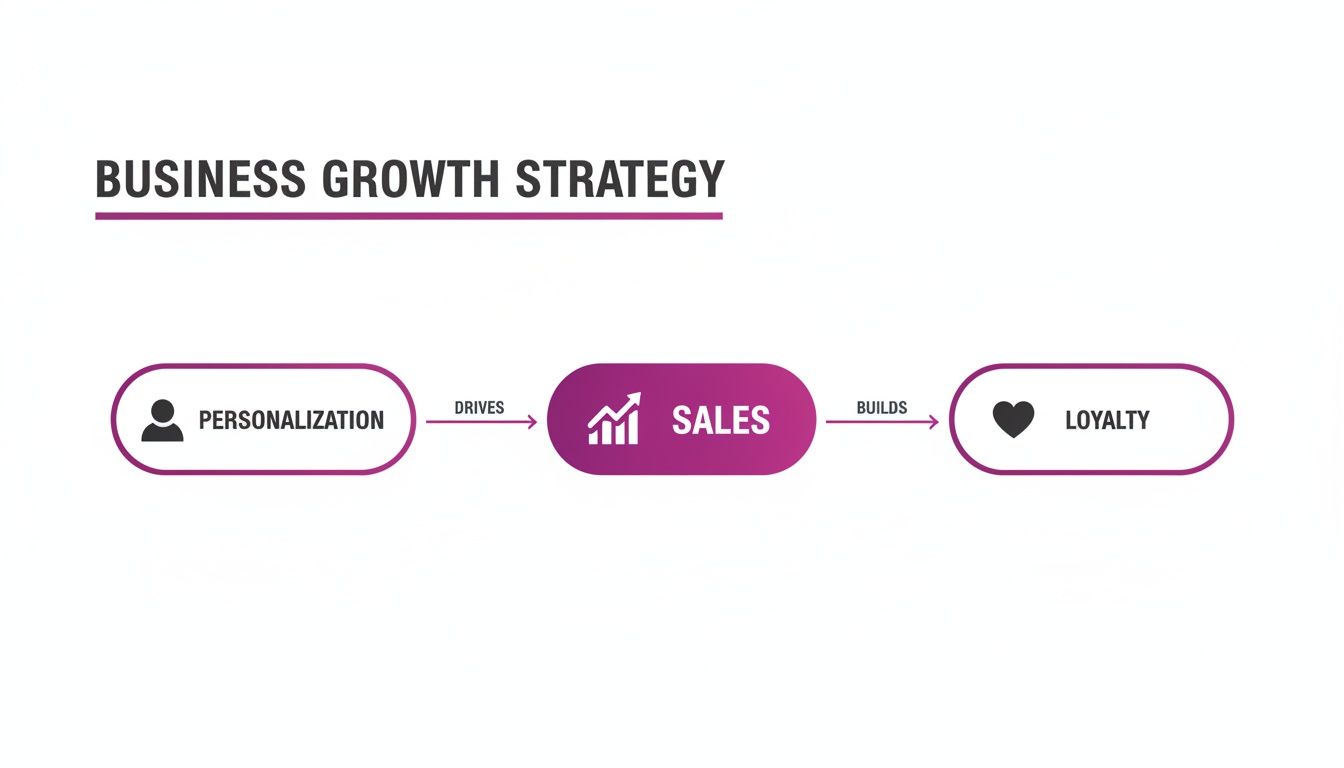
It’s a simple loop: a great personalized experience drives sales, and those positive experiences build the kind of loyalty that sustains a brand long-term.
Personalize Your On-Site Experience
Your website is your digital flagship store, and it needs to feel different for every single person who walks in. The magic behind this is dynamic content. Instead of one static homepage for everyone, you can serve up different banners, promos, and product carousels based on who the visitor is.
For example, a customer clicking in from a chilly part of the world could see a hero image of winter coats. Someone from a warmer spot? They get swimwear. A returning customer who was just looking at running shoes could be greeted with a "New in Footwear" banner right at the top. These aren't massive changes, but they make the whole experience feel instantly smarter and more relevant.
Supercharge Your Email Marketing
This is where email marketing goes from just being effective to being exceptional. Forget the basic "Hi [First Name]" tokens. True personalization is about using behavioral triggers to send automated campaigns that react to what a user does—or doesn't do.
- Browse Abandonment Emails: A shopper checked out a specific product but didn’t add it to their cart. A few hours later, an email lands in their inbox showing them that exact item, maybe with a few similar options. It’s a gentle, helpful nudge.
- Post-Purchase Follow-ups: Someone just bought a new camera. A week later, you can send an automated email with a handpicked list of compatible lenses and camera bags. You’re not just selling; you’re anticipating their next need and providing real value.
- Replenishment Reminders: Selling consumables like coffee or skincare? You can time emails to go out right when you know they’re about to run out. A simple "Time to restock?" email is both a lifesaver for the customer and a massive driver of repeat business.
The aim is to shift every email from feeling like a promotion to feeling like a timely piece of advice. When you nail that, open rates and conversions just naturally climb.
Master Off-Site Retargeting
The conversation shouldn't end when a visitor clicks away from your site. Off-site retargeting on social media platforms lets you keep that conversation going in a way that’s impossible to ignore. Instead of a generic brand ad, you can put the exact products they just viewed or added to their cart right back in their feed.
This keeps you top-of-mind and makes the journey back to your store completely seamless. It’s a powerful reminder of their initial interest, often sweetened with a little offer to seal the deal.
Look no further than the boom in tailored products, like personalized gifts, to see this trend in action. The global market for personalized gifts is on track to hit $33-35 billion by 2026, because 54% of consumers will happily pay more for items made just for them. These unique experiences are proven to deliver 20% sales increases and 65% lifts in conversion, while intelligent product recommendations can account for up to 31% of a store's total revenue. You can see exactly how personalized gifts are reshaping the market in this detailed analysis.
How to Implement Personalization on Shopify
Knowing you should personalize your store is one thing. Actually making it happen on Shopify is a whole different ball game. The great news is that the Shopify ecosystem is incredibly rich, with a whole toolbox ready for merchants of every size—from bootstrapped startups to massive enterprise brands.
Think of it as a set of building blocks. You don't have to build a skyscraper on day one. You can start with simple, plug-and-play solutions and then stack more sophisticated layers on top as your store grows and you gather more customer data. This is your game plan for picking the right blocks to build a personalization strategy that scales right alongside your business.
Start with Powerful Shopify Apps
For the vast majority of merchants, Shopify apps are the quickest and easiest on-ramp to personalization. The Shopify App Store is jam-packed with powerful tools that you can get up and running with little to no coding.
These apps take care of the heavy lifting, from on-site recommendations to complex data collection, letting you roll out proven personalization tactics in a matter of hours, not weeks. They are your first, best step to making your store feel more intelligent and responsive to each shopper.
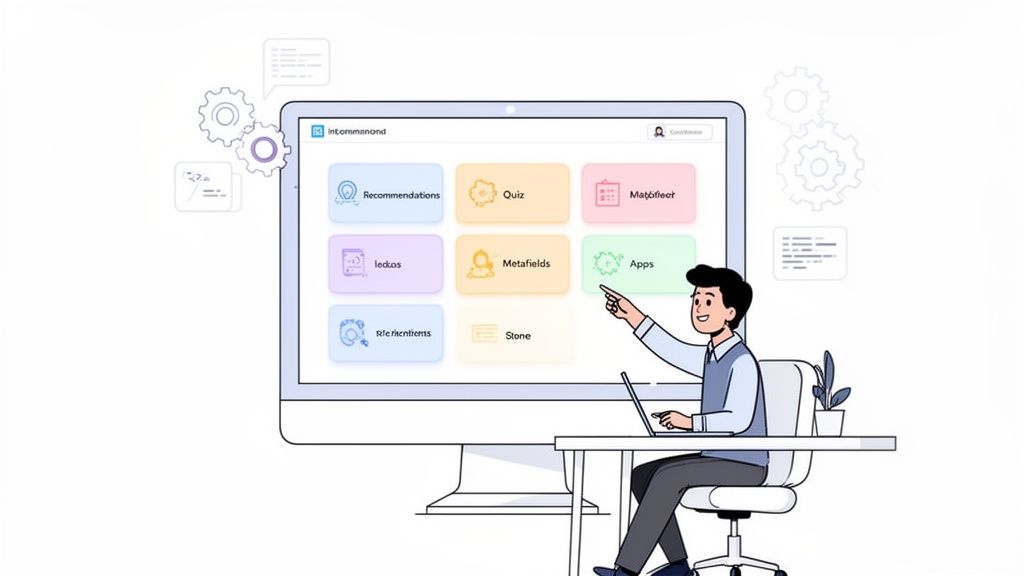
Here are a few essential app categories you should be looking at:
- AI-Powered Product Recommendations: Apps like Rebuy or LimeSpot watch how a customer behaves in real-time. They then power those "You might also like" or "Frequently bought together" sections on your product and cart pages with uncanny accuracy.
- Quiz Builders: Tools like Octane AI or Jebbit let you build fun, interactive quizzes. These are brilliant for collecting what we call zero-party data—information customers willingly give you—which you can immediately use to guide them to the perfect product.
- Email & SMS Personalization: By connecting your email service provider (like Klaviyo), you can tap into deep Shopify data. This lets you automate hyper-relevant messages, like abandoned cart flows that show the exact items a customer left behind.
As you start adding these tools, remember that effective Shopify conversion rate optimization tips will help you squeeze every drop of value out of these app-driven experiences, turning personalized touches into real sales.
Use Your Theme and Metafields
Shopify’s Online Store 2.0 update was a game-changer, handing a ton of control back to merchants without forcing them to hire a developer. The key to this newfound power is metafields—think of them as custom data fields you can attach to products, customers, or orders.
It’s simpler than it sounds. Let’s say you sell coffee. You could create a "Tasting Note" metafield for every bag (e.g., "Chocolate, Nutty, Bold"). You can then pull this custom info right onto your product pages to help shoppers make a more informed choice. You can even create metafields for customers to tag their preferences, allowing you to show them tailored content the next time they log in.
Unlock Advanced Customization with Shopify Plus
When your brand hits a high-growth trajectory, Shopify Plus opens up a whole new level of personalization that standard apps and themes can't touch. These are the tools that let you customize the very core of Shopify's platform.
Shopify Plus capabilities like Functions and checkout extensibility are game-changers. They allow you to build custom business logic directly into the checkout process and other backend systems for a truly unique customer journey.
For example, with Shopify Functions, you could write a script that offers a free gift at checkout only to VIP customers spending over $200. With checkout extensibility, you can add custom features right on the checkout page itself, like a delivery date picker or a last-minute personalized upsell offer. This is how you create a checkout experience that is truly your own.
Go Further with APIs and AI
The final frontier of personalization on Shopify means getting your hands dirty with its powerful APIs and integrating external AI tools. This approach offers almost unlimited flexibility but definitely requires development resources.
The market for AI-powered eCommerce is projected to explode to $41.42 billion by 2032. Retailers that are already using AI aren't just staying current; they're seeing profits jump by up to 15% while simultaneously cutting marketing costs.
With APIs, you could sync all your customer data with a Customer Data Platform (CDP). Then, you'd feed those rich insights back into your store to drive hyper-personalized experiences on-site. By diving deep into the world of personalization apps and techniques for Shopify stores, you can find even more ways to connect these advanced tools. This is how you build completely bespoke customer journeys that are unique to your brand and impossible for your competitors to copy.
How to Measure Your Personalization ROI
Investing in personalization is a powerful move, but if you can't prove it's working, it's just another line item on your budget. Measuring your return on investment (ROI) is what separates a "nice-to-have" feature from a measurable, revenue-driving engine for your store.
This is all about gathering undeniable proof of what’s working and what isn’t.
The best way to get a clear answer is through A/B testing. It's a straightforward concept: you pit a personalized experience against your standard, generic one. For instance, you can show half your visitors a homepage with personalized product recommendations and the other half your standard homepage. Then, you simply see which one drives more sales over a set period.
Core Metrics That Matter Most
While you can track dozens of metrics, you'll get the clearest picture of your success by focusing on a few key performance indicators (KPIs). These are the numbers that directly tie your personalization efforts to real business growth.
Your primary focus should be on these three areas:
- Conversion Rate Lift: This is your most direct measure of success. It shows you the percentage increase in visitors who converted after seeing a personalized experience compared to those who didn't. A solid strategy can easily lift conversion rates by 5-25%.
- Average Order Value (AOV) Increase: Are your personalized product recommendations actually getting shoppers to add more to their carts? AI-driven suggestions have been shown to boost AOV by 10-15%.
- Customer Lifetime Value (CLV) Growth: This is the long-term prize. It answers the question: are personalized experiences turning one-time buyers into loyal, repeat customers? The brands that get this right generate 40% more revenue from personalization than average ones.
Measuring ROI isn't just about justifying budgets; it's about gaining the strategic insights needed to refine your approach. Each test, whether it wins or loses, teaches you something valuable about your customers.
To make this tracking more concrete, it's incredibly helpful to connect each personalization tactic you use directly to the KPIs it's designed to influence. This framework helps you build a solid business case for every initiative you launch.
Mapping Personalization Tactics to Key Performance Indicators (KPIs)
Use this table to connect your personalization efforts to measurable business outcomes and track your ROI effectively.
| Personalization Tactic | Primary KPI to Track | Secondary KPI to Monitor |
|---|---|---|
| Personalized Product Recommendations | Average Order Value (AOV) | Conversion Rate |
| Dynamic Homepage Banners | Click-Through Rate (CTR) | Time on Site |
| Behavioral Email Triggers | Email Open/Click Rate | Cart Recovery Rate |
| Geographic Content Targeting | Conversion Rate by Region | Bounce Rate |
| Personalized Search Results | Search-to-Conversion Rate | Pages per Session |
By using a structured approach like this, you move beyond guesswork and start making data-driven decisions. Each metric tells a part of the story, showing you precisely how your efforts are translating into tangible results for your business.
Your Ecommerce Personalization Launch Checklist
Getting started with personalization doesn't have to be a massive, all-at-once project. The trick is to start small, get some quick wins, and then build on that momentum by layering in more advanced tactics as you learn what works.
Think of it as building a LEGO model. You don't dump all the pieces on the floor and try to build everything at once. You start with the foundation, a few simple bricks, and add more complex pieces over time. This checklist is your step-by-step guide to laying those first few bricks with confidence.
Phase 1: Lay the Foundation
Before you can show a customer the perfect product, you need a plan and the right materials. This first phase is all about setting a clear goal and figuring out what customer data you can already access.
Define Your Core Goal: What’s the one metric you want to move the needle on right now? Are you trying to bump up your conversion rate, increase average order value (AOV), or cut down on abandoned carts? Pick a single, primary goal to keep your first efforts laser-focused.
Audit Your Existing Data: Take a look at what you already know about your customers. This usually includes purchase history, basic browsing data from your analytics platform, and any info you collect when someone creates an account. You probably have more to work with than you realize.
Choose Your First Tool: Don't overcomplicate it. Select one high-impact personalization app to get started. A solid first choice is a product recommendation tool that can power "You Might Also Like" sections. It's relatively easy to set up and provides an immediate, visible impact right on your product pages.
Phase 2: Launch Your First Initiative
With the groundwork in place, it’s time to launch your first simple personalization tactic. The goal here is to prove the concept, get a quick win under your belt, and start seeing some real results.
Don't get hung up on perfection. Your first initiative is a test, plain and simple. The real goal is to learn what your customers respond to and then build from there. Success comes from iteration, not from a single, flawless launch.
A great first move could be adding a "Frequently Bought Together" bundle to your top-selling product pages. It's a straightforward tactic, but it's incredibly effective for nudging your Average Order Value upward.
Phase 3: Expand and Iterate
Once your first tactic is live and you're gathering data, it's time to add another layer. This is where you can start combining different strategies to build a more connected and intelligent experience for your shoppers.
- Introduce Zero-Party Data Collection: Launch a simple product discovery quiz. Ask customers a few questions about their style, needs, or preferences. This gives you incredibly valuable data that you can use right away to serve up the perfect product recommendations.
- Activate Behavioral Emails: Set up a personalized abandoned cart email flow. Go beyond a generic "You left something behind!" message and actually show the specific items the customer added to their cart. This one tactic alone can recover a huge percentage of otherwise lost sales.
By following this roadmap, you can take the mystery out of what is ecommerce personalization. You build momentum with each small win, turning customer insights into real, measurable growth and scaling your efforts with a clear, actionable plan.
Frequently Asked Questions About Ecommerce Personalization
As you start thinking about bringing these strategies to your own store, a few common questions always pop up. Let's get you some direct, practical answers to help clear things up.
How Much Data Do I Really Need to Get Started?
A lot of merchants think you need mountains of data before you can even begin, but that's a huge misconception. The truth is, you can start personalizing your store with the basic information you probably already have.
Every Shopify store, right out of the box, tracks fundamental behaviors like which products get viewed, what’s added to a cart, and a customer's purchase history. This is more than enough to launch a high-impact initiative. Think a "Recently Viewed" product carousel or a simple abandoned cart email. You don’t need a massive customer database to make your first move.
Is There a Risk of Personalization Coming Across as Creepy?
Yes, and it’s a fine line to walk between helpful and intrusive. The secret to staying on the right side of that line is a simple trade: transparency and value exchange. Customers are usually fine with sharing information if they get something worthwhile in return, like a genuinely better shopping experience or offers that actually make sense for them.
The "creepy" feeling kicks in when personalization has no clear value for the customer. When you use data to solve their problem or make their life easier, it feels like great service. When you use it without any obvious benefit to them, it can feel like surveillance.
Always be upfront about the data you're collecting and, more importantly, focus on using it to make their experience better.
What's the Real Difference Between Personalization and Customization?
This is a really important distinction. The easiest way to think about it is "done for you" versus "done by you."
Personalization is proactive. The website uses data and logic to automatically tailor the experience for the user. A great example is showing a returning visitor products based on their past browsing, without them lifting a finger.
Customization is reactive. The user has to take action to change their experience to match their preferences. This is what happens when a customer uses filters to narrow down a search or picks the color of a t-shirt.
In short, personalization anticipates what a customer needs, while customization requires the user to spell it out.
Can Small Stores Actually Afford to Implement This?
Absolutely. You definitely don’t need an enterprise-level budget to see results. The Shopify App Store is packed with affordable, high-impact apps that put personalization within reach for stores of any size. Many of the best product recommendation or email marketing apps have free or low-cost plans to get you started.
By beginning with just one or two budget-friendly tools aimed at a specific goal—like recovering abandoned carts or adding a recommendation widget—small stores can see a real, tangible return on their investment very quickly.
Ready to transform your generic storefront into a personalized shopping experience that drives real growth? The team of dedicated Shopify specialists at ECORN is here to help you implement effective design, development, and CRO strategies that convert. Start your journey with us today.


Shopify Theme Kit: Setup, Commands, and Migration Guide
Shopify Extension Development: A Practical 2026 Guide
Shopify Speed Score Explained and How to Improve It
Shopify Mobile Optimization: The 2026 Playbook
How to Add Subcategory in Shopify for Better UX
How to Implement Structured Data for Ecommerce in 2026
SEO App Mobile: Shopify Store Optimization Guide
Shopify Plus Support: What It Includes and How to Choose
Google Ads for Shopify: The Complete 2026 Playbook
Shopify New York: How to Find and Hire the Right Agency
Google Search Console for Shopify: The Complete Setup
First Party Data Collection for eCommerce Growth
FAQ Online Store Guide: Build and Measure It Right
Do FB Ads Work for eCommerce in 2026?
One Page Checkout for Shopify: Design and Implementation
Shopify GraphQL vs REST: The 2026 Developer Decision
Shopify Ecommerce Consulting: Strategy, Pricing &
Are Reddit Ads Worth It for eCommerce Brands
Shopify Title and Meta Description: A Practical 2026 Guide

Product Video Best Practices for Shopify Brands
Real-Time Inventory Management: A 2026 Guide
AI Chatbot Integration for Shopify Stores
Affiliate Program Management: A Shopify Guide
10 Best Performance Monitoring Tools for Shopify in 2026
Digital Asset Management for eCommerce Brands in 2026
Every Type of Facebook Ads Explained for eCommerce Growth
Product Information Management Explained for Shopify Brands
Support Ticket System: A Guide for Shopify Stores

10 Best Customer Service Tools for Shopify in 2026

Can I Start a Business with No Money? a 2026 Blueprint
What Sells Good on Etsy: Best Niches for 2026

Shopify Add to Cart Button: A Practical 2026 Guide

Customer Feedback Automation: A Practical eCommerce Guide
Critical Rendering Path: A Guide for Shopify Stores

How to Promote on TikTok for eCommerce in 2026

B2B eCommerce Consulting That Drives Real Revenue
10 Best Practices for Site Navigation in 2026
Return vs Refund for Shopify Stores: A Practical Guide
What Is Customer Lifetime Value and Why It Matters
What Is Voice of Customer Research for eCommerce

SMS Marketing for Ecommerce That Actually Converts

Master How to Improve Email Deliverability in 2026

Top 7 eCommerce Partners NYC for Shopify Brands in 2026
Machine Learning for Ecommerce: Boost Your Shopify Store
Beauty Market Research: Your 2026 Growth Guide
Shopify International Expansion: A 2026 Roadmap
What Does CRO Stand for in Business: Understanding CRO
Shopify Visual Merchandising: A Playbook for Higher Sales

Shopify Landing Page Design: Master Conversion in 2026
10 Best AI SEO Optimization Tools for Shopify in 2026

Agentic AI for Ecommerce: Boost Your Sales in 2026
Mastering Email Marketing Data for eCommerce Growth
Conversion Rate Optimisation Australia: Boost Your Sales
Conversion Rate Optimization AI: Your Shopify Store Guide

10 Product Bundling Strategies for Shopify in 2026
How to Increase Customer Lifetime Value: A Shopify Playbook
AI Customer Service Automation: Shopify Guide 2026
Clean Website Design: A Shopify Conversion Playbook

Omnichannel Retail Strategy: A Shopify Playbook
Product Data Enrichment: A Guide for Shopify Brands
Instagram Shopping Features a Guide for Shopify Stores
What Is Revenue Optimization: A Holistic RevOps Guide
Benefits of Conversion Rate Optimization: Boost Your
WordPress to Shopify Migration: Your 2026 Seamless Switch
Boost Sales: Ecommerce Payment Processing Guide 2026
Unified Commerce Platform: Benefits, KPIs & Shopify Guide
How to Reduce Bounce Rate eCommerce: Your 2026 Guide
Shopify API Integration: A Practical End-to-End Guide

How to Implement Data Governance: A 2026 Guide
Shopify Store Development Cost: A 2026 Breakdown
What Is Server Side Tracking: The Shopify Guide 2026
Marketing Automation Workflows: A Shopify Guide for 2026
Shopify: How to Reduce Technical Debt

Shopify UX Design Change: A Playbook for Growth
User Generated Content Strategy: Shopify Playbook

Shopify Pause and Build Plan Cost: A Complete 2026 Guide
Compare at Price on Shopify: A Complete Guide for 2026
Where Can I Sell My Prints? 10 Best Platforms for 2026
Shopify Order Management System: The Ultimate Guide 2026
What Is Marketing Attribution? an eCommerce Guide for 2026
10 Best Black Friday Sales Sheets for 2026

Discover the Top Social Media Marketing Agencies For
Consumer Confidence Definition for eCommerce in 2026
What Is Social Commerce? Your 2026 Guide to Boosting Sales
A Social Ad Campaign Playbook for eCommerce Growth
7 Best FAQ Page Examples for SaaS & eCommerce

Market Research in Fashion Industry: A Guide for Shopify
Shopify Migration Services: Expert Guide for 2026
Mastering FB Retargeting Ads for Shopify in 2026
What Is Omnichannel Ecommerce
Master Your Shopify Plus Migration: The 2026 Guide
Shopify Integration Services: A Merchant's 2026 Guide
Shopify Collection Description: A Guide to SEO & Sales
Shopify Plus Contact: Reach Sales & Support Effectively

Top Luxury Shopify Stores: Design & UX Strategies
How to Improve Customer Experience: A Shopify Roadmap
Creative Facebook Ads: 10 Examples for Shopify Brands

Remarketing with Facebook Ads: A Shopify Guide for 2026

SEO Linking Strategies for Shopify Stores
Top 7 Statistics YouTube Channels for eCommerce in 2026


newsletter in your inbox