

In the hyper-competitive eCommerce market, simply running Facebook ads is not enough. For Shopify merchants, the key to unlocking scalable growth lies in mastering the right ad formats and strategies. Generic campaigns produce generic results, burning through budgets with little to show for it. The difference between stagnation and significant growth often comes down to a deliberate advertising approach that combines compelling creative, precise targeting, and conversion-focused copy.
This guide moves beyond surface-level advice to provide a detailed roundup of the 10 best ads Facebook offers, specifically curated for eCommerce brands. We'll dissect high-performing examples, offer actionable templates, and provide frameworks for A/B testing, budgeting, and performance benchmarking. Whether you're aiming to boost Average Order Value (AOV), reduce cart abandonment, or generate high-quality leads, this curated list will equip you with the advanced strategies needed to turn your ad spend into predictable revenue.
We'll explore everything from dynamic testimonial videos that build trust to AI-powered campaigns that give you a competitive edge, ensuring every dollar you invest works harder for your brand. While this guide provides the frameworks to build powerful campaigns yourself, scaling effectively often requires expert-level management. For deeper dives into professional campaign management, consider leveraging specialized Meta Advertising services. Our focus here is to give you the blueprint for success, covering the creative formats, objectives, and copy that drive real results. Let's dive into the ad types that will define your store's performance.
1. Video Testimonials and Case Studies
Nothing builds trust faster than seeing someone just like you succeed. Video testimonials and case studies are some of the best ads on Facebook because they offer powerful social proof, directly from a satisfied client. Instead of telling prospects your service is great, you let a real customer show them. These short-form videos (typically 15-30 seconds) are perfect for grabbing attention in a crowded feed by presenting tangible results and authentic stories.
For eCommerce brands, this format is especially effective. An agency can feature a client discussing how their Shopify store’s revenue doubled, or a CRO firm can showcase a partner explaining a 30% conversion rate lift. The key is authenticity; the less polished and more genuine the testimonial, the more it resonates with potential customers evaluating a new partnership.
How to Implement This Strategy
To get the most out of video testimonials, focus on specific details and clear calls to action.
- Highlight Metrics: Don't just say you "improved sales." Use concrete numbers like, "We saw a 150% increase in add-to-carts in 60 days." Specificity makes the results believable and compelling.
- Segment Your Audience: Create different versions of your testimonial ads for different audience segments. A testimonial from a Shopify Plus brand will resonate more with other large stores, while a story from an emerging brand will connect with startups.
- Optimize for Sound-Off Viewing: The majority of Facebook videos are watched without sound. Always include clear, easy-to-read captions to ensure your message gets across.
- Rotate Creative: Keep your ads fresh by rotating new testimonials quarterly. This prevents ad fatigue and allows you to test which client stories and industry verticals perform best.
- Drive to a Deeper Story: The short video ad is the hook. Your call to action (CTA) should direct interested viewers to a full case study page on your website where they can get the complete story.
2. Educational Carousel Ads
Instead of a hard sell, the best ads on Facebook often provide upfront value. Educational carousel ads do exactly that, turning a standard ad unit into a mini-guide or checklist. This format uses 5-10 interactive slides to teach eCommerce marketers about a specific topic, such as "5 CRO Quick Wins" or a "Shopify Store Audit Checklist." It provides immediate, actionable insights while positioning your brand as a trusted authority.
The interactive nature of carousels encourages users to swipe through, leading to higher engagement and longer ad interaction times compared to static images. For an eCommerce agency, this could mean an ad breaking down "10 Conversion Rate Optimization Tactics" or "AI Tools for eCommerce." The goal is to educate first, sell second. This approach warms up cold audiences by building trust before asking for a commitment.
How to Implement This Strategy
To create effective educational carousel ads, focus on delivering tangible value in a visually cohesive package.
- Hook with Your Strongest Tip: Place your most compelling data point or tip on the first or second card. This grabs attention and gives users a reason to swipe for more.
- Maintain Consistent Branding: Use consistent colors, fonts, and styling across all carousel cards to create a professional and unified experience. This reinforces your brand identity.
- Include Data and Visuals: Each card should offer a distinct piece of information. Use statistics, brief charts, or icons to make complex points easy to digest quickly.
- Reserve the Final Card for a CTA: After delivering value, the last slide is your opportunity to convert. Direct users to a gated lead magnet like a full guide or a free consultation.
- Test Ad Length and Topics: Experiment with different carousel lengths. A/B test a short 3-5 card version against a more detailed 8-10 card version. Also, test various topic angles to see what resonates most with your target audience.
3. Dynamic Product/Service Carousel with Pricing
Transparency is a powerful tool in B2B marketing, and carousel ads are one of the best ads on Facebook to deliver it effectively. This format allows you to showcase multiple service packages, complete with clear pricing and value propositions, all within a single, interactive ad unit. For eCommerce decision-makers, seeing the cost upfront removes a major point of friction and qualifies leads before they even click.
This approach is particularly useful for agencies and service providers with tiered offerings. A dynamic carousel can automatically show a startup the "Growth" package, while a larger enterprise sees the "Shopify Plus" specialization. By presenting clear options and investment levels, you attract prospects who are serious about their budget and ready to have a meaningful conversation, saving time for both parties.
How to Implement This Strategy
To create a high-performing carousel ad that converts, focus on clarity, value, and targeted messaging.
- Show ROI with Pricing: Don't just list the price; frame it as an investment. Place a compelling ROI metric or value proposition right next to the cost, such as "From $2,500/mo - Average 4x ROAS for clients."
- Highlight the 'Best' Option: Use a visual cue like a ribbon or "Most Popular" banner on your recommended tier. This guides user choice and simplifies the decision-making process for prospects who are unsure where to start.
- Include a Trust Signal: Each carousel card is a new opportunity to build confidence. Add a small badge with a guarantee ("Results Guaranteed"), a customer quote, or a key statistic ("100+ Shopify Stores Grown") to reinforce credibility.
- Test Pricing Presentations: Experiment with how you display costs. Try different formats like "Starting at $X," "$X/mo," or project-based flat fees. See which presentation generates the most qualified inquiries.
- Tailor CTAs to Tiers: Use different calls to action for different packages. A lower-priced tier might have a "Learn More" button, while a premium Shopify Plus package could feature a "Book a Free Consultation" CTA to encourage direct engagement.
4. Store Audit/Conversion Opportunity Ads
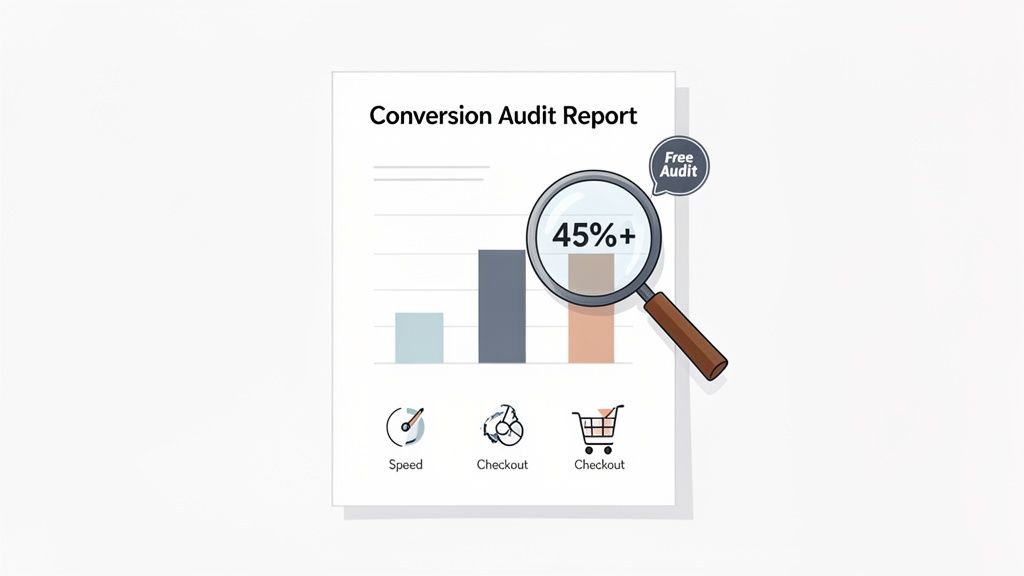
Offering a free, high-value service is one of the most effective ways to generate qualified leads. Store audit or conversion opportunity ads are some of the best ads on Facebook because they directly address a core pain point for eCommerce merchants: underperformance. This lead magnet format exchanges a free, expert analysis of a potential client's Shopify store for their contact information, creating a direct path to a sales conversation.
Instead of a generic guide, this ad offers a personalized assessment, making the perceived value extremely high. Headlines like "Free Shopify Store Conversion Audit (Valued at $500)" or "Discover Your Conversion Rate Optimization Gaps" immediately capture attention. The low commitment of a "free audit" overcomes initial resistance and attracts store owners who are actively looking for ways to improve their bottom line.
How to Implement This Strategy
To maximize lead quality and conversion, your audit ads must build trust and clearly demonstrate value. A well-executed campaign can become a consistent source of high-intent prospects.
- Show, Don't Just Tell: Include a sneak peek of the audit in your ad creative. A visual showing 1-2 specific findings (e.g., "Slow page speed is costing you 15% of mobile sales") makes the offer tangible and credible.
- Segment by Platform: Target your ads based on the eCommerce platform. An ad specifically mentioning "Shopify Store Audit" will perform better with Shopify merchants than a generic "eCommerce Audit" ad.
- Build Trust on the Landing Page: Your lead form page should include security badges and social proof to reassure users about sharing their information. A high-value offer can sometimes seem too good to be true, so trust signals are essential.
- Retarget Incomplete Forms: Many users will start the form but not finish. Create a retargeting audience of these individuals and serve them ads that address common objections or reiterate the value of the free audit.
- Follow Up with Speed and Value: The speed of your follow-up is critical. Contact leads within 24 hours with their audit findings to maintain momentum. This immediate response is a key part of building a powerful eCommerce digital marketing strategy and turning a lead into a client.
5. Industry-Specific Pain Point Ads
Generic marketing messages fall flat. Industry-specific pain point ads are some of the best ads on Facebook because they speak directly to the unique challenges of a particular eCommerce vertical. Instead of offering a one-size-fits-all solution, you show a deep understanding of a niche's specific problems, positioning your brand as a specialist rather than a generalist. This high degree of personalization boosts relevance and makes potential clients feel understood.
For an eCommerce agency, this approach is extremely powerful. You can run an ad for fashion brands with the headline, "Tired of High Return Rates Eating Your Margins?" or one for beauty brands asking, "Struggling to Increase Repeat Purchases for Your Cosmetics Subscription Box?" By calling out a specific, known frustration, you immediately capture the attention of founders and marketers in that space and present yourself as the expert who can solve it.
How to Implement This Strategy
To execute this effectively, you need to combine deep industry research with hyper-targeted creative and messaging.
- Research Key Verticals: Identify your top 5-7 client verticals. Dig into their common obstacles, industry jargon, and performance benchmarks. Create ads that address distinct pain points like cart abandonment in fashion or checkout friction for food delivery integrations.
- Use Niche-Specific Creative: Your ad's visuals must match the industry. Use imagery, color schemes, and even fonts that are appropriate for the vertical you’re targeting, whether it's high-end home goods or a fast-growing beverage brand.
- Highlight Relevant Integrations: Mention specific Shopify apps or platform integrations that are popular within that vertical. For example, an ad for a beauty brand could reference how you optimize subscription flows using Recharge or Bold Subscriptions.
- Create Dedicated Landing Pages: Don't send traffic from a fashion-focused ad to a generic homepage. Direct them to a dedicated landing page that continues the conversation about solving fashion-specific challenges, complete with a relevant case study.
- Test Different Pain Point Angles: Within a single vertical, test ads that focus on different business goals. You might find that ads about improving conversion rates outperform those about customer retention, or vice versa, allowing you to refine your messaging.
6. Behind-the-Scenes Team/Culture Ads
People buy from people, not faceless corporations. Behind-the-scenes (BTS) ads humanize your brand by showing the real individuals behind your success. This casual, authentic video content, featuring your team working, celebrating milestones, or explaining processes, builds a strong emotional connection. For eCommerce founders looking for a partner, these ads cut through the noise of a commodity market by showcasing the culture and expertise they’ll be working with.
This format is one of the best ads on Facebook for building trust and likability before a prospect even visits your website. Snippets of a daily standup, a designer explaining their creative process, or the team celebrating a client win make your agency feel more accessible and genuine. It shows potential clients that they aren't just hiring a service; they are partnering with a dedicated group of experts who are passionate about their work.
How to Implement This Strategy
To create effective behind-the-scenes content, focus on authenticity and showing your team's personality.
- Show, Don't Just Tell: Instead of saying you have a great culture, show it. Capture candid moments from team events, strategy sessions, or even a casual conversation in the office. Genuine interactions are far more powerful than staged content.
- Spotlight Your Experts: Feature different team members each month. A short 15-second clip of an engineer explaining a technical solution or a media buyer discussing a targeting strategy positions your team as approachable authorities.
- Optimize for the Feed: Keep videos short, ideally between 15-30 seconds, to capture attention quickly. Since most users watch without audio, always include clear, bold captions to convey your message effectively.
- Subtle Social Proof: When filming in your office, naturally include elements like whiteboards with client names or logos visible in the background. This reinforces your credibility without an overt sales pitch.
- Extend the Conversation: Pair your video ad with employee testimonials in the ad comments or description. This adds another layer of social proof and gives prospects more insight into your company's values and work environment.
7. AI and Innovation Ads
Highlighting your use of artificial intelligence and new technologies can make your agency stand out. AI and innovation ads are some of the best ads on Facebook because they position your service as a modern solution for brands seeking a competitive advantage. These ads demonstrate your agency’s forward-thinking approach, attracting decision-makers who want to be at the forefront of eCommerce and are willing to invest in premium, results-driven partnerships.
For eCommerce brands, the promise of automation, predictive insights, and intelligent optimization is a powerful draw. An ad that showcases how your agency uses AI to personalize customer journeys or automate conversion testing speaks directly to a merchant's core desire for efficiency and growth. It shifts the conversation from just running ads to building an intelligent, self-improving marketing engine, which is a key differentiator in a crowded market.
How to Implement This Strategy
To effectively market your AI capabilities, focus on tangible benefits and demystify the technology.
- Explain Benefits Simply: Translate complex AI functions into clear business outcomes. Instead of "machine learning algorithms," say "AI that predicts which products your customers will buy next." Focus on the "what" and "why," not just the "how."
- Show, Don't Just Tell: Use visuals to display the output of your AI tools. This could be a screenshot of a predictive analytics dashboard, a before-and-after of an AI-optimized landing page, or a graph showing improved conversion rates from intelligent A/B testing.
- Name Specific Tools: Mentioning recognized tools like ChatGPT for copy generation or Midjourney for creative development adds credibility and makes your process more transparent. It shows you are actively using current technology. You can find more detail on this topic in our guide on how to use AI in eCommerce.
- Compare Old vs. New: Create ads that directly compare traditional methods with your AI-enhanced approach. For example, "Stop guessing what ad copy works. Our AI tests 100s of variations to find the winner in half the time."
- Address Concerns Transparently: Acknowledge and address common concerns about AI, such as data privacy or potential biases. Briefly explaining your ethical framework for using these tools can build significant trust with cautious prospects.
8. Comparison/Competitor Positioning Ads
Directly addressing how your agency is different from the competition is a bold move, but it can be one of the best ads on Facebook for attracting high-intent prospects. Comparison ads help prospects make a decision by clearly laying out the advantages of your specific approach. Instead of letting potential clients guess why you’re better, you show them by positioning your service against generic agencies, freelancers, or even DIY efforts.
This format works exceptionally well for service-based businesses because it shortens the consideration phase. For an eCommerce agency, an ad comparing a "Dedicated Shopify Team" to a "Generalist Freelancer" can immediately clarify your value. The ad directly tackles common objections and highlights your unique selling propositions, such as specialized expertise or a results-based partnership model, making the choice clearer for the prospect.
How to Implement This Strategy
To create effective comparison ads without appearing aggressive, focus on your value proposition and the client's results.
- Use a Comparison Table: A simple side-by-side visual is one of the most effective formats. Create columns for "Our Approach," "Typical Agency," and "DIY," then list features like "Dedicated Growth Strategist," "Generic Account Manager," and "You do everything." This makes your advantages scannable and easy to understand.
- Focus on Approach, Not Attacks: Frame the comparison around methodology and outcomes. For example, contrast a "Results-Based Partnership" with a "Standard Hourly Retainer." This positions your model as superior without directly naming or disparaging a competitor.
- Highlight Specific Proof: Back up your claims with data. If you state you offer superior results, include a metric like, "Our partners see a 40% average revenue lift in 90 days." This adds credibility to your positioning. To stay ahead in the competitive landscape, it is essential to explore cutting-edge approaches like Mastering Facebook AI Ads to deliver such measurable outcomes.
- Add a Guarantee: Reduce perceived risk for prospects on the fence. Including a risk-reversal element, such as a performance guarantee or a satisfaction promise, can be a powerful final push to encourage them to book a call.
- Target High-Intent Audiences: Run these ads to remarketing audiences who have visited your site or engaged with other content. You can also target users based on interests related to competitor brands or software they might be using.
9. User-Generated Content (UGC) and Client Wins Ads
User-generated content (UGC) and client win ads shift the spotlight from your brand to your customers' success. These are some of the best ads on Facebook because they use authentic, third-party validation to build immense credibility. Instead of crafting your own marketing message, you showcase real screenshots of revenue growth, celebratory social media posts from clients, or even glowing emails that highlight their satisfaction. This approach creates powerful social proof at scale, showing potential customers what's possible when they partner with you.
For an eCommerce agency, this could be a screenshot of a client’s Shopify dashboard showing a record sales day or a LinkedIn post from a founder thanking your team for their partnership. These candid moments feel more genuine and trustworthy than any polished corporate ad. The raw, unfiltered nature of UGC cuts through the noise of a busy feed, grabbing attention with verifiable proof of your impact.
How to Implement This Strategy
A systematic process for collecting and deploying client content is key to making this strategy work.
- Ask for Permission Upfront: When you onboard a new client, include a clause in your agreement or a separate consent form that grants you permission to use their brand name, results, and testimonials in your marketing materials.
- Create a Collection System: Don't wait for wins to happen. Actively collect positive feedback. Create a dedicated Slack channel or a shared folder where your team can save screenshots of client wins, positive emails, and social media mentions as they occur.
- Offer Incentives for Sharing: Encourage clients to share their success stories publicly by offering a small bonus, a discount on their next month's service, or a free strategy session. This makes them active participants in your marketing.
- Tag and Credit Clients: When you post a client's win on social media, always tag their business page and the founder. This not only gives them credit but also amplifies the post's reach to their own network, further validating the partnership.
- Rotate Content Monthly: Keep your ad creative fresh by showcasing a diverse range of client results. Rotate the UGC you feature every month to prevent ad fatigue and demonstrate your ability to deliver results across different industries and business sizes.
10. Educational Webinar and Workshop Ads
Educational content is a powerful way to establish your brand as a trusted authority. Ads that promote free or paid webinars and workshops on relevant topics like ‘Mastering Shopify Conversion Rate Optimization’ or ‘Building Your eCommerce Tech Stack’ are some of the best ads on Facebook for generating high-quality leads. This approach moves beyond a direct sales pitch, offering genuine value upfront to attract a more engaged and qualified audience.
For agencies and service providers, this format is exceptionally effective. By teaching a valuable skill or sharing exclusive industry insights, you attract merchants who are actively seeking solutions. A free webinar on a topic like ‘5-Step Shopify Conversion Audit Process’ not only demonstrates your expertise but also captures leads who have self-selected as being interested in conversion rate optimization, making the follow-up conversation much warmer.
How to Implement This Strategy
To maximize registrations and lead quality, your webinar promotion requires a strategic approach from the ad creative to the post-event follow-up.
- Emphasize Unique Insights: Your ad copy must clearly state what attendees will learn that they can't find elsewhere. Use phrases like "exclusive data" or "our proven framework" to create urgency and highlight value.
- Showcase Speaker Credentials: Build credibility by including photos and brief bios of the speakers. Highlighting their experience, such as "Ex-Shopify Plus Strategist," adds significant weight and encourages sign-ups.
- Offer Replay Access: Many potential leads have scheduling conflicts. Mentioning that a replay will be available to all registrants can significantly boost your sign-up rate, as it removes the barrier of live attendance.
- Repurpose All Content: A one-hour webinar is a content goldmine. Record the session and slice it into short video clips for social media, create a summary blog post, and design an infographic with key statistics. This multiplies the ROI of your initial effort.
- Include a Clear, Low-Pressure CTA: During the webinar, your call to action should feel like a natural next step, not a hard sell. Offer a free consultation, a resource download, or an audit to guide interested attendees deeper into your funnel.
Top 10 Facebook Ads Comparison
| Item | Implementation Complexity 🔄 | Resource Requirements ⚡ | Expected Outcomes 📊 | Ideal Use Cases 💡 | Key Advantages ⭐ |
|---|---|---|---|---|---|
| Video Testimonials and Case Studies | Medium | Moderate video production + client participation | High credibility and conversions; est. 3–5x ROAS | Mid/bottom-funnel social proof for agency selection | Builds trust quickly; strong engagement on social |
| Educational Carousel Ads | Medium–High | Higher creative/design time for multi-card assets | Medium–High lead gen & engagement; est. 2–4x ROAS | Top/mid-funnel education and list-building | Establishes thought leadership; higher CTRs |
| Dynamic Product/Service Carousel with Pricing | Medium | Requires pricing updates, targeting per tier | High conversion intent; est. 2–6x ROAS | Consideration/bottom-funnel buyers comparing packages | Transparency reduces friction; self-selection by buyers |
| Store Audit / Conversion Opportunity Ads | Medium–High | Audit team time and operational bandwidth | Very high qualified leads; est. 4–8x ROAS | Lead capture for demos and sales conversations | Generates sales-ready leads and strong segmentation |
| Industry-Specific Pain Point Ads | High | Industry research + many creative variants | High relevance and conversion per vertical; est. 3–5x ROAS | Niche vertical targeting and specialist positioning | Higher engagement and better-qualified leads |
| Behind-the-Scenes Team / Culture Ads | Low–Medium | Low production; steady content cadence | Medium awareness/consideration; est. 1.5–3x ROAS | Brand humanization and employer-branding efforts | Humanizes agency; builds emotional connection |
| AI and Innovation Ads | Medium | Subject-matter expertise + case examples | High positioning/awareness; est. 2–4x ROAS | Attract tech-forward brands and justify premium pricing | Differentiates as cutting-edge; supports premium rates |
| Comparison / Competitor Positioning Ads | Medium | Careful messaging, proof points, legal review | Very high conversion for high-intent prospects; est. 4–7x ROAS | Bottom-funnel prospects comparing agency options | Accelerates decision-making; addresses objections directly |
| UGC and Client Wins Ads | Medium | Processes to collect client content + permissions | Very high trust and conversions; est. 4–8x ROAS | Social proof campaigns and organic amplification | Most authentic credibility; low production cost |
| Educational Webinar and Workshop Ads | High | Significant prep, technical setup, speaker time | Very high-quality leads; est. 5–10x ROAS | Deep engagement, mid-funnel nurturing, sales follow-up | Establishes authority and enables long-term nurture |
From Insight to Impact: Implementing Your High-ROI Ad Strategy
You now possess a strategic playbook filled with some of the best ads Facebook offers for ambitious Shopify merchants. This collection, from UGC-driven campaigns to in-depth Educational Carousels, represents a powerful toolkit designed to move beyond generic advertising and forge genuine connections with your audience. The real art is not in copying these examples verbatim, but in understanding the why behind each one.
The common thread weaving through these high-performing ads is a deep commitment to providing value upfront. Whether it’s through an insightful Store Audit ad that diagnoses a real problem or a Behind-the-Scenes look that humanizes your brand, success hinges on putting the customer’s needs and interests first. This approach inherently builds trust, which is the foundational currency of eCommerce. Without trust, even the most technically perfect ad campaign will falter.
Charting Your Course: Actionable Next Steps
Feeling overwhelmed by the options is a natural reaction. The key is to avoid analysis paralysis and take deliberate, measured action. The goal is not to launch all ten ad types at once but to methodically test and scale what works for your specific business.
Here is a simple framework to get started:
- Identify Your Primary Goal: What is the single most important objective for your business right now? Is it generating qualified leads for a high-ticket service? Increasing Average Order Value? Or building a stronger brand identity to stand out in a crowded market?
- For Lead Generation: Start with the Store Audit/Conversion Opportunity Ad or the Educational Webinar Ad.
- For Boosting Conversions & Social Proof: Prioritize UGC and Client Wins Ads or Video Testimonials.
- For Top-of-Funnel Brand Building: Experiment with Behind-the-Scenes Team/Culture Ads or Industry-Specific Pain Point Ads.
- Establish a Testing Budget & Timeline: Dedicate a specific, manageable budget for your first test. Run the campaign for a set period, like 14-30 days, to gather enough data to make informed decisions. Don’t be discouraged if the first attempt isn't a home run; the initial goal is learning, not immediate perfection.
- Analyze, Iterate, and Scale: Once the test concludes, dive into the metrics. What worked? What didn't? Use these findings to refine your creative, copy, or targeting and then relaunch with an improved version. Successful scaling is built on a foundation of continuous iteration.
Mastering this strategic approach to Facebook advertising is what separates fleeting successes from sustainable growth. It moves you from a reactive "boost post" mentality to a proactive, system-driven engine for acquiring customers and building brand equity. The best ads Facebook can deliver for your brand are the ones born from a deep understanding of your customer, a clear strategic objective, and a relentless dedication to testing and improvement. This is how you turn advertising spend into a predictable and profitable investment.
Ready to turn these insights into measurable results and scale your Shopify store? The team at ECORN specializes in implementing the advanced strategies covered in this article, helping brands move from planning to profitable execution. We can build and manage your next high-performing campaign, ensuring your advertising efforts are effective today and prepared for tomorrow.


E Business Strategy Implementation
Conversion Tracking Setup for Shopify Stores
BigCommerce vs Shopify Plus Which Enterprise Wins in 2026
Shopify Theme Kit: Setup, Commands, and Migration Guide
Shopify Extension Development: A Practical 2026 Guide
Shopify Speed Score Explained and How to Improve It
Shopify Mobile Optimization: The 2026 Playbook
How to Add Subcategory in Shopify for Better UX
How to Implement Structured Data for Ecommerce in 2026
SEO App Mobile: Shopify Store Optimization Guide
Shopify Plus Support: What It Includes and How to Choose
Google Ads for Shopify: The Complete 2026 Playbook
Shopify New York: How to Find and Hire the Right Agency
Google Search Console for Shopify: The Complete Setup
First Party Data Collection for eCommerce Growth
FAQ Online Store Guide: Build and Measure It Right
Do FB Ads Work for eCommerce in 2026?
One Page Checkout for Shopify: Design and Implementation
Shopify GraphQL vs REST: The 2026 Developer Decision
Shopify Ecommerce Consulting: Strategy, Pricing &
Are Reddit Ads Worth It for eCommerce Brands
Shopify Title and Meta Description: A Practical 2026 Guide
Product Video Best Practices for Shopify Brands
Real-Time Inventory Management: A 2026 Guide
AI Chatbot Integration for Shopify Stores
Affiliate Program Management: A Shopify Guide
10 Best Performance Monitoring Tools for Shopify in 2026
Digital Asset Management for eCommerce Brands in 2026
Every Type of Facebook Ads Explained for eCommerce Growth
Product Information Management Explained for Shopify Brands
Support Ticket System: A Guide for Shopify Stores

10 Best Customer Service Tools for Shopify in 2026

Can I Start a Business with No Money? a 2026 Blueprint
What Sells Good on Etsy: Best Niches for 2026

Shopify Add to Cart Button: A Practical 2026 Guide

Customer Feedback Automation: A Practical eCommerce Guide
Critical Rendering Path: A Guide for Shopify Stores

How to Promote on TikTok for eCommerce in 2026

B2B eCommerce Consulting That Drives Real Revenue
10 Best Practices for Site Navigation in 2026
Return vs Refund for Shopify Stores: A Practical Guide
What Is Customer Lifetime Value and Why It Matters
What Is Voice of Customer Research for eCommerce

SMS Marketing for Ecommerce That Actually Converts

Master How to Improve Email Deliverability in 2026
Top 7 eCommerce Partners NYC for Shopify Brands in 2026
Machine Learning for Ecommerce: Boost Your Shopify Store
Beauty Market Research: Your 2026 Growth Guide
Shopify International Expansion: A 2026 Roadmap
What Does CRO Stand for in Business: Understanding CRO
Shopify Visual Merchandising: A Playbook for Higher Sales
Shopify Landing Page Design: Master Conversion in 2026
10 Best AI SEO Optimization Tools for Shopify in 2026

Agentic AI for Ecommerce: Boost Your Sales in 2026
Mastering Email Marketing Data for eCommerce Growth
Conversion Rate Optimisation Australia: Boost Your Sales
Conversion Rate Optimization AI: Your Shopify Store Guide

10 Product Bundling Strategies for Shopify in 2026
How to Increase Customer Lifetime Value: A Shopify Playbook
AI Customer Service Automation: Shopify Guide 2026
Clean Website Design: A Shopify Conversion Playbook

Omnichannel Retail Strategy: A Shopify Playbook
Product Data Enrichment: A Guide for Shopify Brands
Instagram Shopping Features a Guide for Shopify Stores
What Is Revenue Optimization: A Holistic RevOps Guide
Benefits of Conversion Rate Optimization: Boost Your
WordPress to Shopify Migration: Your 2026 Seamless Switch
Boost Sales: Ecommerce Payment Processing Guide 2026
Unified Commerce Platform: Benefits, KPIs & Shopify Guide
How to Reduce Bounce Rate eCommerce: Your 2026 Guide
Shopify API Integration: A Practical End-to-End Guide
How to Implement Data Governance: A 2026 Guide
Shopify Store Development Cost: A 2026 Breakdown
What Is Server Side Tracking: The Shopify Guide 2026
Marketing Automation Workflows: A Shopify Guide for 2026
Shopify: How to Reduce Technical Debt

Shopify UX Design Change: A Playbook for Growth
User Generated Content Strategy: Shopify Playbook
Shopify Pause and Build Plan Cost: A Complete 2026 Guide
Compare at Price on Shopify: A Complete Guide for 2026
Where Can I Sell My Prints? 10 Best Platforms for 2026
Shopify Order Management System: The Ultimate Guide 2026
What Is Marketing Attribution? an eCommerce Guide for 2026
10 Best Black Friday Sales Sheets for 2026

Discover the Top Social Media Marketing Agencies For
Consumer Confidence Definition for eCommerce in 2026
What Is Social Commerce? Your 2026 Guide to Boosting Sales
A Social Ad Campaign Playbook for eCommerce Growth
7 Best FAQ Page Examples for SaaS & eCommerce

Market Research in Fashion Industry: A Guide for Shopify
Shopify Migration Services: Expert Guide for 2026
Mastering FB Retargeting Ads for Shopify in 2026
What Is Omnichannel Ecommerce
Master Your Shopify Plus Migration: The 2026 Guide
Shopify Integration Services: A Merchant's 2026 Guide
Shopify Collection Description: A Guide to SEO & Sales
Shopify Plus Contact: Reach Sales & Support Effectively

Top Luxury Shopify Stores: Design & UX Strategies
How to Improve Customer Experience: A Shopify Roadmap
Creative Facebook Ads: 10 Examples for Shopify Brands


newsletter in your inbox