


Are your remarketing ads bringing shoppers back, or are they just repeating the same message to people who already ignored it?
That distinction decides whether remarketing becomes a profitable recovery channel or a budget leak. I see the same pattern in Shopify accounts all the time. A store launches basic cart abandonment ads, keeps the same product image and CTA for every audience, then wonders why frequency rises while conversions stall.
The problem usually is not remarketing itself. It is the lack of segmentation, message control, and creative variation. Product viewers, cart abandoners, repeat customers, and seasonal browsers should not see the same ad. They are at different levels of intent, they have different objections, and they respond to different offers.
This guide treats remarketing ad examples like a strategist would. Instead of stopping at screenshots, it breaks each source into a working playbook. For every example, the analysis focuses on the visual, the copy angle, the likely audience, the CTA that fits, the KPIs worth tracking, A/B test ideas, and one Shopify implementation tip you can use.
If you need more context on what strong paid social creative looks like before you assess remarketing specifically, review these best Facebook ad examples for ecommerce brands.
Start here if your current setup is stuck in simple product reminder mode.
1. Meta Ad Library
If you want the fastest reality check on what DTC brands are running, start with Meta Ad Library. It's free, official, and current. That matters because most blog roundups age badly. Meta's library shows what's live across Facebook, Instagram, Messenger, and Audience Network, including images, videos, carousels, headlines, primary text, CTAs, placements, and start dates.
The catch is obvious. Meta doesn't label anything as "remarketing." You have to infer intent from the creative. Still, that's usually easy enough. If you see viewed-product carousels, return-to-cart copy, review-led creatives, or offers aimed at past visitors, you're looking at remarketing patterns.
How to use it like a strategist
Search competitor brands first, then broader category terms. Look for repeated motifs, not one-off clever ads. In practice, the most useful thing in Meta Ad Library isn't inspiration. It's pattern recognition.
For remarketing ad examples, I'd pay attention to:
- Visual approach: Product close-ups, UGC, static offer cards, and carousels that mimic on-site browsing.
- Copy angle: Reminder, objection handling, social proof, or incentive.
- Audience inference: Product viewers, cart abandoners, past customers, or category browsers.
- CTA fit: "Shop now" works for warm traffic. "Learn more" often works better when the friction is trust, sizing, or product education.
Practical rule: If the ad could also work for a cold audience, it's probably too generic for true remarketing.
Best use case for Shopify brands
Meta Ad Library is strongest when your team needs fresh creative references before a production sprint. Designers can pull layouts. Copywriters can review headline density and offer framing. Media buyers can see whether competitors lean on statics, Reels, or carousels.
For Shopify teams building paid social systems, I'd pair this research with ECORN's breakdown of the best Facebook ads for eCommerce brands. It helps translate what you're seeing in the library into formats that fit a store funnel.
The trade-off is that you won't get spend, targeting, or performance data. Use it to study message-market fit, not to guess winners with certainty.
2. Think with Google and dynamic remarketing case studies
Google's Think with Google is where I'd go when Meta gives me creative inspiration but I need a cleaner technical blueprint. The best material there tends to come from dynamic remarketing case studies. Those examples are useful because they connect feed structure, audience behavior, and ad output. That's the part many Shopify brands underbuild.

One case worth noting comes from the So Bebê Store example summarized by Overthink Group. Using Google dynamic remarketing with product-specific ads and a 30-day recency window, the retailer saw conversions rise by 89% after two months, as described in this So Bebê dynamic remarketing case summary. The underlying lesson is more important than the lift itself. When users see the exact products they viewed, decision friction drops.
What a strong Google remarketing ad usually includes
Google remarketing ad examples work best when the ad feels like a continuation of the product page, not a separate campaign. The visual should pull directly from the feed. The copy should stay tight and supportive.
A solid setup usually looks like this:
- Visual: Exact viewed product, clean pricing, and optional supporting products.
- Copy: Product-led, benefit-led, or urgency-led if the site experience already established trust.
- Target audience: Product viewers, cart abandoners, and category viewers segmented separately.
- CTA: "Shop now" for viewed-product audiences, "Complete purchase" for cart audiences.
The strongest dynamic remarketing ads don't try to say everything. They simply restore context.
Shopify implementation tip
If you run Shopify, feed hygiene matters as much as bidding. Titles, images, product types, sale price formatting, and availability labels all shape what the ad can become. That's why Google examples are practical. They force you to think structurally.
For merchants building this inside Google's ecosystem, ECORN's guide to Google Ads for eCommerce is a useful companion. It bridges the gap between a polished case study and an actual store setup.
The downside with Think with Google is volume. You won't get a massive swipe file of day-to-day creative variants. You get fewer examples, but they're stronger when you need implementation clarity.
3. Criteo case studies and catalog retargeting
What changes once your remarketing account has hundreds or thousands of SKUs? The job shifts from designing single ads to controlling product selection, feed quality, and recommendation logic. That is why Criteo is a useful reference point.
Their case studies are strongest for brands with real catalog depth. Apparel, home, beauty, accessories, and bundle-heavy stores usually hit the same ceiling. Manual creative decisions stop scaling, and remarketing starts behaving more like automated merchandising.
That makes Criteo different from the Google examples above. The question is not just whether the ad matches the last product view. The better question is whether the ad assembles the right product set for that shopper, in that moment, on that placement.
The playbook behind Criteo-style catalog ads
The ad format itself is usually simple. Product image. Price. Sale price if relevant. Sometimes a small strip of related items. The strategy sits underneath the layout.
A strong Criteo-style setup usually includes:
- Visual: The viewed product first, followed by substitutes, complements, or higher-margin options that still make sense for the same shopping session.
- Copy: Short and restrained. Price, offer, or a brief product cue is enough if the product mix is doing its job.
- Target audience: High-intent product viewers, multi-page category browsers, repeat visitors, and cart abandoners split into separate pools.
- Recommended CTA: "View product" for browse-stage users. "Return to cart" or "Checkout now" for cart-stage users.
- Primary KPIs: Product-level CTR, view-through revenue, return rate to product page, cart recovery rate, and revenue per thousand impressions.
- A/B test ideas: Last-viewed product only versus last-viewed plus related items, discount badge versus no badge, bestsellers versus personalized recommendations, and margin-prioritized sequencing versus relevance-prioritized sequencing.
- Shopify implementation tip: Audit your product feed before scaling spend. Product titles, image consistency, variant handling, availability status, and custom labels all affect which products can be pulled into dynamic ads and how credible those ads look.
Standard catalog retargeting often fails at this stage. The platform can only assemble good ads if the feed gives it clean inputs. If your Shopify catalog has inconsistent titles, duplicate variant images, or poor collection structure, the ads start repeating low-quality combinations and your frequency problem gets worse.
Personalized product recommendations often outperform generic reminder ads, as noted earlier. The practical takeaway is simple. Do not limit every retargeting impression to the exact item a shopper touched if your catalog gives you better options. In many accounts, the highest-return version is the product they viewed plus one adjacent item that reduces hesitation or raises average order value.
Where Criteo examples are most useful
Use Criteo as a benchmark when your remarketing needs merchandising logic. That usually means a large assortment, frequent browsing across categories, or enough traffic to support segmented product recommendations.
It is less useful for a store with ten products and a trust problem. In that situation, the bottleneck is usually offer clarity, landing page strength, or social proof, not catalog sequencing.
The trade-off with vendor case study libraries is visibility. You can usually see the outcome and the creative pattern, but not the exact feed rules, exclusion logic, or audience thresholds that produced it. Even with that limitation, Criteo is still one of the better places to study catalog retargeting as a system instead of a screenshot.
4. RTB House and deep personalization
RTB House case studies are useful when your remarketing problem isn't just creative. It's channel overlap, regional complexity, or partner duplication. Most smaller brands won't need that level of sophistication on day one, but growth-stage Shopify Plus merchants should pay attention early because messy remarketing stacks get expensive fast.

Their examples tend to frame retargeting as a personalization engine rather than just an ad tactic. That changes the creative brief. You're no longer asking, "What ad should we show?" You're asking, "What decision should the ad help this user make next?"
The advanced playbook hidden inside these examples
The strongest RTB House-style setups usually involve three disciplines working together. Audience prioritization. Creative personalization. Deduplication across channels.
For actual campaign planning, that translates into:
- Visual: Dynamic product combinations or category-led layouts aligned with intent.
- Copy: Lightweight, because personalization is already doing the relevance work.
- Target audience: Multi-touch users, repeat visitors, and cross-region segments.
- CTA: Usually product exploration or completion focused, rather than heavy discount pushes.
If two platforms are chasing the same user with the same message, your reporting may look busy while your incrementality stays weak.
That's the part many teams miss. More remarketing doesn't automatically mean more conversions. It can also mean cannibalization.
Shopify implementation tip
If you operate multiple storefronts or sell across regions, unify event naming and catalog logic before you scale media. Otherwise your dynamic ads can become fragmented fast. Product viewers from one storefront don't map cleanly to audiences in another. Recommendation logic breaks. Reporting gets noisy.
RTB House examples are strongest for operators who need to think beyond ad design and into orchestration. The limitation is that many of their case studies feature larger retailers, so you'll need to simplify the framework for a mid-market Shopify stack.
5. StackAdapt for seasonal remarketing
Need remarketing ideas for Black Friday, gifting season, or a short promotion window? StackAdapt case studies are useful because they show how timing changes campaign structure, not just ad design.

I use StackAdapt examples less for channel-specific execution and more for planning pressure-tested seasonal flows. During a sale, audience age matters more than usual. A shopper who viewed a product in the last 24 hours is reacting to a different trigger than a shopper who last visited before the offer launched. If both users get the same creative, one message will be late and the other will be premature.
That is the practical value in these examples. They force you to examine timing, merchandising, and promotional sequencing together.
What seasonal remarketing should actually change
Seasonal remarketing works best when the promotion changes the whole playbook, not just the banner.
Use each example like a teardown:
- Visual: Feature the offer clearly, but keep the product recognizable. If the sale treatment overwhelms the item, click quality usually drops.
- Copy: Match the point in the calendar. Early-season ads can sell selection. Late-season ads should stress urgency, shipping cutoffs, or last-chance availability.
- Target audience: Split by recency first, then by intent. Recent cart abandoners, recent product viewers, and past seasonal buyers should not see the same message.
- Recommended CTA: "Shop the sale," "Complete your order," or "Get it before the cutoff" usually fits better than a generic "Learn more."
- KPIs: Watch CTR, view-through conversions, conversion rate by audience window, and revenue per thousand impressions. Seasonal campaigns can look efficient on blended ROAS while wasting spend on stale visitors.
- A/B test ideas: Test 3-day versus 7-day recency pools, product-first versus offer-first creative, and urgency copy versus gift-guide framing.
- Shopify implementation tip: Build audience rules around your promo calendar before launch. Tag holiday collections, sale exclusions, and shipping deadline pages in advance so your feeds and destination URLs stay clean when the campaign goes live.
A common mistake is stretching audience duration because CPMs look cheaper at larger scale. In practice, that often pulls in low-intent users who clicked around before the seasonal offer was relevant. Broader reach can help prospecting. In remarketing, it often muddies the signal.
Best Shopify use case
Use StackAdapt-style planning if your store has clear promotional phases and enough traffic to break remarketing into smaller windows. It fits best for gifting brands, stores with multiple category pushes in one quarter, and merchants that change offers several times in a short period.
The trade-off is translation. Some case studies come from programmatic environments with controls you may not mirror exactly in Meta or Google. Treat them as strategic playbooks. Keep the audience logic, CTA timing, and merchandising sequence. Then adapt the execution to the channels you operate.
6. AdRoll and message angle planning
What should your remarketing ad say once the audience is defined?
AdRoll's article on 12 retargeting examples is useful because it helps answer that question fast. I use it as a message planning reference when a team already knows who it wants to retarget but has not decided which objection to address first.
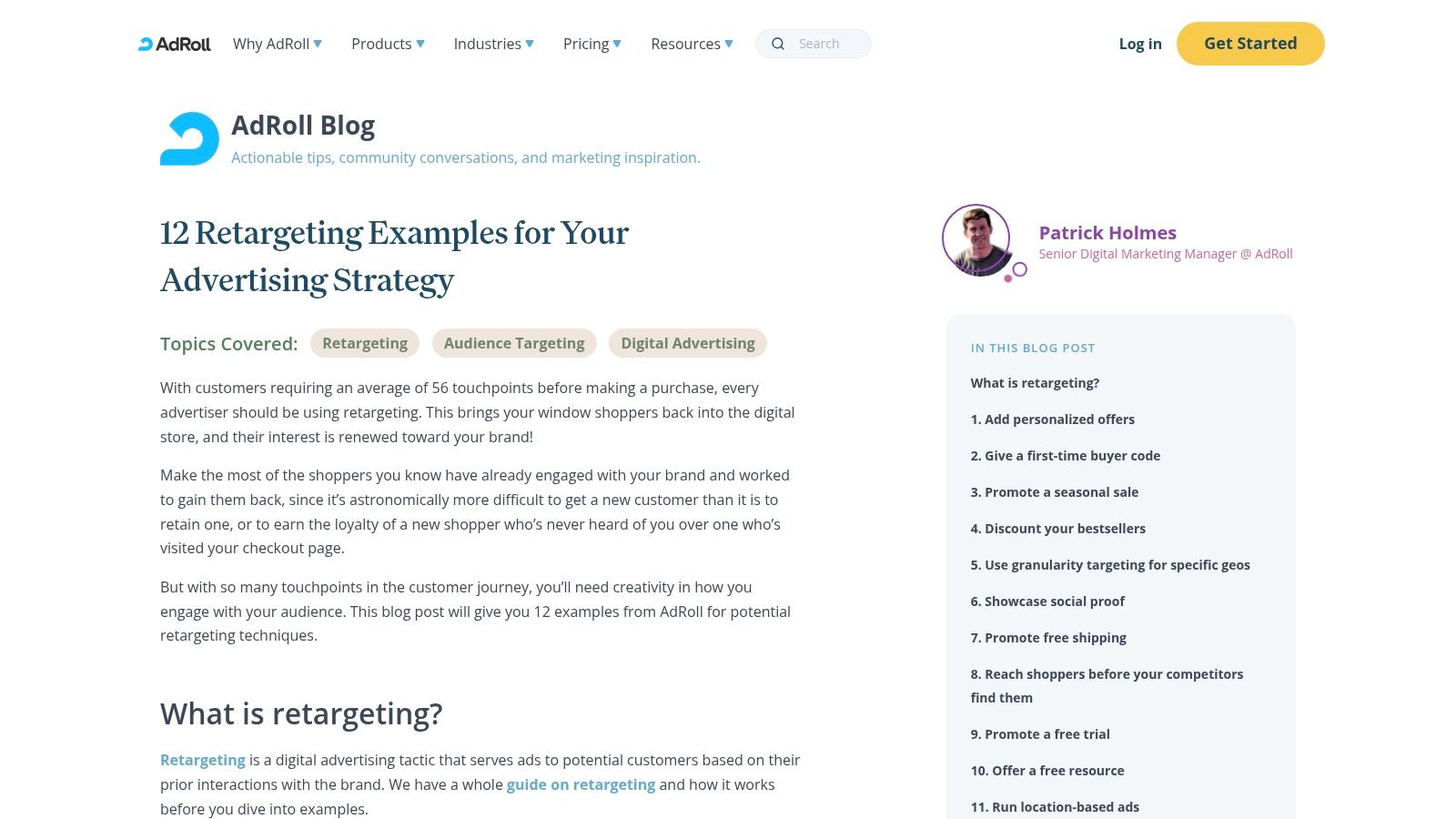
The value is not the screenshots alone. The value is the angle library behind them. AdRoll groups familiar remarketing themes such as social proof, urgency, incentives, free shipping, and first-order offers. That gives marketers a faster path from vague feedback like “performance is flat” to a real test plan with creative, copy, CTA, and audience logic.
Use the examples like a creative brief template. Match the message to the friction point.
- Trust concern: Lead with reviews, creator content, guarantees, or return policy reassurance.
- Price resistance: Test bundles, threshold-based discounts, subscribe-and-save, or value framing instead of a blanket coupon.
- Interrupted purchase: Run a simple cart reminder with the product, price, and a direct path back to checkout.
- Fulfillment hesitation: Put shipping speed, delivery estimate, or free returns in the headline.
Many Shopify brands waste spend at this stage. They segment audiences by behavior, then serve the same generic ad to everyone inside that segment. The audience setup is technically correct, but the message misses the reason the shopper stalled. A visitor who checked sizing details usually needs reassurance. A visitor who abandoned after seeing shipping costs may need delivery clarity or a threshold offer.
A simple planning question fixes a lot of this: what likely stopped this buyer from finishing?
The playbook to steal
AdRoll-style examples are most useful when you break each one into operating parts instead of treating it as inspiration. For each ad concept, define the visual, copy angle, target audience, CTA, KPI, and one test variable before design starts.
A practical setup looks like this:
- Visual: Show the exact product for cart and product viewers. Use lifestyle or UGC for trust-focused ads.
- Copy: Keep one message angle per ad. Do not mix urgency, social proof, shipping, and discounts into the same unit.
- Target audience: Tie each angle to a behavior. Size guide viewers, return policy visitors, cart abandoners, and repeat customers should not get the same pitch.
- Recommended CTA: Use “Complete purchase” for cart recovery, “See reviews” for trust-building, and “Shop bundle” or “Get free shipping” for value-driven offers.
- KPIs: Track click-through rate, conversion rate by audience segment, checkout completion rate, and revenue per impression.
- A/B test ideas: Test review-led headlines versus shipping-led headlines, product image versus UGC, and direct CTA versus softer education-first CTA.
Shopify implementation tip
Build audiences around friction signals, not only around page depth. Cart and product page visitors are the baseline. The better move is to create separate pools for shoppers who viewed the shipping policy, returns page, FAQ, or size guide, then feed each group a message that answers the likely objection.
The trade-off is scale. Highly specific audiences often produce better message match, but they can get small fast, especially for lower-traffic stores. In that case, combine related friction signals into one ad set, but keep the creative angle tight. Shipping and returns can live together. Price resistance and trust concerns usually should not.
7. HawkSEM and plain-English campaign ideas
What should a team study when it needs remarketing ideas fast, but does not want to sort through hundreds of screenshots with no context?
HawkSEM's retargeting ad examples article is useful because it translates campaign strategy into plain language. I recommend resources like this when a Shopify team already understands the channels, but needs clearer campaign angles for each audience before building creative.
Planning discipline provides the primary value here. HawkSEM organizes ideas around audience intent, which makes it easier to turn a broad example into an actual launch brief. That matters more than it sounds. A lot of remarketing underperforms because the ad account has audiences, but no message system behind them.
Use that framing as a working playbook:
- Visual: Match the asset to the buying moment. Product viewers usually respond best to the specific item, category collage, or a short explainer visual. Cart abandoners need cleaner conversion-focused creative with fewer distractions. Past buyers often need a fresh product set, not the same hero image they already bought from.
- Copy: Write in plain English. Lead with the reason to return, such as product benefit, restock timing, or offer clarity. If the line sounds like brand copy instead of sales copy, tighten it.
- Target audience: Split audiences by commercial intent, not just recency. Viewed product, started checkout, purchased once, and purchased multiple times should each have different ad logic.
- Recommended CTA: Use “View product” for warmer browsers, “Finish checkout” for abandoners, and “Shop again” or “See new arrivals” for existing customers.
- KPIs: Watch click-through rate, view-through assisted conversions, cost per returning customer, and revenue by audience tier.
- A/B test ideas: Test product-led creative against offer-led creative for cart abandoners. Test same-product reminder ads against complementary product ads for recent buyers. Test shorter copy against objection-handling copy for high-consideration products.
The trade-off is depth versus immediacy. HawkSEM gives teams usable campaign directions quickly, but it is still a curated article, not a live ad database. That means it works best for briefing, message mapping, and first-round test planning, not competitor monitoring.
Shopify implementation tip
Turn these ideas into a simple audience-to-creative matrix before you build ads in Meta or Google. One row per audience. One message angle. One CTA. One success metric.
For example, a store selling supplements might map recent product viewers to education-led ads, cart abandoners to subscription or shipping-friction ads, and past customers to replenish-by-window campaigns based on expected usage cycle. A fashion store might use the same structure but swap in new arrivals, size-confidence messaging, and category cross-sells.
That structure keeps testing clean. It also prevents the common mistake of writing one generic remarketing ad and forcing every audience through it.
Comparison of 7 Remarketing Ad Examples
| Resource / Tool | Implementation Complexity 🔄 | Resource Requirements & Setup ⚡ | Expected Outcomes / Impact 📊 | Ideal Use Cases 💡 | Key Advantages ⭐ |
|---|---|---|---|---|---|
| Meta Ad Library (official) | Low, searchable UI; API optional | Low, free access; API needs basic dev work | Inspiration-focused: current creatives, formats; no performance data | Benchmarking competitors' creatives; eCommerce creative sourcing | Official, free, continuously updated; broad creative formats |
| Think with Google – Dynamic Remarketing Case Studies | Medium, study + adapt technical notes | Moderate, requires feed/tag and Google setup knowledge | Actionable ROAS/ROI examples and implementation blueprints | Planning Google Display/Performance Max dynamic remarketing | Authoritative case studies linking creative to technical best practices |
| Criteo Case Studies – Dynamic Retargeting | Medium, vendor-specific workflows | Moderate to high, catalog integration and vendor collaboration | Demonstrates uplift from catalog-driven ads and social placements | Catalog-heavy Shopify stores and multi-SKU retailers | Shows multi-platform delivery and sequencing tied to catalogs |
| RTB House – Retargeting Case Studies | High, advanced personalization & optimization | High, enterprise data, deep‑learning integration | Focus on incrementality, revenue lift, deduplication strategies | Large/multi-region retailers seeking scale and incrementality | Deep-learning personalization and partner deduplication insights |
| StackAdapt – Dynamic Retargeting Case Studies | Medium–High, programmatic specifics | Moderate to high, DSP/programmatic setup and seasonal planning | Practical seasonal/low-funnel results; ties spend to revenue | Seasonal campaigns (BFCM), programmatic retargeting strategies | Concrete dynamic executions and attribution-focused tactics |
| AdRoll – “12 Retargeting Examples” | Low, guided examples and templates | Low, vendor guidance; easy-to-translate tactics | Practical messaging and creative do's/don'ts; illustrative (not live) | Briefing designers/copywriters; starter retargeting playbooks | Actionable checklist-style guidance for creatives and messaging |
| HawkSEM – Retargeting Ad Examples | Low–Medium, plain-English playbook | Low, platform-agnostic tips, updated guidance | Platform-agnostic creative ideas and sequencing; few hard metrics | Fast ideation, CRO-aligned messaging, cross-platform briefs | Actionable, current, and easy to implement across channels |
From Examples to Execution: Your Remarketing Playbook
What separates a remarketing ad that recovers revenue from one that just burns impressions?
Execution. The seven sources above are useful because each one points to a different part of the system. Meta Ad Library helps you study live creative in your category. Think with Google is more useful for feed logic and dynamic product delivery. Criteo shows what strong merchandising-led retargeting looks like. RTB House is valuable once personalization, scale, and reporting overlap start getting messy. StackAdapt helps with seasonal timing and programmatic planning. AdRoll is strong for message angle mapping. HawkSEM is good for turning broad ideas into plain-English campaign briefs your team can build.
The practical mistake is copying the ad and skipping the operating model behind it. A good example is not just a screenshot. It is a playbook. Look at the visual, then ask what job it is doing. Is it rebuilding trust, creating urgency, surfacing the right SKU, or reducing choice? Review the copy the same way. Is it answering a price objection, a shipping concern, or simple hesitation? Then pair that with the audience, CTA, KPI, test plan, and Shopify setup required to make the ad perform in the actual account.
For Shopify brands, this is usually where results split. Stores with clean product data, clear exclusion rules, and useful audience windows can run dynamic remarketing without wasting spend. Stores with messy feeds, weak segmentation, and generic copy usually end up showing the wrong product to the wrong person at the wrong time.
A category browser needs a different ad from a cart abandoner. A past purchaser needs a different message from a first-time visitor. A shopper who viewed the same product three times may need social proof or a shipping incentive. A shopper who bounced after seeing the cart may need a simpler CTA and fewer distractions.
That is the framework I would use to turn these examples into campaigns:
Use the visual pattern with a purpose. If the source example wins with product-led imagery, test whether your audience also responds to product-first creative or whether UGC-style framing lowers hesitation better.
Rewrite the copy around one objection. Do not stack discount, scarcity, reviews, and shipping into one ad unless you have already tested that combination. Cleaner messages are easier to diagnose.
Match the CTA to intent. "Shop now" works for warm product viewers. "Complete your order" fits cart abandoners. "See what's new" can work better for past purchasers than another hard-sell conversion prompt.
Pick one primary KPI per sequence. For some audiences, that is click-through rate. For others, it is view-through assisted revenue, return rate, or cost per returning visitor. If every ad is judged by the same metric, the account usually drifts toward bad creative decisions.
Set up one A/B test at a time. Test creative angle before offer. Test CTA before format. Test audience window before frequency cap. If three things change at once, the result is hard to trust.
Tie the campaign back to Shopify operations. Make sure your product titles are usable in ads, out-of-stock items are excluded quickly, collections map cleanly to audience behavior, and repeat-purchase products have their own post-purchase remarketing flow.
As noted earlier, remarketing works because relevance is higher, not because the tactic itself is special. Timing, message match, and feed quality do the heavy lifting.
If you are building this for a Shopify store, the goal is to connect campaign logic across feed setup, segmentation, creative, and landing-page experience. That is the work a partner like ECORN can support. For broader founder education, this roundup of digital resources for Indian women entrepreneurs is also worth saving.
If you want remarketing that does more than recycle product ads, ECORN can help build the full system behind it. That includes Shopify feed setup, creative testing frameworks, audience segmentation, and CRO improvements that make your paid traffic convert instead of leak.



What Is AI Integration for eCommerce

How to Choose the Right eCommerce Website Development Firm
E Business Strategy Implementation
Conversion Tracking Setup for Shopify Stores
BigCommerce vs Shopify Plus Which Enterprise Wins in 2026
Shopify Theme Kit: Setup, Commands, and Migration Guide
Shopify Extension Development: A Practical 2026 Guide
Shopify Speed Score Explained and How to Improve It
Shopify Mobile Optimization: The 2026 Playbook
How to Add Subcategory in Shopify for Better UX
How to Implement Structured Data for Ecommerce in 2026
SEO App Mobile: Shopify Store Optimization Guide
Shopify Plus Support: What It Includes and How to Choose
Google Ads for Shopify: The Complete 2026 Playbook
Shopify New York: How to Find and Hire the Right Agency

Google Search Console for Shopify: The Complete Setup
First Party Data Collection for eCommerce Growth
FAQ Online Store Guide: Build and Measure It Right
Do FB Ads Work for eCommerce in 2026?
One Page Checkout for Shopify: Design and Implementation

Shopify GraphQL vs REST: The 2026 Developer Decision
Shopify Ecommerce Consulting: Strategy, Pricing &

Are Reddit Ads Worth It for eCommerce Brands
Shopify Title and Meta Description: A Practical 2026 Guide

Product Video Best Practices for Shopify Brands
Real-Time Inventory Management: A 2026 Guide

AI Chatbot Integration for Shopify Stores
Affiliate Program Management: A Shopify Guide
10 Best Performance Monitoring Tools for Shopify in 2026
Digital Asset Management for eCommerce Brands in 2026
Every Type of Facebook Ads Explained for eCommerce Growth
Product Information Management Explained for Shopify Brands
Support Ticket System: A Guide for Shopify Stores

10 Best Customer Service Tools for Shopify in 2026

Can I Start a Business with No Money? a 2026 Blueprint

What Sells Good on Etsy: Best Niches for 2026

Shopify Add to Cart Button: A Practical 2026 Guide

Customer Feedback Automation: A Practical eCommerce Guide
Critical Rendering Path: A Guide for Shopify Stores

How to Promote on TikTok for eCommerce in 2026

B2B eCommerce Consulting That Drives Real Revenue
10 Best Practices for Site Navigation in 2026
Return vs Refund for Shopify Stores: A Practical Guide
What Is Customer Lifetime Value and Why It Matters
What Is Voice of Customer Research for eCommerce

SMS Marketing for Ecommerce That Actually Converts

Master How to Improve Email Deliverability in 2026

Top 7 eCommerce Partners NYC for Shopify Brands in 2026
Machine Learning for Ecommerce: Boost Your Shopify Store

Beauty Market Research: Your 2026 Growth Guide

Shopify International Expansion: A 2026 Roadmap
What Does CRO Stand for in Business: Understanding CRO

Shopify Visual Merchandising: A Playbook for Higher Sales

Shopify Landing Page Design: Master Conversion in 2026
10 Best AI SEO Optimization Tools for Shopify in 2026

Agentic AI for Ecommerce: Boost Your Sales in 2026
Mastering Email Marketing Data for eCommerce Growth

Conversion Rate Optimisation Australia: Boost Your Sales
Conversion Rate Optimization AI: Your Shopify Store Guide

10 Product Bundling Strategies for Shopify in 2026
How to Increase Customer Lifetime Value: A Shopify Playbook
AI Customer Service Automation: Shopify Guide 2026

Clean Website Design: A Shopify Conversion Playbook

Omnichannel Retail Strategy: A Shopify Playbook
Product Data Enrichment: A Guide for Shopify Brands
Instagram Shopping Features a Guide for Shopify Stores
What Is Revenue Optimization: A Holistic RevOps Guide

Benefits of Conversion Rate Optimization: Boost Your
WordPress to Shopify Migration: Your 2026 Seamless Switch
Boost Sales: Ecommerce Payment Processing Guide 2026
Unified Commerce Platform: Benefits, KPIs & Shopify Guide
How to Reduce Bounce Rate eCommerce: Your 2026 Guide
Shopify API Integration: A Practical End-to-End Guide
How to Implement Data Governance: A 2026 Guide
Shopify Store Development Cost: A 2026 Breakdown
What Is Server Side Tracking: The Shopify Guide 2026
Marketing Automation Workflows: A Shopify Guide for 2026
Shopify: How to Reduce Technical Debt

Shopify UX Design Change: A Playbook for Growth
User Generated Content Strategy: Shopify Playbook
Shopify Pause and Build Plan Cost: A Complete 2026 Guide
Compare at Price on Shopify: A Complete Guide for 2026
Where Can I Sell My Prints? 10 Best Platforms for 2026
Shopify Order Management System: The Ultimate Guide 2026
What Is Marketing Attribution? an eCommerce Guide for 2026
10 Best Black Friday Sales Sheets for 2026

Discover the Top Social Media Marketing Agencies For
Consumer Confidence Definition for eCommerce in 2026
What Is Social Commerce? Your 2026 Guide to Boosting Sales
A Social Ad Campaign Playbook for eCommerce Growth

7 Best FAQ Page Examples for SaaS & eCommerce

Market Research in Fashion Industry: A Guide for Shopify
Shopify Migration Services: Expert Guide for 2026
Mastering FB Retargeting Ads for Shopify in 2026
What Is Omnichannel Ecommerce
Master Your Shopify Plus Migration: The 2026 Guide
Shopify Integration Services: A Merchant's 2026 Guide
Shopify Collection Description: A Guide to SEO & Sales

Shopify Plus Contact: Reach Sales & Support Effectively

Top Luxury Shopify Stores: Design & UX Strategies


newsletter in your inbox