


A lot of brands reach the same point at the same time. Revenue is up. Paid traffic is working. Email is pulling its weight. Operations are stretched, but in a manageable way. Then the storefront starts acting like the weakest part of the business.
The symptoms are familiar. A flash sale creates tension instead of confidence. International expansion turns into duplicate storefront hacks and app workarounds. The team keeps adding tools for subscriptions, search, bundles, B2B, reviews, and inventory sync, but each new app makes the stack harder to reason about. Simple changes take too long because nobody wants to break checkout, customer accounts, or theme logic that depends on three different integrations.
That's usually when the conversation shifts from “we need a Shopify developer” to “we need someone who can architect this properly.” That distinction matters. A modern shopify plus developer isn't there just to tweak templates or install apps. The role is closer to a technical architect for commerce. Someone who can decide what should be native, what should be custom, what should be automated, and what should be removed before it becomes a scaling problem.
Your Brand Is Growing Fast Is Your Store Ready
A common scenario looks like this. A brand started on standard Shopify with a sensible setup, a premium theme, and a handful of apps. That worked when the business had one market, one customer type, and a straightforward catalog.
Then the business changed.
Now there are regional pricing questions, wholesale requirements, shipping exceptions, and marketing campaigns that demand more from the storefront than the original setup was built to handle. The team is no longer asking for cosmetic changes. They need the store to support operations, merchandising, fulfillment, and retention without creating friction across every department.

That's where many growing brands make the wrong hiring decision. They keep buying point solutions for platform-level problems. An app gets added to solve B2B pricing. Another app handles workflows. Another one patches reporting gaps. Another one tries to coordinate stock or customer data with an ERP or PIM. The result is a store that technically works, but only because the team tiptoes around its weak points.
A stable store isn't the same as a scalable store. Stable means it survives today. Scalable means the next phase of growth won't force a rebuild.
A Plus build changes the question. Instead of asking how to make one storefront do everything through theme logic and app overlays, the better question is how to design commerce infrastructure that matches the business model. That might mean multiple stores, native B2B structures, workflow automation, or a cleaner integration architecture.
If you're already seeing operational friction between your storefront, back office, and growth roadmap, you're not looking for a coder. You're looking for technical judgment.
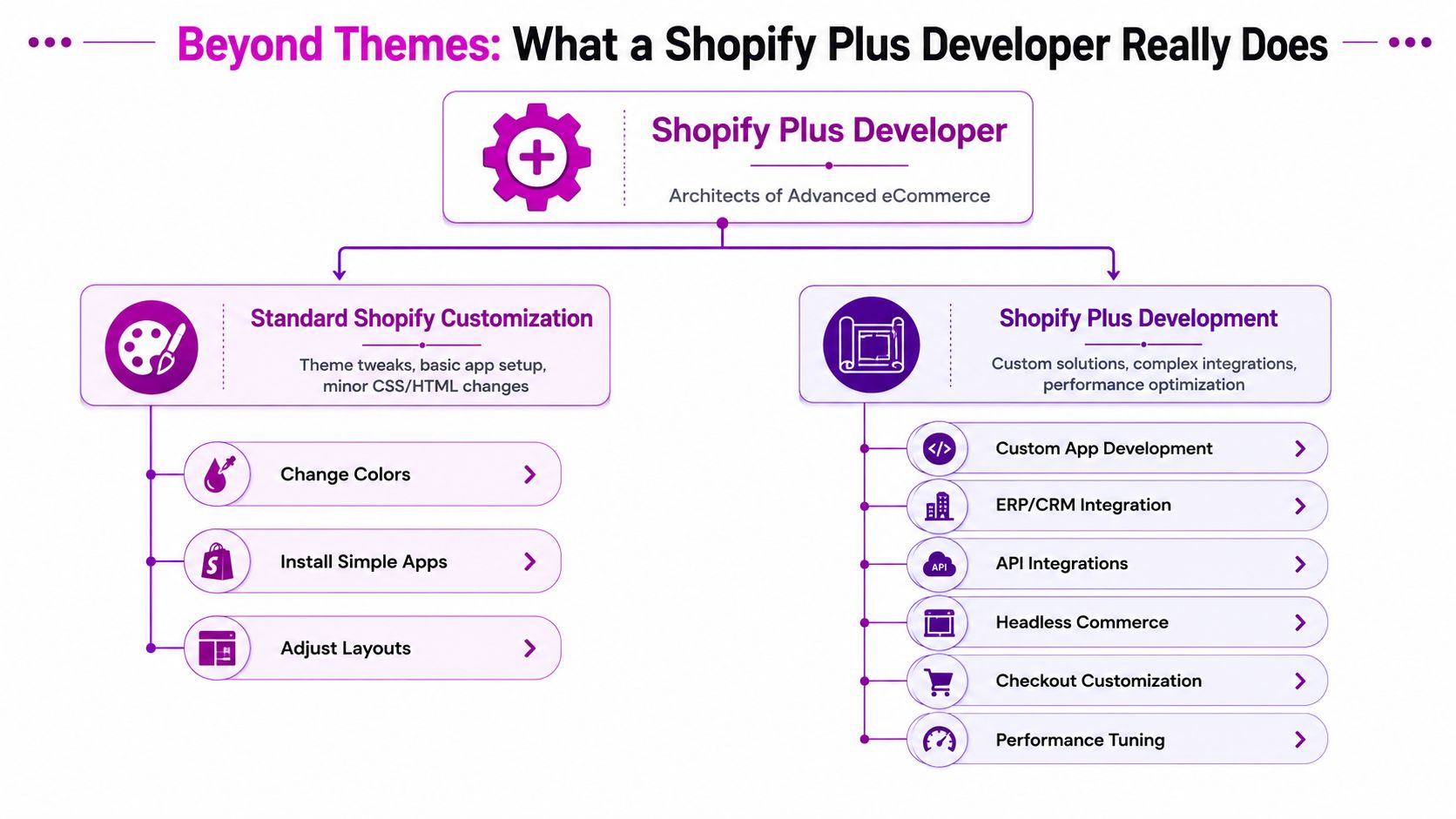
Beyond Themes What a Shopify Plus Developer Really Does
A growing brand usually feels the difference before it can name it. The storefront still looks fine, but new requirements start colliding with each other. Wholesale pricing affects merchandising. International expansion affects tax, inventory, and fulfillment logic. A checkout change depends on app behavior that no one fully owns. At that point, theme development stops being the main problem.
A shopify plus developer handles the store as a commerce system, not just a website. The work includes store architecture, systems integration, checkout extensibility, data flow, and performance under real operational load. The goal is simple. Build a setup the business can keep using as complexity increases, instead of patching short-term fixes until a replatform becomes unavoidable.
Shopify Plus has matured into a serious enterprise option. TechnologyChecker's BuiltWith-based reporting states that Shopify Plus grew from a single detected domain in 2015 to more than 30,619 active domains by mid-2025, with some estimates putting total users above 60,000. That matters because brands are no longer using Plus only for better design control. They are using it for multi-store operations, B2B models, international storefronts, and backend coordination that has to hold up across finance, support, and fulfillment.
The job starts with architecture
The strongest Plus developers begin with operating reality. They map the business model to platform constraints and decide where each piece of logic should live.
That usually means answering questions like these before implementation starts:
- Store structure: One storefront, regional stores, expansion stores, or a combined DTC and B2B setup?
- System ownership: Does Shopify own pricing and product data, or does the ERP, PIM, or custom middleware own it?
- Checkout behavior: What belongs in Shopify's extensibility framework, and what needs an app or external service?
- Failure handling: If an ERP sync fails or a webhook arrives late, what breaks first and how does the team recover?
Those decisions shape cost, speed, and risk for years. Theme work can be revised. Bad architecture usually gets paid for every day through manual workarounds, brittle integrations, and reporting nobody trusts.
For brands comparing implementation scope, our breakdown of Shopify Plus development services shows how those architecture choices connect directly to growth priorities.
Here's the practical difference in responsibility:
| Work type | Standard Shopify developer | Shopify Plus developer |
|---|---|---|
| Theme edits | Common | Common |
| App setup | Common | Common, with tighter review of long-term impact |
| Checkout architecture | Limited | Core responsibility |
| ERP or PIM integration strategy | Occasional | Core responsibility |
| Multi-store planning | Rare | Frequent |
| B2B data modeling | Rare | Frequent |
| Performance budgets and resilience | Sometimes | Expected |
A short overview helps illustrate the shift in responsibilities:
The role has moved beyond theme edits
Shopify's platform direction has pushed Plus work toward extensions, APIs, and modular implementation patterns. In practice, that changes the developer's role from page customizer to technical architect.
A mature Plus build treats front-end work as only one layer. Pricing rules, customer segmentation, subscriptions, B2B permissions, fulfillment events, and reporting dependencies often belong outside the theme. Putting too much logic into Liquid, app blocks, or disconnected apps creates a store that is difficult to test, difficult to maintain, and expensive to change.
A useful rule applies here.
If a requirement touches pricing, permissions, checkout behavior, or cross-system data, treat it as an architecture decision first.
That is what a modern Shopify Plus developer really does. They reduce structural risk, choose patterns the business can sustain, and help the store scale without forcing another platform decision two years later.
Core Services That Drive Enterprise Growth
The easiest way to understand a shopify plus developer is to look at the business problems they solve. Not as a list of technical tasks, but as the services that remove growth bottlenecks.
Migration without operational damage
A migration isn't just a content move. It's a business continuity project.
When a brand moves from Magento, WooCommerce, BigCommerce, or a heavily customized Shopify setup, the risk sits in the details. Product data is messy. Customer records don't map cleanly. Historical orders matter for support, finance, and retention. Redirects, tagging logic, subscriptions, and fulfillment rules all have dependencies.
Shopify's own Plus launch guidance reflects that enterprise reality by recommending import of orders from the past 2 to 5 years during a Plus launch in its Plus launch checklist. That tells you what kind of implementations Plus is built for. This is not a “spin up a nice new theme over the weekend” platform motion.
A strong migration plan usually includes:
- Data mapping: Products, variants, collections, customers, orders, gift cards, and metadata need explicit ownership and transformation rules.
- SEO preservation: Redirect strategy, collection paths, canonical consistency, and content parity need to be handled before launch.
- Parallel validation: Teams should test order flow, refunds, tax handling, shipping logic, and downstream integrations before cutover.
Customization that reduces app sprawl
Most brands don't need more customization. They need better customization.
That usually means choosing native platform capabilities before layering on more third-party logic. Shopify Plus gives developers more room to do that. Elogic's breakdown of Plus capabilities points to up to nine expansion stores, higher API rate limits, Shopify Flow, and native B2B tools including Companies, Catalogs, Price Lists, Payment Terms, and buyer-role management.
Those features matter because they replace a lot of brittle workarounds.
Multi-store and international operations
International growth looks simple in strategy decks and complicated in execution. Different currencies, product mixes, tax rules, promotions, and customer expectations create edge cases quickly.
A Plus developer helps decide whether the brand needs separate stores, localized merchandising within a shared structure, or a hybrid setup. Shopify Plus supports up to nine expansion stores through the capabilities noted in the Elogic source above, which gives brands more flexibility when regional requirements aren't cleanly handled in a single storefront.
That architectural decision affects:
- Catalog control
- Operational overhead
- Reporting consistency
- Translation and localization workflows
- Promo and inventory governance
When this is designed poorly, teams duplicate effort across stores and lose visibility. When it's designed well, the business gets local control without operational chaos.
Integrations that hold up under real load
ERP, PIM, WMS, 3PL, subscriptions, search, loyalty, fraud tooling, and customer support platforms all compete for priority in a growing stack. The Plus developer's job is not to connect everything as fast as possible. It's to connect the right systems in the right direction with the right fallback behavior.
That means thinking about event timing, retries, data ownership, and what should happen when an upstream system fails.
The cleanest integration architecture usually does less than teams expect. It avoids duplicate logic, minimizes API chatter, and keeps Shopify responsible for commerce while external systems handle what they actually own.
This is also where the role shifts from implementation to consulting. If your team is evaluating platform capabilities, custom apps, and workflow design, a practical starting point is this guide to Shopify Plus development services.
When Your Brand Is Ready for a Plus Developer
A common pattern looks like this. Revenue is up, new channels are coming online, and the storefront still ships changes. But every release now pulls in operations, finance, CX, and whoever owns the ERP or fulfillment stack. Simple requests start turning into cross-functional projects.
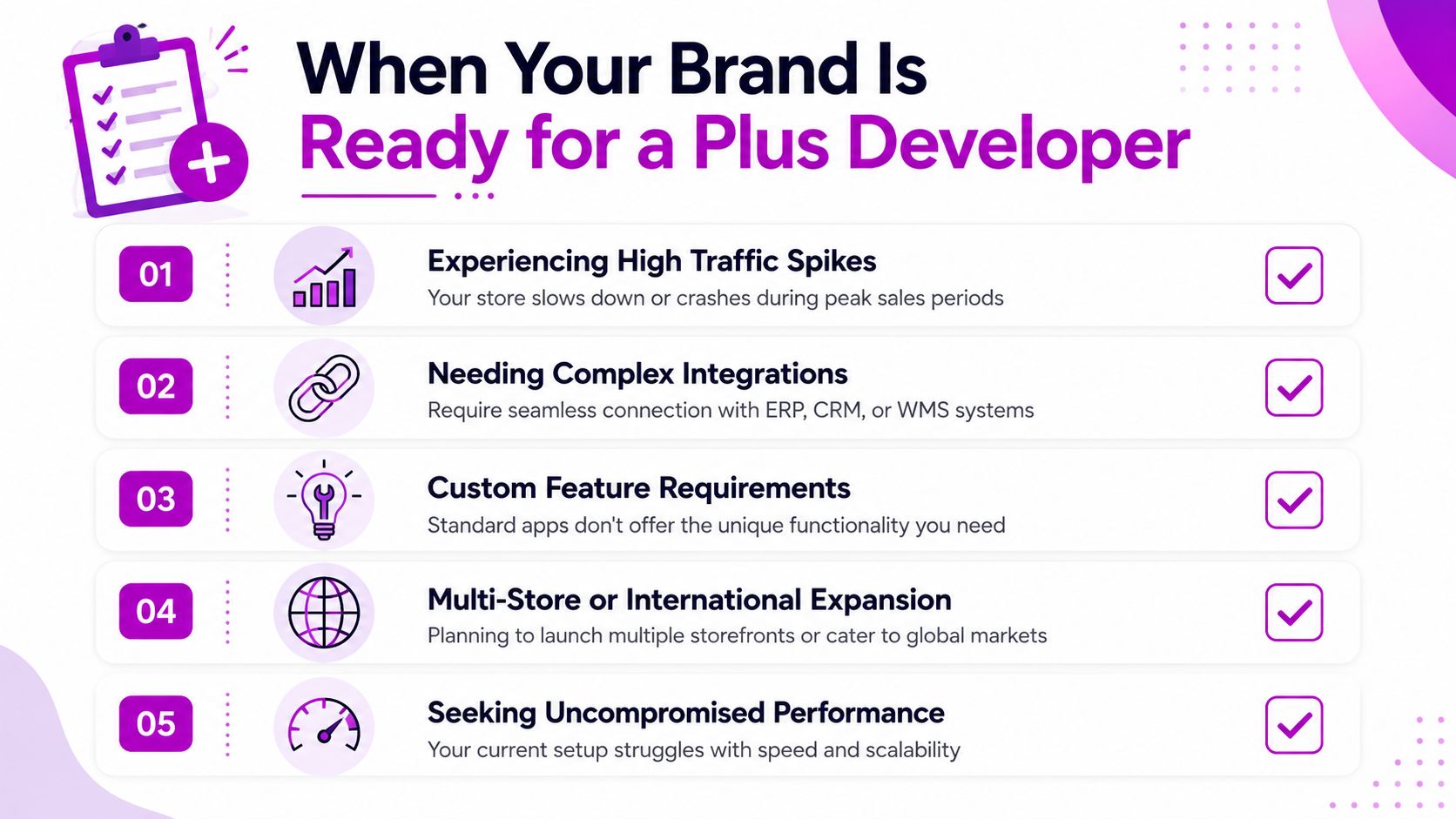
That is usually the point where a Plus developer stops being an implementation resource and starts becoming a systems architect for commerce.
Growth starts exposing architecture debt
A growing brand rarely hires for Plus because it wants a nicer theme. It hires because the store has become tightly connected to how the business runs.
The trigger is usually complexity across models and teams. DTC and wholesale need different pricing logic. International expansion adds tax, catalog, and operational exceptions. Subscriptions, custom accounts, or approval workflows introduce new states that standard storefront patterns do not handle cleanly. The visible symptom is release friction. The underlying problem is that the store was not designed for the next stage of the business.
Experienced teams save money long term by addressing the structure before it forces a bigger rebuild.
The signs are operational
Brands are usually ready for a Shopify Plus developer when these issues show up repeatedly:
- New features create risk in unrelated parts of the store. A merchandising app affects load time. A discount tool conflicts with cart rules. A checkout change breaks reporting or customer tagging.
- B2B has moved from test channel to revenue channel. You need company accounts, negotiated pricing, payment terms, and order rules that fit actual sales operations.
- International growth is creating duplicate work. Teams are repeating content entry, promo setup, QA, and market-specific fixes across regions.
- Checkout behavior needs business logic. Customer type, destination, product mix, fraud controls, or internal workflows now affect what buyers should see and what the business should allow.
- Core systems can no longer fail unnoticed. Inventory sync, order routing, ERP handoff, and fulfillment updates need clear ownership, monitoring, and fallback behavior.
A theme developer can ship pieces of this. A Plus developer should decide how the pieces fit together so the next requirement does not make the stack harder to maintain.
The best timing is before complexity gets expensive
Brands often wait until launches feel slow or unstable. That is late.
A better test is to look at the cost of change. If each new market, channel, app, or workflow takes longer than the last one, the business is paying an architecture tax. It shows up in rework, manual QA, delayed launches, and too many exceptions living in spreadsheets or Slack threads.
At ECORN, we usually advise brands to hire at the point where platform decisions start affecting margin and speed together. That may mean choosing checkout extensibility over another app workaround. It may mean defining which system owns product data before teams add another connector. It may also mean deciding whether the work needs an embedded specialist or a broader delivery team. This breakdown of staff augmentation and outsourcing differences is useful if your internal team is weighing those options.
If launch confidence depends on tribal knowledge, manual checks, or one developer who remembers every exception, the store has outgrown ad hoc development.
That is the business case for a Plus developer. The role reduces operational drag, sets cleaner rules between systems, and gives the brand room to grow without re-platforming the moment complexity increases again.
Choosing Your Partner Agency vs Freelancer
Once the need is clear, the next decision is who should own the work. For most brands, that comes down to an agency or a freelancer. Neither option is automatically better. The right choice depends on how much uncertainty, integration depth, and post-launch responsibility the project carries.
Scope changes the answer
If you need a defined piece of work, a freelancer can be a strong fit. Theme refinements, a contained app setup, or a narrow UX implementation often work well with an experienced solo specialist.
If the project includes migration planning, ERP or PIM integration, multi-store design, checkout extensibility, testing, and launch coordination, an agency usually makes more sense. Those projects require more than code delivery. They need project management, QA discipline, and enough bench depth to avoid the entire timeline depending on one person's availability.
Speed is really about parallel capacity
Founders often compare agency and freelancer cost first. The better comparison is throughput.
A freelancer usually works single-threaded. If they're excellent, that can still work for focused projects. But if discovery, front-end work, backend integration, QA, analytics setup, and launch support all have to move at once, one person becomes a bottleneck.
An agency can split the work across roles. Developer, strategist, QA, designer, CRO support, and project lead. That doesn't guarantee better execution, but it does make parallel delivery possible.
The talent model matters too
Some brands don't want a traditional outsourced engagement. They want extra capacity that behaves like an extension of the internal team. If you're weighing those options, this breakdown of staff augmentation and outsourcing differences is useful because it clarifies who owns planning, management, and delivery accountability in each model.
That distinction matters on Shopify Plus projects. Some brands need a partner to own the roadmap and execution. Others already have strong internal product ownership and just need specialized Plus engineering support.
Agency vs Freelancer A Quick Comparison
| Criterion | Agency | Freelancer |
|---|---|---|
| Project scope | Better for broad or evolving scope | Better for narrow, defined work |
| Skill coverage | Multiple disciplines available | Usually deep in one or two areas |
| Delivery speed | Strong when work can run in parallel | Strong for focused tasks, slower for overlapping streams |
| Risk coverage | Better continuity if one person is unavailable | Higher dependency on one individual |
| Communication | More structured process | More direct, often more informal |
| Cost model | Higher overhead, broader support | Lower overhead, narrower support |
What to choose in practice
Choose a freelancer when the brief is clear, the timeline is flexible, and the work can succeed without a large QA or systems layer.
Choose an agency when the store is tied closely to operations and revenue, especially if the project includes migration, multi-market complexity, B2B architecture, or integration risk. In that middle ground, some teams prefer flexible agency models instead of large retained scopes. ECORN is one example of that approach, offering Shopify design, development, CRO, and flexible subscription-based support for brands that need ongoing specialist capacity without building a full in-house team.
The question isn't “agency or freelancer?” It's “what delivery model matches the risk of this project?”
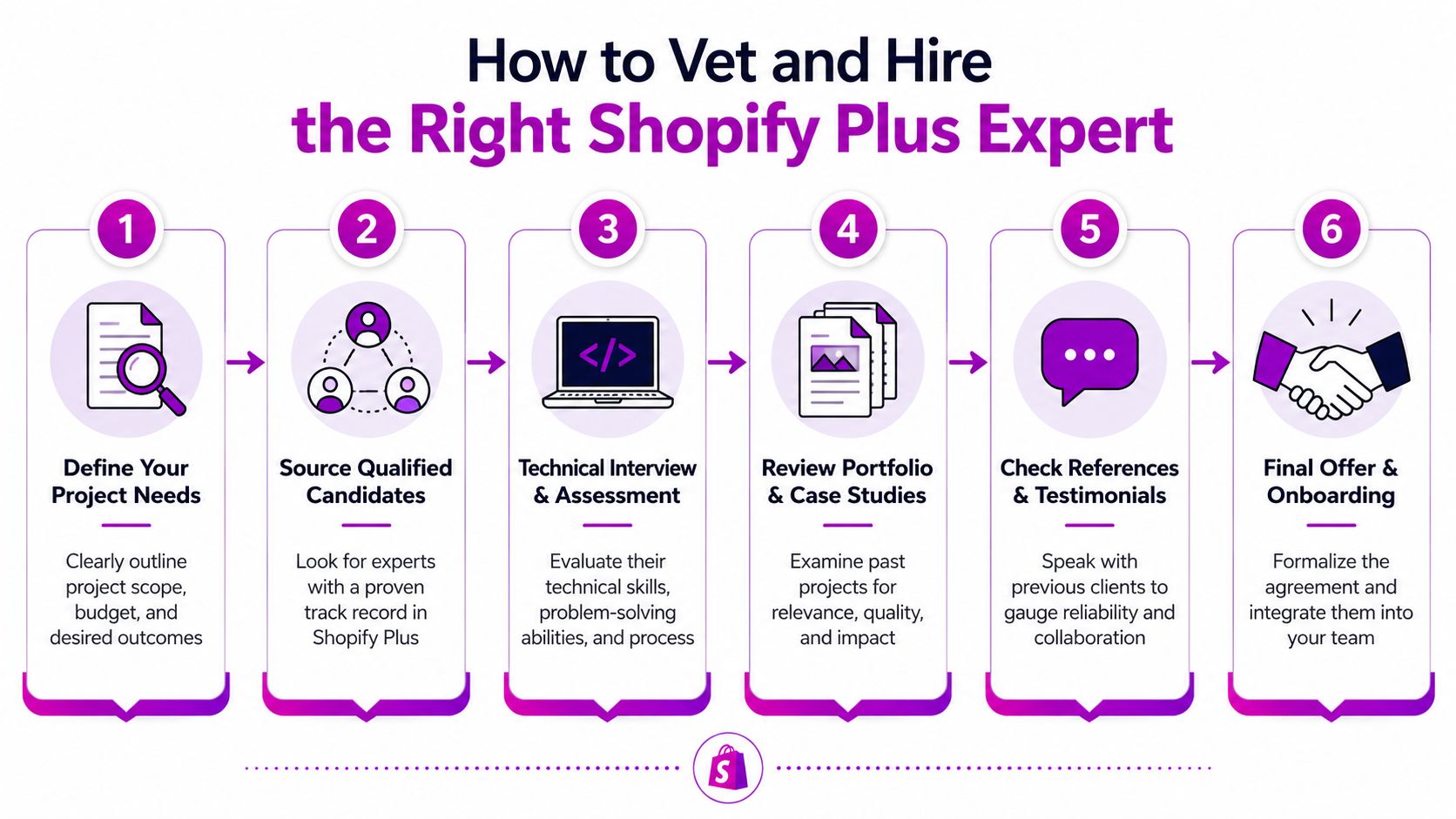
How to Vet and Hire the Right Shopify Plus Expert
A polished portfolio can hide weak technical judgment. That's why hiring a shopify plus developer needs a stricter process than reviewing pretty storefronts and asking about Shopify experience.
Review architecture evidence, not just aesthetics
The first thing to look for is proof that the candidate has handled complexity similar to yours. Ask for examples of projects involving migration, B2B logic, multi-store setups, ERP or PIM integration, checkout extensibility, or performance remediation.
If all you see are redesigned homepages and polished PDPs, that doesn't tell you enough.
The stronger signal is how they describe decisions. Why they chose a native approach instead of an app. How they modeled product or customer data. What they did to avoid brittle dependencies. How they reduced launch risk.
A practical hiring checklist should include:
- Relevant project depth: Ask whether they've solved your kind of complexity before, not just worked on Shopify Plus generally.
- Systems thinking: Listen for ownership boundaries between Shopify and external systems.
- Trade-off awareness: Good candidates can explain what they would not customize, and why.
Ask questions that expose engineering maturity
Shopify's partner qualification standards are a useful benchmark here. The requirements for qualified partners include an average load time under 400 ms, a 99.9% uptime SLO, and limits around Lighthouse degradation for storefront apps in the Shopify partner qualification criteria. You don't need the candidate to recite those standards. You do want them to think in that direction.
Ask questions like:
- How would you approach performance budgeting when multiple apps affect storefront speed?
- If our ERP is delayed or unavailable, what should still work in Shopify and what should fail safely?
- When do you recommend native Shopify features over custom apps?
- How would you structure a Plus build for both DTC and B2B without creating duplicate logic everywhere?
- What would you test before launch if checkout, subscriptions, and customer accounts all changed at once?
Hiring signal: Strong candidates answer with systems, dependencies, and rollback plans. Weak candidates answer with tools and features only.
Vet communication as hard as technical skill
Enterprise commerce projects fail just as often through process gaps as technical gaps. You need to know how the person or team handles scoping, QA, change requests, bug triage, and launch accountability.
Ask to see how they run a project. Not just what they build.
A solid process usually includes:
- Discovery and scoping: Clear assumptions, dependency mapping, and responsibility boundaries.
- QA discipline: Test plans covering storefront, checkout, integrations, and edge cases.
- Reporting cadence: Regular progress updates tied to decisions, blockers, and next actions.
If you're building a remote or distributed team, talent reach matters too. Some brands widen the pool with resources like Hire LATAM talent when they need strong technical coverage in aligned time zones.
For a more detailed hiring framework, this guide on how to hire a Shopify expert developer is a practical companion to the vetting process above.
The right hire should make complexity feel more organized in the first conversation. If they make it sound easy without clarifying dependencies, that's usually a red flag.
Your Partner in Scalable Growth
A fast-growing brand usually feels the strain before it sees it on an org chart. The team adds apps to solve immediate problems, patches workflows between ERP, 3PL, and subscriptions, and keeps shipping campaigns. Then a high-stakes launch exposes the underlying issue. The store still works, but it no longer scales cleanly.
That is why a Shopify Plus developer matters at this stage. The job is to protect architectural clarity as revenue, complexity, and operational dependencies increase.
The strongest Plus developers do more than deliver tickets. They make deliberate decisions about what should live inside Shopify, what should sit in an external system, and what should not be customized at all. That judgment prevents app bloat, fragile integrations, checkout workarounds, and the kind of technical debt that pushes brands into an avoidable replatform discussion two years later.
Shopify's platform direction has also changed the standard for good development work, as noted earlier. Extensions, APIs, and modular architecture reward teams that can design clean system boundaries. Basic theme customization still has a place, but it is no longer the center of gravity for a scaling brand. Value is found in integration design, performance discipline, and choosing a technical approach the business can still operate six months after launch.
A good partner brings business context into technical decisions. They know when custom work creates margin, when native Shopify features are enough, and when a request will increase support load, slow merchandising, or complicate future upgrades.
That is the partnership model growing brands need.
If your brand is reaching that point, ECORN can help you evaluate the architecture, delivery model, and Shopify Plus development work needed to scale without adding more technical drag.


10 Social Selling Platforms for Shopify Merchants

Shopify Website Design Examples: 7 Stores Worth Studying

7 Ecommerce Newsletter Examples for Shopify Brands
One Product Shopify Store: Build and Scale

Mobile Pop Up Strategy for Shopify Stores That Converts

Sitemap for Shopify: How to Find, Optimize, and Submit It

7 Single Product Websites Worth Emulating

Product Variants Shopify: The Complete 2026 Guide
Ecommerce Analytics Consulting for Growth
What Is AI Integration for eCommerce
How to Choose the Right eCommerce Website Development Firm
E Business Strategy Implementation
Conversion Tracking Setup for Shopify Stores
BigCommerce vs Shopify Plus Which Enterprise Wins in 2026
Shopify Theme Kit: Setup, Commands, and Migration Guide
Shopify Extension Development: A Practical 2026 Guide
Shopify Speed Score Explained and How to Improve It
Shopify Mobile Optimization: The 2026 Playbook

How to Add Subcategory in Shopify for Better UX
How to Implement Structured Data for Ecommerce in 2026

SEO App Mobile: Shopify Store Optimization Guide

Shopify Plus Support: What It Includes and How to Choose

Google Ads for Shopify: The Complete 2026 Playbook

Shopify New York: How to Find and Hire the Right Agency

Google Search Console for Shopify: The Complete Setup
First Party Data Collection for eCommerce Growth
FAQ Online Store Guide: Build and Measure It Right
Do FB Ads Work for eCommerce in 2026?

One Page Checkout for Shopify: Design and Implementation
Shopify GraphQL vs REST: The 2026 Developer Decision
Shopify Ecommerce Consulting: Strategy, Pricing &

Are Reddit Ads Worth It for eCommerce Brands

Shopify Title and Meta Description: A Practical 2026 Guide

Product Video Best Practices for Shopify Brands
Real-Time Inventory Management: A 2026 Guide
AI Chatbot Integration for Shopify Stores
Affiliate Program Management: A Shopify Guide
10 Best Performance Monitoring Tools for Shopify in 2026
Digital Asset Management for eCommerce Brands in 2026

Every Type of Facebook Ads Explained for eCommerce Growth
Product Information Management Explained for Shopify Brands
Support Ticket System: A Guide for Shopify Stores

10 Best Customer Service Tools for Shopify in 2026

Can I Start a Business with No Money? a 2026 Blueprint

What Sells Good on Etsy: Best Niches for 2026

Shopify Add to Cart Button: A Practical 2026 Guide

Customer Feedback Automation: A Practical eCommerce Guide

Critical Rendering Path: A Guide for Shopify Stores

How to Promote on TikTok for eCommerce in 2026

B2B eCommerce Consulting That Drives Real Revenue
10 Best Practices for Site Navigation in 2026
Return vs Refund for Shopify Stores: A Practical Guide

What Is Customer Lifetime Value and Why It Matters
What Is Voice of Customer Research for eCommerce

SMS Marketing for Ecommerce That Actually Converts

Master How to Improve Email Deliverability in 2026

Top 7 eCommerce Partners NYC for Shopify Brands in 2026

Machine Learning for Ecommerce: Boost Your Shopify Store

Beauty Market Research: Your 2026 Growth Guide

Shopify International Expansion: A 2026 Roadmap

What Does CRO Stand for in Business: Understanding CRO

Shopify Visual Merchandising: A Playbook for Higher Sales

Shopify Landing Page Design: Master Conversion in 2026
10 Best AI SEO Optimization Tools for Shopify in 2026

Agentic AI for Ecommerce: Boost Your Sales in 2026
Mastering Email Marketing Data for eCommerce Growth

Conversion Rate Optimisation Australia: Boost Your Sales
Conversion Rate Optimization AI: Your Shopify Store Guide

10 Product Bundling Strategies for Shopify in 2026

How to Increase Customer Lifetime Value: A Shopify Playbook
AI Customer Service Automation: Shopify Guide 2026

Clean Website Design: A Shopify Conversion Playbook

Omnichannel Retail Strategy: A Shopify Playbook

Product Data Enrichment: A Guide for Shopify Brands

Instagram Shopping Features a Guide for Shopify Stores
What Is Revenue Optimization: A Holistic RevOps Guide

Benefits of Conversion Rate Optimization: Boost Your
WordPress to Shopify Migration: Your 2026 Seamless Switch
Boost Sales: Ecommerce Payment Processing Guide 2026
Unified Commerce Platform: Benefits, KPIs & Shopify Guide

How to Reduce Bounce Rate eCommerce: Your 2026 Guide
Shopify API Integration: A Practical End-to-End Guide

How to Implement Data Governance: A 2026 Guide
Shopify Store Development Cost: A 2026 Breakdown
What Is Server Side Tracking: The Shopify Guide 2026
Marketing Automation Workflows: A Shopify Guide for 2026

Shopify: How to Reduce Technical Debt

Shopify UX Design Change: A Playbook for Growth

User Generated Content Strategy: Shopify Playbook

Shopify Pause and Build Plan Cost: A Complete 2026 Guide

Compare at Price on Shopify: A Complete Guide for 2026

Where Can I Sell My Prints? 10 Best Platforms for 2026
Shopify Order Management System: The Ultimate Guide 2026
What Is Marketing Attribution? an eCommerce Guide for 2026

10 Best Black Friday Sales Sheets for 2026

Discover the Top Social Media Marketing Agencies For
Consumer Confidence Definition for eCommerce in 2026

What Is Social Commerce? Your 2026 Guide to Boosting Sales

A Social Ad Campaign Playbook for eCommerce Growth

7 Best FAQ Page Examples for SaaS & eCommerce


newsletter in your inbox