

You're probably in one of two camps right now.
Either you've installed a few AI apps in your Shopify store and you're not sure whether they're helping, or you're watching competitors talk about AI in every pitch deck, investor update, and agency proposal and wondering if you're already behind.
Both reactions are reasonable. Most Shopify teams don't have a dedicated data science function. They have a founder, an eCommerce manager, a paid media lead, maybe a lifecycle person, and a dev partner who's already busy. In that setup, “use AI” is not advice. It's just more noise.
The useful question is simpler. Where can AI improve revenue, speed, or decision quality inside the store operations you already run?
The New Competitive Edge for eCommerce Brands
I see the same pattern with growth-stage brands. They don't need another abstract explanation of machine learning. They need to know whether AI can help them sell more products, reduce support load, sharpen merchandising, or make their team faster without breaking the customer experience.
That shift has already happened in the market. In 2025, enterprise spending on generative AI reached $37 billion, up from $11.5 billion in 2024, a 3.2x year-over-year increase, according to Menlo Ventures' 2025 state of generative AI in the enterprise. More than half of that spend, about $19 billion, went to the application layer, where businesses buy practical software instead of building models from scratch.
That matters for Shopify brands because it changes the buying decision. You're no longer choosing between “do nothing” and “hire an AI team.” You're choosing among AI solutions brands that package real use cases into tools, workflows, and managed services you can deploy.
Why this matters on Shopify
Shopify brands usually hit AI demand from operational friction first.
A support team gets buried in repetitive pre-purchase questions. A merchandiser can't manually manage recommendations across a growing catalog. The paid team wants faster creative variation. The CRO roadmap keeps slipping because nobody can synthesize product, behavior, and campaign data fast enough.
AI helps when it's attached to a bottleneck like that. It fails when it's treated as a branding exercise.
Practical rule: If you can't tie an AI initiative to a live operational problem, don't buy it yet.
What strong operators do differently
The best teams don't ask, “Which AI tool is hottest?” They ask better questions:
- Where is the current manual drag? Support, merchandising, campaign analysis, product tagging, search, reporting.
- Which workflow repeats often enough to automate? Repetition is where AI usually earns its place.
- What can be tested without risking trust? Internal workflows and controlled merchandising logic are safer starting points than fully autonomous customer messaging.
That's the core advantage. Not using AI for the sake of it, but using it to remove slow, expensive, error-prone work from the parts of your store that already affect conversion and retention.
High-Impact AI Use Cases for Your Shopify Store
A useful way to think about AI is this. It acts like a set of narrow specialists inside your team. One specialist helps customers find products. Another handles repetitive support. Another helps your marketers produce and test more creative. Another watches product demand signals faster than a spreadsheet ever will.
For Shopify brands, five use cases tend to matter most first.
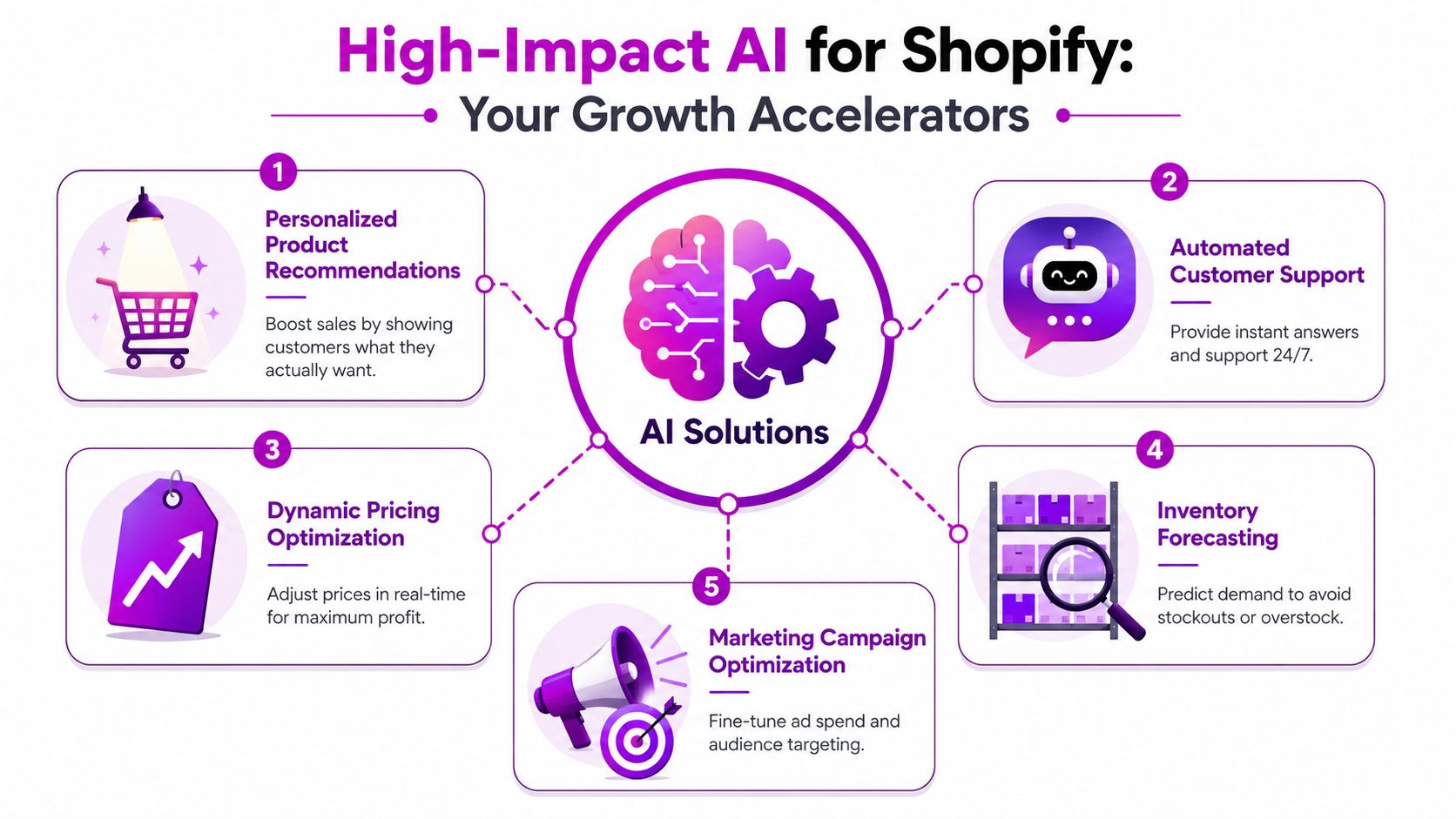
Personalized merchandising and recommendations
Most stores still show too many shoppers the same products in the same order.
AI-driven recommendation systems can change homepage blocks, collection sorting, cross-sells, and post-purchase suggestions based on browsing behavior, purchase history, product affinity, and context. For a returning customer, that could mean surfacing products related to a past purchase. For a new customer, it might mean prioritizing bestsellers or margin-friendly bundles based on referral source and category interest.
What works is focused personalization in places that already influence purchase intent:
- Homepage recommendation slots
- Product page cross-sells
- Cart and checkout upsell logic
- Post-purchase email recommendations
What usually doesn't work is overcomplicating the entire storefront at once. Start with a few high-visibility placements.
If you want a broader overview of where this fits, ECORN has a solid breakdown of AI applications in ecommerce.
Automated customer support
Support is one of the cleanest early AI wins if the use case is narrow and controlled.
A well-configured AI assistant can answer policy questions, order status questions, shipping timing, product detail basics, size guidance, and common pre-purchase objections. That reduces repetitive ticket volume and gives human agents more room to handle exceptions, complaints, and high-value customers.
The mistake is letting a chatbot improvise outside its source material. Good support automation is grounded in your help center, policy pages, product data, and approved responses.
The fastest way to lose trust with customer-facing AI is to let it sound confident when it's wrong.
Inventory forecasting and demand planning
Forecasting is where many brands think they need a giant enterprise stack. They usually don't.
AI can help operators spot patterns across historical sales, seasonality, campaign activity, channel shifts, and product velocity. That matters most when your team is trying to avoid the two classic retail mistakes: running out of core products or tying up cash in weak inventory.
For Shopify brands, this is especially useful in seasonal categories, new product launches, and fast-growing catalogs where manual forecasting starts to break down.
Conversion rate optimization support
CRO teams already use data. AI makes the loop faster.
Instead of manually combing through heatmaps, GA4 reports, funnel data, and on-site search logs, AI can help summarize friction points, cluster common objections, identify weak PDP content, and prioritize testing ideas. It doesn't replace judgment. It helps you get to judgment faster.
AI often fits well with merchandising and content work. If shoppers repeatedly hesitate on sizing, material details, or delivery information, AI can help surface the pattern and support faster experimentation.
A short explainer on the topic is worth watching before you evaluate vendors:
Creative and campaign automation
Creative automation is attractive because it feels immediate. You can generate product copy, ad variants, email drafts, landing page options, and campaign concepts quickly.
It's useful, but only when paired with review. Most AI-generated creative is a starting point, not finished work. Strong brands use it to expand testing velocity and reduce first-draft time. Weak brands publish bland, generic copy that sounds like every other store.
Dynamic pricing and promotional logic
Some Shopify brands can also use AI to support pricing decisions, discount logic, and promotion timing. This is more sensitive than recommendation or support because pricing affects margin, customer trust, and brand perception.
Use it carefully. AI can help spot pricing opportunities and promotional patterns, but human review should stay in the loop unless the rules are very tightly defined.
A Practical Roadmap to Implement AI Solutions
The biggest implementation mistake is trying to “roll out AI” as if it were one project. It isn't. It's a sequence of smaller operational changes.
A better approach is phased. Start with the data, pick one pilot, connect it properly, then decide whether it deserves broader rollout.
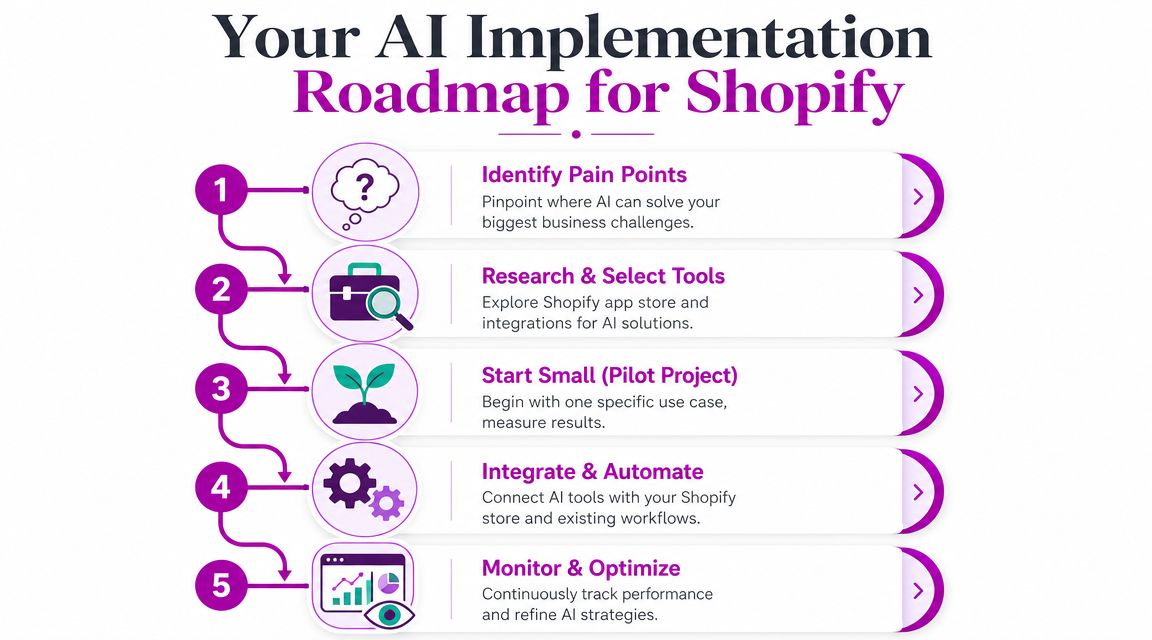
Step one starts with data, not tools
Most brands shop for AI before they've checked whether the underlying data is usable. That's backwards.
In practice, AI implementations often depend more on the quality of the underlying data pipeline than the model itself, especially when systems need data from platforms like Shopify, Google Analytics, and ad channels, as explained in this overview of enterprise AI data pipelines and systems. If your store data, traffic data, and campaign data don't line up, the AI layer won't fix that.
Start with a simple audit:
- Commerce data: Shopify orders, product catalog, collections, refunds, subscriptions, returns.
- Behavior data: GA4 events, landing pages, search behavior, add-to-cart flow, checkout drop-off.
- Acquisition data: Meta, Google, TikTok, email platform, affiliate sources.
- Content inputs: Product attributes, FAQs, help center content, shipping and return policies.
If these sources are fragmented, fix that before you evaluate ambitious AI workflows.
Pick one pilot with low risk and clear ownership
The first pilot shouldn't be the most exciting use case. It should be the one with the cleanest path to value.
Good first pilots usually have three traits:
- Clear business owner
- Low trust risk
- Existing baseline metrics
A support FAQ assistant is often easier to manage than full AI copy generation. Recommendation blocks on PDPs are usually easier to evaluate than a full homepage personalization engine. Internal analysis assistants are easier than autonomous pricing changes.
Integration matters more than feature lists
Many AI solutions brands demo well and deploy poorly.
What you need to understand is how the tool fits your existing stack. Is it a native Shopify app, a middleware layer, an API-first product, or a service team wrapping several systems together? Can it pull from your real catalog and customer data? Can your team maintain it after launch?
Buy for workflow fit, not for demo quality.
A practical tool review should include:
- Data inputs required
- Shopify compatibility
- Need for custom development
- Human review controls
- Fallback behavior when confidence is low
Measure, learn, and only then expand
After launch, don't rush into a second or third AI project just because the first one went live.
Run the pilot long enough to learn where the system helps and where it introduces friction. Review outputs. Check edge cases. Ask support, merchandising, and lifecycle teams what changed in their workload.
Then decide whether to scale in one of three directions:
| Expansion path | When it fits | Example |
|---|---|---|
| More placements | One use case is working in one area | PDP recommendations expand to cart or post-purchase |
| More workflows | One team has adopted the process well | Support AI expands into merchandising analysis |
| More channels | Data quality is stable across systems | On-site AI logic informs email or ad segmentation |
That sequence is what keeps implementation practical. Most brands don't fail because the idea was wrong. They fail because they bought too much, too early, on top of messy operations.
How to Measure AI Success and Calculate ROI
If an AI tool can't be measured against a business outcome, it's a cost center with better branding.
The cleanest ROI conversations tie each AI initiative to the metric that the owning team already cares about. Don't create a separate AI scoreboard unless you have to. Plug it into the operating metrics you already review every week.
Match the use case to the right KPI
Different AI use cases should prove value in different ways.
- Personalization and recommendations should be judged against conversion rate, average order value, revenue per session, and attachment rate for recommended items.
- Customer support automation should be judged by ticket deflection, first-response speed, resolution quality, and how often agents still need to step in.
- Inventory forecasting should be reviewed against stockout frequency, overstock exposure, purchase planning quality, and sell-through stability.
- Creative automation should be measured through production speed, testing velocity, and whether better inputs are reaching paid media and lifecycle teams faster.
- CRO analysis support should be measured by the quality and speed of insight generation, test throughput, and the performance of experiments launched from those insights.
Use a simple ROI frame
You don't need a finance model with ten tabs to evaluate most AI initiatives.
Use this:
ROI = value created + time saved + cost avoided - total tool and implementation cost
The important part is being honest about where value comes from.
For example, if a support assistant reduces repetitive inquiries, the gain may show up as fewer manual tickets, faster responses during peak periods, or reduced need to add headcount. If recommendation logic improves merchandising, the value may show up as better basket construction or stronger monetization of catalog traffic you already paid to acquire.
Separate direct revenue from operational value
Some AI projects generate visible revenue impact. Others enhance operational efficiency.
Both matter, but don't mix them carelessly. A personalization engine may influence sales directly. An internal reporting assistant may help your team make faster decisions, which is valuable, but not the same thing.
That distinction helps prevent inflated business cases.
If a vendor can only describe outcomes in vague productivity language, ask which store metric should move and how soon you should expect to see it.
Review the delta, not just the dashboard
Teams often get impressed by activity. More outputs, more automations, more generated content, more dashboards.
That's not the same as improvement.
Compare the before and after state:
- Was the workflow faster?
- Was the decision better?
- Did the customer experience improve?
- Did the team remove a bottleneck?
- Did the store make more money or operate more cleanly?
If the answer is unclear after a fair testing period, the tool probably isn't earning its place.
Choosing AI Vendors and Avoiding Common Pitfalls
Vendor selection is where a lot of Shopify brands burn time and budget. The pitch sounds simple. Plug in the app, connect your data, let the model work. Then three months later the outputs are noisy, the team doesn't trust it, and nobody owns the workflow.
The market is growing fast, but maturity is uneven. Broader industry projections show how large AI has become, including AI software and spending projections compiled by Vention Teams. That scale is useful context, but it also means there's a wide gap between polished demos and dependable operational tools.
Use a practical screening table
| Criteria | What to Look For | Red Flag |
|---|---|---|
| Shopify integration | Native app support, stable APIs, clear data sync rules | Requires heavy custom work for basic storefront use |
| Data quality fit | Can use your catalog, behavior, and support data cleanly | Needs large manual exports or brittle connectors |
| Governance controls | Approval workflows, prompt controls, role permissions, auditability | Black-box outputs with no review layer |
| Support model | Clear onboarding, implementation help, documented escalation path | “Self-serve” promise for a complex operational rollout |
| Pricing structure | Transparent fees tied to usage or scope | Pricing that rises before value is proven |
| Scalability | Can work across storefronts, markets, or teams if needed | Only works in a single isolated use case |
| Output reliability | Grounded answers, controllable brand voice, testable behavior | Confident but unverifiable customer-facing output |
Governance is not optional
One of the most overlooked facts in AI buying is that 78% of organizations use AI, but many haven't scaled it broadly because risk and governance remain major blockers, as covered in Built In NYC's discussion of enterprise AI adoption and governance. For eCommerce brands, that shows up in very practical ways.
A merchandising tool can surface biased or low-quality recommendations if the input data is weak. A customer-facing assistant can hallucinate policy details. A copy generator can drift from brand standards. Privacy and compliance risk get even more serious when customer data or regulated markets are involved, especially as the EU AI Act phases in obligations.
Here's what I'd check before approving any vendor:
- Who reviews outputs? Someone must own approval for customer-facing content.
- What data is used? Don't assume the vendor's data handling matches your obligations.
- How are mistakes caught? Look for confidence thresholds, fallback rules, and logging.
- Can you limit scope? Strong vendors let you constrain where the AI can act.
- What happens after launch? Monitoring matters as much as setup.
Don't ignore the market signal behind the vendor story
If you want a good read on the genuine direction of AI companies, beyond their marketing claims, I'd keep up with essential AI intelligence for investors. It's useful because vendor selection gets easier when you understand which parts of the market are becoming infrastructure, which are becoming workflow products, and which are mostly noise.
Common mistakes that slow brands down
- Buying horizontal tools for vertical problems when the actual need is Shopify-specific workflow integration
- Letting marketing own the tool alone when support, product, ops, and dev all affect the outcome
- Skipping policy and governance checks because the tool looks lightweight
- Expecting instant automation before the team has clean processes to automate
- Judging the vendor by output style instead of operational fit
A good AI vendor doesn't just generate something impressive. It fits your store, your team, your data, and your tolerance for risk.
AI in Action Real World Examples
The easiest way to understand AI solutions brands is to picture how a Shopify operator would practically use them.
Fashion brand with growing catalog complexity
A fashion store with a large seasonal catalog struggled to surface relevant products on collection and product pages. The team added AI-assisted recommendation logic to highlight complementary items, recent-viewed context, and better cross-sells.
The gain wasn't magical automation. It was that the merch team no longer had to manually curate every relationship across the catalog. They could focus on exceptions, launches, and campaign moments while the system handled the repetitive matching work.
CPG brand with support bottlenecks
A consumables brand was drowning in repetitive support volume around shipping timing, subscriptions, ingredients, and account management. They deployed a customer support assistant grounded in approved help content and product information.
That didn't replace the support team. It filtered repetitive traffic, gave agents cleaner handoffs, and made peak periods less chaotic. The human team still handled edge cases and sensitive issues.
For more patterns like this, these AI in ecommerce examples are useful because they show where AI fits store operations rather than just content generation.
Home and lifestyle brand with weak reporting flow
A home brand had solid data across Shopify, GA4, and ad platforms, but nobody had time to connect it fast enough to guide weekly CRO and merchandising decisions. The team used AI support inside the analytics workflow to summarize behavior patterns, highlight anomalies, and cluster common friction points.
The win came from speed. Instead of spending half the week assembling findings, the team spent more of it deciding what to test.
Strong AI use cases usually remove recurring operational drag first. They rarely start with moonshot automation.
How ECORN Integrates AI into Your Growth Strategy
Most Shopify brands don't need to fully build AI in-house, and they also don't want to buy a stack of disconnected apps they'll never operationalize. That's where the third path matters. Partnering.
This is becoming more relevant because many brands are still sorting out which AI workflows belong inside SaaS tools and which need hands-on implementation tied to storefront operations, CRO, and merchandising. That distinction is part of a broader shift toward more domain-tuned application-layer AI, as noted in Built In's discussion of vertical and specialist AI approaches.
Build, buy, or partner
For Shopify operators, the decision usually looks like this:
- Build if you have technical leadership, reliable data infrastructure, and a clear long-term reason to own the system.
- Buy if the use case is narrow, mature, and fits cleanly into your existing stack.
- Partner if you need the outcome but don't have the in-house bandwidth to connect strategy, implementation, QA, and ongoing optimization.
That partner model is where an agency subscription can make sense. Instead of hiring a full internal AI and experimentation function, brands can use a team that already works inside Shopify growth workflows and can connect AI decisions to CRO, merchandising, development, and operational priorities.
Where that model fits
This approach is usually strongest when a brand needs:
- Use case prioritization instead of another tool list
- Shopify implementation support across apps, custom logic, and theme-level changes
- CRO alignment so AI work improves store performance rather than creating isolated experiments
- Ongoing review because customer-facing AI needs supervision, testing, and iteration
That's the practical middle ground. Not chasing AI for optics, and not waiting until your team is “ready” in some abstract sense. Just applying the right level of tooling and expertise to the workflows that already matter.
If you want help deciding which AI opportunities fit your store, ECORN can support the strategy, implementation, and CRO side of the work without forcing you into a full in-house build. For growing Shopify brands, that's often the fastest way to turn AI from a vague initiative into a measured part of the growth roadmap.


Shopify Plus Automation: A Guide for 2026
10 Social Selling Platforms for Shopify Merchants

Shopify Website Design Examples: 7 Stores Worth Studying
7 Ecommerce Newsletter Examples for Shopify Brands
One Product Shopify Store: Build and Scale

Mobile Pop Up Strategy for Shopify Stores That Converts
Sitemap for Shopify: How to Find, Optimize, and Submit It

7 Single Product Websites Worth Emulating
Product Variants Shopify: The Complete 2026 Guide
Ecommerce Analytics Consulting for Growth
What Is AI Integration for eCommerce
How to Choose the Right eCommerce Website Development Firm
E Business Strategy Implementation
Conversion Tracking Setup for Shopify Stores
BigCommerce vs Shopify Plus Which Enterprise Wins in 2026
Shopify Theme Kit: Setup, Commands, and Migration Guide
Shopify Extension Development: A Practical 2026 Guide
Shopify Speed Score Explained and How to Improve It
Shopify Mobile Optimization: The 2026 Playbook
How to Add Subcategory in Shopify for Better UX
How to Implement Structured Data for Ecommerce in 2026

SEO App Mobile: Shopify Store Optimization Guide
Shopify Plus Support: What It Includes and How to Choose
Google Ads for Shopify: The Complete 2026 Playbook

Shopify New York: How to Find and Hire the Right Agency
Google Search Console for Shopify: The Complete Setup
First Party Data Collection for eCommerce Growth
FAQ Online Store Guide: Build and Measure It Right
Do FB Ads Work for eCommerce in 2026?
One Page Checkout for Shopify: Design and Implementation
Shopify GraphQL vs REST: The 2026 Developer Decision
Shopify Ecommerce Consulting: Strategy, Pricing &

Are Reddit Ads Worth It for eCommerce Brands
Shopify Title and Meta Description: A Practical 2026 Guide

Product Video Best Practices for Shopify Brands
Real-Time Inventory Management: A 2026 Guide
AI Chatbot Integration for Shopify Stores
Affiliate Program Management: A Shopify Guide
10 Best Performance Monitoring Tools for Shopify in 2026
Digital Asset Management for eCommerce Brands in 2026
Every Type of Facebook Ads Explained for eCommerce Growth
Product Information Management Explained for Shopify Brands
Support Ticket System: A Guide for Shopify Stores

10 Best Customer Service Tools for Shopify in 2026

Can I Start a Business with No Money? a 2026 Blueprint

What Sells Good on Etsy: Best Niches for 2026

Shopify Add to Cart Button: A Practical 2026 Guide

Customer Feedback Automation: A Practical eCommerce Guide
Critical Rendering Path: A Guide for Shopify Stores

How to Promote on TikTok for eCommerce in 2026

B2B eCommerce Consulting That Drives Real Revenue
10 Best Practices for Site Navigation in 2026
Return vs Refund for Shopify Stores: A Practical Guide
What Is Customer Lifetime Value and Why It Matters
What Is Voice of Customer Research for eCommerce

SMS Marketing for Ecommerce That Actually Converts

Master How to Improve Email Deliverability in 2026

Top 7 eCommerce Partners NYC for Shopify Brands in 2026
Machine Learning for Ecommerce: Boost Your Shopify Store

Beauty Market Research: Your 2026 Growth Guide

Shopify International Expansion: A 2026 Roadmap
What Does CRO Stand for in Business: Understanding CRO

Shopify Visual Merchandising: A Playbook for Higher Sales

Shopify Landing Page Design: Master Conversion in 2026
10 Best AI SEO Optimization Tools for Shopify in 2026

Agentic AI for Ecommerce: Boost Your Sales in 2026
Mastering Email Marketing Data for eCommerce Growth

Conversion Rate Optimisation Australia: Boost Your Sales
Conversion Rate Optimization AI: Your Shopify Store Guide

10 Product Bundling Strategies for Shopify in 2026
How to Increase Customer Lifetime Value: A Shopify Playbook
AI Customer Service Automation: Shopify Guide 2026

Clean Website Design: A Shopify Conversion Playbook

Omnichannel Retail Strategy: A Shopify Playbook
Product Data Enrichment: A Guide for Shopify Brands

Instagram Shopping Features a Guide for Shopify Stores
What Is Revenue Optimization: A Holistic RevOps Guide

Benefits of Conversion Rate Optimization: Boost Your
WordPress to Shopify Migration: Your 2026 Seamless Switch
Boost Sales: Ecommerce Payment Processing Guide 2026
Unified Commerce Platform: Benefits, KPIs & Shopify Guide

How to Reduce Bounce Rate eCommerce: Your 2026 Guide
Shopify API Integration: A Practical End-to-End Guide
How to Implement Data Governance: A 2026 Guide
Shopify Store Development Cost: A 2026 Breakdown
What Is Server Side Tracking: The Shopify Guide 2026
Marketing Automation Workflows: A Shopify Guide for 2026

Shopify: How to Reduce Technical Debt

Shopify UX Design Change: A Playbook for Growth
User Generated Content Strategy: Shopify Playbook

Shopify Pause and Build Plan Cost: A Complete 2026 Guide

Compare at Price on Shopify: A Complete Guide for 2026

Where Can I Sell My Prints? 10 Best Platforms for 2026
Shopify Order Management System: The Ultimate Guide 2026
What Is Marketing Attribution? an eCommerce Guide for 2026

10 Best Black Friday Sales Sheets for 2026

Discover the Top Social Media Marketing Agencies For
Consumer Confidence Definition for eCommerce in 2026
What Is Social Commerce? Your 2026 Guide to Boosting Sales
A Social Ad Campaign Playbook for eCommerce Growth


newsletter in your inbox