


A familiar scenario plays out right before a Shopify Plus redesign. Revenue is healthy enough to justify a larger budget, the current site feels dated or hard to manage, and the team starts shopping for a designer. Six months later, the brand has sharper visuals, a larger invoice, and no clear lift in conversion rate, AOV, or launch speed.
That usually happens because the hire was framed as a design problem instead of a commerce performance problem.
On Shopify Plus, design decisions affect far more than brand presentation. They shape how quickly product pages load, how clearly variant choices read on mobile, how confidently shoppers move through cart and checkout, and how easily merchandising teams can launch campaigns without breaking the experience. A designer who cannot connect creative choices to those outcomes can still produce polished work. Polished work alone does not justify a Plus budget.
I have hired designers, replatforming partners, and full-service agencies for growth-stage and enterprise stores. The pattern is consistent. The strong ones ask harder questions early. They want to know where conversion drops, which templates drive the most revenue, how discounting affects margin, what international markets need, and where internal teams lose time. They treat the storefront as a sales engine with operating constraints, not a collection of screens.
That distinction matters more now because Shopify Plus serves a much broader set of brands and operating models than it did in its earlier years, as noted earlier in the article. The role has expanded with it. A Shopify Plus designer may need to think through subscription UX, B2B buying flows, localization, search and merchandising logic, accessibility, and the performance cost of every visual decision.
The hiring goal is simple. Find a designer who can improve how the store works for customers and for the team running it. If the conversation stays centered on aesthetics, the business case gets weak fast.
Defining Your Needs Before You Search
Most bad hires start with a bad brief.
“Make it feel more premium” sounds clear until you ask five people what that means. One person thinks typography. Another wants richer imagery. Your retention lead wants subscription UX cleaned up. Your performance lead wants fewer heavy scripts. Your finance lead wants the redesign to stop hurting conversion during launch.
A serious Shopify Plus search starts with the business problem, not the visual direction.
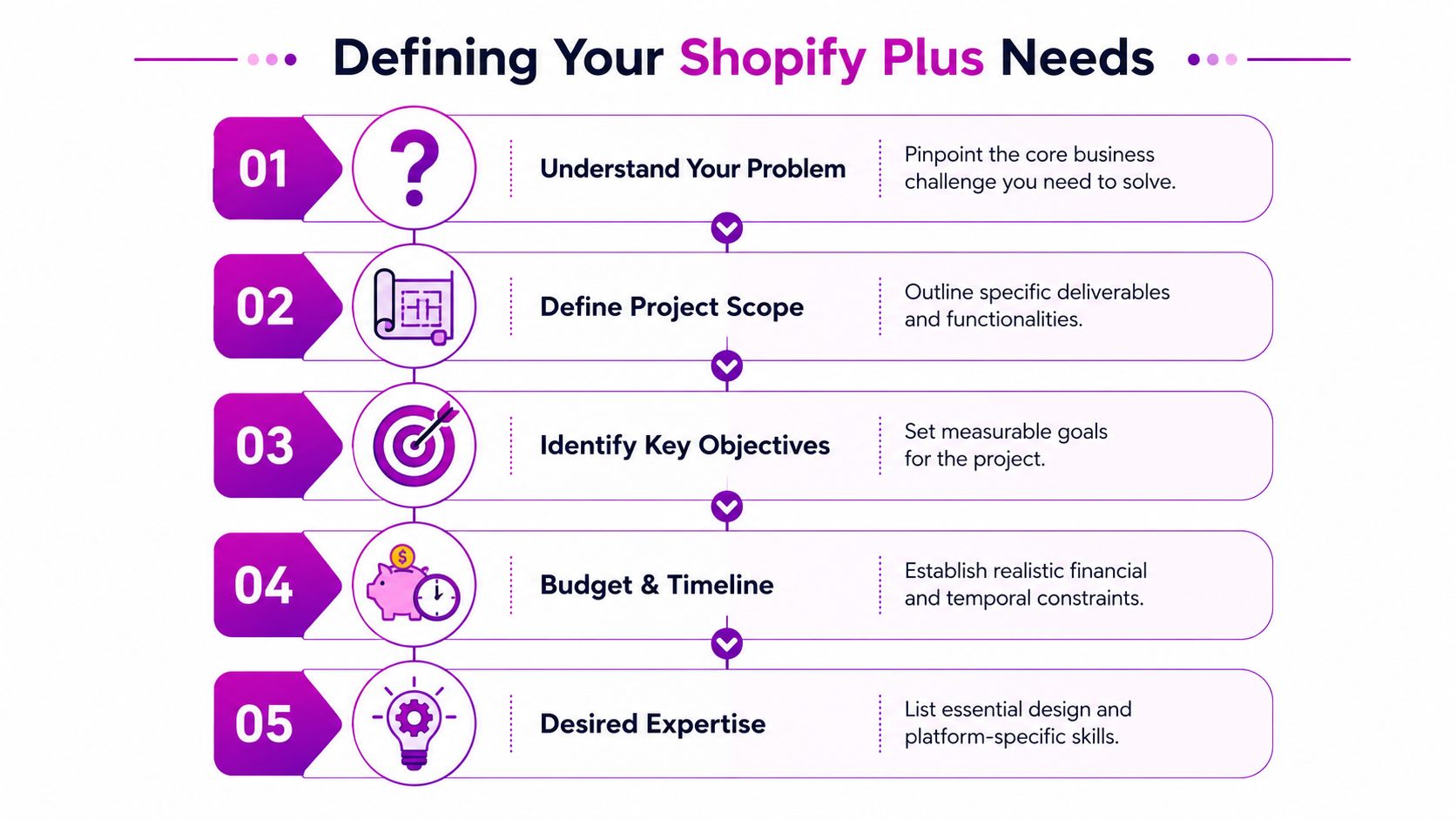
Turn vague dissatisfaction into measurable problems
Write down what is underperforming. Don't begin with homepage inspiration. Begin with symptoms.
That usually sounds more like this:
- Mobile users drop off on product pages: The issue may be information hierarchy, sticky purchase behavior, image loading, or variant selection friction.
- AOV is flat: The problem may sit in bundle UX, cart design, cross-sell placement, or how collections route traffic into product discovery.
- Teams can't launch campaigns cleanly: The issue may be weak design systems, rigid templates, or poor coordination between design and development.
- International expansion feels bolted on: The store may need a designer who understands localization, content hierarchy, and storefront consistency across markets.
Practical rule: If you can't describe the business problem in one sentence, you're not ready to hire.
Decide what the designer should own
A lot of brands overcorrect and write a shopping list of screens. That's still not enough. You need ownership boundaries.
On Shopify Plus, a designer should influence more than polish. Enterprise Shopify work is increasingly framed around planning, strategy, UI/UX, optimization, and coding, and brands should expect design to affect page speed, checkout friction, and mobile usability, as noted in Optimum7's discussion of Shopify Plus development changes.
That means your brief should specify whether the hire is responsible for:
- UX architecture such as navigation, collection logic, filtering, and product page structure.
- Design systems including reusable sections, campaign flexibility, and consistency across markets.
- Conversion inputs such as cart flow, upsell placements, trust elements, and mobile CTA behavior.
- Performance-aware design so visual decisions don't damage load times and usability.
- Collaboration with developers on feasibility, theme structure, and app impact.
Build a scorecard before you meet anyone
This is a commonly skipped step, and it's the one that saves the most time.
Use a simple hiring scorecard with weighted priorities. Not numbers for the sake of neatness. Real decision criteria. For example:
- Business fit: Do they understand your revenue model, product complexity, and customer journey?
- Platform depth: Can they design within Shopify's constraints without producing fantasy comps?
- Performance judgment: Do they know when visual ambition hurts usability?
- Systems thinking: Can they create reusable patterns instead of one-off pages?
- Stakeholder management: Can they work with merchandising, growth, and development without turning every decision into a fight?
A founder hiring Shopify Plus designers should know what success looks like before the first intro call. Otherwise, candidates will define success for you, and they'll usually define it around the work they like doing most.
How to Find and Vet True Shopify Plus Experts
A polished Dribbble portfolio is almost useless for enterprise commerce hiring.
What matters is whether the person or agency has handled the kinds of constraints your business lives with. Shopify Plus work often includes ERP or CRM dependencies, migration complexity, merchandising edge cases, and teams that need design decisions to survive campaign pressure after launch.
Where real expertise usually shows up
The best candidates tend to come from a few channels. Referrals from operators are still the highest-signal source because other operators care about launch discipline, communication, and whether the work held up after handoff. Curated specialist agencies are another strong option, especially when your project mixes design, development, and optimization.
If your stack touches other enterprise systems, evaluate adjacent hiring complexity too. Brands that need commerce design aligned with CRM, service, or sales operations often end up needing parallel technical support, which is why resources on how to recruit global Salesforce developers can be useful when mapping cross-functional hiring around a replatform or redesign.
You should also look at teams that explain how they approach implementation, not just aesthetics. A practical example is this ECORN piece on what a Shopify Plus developer actually does, which helps distinguish screen design from platform execution.
Read portfolios like an operator
Portfolio review shouldn't start with “Do I like this?” It should start with “What problem did this solve?”
Top Shopify Plus teams tend to differentiate themselves through ERP integration, headless commerce, and conversion rate optimization specialization. Some agency roundups specifically call out those technical strengths, and they recommend looking for case studies that show a 1.5% to 3% conversion uplift tied to checkout optimization and improved site speed in First Page Sage's Shopify Plus agency analysis.
That doesn't mean every candidate needs that exact outcome. It means your portfolio review should look for evidence that they can connect design decisions to business results.
| Evaluation Area | What to Look For (Signals of Expertise) | Red Flag |
|---|---|---|
| Strategy | Clear explanation of the business problem, user friction, and success metric | Portfolio talks only about “refreshing the brand” |
| Shopify Plus depth | Work involving custom checkout experiences, multi-store setups, or complex app ecosystems | Generic Shopify theme work presented as enterprise experience |
| Integrations | Evidence they've designed around ERP, PIM, CRM, subscriptions, or OMS realities | No mention of data flow, operational constraints, or backend dependencies |
| UX judgment | Before-and-after rationale for navigation, PDP structure, cart flow, or mobile interactions | Full-page mockups with no explanation of decisions |
| Conversion thinking | Testing mindset, merchandising logic, trust signals, and friction reduction | “Conversion-focused” language without proof of method |
| Scalability | Reusable systems, templates, campaign flexibility, and governance | One-off beautiful pages that won't scale across teams |
| Collaboration | Notes on developer handoff, QA, iteration, and launch support | Design shown as if engineering didn't exist |
Pretty work gets attention. Operationally aware work gets results.
Ask for the missing evidence
If a portfolio looks strong but thin on detail, ask direct follow-up questions:
- What changed in the customer journey after launch?
- Which constraints shaped the design most?
- How did they handle apps, data migration, or third-party systems?
- What did they test or refine after the first release?
- Which decisions protected speed and usability instead of hurting them?
Good Shopify Plus designers answer these questions comfortably. Generalists usually drift back to moodboards, brand language, and animation details.
The Interview Process That Reveals Expertise
Interviews should create productive pressure.
A credible Shopify Plus designer should be able to think through trade-offs in real time, explain why they'd make one decision over another, and push back when a request threatens performance or clarity. If they only sound smart when walking through prepared work, you still don't know how they'll perform in your business.
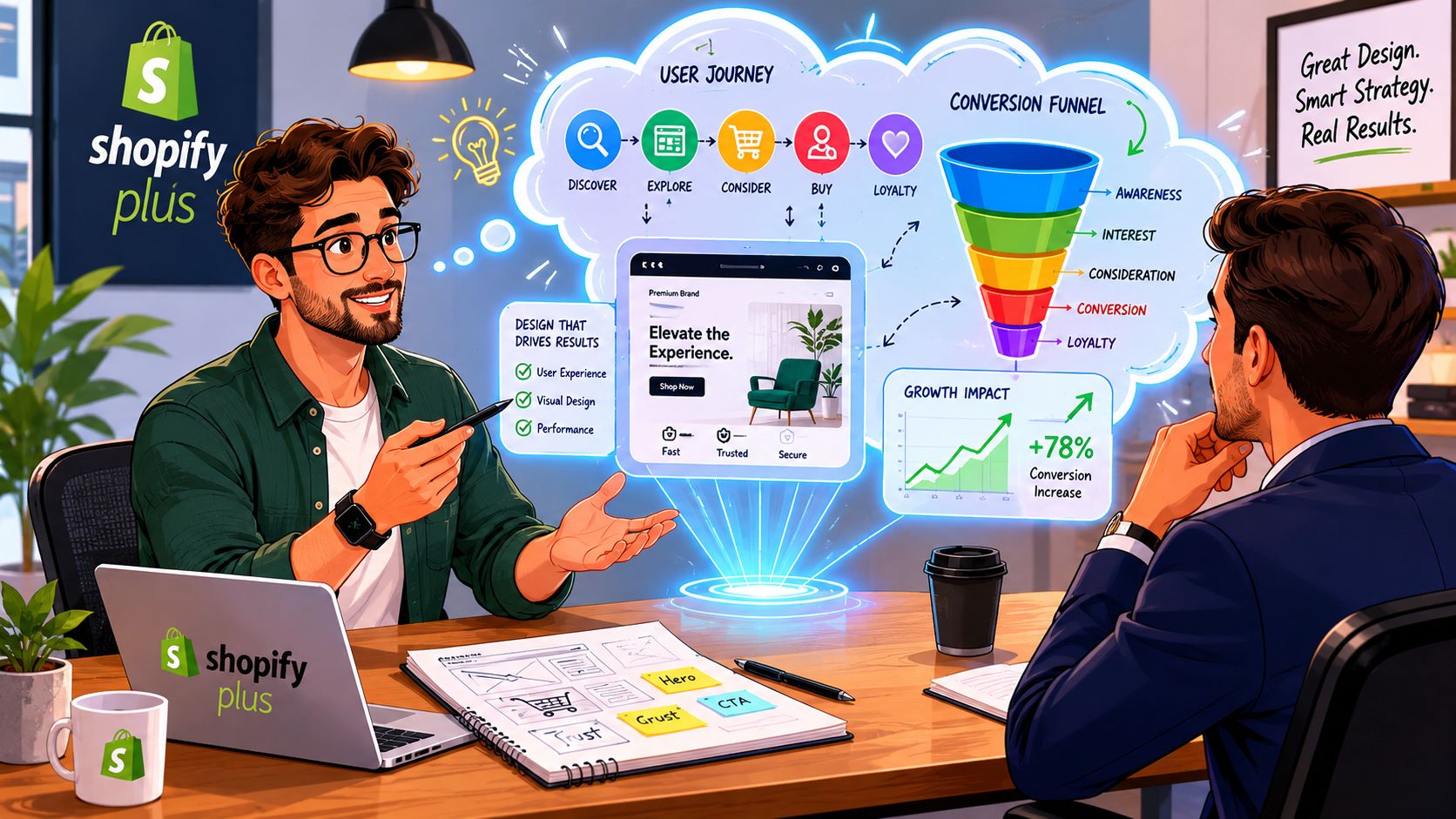
Ask questions that expose judgment
Skip most of the standard interview script. Tool proficiency matters, but Figma competence isn't the hard part.
Use prompts like these instead:
- A stakeholder wants a visually rich homepage with autoplay video, layered motion, and multiple campaign modules. How would you decide what stays?
- How would you design a product page differently for a replenishment product versus a high-consideration purchase?
- Tell me about a time a developer challenged your design on feasibility or speed. What happened next?
- If mobile conversion is weak but traffic quality is strong, where do you look first?
- How do you decide when to introduce a new page pattern versus extend an existing system?
These questions reveal whether the candidate thinks in systems, not screens.
Look for operational language
Strong answers usually include specifics about trade-offs, testing, constraints, and post-launch iteration. Weak answers stay abstract and drift into personal taste.
Listen for whether they naturally mention things like:
- Merchandising logic
- Theme limitations
- App conflicts
- Reusable sections
- Handoff quality
- QA and launch sequencing
- Mobile interaction friction
- Checkout considerations
The best answer isn't the most creative one. It's the one that balances customer experience, technical reality, and commercial impact.
A useful mid-interview exercise is to give them a real page from your store and ask what they'd change first, what they'd leave alone, and what they'd need to validate before recommending a redesign. That format quickly separates strategic designers from order-takers.
Test communication under ambiguity
You're not hiring a solo artist. You're hiring someone who has to work through imperfect briefs, competing stakeholders, and incomplete data.
This kind of conversation works well when you want to see how candidates reason out loud:
Pay attention to how they handle disagreement. A senior Shopify Plus designer shouldn't be defensive. They should be able to say, calmly, “That request may help branding, but it could create friction here,” and then offer an alternative.
That's the person who protects the store when internal opinions get noisy.
Navigating Pricing and Engagement Models
Pricing gets misunderstood because brands compare Shopify Plus design to standard theme work. It's not the same buying decision.
The scale alone tells you that. Industry guidance notes that small to mid-sized Shopify Plus builds with moderate customization often start around $30,000 to $80,000 and take 8 to 12 weeks, while more complex work such as headless builds, custom apps, or multi-country storefronts can exceed $100,000 and run 3 to 6 months, according to Miller Media7's Shopify Plus design and development guide.
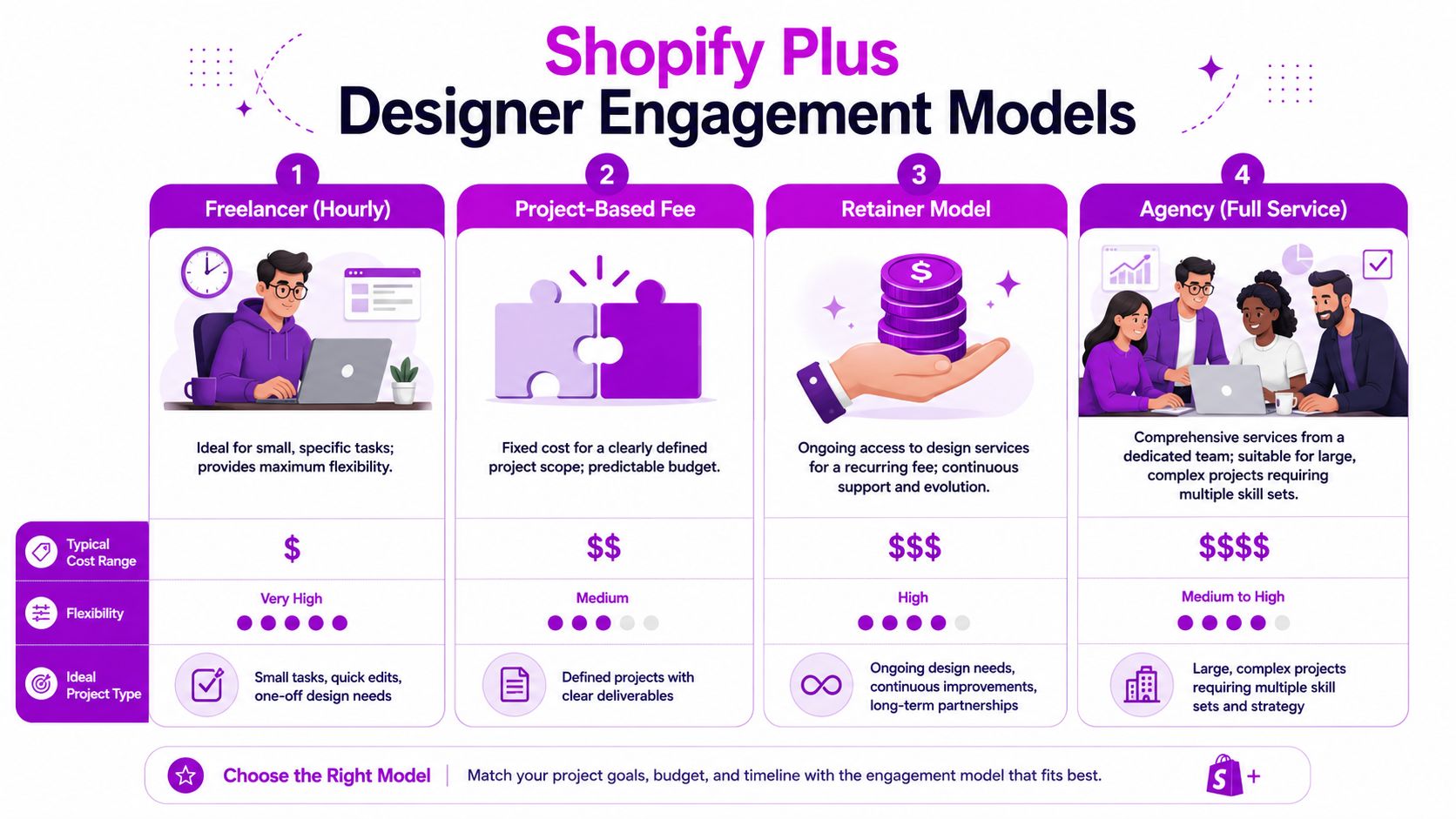
Fixed project versus ongoing support
A fixed project works when your scope is tightly defined. Think redesign of key templates, migration design support, or a clear UX overhaul with known deliverables. The upside is budget clarity. The downside is that most commerce projects reveal new requirements once real stakeholders and real data enter the process.
A retainer makes more sense when your store is already live and needs continuous iteration. That might include seasonal landing pages, CRO updates, merchandising support, design QA, and coordination with development after releases. This model usually creates better long-term outcomes because the team can keep refining instead of shipping once and disappearing.
A flexible subscription sits between those two. It's useful for brands that need recurring design capacity without committing to a large one-time program. For teams comparing service structures, this overview of Shopify design and development services is a practical reference for how ongoing support can be structured around implementation and optimization rather than a single launch.
A simple way to choose the model
Use the engagement model that matches the uncertainty in your business.
| Model | Best fit | Main advantage | Main risk |
|---|---|---|---|
| Freelancer hourly | Small isolated tasks or overflow support | Flexibility | Usually thin on strategy and systems thinking |
| Fixed project fee | Defined redesign or migration scope | Budget predictability | Scope changes create friction fast |
| Retainer | Ongoing optimization and cross-team support | Continuity and iteration | Requires active management and prioritization |
| Full-service agency | Complex builds needing design, dev, QA, and strategy | Broader execution coverage | More process, and often more stakeholders |
Use a paid trial before a larger commitment
If the project is substantial, start with a paid test. Keep it small but meaningful.
Good trial examples include:
- A PDP audit with revised wireframes
- A cart or mini-cart redesign proposal
- A collection page UX rethink
- A design system sample for two reusable modules
Don't use speculative free work. Pay for a contained problem, then evaluate how they think, how they communicate, how much context they absorb, and whether they can defend trade-offs without becoming rigid.
That usually tells you more than another polished case study ever will.
Onboarding and Collaborating for Maximum ROI
A strong hire can still fail if your team onboards them like a vendor instead of a growth partner.
The first month should give Shopify Plus designers enough context to make good decisions without forcing them to reverse-engineer the business from Slack threads and scattered dashboards. They need access to the people who own merchandising, growth, customer support, and development, because each of those groups sees a different part of conversion friction.
Give them one source of truth
Create a master brief that includes your brand priorities, customer segments, product economics, current storefront pain points, app stack, and the KPIs attached to the engagement. Keep it current. If the same designer hears three different definitions of success from marketing, product, and leadership, the work will drift.
A clean onboarding pack usually includes:
- Commercial context: margin realities, hero categories, subscription or one-time mix, and campaign priorities
- Customer insight: repeated support complaints, mobile pain points, and objections that block purchase
- Technical reality: current theme setup, app dependencies, and any known constraints from developers
- Decision process: who approves what, who gives feedback, and who has final sign-off
A redesign gets expensive when feedback arrives as opinion instead of evidence.
Build a working rhythm around evidence
Set a recurring review cadence. Weekly is usually enough for active projects. The important part isn't frequency. It's discipline.
Each review should answer a few questions:
- What changed since the last review?
- Why does that change matter commercially?
- What assumptions still need validation?
- Which dependencies could block launch or learning?
That structure keeps discussion tied to outcomes instead of personal preference.
If your team needs a sharper framework for post-launch optimization, this guide for boosting Shopify sales is useful because it pushes the conversation toward conversion behavior rather than visual taste alone.
Treat design as an operating function
The best long-term relationships happen when design, development, and optimization operate as one loop. Design proposes a change. Development flags constraints. The team launches cleanly. Then performance data informs the next round.
That's especially important on Shopify Plus, where the store is rarely “done.” Campaigns change, product mixes evolve, international needs expand, and apps create new complexity over time. The designer who understands your business and stays close to execution usually becomes far more valuable after launch than before it.
Frequently Asked Questions
Do I need a Shopify Plus specialist or just a strong eCommerce designer
Start with the business model, not the job title.
A strong eCommerce designer can handle a straightforward storefront refresh, campaign landing pages, and core PDP or collection page improvements. Shopify Plus experience matters more when the work touches multiple markets, custom integrations, subscription flows, B2B requirements, or checkout-related decisions. In those cases, the wrong hire does not just slow design. It creates rework for developers, delays launch, and limits what you can test after go-live.
Should I hire a freelancer or an agency
Freelancers work well when the brief is tight and the internal team can supply strategy, development coordination, and QA. Agencies make more sense when design decisions affect merchandising, front-end build, analytics, and release management at the same time.
I usually make this call based on operational load. If your team already knows what to build and can manage execution tightly, a freelancer can be efficient. If the project needs cross-functional leadership and faster problem-solving across disciplines, an agency usually protects margin better, even if the upfront cost is higher.
What's the biggest red flag in a portfolio
Pretty screens with no commercial context.
A credible portfolio should explain what problem existed, what constraints shaped the work, what changed in the customer journey, and how success was measured. If a candidate cannot discuss conversion, average order value, speed, merchandising logic, or implementation trade-offs, they are probably showing visual taste rather than Shopify Plus capability.
How long should a hiring process take
Long enough to test judgment. Short enough to keep momentum.
For a meaningful Shopify Plus engagement, a rushed hire usually leads to weeks of cleanup, unclear ownership, and expensive revision cycles. A solid process gives you time to review relevant work, run a structured interview, and use a paid exercise when the scope is large enough to justify it.
What should I ask for before signing
Ask how they run the work day to day.
You need clarity on discovery, scope control, feedback rounds, developer handoff, QA, launch support, and who owns decisions when trade-offs appear. Good designers answer this plainly. Weak operators stay vague, which is usually a warning sign that delivery will depend on improvisation.
What should the first success milestone be
The first milestone should be strategic alignment around what needs to improve in the buying experience and which metrics should move first.
That could mean reducing friction on mobile PDPs, improving collection page findability, increasing bundle uptake, or cleaning up a confusing cart flow. If the team cannot define the commercial goal early, the project tends to drift toward subjective design reviews instead of measurable gains.
If you're evaluating Shopify Plus designers and want a team that can handle design, development, and CRO in one workflow, ECORN is one option to consider. They work with Shopify-focused brands on scalable storefront design and optimization, which is useful when the priority is improving site performance over time, not just shipping a new look.


10 Shopify App Ideas Worth Building in 2026
Conversion Rate Optimization for Landing Pages: The Playbook
Shopify Plus Automation: A Guide for 2026
10 Social Selling Platforms for Shopify Merchants

Shopify Website Design Examples: 7 Stores Worth Studying
7 Ecommerce Newsletter Examples for Shopify Brands
One Product Shopify Store: Build and Scale

Mobile Pop Up Strategy for Shopify Stores That Converts
Sitemap for Shopify: How to Find, Optimize, and Submit It

7 Single Product Websites Worth Emulating
Product Variants Shopify: The Complete 2026 Guide
Ecommerce Analytics Consulting for Growth

What Is AI Integration for eCommerce
How to Choose the Right eCommerce Website Development Firm
E Business Strategy Implementation
Conversion Tracking Setup for Shopify Stores
BigCommerce vs Shopify Plus Which Enterprise Wins in 2026
Shopify Theme Kit: Setup, Commands, and Migration Guide
Shopify Extension Development: A Practical 2026 Guide
Shopify Speed Score Explained and How to Improve It
Shopify Mobile Optimization: The 2026 Playbook
How to Add Subcategory in Shopify for Better UX
How to Implement Structured Data for Ecommerce in 2026
SEO App Mobile: Shopify Store Optimization Guide
Shopify Plus Support: What It Includes and How to Choose

Google Ads for Shopify: The Complete 2026 Playbook
Shopify New York: How to Find and Hire the Right Agency
Google Search Console for Shopify: The Complete Setup
First Party Data Collection for eCommerce Growth
FAQ Online Store Guide: Build and Measure It Right
Do FB Ads Work for eCommerce in 2026?
One Page Checkout for Shopify: Design and Implementation
Shopify GraphQL vs REST: The 2026 Developer Decision
Shopify Ecommerce Consulting: Strategy, Pricing &

Are Reddit Ads Worth It for eCommerce Brands
Shopify Title and Meta Description: A Practical 2026 Guide

Product Video Best Practices for Shopify Brands
Real-Time Inventory Management: A 2026 Guide

AI Chatbot Integration for Shopify Stores
Affiliate Program Management: A Shopify Guide
10 Best Performance Monitoring Tools for Shopify in 2026
Digital Asset Management for eCommerce Brands in 2026
Every Type of Facebook Ads Explained for eCommerce Growth
Product Information Management Explained for Shopify Brands
Support Ticket System: A Guide for Shopify Stores

10 Best Customer Service Tools for Shopify in 2026

Can I Start a Business with No Money? a 2026 Blueprint

What Sells Good on Etsy: Best Niches for 2026

Shopify Add to Cart Button: A Practical 2026 Guide

Customer Feedback Automation: A Practical eCommerce Guide
Critical Rendering Path: A Guide for Shopify Stores

How to Promote on TikTok for eCommerce in 2026

B2B eCommerce Consulting That Drives Real Revenue
10 Best Practices for Site Navigation in 2026
Return vs Refund for Shopify Stores: A Practical Guide
What Is Customer Lifetime Value and Why It Matters
What Is Voice of Customer Research for eCommerce

SMS Marketing for Ecommerce That Actually Converts

Master How to Improve Email Deliverability in 2026

Top 7 eCommerce Partners NYC for Shopify Brands in 2026

Machine Learning for Ecommerce: Boost Your Shopify Store

Beauty Market Research: Your 2026 Growth Guide

Shopify International Expansion: A 2026 Roadmap
What Does CRO Stand for in Business: Understanding CRO
Shopify Visual Merchandising: A Playbook for Higher Sales
Shopify Landing Page Design: Master Conversion in 2026
10 Best AI SEO Optimization Tools for Shopify in 2026

Agentic AI for Ecommerce: Boost Your Sales in 2026
Mastering Email Marketing Data for eCommerce Growth

Conversion Rate Optimisation Australia: Boost Your Sales
Conversion Rate Optimization AI: Your Shopify Store Guide

10 Product Bundling Strategies for Shopify in 2026
How to Increase Customer Lifetime Value: A Shopify Playbook
AI Customer Service Automation: Shopify Guide 2026
Clean Website Design: A Shopify Conversion Playbook

Omnichannel Retail Strategy: A Shopify Playbook
Product Data Enrichment: A Guide for Shopify Brands

Instagram Shopping Features a Guide for Shopify Stores
What Is Revenue Optimization: A Holistic RevOps Guide

Benefits of Conversion Rate Optimization: Boost Your
WordPress to Shopify Migration: Your 2026 Seamless Switch
Boost Sales: Ecommerce Payment Processing Guide 2026
Unified Commerce Platform: Benefits, KPIs & Shopify Guide
How to Reduce Bounce Rate eCommerce: Your 2026 Guide
Shopify API Integration: A Practical End-to-End Guide

How to Implement Data Governance: A 2026 Guide
Shopify Store Development Cost: A 2026 Breakdown
What Is Server Side Tracking: The Shopify Guide 2026
Marketing Automation Workflows: A Shopify Guide for 2026
Shopify: How to Reduce Technical Debt

Shopify UX Design Change: A Playbook for Growth
User Generated Content Strategy: Shopify Playbook
Shopify Pause and Build Plan Cost: A Complete 2026 Guide
Compare at Price on Shopify: A Complete Guide for 2026
Where Can I Sell My Prints? 10 Best Platforms for 2026
Shopify Order Management System: The Ultimate Guide 2026
What Is Marketing Attribution? an eCommerce Guide for 2026

10 Best Black Friday Sales Sheets for 2026

Discover the Top Social Media Marketing Agencies For
Consumer Confidence Definition for eCommerce in 2026


newsletter in your inbox