

A Shopify brand can have a polished storefront, strong acquisition campaigns, and a growing customer list, yet still struggle to generate the next order. Customers buy once, collect a discount, and disappear. The team responds by adding another promotion, which lifts activity temporarily but makes margin harder to read.
That's where ecommerce loyalty program software earns its place. The right platform connects points, tiers, rewards, customer identity, checkout, messaging, and reporting so retention becomes an operating system rather than a decorative widget. The wrong platform creates another silo, issues liabilities the finance team can't forecast, and leaves customers unable to redeem rewards when they're ready to buy.
For Shopify practitioners, the decision isn't just which app has the most features. It's whether the software can produce profitable repeat behavior, prove incremental value, and keep customer data accurate across every selling channel.
Why Ecommerce Loyalty Program Software Matters Now
A familiar pattern appears across growing Shopify stores. The first purchase performs well, but the second purchase arrives too late or not at all. Marketing knows customers are returning, yet can't easily distinguish a member who redeemed a reward from a subscriber who clicked an email. Finance sees discounts and points as costs, while the retention team sees them as engagement.
Loyalty software can connect those views. A points balance gives the customer a reason to return. A tier can recognize purchase frequency. A reward shown in the cart can remove friction at the moment of decision. The platform then records what happened, allowing the team to compare member behavior with non-member cohorts instead of judging the program by enrollment alone.
Industry roundups report that 90% of loyalty programs report positive returns, with average ROI around 4.8x and top performers reaching a 15–25% annual revenue lift. The same loyalty program statistics roundup reports that loyalty members spend 12–18% more per transaction. These figures don't guarantee that a new program will work. They show why software that tracks earning, redemption, tiers, and repeat orders is increasingly treated as revenue infrastructure.

The category is moving beyond points
Loyalty programs are established, but customer expectations have changed. More than 90% of companies have some form of loyalty program, U.S. consumers held about 3.3 billion loyalty memberships, and the average consumer belonged to 14.8 programs while remaining active in only 6.7, according to the historical loyalty adoption benchmarks.
That gap matters. Customers don't need another generic points balance. They need a program that's visible, understandable, and relevant to the products they buy. A tier should reflect meaningful behavior, not arbitrary status. A reward should be easy to use. A message should arrive when the customer can act, not weeks after the opportunity has passed.
Revenue-quality rule: A loyalty program is successful only when the incremental gross profit from additional behavior exceeds the cost of rewards, discounts, technology, and operations.
The market reflects that shift. The loyalty management market is projected to grow from about $15.19 billion in 2025 to $41.21 billion by 2032, at a projected 15.3% CAGR, according to the cited loyalty management market overview. Brands are investing in infrastructure because retention, basket size, and customer lifetime value require connected data, not just promotional creativity.
How to Evaluate and Choose the Right Platform
Start with the customer journey, not the vendor demo. Map how a customer earns points, sees progress, receives a reward, applies it to a cart, and gets recognized after purchase. Then map the operational journey, including how Shopify, checkout, POS, email, SMS, CRM, customer support, and finance exchange data.
A Shopify-native app usually wins when the program is straightforward and the team wants a fast launch with limited engineering effort. An API-first platform makes more sense when loyalty must span multiple storefronts, POS systems, mobile experiences, regions, or promotion engines. Composable architecture offers flexibility, but your team owns more integration, monitoring, and governance work.
Use the matrix before booking demos
| Criteria | What Good Looks Like | Red Flag |
|---|---|---|
| Shopify compatibility | Reliable customer, order, product, refund, and discount synchronization | Points depend on manual exports or delayed imports |
| Checkout and POS | Customers can see and redeem rewards where they transact | Redemption works only on a loyalty landing page |
| API and webhooks | Documented events, retry handling, audit trails, and clear ownership | Vendor can't explain failed events or duplicate processing |
| Segmentation | Rules based on purchase behavior, tier, product, channel, and lifecycle state | Every customer receives the same reward |
| Governance | Roles, permissions, approvals, expiry rules, and change history | Anyone can alter earning or reward rules without review |
| Economics | Transparent pricing plus visibility into reward liability and cost | Pricing is discussed without modeling redemption |
| Reporting | Cohort views for retention, redemption, CLV, and incremental sales | Dashboard focuses on sign-ups and points issued |
| Omnichannel identity | One member record across online, store, and CRM activity | Separate profiles can earn rewards independently |
Choose for operating complexity
Ask each vendor to demonstrate a real scenario, not a slide deck. For example, show a customer who purchased online, returned part of the order, earned points on the retained items, changed tier, and redeemed in store. A platform that handles the happy path but fails on refunds and identity conflicts will create work after launch.
Also distinguish personalization from simple segmentation. A platform may let you create a VIP audience, but that doesn't mean it can recommend a suitable reward, suppress an unnecessary discount, or adapt an offer to a customer's purchase history.
Deloitte's 2025 loyalty research identifies price, value, and quality as leading loyalty drivers, with loyalty programs close behind. That's a useful warning for platform selection. Software can orchestrate value, but it can't compensate for poor products, confusing service, or rewards that feel irrelevant.
For a growing Shopify brand, shortlist two or three platforms and force each one through the same test cases. Include reward liability, refund handling, data ownership, permissions, and migration support in the commercial discussion. The lowest subscription price may not be the lowest operating cost.
Integration and Launch Checklist That Actually Works
Launch order matters. Teams that install an app, publish a rewards page, and start advertising before validating checkout behavior usually discover problems in production. Customers see missing balances, invalid codes, or rewards that can't be combined with the promotion they were promised.
Use a staged sequence with named owners. Before connecting systems, document the rules in plain language. Define which events create points, which events reverse them, when rewards expire, how returns affect balances, and who approves changes.

Build the integration in dependency order
Install and configure the Shopify connection. Confirm that customer creation, order status, cancellations, refunds, products, and discounts reach the loyalty platform. Review the app's scopes and document which system owns each field. Teams needing broader Shopify implementation support can also review Shopify app integration services.
Create point and tier rules. Start with a narrow rule set. Test purchase earning, referral earning, review actions, exclusions, tier entry, tier downgrade, expiry, and partial refunds. Avoid adding every possible earning action before the core purchase flow works.
Connect cart and checkout. Customers should see their balance, available rewards, and the effect of redemption without leaving the purchase path. Test logged-in and guest behavior, mobile layouts, discount stacking, subscriptions, gift cards, and failed redemption attempts.
Connect lifecycle messaging. Send loyalty events to email and SMS tools such as Klaviyo. Useful triggers include enrollment, points earned, reward earned, reward reminder, tier change, and inactivity. Suppress messages when the customer has already redeemed or when the reward no longer applies.
Sync POS and CRM. If the brand sells in store, reconcile customer identity before launch. Test lookup by email, phone, account, and QR code. Confirm that online and in-store refunds reverse the same liability and that customer service can correct errors without directly editing balances.
Stage the launch
Create a test cohort with realistic order histories. Run the program in staging, then perform controlled transactions in production before public promotion. Compare Shopify order data with loyalty events and CRM profiles. Check timestamps, currencies, tax treatment, refunds, and duplicate identities.
Go-live safeguard: Don't announce a reward until a tester can earn it, see it, apply it, complete checkout, and receive the correct follow-up message.
Keep an incident runbook ready. It should state who pauses campaigns, who investigates missing points, who approves manual adjustments, and how the team communicates with affected customers. Loyalty failures are visible and personal. A clear response process protects trust while the technical issue is being fixed.
Designing Rewards and Tiers That Drive Repeat Purchases
Points are a mechanic, not a strategy. Customers return when the reward feels attainable, useful, and connected to a purchase they already consider. A program that requires too much spending before the first meaningful benefit teaches customers to ignore it.
Begin with the economics of the category. A replenishment brand may reward the next purchase or a subscription continuation. An apparel brand may use early access, product drops, or VIP service. A premium brand may preserve margin with recognition and experiences rather than constant price reductions.
Set earn velocity around real behavior
The earn rate should create visible progress without turning every order into a discount event. Tie tier thresholds to actual purchase frequency and contribution margin. If most customers buy occasionally, a threshold designed for frequent shoppers will make the upper tier irrelevant. If the threshold is too easy, the status loses meaning and the brand funds benefits for behavior that would have happened anyway.
Use different rewards for different jobs:
- Purchase rewards encourage the next transaction, but they need exclusions and margin rules.
- Behavioral rewards can recognize reviews, referrals, or profile completion, provided the action has business value.
- Experiential rewards create distinction through access, service, samples, or private events without relying entirely on discounts.
- Tier benefits should become more valuable through convenience and recognition, not only a larger percentage off.
The reward experience must remain visible. Put balances and progress on the account page, product pages where relevant, cart, checkout, post-purchase messages, and customer service views. The loyalty redemption benchmarks report global average redemption around 50%, while online-only retailers using basic solutions without checkout integration average only 20–30%. The same source reports that members who redeem spend 3.1x more than non-redeeming members.

Protect margin before adding excitement
Reward cost needs a ceiling. Model the liability created by points issued, expected redemption, expiry, refunds, and promotional multipliers. Sales events deserve special attention because redemption can rise by 45–100% during promotional periods, according to the same redemption and sales analysis. That can improve customer activity while compressing contribution margin if the calendar isn't modeled in advance.
Avoid training customers to wait for rewards. Mix dependable benefits with selective, product-specific incentives and recognition. A customer should understand what they gain by staying with the brand, not just wait for the next discount code.
Measuring Performance and Proving Incremental Lift
Enrollment is the easiest number to improve and one of the least useful on its own. A customer can join, earn a welcome bonus, and never return. Measurement should connect loyalty activity to retention, redemption, customer lifetime value, and reward cost.
The ecommerce retention benchmarks cite an average ecommerce customer retention rate of about 30%, while top performers reach 62%. Use those figures as context, not as a promise. Your operating target should reflect category purchase cycles, gross margin, subscription behavior, and the time required for customers to repurchase.
Build a measurement hierarchy
Start with retention. The standard formula is:
Customer retention rate = ((customers at end of period − new customers acquired) / customers at start) × 100
Compare members with non-members by acquisition cohort, first-order category, channel, order frequency, average order value, and CLV. A raw member comparison can mislead because customers who already buy frequently are more likely to enroll. Where possible, use a holdout group or phased rollout so the team can estimate incremental behavior rather than assigning every member order to loyalty.
Track four operating measures:
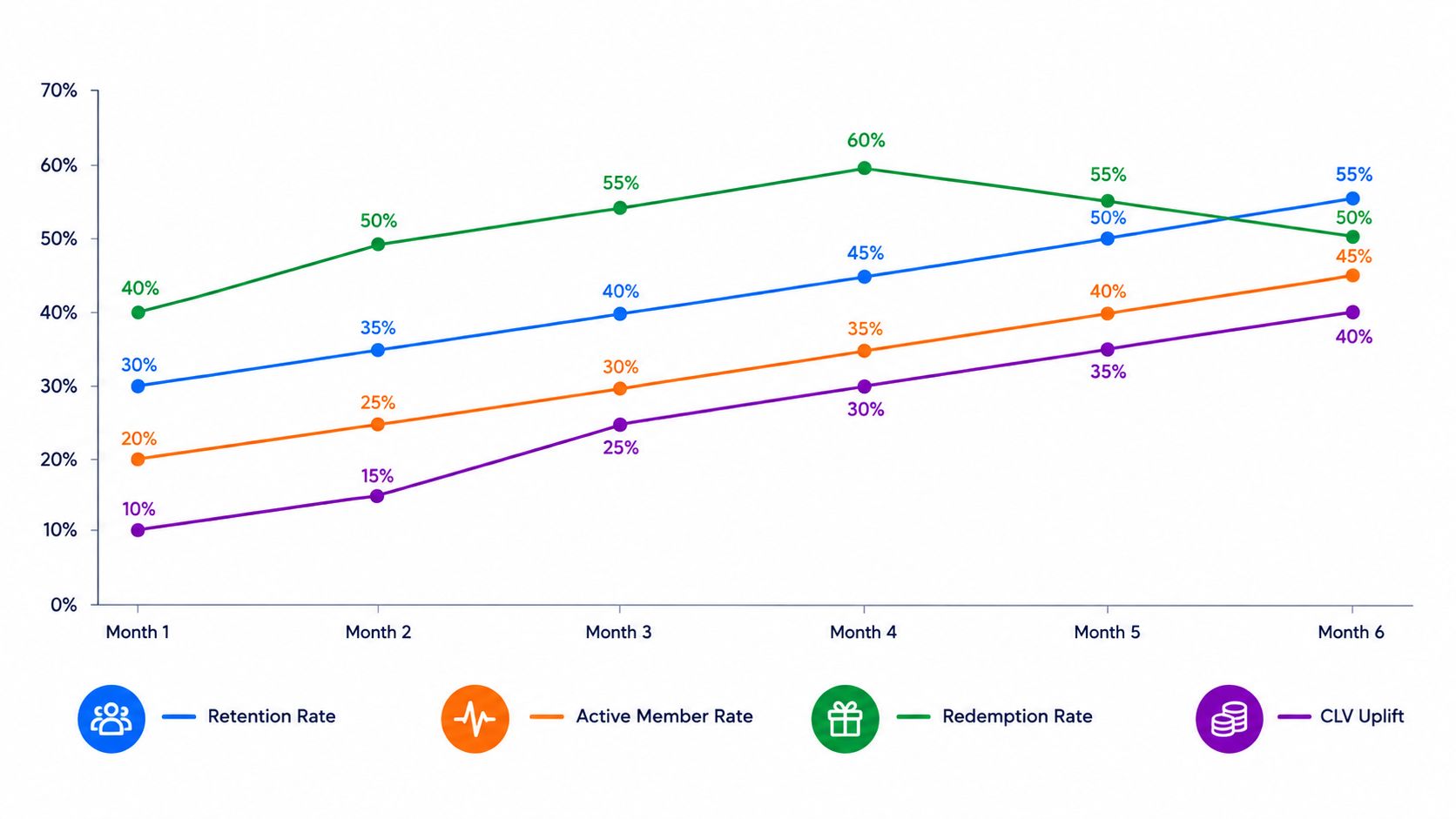
- Retention rate: Are members returning at a healthier rate than comparable non-members?
- Active member rate: Are enrolled customers earning, redeeming, or otherwise engaging?
- Redemption rate: Can customers use rewards smoothly, and does redemption lead to another profitable action?
- CLV uplift: Do members generate more value after reward costs than comparable non-members?
A 2026 benchmark cited in the retention measurement guidance suggests healthy programs often target an active member rate above 30%, member CLV around 1.4–1.6x non-member CLV, and reward cost around 1–3% of member revenue. These are planning benchmarks, not universal thresholds.
Attribute value carefully
Separate loyalty-generated behavior from behavior that would have occurred anyway. Compare customers who received a lifecycle message with similar customers who didn't. Review redemption by channel, reward type, tier, product, and campaign. Then subtract points cost, discounts, platform fees, support time, and any operational overhead.
For a practical framework on the calculation itself, use this customer lifetime value guide. Keep governance in the reporting layer too. If online and POS systems create duplicate profiles, the dashboard may show false retention, missed redemptions, or inflated member value.
The hard question is simple: Would this customer have purchased without the reward? If the answer is usually yes, change the incentive, audience, timing, or measurement design.
Common Pitfalls Migrations and How to Avoid Them
The most expensive loyalty mistake isn't choosing a platform with fewer features. It's launching a program that customers can't use consistently. Poor checkout integration, duplicate profiles, unclear refund logic, and unapproved rule changes damage trust faster than a simple program ever could.
A low redemption rate doesn't automatically mean customers aren't interested. It may indicate that rewards are hidden, checkout integration is weak, the threshold is unrealistic, or the reward doesn't fit the customer. Conversely, high redemption can conceal a margin problem when promotions and loyalty benefits stack without controls.
Watch the failure points
- Checkout is an afterthought. If customers must leave the cart to find a reward, many won't complete the process. Test visibility and application on every supported device.
- Identity is fragmented. Email, phone, POS, guest checkout, and CRM records can create multiple member profiles. Establish matching rules and a manual resolution process before launch.
- Refunds don't reverse liability. A returned order can leave points in circulation unless the platform receives and processes the correct event.
- Promotions collide. Double-points campaigns, sale pricing, free shipping, and reward discounts can combine in ways that erase contribution margin. Add approval gates for campaign changes.
- Migration treats points as decoration. Export balances, tiers, expiry dates, consent status, referral relationships, and transaction history where the new platform requires them. Validate a sample against the old system before switching.
- The team measures sign-ups only. Enrollment can grow while active participation, redemption, or member CLV stays flat. Keep the KPI hierarchy tied to revenue quality.
Migration rule: Freeze rule changes during the cutover window, preserve a read-only copy of the old member ledger, and reconcile balances before inviting customers into the new experience.
A practical migration checklist includes a field map, consent review, duplicate-identity report, points liability reconciliation, reward-code validation, refund tests, customer-service training, and a rollback decision. Notify members about meaningful changes in plain language. Explain what happens to existing points, tiers, rewards, and expiry dates before they need to ask support.
The next step is to audit the current journey. Trace one customer from first order through earning, messaging, redemption, refund, and repeat purchase. Then shortlist software that can support that journey with reliable integrations, visible economics, and governed data. ECORN provides Shopify design, development, CRO, consulting, and custom loyalty program work, including points-based systems, tiered membership, VIP recognition, and exclusive access. Visit ECORN to discuss a loyalty implementation or optimization plan grounded in retention, redemption, and margin.


Shopify Plans Comparison for Every Business Stage
How to Improve User Experience for eCommerce Growth
Shopify Checkout Optimization That Converts More
Shopify Inventory Sync: A Practical Setup Guide
Shopify App Integration Playbook That Scales
Shopify CMS Integration: Your 2026 Guide to Options
Shopify Store Audit: Find Hidden Conversion Leaks
Shopify Plus Experts: How to Hire the Right Team
Chargeback Protection Shopify: A Practical 2026 Guide
8 Examples of Conversion Rate Optimization
How to Conversion Rate Optimization for Shopify Stores

Shopify Design Essentials Every Store Owner Needs
Ecommerce Terms of Service: How to Draft and Implement
How to Implement Structured Data for Ecommerce in 2026
SEO App Mobile: Shopify Store Optimization Guide
Shopify Plus Support: What It Includes and How to Choose

Google Ads for Shopify: The Complete 2026 Playbook
Shopify New York: How to Find and Hire the Right Agency
Google Search Console for Shopify: The Complete Setup
First Party Data Collection for eCommerce Growth
FAQ Online Store Guide: Build and Measure It Right
Do FB Ads Work for eCommerce in 2026?
One Page Checkout for Shopify: Design and Implementation
Shopify GraphQL vs REST: The 2026 Developer Decision
Shopify Ecommerce Consulting: Strategy, Pricing &

Are Reddit Ads Worth It for eCommerce Brands
Shopify Title and Meta Description: A Practical 2026 Guide

Product Video Best Practices for Shopify Brands
Real-Time Inventory Management: A 2026 Guide
AI Chatbot Integration for Shopify Stores
Affiliate Program Management: A Shopify Guide
10 Best Performance Monitoring Tools for Shopify in 2026
Digital Asset Management for eCommerce Brands in 2026
Every Type of Facebook Ads Explained for eCommerce Growth
Product Information Management Explained for Shopify Brands
Support Ticket System: A Guide for Shopify Stores

10 Best Customer Service Tools for Shopify in 2026

Can I Start a Business with No Money? a 2026 Blueprint

What Sells Good on Etsy: Best Niches for 2026

Shopify Add to Cart Button: A Practical 2026 Guide

Customer Feedback Automation: A Practical eCommerce Guide
Critical Rendering Path: A Guide for Shopify Stores

How to Promote on TikTok for eCommerce in 2026

B2B eCommerce Consulting That Drives Real Revenue
10 Best Practices for Site Navigation in 2026
Return vs Refund for Shopify Stores: A Practical Guide
What Is Customer Lifetime Value and Why It Matters
What Is Voice of Customer Research for eCommerce

SMS Marketing for Ecommerce That Actually Converts

Master How to Improve Email Deliverability in 2026

Top 7 eCommerce Partners NYC for Shopify Brands in 2026
Machine Learning for Ecommerce: Boost Your Shopify Store

Beauty Market Research: Your 2026 Growth Guide

Shopify International Expansion: A 2026 Roadmap
What Does CRO Stand for in Business: Understanding CRO

Shopify Visual Merchandising: A Playbook for Higher Sales

Shopify Landing Page Design: Master Conversion in 2026
10 Best AI SEO Optimization Tools for Shopify in 2026

Agentic AI for Ecommerce: Boost Your Sales in 2026
Mastering Email Marketing Data for eCommerce Growth
Conversion Rate Optimisation Australia: Boost Your Sales
Conversion Rate Optimization AI: Your Shopify Store Guide

10 Product Bundling Strategies for Shopify in 2026
How to Increase Customer Lifetime Value: A Shopify Playbook
AI Customer Service Automation: Shopify Guide 2026

Clean Website Design: A Shopify Conversion Playbook

Omnichannel Retail Strategy: A Shopify Playbook
Product Data Enrichment: A Guide for Shopify Brands
Instagram Shopping Features a Guide for Shopify Stores
What Is Revenue Optimization: A Holistic RevOps Guide
Benefits of Conversion Rate Optimization: Boost Your
WordPress to Shopify Migration: Your 2026 Seamless Switch
Boost Sales: Ecommerce Payment Processing Guide 2026
Unified Commerce Platform: Benefits, KPIs & Shopify Guide
How to Reduce Bounce Rate eCommerce: Your 2026 Guide
Shopify API Integration: A Practical End-to-End Guide

How to Implement Data Governance: A 2026 Guide
Shopify Store Development Cost: A 2026 Breakdown
What Is Server Side Tracking: The Shopify Guide 2026
Marketing Automation Workflows: A Shopify Guide for 2026
Shopify: How to Reduce Technical Debt

Shopify UX Design Change: A Playbook for Growth
User Generated Content Strategy: Shopify Playbook
Shopify Pause and Build Plan Cost: A Complete 2026 Guide
Compare at Price on Shopify: A Complete Guide for 2026
Where Can I Sell My Prints? 10 Best Platforms for 2026
Shopify Order Management System: The Ultimate Guide 2026
What Is Marketing Attribution? an eCommerce Guide for 2026

10 Best Black Friday Sales Sheets for 2026

Discover the Top Social Media Marketing Agencies For
Consumer Confidence Definition for eCommerce in 2026
What Is Social Commerce? Your 2026 Guide to Boosting Sales
A Social Ad Campaign Playbook for eCommerce Growth

7 Best FAQ Page Examples for SaaS & eCommerce

Market Research in Fashion Industry: A Guide for Shopify
Shopify Migration Services: Expert Guide for 2026
Mastering FB Retargeting Ads for Shopify in 2026
What Is Omnichannel Ecommerce
Master Your Shopify Plus Migration: The 2026 Guide
Shopify Integration Services: A Merchant's 2026 Guide


newsletter in your inbox