

You're probably sitting on a pile of customer signals already. Support tickets mention sizing confusion, post-purchase emails complain about shipping, one product launch underperforms, and a monthly survey gives you a neat score that still doesn't tell you what to fix first. That's the exact point where voice of customer research stops being a marketing buzzword and starts acting like operating infrastructure for a Shopify brand.
VoC is the formal way to capture what customers think, feel, need, and expect, then turn that feedback into action. Qualtrics describes it as the collective term for customer opinions and feedback, and Harvard Business School Online frames VoC programs as structured efforts that pull input from surveys, interviews, observation, website analytics, social listening, support transcripts, and live chat, which is why VoC is bigger than a single survey form. It's the bridge between customer language and business decisions, especially when your store has outgrown gut feel and scattered anecdotes.
Why Your Customer Feedback Feels Disconnected
A growing Shopify brand often reaches a strange stage. The founder has support transcripts in Gorgias, a few survey results in a spreadsheet, and a marketer forwarding angry emails about checkout issues, yet nobody can answer the simple question of why conversion slipped last month. The data exists, but it's fragmented into little islands that never get connected to one another, so the team keeps reacting to symptoms instead of fixing the cause.
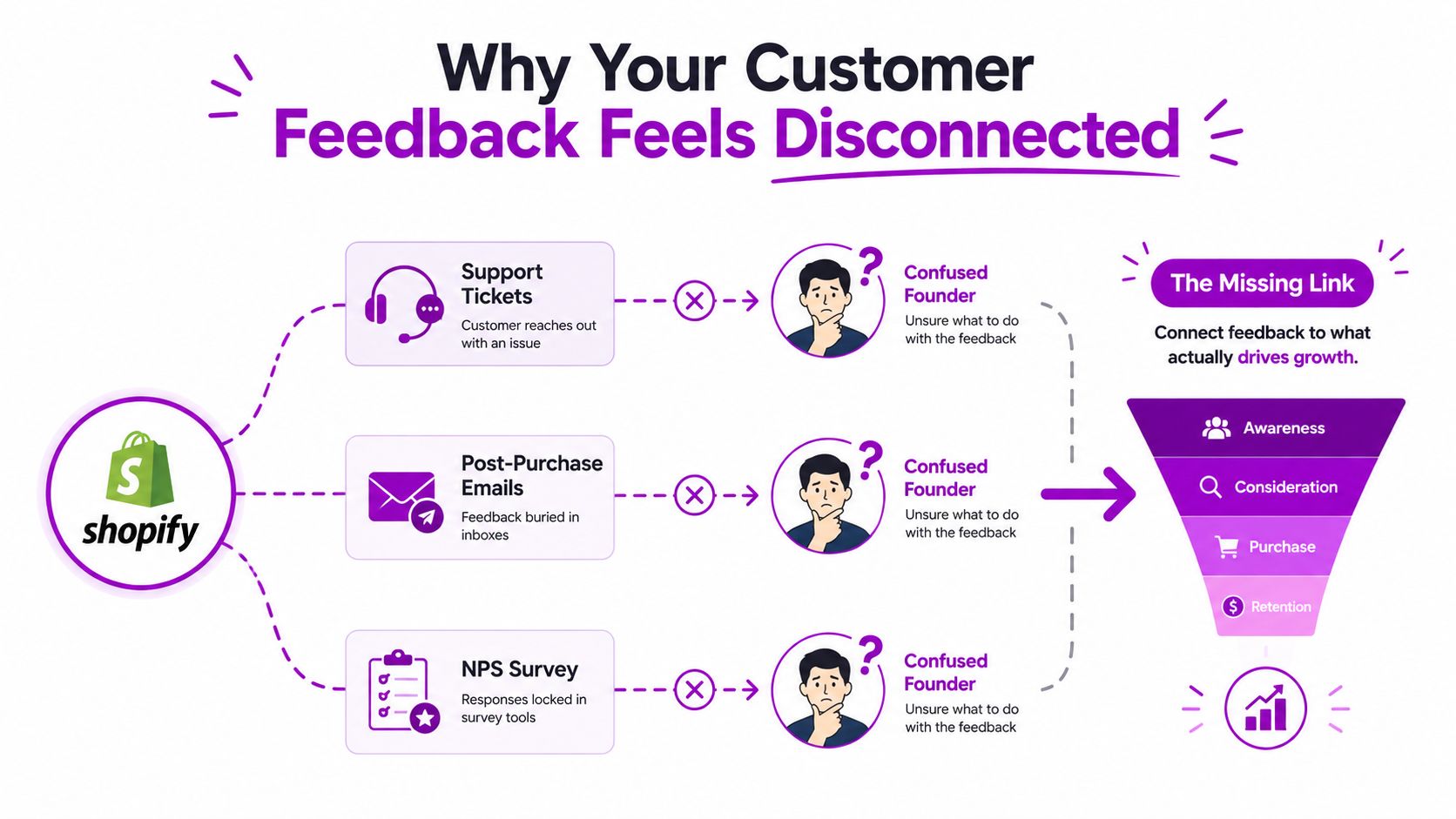
That's where voice of customer research changes the conversation. It isn't another feedback collector or another survey app. It's a formal market-research and customer-experience system that gathers direct and indirect signals, then turns them into prioritized action across product, marketing, support, and operations.
What VoC actually does for an eCommerce team
VoC combines quantitative benchmarks such as NPS, CSAT, and CES with qualitative evidence like verbatim comments, support logs, and chat transcripts. That matters because a top-line score tells you whether there's a problem, but it doesn't explain which page, promise, or process caused it. Modern VoC tools are designed to integrate structured feedback with free-text analysis, then normalize those signals into a common taxonomy so recurring themes can be tracked over time, as noted by Gartner's review of voice of the customer platforms and Qualtrics' description of text and sentiment analysis in VoC programs Gartner's overview of Voice of the Customer platforms, Qualtrics on voice of customer analytics.
That's the missing layer for many founders. A feedback pile is not a decision system. VoC becomes useful when the team can look at one set of evidence and say, “This is a checkout issue,” or “This is a promise mismatch on the product page,” then decide what gets fixed first.
A practical rule helps here.
Practical rule: if feedback can't change a roadmap item, a landing page, or a support workflow, it isn't yet functioning as VoC.
The difference shows up in revenue conversations. Basic feedback says customers are unhappy. Mature VoC tells you what customers are trying to do, where they get stuck, and which friction points deserve the next experiment. That's why it matters less as a reporting exercise and more as the missing decision layer between what customers say and what your team builds next.
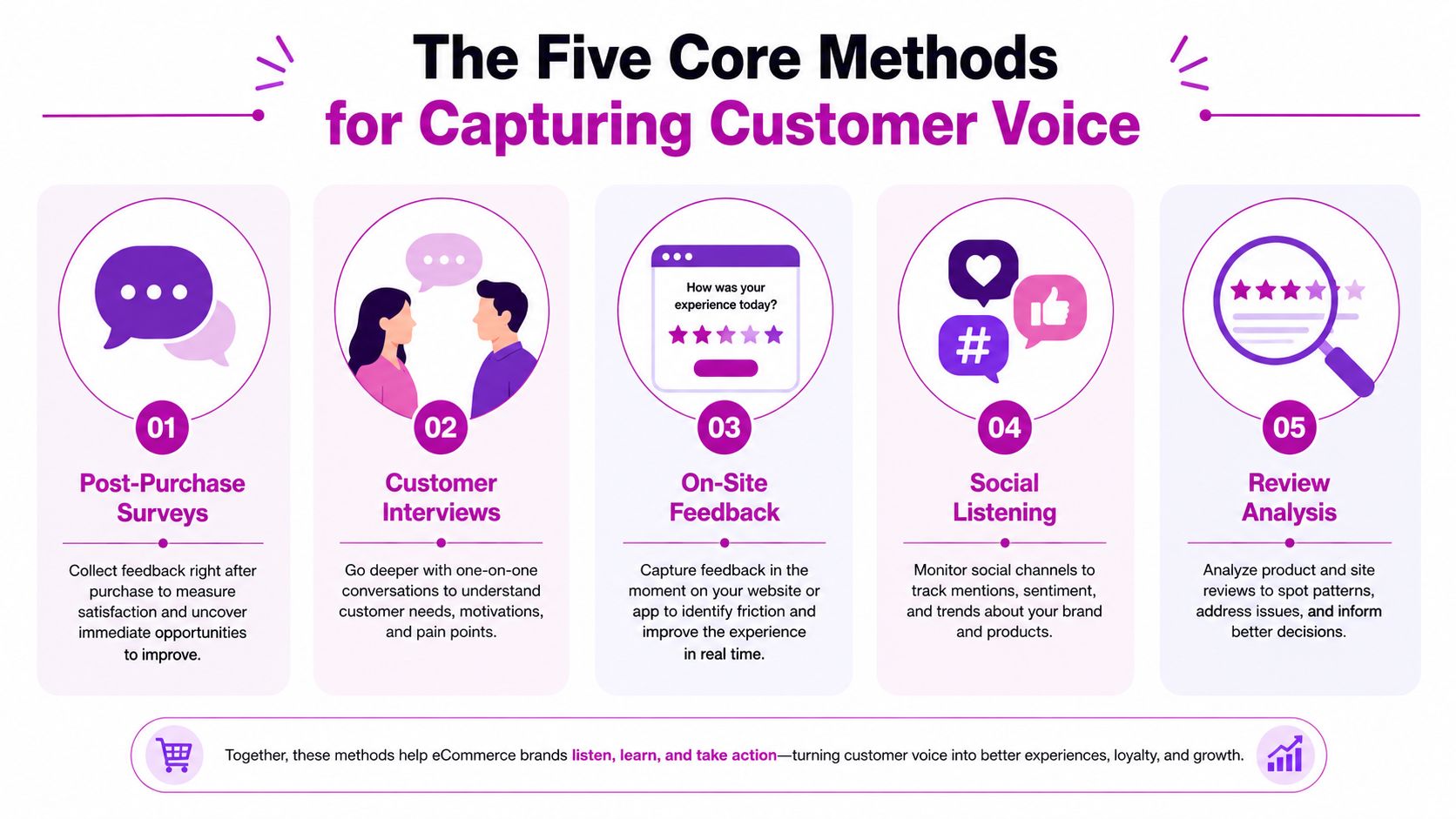
The Five Core Methods for Capturing Customer Voice
The cleanest VoC stack for a Shopify brand doesn't need ten tools. It needs the right mix of methods that answer different questions, because no single channel captures the full story. Surveys benchmark sentiment, interviews surface motivation, widgets catch friction in the moment, social listening reveals unsolicited language, and behavioral analytics show what people do when they don't say much at all.
Post-purchase surveys and on-site prompts
Post-purchase surveys work best when you want a repeatable read on satisfaction trends. If you're trying to understand whether your unboxing experience, shipping promise, or order accuracy is improving, a structured survey gives you a measurable baseline. For a practical example of how these surveys are built in commerce contexts, the guide on post-purchase survey design from ECORN is a useful reference point.
On-site feedback widgets serve a different purpose. They capture feedback in the exact moment someone hits friction, such as a vague shipping estimator, an unclear return policy, or a confusing bundle offer. That makes them especially useful on product pages, carts, and checkout-adjacent pages where intent is high and patience is low.
Interviews, social listening, and review analysis
Customer interviews are where the emotional drivers show up. They're slower, but they're often the fastest way to understand why someone abandoned a cart or hesitated on a premium bundle. If you need help understanding who to talk to before you schedule those calls, the audience work behind understanding your audience with SuperX can sharpen your recruitment.
Social listening captures what people say when they're not talking to you. That includes praise, complaints, and comparative language you won't get in a survey form. Review analysis does something similar, but with a different texture, because reviews often contain the blunt, unfiltered phrases customers use when evaluating your brand against alternatives.
Behavioral analytics as the reality check
Behavioral analytics provide a reality check because what customers say and what they do don't always match. Shopify analytics, heatmaps, and session recordings show where buyers hesitate, loop, or drop out. VoC becomes stronger when the spoken feedback and the observed behavior point to the same problem.
A mature stack doesn't pick one method and call it done. It combines them, then uses each one for the job it does best. That mix is what turns raw customer voice into something your team can work with.
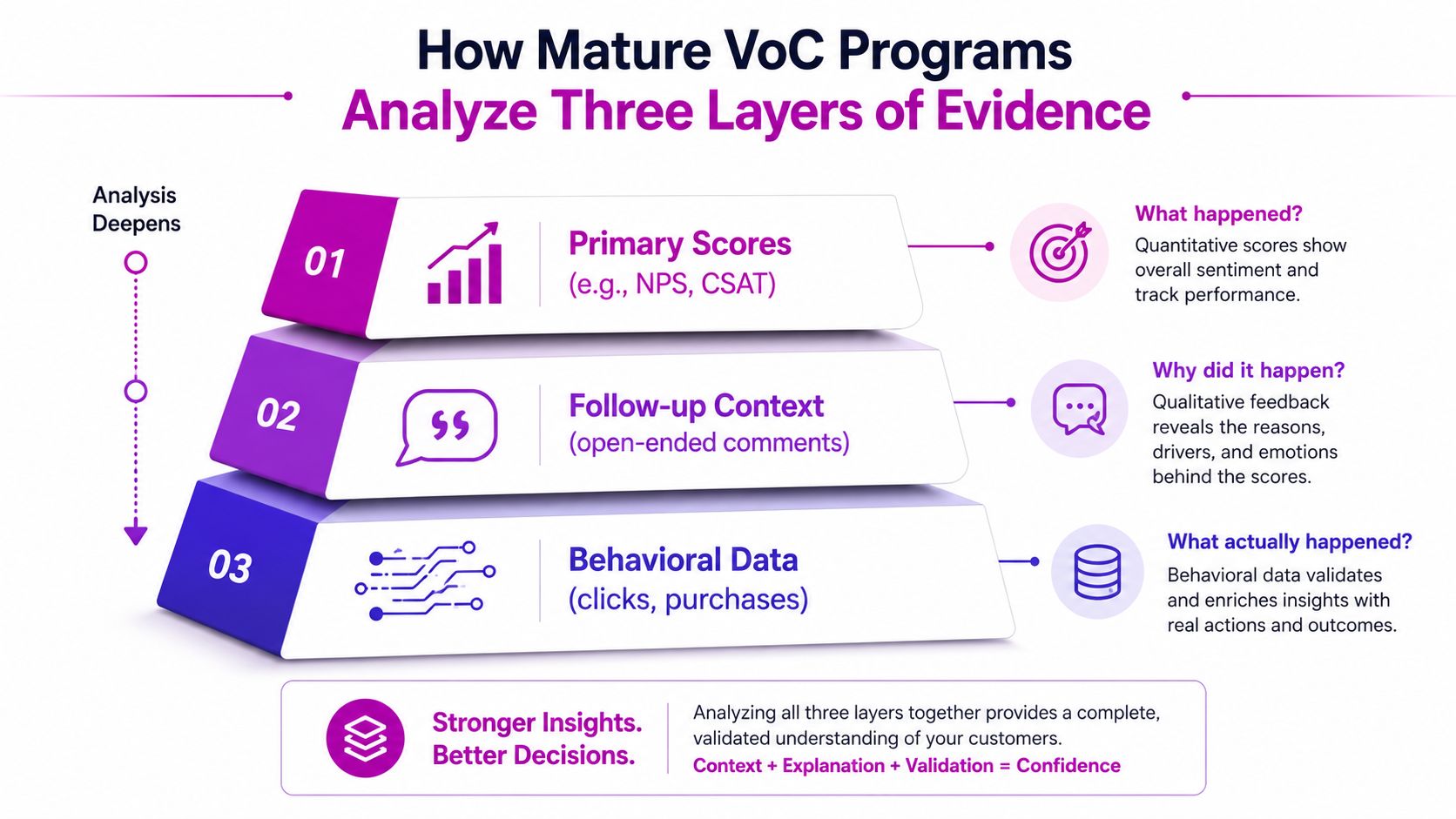
How Mature VoC Programs Analyze Three Layers of Evidence
Basic programs stop at the score. Mature programs start there, then move into the reasons behind the score and the behavior around it. That matters because a low score does not tell you whether the problem came from shipping speed, product fit, a support interaction, or a broken journey step. CustomerGauge's analysis framework is useful here because it separates the main question, the follow-up questions, and the free-text commentary into different layers of evidence CustomerGauge on voice of customer analysis.
Primary score, follow-up driver, free text
The primary score answers whether there is a problem. That is the role of metrics like NPS, CSAT, and CES. The follow-up driver explains why the customer scored the experience that way. The free-text comment then adds the detail that makes the problem actionable, such as a mention of the wrong size guide, a confusing delivery estimate, or a checkout step that felt repetitive.
That three-layer structure turns VoC into an operating system for decisions, not a collection of comments. A CX lead cannot prioritize a theme just because it appears often. The better question is whether it connects to revenue, reorders, refunds, or support load. Mature teams group comments into a common taxonomy, tie them to journey stages, and compare those patterns over time so the team can see whether the same friction keeps showing up in product-page browsing, cart review, or post-purchase follow-up.
A score is a warning light. The comment tells you which part of the engine is failing.
Turning language into a system
The technical work starts with normalization. Customer comments arrive in messy language, but the team needs consistent labels if they want to compare product-page friction with checkout friction or post-purchase dissatisfaction. Text analytics and sentiment analysis help here because they let the team process larger volumes of language without losing the recurring patterns. For a closer look at the analytics side, see our guide to customer experience analytics.
For a Shopify founder, the trade-off is clear. If you chase every complaint, you drown. If you only watch the score, you miss the cause. Mature VoC programs rank themes by business impact, then use the evidence stack to decide what deserves design, development, or messaging attention first. The result is less complaint tracking and more operational clarity.
Turning VoC Insights into Shopify Conversion Improvements
VoC is only valuable when it changes what your team ships. That's why the best Shopify brands don't stop at “customers are confused.” They convert the theme into a testable CRO hypothesis, then validate it with Shopify analytics, heatmaps, and session recordings. If feedback says the size guide is unclear and analytics show a drop-off on the product page, that's not a soft opinion. It's a concrete page-level problem with a fixable path.
A lot of teams make the mistake of feeding VoC into a spreadsheet, then waiting for someone to “review insights.” That usually kills momentum. Instead, turn each repeated theme into a named owner, a target page, and a measurable change request. Designers need the wording customers used, developers need the page location, and marketers need the promise that needs to match the landing page.
What to do with common eCommerce themes
If customers say the size guide is hard to trust, test an interactive sizing tool or a clearer fit selector. If they complain about shipping costs late in the journey, use that language to test threshold messaging or cart framing. If support tickets keep mentioning discount confusion or address errors, inspect checkout friction before you blame traffic quality. The point isn't to guess a solution from thin air. The point is to let customer language shape the hypothesis.
The best VoC output is not a report. It's a backlog item that someone can build, test, and measure.
How to keep teams from ignoring it
The handoff matters as much as the insight. Share a short summary with three parts, the customer phrase, the evidence source, and the likely page or step. That format helps developers, CRO specialists, and store operators move faster than a long deck full of generalities. Use the same language in Jira or Asana so the team doesn't lose the thread between research and execution.
VoC also works as a validation layer. If customers complain about a checkout issue but the session recordings don't show abandonment there, the team should look deeper before spending dev time. Sometimes the issue sits one step earlier, in the PDP, cart, or shipping estimator. VoC helps you locate the friction, but the store data tells you whether the friction is severe enough to matter.
Reaching Customers Who Do Not Answer Standard Surveys
Standard surveys overrepresent the people who like answering surveys. That sounds obvious, but it creates a real blind spot for brands with newer audiences, multilingual shoppers, accessibility needs, or lower-engagement customer segments. Independent research on hard-to-survey populations argues there isn't a single VoC method that fits everyone, and recommends mixing qualitative and quantitative methods, using observation, and meeting people in context when standard questions won't reliably work capture the voice of hard-to-survey populations.
Why some customers stay invisible
Some customers don't answer because the format is wrong, not because the experience doesn't matter. Others can't easily express what happened in survey language. That can include shoppers with limited patience, language barriers, low digital confidence, or a purchase journey that's too complex to compress into a few closed questions. If your VoC program only listens to the easiest responders, it will skew toward the loudest and most engaged segment, not the full customer base.
Contextual interviews help here because they let you ask questions around the actual journey, not an abstract memory of it. Observational methods are useful too, especially when customers struggle to describe a problem but can clearly demonstrate it. Mixed-method work is often the most honest option, because it respects the fact that some feedback is better observed than asked for directly.
Practical ways to widen coverage
Recruitment needs to be more deliberate than a generic email blast. Use support logs, order history, language preferences, and channel behavior to identify people who've experienced the friction you want to study. If your store serves multiple languages, tools such as Spanish-capable sentiment analyzers can help you avoid flattening nuance in multilingual feedback.
A better VoC program doesn't force every customer into the same research format. It mixes methods so the brand hears from people who are easy to survey and people who aren't. That makes the insights less tidy, but a lot more useful.
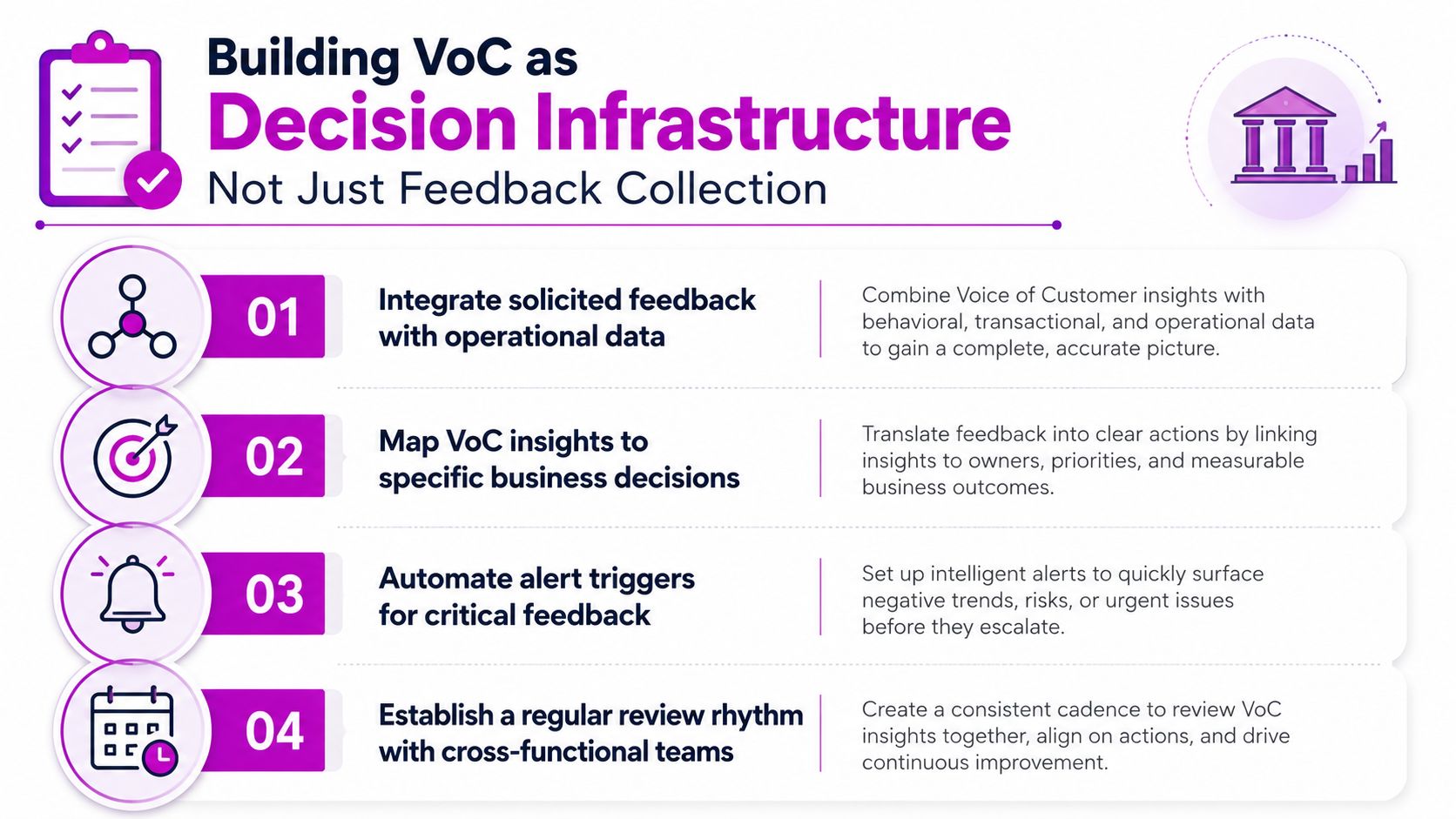
Building VoC as Decision Infrastructure Not Just Feedback Collection
VoC fails when it becomes a quarterly report no one trusts and nobody acts on. Strong programs work differently. They integrate solicited feedback with unsolicited comments and behavioral data, then attach those signals to measurable outcomes like conversion, churn, and cost-to-serve. That's why the right question isn't “Do we collect VoC?” It's “Does VoC change decisions in a way we can see?”
The KPIs that matter
NPS and CSAT still have value, but they're not enough on their own. Mature programs also watch response rate, coverage, and closing-the-loop rate, because a program that reaches too few customers or fails to respond to critical feedback isn't really operating as infrastructure. The KPI set should tell you whether the system is working, not just whether customers are happy.
The historical shift toward always-on VoC matters here too. Heidi Cohen's summary of voice-assistant research shows how customer language became central as voice interactions grew more common, with common use cases including weather checks at 56%, music at 55%, and phone calls at 44% voice consumer statistics from VCI Research via Heidi Cohen. The numbers aren't the point for a Shopify operator. The point is that customer language now appears everywhere, and the best programs are built to capture that language continuously rather than seasonally.
What breaks the system
The most common failure is treating VoC as a one-off project. Another is collecting data without routing it to product, CX, or marketing owners. A third is never closing the loop with customers, which makes the brand look like it asked for input but didn't care enough to respond.
A sustainable rhythm is simpler than many teams think. Create a regular review with the people who can act, keep the taxonomy stable enough to compare themes over time, and trigger escalations when feedback reveals a serious issue. That setup turns VoC from a research artifact into a management habit.
For Shopify brands, that's the prize. You don't need more opinions. You need a system that tells the team where the money is leaking, where the customer experience is breaking, and what deserves the next round of work.
Your Practical VoC Launch Plan for Shopify Brands
Start small and make it real. In the first 30 to 60 days, pick one post-purchase survey, one interview stream, and one on-site feedback point. Ask customers one open-ended question about what almost stopped them from buying, one question about what made the experience easier, and one question about what they still wish were clearer. Keep the language close to the actual store experience, not market research jargon.
Run a simple first-pass analysis session with support, marketing, and whoever owns the storefront. Group comments by theme, match them against Shopify analytics, and mark the issues that appear in both customer language and behavior data. That's the quickest way to avoid overreacting to a noisy complaint and underreacting to a real conversion problem.
Use a lightweight setup at first, then expand only after the team has made one or two changes from the findings. The first proof of value isn't a perfect dashboard. It's a decision that gets made faster because customer voice was visible.
A CTA for ECORN.


How to Cross Sell on Shopify Without Friction
Best Shopify Theme for Custom Products Compared
Multi Store Inventory Management: A Practical Guide

SEO Consulting for Ecommerce: A Practical Guide
Shopify Theme Updater App: A Safe Update Playbook
Shopify Git Integration: A Developer's Guide to 2026
Headless Ecommerce Development Services Explained

How to Build a Shopify Clothing Website That Converts

How to Launch a Box Subscription Business in 2026

Luxury Skincare Branding Playbook That Converters

10 Best Podcast Ecommerce Shows for Store Growth in 2026
Shopify Developer Hourly Rate: What to Pay in 2026
Critical Shopify Setup Errors That Are Secretly Sabotaging Your Store
Ecommerce Conversion Tracking: The Complete How-To Guide
Shopify Design Agency: How to Pick the Right Partner
Mastering Multi Store Management on Shopify
Scale Shopify Store

10 Shopify App Ideas Worth Building in 2026
Conversion Rate Optimization for Landing Pages: The Playbook
Shopify Plus Automation: A Guide for 2026
10 Social Selling Platforms for Shopify Merchants

Shopify Website Design Examples: 7 Stores Worth Studying
7 Ecommerce Newsletter Examples for Shopify Brands
One Product Shopify Store: Build and Scale

Mobile Pop Up Strategy for Shopify Stores That Converts
Sitemap for Shopify: How to Find, Optimize, and Submit It
7 Single Product Websites Worth Emulating
Product Variants Shopify: The Complete 2026 Guide
Ecommerce Analytics Consulting for Growth
What Is AI Integration for eCommerce
How to Choose the Right eCommerce Website Development Firm
E Business Strategy Implementation
Conversion Tracking Setup for Shopify Stores
BigCommerce vs Shopify Plus Which Enterprise Wins in 2026
Shopify Theme Kit: Setup, Commands, and Migration Guide
Shopify Extension Development: A Practical 2026 Guide
Shopify Speed Score Explained and How to Improve It
Shopify Mobile Optimization: The 2026 Playbook
How to Add Subcategory in Shopify for Better UX
How to Implement Structured Data for Ecommerce in 2026
SEO App Mobile: Shopify Store Optimization Guide

Shopify Plus Support: What It Includes and How to Choose

Google Ads for Shopify: The Complete 2026 Playbook

Shopify New York: How to Find and Hire the Right Agency
Google Search Console for Shopify: The Complete Setup
First Party Data Collection for eCommerce Growth
FAQ Online Store Guide: Build and Measure It Right
Do FB Ads Work for eCommerce in 2026?
One Page Checkout for Shopify: Design and Implementation
Shopify GraphQL vs REST: The 2026 Developer Decision
Shopify Ecommerce Consulting: Strategy, Pricing &

Are Reddit Ads Worth It for eCommerce Brands
Shopify Title and Meta Description: A Practical 2026 Guide

Product Video Best Practices for Shopify Brands
Real-Time Inventory Management: A 2026 Guide
AI Chatbot Integration for Shopify Stores
Affiliate Program Management: A Shopify Guide
10 Best Performance Monitoring Tools for Shopify in 2026
Digital Asset Management for eCommerce Brands in 2026
Every Type of Facebook Ads Explained for eCommerce Growth
Product Information Management Explained for Shopify Brands
Support Ticket System: A Guide for Shopify Stores

10 Best Customer Service Tools for Shopify in 2026

Can I Start a Business with No Money? a 2026 Blueprint

What Sells Good on Etsy: Best Niches for 2026

Shopify Add to Cart Button: A Practical 2026 Guide

Customer Feedback Automation: A Practical eCommerce Guide
Critical Rendering Path: A Guide for Shopify Stores

How to Promote on TikTok for eCommerce in 2026

B2B eCommerce Consulting That Drives Real Revenue
10 Best Practices for Site Navigation in 2026
Return vs Refund for Shopify Stores: A Practical Guide
What Is Customer Lifetime Value and Why It Matters

SMS Marketing for Ecommerce That Actually Converts

Master How to Improve Email Deliverability in 2026

Top 8 eCommerce Partners NYC for Shopify Brands in 2026
Machine Learning for Ecommerce: Boost Your Shopify Store

Beauty Market Research: Your 2026 Growth Guide

Shopify International Expansion: A 2026 Roadmap
What Does CRO Stand for in Business: Understanding CRO

Shopify Visual Merchandising: A Playbook for Higher Sales

Shopify Landing Page Design: Master Conversion in 2026
10 Best AI SEO Optimization Tools for Shopify in 2026

Agentic AI for Ecommerce: Boost Your Sales in 2026
Mastering Email Marketing Data for eCommerce Growth

Conversion Rate Optimisation Australia: Boost Your Sales
Conversion Rate Optimization AI: Your Shopify Store Guide

10 Product Bundling Strategies for Shopify in 2026
How to Increase Customer Lifetime Value: A Shopify Playbook
AI Customer Service Automation: Shopify Guide 2026

Clean Website Design: A Shopify Conversion Playbook

Omnichannel Retail Strategy: A Shopify Playbook
Product Data Enrichment: A Guide for Shopify Brands
Instagram Shopping Features a Guide for Shopify Stores
What Is Revenue Optimization: A Holistic RevOps Guide

Benefits of Conversion Rate Optimization: Boost Your
WordPress to Shopify Migration: Your 2026 Seamless Switch
Boost Sales: Ecommerce Payment Processing Guide 2026
Unified Commerce Platform: Benefits, KPIs & Shopify Guide

How to Reduce Bounce Rate eCommerce: Your 2026 Guide


newsletter in your inbox