

Most advice on the type of Facebook ads starts in the wrong place. Store owners open Ads Manager, pick image, video, or carousel, then wonder why CTR looks fine while Shopify revenue stays flat.
That order is backwards. The first decision should be the creative angle, the specific pain, desire, or proof point the ad needs to carry, because format is just the delivery vehicle. Strong practitioners argue the angle matters more than the format, since the test is qualified leads and revenue, not clicks alone (enterprise Facebook Ads optimization tactics). For Shopify brands, that matters even more now that Facebook delivery is overwhelmingly mobile-first and format mix is tied to how people consume content on their phones (81.8% mobile impressions and placement mix data).
That shift changes the whole question. Instead of asking, “Which Facebook ad types exist?” ask, “What buyer objection or desire am I trying to remove at this stage of the funnel?” When you answer that first, the ad format becomes a tactical choice, not a guess.
Why the Wrong Type of Facebook Ads Kills eCommerce Performance
Most eCommerce teams don't have a format problem, they have a message problem. They choose an ad type before they define what the prospect needs to believe, and the result is usually a generic creative that can win attention without creating purchase intent.
That's especially costly on Facebook because the platform's delivery is now shaped by mobile behavior and immersive placements. A 2026 industry roundup says 81.8% of ad impressions are served on mobile, with feed placements at 55–65%, Stories at 30–40%, and Reels at 10–20% (mobile and placement mix data). If the ad isn't built for that environment, it gets skimmed, not absorbed.
Format-first thinking creates false wins
A single-image ad can produce a respectable CTR and still fail on Shopify. That usually happens when the creative is optimized for curiosity instead of purchase intent, so the click is cheap but the session is weak. The store gets traffic that looks active, but the audience wasn't moved by a clear pain point, product benefit, or proof signal.
Practical rule: if you can't say what objection the ad removes, don't scale it yet.
This is why the type of Facebook ads question has to be funnel-aware. A cold prospect seeing a premium skincare brand needs a different proof structure than a cart abandoner who already viewed a product page. The same format can work in both places, but only if the message changes with the buyer's intent.
The angle decides whether the format has any chance
If the angle is weak, no ad type can rescue it. A carousel, a Reel, and a collection ad all fail when they're carrying the same vague line, the same overused lifestyle shot, or the same shallow claim that could apply to any competitor. The format is not the strategy. It's the packaging.
The best operators treat ad types as containers for persuasion. They define the hook first, then choose whether that hook needs motion, sequential slides, product depth, or a direct static visual. That mindset is what keeps CTR from becoming a vanity metric and keeps campaign decisions tied to Shopify economics instead of creative aesthetics.
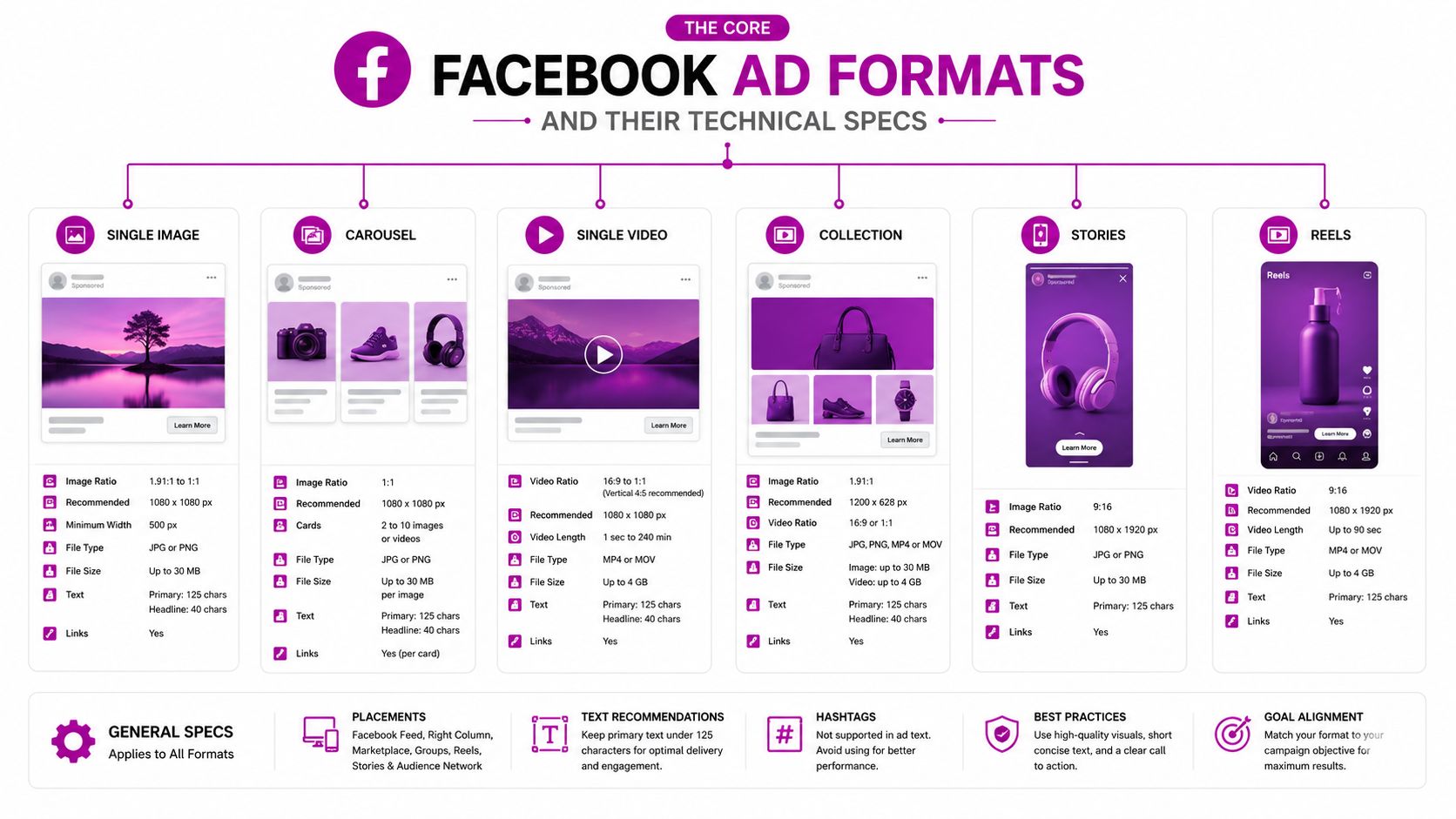
The Core Facebook Ad Formats and Their Technical Specs
The ad format selection looks crowded until you sort it by what it does in a mobile feed. Facebook's market now leans hard toward mobile and immersive consumption, so the practical question is whether the format can survive fast scrolling and still communicate the offer cleanly (placement mix data).
Image, video, carousel, and collection ads
Image ads are still the easiest entry point. Meta's guide recommends the highest-resolution asset that fits the allowed ratio, with common placements supporting 1:1 or 4:5, and a minimum width of 600 pixels (Meta image ad specs). Industry spec roundups also note a 30 MB maximum file size and that 4:5 usually wins more vertical space in mobile feeds. For eCommerce, that matters because a taller frame lets the product dominate the scroll, especially for apparel, beauty, and home goods.
Video ads are stronger when the product needs motion to make sense. Meta specifies a minimum width and height of 120 pixels, a maximum file size of 4 GB, and a duration range from 1 second to 241 minutes (Meta video ad specs). In practice, many performance teams keep videos short because people finish them more often in-feed. Product demos, before-and-after sequences, and UGC-style proof clips all fit here.
Carousel ads work well when the offer needs multiple angles, variants, or steps. They're useful for catalog-heavy brands, bundles, and products that benefit from showing more than one benefit in sequence. I like them when the first card is the hook and the following cards deepen desire, answer objections, or compare SKUs.
Collection ads and Instant Experience are the closest thing to mobile storefronts inside Meta. They're useful when a brand has multiple products or wants to guide people through a curated set rather than a single item. For larger assortments, they feel closer to window shopping than a standard click-out ad.
Operational note: the more products or scenes a format needs, the more important your asset library becomes. Weak photography turns every flexible format into a bottleneck.
Stories, Reels, lead ads, and dynamic product ads
Stories and Reels are the most native to vertical mobile behavior, which is why they often deserve attention even when the creative team prefers feed-style assets. Stories ads favor fast, full-screen communication. Reels ads are the more aggressive short-form environment, and the available benchmark says they can generate 50% higher conversions than static image ads (format benchmark data).
Lead ads are less relevant for pure eCommerce than for high-consideration offers, but they matter when the store sells complex products, subscriptions, or appointment-based offers. They shorten the path to action by letting people submit within Meta instead of jumping to a landing page.
Dynamic product ads pull from the product feed and are essential for catalog retargeting. They're the format most stores underuse because they assume dynamic means automated, but the feed still needs clean titles, prices, images, and segmentation discipline. Poor feed hygiene makes the ad look lazy even when the algorithm is doing the heavy lifting.
If you want a broader creative reference point, this Facebook ads format guide is useful for seeing how different ad types map to eCommerce goals without treating every format like it serves the same job.
Matching Each Ad Type to the Shopify Funnel
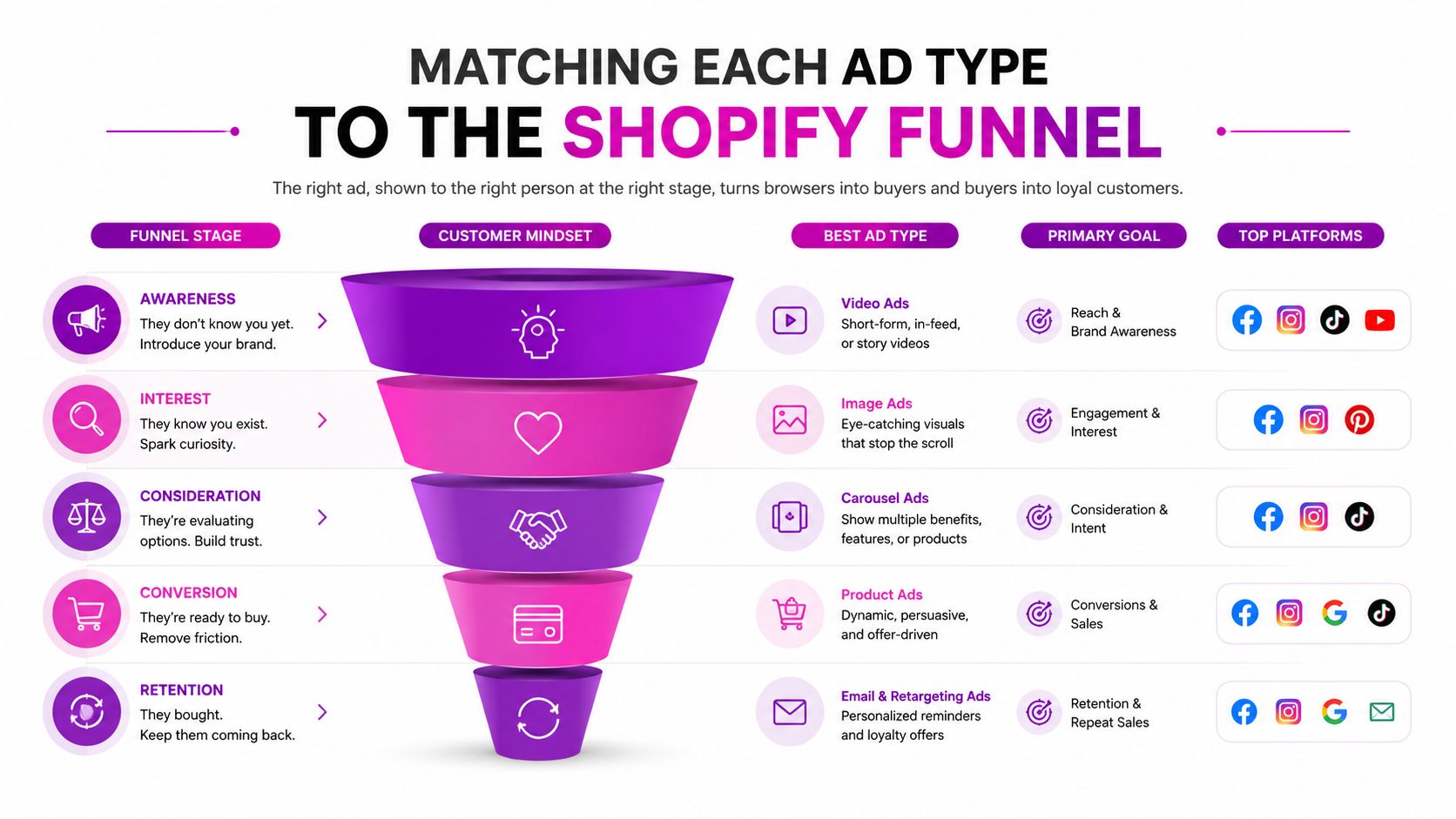
The best way to map Facebook formats to Shopify is to think in purchase stages, not ad categories. A cold visitor needs context, a warm visitor needs comparison, and a nearly-ready buyer needs proof plus friction removal. The format should match that state of mind.
Cold prospecting needs fast belief creation
For cold traffic, video, Reels, and strong image ads do the heavy lifting. The job here is not to explain every feature. It's to get the right person to stop, understand the product promise, and believe the brand can solve a real problem. Short, sharp demos and UGC-style clips usually do that better than polished but abstract brand content.
Use one message, one problem, one visible outcome. If the creative tries to teach, sell, and entertain at the same time, it often loses the first few seconds that matter most.
Mid-funnel needs comparison and product depth
Once people have engaged, carousel ads and collection ads become much more useful. They let you show product variants, bundles, use cases, or feature stacks without forcing the audience into a single linear message. That makes them strong for audiences who already know the category and are deciding between options.
Instant Experience fits higher-consideration products because it gives more space for storytelling, proof, and merchandising without the friction of a full site load. It's especially useful when the purchase needs more reassurance than a simple scroll-stop can provide.
Bottom-funnel needs specificity
For cart abandoners, product viewers, and past purchasers, dynamic product ads and retargeting-focused image or carousel ads are usually the sharpest tools. The ad should reflect the exact item or a close variant, not a generic hero creative. At this stage, the audience doesn't need broad education. It needs a reminder, a nudge, or a reason to come back now.
For stores building structured retargeting, this Facebook retargeting workflow resource is a useful operational reference for how retargeting logic fits into the rest of the account.
Comparing Performance Across Static, Carousel, Video, and Short-Form Ads
The cleanest comparison is not “which format is best,” but “which format gives you the strongest mix of click quality, conversion behavior, and production burden.” That's where many teams make expensive mistakes. They chase the benchmark they like instead of the format their team can support.
Facebook Ad Format Performance Snapshot
| Ad Format | Reported CTR | Conversion Behavior | Best Funnel Stage |
|---|---|---|---|
| Static image ads | 1.9% in the static benchmark, 0.90% average across all industries, and 1.9% for static ads in the AI-powered comparison (benchmark data) | Strong when the visual is obvious and the offer is simple, but limited when the product needs explanation | Cold or retargeting, depending on the angle |
| Carousel ads | 1.92% (benchmark data) | Often better for variant discovery and product comparison because each card can carry its own message | Mid-funnel and warm retargeting |
| Video ads | 1.84% (benchmark data) | Good for education, trust-building, and demonstration, especially when the product needs motion | Cold prospecting and mid-funnel |
| Reels ads | No CTR figure provided in the verified data | Described as generating 50% higher conversions than static image ads (benchmark data) | Cold prospecting and fast-moving creative testing |
Carousel often beats single-image work for product catalogs because it reduces the burden on one frame to do everything. The first card can hook, the second can prove, and the third can close a specific objection. That's a much better fit for stores with multiple variants, bundles, or complementary products.
Video earns its place when the product needs demonstration or social proof. It is harder to produce, but the trade-off is clarity. If the item is procedural, tactile, or visually compelling, the motion can do what a static image can't.
I also like a disciplined asset handoff here. This client delivery workflow for social media photos is a good reminder that the production side matters just as much as the media plan. If creative files arrive late or in the wrong crop, the team loses testing speed before the campaign even has a chance.
Reels deserve attention because they behave more like native content than a classic ad unit. That makes them useful when the brand can look human, unfiltered, and product-first without feeling overly produced. The caveat is obvious, short-form that feels fake or over-edited usually gets ignored.
My rule of thumb: pick the format that removes the most friction for the buyer, then judge it by downstream purchase quality, not by the prettiness of the asset.
Integrating Facebook Ad Formats with Shopify and Retargeting Workflows
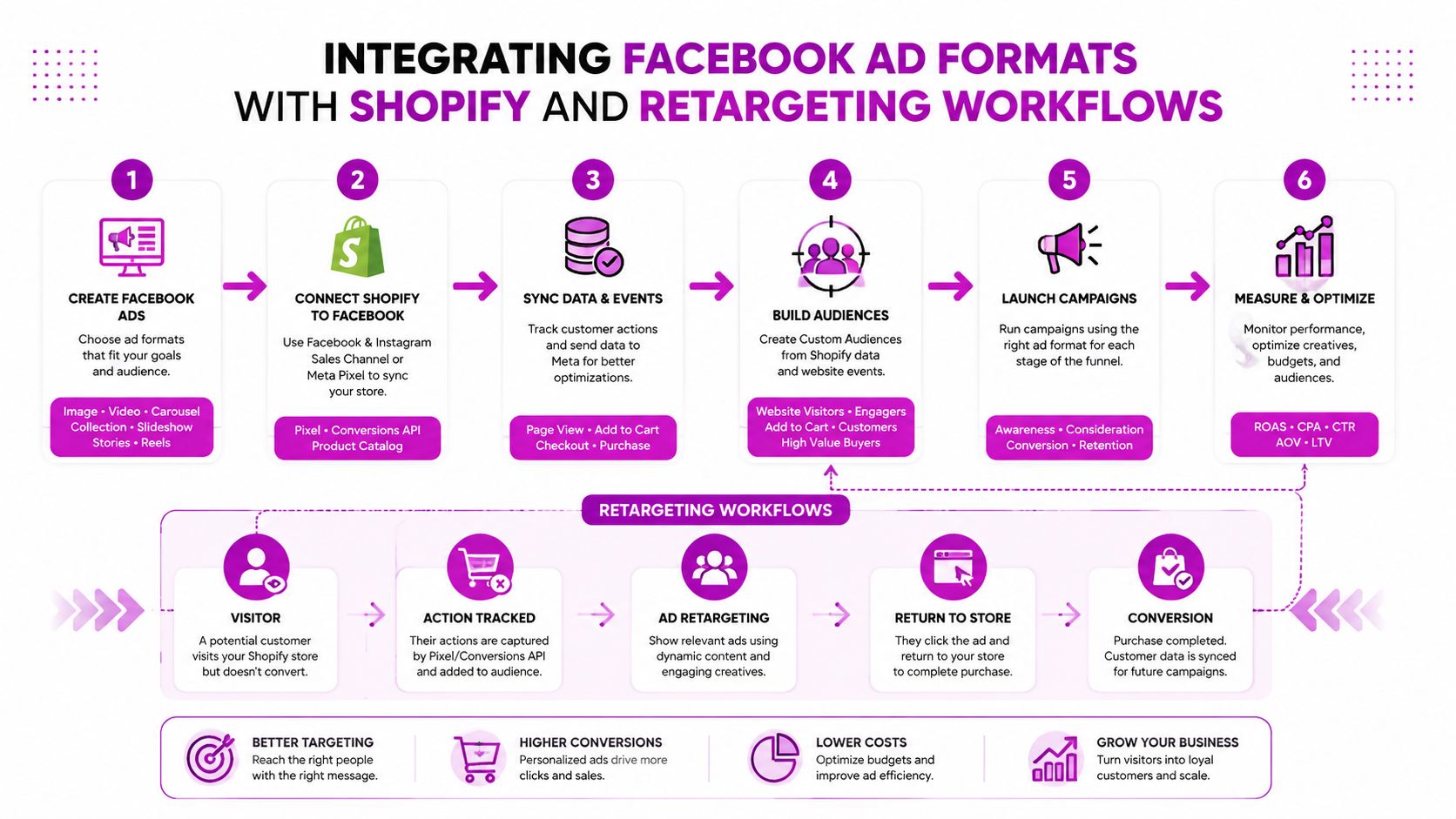
The account works best when the product feed, prospecting creative, and retargeting sequence all point in the same direction. If a cold ad promises one thing and the retargeting ad behaves like a different brand, the path to purchase gets messy fast.
Make the feed do real work
Dynamic product ads are only as good as the Shopify feed behind them. Titles should be legible, product images should be clean, and the catalog should reflect what's in stock. That sounds basic, but it's where many “automated” campaigns often underperform.
Collection ads and Instant Experience can sit on top of that feed and turn it into a curated shopping path. Instead of showing everything at once, you can group products by collection, use case, or margin priority. That's useful when you want to steer attention without manually rebuilding every audience segment.
Match retargeting format to behavior
Someone who viewed a product page needs a different message from someone who added to cart and bounced. The former may need a carousel that shows alternatives or variants. The latter may need a dynamic product ad that brings back the exact item with a tighter proof point.
The common mistake is serving the same generic creative to both audiences. That wastes the warm signal. Retargeting works because the buyer has already shown intent, so the ad should behave like a continuation of the shopping experience, not a restart.
Let automation assist, not define, the strategy
Meta's AI systems are increasingly important, and recent reporting showed family of apps ad impressions rose 11% year over year, average price per ad increased 9% year over year, and Meta's AI recommendation systems contributed to a 5% increase in time spent on Facebook and a 6% increase on Instagram in Q1 2025 (Meta reporting summary). That points to a more competitive environment, which is exactly why creative structure matters.
If you want a managed workflow that includes Shopify-side execution, ECORN's Shopify and ad-operations work can sit in the same stack as creative testing, feed cleanup, and retargeting logic. The point isn't to automate everything. It's to keep every format aligned with the same customer journey.
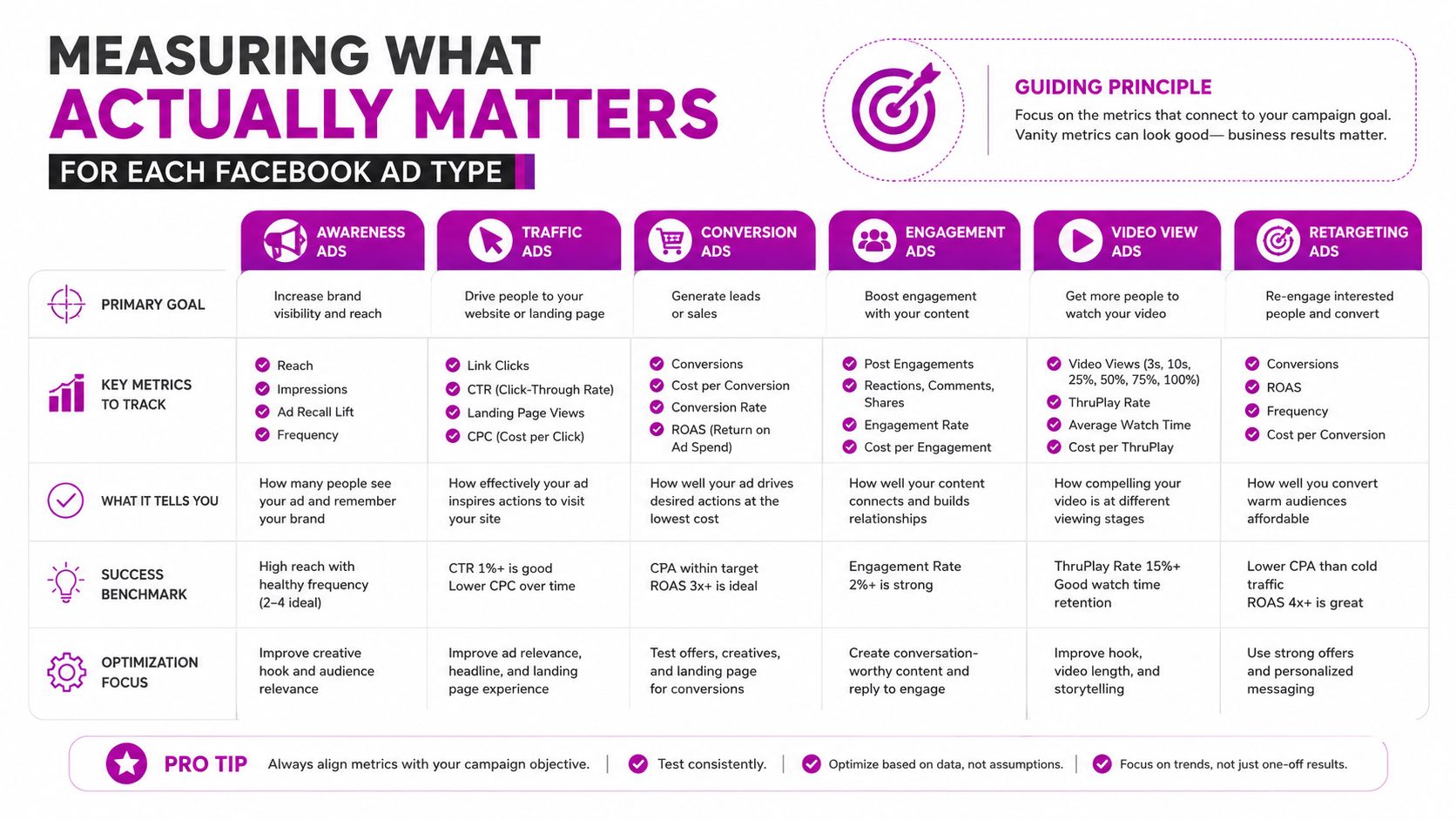
Measuring What Actually Matters for Each Facebook Ad Type
CTR is useful, but it's not the scorecard. A format can earn clicks from the wrong people and still look healthy if you only scan the top line. The better question is whether the ad pulled the right buyer closer to purchase.
Match the metric to the format
For video ads, watch whether people make it far enough into the clip to understand the offer, then compare that to landing page quality and purchase behavior. For carousel ads, look at card-level engagement and whether certain product tiles consistently carry the click. For dynamic product ads, the key signal is whether the retargeted item produces meaningful add-to-cart and purchase activity, not whether the ad gets attention.
For image ads, judge whether the creative drives the kind of visitor who moves through the site. Cheap clicks that bounce quickly are a sign that the visual and the promise were mismatched. For Reels, the metric mix should include the quality of the traffic they produce, because native-feeling short-form can create volume without creating intent.
Use platform and store data together
Meta's dashboard tells part of the story, but Shopify tells the rest. If ad engagement looks fine and onsite behavior is weak, the problem may be message fit, product-market fit, or landing-page friction. If the ad seems modest on-platform but the customers it brings back buy at a higher rate, that format may deserve more budget than it first appears.
Simple filter: scale the format that brings in buyers with fewer objections, not the one that wins the loudest engagement.
For teams that want outside help with campaign setup and measurement hygiene, ReachLabs.ai ad services is one option in the market for Facebook advertising support. The bigger point is to build a measurement system that respects the format's job instead of forcing every ad type into the same KPI box.
A Practical Playbook for Testing and Scaling Facebook Ad Formats
Start with the angle, not the format. Run a small creative test around one pain point, one desire, or one proof point, then let the winning message tell you which format deserves more budget. If the product needs explanation, move toward video or carousel. If it needs immediacy, test strong image or Reels creative.
Keep prospecting and retargeting separate in both creative and logic. Cold traffic should get belief creation. Warm traffic should get comparison and friction removal. That separation keeps the account readable and stops the team from mistaking one good asset for a universal winner.
Scale only when the format is earning qualified behavior downstream, not just a pretty CTR. The worst habit in Meta media buying is over-segmenting audiences before the creative has proven itself. The second worst is following ad-type trends without a conversion hypothesis.
If you want a practical rule, use this one. Test the angle first, then the format, then the audience refinement. That sequence gives Shopify brands a cleaner path to ROAS than chasing the newest placement or defaulting to the prettiest creative.
If you want help turning Facebook ad formats into a Shopify growth system, ECORN can support the creative, CRO, and implementation side together. Visit ECORN to review how their Shopify team handles ad-to-product-page flow, retargeting logic, and conversion-focused execution for brands that need more than a format list.


Conversion Tracking Setup for Shopify Stores
BigCommerce vs Shopify Plus Which Enterprise Wins in 2026
Shopify Theme Kit: Setup, Commands, and Migration Guide

Shopify Extension Development: A Practical 2026 Guide
Shopify Speed Score Explained and How to Improve It
Shopify Mobile Optimization: The 2026 Playbook
How to Add Subcategory in Shopify for Better UX
How to Implement Structured Data for Ecommerce in 2026
SEO App Mobile: Shopify Store Optimization Guide
Shopify Plus Support: What It Includes and How to Choose
Google Ads for Shopify: The Complete 2026 Playbook
Shopify New York: How to Find and Hire the Right Agency
Google Search Console for Shopify: The Complete Setup

First Party Data Collection for eCommerce Growth
FAQ Online Store Guide: Build and Measure It Right
Do FB Ads Work for eCommerce in 2026?
One Page Checkout for Shopify: Design and Implementation
Shopify GraphQL vs REST: The 2026 Developer Decision
Shopify Ecommerce Consulting: Strategy, Pricing &

Are Reddit Ads Worth It for eCommerce Brands
Shopify Title and Meta Description: A Practical 2026 Guide
Product Video Best Practices for Shopify Brands
Real-Time Inventory Management: A 2026 Guide

AI Chatbot Integration for Shopify Stores
Affiliate Program Management: A Shopify Guide
10 Best Performance Monitoring Tools for Shopify in 2026
Digital Asset Management for eCommerce Brands in 2026
Product Information Management Explained for Shopify Brands

Support Ticket System: A Guide for Shopify Stores

10 Best Customer Service Tools for Shopify in 2026

Can I Start a Business with No Money? a 2026 Blueprint

What Sells Good on Etsy: Best Niches for 2026

Shopify Add to Cart Button: A Practical 2026 Guide

Customer Feedback Automation: A Practical eCommerce Guide
Critical Rendering Path: A Guide for Shopify Stores

How to Promote on TikTok for eCommerce in 2026

B2B eCommerce Consulting That Drives Real Revenue
10 Best Practices for Site Navigation in 2026
Return vs Refund for Shopify Stores: A Practical Guide
What Is Customer Lifetime Value and Why It Matters
What Is Voice of Customer Research for eCommerce

SMS Marketing for Ecommerce That Actually Converts

Master How to Improve Email Deliverability in 2026

Top 7 eCommerce Partners NYC for Shopify Brands in 2026
Machine Learning for Ecommerce: Boost Your Shopify Store

Beauty Market Research: Your 2026 Growth Guide

Shopify International Expansion: A 2026 Roadmap
What Does CRO Stand for in Business: Understanding CRO

Shopify Visual Merchandising: A Playbook for Higher Sales
Shopify Landing Page Design: Master Conversion in 2026
10 Best AI SEO Optimization Tools for Shopify in 2026

Agentic AI for Ecommerce: Boost Your Sales in 2026
Mastering Email Marketing Data for eCommerce Growth

Conversion Rate Optimisation Australia: Boost Your Sales
Conversion Rate Optimization AI: Your Shopify Store Guide

10 Product Bundling Strategies for Shopify in 2026

How to Increase Customer Lifetime Value: A Shopify Playbook
AI Customer Service Automation: Shopify Guide 2026

Clean Website Design: A Shopify Conversion Playbook

Omnichannel Retail Strategy: A Shopify Playbook
Product Data Enrichment: A Guide for Shopify Brands
Instagram Shopping Features a Guide for Shopify Stores
What Is Revenue Optimization: A Holistic RevOps Guide

Benefits of Conversion Rate Optimization: Boost Your
WordPress to Shopify Migration: Your 2026 Seamless Switch
Boost Sales: Ecommerce Payment Processing Guide 2026
Unified Commerce Platform: Benefits, KPIs & Shopify Guide
How to Reduce Bounce Rate eCommerce: Your 2026 Guide
Shopify API Integration: A Practical End-to-End Guide

How to Implement Data Governance: A 2026 Guide
Shopify Store Development Cost: A 2026 Breakdown
What Is Server Side Tracking: The Shopify Guide 2026
Marketing Automation Workflows: A Shopify Guide for 2026

Shopify: How to Reduce Technical Debt

Shopify UX Design Change: A Playbook for Growth
User Generated Content Strategy: Shopify Playbook
Shopify Pause and Build Plan Cost: A Complete 2026 Guide
Compare at Price on Shopify: A Complete Guide for 2026
Where Can I Sell My Prints? 10 Best Platforms for 2026
Shopify Order Management System: The Ultimate Guide 2026
What Is Marketing Attribution? an eCommerce Guide for 2026
10 Best Black Friday Sales Sheets for 2026

Discover the Top Social Media Marketing Agencies For
Consumer Confidence Definition for eCommerce in 2026
What Is Social Commerce? Your 2026 Guide to Boosting Sales
A Social Ad Campaign Playbook for eCommerce Growth

7 Best FAQ Page Examples for SaaS & eCommerce

Market Research in Fashion Industry: A Guide for Shopify
Shopify Migration Services: Expert Guide for 2026
Mastering FB Retargeting Ads for Shopify in 2026
What Is Omnichannel Ecommerce
Master Your Shopify Plus Migration: The 2026 Guide
Shopify Integration Services: A Merchant's 2026 Guide
Shopify Collection Description: A Guide to SEO & Sales

Shopify Plus Contact: Reach Sales & Support Effectively

Top Luxury Shopify Stores: Design & UX Strategies
How to Improve Customer Experience: A Shopify Roadmap
Creative Facebook Ads: 10 Examples for Shopify Brands

Remarketing with Facebook Ads: A Shopify Guide for 2026

SEO Linking Strategies for Shopify Stores


newsletter in your inbox