

You're probably in one of two situations right now. You're spending on Meta, traffic is coming in, Shopify sessions look healthy enough, and sales still feel harder than they should. Or your prospecting is doing its job, but too much of that paid traffic hits a product page, browses, maybe even starts checkout, then disappears.
That's where Facebook retargeting stops being a nice add-on and becomes a profit lever. Not because it's magical, and not because Meta says it is, but because it focuses budget on people who already showed intent. The mistake most Shopify brands make is treating fb retargeting ads like a generic abandoned-cart campaign. That approach is outdated. Effective strategy now demands controlling automation, protecting incrementality, tightening audience windows, and knowing when to stop chasing people who aren't going to buy.
Why FB Retargeting Is Your Highest ROI Ad Spend
Most paid traffic doesn't buy on the first visit. That's normal. The problem is what happens next. If you don't have a clear retargeting structure, you keep paying to reacquire attention you already paid for once.
That's why retargeting usually earns its place fast. One industry summary reports that retargeting can reduce cost per acquisition by 40% to 70% compared with cold audiences, and the same guidance recommends capping retargeting at about 15% of total ad budget because it works best as a precision layer, not your main growth engine (Uproas Facebook ads statistics).
That framing matters. Retargeting is not prospecting with a warmer headline. It's a finishing move.
What makes it work
The advantage is simple. These people already know your brand, already saw a product, and already gave you a signal. That signal might be a product page view, an add-to-cart, or a checkout start. You're not inventing demand from scratch. You're trying to recover demand that almost converted.
A lot of Shopify stores underperform here for practical reasons:
- They lump everyone together. Product viewers, cart abandoners, and checkout abandoners get the same ad.
- They overspend on warm traffic. Meta keeps serving ads to a small pool until frequency gets ugly.
- They ignore exclusions. Existing customers keep seeing conversion ads they should never receive.
- They let automation blur the line between true retargeting and broad delivery.
Practical rule: If your retargeting campaign isn't clearly aimed at someone who already took a meaningful on-site action, it's probably not retargeting. It's just loosely controlled prospecting.
Strong fb retargeting ads improve overall account efficiency because they recover missed conversions from traffic you've already funded. For a Shopify brand, that usually means three direct uses: abandoned-cart recovery, dynamic product reminders, and sequential messaging that answers the objection a shopper had the first time around.
Laying the Foundation for Retargeting Success
Most retargeting problems start before the campaign is even built. They start in tracking.
Privacy changes have made lazy setup expensive. A 2026 summary says tracking opt-outs have reduced retargeting audiences by more than 50% and match rates have fallen below 25%, which is why first-party data, the Meta Pixel, and Conversions API matter so much now (Wastenot on Facebook retargeting).
Why Pixel-only setups break down
The browser Pixel still matters. It tracks behavior like product views, add-to-cart actions, and purchases. But browser-only tracking is fragile. Ad blockers, cookie restrictions, and consent limitations all interfere with what Meta receives.
That creates two problems:
| Issue | What it does to your campaigns |
|---|---|
| Lost events | Meta sees less behavior than actually happened |
| Weak audience matching | Fewer visitors qualify for your retargeting pools |
| Messy attribution | You make budget decisions on incomplete data |
Conversions API helps because it sends event data from the server side. For Shopify merchants, that means Meta gets a more dependable signal set than browser tracking alone can provide.
The setup that actually makes sense on Shopify
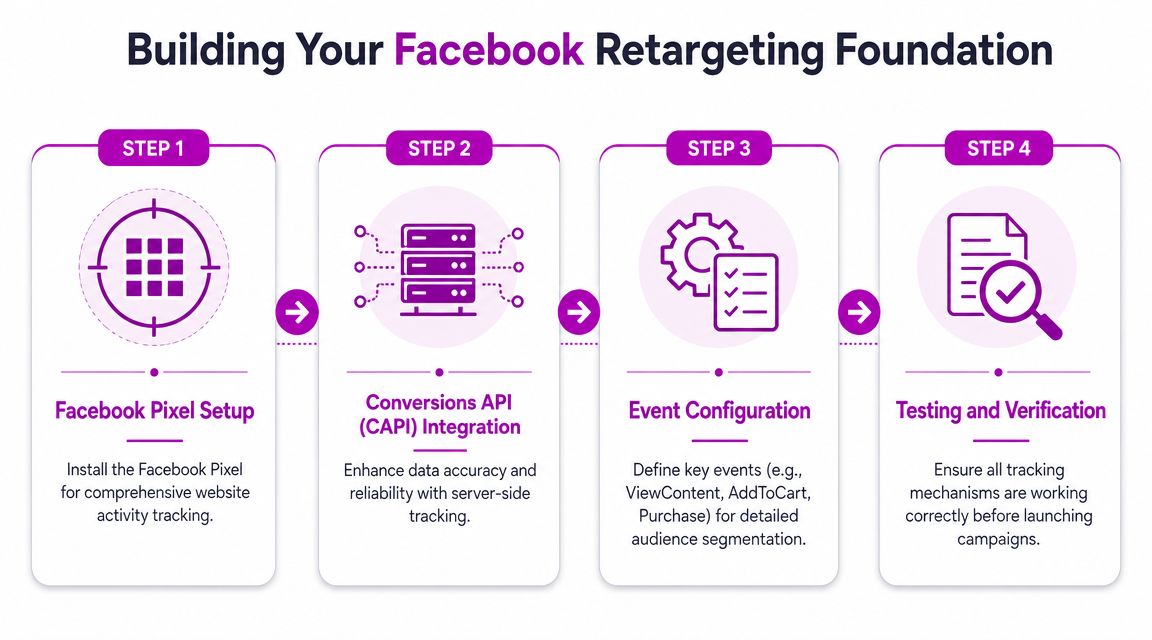
You don't need a complicated custom stack to get this right. In most cases, start with Shopify's native Meta integration and make sure both the Pixel and Conversions API are active.
Use this sequence:
Connect Shopify to Meta properly
Use the Facebook and Instagram sales channel inside Shopify. That's the cleanest route for most brands because it connects catalog, events, and ad account infrastructure in one place.Confirm the Pixel is firing key events
For eCommerce, the baseline events are usuallyViewContent,AddToCart,InitiateCheckout, andPurchase. If those events aren't firing consistently, your audience logic will be unreliable.Enable Conversions API through the integration
Don't treat this as optional. Server-side event support gives Meta a second path to receive conversion data when browser tracking fails.Verify deduplication
If the browser and server both send the same event, Meta needs to recognize them as one action. If deduplication is broken, reporting gets noisy fast.Test before spending
Use Meta Events Manager and run real site actions. Visit a product, add an item to cart, begin checkout, and place a test order if your setup allows it.
Retargeting quality is capped by signal quality. If Meta can't reliably see who viewed, carted, or bought, your campaign structure doesn't matter.
What to check before launch
A clean setup is less about technical perfection and more about avoiding predictable errors.
- Check event priority. Your purchase event should be correctly configured for optimization and measurement.
- Check product catalog sync. Dynamic product ads won't work properly if feed data is stale or mismatched.
- Check domain and storefront consistency. If users move across subdomains or storefront variants, event flow can fragment.
- Check purchaser exclusions. You don't want recent buyers sitting in the same pool as cart abandoners.
- Check consent flow impact. If your store uses consent tools, watch how that affects event volume and audience population.
When brands complain that fb retargeting ads “used to work better,” weak signal coverage is usually part of the story. Not all of it, but enough that fixing tracking often improves performance before you touch creative, budget, or bidding.
Building Your High-Intent Audience Engine
Retargeting gets expensive when you target everyone who touched the site. It gets efficient when you separate people by what they did.
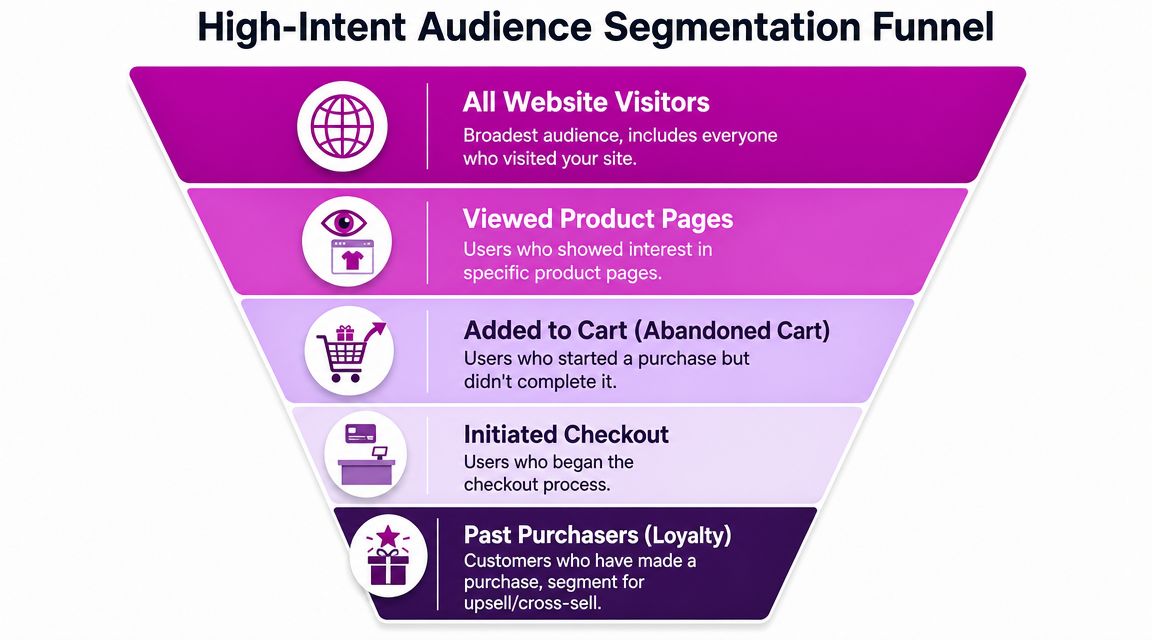
A practical Meta setup should split users into high-intent cohorts like product viewers, cart abandoners, and checkout abandoners, with dynamic catalog ads used for people who viewed specific products and broader reminder ads used for lower-intent visitors (AnyTrack's Facebook retargeting guidance).
Segment by intent, not by convenience
This is the structure I'd use for most Shopify brands.
Product viewers
These are people who reached a product detail page but didn't add to cart. They're interested, but they're still early. Don't hit them with heavy-handed urgency unless you know the product category supports it.
Better ad angles here include:
- Product reminder creatives that bring the item back into view
- Category-level carousels that show alternatives or complementary products
- Benefit-led messaging that clarifies why the product is worth a second look
For this audience, dynamic product ads usually make sense because they reconnect the shopper with what they viewed.
Add-to-cart users
This audience is stronger. They didn't just browse. They started the buying process and stopped.
Your creative should address friction, not just repeat the product. Useful themes include:
- Trust-building proof like reviews, guarantees, or shipping reassurance
- Objection handling around sizing, use case, ingredients, materials, or compatibility
- Softer urgency if the product category supports limited-time decision pressure
The ad doesn't need to scream discount. In many accounts, that trains people to wait.
Checkout abandoners deserve their own treatment
People who initiated checkout are usually your highest-intent non-buyers. Don't bury them inside a larger audience. Give them their own ad set or campaign, depending on account size.
Message precision matters most here:
| Audience | What they likely need | What usually underperforms |
|---|---|---|
| Viewed product | Reminder, clarity, relevance | Aggressive close-now copy |
| Added to cart | Confidence, friction removal | Generic lifestyle creative |
| Initiated checkout | Final nudge, trust, convenience | Broad brand messaging |
If you're using dynamic product ads, tighten the experience. The ad should match the product intent. If you're using static creative, make sure the first frame still feels connected to what the shopper previously considered.
A strong explainer on audience thinking and warm traffic structure is this walkthrough:
Exclusions matter as much as inclusions
A lot of wasted spend comes from poor exclusion logic, not poor targeting logic.
Build exclusions like a grown-up account manager:
- Exclude recent purchasers from conversion-focused retargeting unless you're intentionally running upsell or cross-sell campaigns.
- Exclude lower-intent pools from higher-intent ad sets when needed, so checkout abandoners don't get swallowed by broader visitor groups.
- Separate loyalty messaging from acquisition messaging. Past purchasers shouldn't see the same angle as first-time buyers.
Smaller, cleaner audiences usually beat larger, messy ones in retargeting because the message stays tied to the user's actual behavior.
A simple operating model for Shopify brands
You don't need fifteen overlapping audiences. You need a usable structure.
Start with these layers:
- Viewed product but no cart
- Added to cart but no checkout
- Initiated checkout but no purchase
- Past purchasers for cross-sell, upsell, or reorder logic
That model gives you enough separation to tailor the message without turning campaign management into a spreadsheet hobby.
Creating Retargeting Ads That Re-engage and Convert
Audience structure gives you targeting precision. Creative is what turns that precision into revenue.
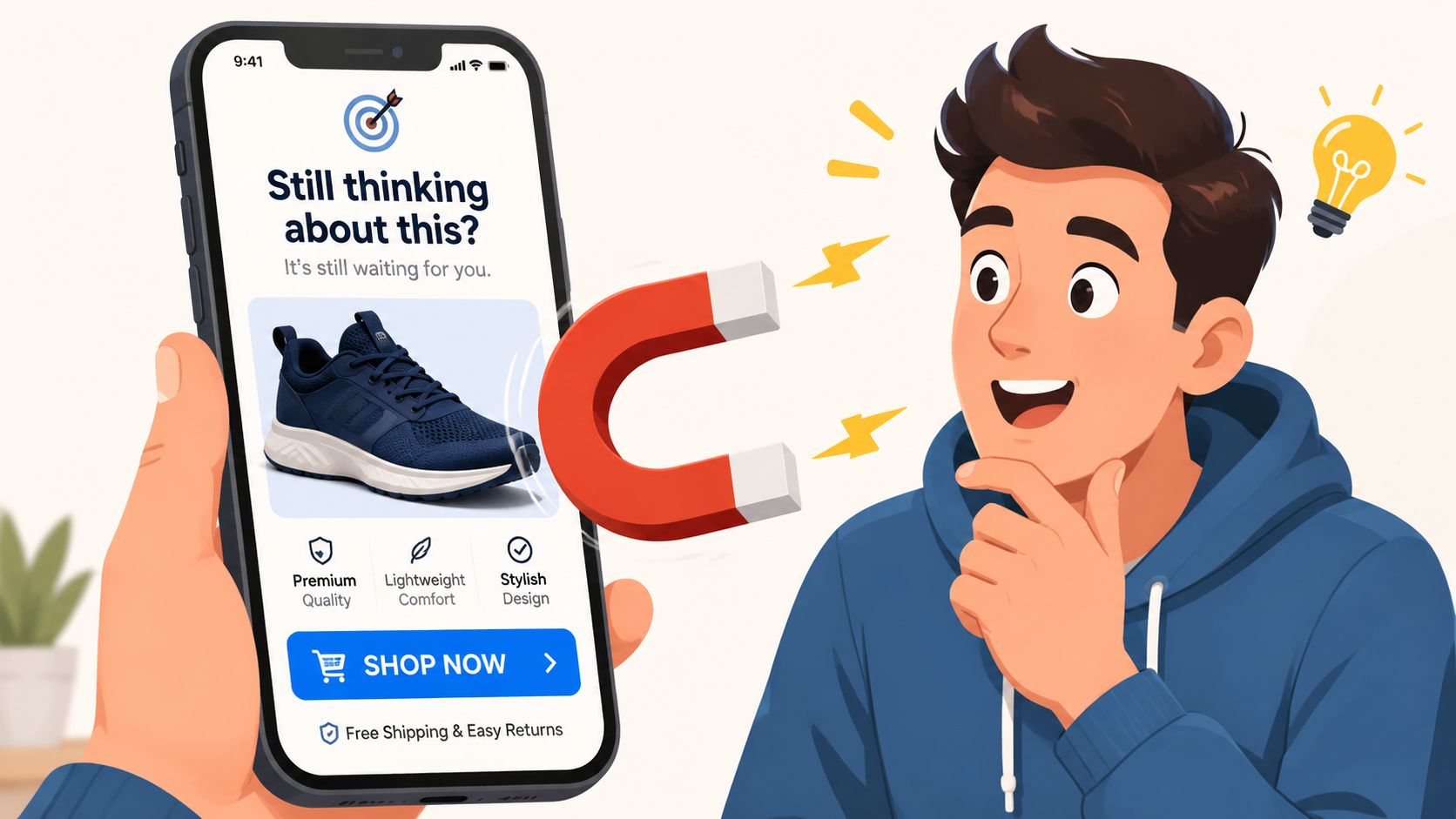
The biggest creative mistake in fb retargeting ads is using one ad style for every warm audience. A shopper who casually viewed a product page does not need the same message as someone who abandoned checkout. Retargeting creative works when it reflects what the user already knows and what probably stopped them.
Dynamic product ads should do the heavy lifting
For most Shopify catalogs, Dynamic Product Ads are the backbone of retargeting. They pull from your product feed in Meta Commerce Manager and automatically show users the products they viewed or considered.
That matters because relevance is doing most of the work. You're not asking the shopper to reconnect the dots. The ad already does it.
Use DPAs when:
- The shopper viewed specific products and your catalog data is clean
- You carry multiple SKUs or variants where manual ad building becomes messy
- You want scale without losing relevance across a wider product range
Where brands go wrong is treating DPAs as self-sufficient. They're not. Feed-based personalization solves product matching, not messaging. You still need strong primary text, a coherent offer strategy, and a landing experience that doesn't create new friction.
Match the ad to the stage
Creative should follow buyer intent.
For product viewers
Keep the ad simple. The goal is to reintroduce the product and remove uncertainty. A reminder-style ad, a carousel of related products, or a short video showing the item in use can all work.
Useful angles:
- How it fits into daily life
- Key product benefit
- What makes it different from obvious alternatives
For cart abandoners
These shoppers need a reason to resume. That reason isn't always a discount. Sometimes it's proof.
Try creatives built around:
- Customer reviews and user-generated content
- A fast explanation of the product's main payoff
- Shipping, returns, or guarantee reassurance
- A direct “still thinking it over?” style hook
For checkout abandoners
Keep it direct. They've already done most of the work. Here, friction-removal copy usually beats brand storytelling.
Examples of stronger message directions:
- Finish your order
- Your cart is waiting
- Complete checkout with confidence
- Quick reminder of shipping or return terms
The closer the shopper got to buying, the less your ad should educate and the more it should reassure.
Good retargeting copy sounds familiar
Your ad copy should acknowledge prior interest without sounding invasive. Don't overplay the “we saw you” angle. Stay close to the product and the benefit.
A practical framework:
| Audience | Better copy direction | Worse copy direction |
|---|---|---|
| Viewer | Reminder plus value | Hard-sell urgency |
| Cart user | Objection handling plus proof | Generic branding |
| Checkout user | Completion nudge | Long-form explanation |
If you want a broader refresher on message structure, testing discipline, and account hygiene, UFO's guide to Facebook Ads is a useful companion read.
Creative testing also matters outside the ad itself. The click has to land on a page that continues the same conversation. If your retargeting ad highlights proof, bundles, or a key product angle, the destination page should echo that. This breakdown of creative Facebook ads is helpful if you're tightening the link between ad concept and on-site experience.
Fight fatigue before Meta forces the issue
Warm audiences are small by definition. That means fatigue shows up faster.
The practical fixes are straightforward:
- Rotate angles, not just thumbnails. A new image with the same weak message isn't a new ad.
- Refresh social proof. New reviews, UGC clips, and testimonials keep trust assets from going stale.
- Vary format. Static image, carousel, product demo video, and founder-style message all create different reactions.
- Control repetition with exclusions. If someone bought, stop selling them the same conversion ad.
Retargeting creative wins when it feels timely, relevant, and proportionate to intent. Most brands don't need louder ads. They need sharper ones.
Driving Profitability with Advanced Optimization
The lazy advice is to keep retargeting always on, let Meta optimize, and trust the algorithm. That advice sounds efficient. It also creates a lot of wasted spend.
A frequently missed decision is when retargeting stops paying off. More nuanced guidance recommends very tight windows, including 1-day click for dynamic product ads, excluding purchasers, and only using longer windows when the brand has a known repeat-purchase cycle beyond 30 or 90 days (Common Thread Collective on Facebook retargeting).
Stop treating retargeting like an unlimited harvest channel
Retargeting is finite. Your audience is smaller, warmer, and easier to saturate. If you keep widening windows just to spend budget, you eventually start paying to show ads to people who already decided not to buy, already bought somewhere else, or would have come back on their own.
That's where account discipline matters more than platform optimism.
Signs your retargeting window is too long
- You're spending into old traffic that no longer remembers the product clearly
- Your message gets repetitive because the same users keep seeing the same assets
- The campaign looks active but quality is softening
- You can't explain why a shopper from weeks ago is still seeing a conversion ad
In a lot of Shopify accounts, the strongest retargeting value sits close to the visit. Especially for dynamic product ads. The longer the delay, the more likely you're buying low-intent impressions dressed up as warm traffic.
Good retargeting isn't about following every visitor for as long as possible. It's about responding while intent is still alive.
Tight windows usually beat lazy windows
There isn't one universal window that fits every store. Product price, purchase cycle, and consideration depth all change the answer. But the logic stays the same. Match the window to the buyer's decision speed.
A simple planning lens:
| Audience type | Better default thinking | When to extend |
|---|---|---|
| Viewed product | Keep windows relatively tight | Extend only if your category has longer consideration |
| Added to cart | Prioritize recent users first | Extend if buyers commonly compare before purchasing |
| Initiated checkout | Focus on immediate recovery | Extend cautiously and exclude purchasers fast |
| Past purchasers | Build reactivation around real repurchase timing | Extend when reorder behavior is predictable |
Operators need to think like merchants, not media buyers. A fast-moving impulse product and a considered premium item should not share the same recency logic.
Watch Meta's audience broadening carefully
One of the biggest current issues in fb retargeting ads is automation leakage. Practitioner guidance around Meta's broader audience controls warns that advertisers need to explicitly exclude custom audiences and purchases, because broad expansion can push delivery outside the intended warm pool and muddy reporting (Meta retargeting audience broadening discussion).
That's not a minor setting issue. It changes whether your “retargeting” campaign is properly retargeting.
Here's where brands get caught:
- Advantage-style expansion stays enabled
- Audience suggestions are accepted without checking exclusions
- Prospecting and retargeting blur together in reporting
- Performance looks acceptable, but incrementality is weaker than it appears
If your goal is to recover high-intent traffic, your audience controls need to reflect that. Be explicit with exclusions. Separate warm traffic from broader automation wherever possible. If you want Meta to prospect, run a prospecting campaign. Don't let a retargeting setup become a stealth prospecting campaign.
Budgeting and bidding should follow scarcity
Retargeting audiences are limited. That's why many practitioners keep retargeting near a capped share of total account spend rather than forcing scale through budget pressure. If delivery is already covering the available warm pool, adding more budget often just increases repetition.
A more useful optimization routine looks like this:
Audit audience freshness first
Before adjusting bids or budget, look at recency and exclusions. Fresh traffic usually matters more than aggressive bidding.Review creative by cohort
If checkout abandoners and product viewers are sharing weak or generic creative, fix the message before touching spend.Assess overlap
Smaller pools can cannibalize each other if audience logic isn't clean.Check profitability, not just reported platform conversion volume
A campaign can look productive in Ads Manager while still adding little incremental value.
Stores need a cleaner read on contribution. If you're reworking spend allocation and trying to decide whether retargeting is still paying for itself, this guide on how to calculate return on ad spend is worth using as a practical checkpoint.
Know when to turn campaigns off
Some visitors won't convert, and some products don't justify long pursuit. Smart operators accept that.
Turn down or pause retargeting when:
- Audience recency is stale
- Creative fatigue is obvious
- You're repeatedly hitting old users with low buying intent
- A shopper is better suited for email, SMS, or reactivation later in the lifecycle
The point of retargeting isn't to keep the campaign running forever. The point is to recover profitable intent while it's still there.
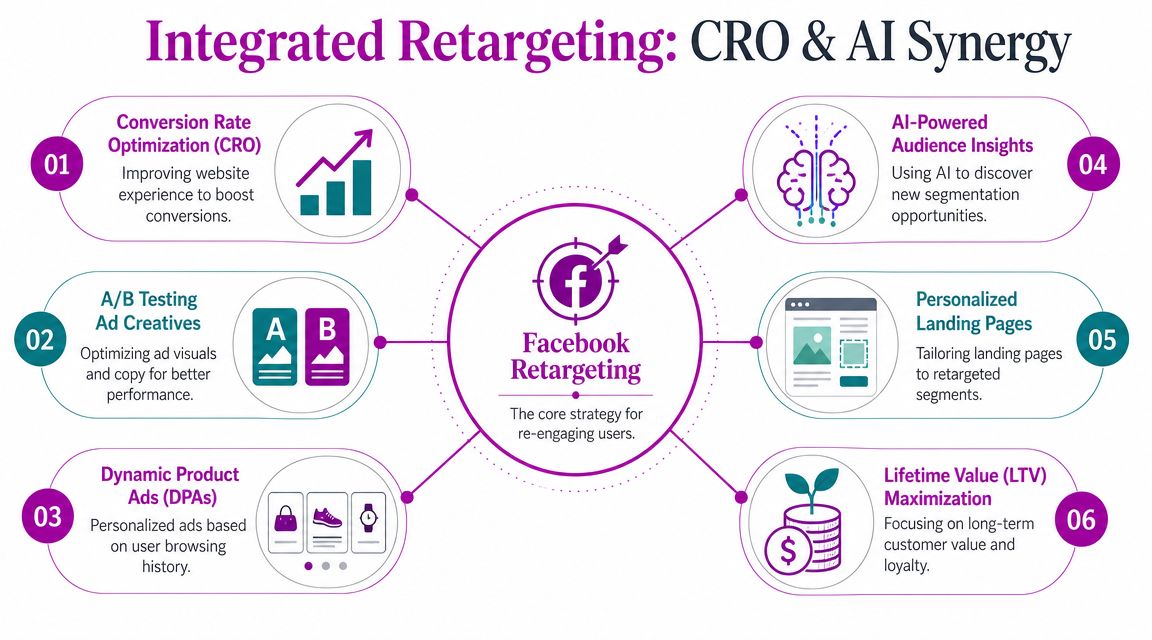
Scaling Your Strategy with CRO and AI Integration
Retargeting gets overvalued when brands treat it as the fix for every conversion problem. It isn't. It's a mirror. It shows you where your funnel leaks, where product pages fail to close, and where checkout friction is costing you money.
Benchmark data indicates Facebook retargeting ads often produce CTRs around 0.9% to 1.5%, and retargeted visitors are about 70% more likely to convert, which is why retargeting belongs inside a broader CRO system rather than sitting off to the side as a standalone media tactic (SQ Magazine retargeting performance statistics).
Use retargeting data to fix the store, not just the ads
If lots of users view products and few add to cart, that's often a product page issue. If many add to cart and drop before purchase, the issue may sit in shipping presentation, trust elements, or checkout usability.
Look at retargeting segments as diagnostic buckets:
- Heavy product-page traffic with weak cart creation points to merchandising or page clarity problems
- Strong cart activity with weak checkout completion often points to friction later in the funnel
- Repeat retargeting engagement without purchase suggests your ad is doing its job but the site isn't closing
That's why retargeting and CRO should share the same feedback loop. Ads tell you where attention exists. The site tells you whether that attention can be monetized.
If retargeting keeps rescuing the same leak, fix the leak. Don't just increase the rescue budget.
Where AI actually helps
AI is useful in retargeting when it improves speed, variation, and relevance. It's not useful when it becomes a substitute for strategy.
The best current use cases are practical:
| AI use | What it helps with |
|---|---|
| Creative variation | Producing more hooks, headlines, and angle tests for warm audiences |
| Copy adaptation | Rewriting the same core offer for viewers, cart users, and repeat buyers |
| Pattern spotting | Identifying which segments respond to specific message types |
| Landing page alignment | Matching on-site messaging more closely to ad intent |
For teams trying to understand where machine learning fits into paid media operations more broadly, PPC strategies using machine learning offers a useful perspective.
You can also use service partners and operators that sit closer to the Shopify stack. For example, ECORN works across Shopify development, CRO, and eCommerce consulting, which is relevant when retargeting performance depends as much on site experience as on ad setup.
The compounding model
The strongest fb retargeting ads accounts usually share one trait. They don't isolate channel work from conversion work.
They do three things well:
- Capture better signals
- Segment by real intent
- Improve the destination experience based on what retargeting data reveals
That creates compounding gains. Better signal quality improves audience quality. Better audience quality improves creative relevance. Better creative relevance sends more qualified users back to pages that are increasingly tuned to convert.
That's how retargeting becomes more than a recovery tactic. It becomes part of a system that improves the whole store.
If your Shopify brand needs a tighter retargeting setup, cleaner audience logic, and conversion work that supports paid media instead of fighting it, ECORN is one option to evaluate. They work across Shopify development, CRO, and eCommerce strategy, which is useful when profitable Meta performance depends on both the ad account and the store behind it.


Shopify Theme Updater App: A Safe Update Playbook
Shopify Git Integration: A Developer's Guide to 2026
Headless Ecommerce Development Services Explained

How to Build a Shopify Clothing Website That Converts
How to Launch a Box Subscription Business in 2026

Luxury Skincare Branding Playbook That Converters
10 Best Podcast Ecommerce Shows for Store Growth in 2026
Shopify Developer Hourly Rate: What to Pay in 2026
Critical Shopify Setup Errors That Are Secretly Sabotaging Your Store
Ecommerce Conversion Tracking: The Complete How-To Guide
Shopify Design Agency: How to Pick the Right Partner
Mastering Multi Store Management on Shopify
Scale Shopify Store
10 Shopify App Ideas Worth Building in 2026
Conversion Rate Optimization for Landing Pages: The Playbook
Shopify Plus Automation: A Guide for 2026
10 Social Selling Platforms for Shopify Merchants

Shopify Website Design Examples: 7 Stores Worth Studying
7 Ecommerce Newsletter Examples for Shopify Brands
One Product Shopify Store: Build and Scale
Mobile Pop Up Strategy for Shopify Stores That Converts
Sitemap for Shopify: How to Find, Optimize, and Submit It
7 Single Product Websites Worth Emulating
Product Variants Shopify: The Complete 2026 Guide
Ecommerce Analytics Consulting for Growth
What Is AI Integration for eCommerce
How to Choose the Right eCommerce Website Development Firm
E Business Strategy Implementation
Conversion Tracking Setup for Shopify Stores
BigCommerce vs Shopify Plus Which Enterprise Wins in 2026
Shopify Theme Kit: Setup, Commands, and Migration Guide
Shopify Extension Development: A Practical 2026 Guide
Shopify Speed Score Explained and How to Improve It
Shopify Mobile Optimization: The 2026 Playbook
How to Add Subcategory in Shopify for Better UX
How to Implement Structured Data for Ecommerce in 2026
SEO App Mobile: Shopify Store Optimization Guide
Shopify Plus Support: What It Includes and How to Choose
Google Ads for Shopify: The Complete 2026 Playbook
Shopify New York: How to Find and Hire the Right Agency
Google Search Console for Shopify: The Complete Setup
First Party Data Collection for eCommerce Growth
FAQ Online Store Guide: Build and Measure It Right
Do FB Ads Work for eCommerce in 2026?
One Page Checkout for Shopify: Design and Implementation
Shopify GraphQL vs REST: The 2026 Developer Decision
Shopify Ecommerce Consulting: Strategy, Pricing &
Are Reddit Ads Worth It for eCommerce Brands
Shopify Title and Meta Description: A Practical 2026 Guide
Product Video Best Practices for Shopify Brands
Real-Time Inventory Management: A 2026 Guide
AI Chatbot Integration for Shopify Stores
Affiliate Program Management: A Shopify Guide
10 Best Performance Monitoring Tools for Shopify in 2026
Digital Asset Management for eCommerce Brands in 2026
Every Type of Facebook Ads Explained for eCommerce Growth
Product Information Management Explained for Shopify Brands
Support Ticket System: A Guide for Shopify Stores

10 Best Customer Service Tools for Shopify in 2026

Can I Start a Business with No Money? a 2026 Blueprint

What Sells Good on Etsy: Best Niches for 2026

Shopify Add to Cart Button: A Practical 2026 Guide

Customer Feedback Automation: A Practical eCommerce Guide
Critical Rendering Path: A Guide for Shopify Stores

How to Promote on TikTok for eCommerce in 2026

B2B eCommerce Consulting That Drives Real Revenue
10 Best Practices for Site Navigation in 2026
Return vs Refund for Shopify Stores: A Practical Guide
What Is Customer Lifetime Value and Why It Matters
What Is Voice of Customer Research for eCommerce

SMS Marketing for Ecommerce That Actually Converts

Master How to Improve Email Deliverability in 2026

Top 8 eCommerce Partners NYC for Shopify Brands in 2026
Machine Learning for Ecommerce: Boost Your Shopify Store

Beauty Market Research: Your 2026 Growth Guide
Shopify International Expansion: A 2026 Roadmap
What Does CRO Stand for in Business: Understanding CRO

Shopify Visual Merchandising: A Playbook for Higher Sales
Shopify Landing Page Design: Master Conversion in 2026
10 Best AI SEO Optimization Tools for Shopify in 2026

Agentic AI for Ecommerce: Boost Your Sales in 2026
Mastering Email Marketing Data for eCommerce Growth
Conversion Rate Optimisation Australia: Boost Your Sales
Conversion Rate Optimization AI: Your Shopify Store Guide

10 Product Bundling Strategies for Shopify in 2026
How to Increase Customer Lifetime Value: A Shopify Playbook
AI Customer Service Automation: Shopify Guide 2026

Clean Website Design: A Shopify Conversion Playbook

Omnichannel Retail Strategy: A Shopify Playbook
Product Data Enrichment: A Guide for Shopify Brands
Instagram Shopping Features a Guide for Shopify Stores
What Is Revenue Optimization: A Holistic RevOps Guide
Benefits of Conversion Rate Optimization: Boost Your
WordPress to Shopify Migration: Your 2026 Seamless Switch
Boost Sales: Ecommerce Payment Processing Guide 2026
Unified Commerce Platform: Benefits, KPIs & Shopify Guide
How to Reduce Bounce Rate eCommerce: Your 2026 Guide
Shopify API Integration: A Practical End-to-End Guide
How to Implement Data Governance: A 2026 Guide
Shopify Store Development Cost: A 2026 Breakdown


newsletter in your inbox