

You've had one of those weeks where the dashboard makes no sense.
Meta ads are stable. Klaviyo flows are healthy. The site is fast. Your PDPs are cleaner than they were last quarter. Yet conversion softens, average order value gets choppy, and customers who used to buy on the first visit now hesitate, browse, and leave.
That pattern pushes a lot of founders into the wrong diagnosis. They assume the problem sits inside the store. Sometimes it does. Often, it doesn't.
A big part of demand lives outside your ad account and analytics stack. It lives in how safe or exposed shoppers feel about jobs, income, and the broader economy. That broader signal is what people mean when they talk about consumer confidence. If you run an eCommerce brand, understanding the consumer confidence definition helps you separate a merchandising problem from a market problem, and react with better timing.
Why Your Sales Are Up and Down
A familiar scenario looks like this. A brand tightens creative testing, improves landing pages, trims checkout friction, and still sees weird week-to-week swings. The team starts debating attribution, discount depth, ad fatigue, or whether the season itself is behaving differently than expected.
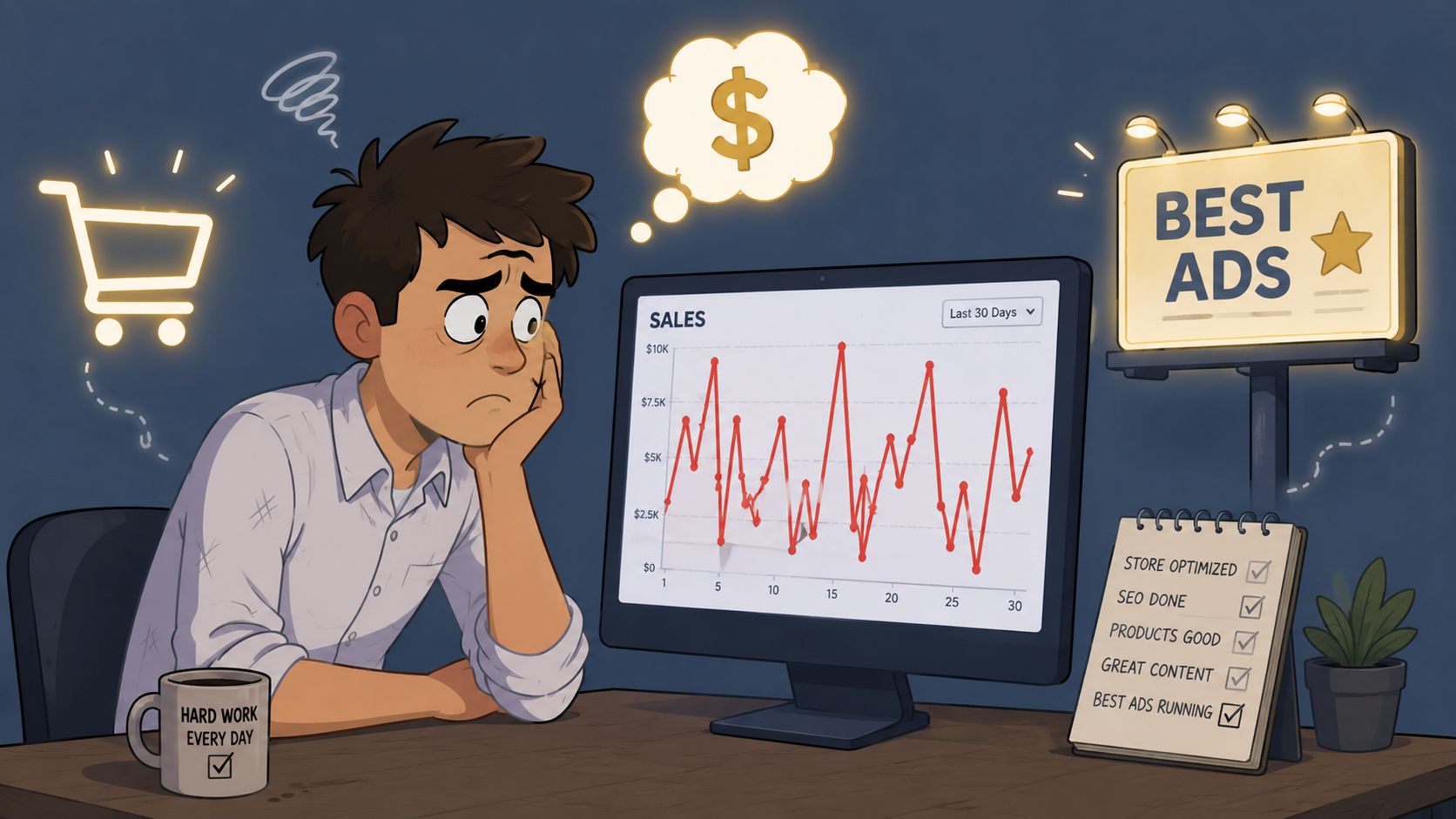
Sometimes that debate misses the larger force. Shoppers don't buy in a vacuum. They bring their own job worries, income expectations, and economic outlook into every cart decision, especially for products they can postpone, swap, or trade down on.
Internal fixes don't solve external caution
Operators often get stuck. They keep optimizing as if every dip is a store issue. They rerun ad tests, rewrite headlines, and tweak upsells when the actual shift is that buyers have become more cautious at the same time.
That doesn't mean store work stops mattering. It means your interpretation has to change.
If demand softness lines up with a wider drop in buyer confidence, the smartest move usually isn't to panic and rebuild the site. It's to adjust message, offer, and inventory exposure to fit a more defensive customer mindset. Founders already do this with eCommerce seasonality trends. Consumer confidence belongs in that same planning layer.
Strong operators don't just ask, "What changed on the site?" They also ask, "What changed in the buyer's head before they landed here?"
The hidden variable in discretionary demand
This matters most if you sell products customers can delay. Apparel, beauty devices, premium home goods, fitness gear, gifting, and lifestyle accessories all feel different to consumers when the economic backdrop turns uncertain.
When confidence softens, buyers often still want the product. They just need more reassurance, more value clarity, or more time. If you ignore that and keep speaking in pure aspiration, your store starts sounding out of sync with the market.
That's why the consumer confidence definition isn't academic. It gives you context for sales volatility that your own dashboards can't fully explain.
The Consumer Confidence Definition You Can Actually Use
The simplest useful definition is this. Consumer confidence is a survey-based economic indicator that measures how optimistic or pessimistic households are about the economy and their own finances. The OECD standardizes it so that 100 equals the long-term average, with readings above 100 signaling stronger willingness to spend and weaker saving motives, and readings below 100 signaling more caution and more saving behavior, according to the OECD's consumer confidence indicator explainer.
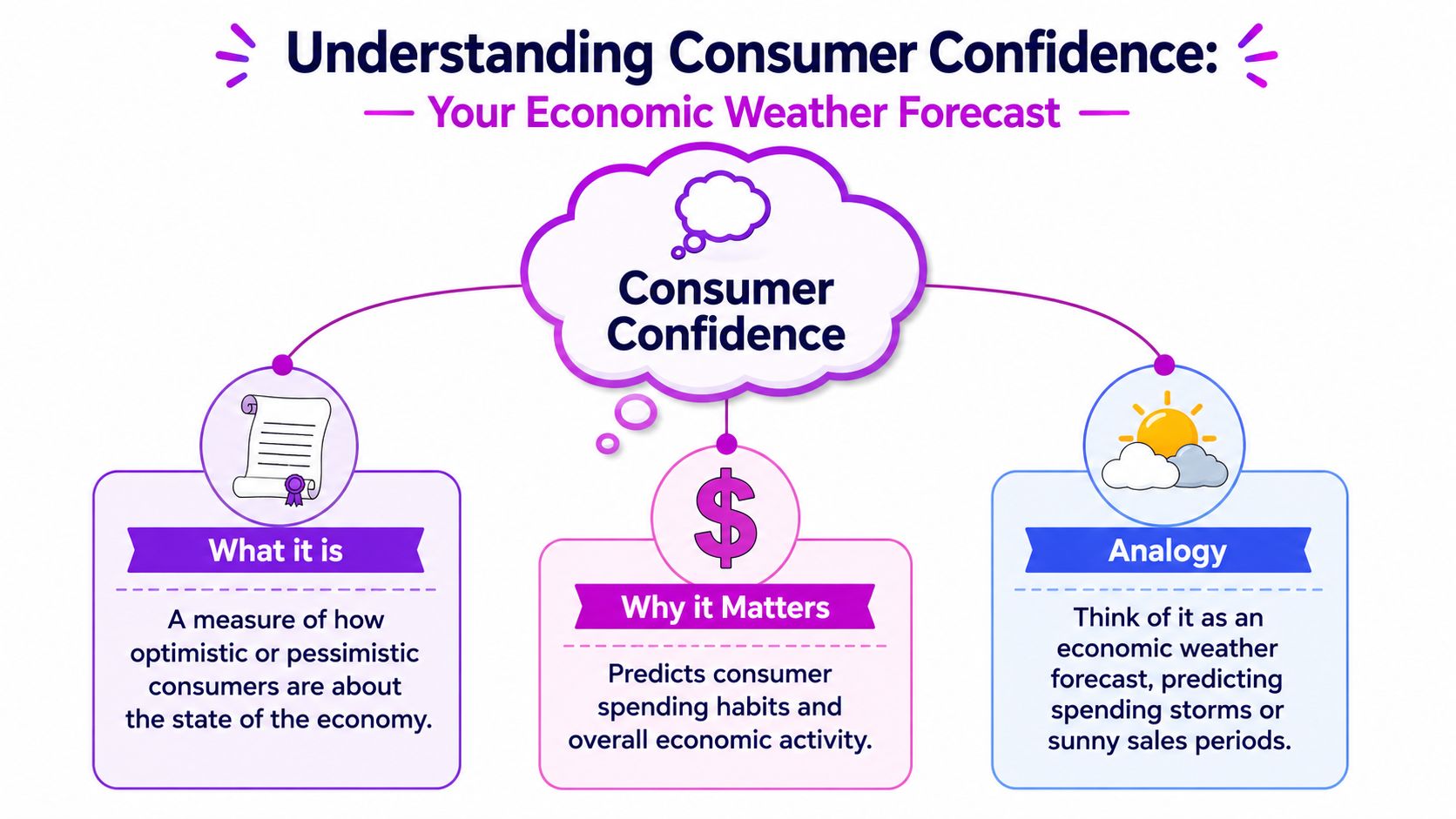
Think of it as a weather forecast for spending
That's the version founders can effectively use.
Consumer confidence doesn't tell you what one shopper will do today. It tells you what the overall spending climate is starting to look like. If the reading is healthy, more buyers are comfortable making discretionary purchases, upgrading, and acting faster. If it weakens, hesitation rises. Shoppers comparison-shop more, delay decisions, and put more weight on affordability.
This is why the consumer confidence definition matters to eCommerce teams. It helps you anticipate how customers are likely to behave before those shifts fully show up in topline revenue.
Confidence and sentiment aren't the same thing
A lot of articles blur consumer confidence and consumer sentiment into one idea. That's a mistake.
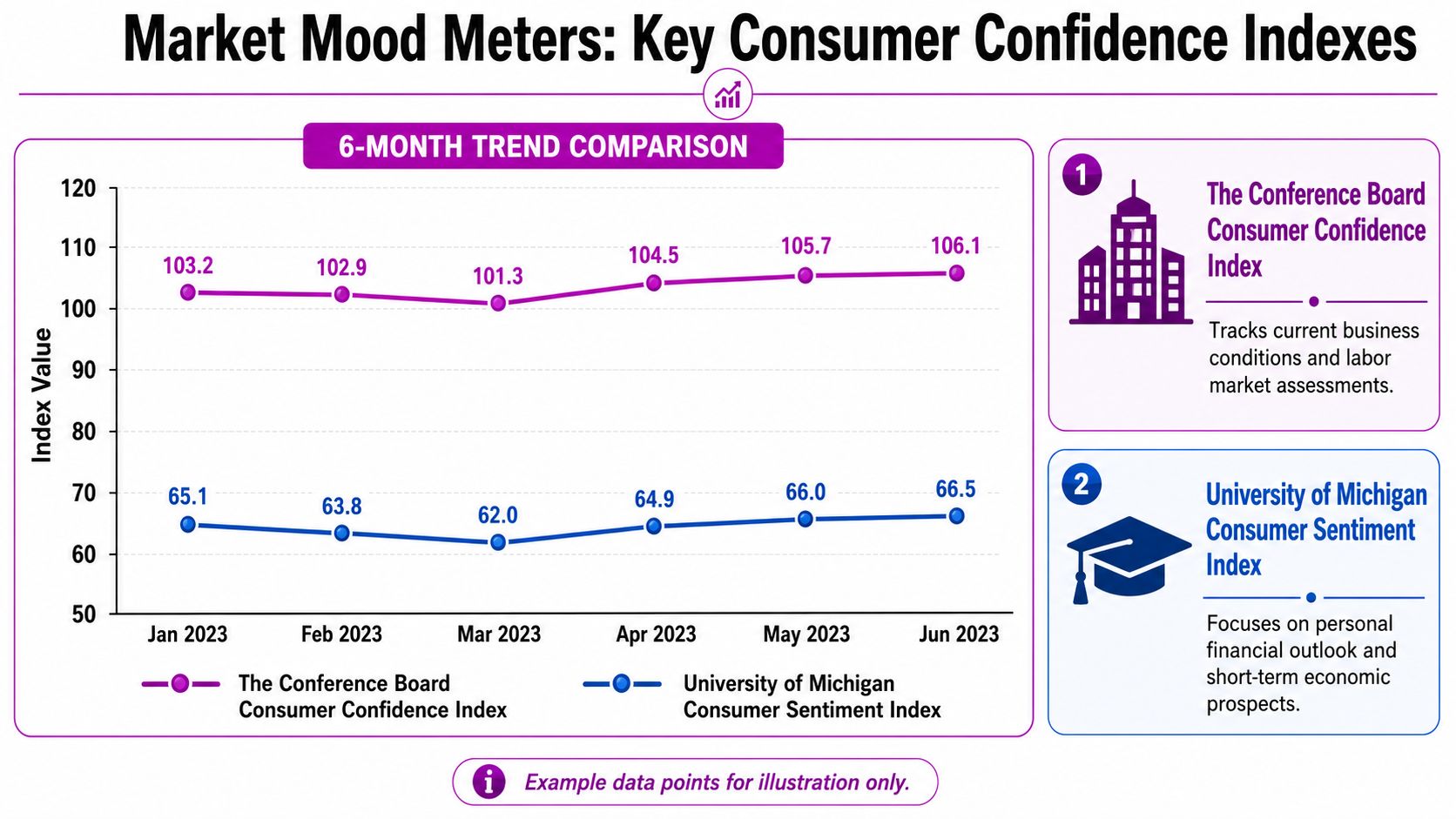
Consumer confidence is the broader economic measure and leans heavily on labor market and business conditions. Consumer sentiment is more focused on personal household finances. That distinction matters because they can move differently, and your store can feel the difference.
According to Revuze's explanation of consumer confidence, confusion between these terms leads eCommerce businesses to misread sales volatility. A drop in confidence may not immediately crush spending if sentiment remains high, while a drop in sentiment is more directly tied to reduced discretionary spending.
Here's the practical read:
- Confidence falls, sentiment holds: shoppers may still buy, but they become slower and more selective.
- Sentiment falls: buyers feel the squeeze personally. Cart value and urgency usually come under more pressure.
- Both weaken: premium positioning gets harder unless your offer is unusually strong or your audience is insulated.
Practical rule: If your customers still feel personally secure, they may keep spending through broader economic noise. If they no longer feel secure in their own finances, your conversion strategy has to change fast.
How We Measure the Mood of the Market
Consumer confidence sounds soft, but the main U.S. index is built from a fixed survey structure rather than a vague vibe.
The Conference Board's Consumer Confidence Index is a monthly survey-based measure of U.S. economic health from the consumer's perspective. It uses 5,000 households and is calculated from five questions covering current business conditions, current employment conditions, expected business conditions, expected employment conditions, and expected family income over the next six months, as outlined in The Conference Board technical note.
What the headline number is built from
The index isn't a simple yes-or-no poll. Each question produces a relative value based on positive versus negative responses, and the final index is the average of those values, benchmarked to 1985 = 100. It's also weighted so that 40% comes from the Present Situation Index and 60% comes from the Expectations Index, which means future employment and income expectations drive a bigger share of movement in the headline number.
For operators, that weighting matters. The index doesn't only reflect how shoppers feel right now. It also captures what they think is coming next, which is often what changes buying behavior first.
A useful industry benchmark to watch is the ECORN eCommerce agency confidence index, especially when you want to compare macro demand mood with what merchants and operators are seeing on the ground.
How to read the benchmark fast
If you see a headline reading around the benchmark, the market mood is close to normal. If it moves above that line, consumers are generally more comfortable spending. If it moves below, caution is taking over.
You can see that framework clearly in the way major indexes are reported. Britannica notes a U.S. reading of 93.1 in May, down from 93.8 in April, with the Present Situation Index at 121.2 and the Expectations Index at 74.4, which shows a market where current conditions look firmer than the forward view in Britannica's overview of consumer confidence.
This short video gives a clean overview of how these measures show up in real-world economic reporting.
What to watch as an eCommerce founder
You don't need to become a macro analyst. You need a repeatable interpretation habit.
| Signal | What it usually tells you |
|---|---|
| Above benchmark | Buyers are more open to non-essential spending |
| Below benchmark | Buyers lean toward caution, saving, and trade-down behavior |
| Present stronger than expectations | Customers may still spend, but future demand can get shakier |
| Expectations weakening first | Hesitation often appears before revenue fully reflects it |
Reading the Signs What Trends Mean for Your Store
Your ad account can look healthy on Monday and weak by Friday, even when nothing obvious changed in the store. Often the shift starts with buyer confidence. People still browse, click, and compare. They just hesitate longer, trim the cart, or postpone the purchase.
That is the part founders need to read well.
Consumer confidence is not the same as consumer sentiment. Sentiment is broader and more emotional. Confidence is more tied to whether people feel secure enough to spend. For eCommerce operators, that distinction matters because confidence usually shows up in purchase behavior faster. It affects average order value, promo response, category mix, and how hard customers need to be pushed before they convert.
Four patterns worth watching
A high and stable reading usually supports steadier demand for discretionary products. Shoppers are more open to premium options, bundles, gifts, and upgrades. In that environment, brands can often protect margin better because the customer is not filtering every decision through price alone.
A low and stable reading creates a stricter buying environment. Demand may still exist, but the threshold for purchase gets higher. Customers want a practical reason to buy now, clearer proof of value, and fewer chances to make a costly mistake.
A rising trend often matters more than one headline number. Improvement in confidence can show up first in softer metrics. More product page depth, better email engagement, stronger bundle take rates, and less discount dependence. That is usually the time to test broader offers before you expand budgets too aggressively.
A falling trend catches brands that only watch revenue.
Traffic may hold for a while. Conversion quality often weakens first. Shoppers delay replacements, abandon larger carts, trade down to entry products, and become less responsive to lifestyle positioning. If a founder waits until top-line sales clearly break, the team is already reacting late.
When confidence drops, hesitation usually shows up before demand disappears.
Category behavior changes at different speeds
If you sell essentials, weaker confidence often changes which version people buy more than whether they buy at all. Customers still need the category. They just shift toward smaller packs, lower-priced variants, replenishment timing, or brands that feel safer and easier to justify.
If you sell discretionary products, the effect is sharper. A softer confidence environment usually means longer consideration cycles and more deferred purchases. That is why two stores can face the same economic backdrop and get very different outcomes. A beauty replenishment brand may see mix changes. A premium home decor brand may see demand timing change altogether.
This is also where founders confuse confidence with sentiment. A shopper can feel negative about the economy and still buy necessities on schedule. That is sentiment without the same spending impact. Confidence becomes more useful because it is closer to the question that matters to your store: will customers act, wait, or trade down?
A practical way to read the signal looks like this:
- Higher confidence: use stronger premium framing, bundles, and new product discovery.
- Lower confidence: make value obvious, reduce purchase anxiety, and tighten offer clarity.
- Falling confidence: protect margin carefully, expect weaker cart conviction, and watch for trade-down behavior.
- Rising confidence: test expansion in offers and acquisition, but validate with store data before increasing inventory commitments.
The indicator gives context. Your store data confirms how that context is hitting your category, price point, and customer base. That is the combination that turns a macro signal into an operating decision.
Your eCommerce Playbook for Every Economic Climate
For eCommerce businesses, consumer confidence becomes useful when it changes decisions. The core idea is simple. A high CCI tends to line up with more discretionary spending on non-essential goods, while a low CCI points to a tighter market where shoppers prioritize essentials, which makes it directly relevant to conversion strategy and inventory planning, according to the Federal Reserve Bank of St. Louis discussion of consumer confidence.
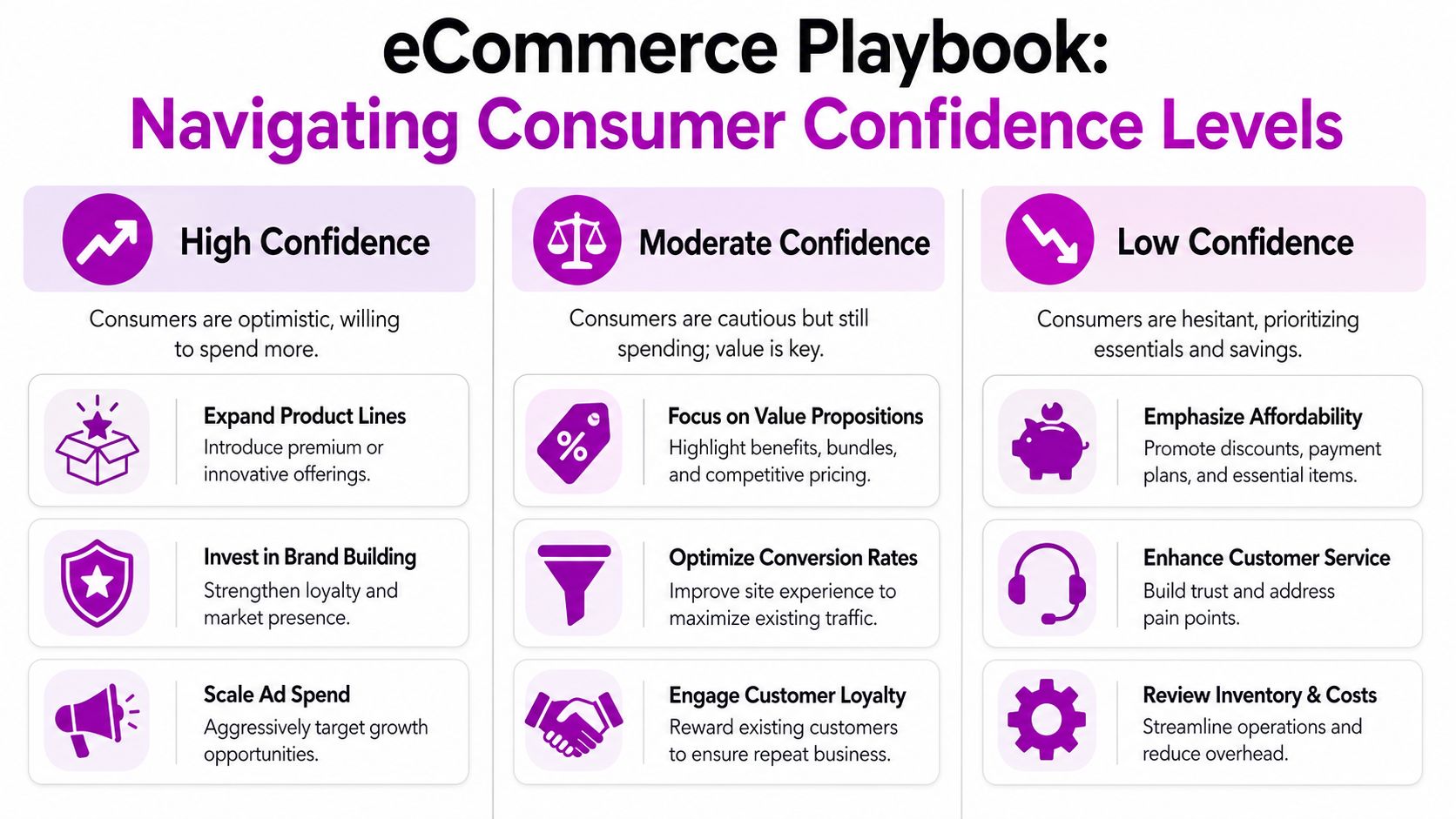
CRO moves that fit the market
When confidence is soft, most brands make one of two mistakes. They either slash prices too quickly, or they keep selling as if shoppers are still in an impulse-buying mood.
A better CRO response is more targeted:
- Lead with value clarity: Show what the product replaces, how long it lasts, or why it saves time. On PDPs, that often means moving practical proof above aesthetic detail.
- Reduce commitment anxiety: Use clearer return messaging, delivery expectations, and product comparison modules so buyers feel safer choosing.
- Surface affordable paths: Bundles can still work in a cautious market if the math feels obvious. So can entry-level variants, smaller packs, and payment options where appropriate.
- Trim checkout doubt: In weaker confidence periods, hidden costs and vague shipping copy kill more demand than usual.
In stronger confidence environments, the CRO focus changes. You can test premium bundles, upgraded versions, and merchandising that nudges shoppers toward higher-intent paths instead of pure reassurance.
Operator note: During cautious periods, the best-performing PDPs usually answer "Why buy this now?" before they try to answer "Why is this brand inspiring?"
Marketing that matches shopper psychology
Ad messaging should track consumer mindset more closely than most brands think.
In a lower-confidence climate, effective messaging often sounds like this:
- Practical: durability, everyday usefulness, lower regret
- Defensive: smart purchase, dependable quality, worthwhile value
- Specific: what problem gets solved, what cost gets avoided, what uncertainty gets reduced
That doesn't mean every ad needs to scream discount. It means the customer should feel that the brand understands restraint.
In a higher-confidence climate, you can safely push harder on:
- Aspirational positioning
- Lifestyle identity
- Premium features
- Seasonal launches and discovery-focused campaigns
This is also where channel mix shifts. In cautious periods, retention channels usually matter more because existing customers already trust you. In stronger periods, prospecting for category expansion tends to get more room.
Inventory decisions that avoid expensive mistakes
Inventory is where macro misreads get costly.
If confidence is falling, don't assume last quarter's winners deserve the same open-to-buy. Review which SKUs depend on impulse, gifting, or premium trade-up behavior. Those are usually the first lines that need tighter forecasting.
Three useful moves in a softer environment:
Protect your core assortment
Keep in-stock depth on proven essentials or hero SKUs that solve a clear problem.Be selective with premium exposure
Premium products can still sell, but they need stronger storytelling and tighter targeting. Don't spread inventory too broadly across speculative variants.Use promotions surgically
Broad discounting trains customers to wait. Target aging stock, slow colorways, or low-velocity bundles instead of dragging the whole catalog down.
When confidence improves, you can loosen that stance. Newness becomes more attractive. Premium add-ons become easier to merchandise. You can also afford to test wider assortment edges if your category supports exploratory spending.
A simple operating rhythm
You don't need a giant macro model. You need a monthly habit.
Use a short review cadence:
- Check the latest confidence direction: rising, falling, or flat
- Classify your category: essential, replaceable, aspirational, or premium discretionary
- Match your site message: reassurance or desire
- Adjust media posture: efficiency-first or growth-first
- Review inventory risk: core, expandable, or vulnerable
This is what works. Brands that translate consumer confidence into merchandising and marketing choices stay steadier. Brands that treat every demand shift like a channel problem usually overspend, overstock, or over-discount.
Build a More Resilient eCommerce Business
The value of understanding the consumer confidence definition is that it makes your business less reactive.
You stop treating every sales wobble like a mystery. You get better at distinguishing a funnel issue from a market-wide hesitation problem. You write different ads, present products differently, and buy inventory with more discipline because you understand what kind of shopper is showing up.
That doesn't mean consumer confidence predicts everything. The St. Louis Fed notes its forecasting power is modest when analyzed alongside other widely available economic data. That's exactly the right way to use it. Not as a magic signal, but as one practical input that sharpens judgment.
What resilient brands do differently
They don't wait for a bad month to rethink positioning.
They build a planning habit around external signals, customer behavior, and category sensitivity. They know when to push premium and when to emphasize affordability. They know when hesitation is temporary and when it's broad enough to justify a strategic shift.
If you're planning to expand during a stronger cycle, or need flexibility to invest through a weaker one, this resource for entrepreneurs seeking expansion capital is a useful reference point for thinking through financing options without forcing growth decisions at the wrong moment.
The brands that handle volatile demand best usually aren't guessing better. They're reading the market earlier and adjusting faster.
Consumer confidence won't run your store for you. But it will help you make smarter choices about marketing, CRO, and inventory before the numbers in Shopify make the problem obvious.
If you want help turning market signals into practical Shopify actions, ECORN can support the work where it matters: conversion rate optimization, Shopify development, design, and strategic eCommerce execution that fits the way customers are buying now.


Shopify Plus Ecommerce Agency: How to Pick the Right One
Shopify Themes Retina: How to Serve 2x Images

How to Cross Sell on Shopify Without Friction

Best Shopify Theme for Custom Products Compared
Multi Store Inventory Management: A Practical Guide

SEO Consulting for Ecommerce: A Practical Guide

Shopify Theme Updater App: A Safe Update Playbook

Shopify Git Integration: A Developer's Guide to 2026
Headless Ecommerce Development Services Explained

How to Build a Shopify Clothing Website That Converts
How to Launch a Box Subscription Business in 2026

Luxury Skincare Branding Playbook That Converters
10 Best Podcast Ecommerce Shows for Store Growth in 2026
Shopify Developer Hourly Rate: What to Pay in 2026
Critical Shopify Setup Errors That Are Secretly Sabotaging Your Store
Ecommerce Conversion Tracking: The Complete How-To Guide
Shopify Design Agency: How to Pick the Right Partner
Mastering Multi Store Management on Shopify
Scale Shopify Store

10 Shopify App Ideas Worth Building in 2026
Conversion Rate Optimization for Landing Pages: The Playbook
Shopify Plus Automation: A Guide for 2026
10 Social Selling Platforms for Shopify Merchants

Shopify Website Design Examples: 7 Stores Worth Studying
7 Ecommerce Newsletter Examples for Shopify Brands
One Product Shopify Store: Build and Scale
Mobile Pop Up Strategy for Shopify Stores That Converts
Sitemap for Shopify: How to Find, Optimize, and Submit It
7 Single Product Websites Worth Emulating
Product Variants Shopify: The Complete 2026 Guide
Ecommerce Analytics Consulting for Growth
What Is AI Integration for eCommerce
How to Choose the Right eCommerce Website Development Firm
E Business Strategy Implementation
Conversion Tracking Setup for Shopify Stores
BigCommerce vs Shopify Plus Which Enterprise Wins in 2026
Shopify Theme Kit: Setup, Commands, and Migration Guide
Shopify Extension Development: A Practical 2026 Guide
Shopify Speed Score Explained and How to Improve It
Shopify Mobile Optimization: The 2026 Playbook
How to Add Subcategory in Shopify for Better UX
How to Implement Structured Data for Ecommerce in 2026
SEO App Mobile: Shopify Store Optimization Guide
Shopify Plus Support: What It Includes and How to Choose
Google Ads for Shopify: The Complete 2026 Playbook

Shopify New York: How to Find and Hire the Right Agency
Google Search Console for Shopify: The Complete Setup
First Party Data Collection for eCommerce Growth
FAQ Online Store Guide: Build and Measure It Right
Do FB Ads Work for eCommerce in 2026?
One Page Checkout for Shopify: Design and Implementation
Shopify GraphQL vs REST: The 2026 Developer Decision
Shopify Ecommerce Consulting: Strategy, Pricing &
Are Reddit Ads Worth It for eCommerce Brands
Shopify Title and Meta Description: A Practical 2026 Guide

Product Video Best Practices for Shopify Brands
Real-Time Inventory Management: A 2026 Guide

AI Chatbot Integration for Shopify Stores
Affiliate Program Management: A Shopify Guide
10 Best Performance Monitoring Tools for Shopify in 2026
Digital Asset Management for eCommerce Brands in 2026
Every Type of Facebook Ads Explained for eCommerce Growth
Product Information Management Explained for Shopify Brands
Support Ticket System: A Guide for Shopify Stores

10 Best Customer Service Tools for Shopify in 2026

Can I Start a Business with No Money? a 2026 Blueprint

What Sells Good on Etsy: Best Niches for 2026

Shopify Add to Cart Button: A Practical 2026 Guide

Customer Feedback Automation: A Practical eCommerce Guide
Critical Rendering Path: A Guide for Shopify Stores

How to Promote on TikTok for eCommerce in 2026

B2B eCommerce Consulting That Drives Real Revenue
10 Best Practices for Site Navigation in 2026
Return vs Refund for Shopify Stores: A Practical Guide
What Is Customer Lifetime Value and Why It Matters
What Is Voice of Customer Research for eCommerce

SMS Marketing for Ecommerce That Actually Converts

Master How to Improve Email Deliverability in 2026

Top 8 eCommerce Partners NYC for Shopify Brands in 2026
Machine Learning for Ecommerce: Boost Your Shopify Store

Beauty Market Research: Your 2026 Growth Guide

Shopify International Expansion: A 2026 Roadmap
What Does CRO Stand for in Business: Understanding CRO

Shopify Visual Merchandising: A Playbook for Higher Sales

Shopify Landing Page Design: Master Conversion in 2026

10 Best AI SEO Optimization Tools for Shopify in 2026

Agentic AI for Ecommerce: Boost Your Sales in 2026
Mastering Email Marketing Data for eCommerce Growth

Conversion Rate Optimisation Australia: Boost Your Sales
Conversion Rate Optimization AI: Your Shopify Store Guide

10 Product Bundling Strategies for Shopify in 2026
How to Increase Customer Lifetime Value: A Shopify Playbook
AI Customer Service Automation: Shopify Guide 2026

Clean Website Design: A Shopify Conversion Playbook

Omnichannel Retail Strategy: A Shopify Playbook
Product Data Enrichment: A Guide for Shopify Brands
Instagram Shopping Features a Guide for Shopify Stores
What Is Revenue Optimization: A Holistic RevOps Guide
Benefits of Conversion Rate Optimization: Boost Your
WordPress to Shopify Migration: Your 2026 Seamless Switch


newsletter in your inbox