


Australian eCommerce has a conversion problem, but it's also a margin opportunity. The average website conversion rate in Australia is approximately 1.78%, which sits below the global average of 2.9% to 3.3%, according to Marketix Digital's CRO benchmarks. That gap matters because most Shopify brands don't need more sessions first. They need fewer leaks.
For founders, conversion rate optimisation in Australia isn't a design tidy-up. It's the discipline of removing friction from the path to purchase so more of your existing traffic turns into revenue. For local stores, that work has extra layers. Shipping expectations are different. GST visibility matters. Trust signals that work in the US often feel generic here. Cross-border returns can undermine intent even when traffic quality is solid.
The stores that improve fastest usually stop asking, “How do we get more clicks?” and start asking, “Why are ready-to-buy customers stalling?” That shift changes what gets prioritised. Product page clarity beats homepage polish. Checkout friction beats another ad campaign. Local reassurance beats borrowed global templates.
Why Your Australian Store Is Leaking Revenue
Australian ecommerce conversion rates sit below global benchmarks, and that gap shows up in profit long before it shows up in traffic charts. For Shopify founders here, revenue usually leaks after the click, when buying feels uncertain, slow, or harder than it should.
A lot of stores assume the issue sits in acquisition because ad costs are visible and easy to blame. In practice, the underlying issue is often on-site friction. Visitors reach product pages with intent, then hit unanswered questions about delivery timing, GST, returns, or whether the brand operates like an Australian business.
That matters more in this market than many US CRO playbooks admit. Australian shoppers are used to checking shipping thresholds, scanning return terms, and comparing local alternatives before they commit. If those details are vague, even a strong product and decent traffic mix will underperform.
For stores already generating qualified sessions, conversion rate optimisation Australia work usually produces a faster margin gain than pushing more spend into paid traffic. The job is to remove purchase friction where intent is already high, not to buy more top-of-funnel visits and hope the store sorts itself out.
Where the revenue usually slips out
In Australian Shopify builds, the same failure points show up again and again:
- Total cost is unclear. Shoppers cannot quickly confirm whether prices are in AUD, whether GST is included, or what shipping will cost to metro versus regional areas.
- Trust feels generic. The store looks polished, but local proof is thin. No Australian contact details, weak delivery messaging, and return policies written like a template.
- Mobile buying takes too much work. Product pages stack badly on smaller screens, key selling points sit too low, and sticky add-to-cart behaviour is missing or poorly implemented.
- Cross-border setup overrides local expectations. Stores selling globally often use broad messaging that ignores what local buyers want to see first, such as dispatch location, local shipping times, and clear refund terms.
Small doubts kill momentum.
I see this often with brands that have done a solid job on creative and traffic acquisition. The site looks credible at first glance, but the path to purchase asks the customer to interpret too much. Every extra question adds hesitation. Every hesitation lowers the odds of checkout completion.
A good way to frame it is through conversion funnel analysis for Shopify stores. Revenue leaks rarely come from one dramatic flaw. They usually come from several smaller issues stacked across product pages, cart, and checkout.
Why fixing leaks beats buying more clicks
More traffic into a weak funnel increases spend faster than revenue. That trade-off gets expensive in Australia, where CPMs are rarely forgiving and shipping margins can already be tight.
CRO improves the return on traffic you already paid for. That includes Google, Meta, email, SEO, affiliates, and repeat customer flows. On Shopify, the wins usually come from sharper product page hierarchy, clearer offer framing, stronger shipping and returns messaging, and checkout reassurance that feels relevant to Australian buyers rather than copied from US brands.
If people are landing on your store, viewing products, and dropping out, the lost revenue is already in the funnel. The fix is rarely another campaign. It is a store experience that answers local buying questions before doubt has time to grow.
Auditing Your Store's Conversion Funnel
Before changing buttons, banners, or templates, find the exact stage where intent falls apart. A good audit combines quantitative data with behavioural evidence. One tells you where the leak is. The other tells you why it's happening.
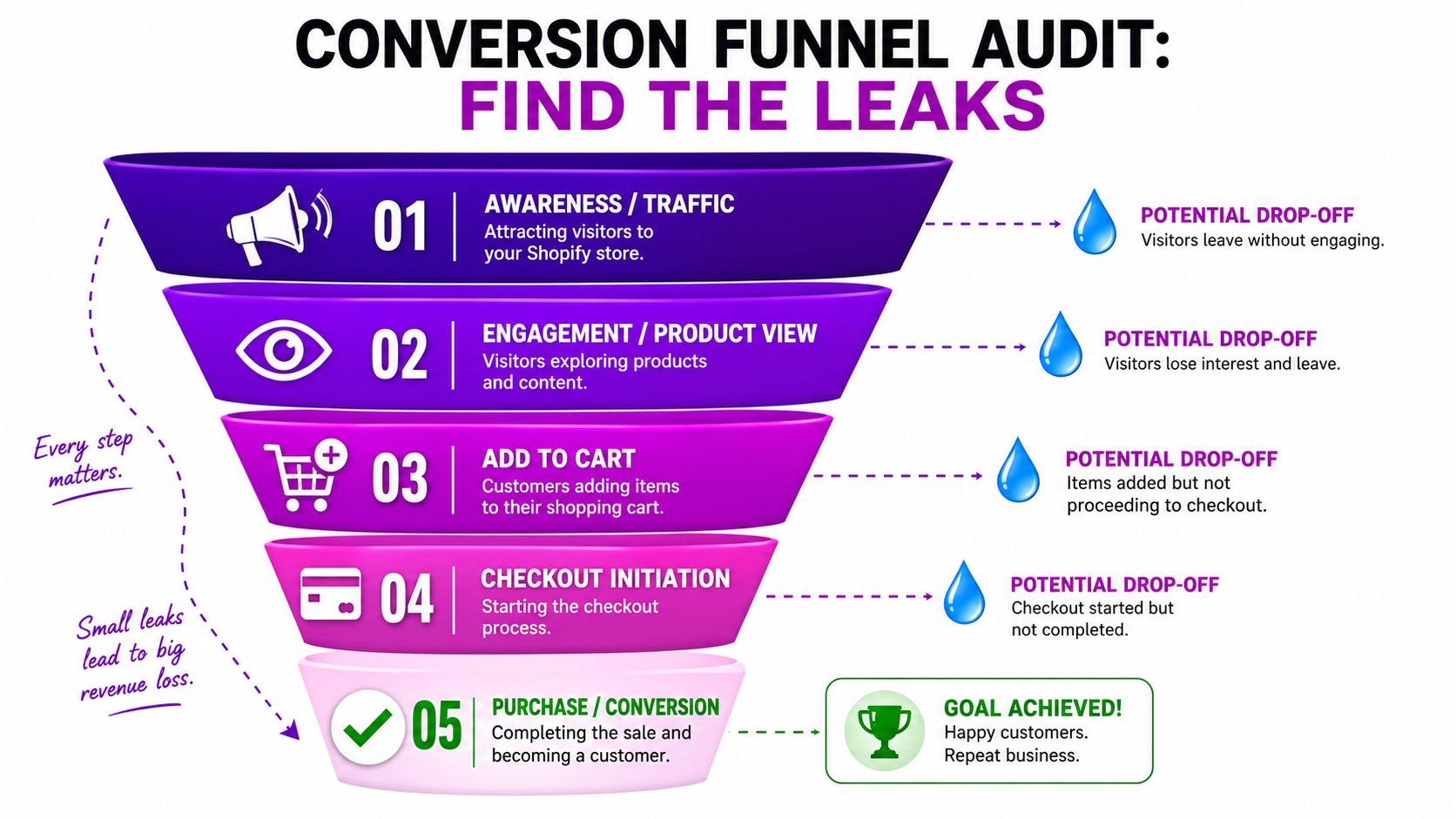
Australian eCommerce benchmarks put a solid baseline at 2% to 2.5% for most sectors, and common failures include no clear conversion path, where weak contrast, small buttons, or vague CTAs create abandonment, as outlined by RankingCo's Australian CRO overview. If your store sits below that range, start with the funnel before touching brand aesthetics.
Start with the numbers
In GA4, map the full commerce journey. At minimum, review:
- Landing page to product view
- Product view to add to cart
- Add to cart to checkout start
- Checkout start to purchase
Don't just look at sitewide conversion. Break it down by landing page, device, traffic source, and product category. A healthy homepage can hide a weak PDP. A strong returning-customer segment can hide a poor first-visit experience.
For deeper diagnosis, this guide to conversion funnel analysis is a practical framework for spotting stage-level drop-off.
Then inspect behaviour
Heatmaps, scroll maps, session recordings, and form analytics show what metrics can't. They reveal whether visitors miss the shipping message, fail to notice the add-to-cart button, rage-click size selectors, or hesitate when returns policy details are buried.
Use them to answer questions like:
- Are users seeing the primary CTA?
- Do they scroll to delivery and returns content?
- Are variant selectors or subscription options causing confusion?
- Does the cart drawer interrupt momentum or support it?
A store can have “traffic problems” on paper when the real issue is that shoppers don't trust the shipping promise.
What to look for on Australian Shopify stores
Local stores tend to run into a different set of friction points than US playbooks assume. Audit these closely:
| Funnel area | What to check | Why it matters |
|---|---|---|
| Product page | Shipping estimates, returns summary, stock messaging | Aussie shoppers want certainty before cart |
| Cart | GST clarity, shipping thresholds, promo code behaviour | Surprise cost kills intent |
| Checkout | Payment mix, address friction, mobile keyboard flow | Tiny annoyances compound fast |
| Trust | AU phone number, local reviews, policy visibility | Local signals reduce hesitation |
Don't audit in isolation
Numbers without context lead teams to chase the wrong fix. A drop in add-to-cart rate might look like a pricing problem, but recordings may show customers hunting for delivery timelines. Checkout abandonment might look like payment resistance, but the underlying issue may be a vague returns policy for international orders.
A useful audit ends with a shortlist, not a giant wish list. Keep it tight:
- One primary bottleneck: The biggest revenue leak.
- One supporting issue: Something that worsens the main problem.
- One fast technical fix: Usually speed, layout clarity, or form friction.
That creates the foundation for a testable hypothesis instead of a redesign based on taste.
Building a Data-Driven Hypothesis
Most bad CRO work starts with an opinion disguised as insight. “The button should be bigger.” “Let's move reviews higher.” “We need a cleaner page.” None of those statements explain why the change matters or how success will be judged.
A stronger approach follows the five-step scientific loop used in Australian CRO programmes: Data Analysis, User Behaviour Research, Hypothesis Creation, A/B Testing, and Ongoing Optimisation, as described by Resolution Digital. The critical step is the middle one. A hypothesis turns scattered observations into a test with a clear purpose.
Use a simple hypothesis structure
A format that works well on Shopify is:
Because we observed [data or behaviour], we believe that changing [page element] to [specific variation] will improve [metric], measured by [primary KPI].
That structure forces discipline. It also stops teams from bundling five ideas into one test.
Here's a weak version:
- Make the product page more engaging.
Here's a usable version:
- Because session recordings show users scrolling to delivery info before deciding, we believe moving shipping and returns reassurance closer to the add-to-cart area will improve add-to-cart rate, measured by product page conversion.
Build hypotheses from evidence, not preference
Good hypotheses usually come from one of three sources:
- Observed hesitation: Users pause, scroll back up, or leave before an action.
- Message mismatch: Paid ad promise and landing page wording don't line up.
- Decision friction: Customers need information that's present, but too late.
Watch for this trap: If the only reason for a test is “it looks better,” you're already designing based on opinion.
Keep one variable per test
A common mistake is changing headline, CTA, image order, trust badges, and shipping copy all at once. If results move, you won't know what caused it. Clean tests isolate one core idea.
A practical worksheet looks like this:
| Problem | Evidence | Hypothesis | KPI |
|---|---|---|---|
| Low add-to-cart from PDP | Scroll maps show users search for delivery details | Move delivery and returns summary above the fold | Add-to-cart rate |
| Cart drop-off | Recordings show promo code hunting | Reduce promo code emphasis in cart | Checkout initiation |
| Checkout exits | Behaviour suggests trust hesitation | Add clear local support details before payment step | Purchase completion |
The metric matters as much as the idea. If you're testing a product page CTA, don't judge it on total revenue first. Start with the nearest meaningful action, then review downstream impact after the test closes.
Strong hypotheses save time because they narrow the field. Instead of debating opinions in Slack, the team runs a test with a clear reason and a clean measurement plan.
Designing and Implementing Tests on Shopify
Once the hypothesis is solid, implementation should stay simple. Most Shopify stores don't need elaborate experimentation programmes at the start. They need a small queue of high-impact tests run cleanly.
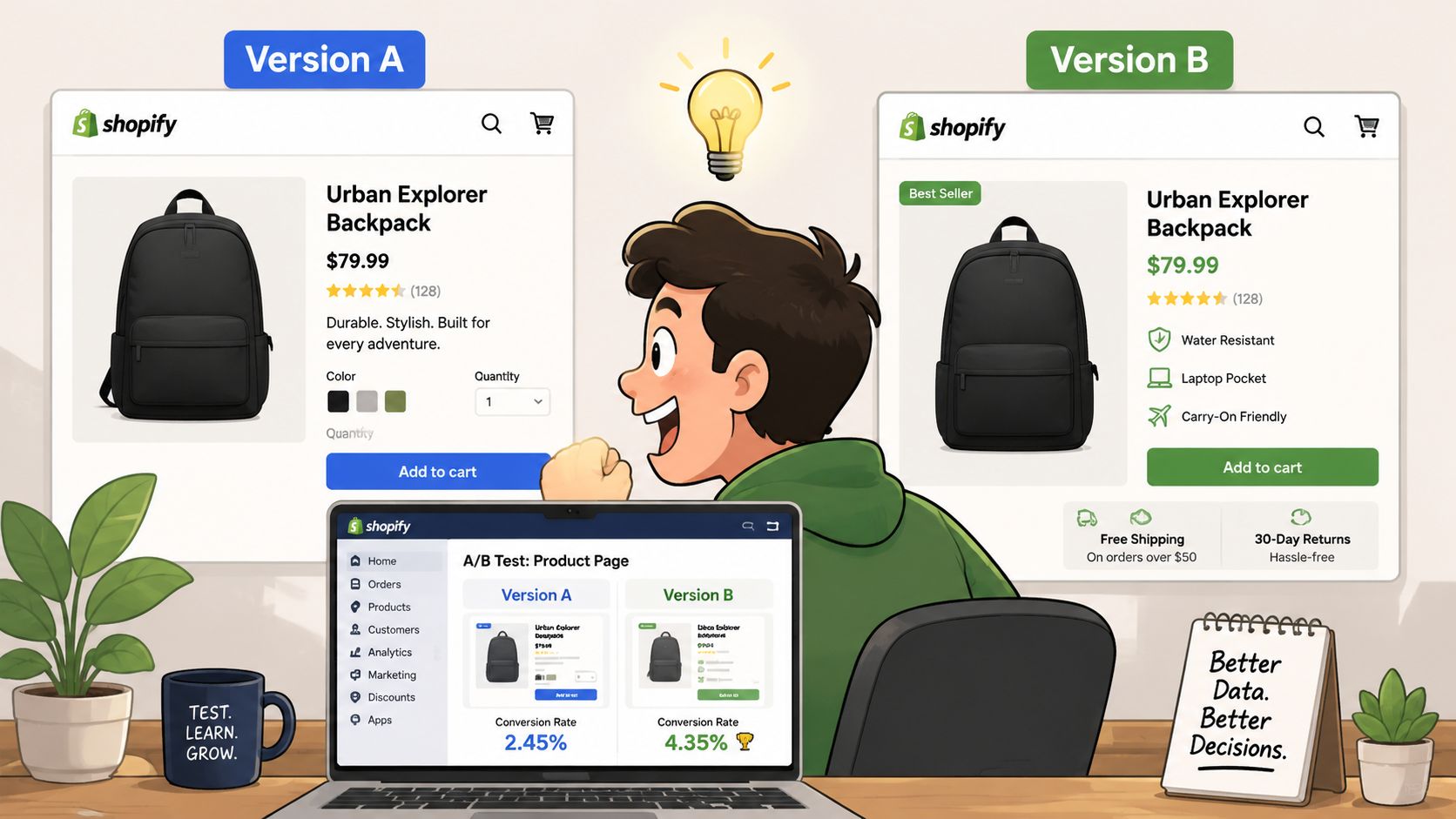
The upside is real when testing is done properly. The average A/B test can boost conversion rates by about 49%, and personalized calls-to-actions perform 202% better than basic CTAs, according to ElectroIQ's CRO statistics roundup. Those numbers don't mean every test wins. They do show why disciplined experimentation beats intuition.
Choose the right test type
Not every test belongs in the same bucket.
A/B testing is the default. You compare version A against version B with one meaningful difference. This is the right choice for most Shopify stores.
Split testing usually means sending traffic to separate page versions or templates. It's useful when layout differences are large enough that editing one block won't cover it.
Multivariate testing changes several elements at once to study combinations. This needs more traffic and tighter setup, so it's usually better for mature programmes than early-stage stores.
What to test first
Start where purchase intent is strongest. Founders often begin on the homepage because it's visible. In practice, product pages, cart, and checkout usually produce faster learning.
Prioritise tests like these:
- Headline clarity: State product value more directly, especially if your ads promise a specific outcome.
- CTA wording: Replace generic actions with language tied to the product or offer.
- Trust placement: Move reviews, guarantees, or delivery reassurance closer to the buying decision.
- Media order: Lead with imagery that answers fit, size, material, or use-case questions.
- Offer framing: Test bundle language, shipping thresholds, or return reassurance.
If you're looking at setup options, this walkthrough on A/B testing for Shopify covers the practical side well.
Tools that fit the Shopify stack
Shopify Plus merchants can use native experimentation features where available within their stack. Standard Shopify plans usually rely on third-party tools. Common options include VWO and other visual testing platforms that integrate with Shopify themes and event tracking.
Some brands also work with specialist partners that handle test design, implementation, QA, and readout. ECORN is one example. The agency works on Shopify CRO, including A/B testing across product pages, discovery flows, checkout experience, and speed-related friction.
After setup, keep your test hygiene tight:
- QA on mobile first: Most issues show up there first.
- Check tracking before launch: Don't assume events are firing correctly.
- Avoid overlapping tests: Interference makes readouts muddy.
- Freeze unrelated changes: A merchandising update can contaminate results.
A useful demo of testing workflow is below.
What not to do
Founders lose momentum when they test cosmetic changes with no purchase relevance. Swapping background shades, adjusting icon style, or rewriting three headings at once rarely teaches much.
A better rule is simple: test the parts of the page that answer the buyer's last objection.
If customers still doubt delivery, returns, sizing, payment, or trust, changing the hero image won't rescue the session.
On Shopify, the strongest tests usually improve clarity before they improve creativity.
The Australian Edge Localisation That Converts
Generic CRO advice often assumes one global shopper profile. Australian stores know that's false. Local expectations shape whether a store feels trustworthy, expensive, vague, or easy to buy from.
The most overlooked gains in conversion rate optimisation Australia work often come from localisation. Not just currency switching. Real localisation that reduces doubt for an Australian buyer before they reach checkout.
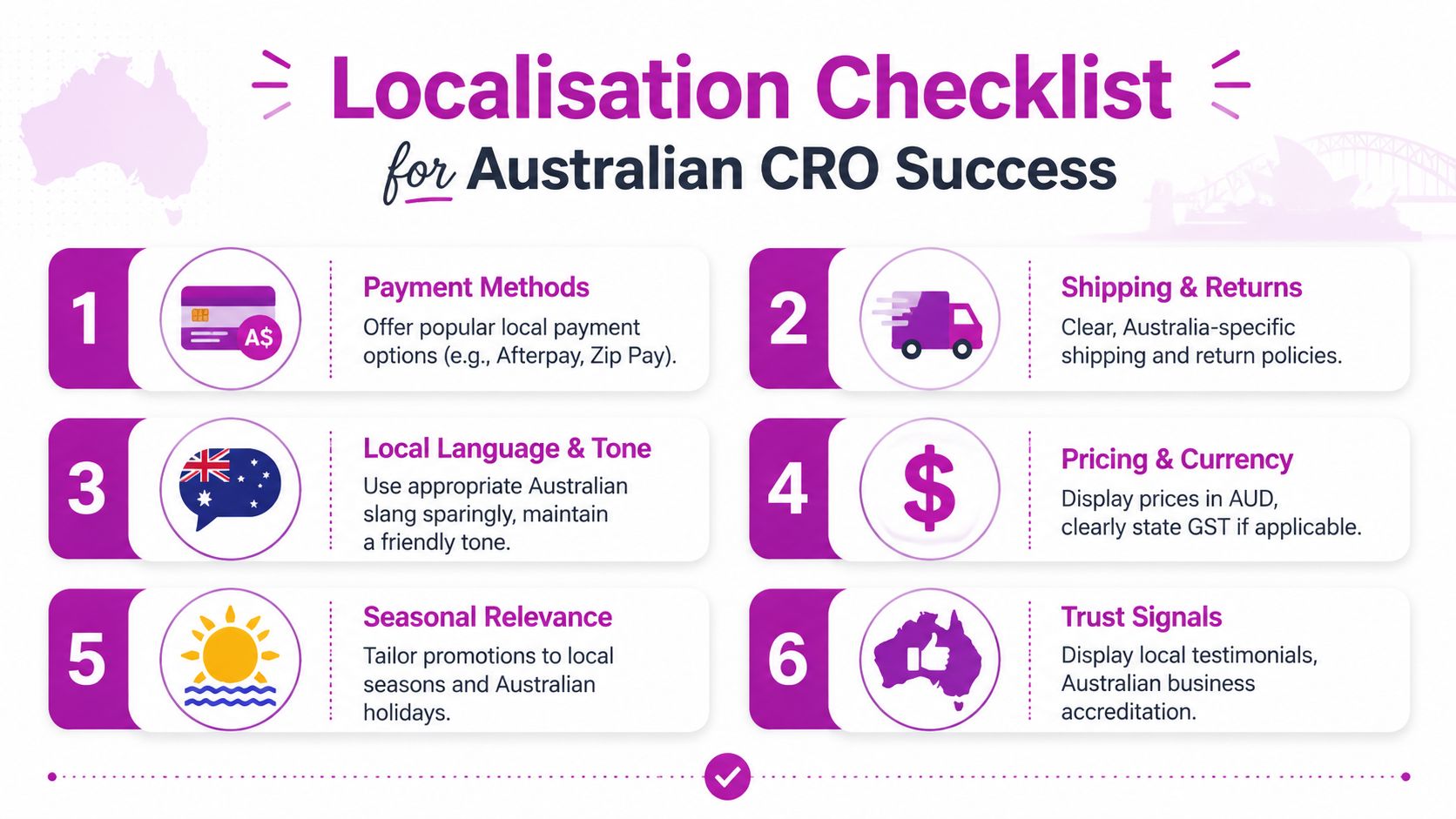
One data point stands out. Optimising for local trust signals, such as displaying Australian phone numbers and local payment badges like PayID, drives 19% higher conversion than globalized UX for Aussie visitors, according to Adobe's Australia-focused ecommerce CRO article. That's why imported US templates often look polished but convert weakly here.
Local trust beats global polish
Australian shoppers tend to respond well when the store feels accountable. That means visible support channels, clear business identity, and policy language that sounds specific rather than legalistic.
Key trust builders include:
- Australian contact details: A local phone number and clear support pathway.
- Local payment familiarity: Afterpay, Zip, PayID, and other recognisable options where relevant.
- Policy clarity: Shipping, returns, and exchanges explained in plain English.
- Local social proof: Reviews from Australian customers and delivery expectations that match geography.
Shipping, GST, and returns need plain language
A lot of stores hide important operational detail because they don't want the page to feel cluttered. That usually backfires. Customers want quick answers, not a scavenger hunt.
On product and cart pages, make these points easy to find:
| Buyer concern | What your store should show |
|---|---|
| Delivery timing | A realistic delivery estimate, not vague marketing copy |
| Shipping cost | Clear thresholds and any conditions |
| GST | Whether pricing already reflects it, stated plainly |
| Returns | The process, who pays, and how international returns work |
Cross-border stores need special care here. If you ship internationally but serve a core Australian audience, don't let global operations dilute local confidence. Keep the local buying experience front and centre.
Localisation isn't decoration. It removes the moment where a customer asks, “Is this store really set up for me?”
Copy and merchandising should feel Australian
This doesn't mean stuffing pages with slang. It means writing in a way that feels natural to the customer you want. Seasonal timing matters too. Promotional calendars, delivery messaging, and gift campaigns should reflect Australian seasons and local buying periods, not imported northern hemisphere defaults.
Small changes can make the site feel more grounded:
- Use AUD consistently
- Match local spelling and tone
- Reference delivery expectations accurately
- Avoid overblown trust copy that feels borrowed
The strongest Australian stores don't shout “we're local” everywhere. They remove the signals that make shoppers wonder if they aren't.
Measuring Success and Scaling Your CRO Program
Australian Shopify stores that improve conversion over time usually do one thing well. They measure changes beyond the first headline lift and turn each test into a repeatable operating process.
One winning experiment is useful. A working CRO program is better. Stores lose momentum when a result gets rolled out but nobody records why it worked, what segment responded, or whether margin and retention held up after the initial bump. Six months later, the team is testing the same idea again with different copy.

Read results like an operator
Start with the commercial question, not the test tool screenshot.
A variant can lift add to cart and still be a poor decision if it increases returns, pushes customers toward lower-margin bundles, or creates support issues after purchase. For Australian stores, I also check whether the result held across metro and regional traffic, new versus returning customers, and mobile sessions. Shipping expectations, delivery cost sensitivity, and trust concerns often differ by state and postcode.
When a test ends, review four things:
- Primary KPI: Did conversion rate, revenue per session, or another chosen KPI move enough to matter?
- Quality of the win: Did AOV, margin, refund rate, and checkout completion stay healthy?
- Consistency: Did the result hold for long enough across normal trading days, not just a promo spike or payday bump?
- Customer insight: What objection or hesitation did the winner reduce?
Statistical confidence still matters. The practical mistake is calling a winner too early from a short run, especially during sale periods, paid traffic swings, or email-heavy weeks.
Build a learning library
Every completed test needs a record your team can use later. Keep it tight and useful.
| Record field | What to note |
|---|---|
| Hypothesis | What you expected to change and the evidence behind it |
| Variation | The exact page, element, and copy or design change |
| Outcome | Win, loss, or inconclusive |
| Learning | What the result suggests about buyer behaviour |
| Rollout | Where else the same insight should be applied |
This is how a CRO program scales. If repeated tests show that clearer dispatch timing improves conversion on product pages, apply that learning to collection pages, cart messaging, landing pages, and retention flows. If the uplift appears only for first-time visitors from paid social, treat it as a segment insight, not a sitewide rule.
Good records also stop internal debates from resetting every quarter.
Scale carefully
As your testing process matures, personalisation and automation become more useful. Product recommendations, dynamic merchandising, and checkout changes can reduce friction. They can also create noise if they are added faster than the team can measure them.
Australian brands need extra care here. Privacy expectations are higher than many offshore CRO playbooks assume, and blunt personalisation can hurt trust fast. Consent settings, tracking limitations, and transparent messaging all affect what you can reasonably test. GST-inclusive pricing, shipping thresholds, and local delivery promises also need to stay consistent when content changes by audience or device.
The rule is simple. Add one layer of complexity at a time, and prove it pays its way.
The strongest stores treat CRO as a monthly operating rhythm across merchandising, analytics, design, development, and customer service. That structure is what turns test wins into sustained growth.
If you want a Shopify-focused team to help audit funnel leaks, design tests, and build a practical CRO roadmap for your store, ECORN works with brands on design, development, and conversion rate optimisation through flexible project and subscription models.


Ecommerce Conversion Tracking: The Complete How-To Guide
Shopify Design Agency: How to Pick the Right Partner
Mastering Multi Store Management on Shopify
Scale Shopify Store

10 Shopify App Ideas Worth Building in 2026
Conversion Rate Optimization for Landing Pages: The Playbook
Shopify Plus Automation: A Guide for 2026
10 Social Selling Platforms for Shopify Merchants

Shopify Website Design Examples: 7 Stores Worth Studying
7 Ecommerce Newsletter Examples for Shopify Brands
One Product Shopify Store: Build and Scale

Mobile Pop Up Strategy for Shopify Stores That Converts
Sitemap for Shopify: How to Find, Optimize, and Submit It
7 Single Product Websites Worth Emulating
Product Variants Shopify: The Complete 2026 Guide
Ecommerce Analytics Consulting for Growth
What Is AI Integration for eCommerce

How to Choose the Right eCommerce Website Development Firm
E Business Strategy Implementation
Conversion Tracking Setup for Shopify Stores
BigCommerce vs Shopify Plus Which Enterprise Wins in 2026
Shopify Theme Kit: Setup, Commands, and Migration Guide
Shopify Extension Development: A Practical 2026 Guide
Shopify Speed Score Explained and How to Improve It
Shopify Mobile Optimization: The 2026 Playbook
How to Add Subcategory in Shopify for Better UX
How to Implement Structured Data for Ecommerce in 2026

SEO App Mobile: Shopify Store Optimization Guide
Shopify Plus Support: What It Includes and How to Choose

Google Ads for Shopify: The Complete 2026 Playbook

Shopify New York: How to Find and Hire the Right Agency
Google Search Console for Shopify: The Complete Setup

First Party Data Collection for eCommerce Growth
FAQ Online Store Guide: Build and Measure It Right

Do FB Ads Work for eCommerce in 2026?
One Page Checkout for Shopify: Design and Implementation
Shopify GraphQL vs REST: The 2026 Developer Decision
Shopify Ecommerce Consulting: Strategy, Pricing &

Are Reddit Ads Worth It for eCommerce Brands
Shopify Title and Meta Description: A Practical 2026 Guide

Product Video Best Practices for Shopify Brands
Real-Time Inventory Management: A 2026 Guide

AI Chatbot Integration for Shopify Stores
Affiliate Program Management: A Shopify Guide
10 Best Performance Monitoring Tools for Shopify in 2026

Digital Asset Management for eCommerce Brands in 2026
Every Type of Facebook Ads Explained for eCommerce Growth
Product Information Management Explained for Shopify Brands
Support Ticket System: A Guide for Shopify Stores

10 Best Customer Service Tools for Shopify in 2026

Can I Start a Business with No Money? a 2026 Blueprint

What Sells Good on Etsy: Best Niches for 2026

Shopify Add to Cart Button: A Practical 2026 Guide

Customer Feedback Automation: A Practical eCommerce Guide
Critical Rendering Path: A Guide for Shopify Stores

How to Promote on TikTok for eCommerce in 2026

B2B eCommerce Consulting That Drives Real Revenue

10 Best Practices for Site Navigation in 2026
Return vs Refund for Shopify Stores: A Practical Guide
What Is Customer Lifetime Value and Why It Matters
What Is Voice of Customer Research for eCommerce

SMS Marketing for Ecommerce That Actually Converts

Master How to Improve Email Deliverability in 2026

Top 7 eCommerce Partners NYC for Shopify Brands in 2026

Machine Learning for Ecommerce: Boost Your Shopify Store

Beauty Market Research: Your 2026 Growth Guide

Shopify International Expansion: A 2026 Roadmap
What Does CRO Stand for in Business: Understanding CRO

Shopify Visual Merchandising: A Playbook for Higher Sales

Shopify Landing Page Design: Master Conversion in 2026

10 Best AI SEO Optimization Tools for Shopify in 2026

Agentic AI for Ecommerce: Boost Your Sales in 2026
Mastering Email Marketing Data for eCommerce Growth
Conversion Rate Optimization AI: Your Shopify Store Guide

10 Product Bundling Strategies for Shopify in 2026

How to Increase Customer Lifetime Value: A Shopify Playbook
AI Customer Service Automation: Shopify Guide 2026

Clean Website Design: A Shopify Conversion Playbook

Omnichannel Retail Strategy: A Shopify Playbook
Product Data Enrichment: A Guide for Shopify Brands

Instagram Shopping Features a Guide for Shopify Stores
What Is Revenue Optimization: A Holistic RevOps Guide

Benefits of Conversion Rate Optimization: Boost Your
WordPress to Shopify Migration: Your 2026 Seamless Switch
Boost Sales: Ecommerce Payment Processing Guide 2026
Unified Commerce Platform: Benefits, KPIs & Shopify Guide

How to Reduce Bounce Rate eCommerce: Your 2026 Guide
Shopify API Integration: A Practical End-to-End Guide

How to Implement Data Governance: A 2026 Guide
Shopify Store Development Cost: A 2026 Breakdown
What Is Server Side Tracking: The Shopify Guide 2026
Marketing Automation Workflows: A Shopify Guide for 2026

Shopify: How to Reduce Technical Debt

Shopify UX Design Change: A Playbook for Growth
User Generated Content Strategy: Shopify Playbook

Shopify Pause and Build Plan Cost: A Complete 2026 Guide
Compare at Price on Shopify: A Complete Guide for 2026

Where Can I Sell My Prints? 10 Best Platforms for 2026
Shopify Order Management System: The Ultimate Guide 2026
What Is Marketing Attribution? an eCommerce Guide for 2026


newsletter in your inbox