


Your Shopify store already has traffic, some product-market fit, and at least one product customers reliably buy. The frustrating part is what happens after that first add-to-cart. Too many stores stop at the product page, then hope a generic upsell widget does the rest. It usually doesn't.
Smart product bundling strategies fix that gap. Done well, bundling raises basket size, improves merchandising, helps move awkward inventory, and makes the buying decision simpler for the customer. Effective bundling strategies have been shown to generate a 20% increase in sales and a 30% boost in profits by increasing average order value. That's why serious Shopify operators treat bundles as part of CRO, not just merchandising.
The good news is you don't need a full replatform or a six-month data project to start. You need better bundle logic, stronger placement, and cleaner testing. If you want to see how bundle merchandising looks in practice, you can discover Morfose collections for a live retail example.
1. Pure Bundling Strategy
Pure bundling works when the bundle is the product. Customers don't pick pieces. They buy the full set or they don't buy at all. This approach is strongest when the combined items solve a single use case better than any one item could alone.
Think starter kits, treatment systems, travel sets, launch packs, or onboarding kits. In Shopify, this usually performs best when the customer doesn't want to configure anything. They want a ready-made answer.

Best tools and setup
For fixed bundles, I'd start with Shopify Bundles if your catalog is straightforward and you want native bundle creation. If you need stronger merchandising control, Bundler gives more flexibility around fixed sets and discount logic.
Pure bundles fail when merchants leave individual SKUs visible everywhere else on site and call it a bundle strategy. That creates conflict. If the bundle is meant to be the offer, the PDP, collection placement, and cart should reinforce that.
A strong pure-bundle build includes:
- One primary PDP: Route paid and email traffic to the bundle, not the component SKUs.
- One visual story: Show the full kit in the gallery, then break down each included item below the fold.
- One inventory logic: Make sure returns, swaps, and warehouse pick rules are defined before launch.
For implementation detail, ECORN has a useful breakdown of how Shopify product bundles can transform store revenue.
Practical rule: Don't use pure bundling when customers already know exactly which single item they want.
CRO and testing ideas
Test a fixed bundle above the fold against a standard single-SKU PDP. Then test whether the component breakdown belongs as icons, a comparison grid, or a short “what's included” strip near the add-to-cart button.
For service businesses like ECORN, pure bundling also works as a packaged engagement. Design, development, and CRO can be sold as one scoped offer when the buyer wants speed and clarity more than customization.
2. Mixed Bundling Strategy
A customer lands on a product page ready to buy one item. The fastest revenue lift often comes from giving them a better-value bundle without forcing them off that decision. That is mixed bundling. The single SKU stays available, but the bundle makes the larger purchase feel justified and easy to compare.
This strategy works well for Shopify brands that have one clear entry product and enough attachable items to raise average order value. It also protects conversion better than forcing a bundle-only offer, because shoppers who want the main product can still buy it without friction.
Best tools and setup
For mixed bundling on Shopify, Fast Bundle is a solid fit when you need bundle widgets on product pages and collection pages, along with straightforward discount rules. If your catalog is smaller or your team wants tight control over fixed offers and quantity breaks, Bundler can also handle mixed bundle setups well without adding too much front-end complexity.
The trade-off is clarity versus optionality. More choices can increase cart value, but they also raise decision time. On most PDPs, one single-product option plus one bundle option is enough. A second bundle tier can work if the difference is obvious, such as “starter” versus “full routine.”
What tends to work
- Anchor the decision on the hero SKU: Let shoppers understand the main product first, then present the bundle as the smarter upgrade.
- Show the savings next to the total bundle value: Customers should see both the bundle price and what is included without doing math.
- Keep the visual hierarchy tight: Use cards, radio buttons, or a simple comparison row so the bundle reads as an upgrade path, not a second catalog.
- Match the bundle to buying intent: A replenishment product pairs well with quantity-based bundles. A discovery product pairs better with a curated starter set.
One implementation detail matters more than brands expect. The bundle module should sit close to the buy box, not buried below reviews or long-form content. If shoppers have to hunt for the upgrade path, the single SKU usually wins by default.
Mixed bundling performs best when the bundle feels like the obvious next choice.
CRO and testing ideas
Start with placement. Test the bundle selector inside the main buy box against a version directly below it. Then test framing. “Buy together and save” often attracts price-sensitive shoppers, while “Build the full routine” can perform better for beauty, wellness, and education-driven products.
Test presentation too. I usually compare a radio-button layout against side-by-side offer cards, because the format changes how expensive the upgrade feels. On mobile, compress the offer into one clean selector with short benefit bullets. Long bundle explanations drag.
For service businesses, the same model applies to packaged retainers. A prospect can buy CRO by itself, or choose a mixed offer that includes CRO, design support, and Shopify development. That structure fits firms like ECORN because it preserves a lower-commitment entry point while increasing package size for clients who already know they need broader execution.
3. Leader Bundling Strategy
Leader bundling starts with your bestseller and uses it to pull slower-moving inventory through the same transaction. This is one of the most practical product bundling strategies for brands that already know which SKUs drive demand but struggle to move accessories, seasonal leftovers, or secondary lines.
The logic has to be tight. If the extra item feels random, customers spot it instantly. If it feels useful, they accept the bundle as a convenience purchase.
Best tools and setup
Use SellUp or qikify Upsell & Product Bundle when you want to merchandise add-on bundles around a proven hero product. Both are workable for “buy the main thing, get the rest in one click” setups.
This strategy benefits from pre-launch economics. B2B guidance specifically recommends running margin analysis for every bundle and SKU combination before launch, not after, because hidden component costs can wreck the model. That same source notes that 60% of failed bundle initiatives stem from uncalculated component costs. That's not just a B2B problem. Shopify brands hit the same wall when packaging, fulfillment time, or discount stacking gets ignored.
What works versus what doesn't
- Works: Bestselling cleanser plus refill, bestselling supplement plus shaker, bestselling device plus care kit.
- Doesn't work: Bestselling SKU plus anything the team wants gone.
- Works: Slower mover that improves the hero product experience.
- Doesn't work: Low-demand item that makes the offer feel padded.
CRO and testing ideas
Test the leader bundle in-cart, not just on the PDP. Customers often commit to the hero product first, then accept the bundle once they've psychologically decided to buy.
For service businesses, the leader offer might be a Shopify audit or CRO sprint. Bundle that with implementation support or a design cleanup package. The lead service earns attention. The secondary services increase account value if they clearly remove friction.
4. Cross-Category Bundling Strategy
A customer adds a travel backpack to cart. The higher-converting offer is rarely a second backpack at a discount. It is the packing cubes, charger, and toiletry kit that complete the trip.
That is the logic behind cross-category bundling. The products live in different parts of the catalog, but the customer experiences them as one purchase decision tied to one outcome. On Shopify, this strategy works best when the bundle reflects a real use case instead of a merchandising guess.

Best tools and setup
Cross-category bundles need stronger merchandising than a basic discount app can provide. PageFly is useful for building dedicated bundle landing pages around a scenario such as “desk setup,” “starter skincare routine,” or “new puppy essentials.” If you need recommendation logic inside the theme, use a Shopify app that can read cart contents, purchase history, or quiz responses and then surface related items from other collections.
The key input is buyer behavior. Look for products that repeatedly appear in the same customer journey, even if they sit in different categories and have different margins. AOV usually rises when the bundle removes planning effort for the customer. Conversion usually falls when the bundle looks like unrelated inventory pushed together.
This also applies to services. ECORN is a useful example because design, Shopify development, and CRO are separate service lines, but many brands buy them to solve one commercial problem: improve store performance without handing work across three vendors.
CRO and testing ideas
Build the page around the job, not the catalog structure. Lead with the outcome, show the full setup in one visual, then explain what each item or service contributes. Cross-category bundles sell better when the customer can grasp the finished result in a few seconds.
Test a dedicated use-case landing page against a standard product page widget. Then test the bundle location. For many Shopify stores, the highest-yield placements are the cart drawer, post-add-to-cart modal, and collection landing pages built around intent rather than product type.
A second test is presentation. Compare isolated product tiles against one styled image that shows the complete setup in context. For service businesses, test a scope-based bundle page against separate service cards. The bundled version often wins when the offer reduces decision fatigue and makes implementation feel easier.
5. Tiered Bundling Strategy
A shopper lands on your product page, likes the offer, then hesitates because one bundle feels too small and another feels excessive. Tiered bundling fixes that decision gap. It gives customers a clear path based on budget, urgency, and expected outcome, while giving the store a cleaner way to increase average order value.
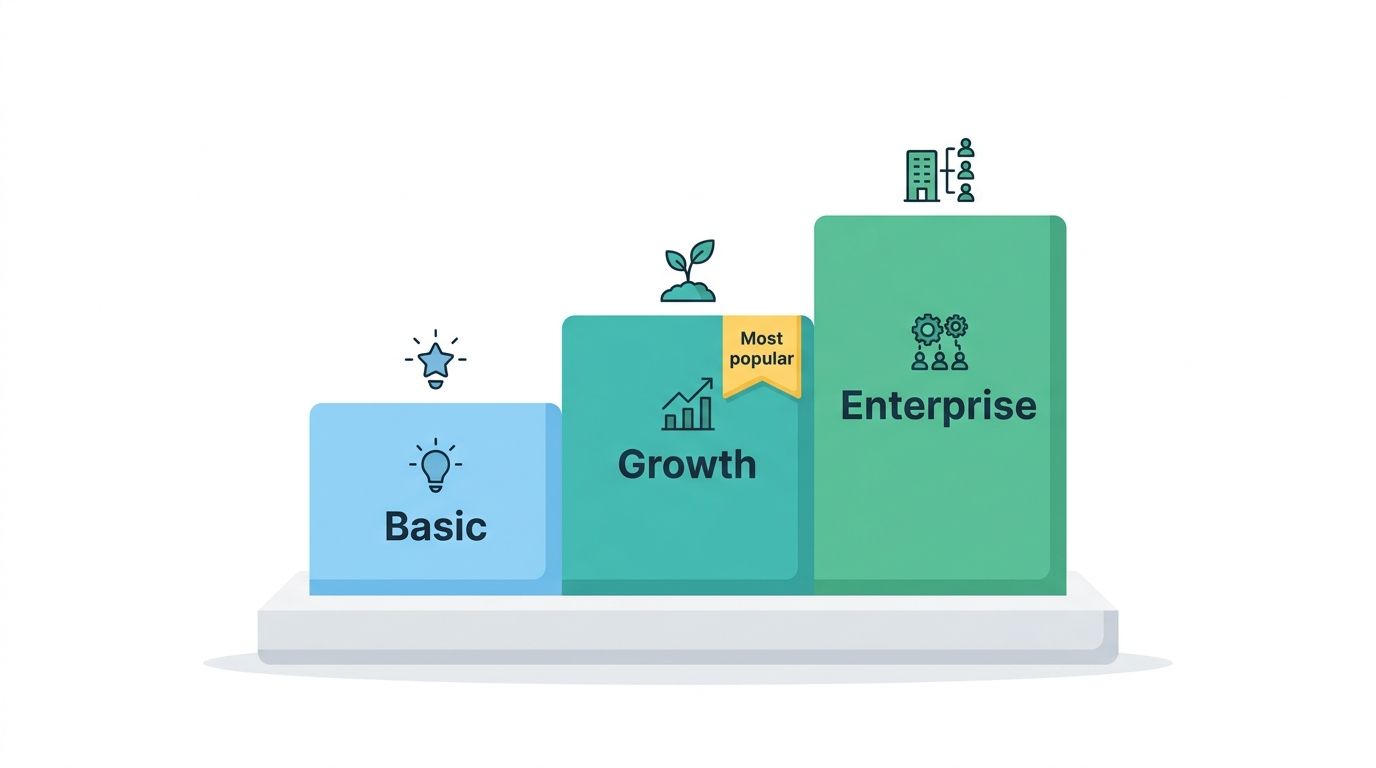
A good tier structure does two jobs at once. It lowers the entry barrier for hesitant buyers and creates a credible reason to trade up. The mistake is making tiers that differ only by price or vague labels. Customers need to see what changes: quantity, turnaround time, support level, included products, implementation help, or some other concrete increase in value.
Best tools and setup
For product-led offers, Bold Bundles works well when each tier includes different product combinations, discount rules, or promotional logic. For service-led brands, Gempages and Instant are useful for building comparison layouts that explain scope better than a default Shopify theme section.
The page design matters as much as the offer. Put the three tiers in one comparison view. Keep the naming plain. Show the price difference, the intended buyer, and the added value in each step. If a customer has to open multiple accordions to understand why Growth costs more than Basic, the tiering is doing extra work instead of reducing friction.
What good tiering looks like
- Basic: A focused entry offer for customers who want a fast, lower-risk starting point.
- Growth: The practical choice for the largest share of buyers, usually with the extras they were likely to add anyway.
- Premium: A higher-commitment option built around speed, access, convenience, or fuller implementation.
Field note: Three tiers is usually enough. A fourth tier can work in technical categories or high-consideration services, but for many Shopify stores it adds comparison fatigue.
This structure also fits service businesses. ECORN, for example, can package design, development, and CRO support into tiered scopes so clients can compare deliverables without going through a long custom quote cycle. That works because the differences are operational, not cosmetic. One tier might cover audits and wireframes, the next adds implementation, and the top tier includes ongoing optimization or faster turnaround.
CRO and testing ideas
Start with offer framing. Test outcome-led tier names against generic names like Basic, Growth, and Premium. In many stores, names tied to the customer goal make comparison easier.
Then test the middle tier treatment. A highlighted middle plan often raises conversion because it acts as the safe choice, but it can also suppress premium uptake if the visual emphasis is too aggressive. I usually test three variations: no highlighted plan, a lightly emphasized middle tier, and a premium tier badge built around speed or support.
For physical products, test what makes the upgrade feel worth it. More items is only one path. Exclusive SKUs, giftable packaging, faster replenishment, setup help, or convenience features often outperform a simple quantity increase. For service offers, test whether buyers respond better to scope-based differences, turnaround guarantees, or access to senior execution.
The best tier wins when the value jump is obvious in under ten seconds. If customers need a sales call to understand the difference between tiers, the packaging still needs work.
6. Frequency-Based Bundling Strategy
A customer buys a 30-day product on January 3, likes it, then disappears because the store never gave them an easy way to reorder on time. Frequency-based bundling fixes that gap. It packages repeat demand into a buying rhythm the customer can accept once instead of rebuilding every month.
This works well for replenishment brands, but the same logic applies to service businesses. If a client needs ongoing design production, landing page updates, or CRO implementation, a recurring bundle often sells better than repeated project scoping because the cadence, scope, and billing are already defined.
Best tools and setup
For Shopify brands, Skio and Recharge are the practical starting points. Both handle subscription infrastructure, customer portals, skipped orders, and recurring billing well enough to support bundle offers that are built around timing instead of one-off discounts.
A key margin win comes from matching the bundle to consumption behavior. A 30-day supplement plan, a 60-day refill pack, and a quarterly family-size option should not sit behind the same reorder prompt. Segment by usage rate, first-order size, and time since purchase. If you need on-site promo mechanics to support those offers, ECORN's guide to Shopify promotional apps for profit is a useful reference for implementation options.
Practical application
- Replenishment brands: Build bundles around actual reorder windows, such as 30, 45, or 60 days.
- Consumables: Package refills by usage pattern, not just by unit count. Daily users and occasional users should not see the same cadence.
- Services: Sell recurring deliverables in a fixed monthly bundle, such as design requests, CRO reviews, development hours, or sprint-based execution.
The strongest repeat offer shows up before the customer needs to remember to buy again.
That timing matters. If the bundle is presented too late, the customer has already improvised with a competitor, delayed the purchase, or dropped the habit entirely.
CRO and testing ideas
Test the first exposure point. Some stores get better subscription-bundle uptake on the PDP, especially when the product has an obvious replenishment cycle. Others convert better after checkout, where the buyer has already committed and is more open to adding convenience.
Then test the value framing. “Subscribe and save” can work, but convenience-led copy often wins when discounting is not the main motivator. Options like “deliver every 30 days,” “auto-refill before you run out,” or “monthly essentials pack” usually make the commitment clearer.
For service businesses, frequency bundling needs one thing above all else: operational clarity. A monthly growth package should specify what ships each cycle, what turnaround looks like, and what happens if requests exceed scope. That is especially relevant for agencies and operators like ECORN, where recurring work can span design, development, merchandising, and optimization. Buyers stay longer when the bundle feels predictable to manage, not just attractive to buy.
7. Seasonal and Promotional Bundling Strategy
A shopper lands on your store two weeks before Black Friday, or three days before Mother's Day. They are not browsing the way they do in February. They want a fast answer to a time-bound need, whether that is gifting, event prep, holiday inventory, or a limited campaign buy. Seasonal bundling works because it reduces decision time at the exact moment urgency is already high.
That is why this strategy can outperform a plain sitewide discount. A seasonal bundle gives the promotion context. Instead of cutting price across the catalog, you group products around the occasion, the use case, or the buyer type, then merchandise that bundle like a campaign instead of a markdown.
Best tools and setup
Use Klaviyo to segment by past holiday buyers, gift shoppers, product affinity, or discount sensitivity. Use Shopify Flow to schedule collection visibility, auto-tag campaign products, and switch promotional logic on and off without manual cleanup. For the on-site layer, this guide to Shopify promotional apps for profit is a strong reference for bars, popups, and timed offer mechanics inside Shopify.
Execution matters more than the calendar itself. The winning stores usually launch the campaign page early, build traffic before the peak week, and give the bundle a clear reason to exist. Gift-ready packaging, event-specific copy, limited-run SKUs, and deadline messaging all help.
A useful example shows up outside standard DTC gifting. In food packaging and seasonal takeaway demand, buyers often purchase around events, catering spikes, and holiday volume. The complete guide for UK food businesses reflects that same buying pattern. Customers respond better when the offer is organized around the moment they are preparing for.
What to avoid
- Holiday bundles built from random overstock with no clear seasonal logic
- Campaign pages published so late that ads, email, and organic traffic have no time to build momentum
- Bundles that ignore gifting needs such as recipient type, price range, delivery cutoff, or presentation
CRO and testing ideas
Start with landing page structure. Test a dedicated seasonal collection or gift guide against a standard PDP-led path. In many Shopify stores, the campaign page wins because it lets shoppers self-select by occasion, budget, or recipient before they ever compare individual products.
Then test merchandising cues. Countdown timers can work, but they are not the safest first test for every brand. I usually test themed photography, gift-focused headlines, and delivery deadline placement before adding urgency widgets. Premium brands often get better results from clarity and relevance than from aggressive pressure.
Service businesses can apply the same model. A time-boxed Q4 launch package, Black Friday audit plus implementation sprint, or holiday retention campaign bundle gives the buyer a deadline, a scope, and a reason to purchase now. That is especially useful for operators like ECORN, where the offer may combine design, development, merchandising, and campaign execution into one promotional package.
8. Solution-Based Bundling Strategy
A buyer lands on your store with a job to get done. They are trying to launch faster, fix a workflow, start a routine, or replace a messy multi-step purchase with one clear decision. Solution-based bundling works because it matches that intent.
This strategy performs well when the customer cares more about the finished result than the individual SKU list. That makes it a strong fit for B2B offers, technical product catalogs, high-consideration DTC purchases, and service businesses. A skincare starter system, a home office setup, or a retention audit plus implementation package all follow the same logic. Sell the outcome, then support it with the included components.
Best tools and setup
Use Zipify Pages or Shogun to build a landing page around the customer problem, the promised result, and the buying path. Pair that with LimeSpot if you want to recommend add-ons that support the main solution without distracting from it.
Execution matters more here than in simpler bundle types. The page needs a clear problem statement, a defined outcome, visible deliverables, and proof that the package fits a specific use case. If the shopper has to infer what the bundle solves, conversion usually drops.
Service brands should pay attention to this model. ECORN is a useful example because merchants rarely buy isolated tasks. They buy a business result, such as a store redesign tied to conversion improvement, a landing page build tied to campaign performance, or a retention package tied to repeat purchase growth.
A useful parallel shows up in packaging categories too. Buyers often want the right setup for their operation, not a long list of separate item decisions. For a category-specific example, this complete guide for UK food businesses shows how customers evaluate operational fit, usability, and purchasing practicality together.
Lead with the result. Use the component list to reduce risk and answer objections.
CRO and testing ideas
Start with headline framing. Outcome-led copy usually beats a components-led headline because it gives the shopper a reason to care before asking them to process the details. Test a promise-led headline against a deliverables-led headline and watch both conversion rate and average order value.
Then test page structure. For physical products, lead with the use-case image or routine visual before the bundle breakdown. For services, put the business outcome, timeline, and scope near the top, then explain what is included and how the work will be delivered.
I also recommend testing how you present proof. Some brands get better results from before-and-after examples. Others convert better with a simple three-step process, deliverables table, or objections section that answers implementation concerns, timeline questions, and expected results. The right format depends on whether the buyer is comparing alternatives, justifying budget, or trying to reduce decision fatigue.
9. Customizable Modular Bundling Strategy
Customizable bundles let customers build within rules. That's the distinction that matters. This isn't unlimited choice. It's controlled flexibility, where the store defines the categories and the customer selects the components.
This works well when customers have different preferences but still want the economics and convenience of a bundle. Beauty routines, snack boxes, gifting, office setups, and configurable service retainers all fit.
Best tools and setup
For build-your-own functionality on Shopify, BundleBuilder and PickyStory are strong places to start. They support guided selection and dynamic bundle composition better than simpler fixed-bundle apps.
The implementation risk is complexity. You need clean product rules, fulfillment logic, and category boundaries. Technical guidance on bundling analytics recommends combining browsing data and shopping cart data because that dual-data approach is more effective than relying on one behavior source alone. The same guidance also recommends A/B testing bundle configurations, price points, and promotional messages while tracking conversion rate and repeat purchase rate.
Build rules that protect conversion
- Limit category choice: Too many slots turn the experience into work.
- Show compatibility clearly: Customers shouldn't guess whether the selected items belong together.
- Update price feedback instantly: If the bundle economics are unclear, people abandon.
CRO and testing ideas
Test guided flows against open grids. In many stores, a step-by-step builder converts better because it lowers cognitive load. Also test whether customers respond better to “build your routine” language versus “choose any three.”
For service businesses, modular bundling can package recurring support. A client selects a fixed number of service blocks, such as design tasks, CRO experiments, or development requests, within a defined monthly bundle.
10. Performance-Based Bundling Strategy
A founder buys a growth package expecting a measurable lift, but the scope is vague, attribution is messy, and nobody agrees on what success looks like 30 days later. Performance-based bundling fails fast when the offer is not tightly defined. It works when the bundle ties pricing, bonuses, or delivery stages to metrics the customer can verify.
This model shows up more often in services, but Shopify brands can apply a practical version of it. High-consideration products can be bundled with setup, onboarding, training, optimization, or post-purchase support. The point is simple. The customer is not only buying items. They are buying a clearer path to a result.
Best tools and setup
Use Triple Whale, Northbeam, or Shopify-native analytics to define the metric before the offer goes live. If the team cannot measure the outcome with reasonable confidence, sell a fixed deliverable bundle instead.
For Shopify stores, that usually means choosing one primary success metric and one guardrail metric. A primary metric could be conversion rate lift, subscription retention, or repeat purchase rate. A guardrail metric could be return rate, support ticket volume, or margin. That structure keeps the offer commercially useful without creating incentives that hurt the business elsewhere.
For service businesses such as ECORN, this matters even more. Performance language attracts attention, but vague promises create sales friction and margin risk. Tie the bundle to a measurement window, required client inputs, tracking access, and a short list of excluded factors before the proposal goes out.
Where this fits best
- Agencies: CRO, landing page work, and implementation tied to agreed reporting periods
- B2B services: Launch or migration packages tied to delivery milestones and adoption targets
- Complex products: Product plus setup, support, or optimization sold as one outcome-oriented offer
If outside variables heavily affect the result, tie the commercial model to deliverables, milestones, or bonus thresholds instead of guaranteed revenue outcomes.
CRO and testing ideas
Test a fixed-fee bundle with a performance bonus against a fully variable offer. In practice, many buyers want a defined base scope because procurement and budgeting get easier.
Test the page layout too. A performance-led bundle often converts better when the offer page shows four blocks in order: what is included, how success is measured, what the customer must provide, and when results are reviewed. That sequence reduces ambiguity at the point of decision.
For Shopify implementation, use a short comparison table near the CTA. Show the difference between a standard service package and the performance-based version. Include tracking requirements, timeline, reporting cadence, and any bonus or milestone terms. This is a UX detail, but it does real sales work.
For ECORN-style engagements, performance-based bundling is viable when metrics, responsibilities, and review windows are explicit. If those terms stay fuzzy, the bundle reads like a promise you cannot control.
10-Point Product Bundling Comparison
If a Shopify team asks which bundling model to launch first, the right answer is usually. the one they can implement cleanly, measure fast, and support operationally. A bundle that looks smart in a strategy deck can still fail if inventory rules, PDP UX, and app setup are sloppy.
Use this comparison to match bundle type to catalog structure, buying behavior, and team capacity. For product brands, that usually means balancing AOV upside against fulfillment complexity. For service businesses such as ECORN, it means packaging scope, outcomes, and delivery in a way buyers can understand and approve.
| Strategy | 🔄 Implementation Complexity | ⚡ Resource / Speed | ⭐ Effectiveness/Quality | 📊 Expected Outcomes/Impact | 💡 Ideal use cases & Key advantages |
|---|---|---|---|---|---|
| Pure Bundling Strategy | 🔄 Medium. Fixed composition, straightforward to launch | ⚡ Moderate. Low ongoing ops, but still needs pricing and offer testing | ⭐⭐⭐⭐. Strong AOV lift when products are naturally bought together | 📊 Higher order value, cleaner merchandising, fewer product-choice decisions. Return risk increases if one item feels unnecessary | 💡 Best for complementary SKUs. Good fit for gift sets, starter kits, and replenishment pairings. Tip: keep bundle savings clear and easy to verify against single-item pricing |
| Mixed Bundling Strategy | 🔄 High. You manage singles and bundles at the same time | ⚡ Moderate. Requires clear variant handling and merchandising logic | ⭐⭐⭐⭐. Flexible and conversion-friendly because customers keep choice | 📊 Broader customer coverage, stronger conversion, and better pricing data. Bundle margin can tighten if discounts are too aggressive | 💡 Best for catalogs with different buyer intents. Strong option for Shopify brands using bundle apps like Fast Bundle or Bundler with visible savings modules and cart-level tests |
| Leader Bundling Strategy | 🔄 Medium. Requires clean product-level sales analysis to pick the lead SKU | ⚡ Low to moderate. Existing demand does a lot of the work | ⭐⭐⭐. Effective for improving attach rate and moving slower inventory | 📊 Faster sales velocity, better inventory flow, and higher basket size. Margin pressure can show up if the hero SKU carries the offer alone | 💡 Best when one bestseller clearly pulls demand. Good fit for PDP add-on sections, sticky cart offers, and post-purchase upsells |
| Cross-Category Bundling Strategy | 🔄 High. Requires customer journey mapping, compatibility checks, and tighter merchandising control | ⚡ High. Fulfillment and inventory coordination get harder fast | ⭐⭐⭐⭐. High perceived value when the bundle solves a broader buying need | 📊 Larger baskets, exposure to additional categories, and stronger repeat-purchase potential. Execution gets messy if products ship differently or serve different use cases | 💡 Best for brands selling routines, systems, or lifestyle combinations. Strong results usually depend on clearer copy, bundle education, and landing pages built around use case rather than SKU features |
| Tiered Bundling Strategy | 🔄 Medium. Clear differentiation matters more than the number of tiers | ⚡ Moderate. Needs pricing logic, comparison design, and offer positioning | ⭐⭐⭐⭐. Strong for upsell paths and price discrimination | 📊 Better revenue capture across budget levels and a reliable push toward premium tiers. Confusion rises if the value jump between tiers is weak | 💡 Best for services, subscriptions, and curated kits. On Shopify, comparison tables, default tier highlighting, and a middle-plan anchor usually do the heavy conversion work |
| Frequency-Based Bundling Strategy | 🔄 Medium. Subscription logic and retention flows must be configured properly | ⚡ Moderate to high. Requires recurring billing setup and lifecycle messaging | ⭐⭐⭐⭐. Strong LTV and revenue predictability when repeat purchase behavior already exists | 📊 More recurring revenue, stronger retention, and better reorder consistency. Churn rises if quantity or cadence feels misaligned with actual usage | 💡 Best for consumables and repeat-order categories. Strong fit for Shopify setups using Recharge or Skio, especially when customers can adjust cadence, swap items, or skip without friction |
| Seasonal & Promotional Bundling Strategy | 🔄 Medium. Planning, forecasting, and merchandising windows matter | ⚡ High in short bursts. Teams need to move quickly around campaign dates | ⭐⭐⭐. Strong short-term revenue effect, less dependable outside the promotional window | 📊 Sales spikes, better campaign merchandising, and faster movement of timely inventory. Forecasting mistakes can leave leftover stock or weaker margins after the event | 💡 Best for holidays, launches, and retail moments with built-in urgency. Strong execution usually includes dedicated landing pages, countdown logic, and promo-specific creative rather than a generic bundle tile |
| Solution-Based Bundling Strategy | 🔄 High. Offer design needs research, customer insight, and tighter positioning | ⚡ High. More strategy, sales enablement, and implementation work upfront | ⭐⭐⭐⭐⭐. Supports premium pricing when the bundle is tied to a clear outcome | 📊 Higher-ticket orders, stronger trust, and better fit for complex buying decisions. Sales cycles can be longer because the buyer is evaluating the result, not just the items included | 💡 Best for B2B, services, and more consultative ecommerce offers. For ECORN-style businesses, this works well when deliverables, timeline, and expected result are spelled out clearly on the page |
| Customizable/Modular Bundling Strategy | 🔄 High. Dynamic rules, inventory logic, and UX clarity are all required | ⚡ High. More app configuration, more QA, more edge cases | ⭐⭐⭐⭐. Strong personalization value when the builder stays easy to use | 📊 Better conversion for shoppers with specific preferences, plus useful first-party preference data. Complexity can hurt conversion if the builder asks for too many choices too early | 💡 Best for brands with broad assortments or giftable products. Shopify execution works best with guided defaults, progress indicators, and recommended presets instead of a blank-slate configurator |
| Performance-Based Bundling Strategy | 🔄 High. Success metrics, scope terms, and review rules must be defined upfront | ⚡ High. Reporting, tracking, and sales alignment all need to be in place | ⭐⭐⭐⭐⭐. High trust potential when the commercial model is clear and credible | 📊 Better alignment between seller and buyer, premium positioning, and stronger close rates for the right accounts. Margin risk rises if inputs, baselines, or responsibilities are vague | 💡 Best for agencies and service providers. Works well when the offer page explains deliverables, measurement method, reporting cadence, and any milestone or bonus terms in plain language |
Start Bundling Your Next Steps to Higher Revenue
A Shopify store can have healthy traffic, solid products, and still leave money on the table because the offer structure is weak. That is usually the core issue. Customers arrive ready to buy, but the PDP, cart, and post-add-to-cart flow do not give them a better way to purchase more of what they already want.
Start narrower.
Launching several bundle types at once usually creates reporting noise, merchandising clutter, and avoidable operational mistakes. Pick the first strategy based on buying behavior you can already see in Shopify data. A clear hero SKU points to leader bundling. Repeat add-ons and accessory behavior point to mixed bundling. Problem-oriented shopping patterns point to solution-based bundles.
Bundling works when the offer fits the customer, the page placement fits the moment, and the margin still holds after discounts, fulfillment, and returns. A widget alone will not do that. The work is in bundle logic, merchandising, UX, and testing.
For product brands, the practical starting point is simple. Review sales velocity, gross margin, attach rate, and refund risk at the SKU level. Then compare that with on-site behavior. Cart combinations show what customers buy today, but search queries, collection paths, and PDP clicks often show what they were trying to buy before the order happened. The best bundles usually come from both views, not just one.
For Shopify implementation, keep the first release easy to measure. Use one app, one placement, and one bundle type for the initial test. For example, a brand using Fast Bundle, Bundler, or Shopify Functions-based discount logic should avoid adding a cart drawer upsell, PDP bundle block, and checkout incentive all at once. Start with the PDP or cart, then expand after you have a clean baseline.
Good A/B tests here are specific. Test PDP bundle placement against cart placement. Test use-case copy such as “build your routine” against savings-led copy such as “buy together and save.” Test a fixed bundle against a guided customizable version. Test product tile imagery against in-use photography that shows the full bundle outcome. If three variables change at once, the result is not useful.
Operations decide whether a bundle scales. Check inventory sync, pick-and-pack handling, returns logic, discount stacking, subscription behavior, and how the bundle appears in analytics before launch. Many bundles look persuasive on the storefront and still fail in the warehouse or in margin reporting.
This also applies to service businesses.
An agency, consultant, or retention partner can bundle strategy, implementation, reporting, and optimization into clearer commercial packages instead of selling disconnected line items. For ECORN-style offers, that usually means defining scope, channel coverage, reporting cadence, and expected outcome on the sales page so the bundle feels easier to buy and easier to deliver.
If internal execution is the bottleneck, outside support can help. ECORN is one relevant option because its work spans Shopify design, development, and CRO. That mix matters when a bundle needs app setup, theme changes, testing support, and cleaner purchase flows to perform.
The next step is not to build every bundle on your roadmap. It is to choose the one bundle type with the clearest revenue case, launch it in one high-intent location, and measure it hard for a few weeks. That is how bundling turns from a merchandising idea into a repeatable growth channel.


Mastering Multi Store Management on Shopify
Scale Shopify Store
10 Shopify App Ideas Worth Building in 2026
Conversion Rate Optimization for Landing Pages: The Playbook
Shopify Plus Automation: A Guide for 2026
10 Social Selling Platforms for Shopify Merchants
Shopify Website Design Examples: 7 Stores Worth Studying
7 Ecommerce Newsletter Examples for Shopify Brands
One Product Shopify Store: Build and Scale
Mobile Pop Up Strategy for Shopify Stores That Converts
Sitemap for Shopify: How to Find, Optimize, and Submit It
7 Single Product Websites Worth Emulating
Product Variants Shopify: The Complete 2026 Guide
Ecommerce Analytics Consulting for Growth
What Is AI Integration for eCommerce
How to Choose the Right eCommerce Website Development Firm
E Business Strategy Implementation
Conversion Tracking Setup for Shopify Stores
BigCommerce vs Shopify Plus Which Enterprise Wins in 2026
Shopify Theme Kit: Setup, Commands, and Migration Guide
Shopify Extension Development: A Practical 2026 Guide
Shopify Speed Score Explained and How to Improve It
Shopify Mobile Optimization: The 2026 Playbook
How to Add Subcategory in Shopify for Better UX
How to Implement Structured Data for Ecommerce in 2026
SEO App Mobile: Shopify Store Optimization Guide
Shopify Plus Support: What It Includes and How to Choose
Google Ads for Shopify: The Complete 2026 Playbook
Shopify New York: How to Find and Hire the Right Agency
Google Search Console for Shopify: The Complete Setup
First Party Data Collection for eCommerce Growth
FAQ Online Store Guide: Build and Measure It Right
Do FB Ads Work for eCommerce in 2026?
One Page Checkout for Shopify: Design and Implementation
Shopify GraphQL vs REST: The 2026 Developer Decision
Shopify Ecommerce Consulting: Strategy, Pricing &
Are Reddit Ads Worth It for eCommerce Brands
Shopify Title and Meta Description: A Practical 2026 Guide
Product Video Best Practices for Shopify Brands
Real-Time Inventory Management: A 2026 Guide
AI Chatbot Integration for Shopify Stores
Affiliate Program Management: A Shopify Guide
10 Best Performance Monitoring Tools for Shopify in 2026
Digital Asset Management for eCommerce Brands in 2026
Every Type of Facebook Ads Explained for eCommerce Growth
Product Information Management Explained for Shopify Brands
Support Ticket System: A Guide for Shopify Stores

10 Best Customer Service Tools for Shopify in 2026

Can I Start a Business with No Money? a 2026 Blueprint
What Sells Good on Etsy: Best Niches for 2026

Shopify Add to Cart Button: A Practical 2026 Guide

Customer Feedback Automation: A Practical eCommerce Guide
Critical Rendering Path: A Guide for Shopify Stores

How to Promote on TikTok for eCommerce in 2026

B2B eCommerce Consulting That Drives Real Revenue
10 Best Practices for Site Navigation in 2026
Return vs Refund for Shopify Stores: A Practical Guide
What Is Customer Lifetime Value and Why It Matters
What Is Voice of Customer Research for eCommerce

SMS Marketing for Ecommerce That Actually Converts

Master How to Improve Email Deliverability in 2026
Top 7 eCommerce Partners NYC for Shopify Brands in 2026
Machine Learning for Ecommerce: Boost Your Shopify Store
Beauty Market Research: Your 2026 Growth Guide
Shopify International Expansion: A 2026 Roadmap
What Does CRO Stand for in Business: Understanding CRO
Shopify Visual Merchandising: A Playbook for Higher Sales
Shopify Landing Page Design: Master Conversion in 2026
10 Best AI SEO Optimization Tools for Shopify in 2026

Agentic AI for Ecommerce: Boost Your Sales in 2026
Mastering Email Marketing Data for eCommerce Growth
Conversion Rate Optimisation Australia: Boost Your Sales
Conversion Rate Optimization AI: Your Shopify Store Guide
How to Increase Customer Lifetime Value: A Shopify Playbook
AI Customer Service Automation: Shopify Guide 2026
Clean Website Design: A Shopify Conversion Playbook

Omnichannel Retail Strategy: A Shopify Playbook
Product Data Enrichment: A Guide for Shopify Brands
Instagram Shopping Features a Guide for Shopify Stores
What Is Revenue Optimization: A Holistic RevOps Guide
Benefits of Conversion Rate Optimization: Boost Your
WordPress to Shopify Migration: Your 2026 Seamless Switch
Boost Sales: Ecommerce Payment Processing Guide 2026
Unified Commerce Platform: Benefits, KPIs & Shopify Guide
How to Reduce Bounce Rate eCommerce: Your 2026 Guide
Shopify API Integration: A Practical End-to-End Guide
How to Implement Data Governance: A 2026 Guide
Shopify Store Development Cost: A 2026 Breakdown
What Is Server Side Tracking: The Shopify Guide 2026
Marketing Automation Workflows: A Shopify Guide for 2026
Shopify: How to Reduce Technical Debt
Shopify UX Design Change: A Playbook for Growth
User Generated Content Strategy: Shopify Playbook
Shopify Pause and Build Plan Cost: A Complete 2026 Guide
Compare at Price on Shopify: A Complete Guide for 2026
Where Can I Sell My Prints? 10 Best Platforms for 2026
Shopify Order Management System: The Ultimate Guide 2026
What Is Marketing Attribution? an eCommerce Guide for 2026
10 Best Black Friday Sales Sheets for 2026

Discover the Top Social Media Marketing Agencies For


newsletter in your inbox