

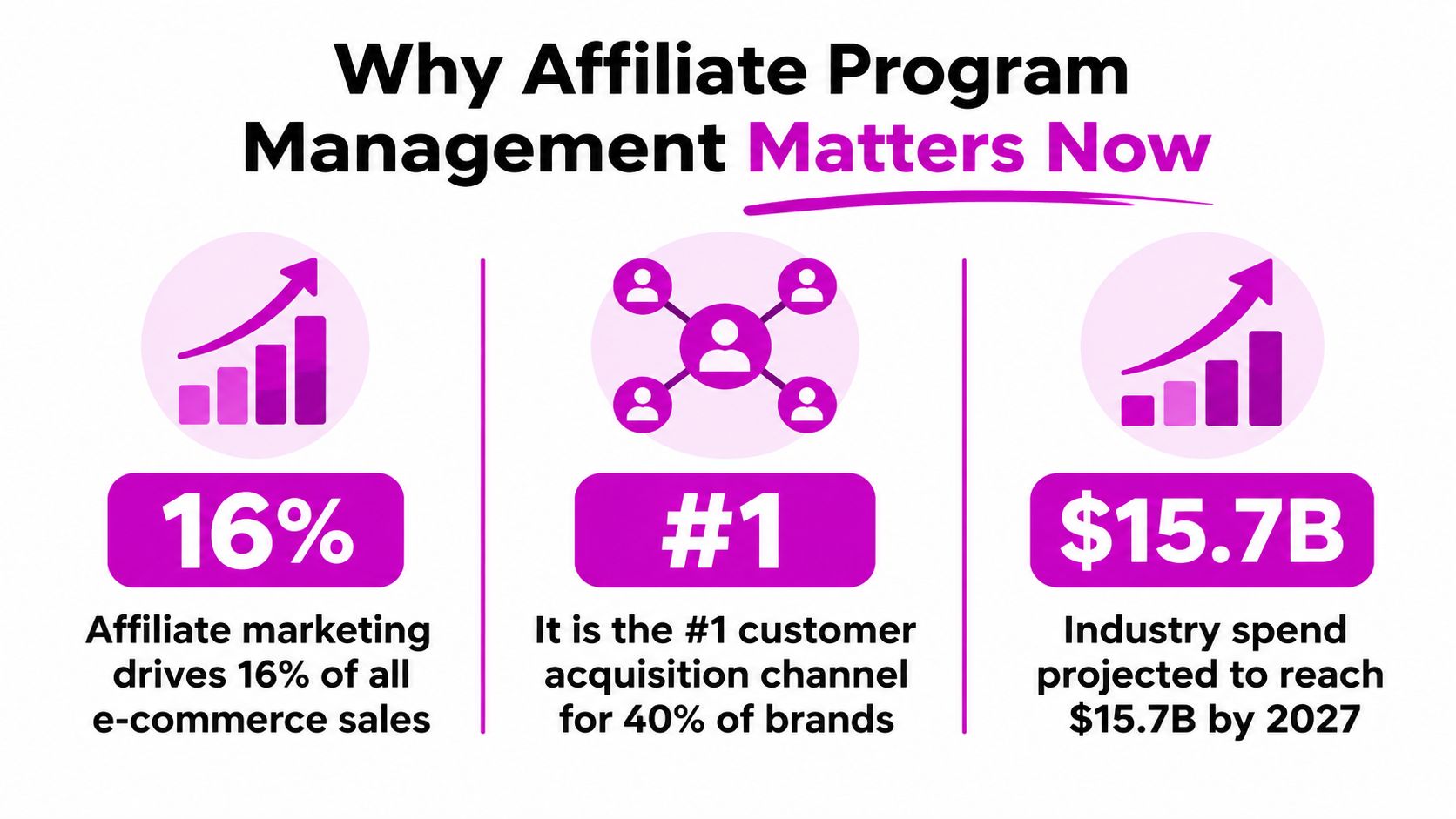
81% of brands worldwide now run an active affiliate program, and the channel is projected to surpass $17 billion in 2026 according to one 2026 industry roundup. That alone should change how Shopify operators think about affiliate program management, because this isn't a side tactic anymore, it's a mainstream revenue function that needs daily attention, clear rules, and someone accountable for the details.
The hard part isn't launching a program. The hard part is keeping it useful after the first month, when the easy partners have joined, the first payouts are due, and the inbox starts filling up with tracking questions, content requests, and edge-case approvals. That's where affiliate program management becomes operational work, not just strategy.
Why Affiliate Program Management Matters Now
When 81% of brands worldwide already run an active affiliate program and the channel is projected to surpass $17 billion in 2026, affiliate marketing has moved into core revenue work source. The same roundup says affiliate marketing is growing 3x faster than traditional digital advertising, which helps explain why so many teams use it to reduce dependence on one paid channel.
For Shopify brands, that shift changes the job. Affiliate program management now covers customer acquisition, revenue diversification, and partner ecosystem development, along with the daily decisions that keep the program healthy. If paid media is under pressure, affiliates can become a useful second engine, but only if the program is run with the same discipline you would apply to email, paid search, or lifecycle marketing.
The geography matters too. Analysts in the same data set identify Asia-Pacific as the fastest-growing market at 24% annual growth, followed by Europe at 16% and North America at 14% source. That shows the channel is not just a U.S. or Western Europe play, and it is one more reason to build a program that can handle different partner types, markets, and operating norms.
If you want a plain-English overview of the channel before you get into the mechanics, the affiliate marketing insights piece from Reddog Consulting Group is a useful primer.
Practical rule: treat the affiliate channel like a lifecycle program. If nobody owns partner onboarding, payout timing, and quality control, it turns into a list of accounts instead of a growth lever.
What I see repeatedly on Shopify teams is simple. The launch gets attention, then the program gets left alone. The partners who produce early revenue keep getting management, while the rest sit in the roster doing nothing. That wastes potential, and it shows why the day-to-day work matters as much as the strategy.
Choosing the Right Commission and Attribution Model
The payout model sets the tone for the entire program. If you make the structure confusing or misaligned with the product, you'll attract the wrong partners and spend too much time explaining the rules. The cleanest starting point is usually the one that matches the outcome you want, whether that's a lead, a sale, or a share of revenue.
Match the payout to the job the affiliate is doing
Revenue share works well when the affiliate drives the full purchase decision, especially for content partners and review sites that influence high-consideration buys. CPA is simpler when you want a fixed cost per sale, and CPL can fit lead-gen or B2B-style funnels where the sale happens later. The right choice depends on how much value the affiliate creates before the customer reaches your store.
The most useful internal resource I've seen for Shopify merchants on this topic is this guide to affiliate links and revenue flow, because the mechanics of links and crediting shape everything else downstream.
| Commission Model | Best For | Key Trade-Off |
|---|---|---|
| Revenue share | Content-led, high-consideration sales | Harder to forecast if order values vary |
| CPA | Clear direct-response offers | Can under-reward partners on larger carts |
| CPL | Lead generation or pre-sale capture | Needs strong downstream qualification |
Attribution rules need to be explicit
First-click and last-click aren't just technical choices, they affect partner motivation. First-click rewards discovery and top-of-funnel influence, while last-click rewards the partner who closes the sale. Cookie window length has the same effect, because a short window can make good content partners look weak even when they're influencing purchases.
Tiered commissions and performance bonuses usually make more sense than one flat rate forever. They give top partners a reason to keep prioritizing you, and they help the program evolve without forcing a full renegotiation every time a partner overperforms. The key is to keep the logic simple enough that affiliates can explain it back to you without guessing.
If a partner can't summarize your commission structure in one sentence, it's probably too complicated.
The decision framework is straightforward. Pick one payout model, write down the attribution rule, define the cookie window, and decide what qualifies for a bonus before you recruit anyone. A simple, outcome-aligned structure beats a clever one that nobody understands.
Recruiting, Vetting, and Activating Partners
Recruitment gets the attention, but vetting and activation decide whether the roster moves. I've seen too many programs celebrate a growing list of approved affiliates while referral volume stays flat, because nobody checked traffic quality or gave new partners a usable first campaign.
The numbers make that problem hard to ignore. In one analysis of 31 million referrals, only 15% of approved affiliates in the median program ever produced a referral, and just 6.4% produced a paying customer source. Approval alone does not create output. The essential work is getting the right partners in, then getting them live before interest fades.
Vet before you approve
Manual review should be standard. Check the site or social profile, verify that the audience fits your product, and look for obvious mismatches between their content and your offer. If the partner's traffic source is unclear, or the audience is too broad, slow down.
A strong onboarding flow starts the minute someone is approved. Send a welcome email, ship creative assets, give a simple explanation of the offer, and assign a first campaign they can launch without waiting on a designer or copywriter. The goal is to remove friction before it turns into inactivity.
The same dataset found that half of affiliates who did refer made their first referral within 7 days of joining, and affiliates quiet for two months were unlikely to convert without intervention source. That is why the first 30 days matter more than the recruitment pitch.
Use a simple activation sequence
- Source prospects. Look for fit before volume.
- Manual review and vetting. Check audience, traffic source, and brand alignment.
- Approval and welcome kit. Give links, assets, and expectations immediately.
- Activation and first campaign. Ask for one clear action, not five.
What works: a tight welcome kit and a specific first task.
What wastes time: long onboarding docs that sit unread while the partner waits for direction.
Inactive-partner re-engagement also has to be part of the workflow. If someone goes quiet, reach out quickly with a new angle, a better asset, or a fresh offer. Waiting on passive partners is usually less effective than giving them a reason to start again.
For teams that need tighter alignment between affiliate credit and the rest of the measurement stack, a practical marketing attribution guide helps keep definitions consistent across tracking, analytics, and finance.
Tracking, Attribution, and Fraud Controls
Most affiliate program frustration shows up here, in lost credit, disputed commissions, and traffic that does not look right. If tracking and attribution rules are loose, every payout conversation turns into a forensic exercise, and nobody wins from that.
Refunds and cancellations also need to be part of the operating model. A program can look healthy on gross sales and still lose meaningful commission value once orders reverse, so managers need to plan for clawbacks instead of treating them like rare exceptions.
Define the rules before the dispute starts
First-click and last-click models need written definitions, not assumptions. So do the cookie window, deduplication rules, and the conditions that void a commission. If a partner asks why a sale disappeared, you should be able to point to a policy, not a memory.
A practical marketing attribution framework helps keep affiliate credit aligned with the rest of your Shopify measurement stack. The goal is consistency, because affiliate data, analytics data, and finance data all need to agree often enough to trust the program.
Build a fraud review habit
Paid traffic abuse needs active monitoring. Weak controls can leave you paying for referrals that were never meant to earn commission, or for traffic that should have been excluded before payout.
Common signals include duplicate leads, VPN usage, suspicious click spikes, and brand-term bidding that should have been blocked. The goal is to define thresholds, review exceptions, and enforce the policy consistently.
A workable cadence is weekly review for active programs and a deeper monthly audit for attribution disputes, flag patterns, and abnormal partner behavior. Anything less and you end up reacting after the payout has already gone out.
Track the partners who matter most, and scrutinize the traffic that looks too easy. Affiliate management gets expensive when nobody notices the same pattern twice.
Legal, Compliance, and Contract Essentials
A program can look healthy on paper and still get exposed by weak compliance. The legal basics aren't glamorous, but they're what keep partner relationships from turning into payout disputes, brand problems, or messy cleanup work later.
Disclosures are the first line. If a partner is endorsing your product, the content has to make that relationship visible in a way people can understand. That means you can't leave disclosure placement to chance, especially when partners reuse the same creative across multiple channels.
For brands working across Europe, GDPR deserves attention as part of the operational setup, not as an afterthought. Affiliate audiences may sit inside data flows that touch consent, tracking, and retention practices, so the program needs to be built with those realities in mind.
Put the rules in the agreement
A good partner agreement should cover payment timing, prohibited traffic sources, trademark use, disclosure expectations, and termination rights. If you don't spell those out, enforcement gets awkward the first time a partner crosses the line.
That matters because compensation design without routine monitoring opens the door to fraud, abuse, and inaccurate attribution that can erode incremental sales source. The agreement is only half the job. The other half is enforcing what's written.
Use the contract as an operating document, not a legal ornament. It should tell partners how they can promote, what they can't do, and what happens when a rule gets broken. Clear language makes enforcement faster and keeps emotions out of the process.
Keep disclosures visible
Disclosures should live where the endorsement lives. If a creator uses a social post, the disclosure has to be in the post. If a coupon partner runs a page, the disclosure has to be visible there too.
Practical rule: write the compliance checklist before the first payout, not after the first complaint.
The best programs I've seen don't wait for legal to become a rescue function. They build compliance into onboarding, assets, and review cycles, so partners know the boundaries from day one.
Scaling With Shopify Integrations and Automation
A Shopify affiliate program can stay manageable while the roster is small. Once the list grows, the burden shifts to onboarding, reporting, payout checks, commission edits, and partner follow-up, and that work has to be handled every week without slipping.
I've watched a Shopify Plus brand grow from 20 active affiliates to 200. At 20, a spreadsheet and a shared inbox can still hold together. At 200, they start to buckle unless the team automates repetitive tasks and keeps human attention on the partners who drive revenue.
Use technology for the work that repeats
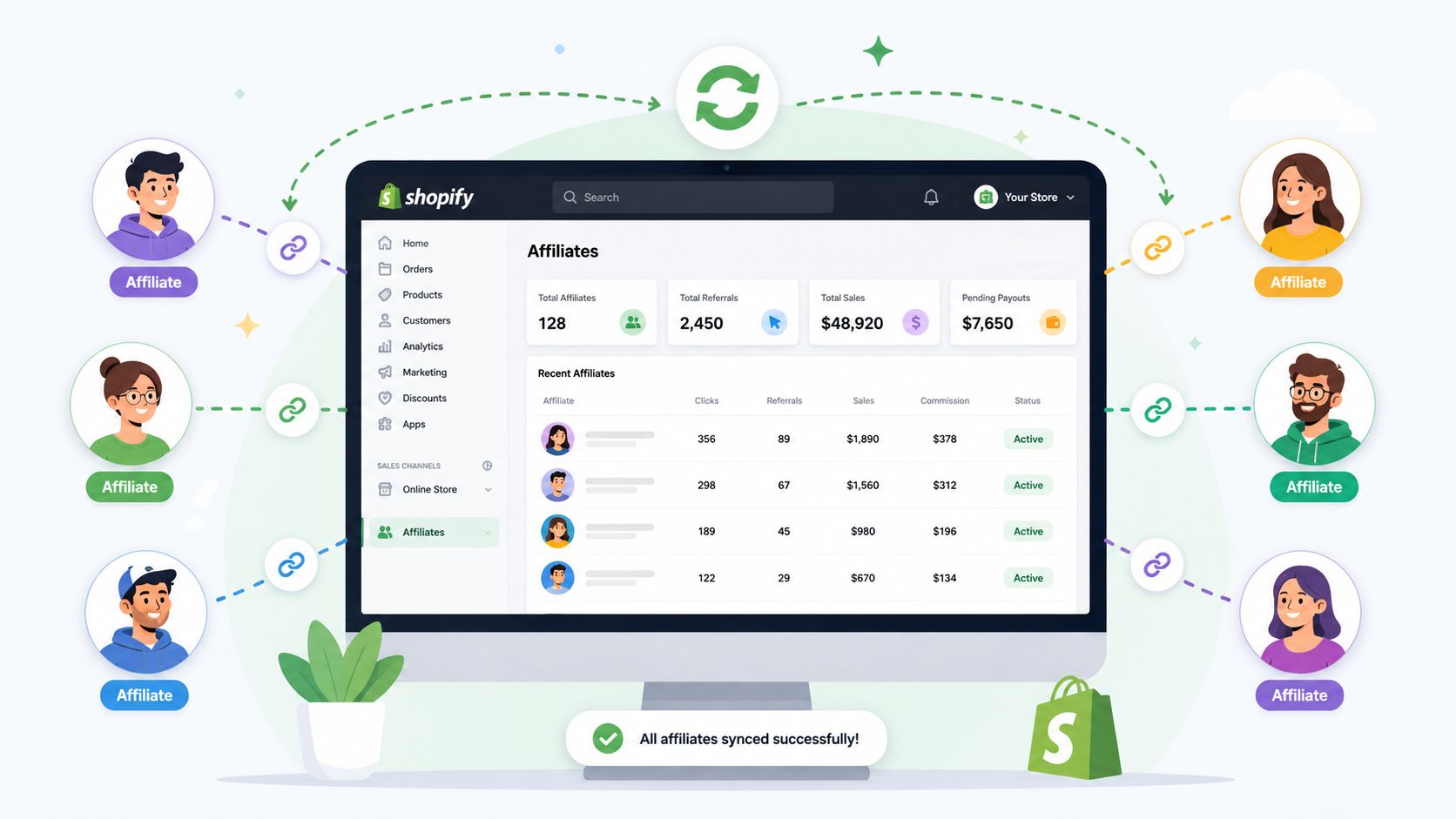
Shopify and Shopify Plus can connect to affiliate platforms through apps and APIs, which is where automation starts paying off. I would automate onboarding emails, reporting pulls, payouts, and commission updates first, because those steps are routine, prone to error, and never really finished.
Segmentation matters too. Once the roster expands, affiliates should be grouped by type or vertical, because a content publisher needs different treatment from a coupon partner or a technology partner. That makes reporting cleaner and gives you a faster path to private deals for the partners who have earned them.
Reserve human time for the top partners
A realistic scaling model keeps the repetitive workflows automated, runs quarterly performance audits, and creates private offers for top performers so they can see the account is being managed intentionally. That combination keeps the team responsive without turning every day into admin.
A Shopify specialist can take some of that load. ECORN can handle the operational layer around Shopify builds, CRO, and coordination work, which helps when the program needs more cross-functional support than one marketer can reasonably carry. Fit matters more than hype, and the workflow needs coverage rather than a slogan.
When the program grows faster than the process, automation stops being optional. It is the way to keep management sustainable.
The practical cutoff is straightforward. Once manual follow-up starts slipping, the program needs systems that reduce handwork without flattening the partner relationships that matter.
KPIs to Track and When to Bring in an Agency
The KPIs that matter most are the ones that show whether the program is healthy, not just busy. I'd watch activation rate, revenue per active affiliate, top-decile concentration, refund clawback rate, and fraud flags before I obsess over roster size or raw signups.
The concentration stat is especially useful. In a lot of programs, a small group of affiliates drives most of the referred revenue, which means the top tier deserves far more management attention than its headcount suggests. That reality changes how you spend time, how you set offers, and how closely you monitor individual partner behavior.
Watch the operational warning signs
If partner re-engagement is slipping, payouts are delayed, or reporting takes too long to reconcile, the program has probably outgrown its current owner. Those are management problems, not affiliate problems. They usually show up before revenue drops, which is why they're worth tracking.
A good quarterly checklist is short and practical.
- Review activation speed: check whether new partners are producing early activity or sitting idle.
- Audit the top decile: look closely at your highest-producing affiliates, because they drive a disproportionate share of revenue.
- Inspect clawbacks and flags: use refund and review data to spot patterns, not one-off noise.
- Check re-engagement gaps: if inactive partners aren't being contacted, the roster is decaying.
- Evaluate workload: if manual tasks are delaying decisions, the program needs process support.
When the backlog starts costing you partners, it's time to bring in outside help. A Shopify-specialist agency can take over the operational layer while your team keeps strategic control of the offer, the partnerships, and the economics.
If affiliate program management is starting to feel like an endless queue of approvals, payouts, and follow-ups, ECORN can help you structure the Shopify side so the program stays manageable as it grows. Visit ECORN to talk through your affiliate workflow, tighten the operational layer, and decide whether your program needs a stronger system behind it.


What Is AI Integration for eCommerce
How to Choose the Right eCommerce Website Development Firm
E Business Strategy Implementation
Conversion Tracking Setup for Shopify Stores
BigCommerce vs Shopify Plus Which Enterprise Wins in 2026
Shopify Theme Kit: Setup, Commands, and Migration Guide

Shopify Extension Development: A Practical 2026 Guide
Shopify Speed Score Explained and How to Improve It
Shopify Mobile Optimization: The 2026 Playbook

How to Add Subcategory in Shopify for Better UX
How to Implement Structured Data for Ecommerce in 2026
SEO App Mobile: Shopify Store Optimization Guide
Shopify Plus Support: What It Includes and How to Choose

Google Ads for Shopify: The Complete 2026 Playbook

Shopify New York: How to Find and Hire the Right Agency

Google Search Console for Shopify: The Complete Setup
First Party Data Collection for eCommerce Growth
FAQ Online Store Guide: Build and Measure It Right
Do FB Ads Work for eCommerce in 2026?

One Page Checkout for Shopify: Design and Implementation
Shopify GraphQL vs REST: The 2026 Developer Decision
Shopify Ecommerce Consulting: Strategy, Pricing &

Are Reddit Ads Worth It for eCommerce Brands

Shopify Title and Meta Description: A Practical 2026 Guide

Product Video Best Practices for Shopify Brands
Real-Time Inventory Management: A 2026 Guide
AI Chatbot Integration for Shopify Stores
10 Best Performance Monitoring Tools for Shopify in 2026
Digital Asset Management for eCommerce Brands in 2026
Every Type of Facebook Ads Explained for eCommerce Growth
Product Information Management Explained for Shopify Brands
Support Ticket System: A Guide for Shopify Stores

10 Best Customer Service Tools for Shopify in 2026

Can I Start a Business with No Money? a 2026 Blueprint

What Sells Good on Etsy: Best Niches for 2026

Shopify Add to Cart Button: A Practical 2026 Guide

Customer Feedback Automation: A Practical eCommerce Guide
Critical Rendering Path: A Guide for Shopify Stores

How to Promote on TikTok for eCommerce in 2026

B2B eCommerce Consulting That Drives Real Revenue
10 Best Practices for Site Navigation in 2026
Return vs Refund for Shopify Stores: A Practical Guide

What Is Customer Lifetime Value and Why It Matters
What Is Voice of Customer Research for eCommerce

SMS Marketing for Ecommerce That Actually Converts

Master How to Improve Email Deliverability in 2026

Top 7 eCommerce Partners NYC for Shopify Brands in 2026

Machine Learning for Ecommerce: Boost Your Shopify Store

Beauty Market Research: Your 2026 Growth Guide

Shopify International Expansion: A 2026 Roadmap

What Does CRO Stand for in Business: Understanding CRO

Shopify Visual Merchandising: A Playbook for Higher Sales

Shopify Landing Page Design: Master Conversion in 2026
10 Best AI SEO Optimization Tools for Shopify in 2026

Agentic AI for Ecommerce: Boost Your Sales in 2026
Mastering Email Marketing Data for eCommerce Growth

Conversion Rate Optimisation Australia: Boost Your Sales
Conversion Rate Optimization AI: Your Shopify Store Guide

10 Product Bundling Strategies for Shopify in 2026
How to Increase Customer Lifetime Value: A Shopify Playbook
AI Customer Service Automation: Shopify Guide 2026

Clean Website Design: A Shopify Conversion Playbook

Omnichannel Retail Strategy: A Shopify Playbook
Product Data Enrichment: A Guide for Shopify Brands
Instagram Shopping Features a Guide for Shopify Stores
What Is Revenue Optimization: A Holistic RevOps Guide

Benefits of Conversion Rate Optimization: Boost Your
WordPress to Shopify Migration: Your 2026 Seamless Switch
Boost Sales: Ecommerce Payment Processing Guide 2026
Unified Commerce Platform: Benefits, KPIs & Shopify Guide
How to Reduce Bounce Rate eCommerce: Your 2026 Guide
Shopify API Integration: A Practical End-to-End Guide
How to Implement Data Governance: A 2026 Guide
Shopify Store Development Cost: A 2026 Breakdown
What Is Server Side Tracking: The Shopify Guide 2026
Marketing Automation Workflows: A Shopify Guide for 2026

Shopify: How to Reduce Technical Debt

Shopify UX Design Change: A Playbook for Growth
User Generated Content Strategy: Shopify Playbook

Shopify Pause and Build Plan Cost: A Complete 2026 Guide

Compare at Price on Shopify: A Complete Guide for 2026

Where Can I Sell My Prints? 10 Best Platforms for 2026
Shopify Order Management System: The Ultimate Guide 2026
What Is Marketing Attribution? an eCommerce Guide for 2026

10 Best Black Friday Sales Sheets for 2026

Discover the Top Social Media Marketing Agencies For
Consumer Confidence Definition for eCommerce in 2026
What Is Social Commerce? Your 2026 Guide to Boosting Sales
A Social Ad Campaign Playbook for eCommerce Growth

7 Best FAQ Page Examples for SaaS & eCommerce

Market Research in Fashion Industry: A Guide for Shopify
Shopify Migration Services: Expert Guide for 2026
Mastering FB Retargeting Ads for Shopify in 2026
What Is Omnichannel Ecommerce

Master Your Shopify Plus Migration: The 2026 Guide
Shopify Integration Services: A Merchant's 2026 Guide
Shopify Collection Description: A Guide to SEO & Sales

Shopify Plus Contact: Reach Sales & Support Effectively

Top Luxury Shopify Stores: Design & UX Strategies
How to Improve Customer Experience: A Shopify Roadmap


newsletter in your inbox