

You're probably already doing a lot right.
Your Shopify store gets traffic. Product pages are polished. Ads are live. Email flows exist. Conversion rate isn't embarrassing. Yet revenue feels stuck, or worse, it grows while margin quality gets softer. You add more campaigns, more landing page tweaks, more discount tests, and the business gets busier without getting cleaner.
That's the moment when most brands over-rotate into isolated fixes. They blame Meta creative, the product page template, the offer, or the retention tool. Sometimes one of those is the problem. More often, the issue is that each team is optimizing its own slice of the funnel without a shared revenue system behind it.
A paid media manager can lower acquisition costs while merchandising cuts price too aggressively. A CRO lead can improve conversion on a low-margin bundle. Support can hear the same objection every day while no one feeds that insight back into offer strategy. Shopify itself rarely causes the plateau. Fragmented decision-making does.
That's where revenue optimization becomes useful. Not as a buzzword. As an operating model.
Beyond the Plateau Your Introduction to Revenue Optimization
Revenue optimization starts when you stop asking, “How do I get more orders?” and start asking, “How do I make the whole commercial machine produce better revenue?”
That shift matters because healthy top-line metrics can hide structural problems. A brand can post decent conversion rates while over-discounting. It can scale traffic while sending shoppers into a weak collection architecture. It can win first purchases while losing money on what happens after checkout. Revenue optimization forces a broader view.
What the plateau usually looks like
For Shopify brands, the stall often shows up in a few familiar ways:
- Traffic rises but output doesn't: Sessions grow, but incremental revenue feels expensive.
- Promotions carry too much weight: The business needs constant discount pressure to keep momentum.
- Retention underperforms: First-time customer volume is fine, but repeat behavior lags.
- Teams work hard in silos: Marketing, merchandising, finance, and support each have their own truth.
In practice, that means your store may not need “more tactics.” It may need better alignment between pricing, campaigns, merchandising, customer experience, and data.
Practical rule: If each department reports success but the brand still feels less profitable than it should, you don't have a channel problem. You have a coordination problem.
The RevOps lens Shopify brands often miss
The most useful way to think about revenue optimization is through Revenue Operations, or RevOps. RevOps aligns the systems, data, and decision-making across marketing, sales, finance, and customer service so the business acts on one version of reality.
For an eCommerce brand, that means Shopify shouldn't sit in one corner while ad platforms, Klaviyo, support tickets, inventory data, and finance reports all tell different stories. The job is to connect them well enough that the next decision improves revenue quality, not just activity volume.
A lot of stores chase conversion gains before they've cleaned up the underlying machine. That usually creates temporary lifts and long-term confusion. Sustainable growth comes from coordinated inputs. Pricing logic, offer design, campaign timing, stock position, and post-purchase experience all need to pull in the same direction.
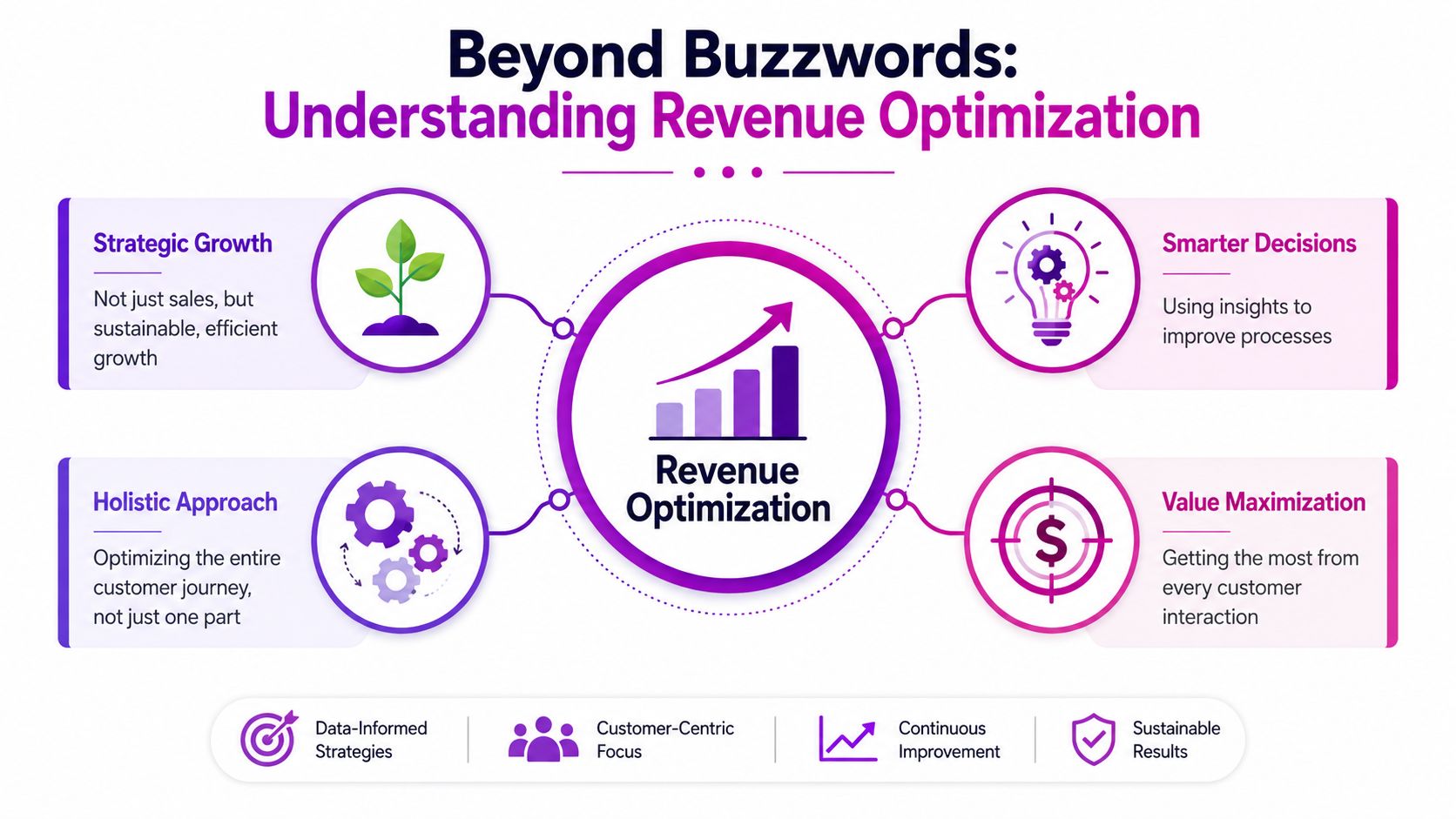
Defining Revenue Optimization Beyond the Buzzwords
Think of revenue optimization like a conductor leading an orchestra.
A CRO specialist can make one violin louder. A pricing consultant can bring in the brass. A retention marketer can sharpen the percussion. But if nobody is conducting, the result is still noise. Revenue optimization is the discipline of making the whole performance work together.
According to Salesforce's overview of revenue optimization, revenue optimization is a data-driven strategic approach that enables organizations to achieve higher revenue, better margins, and more sustainable growth. The important part isn't just “higher revenue.” It's the idea that the business redesigns the revenue environment so each component works together, rather than trying to force output from one isolated lever.
What revenue optimization is not
It's not the same thing as CRO.
CRO asks whether more visitors complete a desired action. That matters, and a lot of brands should still get better at it. If you want a clean primer on that piece, this guide on how to apply conversion optimization on Shopify is useful because it frames store-level conversion work in practical terms.
It's also not the same thing as pricing strategy alone. Pricing can improve revenue quality, but pricing without merchandising, offer architecture, and lifecycle coordination often creates side effects. You may raise average order value while hurting repeat rate. You may grow unit sales while damaging margin.
What it includes in real operations
Revenue optimization sits above those disciplines and forces them to cooperate. For Shopify teams, that usually covers:
| Area | What gets optimized | Common failure mode |
|---|---|---|
| Pricing | Offer structure, discount logic, bundle economics | Blanket promos that train customers to wait |
| CRO | Product pages, cart flow, checkout friction | Better conversion on the wrong traffic or product mix |
| Lifecycle marketing | Welcome, browse, cart, post-purchase, win-back | Automation without segmentation discipline |
| Merchandising | Collection order, product exposure, bundle placement | Hero products carry weak assortment strategy |
| Customer experience | Delivery clarity, support loops, returns experience | Support insights never influence commercial choices |
Why RevOps changes the definition
Most brands define revenue optimization too narrowly because they assign it to one function. In reality, the hidden lever is operational alignment. The work only compounds when the same data informs marketing, merchandising, support, and financial decisions.
Revenue optimization isn't “how do we squeeze more from one page?” It's “how do we make every revenue decision reinforce the next one?”
That's why the RevOps framing matters. It turns a collection of channel tactics into one commercial system.
The Three Pillars of Effective Revenue Optimization
The foundation is simpler than often assumed. Effective revenue optimization relies on marketing automation, sales efficiency, and proper data collection, as described by SBI Growth's breakdown of revenue optimization. If one pillar is weak, the others stop compounding.
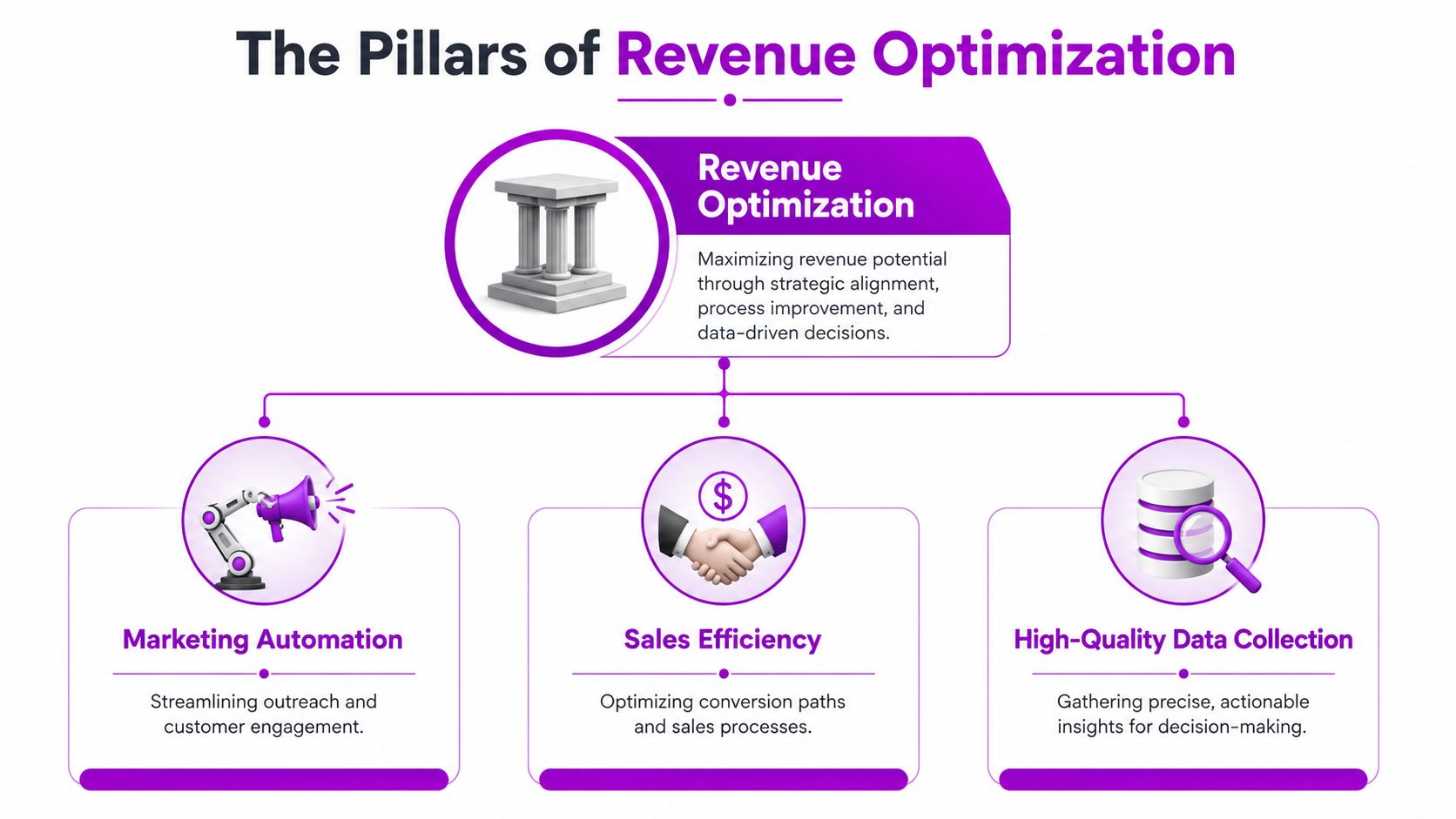
Marketing automation
Automation should do more than fire a welcome email.
On Shopify, useful automation means shoppers get relevant prompts based on behavior, product interest, and stage in the customer journey. Tools like Klaviyo, Shopify Flow, and Gorgias can work together here. A customer who viewed a replenishable product shouldn't receive the same message as someone who abandoned a premium bundle after comparing options.
What doesn't work is broad automation built on weak segmentation. Brands often build flows quickly, then never revisit the trigger logic. Revenue optimization requires the automation layer to reflect actual buying patterns, not just generic email best practices.
Sales efficiency
For most eCommerce brands, “sales efficiency” doesn't mean a traditional sales team. It means the path from first touch to checkout, and from first order to second order, should have as little friction as possible.
That includes:
- Clear product discovery: Navigation, collection filtering, and onsite search should help shoppers find the right item fast.
- Offer clarity: Bundles, subscriptions, add-ons, and promotions should feel easy to understand.
- Fast objection handling: Shipping details, returns, ingredients, sizing, and compatibility information should be visible before support has to step in.
If you sell into retail or wholesale as well, the same principle applies. Sales process friction creates leakage just as quickly off-site as it does on your storefront.
High-quality data collection
This is the pillar brands underestimate most. Good data quality means teams audit data for duplicates, standardize fields, and segment data appropriately, which SBI Growth notes is essential to optimizing pricing and marketing decisions. Bad data makes smart teams look careless because they're working from mismatched inputs.
Operator's view: Before you test a new pricing model, make sure your product tags, customer segments, channel attribution, and order classifications actually mean the same thing across systems.
A practical way to think about this is that data quality is the fuel line. You can study broader approaches like retail pricing optimization for CPG for pricing context, but none of that logic helps if your underlying product, channel, or customer data is messy.
Build the engine first. Then race the car.
Key Metrics for Measuring Optimization Success
If you only track revenue, you'll miss whether the business is getting healthier or just louder.
ScanmarQED's revenue optimization framework identifies Customer Acquisition Cost (CAC), Sales Cycle Length, Revenue Growth Rate, and retention or expansion metrics as key KPIs for assessing whether acquisition, retention, and expansion strategies are aligned. For a Shopify brand, those metrics tell a much richer story than top-line sales alone.
What each metric is really telling you
Here's the practical interpretation:
- Customer Acquisition Cost: CAC tells you how expensive demand creation has become. Rising CAC can mean paid media fatigue, weak conversion paths, or poor audience quality.
- Sales Cycle Length: In eCommerce, this often shows up as time from first visit to first purchase, or from first order to repeat purchase. If that stretches, friction has crept into the journey.
- Revenue Growth Rate: Growth rate matters, but only when read alongside the quality of that growth. Revenue fueled by deep discounting isn't the same as revenue supported by stronger product mix and retention.
- Retention and expansion metrics: These reveal whether customers come back, buy broader assortments, or increase value over time.
A simple dashboard logic for Shopify teams
Rather than obsess over one metric, pair them.
| If this changes | Read it alongside | Why it matters |
|---|---|---|
| CAC rises | Conversion performance and merchandising | You may be paying for traffic your store doesn't convert efficiently |
| Sales cycle lengthens | Support inquiries and offer clarity | Shoppers may need more reassurance before buying |
| Revenue grows | Retention and discount reliance | Growth may be healthy, or it may be bought too aggressively |
| Retention slips | Product experience and post-purchase comms | The problem may start after checkout, not before it |
That pairing mindset is what separates reporting from analysis.
What brands often get wrong
Many teams build dashboards that answer easy questions instead of useful ones. They know what campaign drove traffic, but not whether that traffic led to profitable customer behavior. They know a collection page converted, but not whether it over-indexed on low-margin products. They know repeat orders happened, but not which first-purchase path created the best follow-on value.
A stronger metric stack makes teams less reactive. If you need a broader view of the operating layer behind the numbers, this breakdown of eCommerce performance metrics to track is a good companion because it helps frame what should sit on the dashboard versus what belongs in deeper analysis.
If a KPI doesn't change what your team does next week, it's probably a reporting artifact, not an operating metric.
Actionable Revenue Strategies for Shopify Merchants
Most Shopify brands don't need more ideas. They need fewer disconnected ideas and more strategies that reinforce each other.
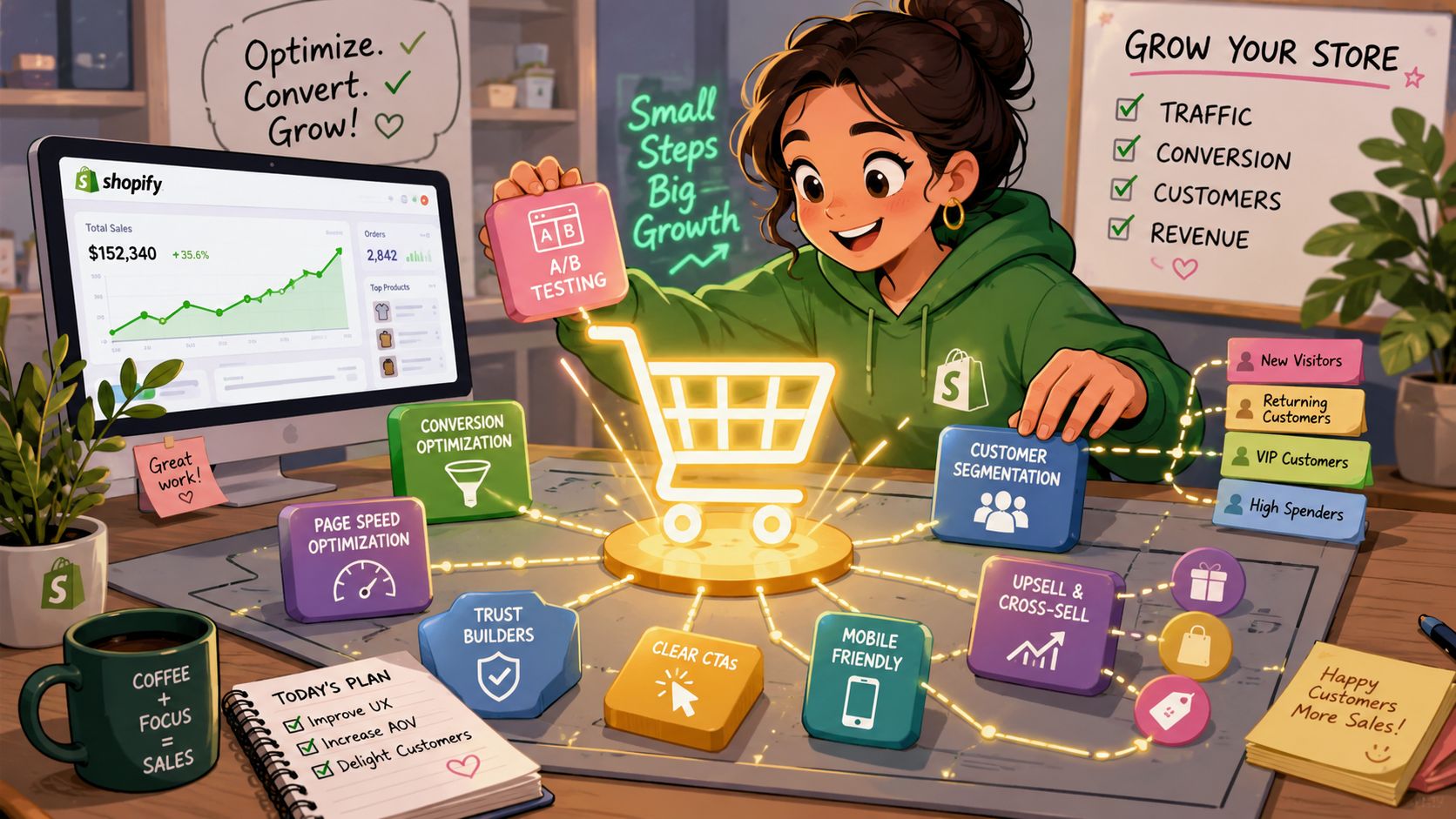
Move from page tweaks to path design
A common “before” state looks like this: the team runs A/B tests on button color, rewrites product page headlines, and adds urgency widgets.
A stronger “after” state focuses on the full path. Collection pages route shoppers to the right category faster. Product pages answer the objections support sees most. Cart upsells reflect actual purchase compatibility. Post-purchase messaging sets up the next sale instead of stopping at order confirmation.
Useful tools here include Shopify Search & Discovery, Klaviyo, Rebuy, and Gorgias. The goal isn't to install everything. It's to remove revenue friction across discovery, decision, and follow-up.
Replace flat discounting with smarter offer architecture
Another familiar “before” state is constant sitewide promotions. The store converts, but margin quality erodes and customers learn to delay purchase.
The “after” version usually looks more structured:
- Bundle instead of blanket discount: Pair products with a natural use case.
- Tier offers by cart value: Reward stronger baskets rather than every basket.
- Use product-specific incentives: Protect margin on hero SKUs and use offers where they stimulate movement.
If your team is revisiting this area, a practical resource on eCommerce pricing strategies can help you pressure-test whether your current pricing logic is helping or subtly training bad customer behavior.
Use dynamic pricing carefully
Dynamic pricing gets talked about loosely, but in practice it only works when the brand can track demand, inventory, and customer behavior closely enough to act with discipline.
According to the verified trend data provided, Gainsight (2025) reports that 45% of eCommerce brands are experimenting with usage-based pricing, and that model can increase revenue by 18-24% for high-volume users, but it requires real-time customer behavior tracking to avoid revenue leakage. That matters most for Shopify brands with SaaS-enabled offers, memberships, service layers, or transaction-linked pricing.
What doesn't work is copying a usage-based model because it sounds modern. If customers can't understand the value exchange, trust drops fast.
Improve merchandising like an operator, not a designer
The visual layout of a Shopify store matters. But revenue optimization starts with commercial logic, not aesthetics.
A weak setup puts bestsellers everywhere because they're safe. A stronger setup uses collection sequencing, product badges, and bundle placement to direct shoppers toward combinations that improve both customer fit and basket quality. Merchandising should answer two questions at once: what's most likely to convert, and what creates the strongest downstream customer value?
For brands tightening this journey, studying broader sales funnel optimization can help sharpen the handoff points between awareness, consideration, and purchase intent.
Here's a useful walkthrough to anchor the pricing and experimentation side of the work:
Put AI where it earns its keep
AI is useful when it helps teams prioritize. It's less useful when it generates generic copy or floods the roadmap with low-quality test ideas.
For Shopify merchants, the highest-value uses are often:
- Predictive segmentation: Distinguish likely repeat buyers from one-time deal hunters.
- Pricing support: Flag demand patterns or response to offer changes.
- Experiment triage: Identify where a test is likely to affect revenue quality, not just clicks.
That's the difference between using AI as a toy and using it as an operating assistant.
Your Revenue Optimization Implementation Roadmap
The biggest mistake teams make is treating revenue optimization like a campaign. It works better as an operating change.
The RevOps angle is the reason. The verified data shows that 73% of high-growth eCommerce brands prioritize RevOps alignment, while only 28% of mid-market firms have fully integrated workflows, and teams with cross-departmental visibility achieve 3.2x higher revenue predictability. The same dataset notes that better data flow can reduce operational inefficiencies by 31%. Those figures point to the core issue. Most brands don't lack tools. They lack alignment.
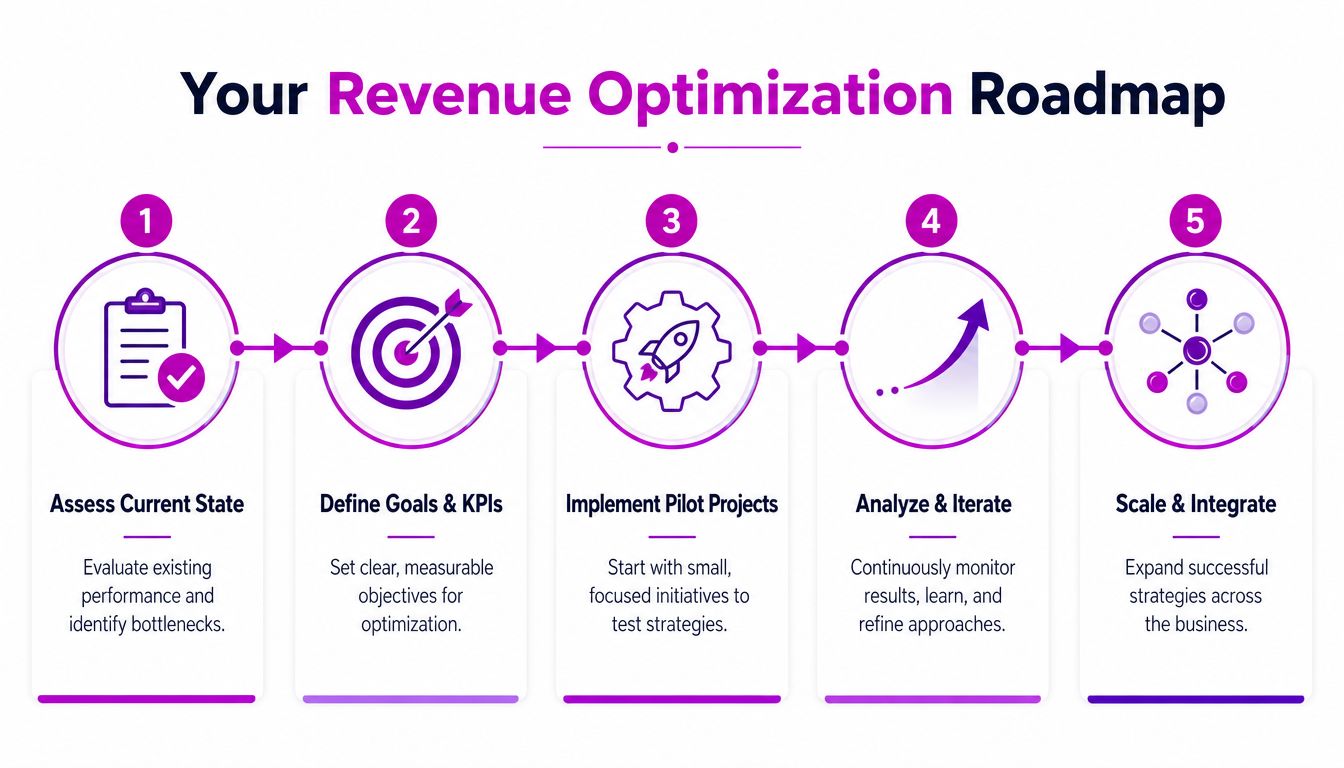
Step one starts with data, not tactics
Pull together the systems that shape commercial decisions. For a Shopify brand, that usually means Shopify, Klaviyo, ad platform reporting, support data, inventory tools, subscription tools if relevant, and finance reporting.
Audit for basic truth first:
- Naming consistency: Product categories, channels, and customer segments should match across reports.
- Attribution sanity: Teams should agree on how they define acquisition and repeat behavior.
- Order classification: Promotional, subscription, wholesale, and one-time orders should be clearly separated.
If that sounds unglamorous, that's because it is. It's also where good revenue optimization starts.
Step two aligns the people who influence revenue
Bring marketing, merchandising, operations, finance, and support into the same review rhythm. Not for a broad strategy offsite. For recurring operating decisions.
Support often knows which objections kill conversion. Finance sees margin pressure before the growth team does. Merchandising knows which products are carrying too much promotional weight. RevOps turns those isolated truths into shared action.
Better data flow beats another dashboard. If teams don't trust the same inputs, they won't make coordinated decisions.
Step three proves the model with a focused pilot
Pick one area with visible upside and manageable complexity. Good examples include:
- Cart and bundle strategy for a product family with clear attachment opportunities.
- Welcome and post-purchase flows for a segment with strong repeat potential.
- Pricing and promo structure for a category that over-relies on markdowns.
Keep the scope narrow enough that the team can learn from the test. Revenue optimization fails when brands launch too many initiatives at once and can't isolate what improved.
Step four scales what the business can operationalize
Once a pilot works, document the logic behind it. Then apply that logic to other categories, segments, or lifecycle points.
Scaling isn't copying a tactic everywhere. It's translating the principle. If personalized post-purchase cross-sells work in one category because customers need a companion item, expand that where the same buying behavior exists. If it doesn't map cleanly, don't force it.
This is why RevOps is the hidden lever. It gives the business a repeatable way to turn isolated wins into a system.
Frequently Asked Questions
Is revenue optimization just another name for profit maximization
No. Profit maximization often gets interpreted too narrowly and too short-term. Teams cut spend, pull back on service, or squeeze pricing without thinking through retention, brand perception, or future demand.
Revenue optimization is broader. It aims for stronger, more sustainable revenue quality by improving the system that produces it. Sometimes that means protecting margin. Sometimes it means investing in a better customer journey because the downstream value is worth it.
Where does customer service fit into revenue optimization
Customer service is closer to revenue than most brands admit.
Support teams hear friction in plain language. They know when shoppers don't understand sizing, shipping windows, compatibility, subscription terms, or return policies. That information should influence product page content, offer design, and post-purchase messaging. If support lives outside commercial planning, the brand loses one of its best revenue intelligence sources.
What's the biggest mistake when getting started
Buying tools before fixing process and data.
Teams often add another app, another dashboard, or another automation layer before they've agreed on definitions, cleaned segmentation, or established decision ownership. That creates more noise. Start with data integrity, shared reporting logic, and one cross-functional operating rhythm. Then layer technology onto a system that can use it well.
Do small Shopify brands need RevOps too
Yes, but the implementation can be lean.
You don't need a formal RevOps department to act like a coordinated business. You need one source of truth for core metrics, clean data, and regular alignment between whoever owns marketing, merchandising, operations, and customer experience. The earlier that discipline starts, the easier it is to scale without building confusion into the business.
If your Shopify brand is growing but the revenue engine feels fragmented, ECORN can help you turn disconnected CRO, design, development, and optimization work into a system that scales cleanly. Their team specializes in Shopify strategy and execution for brands that want better performance without adding more operational chaos.


One Product Shopify Store: Build and Scale

Mobile Pop Up Strategy for Shopify Stores That Converts
Sitemap for Shopify: How to Find, Optimize, and Submit It

7 Single Product Websites Worth Emulating
Product Variants Shopify: The Complete 2026 Guide
Ecommerce Analytics Consulting for Growth
What Is AI Integration for eCommerce
How to Choose the Right eCommerce Website Development Firm
E Business Strategy Implementation
Conversion Tracking Setup for Shopify Stores
BigCommerce vs Shopify Plus Which Enterprise Wins in 2026
Shopify Theme Kit: Setup, Commands, and Migration Guide
Shopify Extension Development: A Practical 2026 Guide
Shopify Speed Score Explained and How to Improve It
Shopify Mobile Optimization: The 2026 Playbook
How to Add Subcategory in Shopify for Better UX
How to Implement Structured Data for Ecommerce in 2026

SEO App Mobile: Shopify Store Optimization Guide

Shopify Plus Support: What It Includes and How to Choose

Google Ads for Shopify: The Complete 2026 Playbook

Shopify New York: How to Find and Hire the Right Agency
Google Search Console for Shopify: The Complete Setup
First Party Data Collection for eCommerce Growth
FAQ Online Store Guide: Build and Measure It Right
Do FB Ads Work for eCommerce in 2026?
One Page Checkout for Shopify: Design and Implementation
Shopify GraphQL vs REST: The 2026 Developer Decision
Shopify Ecommerce Consulting: Strategy, Pricing &

Are Reddit Ads Worth It for eCommerce Brands

Shopify Title and Meta Description: A Practical 2026 Guide

Product Video Best Practices for Shopify Brands
Real-Time Inventory Management: A 2026 Guide
AI Chatbot Integration for Shopify Stores
Affiliate Program Management: A Shopify Guide
10 Best Performance Monitoring Tools for Shopify in 2026
Digital Asset Management for eCommerce Brands in 2026
Every Type of Facebook Ads Explained for eCommerce Growth
Product Information Management Explained for Shopify Brands
Support Ticket System: A Guide for Shopify Stores

10 Best Customer Service Tools for Shopify in 2026

Can I Start a Business with No Money? a 2026 Blueprint

What Sells Good on Etsy: Best Niches for 2026

Shopify Add to Cart Button: A Practical 2026 Guide

Customer Feedback Automation: A Practical eCommerce Guide
Critical Rendering Path: A Guide for Shopify Stores

How to Promote on TikTok for eCommerce in 2026

B2B eCommerce Consulting That Drives Real Revenue
10 Best Practices for Site Navigation in 2026
Return vs Refund for Shopify Stores: A Practical Guide
What Is Customer Lifetime Value and Why It Matters
What Is Voice of Customer Research for eCommerce

SMS Marketing for Ecommerce That Actually Converts

Master How to Improve Email Deliverability in 2026

Top 7 eCommerce Partners NYC for Shopify Brands in 2026

Machine Learning for Ecommerce: Boost Your Shopify Store

Beauty Market Research: Your 2026 Growth Guide
Shopify International Expansion: A 2026 Roadmap

What Does CRO Stand for in Business: Understanding CRO

Shopify Visual Merchandising: A Playbook for Higher Sales

Shopify Landing Page Design: Master Conversion in 2026
10 Best AI SEO Optimization Tools for Shopify in 2026

Agentic AI for Ecommerce: Boost Your Sales in 2026
Mastering Email Marketing Data for eCommerce Growth

Conversion Rate Optimisation Australia: Boost Your Sales
Conversion Rate Optimization AI: Your Shopify Store Guide

10 Product Bundling Strategies for Shopify in 2026
How to Increase Customer Lifetime Value: A Shopify Playbook
AI Customer Service Automation: Shopify Guide 2026

Clean Website Design: A Shopify Conversion Playbook

Omnichannel Retail Strategy: A Shopify Playbook
Product Data Enrichment: A Guide for Shopify Brands

Instagram Shopping Features a Guide for Shopify Stores

Benefits of Conversion Rate Optimization: Boost Your
WordPress to Shopify Migration: Your 2026 Seamless Switch
Boost Sales: Ecommerce Payment Processing Guide 2026
Unified Commerce Platform: Benefits, KPIs & Shopify Guide
How to Reduce Bounce Rate eCommerce: Your 2026 Guide
Shopify API Integration: A Practical End-to-End Guide
How to Implement Data Governance: A 2026 Guide
Shopify Store Development Cost: A 2026 Breakdown
What Is Server Side Tracking: The Shopify Guide 2026
Marketing Automation Workflows: A Shopify Guide for 2026
Shopify: How to Reduce Technical Debt

Shopify UX Design Change: A Playbook for Growth
User Generated Content Strategy: Shopify Playbook
Shopify Pause and Build Plan Cost: A Complete 2026 Guide
Compare at Price on Shopify: A Complete Guide for 2026

Where Can I Sell My Prints? 10 Best Platforms for 2026
Shopify Order Management System: The Ultimate Guide 2026
What Is Marketing Attribution? an eCommerce Guide for 2026

10 Best Black Friday Sales Sheets for 2026

Discover the Top Social Media Marketing Agencies For
Consumer Confidence Definition for eCommerce in 2026

What Is Social Commerce? Your 2026 Guide to Boosting Sales
A Social Ad Campaign Playbook for eCommerce Growth

7 Best FAQ Page Examples for SaaS & eCommerce

Market Research in Fashion Industry: A Guide for Shopify
Shopify Migration Services: Expert Guide for 2026
Mastering FB Retargeting Ads for Shopify in 2026
What Is Omnichannel Ecommerce


newsletter in your inbox