


You've probably seen the pattern already. A shopper adds a product, disappears, your email sequence does the polite work, and nothing happens for hours. Then one short text lands on the phone, the buyer taps back, and checkout closes before the tab even gets cold. That's why sms marketing for ecommerce keeps winning when the offer is urgent, the inventory is limited, or the customer just needs a nudge at the right moment.
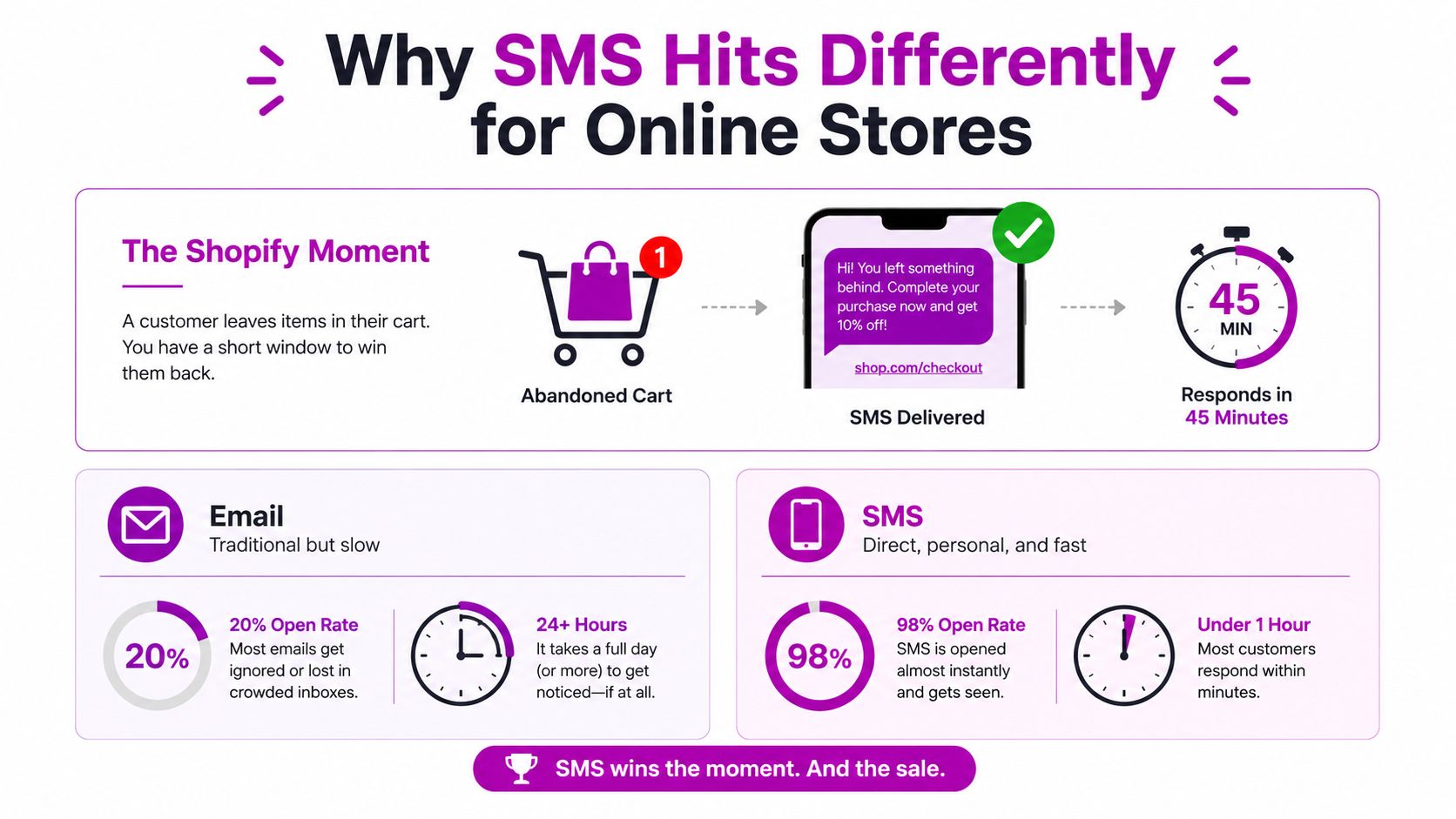
The trap is treating SMS like a louder email blast. It isn't. SMS behaves like a direct operations channel, which means the advantage is speed, attention, and reply-level intent, not just reach. Industry summaries for 2025 to 2026 put SMS at 90% to 98% open rates, with about 80% of messages read within five minutes and roughly 45% average response rates versus about 6% for email. Those same sources estimate ROI at $21 to $41 for every $1 spent, with peak-season campaigns reaching $71 per $1. That's not just a marketing stat, it's a clue that the channel works best when it's tied to actual store events, not random blasts. SMS marketing statistics and data-backed insights for 2025 to 2026
For a broader retention view, the logic fits cleanly inside an omnichannel stack, not a standalone channel. That's why teams pairing SMS with email, paid media, and on-site capture often start with a playbook like omnichannel marketing strategies.
A good launch usually starts with the basics: collect consent cleanly, send utility first, then earn the right to send promotions. A practical Australian walkthrough of the storefront side of that setup is the Australian online store guide, especially if your team is still tightening the relationship between site UX and conversion.
Why SMS Hits Differently for Online Stores
The strongest SMS programs usually feel less like marketing and more like a fast, useful intervention. A Shopify founder watches a cart get abandoned, a text goes out inside the hour, and the order comes back before support even notices the drop. That's the core difference, SMS lives inside the same device where the customer is already deciding, so the path from message to purchase is short and familiar.
The channel works because the attention model is different
Email asks for patience. SMS asks for a glance. That distinction matters because the economics of ecommerce are built on timing, and the channel with the shortest distance between intent and action often gets the sale.
SMS also behaves differently because it creates a reply-capable relationship, not just a one-way broadcast. When a customer can answer a shipping question, confirm a back-in-stock alert, or ask for help without leaving the thread, the message becomes more than a campaign. It becomes part of the shopping experience.
Practical rule: use SMS where delay costs money, and use email where the customer can wait.
That's why the best operators don't ask whether SMS is better than email in the abstract. They ask which moment deserves immediacy, and which deserves explanation. Cart recovery, flash sales, delivery updates, and VIP drops usually sit in the first group. Longer storytelling, education, and multi-step persuasion still belong in email.
What a useful SMS stack looks like
The stores that get this right don't start by blasting everyone. They start with one clean trigger, one short path, and one clear outcome. If you're trying to map that into a broader retention system, think of SMS as the shortest feedback loop in your stack, not the whole stack.
- Fast action: the customer sees the message while the purchase is still fresh.
- Low friction: the tap path should go straight to the right page, not a homepage maze.
- High intent: the message should feel tied to a real store event, not a random campaign.
- Tighter accountability: every send should be linked to a commercial outcome, not just a spike in opens.
That's the reason SMS keeps showing up in ecommerce playbooks. It's not because people like texts more than emails in some vague sense. It's because the channel compresses decision time, which is exactly what stores need when attention is expensive and carts are fragile.
Building a Compliant Opt-In List From Real Storefront Moments
Most brands still make the same mistake, they treat phone capture like a discount pop-up problem. That's too narrow. The better list-building model is to collect consent at moments where the customer already has a reason to stay connected, then match the offer to the traffic source so you don't train bargain hunters to join and leave.
Use storefront moments, not generic lead magnets
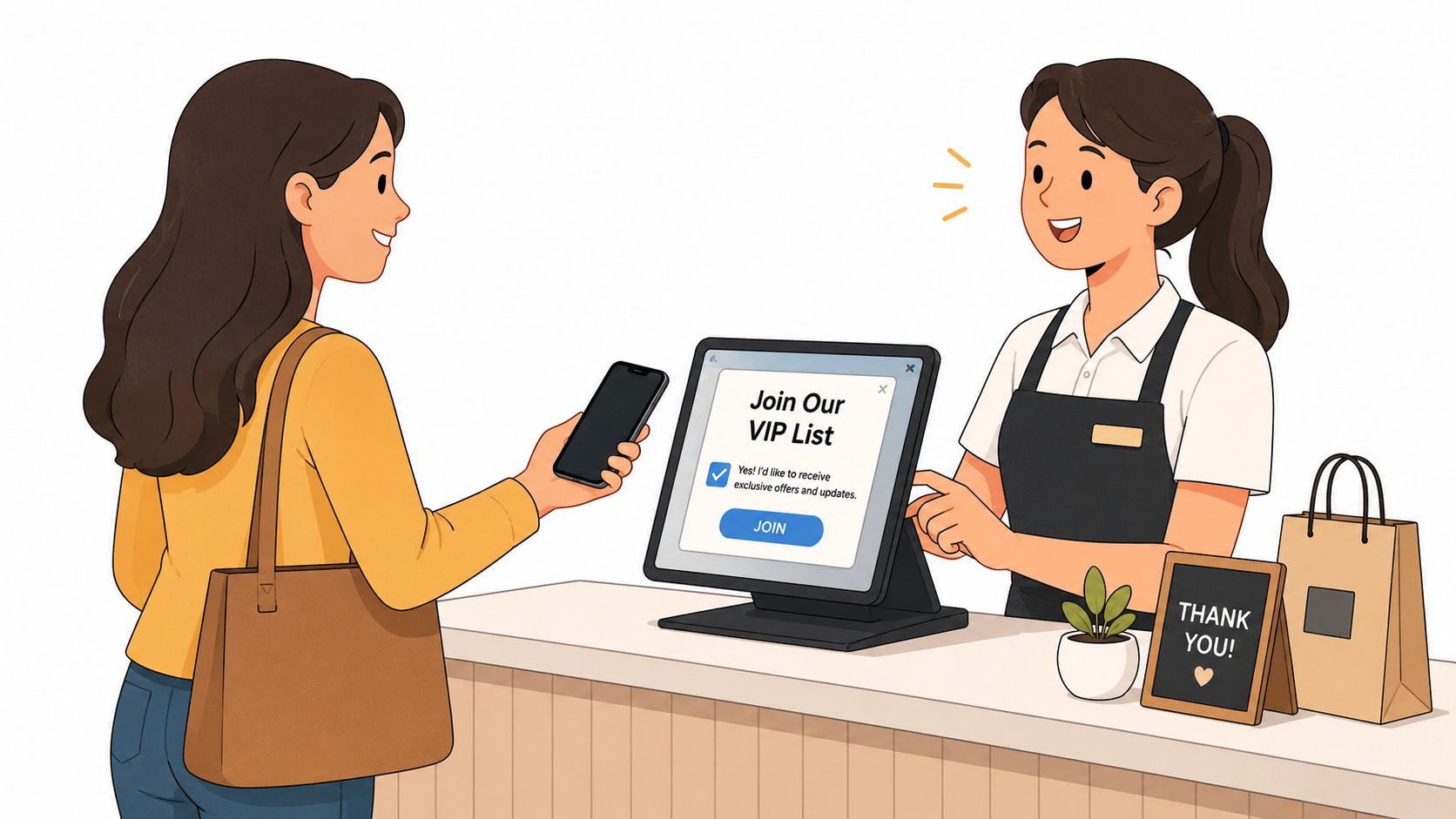
On-site pop-ups still work, but they shouldn't be your only source. Checkout checkboxes, footer forms, thank-you pages, and post-purchase prompts all capture different intent levels, and each one deserves a different message promise. A shopper who has just bought from you is ready for utility and service. A first-time browser might only tolerate a light welcome offer and a clear explanation of what they're signing up for.
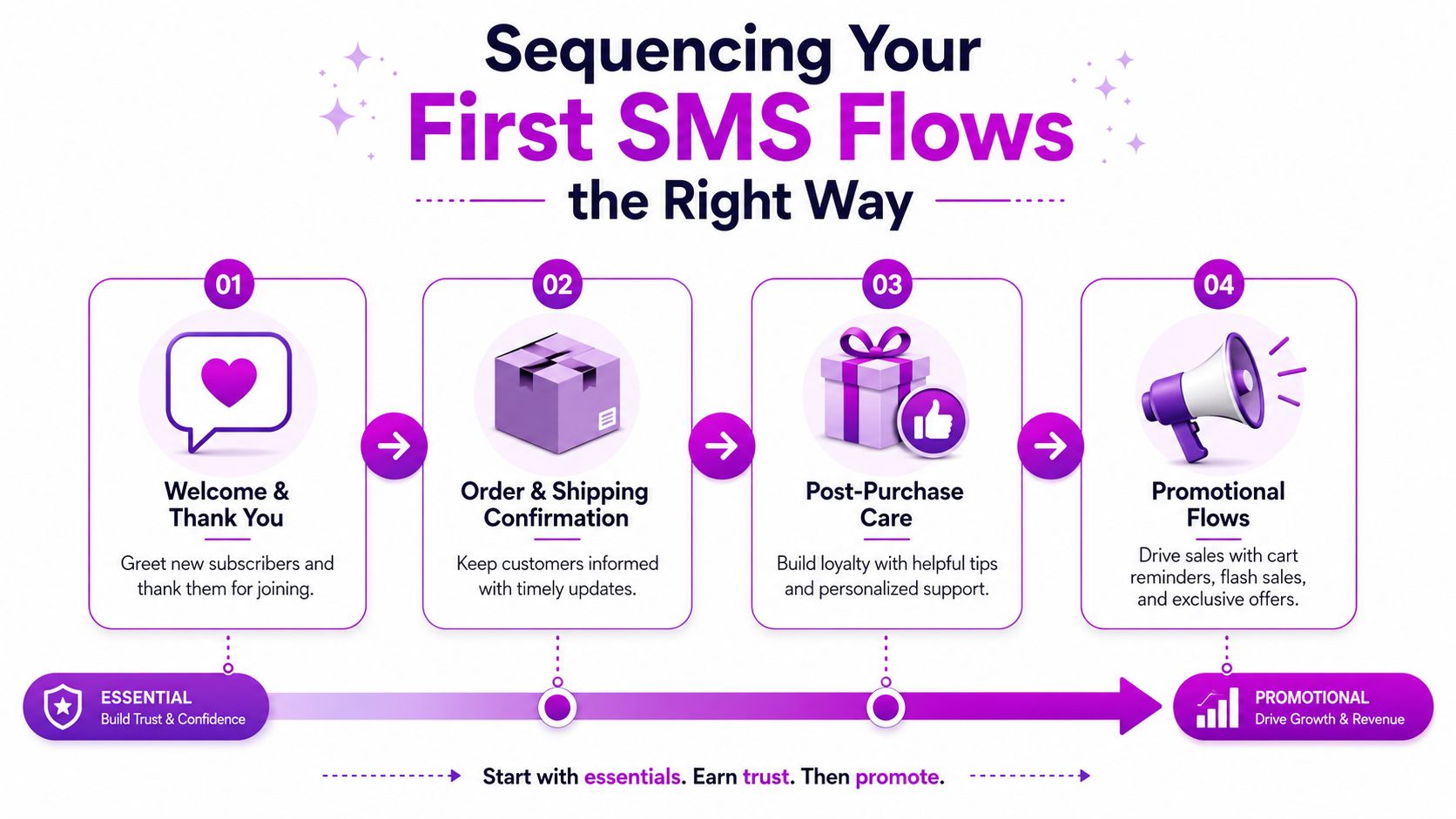
Klaviyo's ecommerce SMS guidance stresses a sensible launch order, consent first, then transactional messages, then post-purchase support, and only after that the heavier promotional automations. That sequence matters because it builds trust before frequency, and trust before discounting. It also reduces list fatigue, which is one of the fastest ways to ruin a promising channel. Klaviyo ecommerce SMS marketing guide
The practical decision is simple, but brands overcomplicate it:
- Checkout traffic: use the clearest consent ask, because intent is already high.
- Post-purchase traffic: emphasize shipping updates, support, and convenience.
- Browse traffic: keep the incentive modest and expectations explicit.
- Paid social traffic: use a keyword or short-form opt-in that matches the promise in the ad.
Single opt-in versus double opt-in needs an honest test
Double opt-in is safer. It also shrinks the list, and the trade-off is real. Brands that assume every extra verification step is harmless usually discover that list growth slows and paid acquisition costs climb elsewhere. That doesn't mean single opt-in is always the answer. It means the decision should follow your risk tolerance, list quality, and traffic source.
Referral and word-of-mouth flows can help here because they come with social proof, not just a coupon. If you're trying to pair list growth with loyalty mechanics, the increase customer loyalty with referrals perspective is useful because it reminds you that consented growth is easier to protect than bought attention.
A clean list is built at the moment of consent, not rescued later with segmentation.
The best brands set the promise early. Say what kinds of texts subscribers will get, how often they'll hear from you, and what value they'll get in return. That one move does more for deliverability and long-term margin than any clever incentive ever will.
Sequencing Your First SMS Flows the Right Way
The launch order matters more than many teams admit. A lot of brands sprint straight to abandoned cart and flash-sale blasts because those are the sexy flows, then wonder why opt-outs rise before the channel has time to prove itself. The cleaner path is to earn attention with utility first, then retention, then promotion.
Start with transactional messages
Order confirmation, shipping updates, delivery notices, and out-for-delivery alerts carry the least friction and the highest customer expectation. People want them. They search for them. They don't read them as an interruption. That makes transactional SMS the safest place to establish cadence, brand tone, and quiet-hours logic before you ask for any promotional tolerance.
Post-purchase care belongs close behind. If a customer has a sizing issue, a late delivery, or a question about an order, SMS can shorten the service loop and reduce the need for a back-and-forth email chain. That's especially valuable as order volume grows, because support bottlenecks become a revenue problem, not just a service problem.
Then layer in retention and only later promotion
Once the utility flows are stable, add welcome messages, product education, and review requests. Only after that should you lean harder into abandoned cart, flash sales, VIP early access, and back-in-stock alerts. Postscript's ecommerce guidance makes the same point clearly, SMS is not only a promo engine, it's a trust and support channel that should reinforce the post-purchase relationship too. Postscript SMS for ecommerce guide
The abandoned-cart timing debate is where teams get sloppy. One provider recommends the first reminder within a few hours of abandonment and a second follow-up 48 hours later, while another guide says the strongest reminders are often sent 30 to 60 minutes after the cart is left. The honest answer is that the best timing window sits close to the trigger event, but the exact window is brand-specific and should be tested. Do not copy a competitor's timing and assume it's gospel.
The operational mistakes are consistent across brands. Teams skip permission capture, forget to set frequency expectations in the welcome text, and try to use SMS as a replacement for email instead of a separate channel with higher urgency and lower tolerance for noise.
Marketing automation workflows is a useful reference if you're mapping SMS into a broader automation map rather than treating each flow like a one-off campaign.
Writing SMS Messages That Get Read and Clicked
The message itself is where a lot of campaigns die. Not because the product is weak, but because the copy tries to do too much. SMS needs one job, one action, and almost no extra words. When a text becomes a mini landing page, the customer stops reading before the value lands.
Keep the text short and the path obvious
A useful benchmark is to stay under 160 characters so you don't split a message into multiple billable segments, and one ecommerce benchmark recommends sending between 10 a.m. and 7 p.m. in the recipient's local time zone to reduce unsubscribes. Another guidance set suggests 4 to 8 promotional SMS per month for most ecommerce brands, with no more than half of monthly volume being promotional. Those numbers aren't magic, but they do reflect how quickly fatigue shows up when frequency gets sloppy. Ecommerce SMS mobile commerce benchmarks
Short doesn't mean bland. It means disciplined. The best texts are easy to scan, easy to tap, and easy to ignore if they're not relevant, which sounds counterintuitive until you realize that respectful messages keep the list healthier than aggressive ones.
Here's how that looks in practice:
- Welcome text: say what subscribers will get and how often, then offer one simple action.
- Abandoned cart: remind them of the item, then link directly back to cart or checkout.
- Back-in-stock: name the product and make the rest of the sentence disappear into the link.
- VIP early access: make exclusivity clear without turning it into a long campaign.
- Shipping update: state the status first, because that's the entire point of the text.
- Review request: ask for one response type, not a survey disguised as a text.
Use one CTA and write for the thumb
A phone screen punishes indecision. If the text includes a discount, a story, a secondary offer, and a soft ask, the customer has to choose before acting. That's too much work for a medium built for speed. One clear CTA beats three every time because it matches how people use their phones, quickly and without ceremony.
Practical rule: if the customer needs to think about what to do next, the SMS is already too complicated.
The brands that do this well also segment by behavior and engagement. A repeat buyer should not get the same copy as a first-time browser, and a VIP should not receive the same urgency as someone who only opened one previous campaign. The message should feel like it came from someone who knows what the customer just did, because in a good SMS program, it did.
Staying Compliant Without Slowing Down
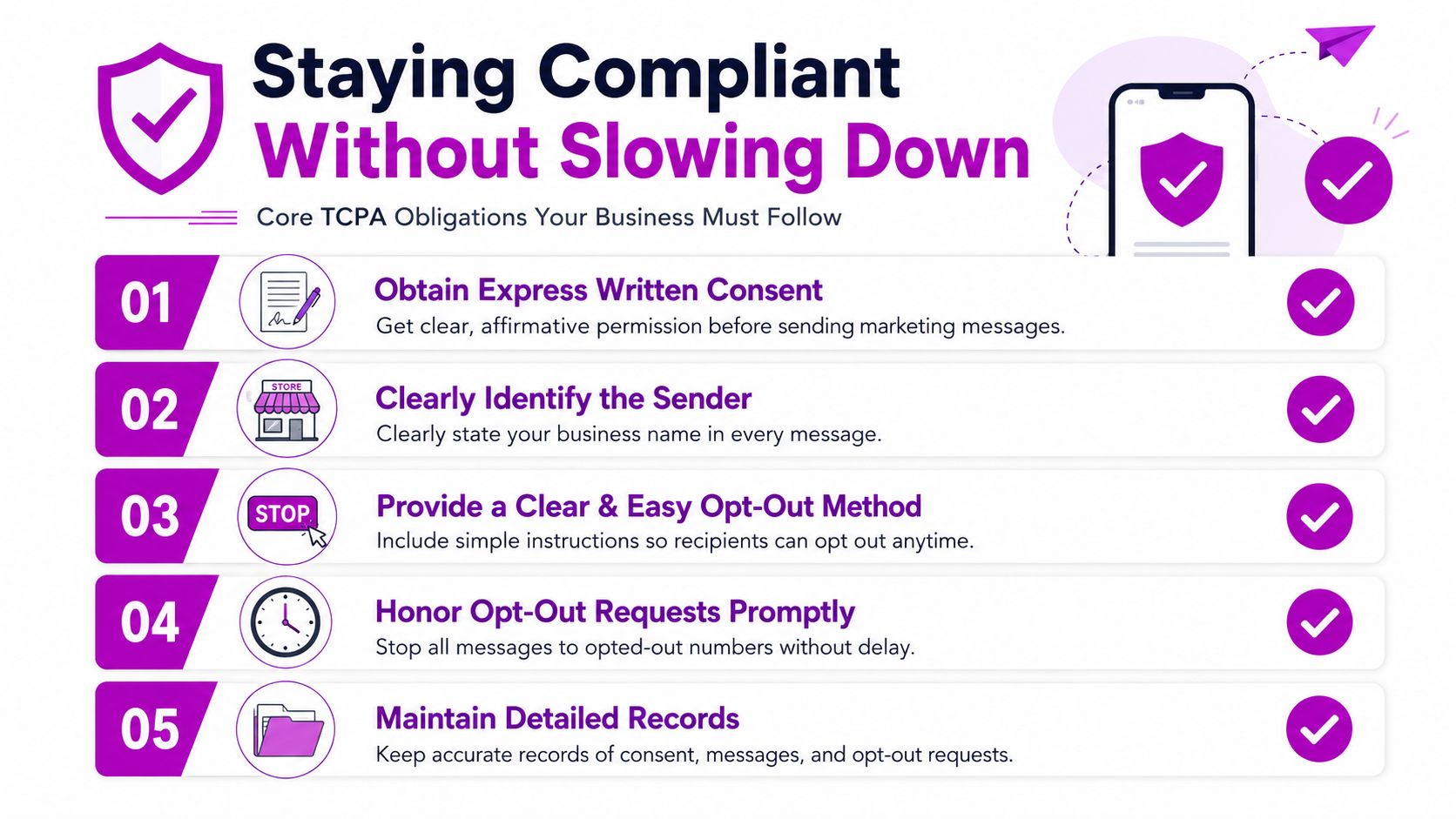
Compliance sits inside the SMS build, not around it. If you treat it like a legal appendix, you slow the team down later or spend real money cleaning up the mistakes. The better setup is to build consent, sender identity, and opt-out handling into the first version of the flow so the program can move quickly without guesswork.
Build the rules into the welcome journey
In the US, TCPA expectations are clear in principle, express written consent, clear identification of the sender, easy opt-out instructions, and respect for quiet hours. For European audiences, GDPR adds lawful basis, explicit consent, and data subject rights. Carriers and aggregators also enforce CTIA-style behavior through deliverability rules, so compliance is an operational job as much as a legal one.
The welcome message has to do more than say hello. It should set expectations in plain language, explain what kinds of texts the subscriber will receive, and show how to stop them. It also needs a clean suppression process so opted-out numbers and invalid numbers do not keep cycling back into campaigns. Once those records get messy, deliverability and trust both suffer.
If a customer can't tell who's texting them or how to stop it, the program isn't ready.
Quiet hours should follow the customer, not the office
A lot of brands still schedule sends around internal working hours and ignore the recipient's time zone. Quiet-hour logic should use the subscriber's local time, not the marketer's calendar. That one operational choice avoids unnecessary friction and makes the brand feel more considerate.
Compliance also has a financial side. TCPA violations can run $500 to $1,500 per message according to FTC TCPA enforcement guidance, which is a sharp reminder that “we'll fix it later” is a bad plan. Building guardrails up front is cheaper than litigating a broken process or rebuilding your SMS stack after the fact. Keep the records, keep the proofs, and keep the system simple enough that your team can follow it.
Measuring What SMS Actually Contributes
Open rate is the wrong place to start. Of course SMS gets opened. That's the channel's baseline, not the signal. If you measure SMS like email, you'll overvalue attention and undervalue contribution, which is how teams end up defending campaigns that didn't really move profitable revenue.
Measure completed payments, not just clicks
The harder question is whether a send produced a payment that would not have happened otherwise. Then ask what the margin on that order was, and whether the subscriber stayed opted in after the message. That trio matters because a campaign that drives revenue but destroys margin, or a campaign that converts once and burns the list, isn't healthy.
The most useful tests are controlled and boring. Change one variable at a time. Test timing without changing the offer. Test the offer without changing the audience. Test the audience without changing the CTA. If you change all three, you won't know what worked, and you'll spend the next month arguing about the dashboard instead of improving the flow.
Read the downstream effects
A mature program looks at repeat purchase behavior, retained subscriber count, and revenue per recipient alongside direct conversion. That keeps the team honest. A great open rate paired with rising opt-outs is a warning sign, not a win.
Tagada's ecommerce guidance gets this right by pushing teams toward controlled experiments and downstream outcomes, not just click reporting. It also notes the risk of broad segments hiding the actual driver of lift, which is exactly what happens when a brand gets excited about “VIPs” but never defines who really belongs there. SMS marketing for ecommerce revenue measurement
Key takeaway: SMS is a revenue system, so the metric stack has to include margin, retention, and subscriber health.
Behavioral segmentation usually beats generic blasts, but only when the segments are specific enough to act on. If they're too broad, they become a comforting label instead of a useful control group.
Your 30-60-90 Day SMS Rollout Plan
The rollout should feel operational, not aspirational. Too many brands try to launch every flow at once, then they can't tell whether the issue was consent quality, copy, timing, or offer pressure. A staged plan gives you cleaner data and fewer mistakes.
Days 1 to 30
Lock consent capture on-site and in checkout, then launch transactional messages first. Set frequency expectations in the welcome text, define your opt-out handling, and make sure quiet hours respect the subscriber's local time. If you're running content or creative ops alongside this work, it helps to keep the input side tight too, and AI-powered fashion photo tools is a useful reminder that speed matters most when the rest of the stack is already disciplined.
Days 31 to 60
Add the welcome series and abandoned cart. Run the first timing test with one variable changed, not three, and build a behavioral segment for repeat buyers and VIPs. This is also the phase where you decide whether your list quality is strong enough to support more promotional volume.
Days 61 to 90
Layer in back-in-stock alerts, flash sales, and post-purchase retention flows. Stand up a dashboard that tracks revenue per recipient, retained subscribers, and incremental margin so you're not mistaking activity for profit. If opt-out behavior jumps or support complaints spike, pause the send, diagnose the trigger, and fix the issue before adding more volume.
The most common scaling mistakes are predictable. Brands over-text cold subscribers, copy the same flow across every storefront without localizing timing or merchandising, and lean too hard on discounts because they're easy to measure. A better path is to prove one profitable SMS system on one brand, then expand it only after the data shows the channel can carry margin, not just clicks.
If you want SMS to do more than generate noisy spikes, build it like an operating system for revenue, not a campaign calendar. ECORN can help you map the consent, flow architecture, and measurement layer into a Shopify setup that's built to scale, so if you're ready to turn SMS into a real retention engine, reach out through ECORN and get the rollout plan moving.


Best Shopify Theme for Custom Products Compared
Multi Store Inventory Management: A Practical Guide

SEO Consulting for Ecommerce: A Practical Guide
Shopify Theme Updater App: A Safe Update Playbook
Shopify Git Integration: A Developer's Guide to 2026
Headless Ecommerce Development Services Explained

How to Build a Shopify Clothing Website That Converts
How to Launch a Box Subscription Business in 2026

Luxury Skincare Branding Playbook That Converters
10 Best Podcast Ecommerce Shows for Store Growth in 2026
Shopify Developer Hourly Rate: What to Pay in 2026
Critical Shopify Setup Errors That Are Secretly Sabotaging Your Store
Ecommerce Conversion Tracking: The Complete How-To Guide
Shopify Design Agency: How to Pick the Right Partner
Mastering Multi Store Management on Shopify
Scale Shopify Store
10 Shopify App Ideas Worth Building in 2026
Conversion Rate Optimization for Landing Pages: The Playbook
Shopify Plus Automation: A Guide for 2026
10 Social Selling Platforms for Shopify Merchants
Shopify Website Design Examples: 7 Stores Worth Studying
7 Ecommerce Newsletter Examples for Shopify Brands
One Product Shopify Store: Build and Scale
Mobile Pop Up Strategy for Shopify Stores That Converts
Sitemap for Shopify: How to Find, Optimize, and Submit It
7 Single Product Websites Worth Emulating
Product Variants Shopify: The Complete 2026 Guide
Ecommerce Analytics Consulting for Growth
What Is AI Integration for eCommerce
How to Choose the Right eCommerce Website Development Firm
E Business Strategy Implementation
Conversion Tracking Setup for Shopify Stores
BigCommerce vs Shopify Plus Which Enterprise Wins in 2026
Shopify Theme Kit: Setup, Commands, and Migration Guide
Shopify Extension Development: A Practical 2026 Guide
Shopify Speed Score Explained and How to Improve It
Shopify Mobile Optimization: The 2026 Playbook
How to Add Subcategory in Shopify for Better UX
How to Implement Structured Data for Ecommerce in 2026
SEO App Mobile: Shopify Store Optimization Guide
Shopify Plus Support: What It Includes and How to Choose
Google Ads for Shopify: The Complete 2026 Playbook
Shopify New York: How to Find and Hire the Right Agency
Google Search Console for Shopify: The Complete Setup
First Party Data Collection for eCommerce Growth
FAQ Online Store Guide: Build and Measure It Right
Do FB Ads Work for eCommerce in 2026?
One Page Checkout for Shopify: Design and Implementation
Shopify GraphQL vs REST: The 2026 Developer Decision
Shopify Ecommerce Consulting: Strategy, Pricing &
Are Reddit Ads Worth It for eCommerce Brands
Shopify Title and Meta Description: A Practical 2026 Guide
Product Video Best Practices for Shopify Brands
Real-Time Inventory Management: A 2026 Guide
AI Chatbot Integration for Shopify Stores
Affiliate Program Management: A Shopify Guide
10 Best Performance Monitoring Tools for Shopify in 2026
Digital Asset Management for eCommerce Brands in 2026
Every Type of Facebook Ads Explained for eCommerce Growth
Product Information Management Explained for Shopify Brands
Support Ticket System: A Guide for Shopify Stores

10 Best Customer Service Tools for Shopify in 2026

Can I Start a Business with No Money? a 2026 Blueprint
What Sells Good on Etsy: Best Niches for 2026

Shopify Add to Cart Button: A Practical 2026 Guide

Customer Feedback Automation: A Practical eCommerce Guide
Critical Rendering Path: A Guide for Shopify Stores

How to Promote on TikTok for eCommerce in 2026

B2B eCommerce Consulting That Drives Real Revenue
10 Best Practices for Site Navigation in 2026
Return vs Refund for Shopify Stores: A Practical Guide
What Is Customer Lifetime Value and Why It Matters
What Is Voice of Customer Research for eCommerce

Master How to Improve Email Deliverability in 2026

Top 8 eCommerce Partners NYC for Shopify Brands in 2026
Machine Learning for Ecommerce: Boost Your Shopify Store

Beauty Market Research: Your 2026 Growth Guide
Shopify International Expansion: A 2026 Roadmap
What Does CRO Stand for in Business: Understanding CRO
Shopify Visual Merchandising: A Playbook for Higher Sales
Shopify Landing Page Design: Master Conversion in 2026
10 Best AI SEO Optimization Tools for Shopify in 2026

Agentic AI for Ecommerce: Boost Your Sales in 2026
Mastering Email Marketing Data for eCommerce Growth
Conversion Rate Optimisation Australia: Boost Your Sales
Conversion Rate Optimization AI: Your Shopify Store Guide

10 Product Bundling Strategies for Shopify in 2026
How to Increase Customer Lifetime Value: A Shopify Playbook
AI Customer Service Automation: Shopify Guide 2026
Clean Website Design: A Shopify Conversion Playbook

Omnichannel Retail Strategy: A Shopify Playbook
Product Data Enrichment: A Guide for Shopify Brands
Instagram Shopping Features a Guide for Shopify Stores
What Is Revenue Optimization: A Holistic RevOps Guide
Benefits of Conversion Rate Optimization: Boost Your
WordPress to Shopify Migration: Your 2026 Seamless Switch
Boost Sales: Ecommerce Payment Processing Guide 2026
Unified Commerce Platform: Benefits, KPIs & Shopify Guide
How to Reduce Bounce Rate eCommerce: Your 2026 Guide
Shopify API Integration: A Practical End-to-End Guide


newsletter in your inbox