

Are Facebook ads producing incremental profit, or are they just taking credit for customers who were already close to buying? That question matters more than whether Meta reports clicks, purchases, or a positive return on ad spend.
For Shopify operators, “do FB ads work” has no universal answer. The channel can generate inexpensive traffic, leads, and sales at scale, but the result depends on the campaign objective, contribution margin, creative-market fit, post-click funnel, and measurement model. A campaign that looks healthy in Ads Manager can still fail the cash-flow test once returns, discounts, email influence, and untracked conversions are included.
What People Actually Mean When They Ask If Facebook Ads Work
Stop asking whether Facebook ads work in general. Ask for whom, at what scale, for which objective, and measured against what business outcome.
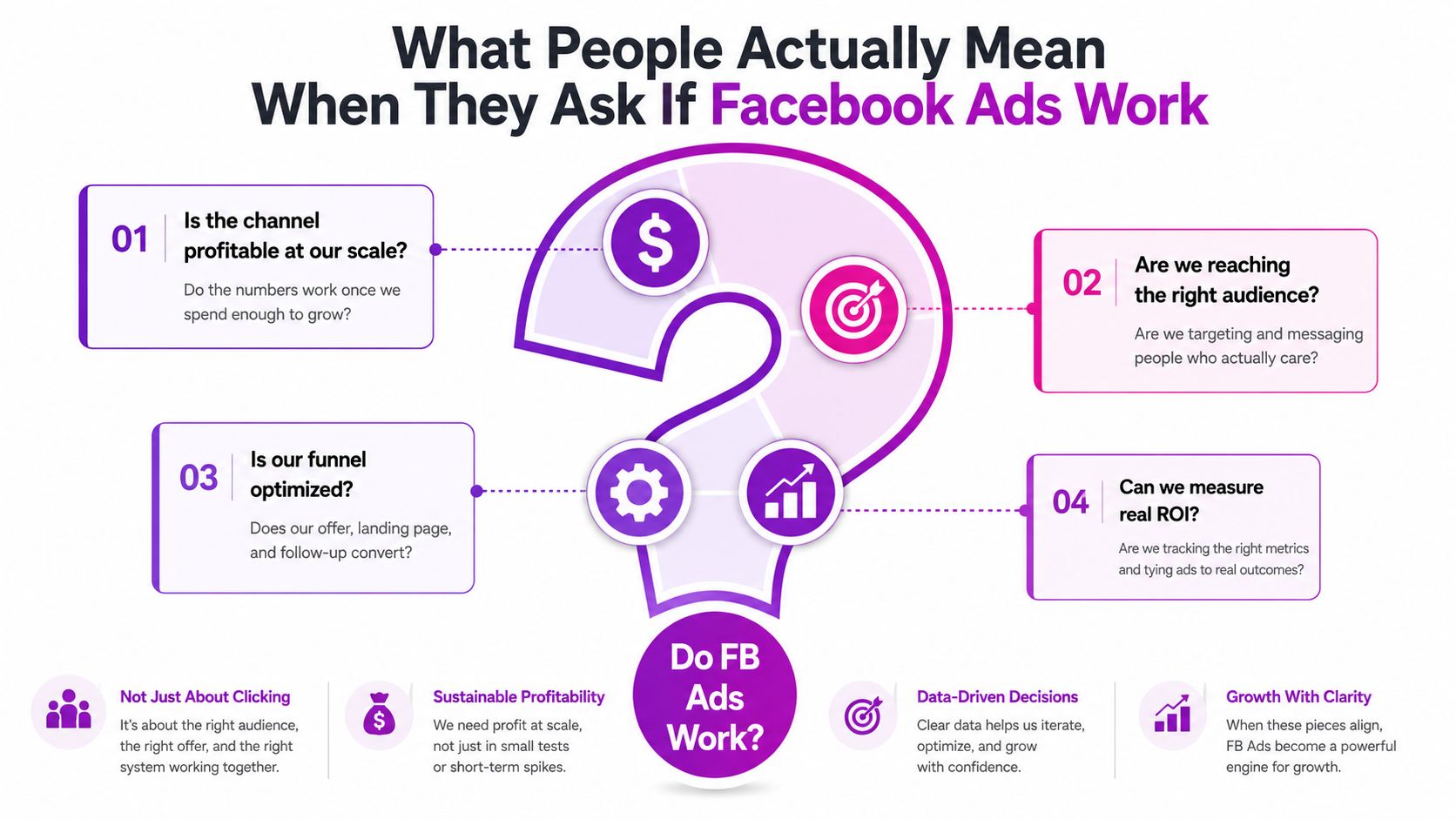
When an operator asks the question, they're usually combining several separate decisions:
- Profitability: Can the channel acquire customers below the store's allowable CPA after product costs, fulfilment, discounts, returns, and payment fees?
- Scalability: Can performance survive higher spend, or does the campaign only work while it reaches a small pocket of highly responsive users?
- Measurement: Does Meta's reported conversion value resemble Shopify revenue and contribution margin?
- Creative-market fit: Does the advertising give a specific audience a compelling reason to stop, understand the offer, and buy?
A link click answers none of those questions. Reach and impressions describe distribution, not commercial impact. Even CTR is diagnostic rather than definitive. Benchmark data shows that traffic campaigns averaged a 1.71% CTR and about $0.70 CPC, while lead campaigns averaged a 2.59% CTR and about $1.92 CPC, with conversion performance varying materially by objective and offer quality (Triple Whale's Facebook Ads benchmarks).
The useful verdict is conditional
Facebook ads can work when the auction finds enough people who match the message, the offer converts after the click, and the resulting customers create acceptable contribution margin. They stop appearing to work when one of those inputs breaks, particularly when an operator blames targeting for a weak product page or blames Meta for generic creative.
The most defensible evaluation uses three layers:
- Delivery metrics, such as CPM, CTR, CPC, and frequency, to identify auction and creative problems.
- Funnel metrics, such as landing-page conversion, checkout progression, and purchase rate, to locate post-click leakage.
- Business metrics, including Shopify-attributed revenue, blended efficiency, contribution margin, and incremental lift, to decide whether the spend deserves more capital.
Meta benchmark reporting places median ROAS across industries at 1.88, with median CPA of $38.99 and CPM of $15.06 (Sprout Social's Facebook advertising benchmarks). Those figures indicate measurable commercial activity, not guaranteed profit. Your margin structure determines whether that baseline is useful or unacceptable.
Analyst's rule: A Facebook campaign works only when it creates enough incremental contribution to justify the next dollar of spend.
How Facebook Ads Actually Work Behind the Auction
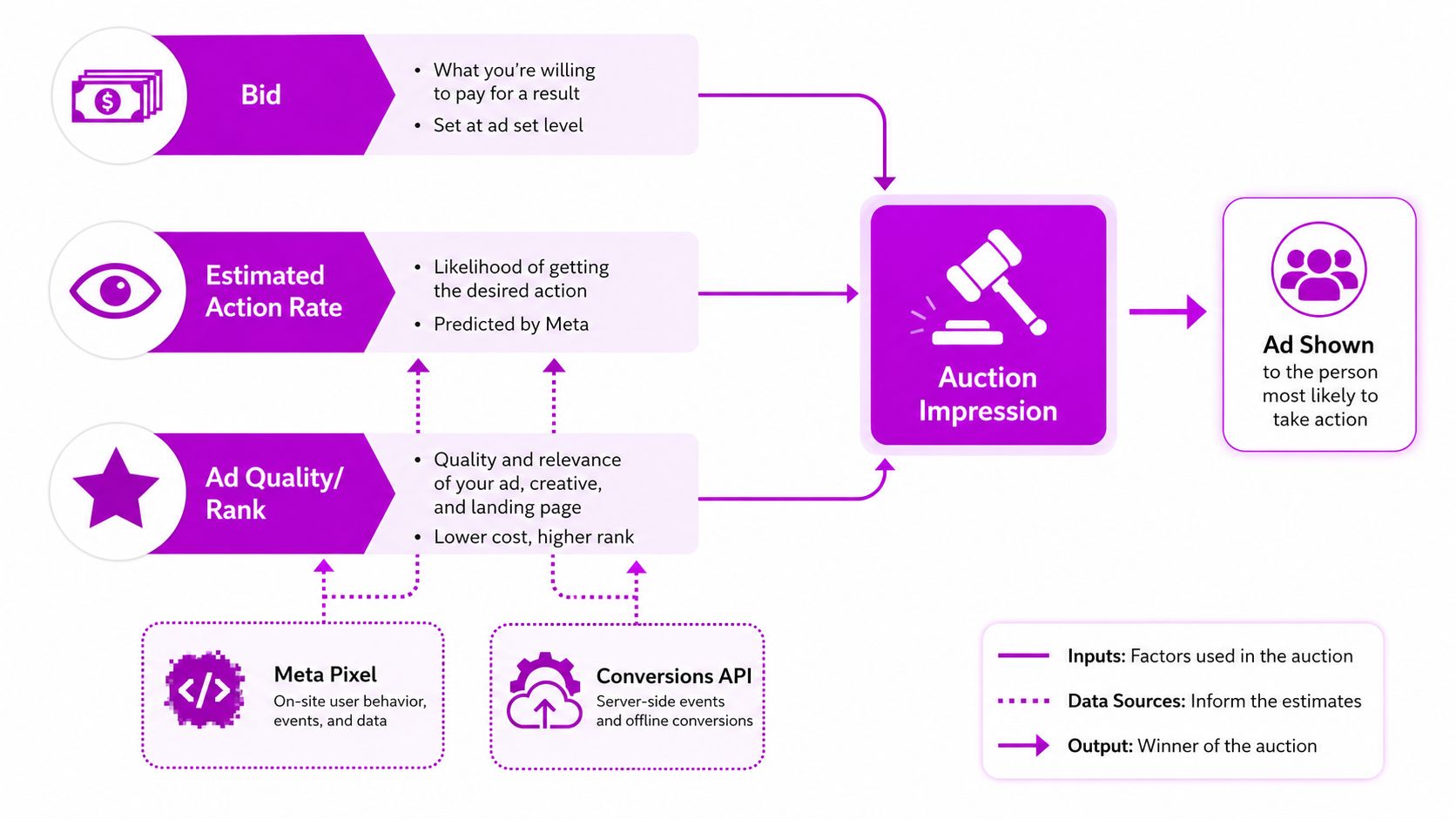
Meta doesn't sell impressions through a simple highest-bid-wins system. Each eligible impression passes through an auction that weighs the advertiser's bid, the estimated likelihood of the desired action, and the ad's quality or relevance.
Three inputs shape delivery
Bid represents how aggressively the system can compete for an impression under the chosen optimization strategy. A higher bid can help access inventory, but it won't rescue an offer that produces weak downstream actions.
Estimated action rate is Meta's prediction that a person will complete the event selected by the campaign. If you optimize for a purchase, the system looks for signals associated with purchases. If you optimize for landing-page views or traffic, it searches for people likely to click or visit, not necessarily people likely to buy.
Ad quality and rank reflect how the creative is likely to be received in the user experience. Clear, relevant ads can compete more efficiently than repetitive or misleading ads, even when another advertiser bids more.
Meta's delivery system behaves partly like a silent auction and partly like a recommender system. It isn't merely asking, “Who paid the most?” It's asking, “Which ad is most likely to create the outcome this advertiser selected while maintaining a useful user experience?”
Event data determines what the system can learn
The Meta Pixel records browser-side events, while the Conversions API sends events from the server. Used together with careful event matching and deduplication, they give Meta more reliable feedback about what happened after an impression or click.
That signal quality matters during learning. If purchase events are missing, duplicated, delayed, or attributed to the wrong source, the system receives a distorted picture of which users and creatives produce value. Operators should treat event tracking as an input to bidding, not as a reporting accessory.
Campaign objectives change the behaviour you're buying. Sales campaigns seek purchase-oriented users, Lead campaigns seek form completions or other lead events, and Engagement campaigns seek interactions. A campaign can therefore generate an excellent result against its selected objective while failing the commercial objective the business cares about.
For a practical explanation of Meta Ads audience targeting, focus on how audience signals support the chosen conversion event rather than treating targeting options as a substitute for a strong offer.
The Benchmarks That Matter for eCommerce in 2026
Do Facebook ads work for eCommerce? The useful answer depends on what the benchmark is measuring, which business outcome matters, and whether reported conversions are incremental. Cheap clicks can indicate efficient traffic delivery while sending low-intent visitors to a product page. A lead campaign can show a strong form conversion rate and still produce weak sales quality. Benchmarks diagnose account conditions, but they cannot determine whether a store's margin supports the resulting costs.
Available 2026 benchmark data illustrates the difference. Facebook lead campaigns averaged a 7.72% conversion rate across industries, while traffic campaigns averaged 1.71%. Traffic campaigns also averaged about $0.70 CPC, making them attractive for inexpensive visits without establishing them as a sales engine, according to Sprout Social's benchmark data.
Use benchmarks as diagnostic signals
| Metric | Early Stage ($0-10K/mo) | Growth Stage ($10-100K/mo) | Established ($100K+/mo) |
|---|---|---|---|
| Objective | Validate offer and creative | Improve acquisition efficiency | Defend profitable scale |
| Primary diagnostic | Purchase quality and funnel leakage | Creative fatigue and blended efficiency | Incrementality and marginal contribution |
| Useful comparison | Shopify-attributed revenue | Meta versus Shopify attribution | Incremental lift versus reported ROAS |
| Main risk | Treating cheap traffic as demand | Scaling before creative depth exists | Paying for customers already influenced elsewhere |
The table avoids invented stage-specific cost bands. The verified benchmark set does not provide reliable CPM, CTR, CPC, hook-rate, hold-rate, ROAS, or MER ranges by Shopify business stage. Without comparable objective, geography, product category, attribution window, and margin, a benchmark creates false precision.
Broader reporting places median ROAS across industries at 1.88, median CPA at $38.99, and median CPM at $15.06, as noted above. Those figures frame account performance, but an early-stage store with low average order value and thin gross margin cannot evaluate them like a high-margin brand.
Separate leading indicators from business outcomes
CTR and CPC show whether an ad earns attention efficiently. Conversion rate shows whether the offer and funnel turn that attention into the selected action. ROAS shows reported revenue relative to spend, but it does not establish that the ad caused the sale.
A useful audit maps each metric to a decision:
- Low CTR: investigate the hook, visual, audience-message fit, and placement.
- Healthy CTR with weak purchase rate: inspect the product page, price, proof, shipping information, and checkout.
- Healthy reported ROAS with flat total revenue: test incrementality and compare results against a holdout.
- Rising CPC with declining engagement: review creative fatigue and auction competition.
Apply a consistent return on ad spend calculation, then compare it with Shopify-attributed revenue and contribution margin. Teams testing new production methods, including GEO and GenAI ad tactics, should judge AI-assisted assets by the same incremental and financial criteria used for creator content or studio production.
The Five Factors That Decide Whether FB Ads Succeed
Facebook ads usually get blamed too early. In audited Shopify accounts, the channel is often neutral while one or more business inputs are defective.
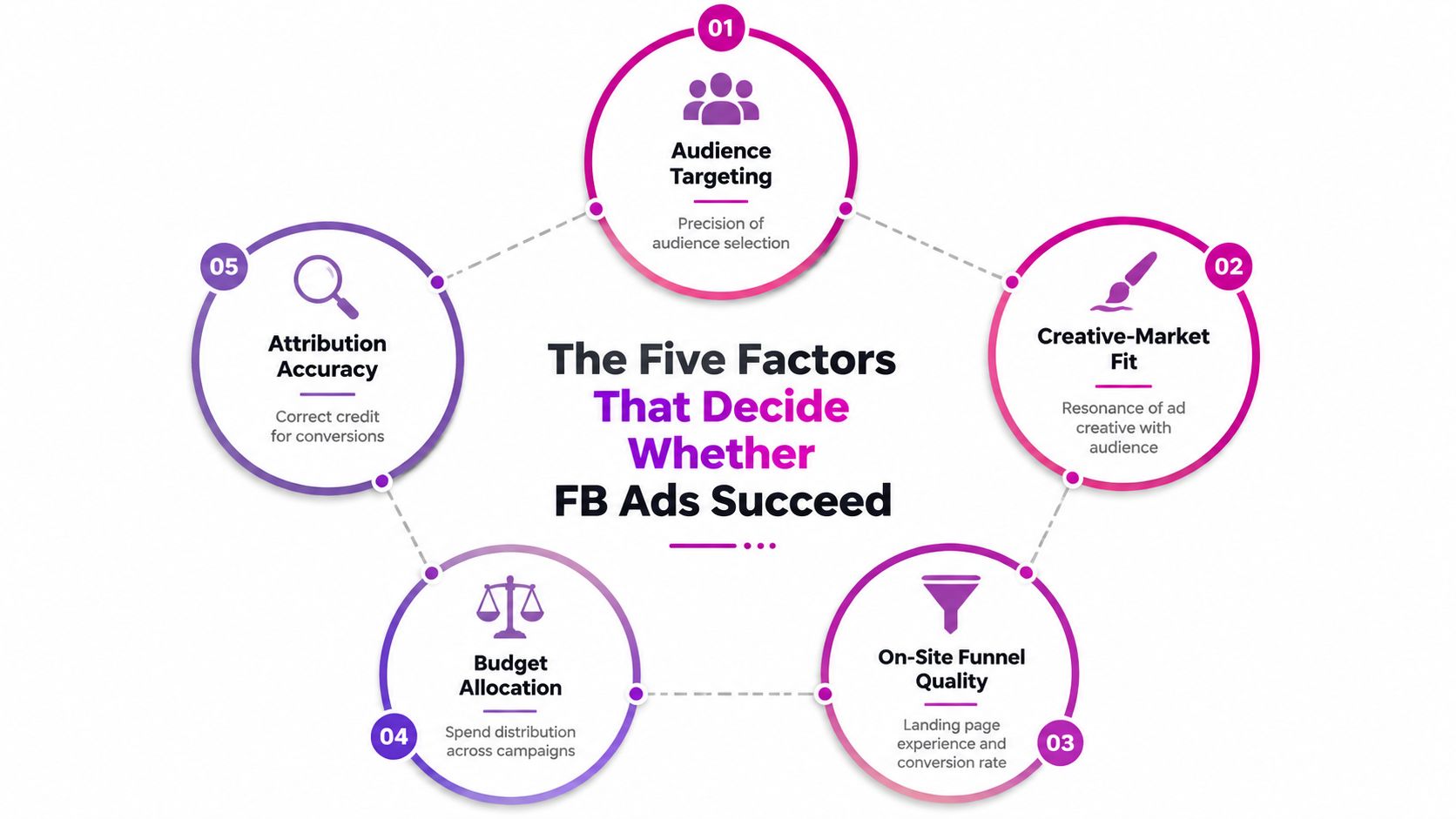
Audience targeting
Start with the buyer, not the interface. Can you explain why this person needs the product now, which alternatives they considered, and what language they use to describe the problem?
Broad targeting can work when the creative and event signal give Meta enough information to find likely buyers. Narrow interest stacks can work when they reflect genuine buying context, but they can also restrict delivery and hide weak messaging behind a small audience.
If CPM rises while CTR stays flat, inspect audience size, placement mix, and auction pressure. If CTR is strong but purchases are absent, expanding targeting won't solve the post-click problem.
Creative-market fit
Creative must make the product legible to a specific market. A generic product montage asks the viewer to do the strategic work. A strong ad demonstrates the problem, shows the product in context, handles an objection, or gives the audience language that feels familiar.
Ask whether a new customer can identify the product's use case without reading the entire caption. If not, the campaign probably needs a new angle, not another interest category.
On-site funnel quality
The landing page inherits the promise of the ad. When the ad frames a particular pain point but the product page opens with vague lifestyle language, conversion suffers because the buyer has to reconstruct the argument.
Check page speed, product proof, variant selection, delivery details, returns, payment options, and mobile checkout. A high add-to-cart rate with weak checkout completion points to friction or trust. A weak add-to-cart rate points earlier, usually to offer clarity, price perception, or product-page relevance.
Budget allocation
Budget should follow evidence, but not every apparent winner deserves immediate expansion. Operators need enough spend and conversion volume to distinguish a repeatable pattern from a lucky pocket of demand.
Keep prospecting, retargeting, and testing decisions visible. Retargeting can look efficient because it reaches users who already know the brand, while prospecting carries the cost of creating new demand. Combining them into one blended number can conceal a shrinking acquisition engine.
Attribution accuracy
Ask a harder question than “What did Ads Manager report?” Ask how many purchases would have occurred without the impression.
Attribution records that a click or view preceded a conversion. Incrementality tests whether the ad caused a conversion that otherwise would not have happened. Controlled lift studies compare exposed and unexposed groups, making them the most defensible way to estimate causal impact (iDimension's explanation of attribution and incrementality).
Practical audit question: Which of these five levers can you disprove with account data today?
Common Myths That Lead Operators to Misjudge FB Ads
The useful question is not whether Facebook ads work in general. It is whether the account creates incremental demand from the right audience, with creative that matches the market and a funnel that can convert it.
| Myth | What the Data Actually Shows | Diagnostic to Run |
|---|---|---|
| More spend always creates more profit | Results depend on objective, creative quality, audience, and funnel design | Compare marginal contribution as spend rises |
| Facebook ads died after iOS privacy changes | The channel still generates measurable engagement, traffic, leads, and sales, but web measurement is less complete | Compare platform reporting with Shopify and lift evidence |
| The right audience can sell any product | Audience quality cannot compensate for weak creative-market fit or an unconvincing offer | Test distinct customer problems and messages |
| Reported ROAS equals real ROAS | Attribution can credit conversions that would have happened through another path | Run holdouts or controlled lift tests |
The first myth treats scale as proof of efficiency. Additional impressions can reach weaker audience pockets, expose creative fatigue, and raise marginal acquisition costs. A campaign may keep spending while its next customer no longer meets the business's contribution-margin requirement.
The second myth confuses weaker measurement with weaker demand. Apple's privacy changes affected web conversion visibility, attribution windows, and retargeting accuracy. Incomplete reporting therefore cannot serve as a clean measure of customer behaviour (Adhesion's analysis of iOS 14.5 and Facebook ads).
The benchmark split matters
As noted in the opening section, traffic campaigns averaged 1.71% CTR and about $0.70 CPC, while lead-generation campaigns averaged 2.59% CTR and about $1.92 CPC in large benchmark sets. The gap does not establish that one objective is superior. It shows that Meta optimizes toward the event selected, and that a cheaper click may carry less commercial intent.
That distinction matters when an operator evaluates funnel quality. A high CTR can reflect an effective hook without proving purchase intent, while a higher CPC can be acceptable if the resulting leads or buyers contribute enough margin. Judge the objective by downstream economics and incrementality, not by the cheapest visible interaction.
The fourth myth persists because platform ROAS is convenient. Incrementality is harder to measure and may produce a less flattering result, but a causal estimate is more useful than an attribution story when choosing the next budget allocation.
How FB Ads Perform at Different eCommerce Stages
The same Meta account can behave like three different channels as a business matures. Customer data, creative depth, product-market evidence, retention, and existing brand familiarity all change the quality of the auction signals. Spend matters, but it does not explain performance on its own.
Stage comparisons are more useful as operating models than as universal CPA or ROAS benchmarks. The available evidence does not support reliable stage-specific ranges, so the table identifies the economic question each business must answer.
| Stage | Monthly Revenue | Typical CPA | Reported ROAS | Primary Campaign Type |
|---|---|---|---|---|
| Emerging | Early validation stage | Set from contribution margin | Compare with first-order economics | Sales prospecting with disciplined creative testing |
| Growing | Consistent acquisition and repeat demand | Evaluate against blended margin and retention | Compare with Shopify attribution and marginal efficiency | Broad prospecting with selective retargeting |
| Established | Significant first-party data and brand demand | Evaluate by new-customer contribution | Test for incrementality, not accept at face value | Prospecting, dynamic product ads, and retention-aware audiences |
Emerging brands
An emerging store usually has limited purchaser data and little evidence about which message converts. Broad delivery gives Meta more room to find potential buyers, while also exposing weak positioning, offer structure, or creative-market fit. First-order economics therefore need to stand on their own unless the business has credible evidence that customers return.
The first operating question is, “What must this first order contribute?” If profitability depends on later purchases, the store needs a defensible retention model. An optimistic lifetime-value assumption is not enough to justify an unprofitable acquisition cost.
Creative testing should isolate the message, offer, and product angle that generate qualified demand. A strong click-through rate can still produce poor economics if the landing page, price, or product fails to support the promise in the ad.
Growing brands
A growing brand has more conversion signals, repeat demand, and usable creative history. Its main risk is scaling one successful concept past the point where the audience still responds. Broad prospecting and a controlled retargeting layer can support growth, provided the team keeps developing new hooks and checks event quality.
Reported ROAS may rise while marginal efficiency falls. Retargeting and returning visitors can receive credit for demand that would have converted without the ad. Compare each budget increase with blended revenue, contribution margin, and new-customer volume rather than treating platform-reported revenue as incremental by default.
Established brands
An established brand can use customer lists, product catalogues, repeat-purchase behaviour, and retention cohorts to guide media decisions. Its harder task is separating genuine new demand from existing brand intent. Incrementality testing must account for organic search, email, direct traffic, repeat customers, and other channels that may capture the same purchase.
As discussed earlier, Adhesion reports that Meta's AI-driven advertising tools delivered a 22% ROAS lift and $4.52 returned per dollar in the U.S., compared with average revenue of $3.71 per dollar across all U.S. advertisers. Those platform-reported figures show why tool adoption and implementation can affect results, but they do not establish what an individual Shopify store will achieve. The relevant test remains whether additional spend creates profitable demand beyond the sales that would have occurred anyway.
A Practical Testing Framework to Evaluate FB Ads
A useful test doesn't ask for faith. It creates a clean sequence of technical checks, controlled learning, and financial decisions.
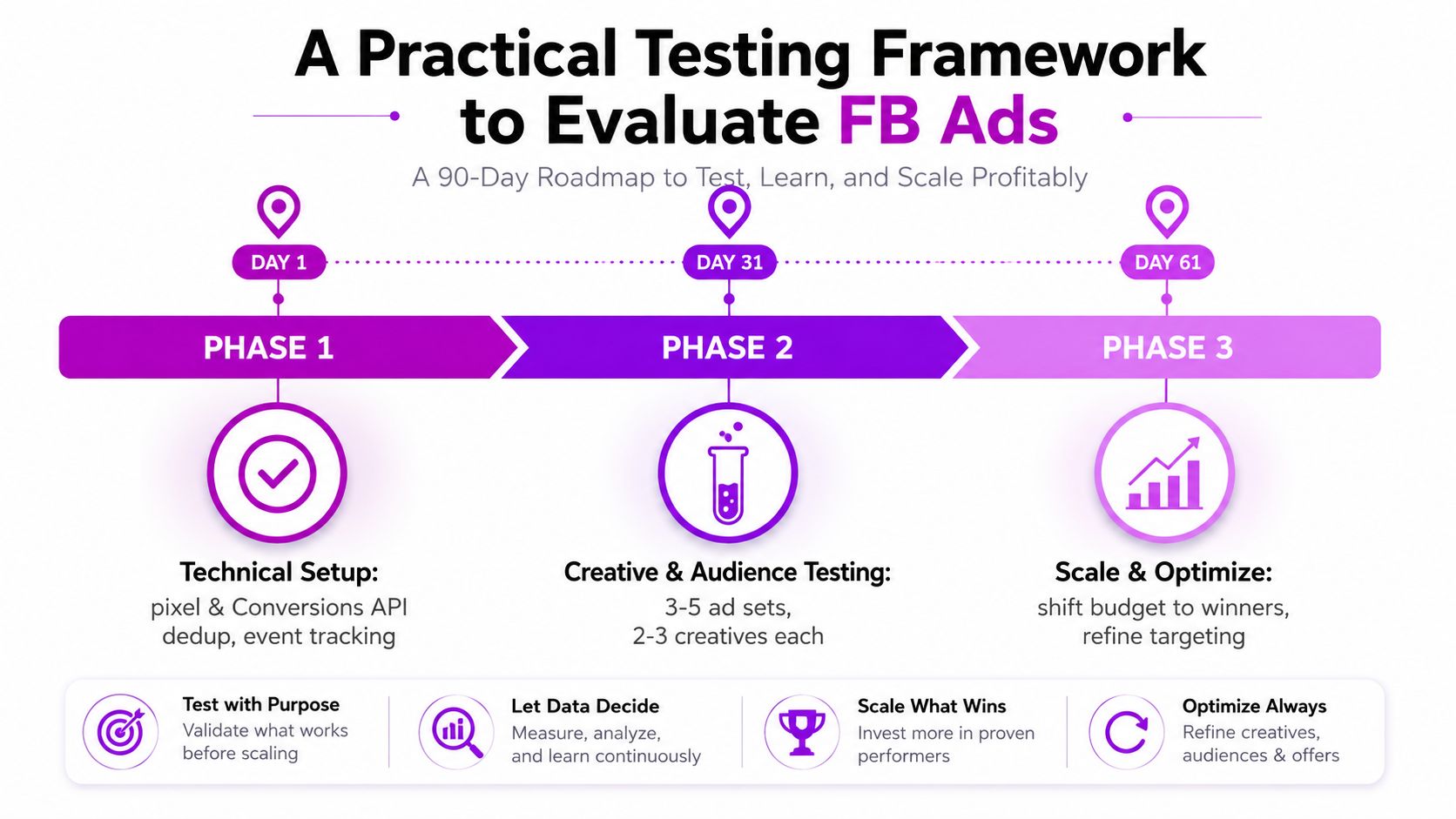
Days 1 to 30, verify the signal
Check Pixel and Conversions API event matching, deduplication, domain configuration, catalogue accuracy, purchase values, and exclusions. Compare Meta events with Shopify orders before interpreting any performance result.
Define the allowable CPA from contribution margin. Choose one primary objective and test a small set of different creative concepts against an audience broad enough for delivery to learn. Don't change the landing page, offer, audience, and creative simultaneously, or you won't know what caused the result.
Days 31 to 60, diagnose the funnel
Review the full path from impression to purchase. A high CTR with weak product-page engagement suggests message mismatch after the click. Strong product-page engagement with weak checkout progression suggests friction, trust, pricing, or fulfilment objections.
Compare Meta-reported results with Shopify-attributed revenue and blended business performance. The purpose isn't to prove one platform wrong. It's to measure the gap that your decision model needs to accommodate.
Use a defined ad creative testing framework that scales to isolate hooks, demonstrations, objections, and offers rather than producing random variations.
Days 61 to 90, allocate capital
Move budget toward repeatable concepts only after they meet the pre-agreed financial rule. Cut weak creative, preserve winning angles, and create new executions that retain the message while changing the opening, proof, format, or demonstration.
Run a holdout or lift test when spend is material enough for causal evidence. The decision should combine Shopify-attributed contribution, total business revenue, and incremental impact, not a single Ads Manager column.
For Shopify-specific implementation considerations, use ECORN's guide to Facebook ads for eCommerce alongside your own account data. ECORN offers Shopify design, development, and CRO services, so its relevance here is practical, particularly when the advertising problem is a storefront or conversion problem.
When to Scale, Hold, or Cut Facebook Ads
Use contribution margin as the gate, then validate the result against Shopify attribution and incrementality. Scale when the next cohort of customers remains profitable, hold when creative or funnel signals deteriorate before the financial result fully collapses, and cut when disciplined testing cannot produce acceptable economics.
| Business Stage | Scale Threshold (ROAS) | Hold Range | Cut Threshold |
|---|---|---|---|
| Emerging | Set from contribution margin | Below the required first-order return | Spend cannot meet allowable CPA |
| Growing | Set from blended margin and retention | Reported return is positive but marginal efficiency weakens | Acquisition fails after structured testing |
| Established | Set from incremental contribution | Reported return exceeds business value evidence | Paid media adds no defensible incremental value |
FB ads are a lever, not a strategy. The right answer depends on the product, margin, funnel, creative, and measurement model, not on the platform's reputation.
If your Shopify account needs a clearer answer to whether Facebook ads are creating profitable, incremental growth, ECORN can help audit the storefront, conversion path, and paid-media economics together. Visit ECORN to discuss Shopify development, CRO, or eCommerce consulting built around the numbers your business needs.


10 Social Selling Platforms for Shopify Merchants
Shopify Website Design Examples: 7 Stores Worth Studying
7 Ecommerce Newsletter Examples for Shopify Brands
One Product Shopify Store: Build and Scale
Mobile Pop Up Strategy for Shopify Stores That Converts
Sitemap for Shopify: How to Find, Optimize, and Submit It
7 Single Product Websites Worth Emulating
Product Variants Shopify: The Complete 2026 Guide
Ecommerce Analytics Consulting for Growth
What Is AI Integration for eCommerce
How to Choose the Right eCommerce Website Development Firm
E Business Strategy Implementation
Conversion Tracking Setup for Shopify Stores
BigCommerce vs Shopify Plus Which Enterprise Wins in 2026
Shopify Theme Kit: Setup, Commands, and Migration Guide
Shopify Extension Development: A Practical 2026 Guide
Shopify Speed Score Explained and How to Improve It
Shopify Mobile Optimization: The 2026 Playbook
How to Add Subcategory in Shopify for Better UX
How to Implement Structured Data for Ecommerce in 2026
SEO App Mobile: Shopify Store Optimization Guide
Shopify Plus Support: What It Includes and How to Choose
Google Ads for Shopify: The Complete 2026 Playbook
Shopify New York: How to Find and Hire the Right Agency
Google Search Console for Shopify: The Complete Setup
First Party Data Collection for eCommerce Growth
FAQ Online Store Guide: Build and Measure It Right
One Page Checkout for Shopify: Design and Implementation
Shopify GraphQL vs REST: The 2026 Developer Decision
Shopify Ecommerce Consulting: Strategy, Pricing &
Are Reddit Ads Worth It for eCommerce Brands
Shopify Title and Meta Description: A Practical 2026 Guide
Product Video Best Practices for Shopify Brands
Real-Time Inventory Management: A 2026 Guide
AI Chatbot Integration for Shopify Stores
Affiliate Program Management: A Shopify Guide
10 Best Performance Monitoring Tools for Shopify in 2026
Digital Asset Management for eCommerce Brands in 2026
Every Type of Facebook Ads Explained for eCommerce Growth
Product Information Management Explained for Shopify Brands
Support Ticket System: A Guide for Shopify Stores

10 Best Customer Service Tools for Shopify in 2026

Can I Start a Business with No Money? a 2026 Blueprint

What Sells Good on Etsy: Best Niches for 2026

Shopify Add to Cart Button: A Practical 2026 Guide

Customer Feedback Automation: A Practical eCommerce Guide
Critical Rendering Path: A Guide for Shopify Stores

How to Promote on TikTok for eCommerce in 2026

B2B eCommerce Consulting That Drives Real Revenue
10 Best Practices for Site Navigation in 2026
Return vs Refund for Shopify Stores: A Practical Guide
What Is Customer Lifetime Value and Why It Matters
What Is Voice of Customer Research for eCommerce

SMS Marketing for Ecommerce That Actually Converts

Master How to Improve Email Deliverability in 2026

Top 7 eCommerce Partners NYC for Shopify Brands in 2026
Machine Learning for Ecommerce: Boost Your Shopify Store

Beauty Market Research: Your 2026 Growth Guide

Shopify International Expansion: A 2026 Roadmap
What Does CRO Stand for in Business: Understanding CRO

Shopify Visual Merchandising: A Playbook for Higher Sales

Shopify Landing Page Design: Master Conversion in 2026
10 Best AI SEO Optimization Tools for Shopify in 2026

Agentic AI for Ecommerce: Boost Your Sales in 2026
Mastering Email Marketing Data for eCommerce Growth
Conversion Rate Optimisation Australia: Boost Your Sales
Conversion Rate Optimization AI: Your Shopify Store Guide

10 Product Bundling Strategies for Shopify in 2026
How to Increase Customer Lifetime Value: A Shopify Playbook
AI Customer Service Automation: Shopify Guide 2026

Clean Website Design: A Shopify Conversion Playbook

Omnichannel Retail Strategy: A Shopify Playbook
Product Data Enrichment: A Guide for Shopify Brands
Instagram Shopping Features a Guide for Shopify Stores
What Is Revenue Optimization: A Holistic RevOps Guide
Benefits of Conversion Rate Optimization: Boost Your
WordPress to Shopify Migration: Your 2026 Seamless Switch
Boost Sales: Ecommerce Payment Processing Guide 2026
Unified Commerce Platform: Benefits, KPIs & Shopify Guide
How to Reduce Bounce Rate eCommerce: Your 2026 Guide
Shopify API Integration: A Practical End-to-End Guide
How to Implement Data Governance: A 2026 Guide
Shopify Store Development Cost: A 2026 Breakdown
What Is Server Side Tracking: The Shopify Guide 2026
Marketing Automation Workflows: A Shopify Guide for 2026
Shopify: How to Reduce Technical Debt

Shopify UX Design Change: A Playbook for Growth
User Generated Content Strategy: Shopify Playbook
Shopify Pause and Build Plan Cost: A Complete 2026 Guide
Compare at Price on Shopify: A Complete Guide for 2026
Where Can I Sell My Prints? 10 Best Platforms for 2026
Shopify Order Management System: The Ultimate Guide 2026
What Is Marketing Attribution? an eCommerce Guide for 2026

10 Best Black Friday Sales Sheets for 2026

Discover the Top Social Media Marketing Agencies For
Consumer Confidence Definition for eCommerce in 2026
What Is Social Commerce? Your 2026 Guide to Boosting Sales
A Social Ad Campaign Playbook for eCommerce Growth

7 Best FAQ Page Examples for SaaS & eCommerce

Market Research in Fashion Industry: A Guide for Shopify


newsletter in your inbox