


The most popular advice for hiring a Shopify agency in New York is also the least useful: check the portfolio, choose a local team, and compare proposals. That process rewards polished presentations, not commercial competence. A Manhattan address doesn't prove an agency understands your customers, your margins, your technical stack, or the pressure facing New York retail.
The better question is whether the agency can make decisions from the right data, improve the parts of your store that limit revenue, use AI without turning it into a sales slogan, and protect unit economics in a selective market. Shopify New York is no longer just a location-based search. It's an evaluation problem involving benchmarking, conversion, technology, and retail strategy.
Why Local Shopify Expertise Matters More Than You Think
Proximity to New York helps with meetings and market context, but those advantages matter only when the team converts local knowledge into better decisions. Plenty of agencies can customize a theme. Far fewer can explain why a premium New York customer abandons a mobile product page, whether a pop-up store deserves investment, or how an omnichannel test should change inventory planning.
The right evaluation starts with evidence. Require a benchmark baseline, a clear testing method, and an explanation of how proposed changes affect conversion, margin, fulfillment, and repeat purchase. An agency that reports only revenue growth can hide expensive acquisition, discounting, or operational work behind an attractive headline.
Shopify treats New York as a serious operating market. The company's NYC office at 85 10th Avenue in Manhattan was reported in April 2025 to be expanding to nearly 60,000 square feet, specifically 59,671 square feet, by adding 24,130 square feet on the eighth floor. The reported lease was set to run alongside Shopify's existing lease until 2035, according to Commercial Observer's report on Shopify's 85 10th Avenue expansion. New York is a durable commerce center, not merely a convenient sales territory.

Local knowledge must affect the brief
Independent location and workforce data place Shopify New York at 131 Greene Street in SoHo, with a described 5,000-square-foot staffed space. Employee-tracking data reported 5,012 Shopify employees in New York, NY and 17 total locations, according to the cited Shopify New York location reference. Shopify's February 2025 SEC filing named New York alongside Ottawa as a principal executive office. That context places the city within Shopify's North American operating structure, not at the edge of it.
A capable New York partner should understand enterprise buying cycles, agency and retail partnerships, high-intent local traffic, premium positioning, and the operational friction of physical-retail testing. It should also know when local activity is a distraction. Your store does not need a New York showroom because an agency has one.
Practical rule: Hire for New York market fluency, not New York geography.
AI tooling maturity deserves the same scrutiny. Ask which tasks the agency automates, which decisions remain human, how customer data is protected, and whether AI outputs are tested against actual store performance. Vague claims about AI reveal little. A useful team can show how tooling improves research, merchandising, forecasting, or experimentation without weakening measurement discipline.
NYC's retail environment is becoming more selective. Chain-store counts fell 1.3% citywide in 2025, with a net loss of 112 stores, while 18 national chains closed all their NYC locations, as reported by amNY's coverage of chain-store changes in New York City. Demand has not disappeared. Weak retail economics receive less forgiveness.
Your agency should treat New York as a high-cost proving ground for omnichannel, brand visibility, and customer learning. Ask whether a physical activation supports repeat purchase, customer acquisition, merchandising insight, or wholesale relationships. “New York gives the brand credibility” is not a strategy.
For practical context on evaluating location-based agency options, review this guide to finding an eCommerce agency near you. Use it as a starting point, then test every agency against commercial, technical, measurement, and unit-economics evidence.
What to Look for in a Shopify Agency Portfolio
A portfolio is a sales document, not proof of competence. Screenshots show taste. Logos show access. Neither proves that an agency can diagnose a conversion problem, build a reliable Shopify Plus implementation, or improve performance without adding operational debt.
Start by establishing the agency's actual role in each project. Did it own strategy, UX, development, CRO, analytics, and post-launch optimization, or only modify a theme? A credible case study identifies the original constraint, the hypothesis, the implementation, and the measurement plan. Phrases such as “enhanced experience” and “smooth journey” offer no usable evidence unless the agency explains what changed and how the result was evaluated.
Audit the measurement discipline
Shopify's benchmarking methodology groups stores by order volume, primary market, and product categories over the past 30 days, then reports median, 25th percentile, and 75th percentile values for conversion, average order value, retention, and fulfillment measures. The Shopify benchmarking methodology gives you a useful standard for judging whether an agency compares your store with a relevant cohort instead of an all-store average.
Conversion analysis should also separate device and traffic source. Independent benchmark data places average Shopify-store conversion around 1.4%, with the top 20% exceeding 3.2% and the top 10% exceeding 4.7%. Shopify's CRO guidance cites a 2.96% Americas benchmark from Dynamic Yield, while the Shopify conversion benchmark analysis recommends starting with the last 90 days of composite conversion before separating device and source performance.
Those figures do not set your target. They test the agency's judgment. A competent team will ask about product category, price positioning, traffic quality, device mix, returning customers, attribution, and merchandising before recommending a goal. An agency that presents one universal conversion target is simplifying the diagnosis to make its proposal easier to sell.
Look beyond theme work
A serious portfolio should show evidence of:
- Shopify Plus capability: Custom checkout work, checkout extensibility, markets, B2B workflows, multi-store operations, or advanced permissions.
- CRO depth: Research, analytics review, session recordings, hypothesis backlogs, controlled testing, and post-launch interpretation.
- Performance ownership: Core Web Vitals, image strategy, app reduction, JavaScript discipline, and mobile testing.
- Integration judgment: ERP, warehouse, subscription, CRM, search, reviews, and customer-service systems selected around operational requirements.
- AI maturity: Personalization, merchandising assistance, support workflows, content operations, or agentic commerce experiments tied to a clear business use case.
A benchmark of 1,000 Shopify stores found that only 48% met Core Web Vitals thresholds on mobile, with median mobile LCP at 2.26 seconds, median INP at 153 milliseconds, and median CLS at 0.01. An agency claiming speed expertise should show its baseline, the changes it made, and the post-launch measurement. “We build fast stores” is not a performance method.
AI claims need the same scrutiny. Ask which tasks the agency automates, which decisions stay with people, how customer data is protected, and how outputs are tested against store performance. A portfolio earns credibility when it connects tooling to research, merchandising, forecasting, experimentation, or support, with a named owner and review process.
Use a scorecard, not instinct
| Evaluation Criteria | Green Flag | Red Flag |
|---|---|---|
| Shopify Plus | Shows relevant architecture and explains trade-offs | Uses “Plus” as a badge without technical detail |
| CRO | Segments by device, source, cohort, and funnel stage | Presents one blended conversion figure |
| AI tooling | Demonstrates a workflow, owner, inputs, and review process | Says “AI-powered” without showing the application |
| Performance | Shares a measurement method and remediation plan | Promises speed without a baseline |
| Delivery | Names the actual team and decision process | The sales lead appears to be the only visible expert |
| Integrations | Documents data ownership, failure handling, and testing | Treats apps as plug-and-play |
| Commercial thinking | Connects recommendations to margin and inventory | Focuses only on design polish |
Before shortlisting, compare the agency's evidence with this Shopify agency partner guide for NYC brands. The deciding factor is whether the team can show disciplined thinking from diagnosis through iteration, not which case study looks the prettiest. Ask for the baseline, the decision logic, and the commercial result. That is where weak portfolios usually fall apart.
Interview Questions That Reveal Real Competence
A polished discovery call can make an average agency sound exceptional. Your job is to force specificity. Ask questions that require the team to explain its reasoning, name its process, and acknowledge trade-offs. Reject answers that could apply to every Shopify store.
Ask how they benchmark your store
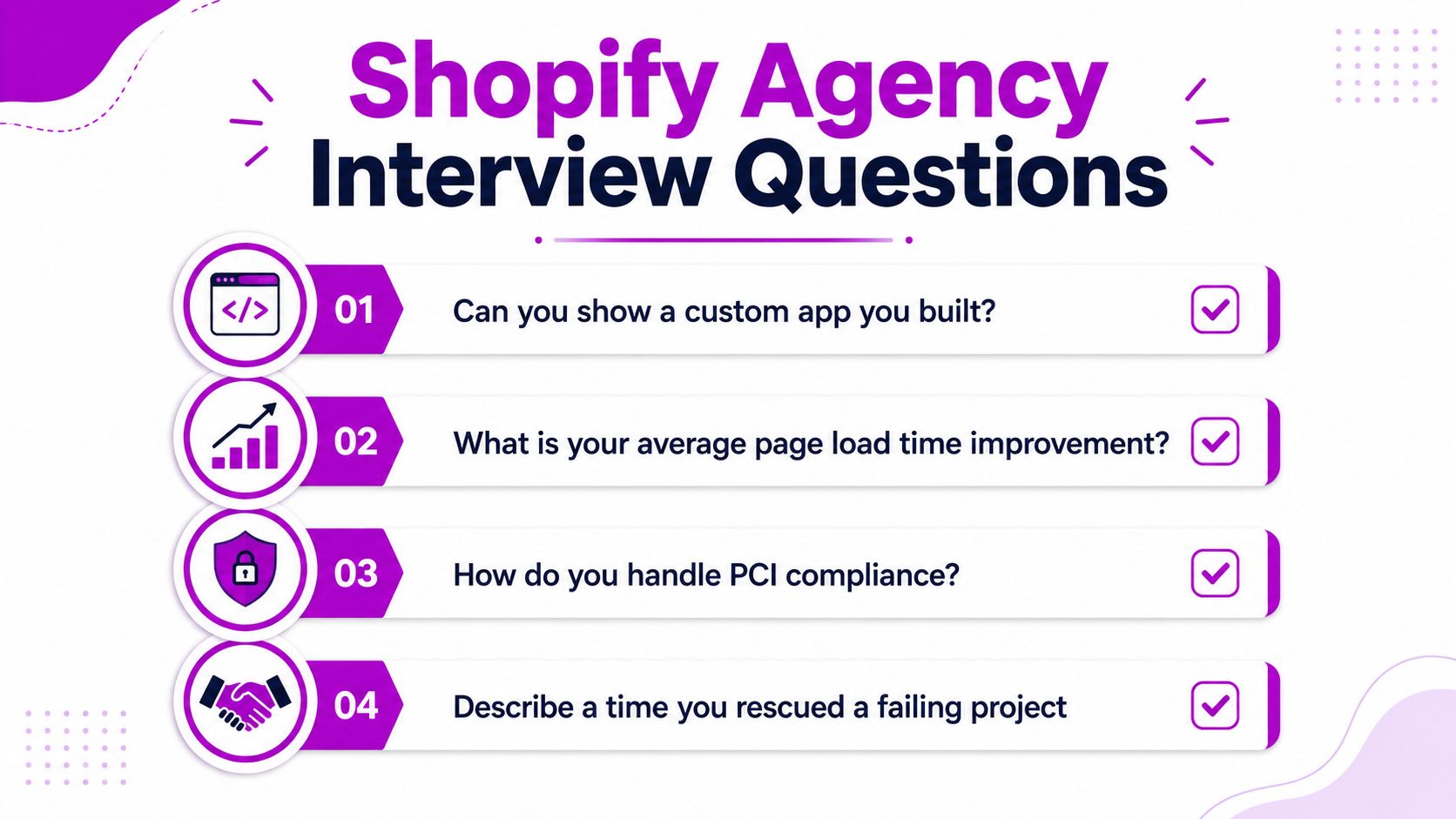
Start with: “Which cohort would you use to benchmark our performance, and why?”
A credible answer should reference primary market, order volume, product category, device mix, traffic source, and customer intent. The agency should explain why median performance may be more useful than a top-percentile comparison for diagnosis, then show how it would use the percentile spread to decide whether a gap is structural or ordinary variance.
A weak answer offers a universal conversion target. That usually means the agency wants a simple success metric for its proposal instead of a defensible measurement plan.
Follow with: “What will you review before recommending a redesign?” Expect product-page analytics, landing-page alignment, search behavior, checkout friction, speed, merchandising, offer structure, and customer research. If the response jumps straight to a new theme, end the conversation.
Test technical depth
Ask: “Show us a custom app or integration you built, and explain what happens when the connected system fails.”
The right answer covers data ownership, retries, monitoring, permissions, testing, and operational fallback. You need to know whether the agency understands how a commerce system behaves during inventory mismatches, delayed fulfillment updates, and third-party outages.
For Shopify Plus, ask: “Which checkout requirements would you solve with checkout extensibility, and which would you solve elsewhere?” A capable team will separate checkout needs from storefront needs and discuss maintainability. A hollow response will list Shopify Plus features without explaining the architecture or its trade-offs.
Probe AI without accepting buzzwords
Ask: “Where would AI improve our workflow or customer experience, and how would you control its output?”
Good answers identify a narrow use case, such as product discovery, customer-service triage, merchandising support, or personalized content. They also address source data, human review, permissions, testing, privacy, and rollback. AI should reduce friction or improve decision quality. Proposals that add AI merely for a modern-sounding paragraph indicate that the agency has not identified a genuine use case.
Ask for a demonstration using your catalog or a representative workflow. You do not need a grand platform. You need evidence that the agency can connect AI to your product data and operating process, with an owner responsible for reviewing the result.
Make the agency explain New York
Ask: “If we test New York retail, what would you measure before expanding?”
You should hear about contribution margin, inventory turns, repeat purchase, store-assisted digital sales, customer acquisition learning, fulfillment constraints, and the role of physical presence in the broader channel plan. New York's contracting retail environment can create pressure to pursue visibility before the economics are proven. The agency should evaluate that pressure through unit economics, not enthusiasm about physical presence.
The agency does not need to recommend a store. It needs to show that it can assess one without confusing attention with profitability, and explain which operating assumptions require validation before more capital is committed.
Use the Shopify agency interview video as a prompt for deeper discussion, then ask each candidate to apply its principles to your store. The strongest partner will challenge your assumptions, specify what it needs to learn, and tell you which proposed work it would not fund yet.
Understanding Shopify Agency Pricing Models
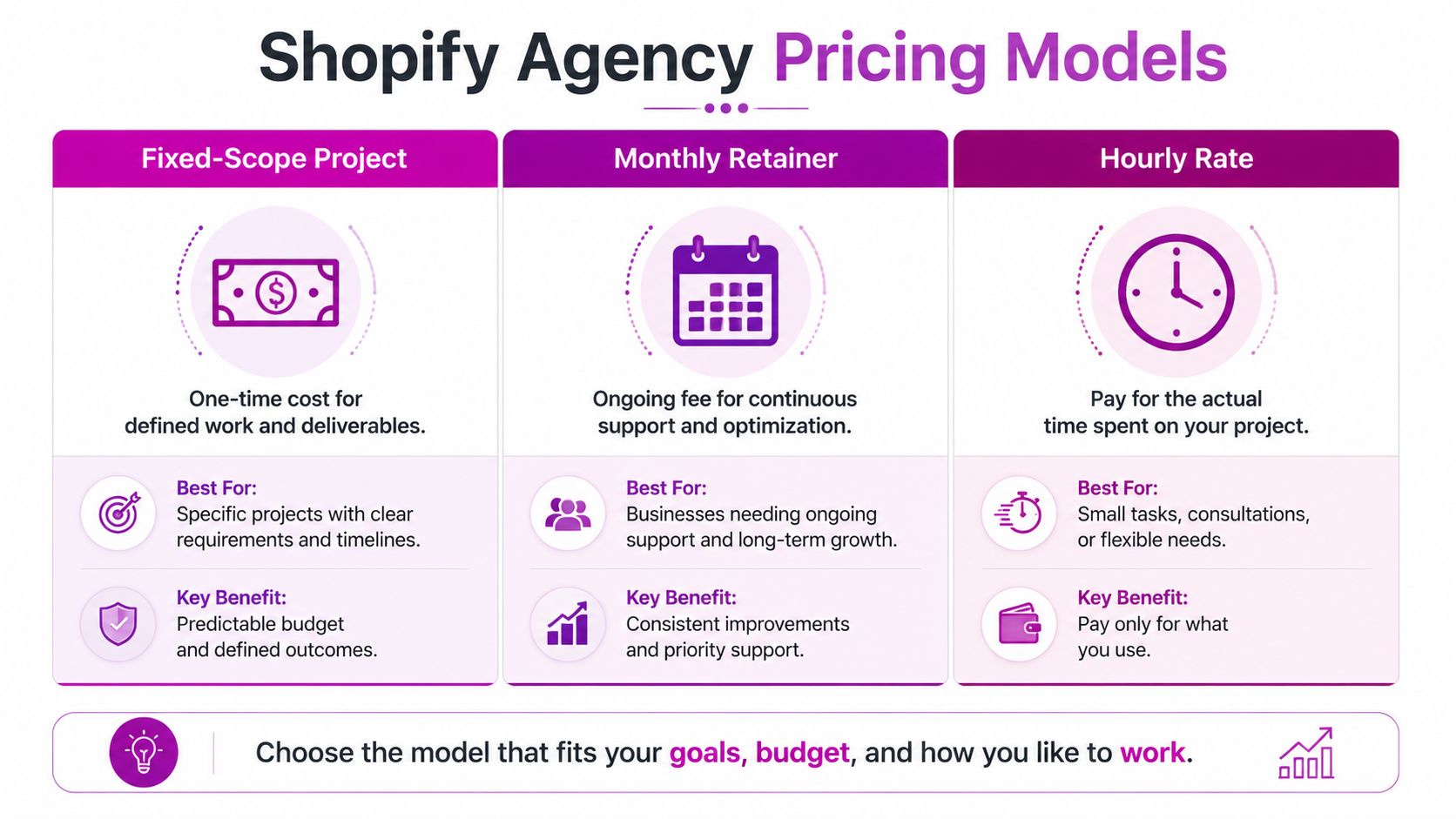
Pricing models are not interchangeable. Each one transfers a different kind of risk between you and the agency. Choose the structure that matches the uncertainty in your project, not the structure that makes the proposal look easiest to approve.
Fixed-scope projects
A fixed-scope project suits a migration, defined theme build, or tightly specified integration. You know the deliverables, acceptance criteria, dependencies, and handover requirements before work begins. The risk is scope rigidity. If discovery is weak, the agency will either protect its margin through change requests or cut corners.
Insist on a written definition of done for templates, integrations, content migration, analytics, testing, training, and launch support. “New Shopify store” is not a scope.
Monthly retainers
A retainer fits a merchant with a persistent optimization backlog. Design, development, CRO, analytics, and merchandising can move in a regular cycle instead of waiting for another procurement process. The danger is inactivity disguised as availability.
Require a visible backlog, weekly priorities, named owners, response expectations, and a monthly summary of completed work. If the agency can't show where capacity went, the retainer is funding ambiguity.
Hourly billing
Hourly billing works for urgent fixes, uncertain technical investigations, and small tasks. It preserves flexibility, but it places estimation and prioritization responsibility on you. Open-ended hours can become expensive when the agency lacks senior oversight or spends time solving symptoms rather than causes.
Ask for estimates by task, a spending cap, and approval before work exceeds the estimate. You should also receive the work product, documentation, and access needed to maintain the change.
Subscription packages
A subscription model can suit brands that need ongoing access but aren't ready for a traditional retainer. It can also reduce commitment risk when the agency allows a merchant to begin with a defined initiative and continue only if the working relationship proves useful. This structure still requires clear priorities. Flexibility isn't a substitute for accountability.
New York agencies often carry higher operating costs, but that alone doesn't justify an opaque premium. Compare seniority, delivery ownership, technical specialization, and commercial judgment. A lower hourly rate can cost more if the team needs excessive supervision or produces fragile work.
Budget rule: Pay for a measurable decision process, not a larger menu of deliverables.
Onboarding and Project Timelines Done Right
The first month reveals whether the agency can operate. Strong teams create momentum through access, decisions, and early evidence. Weak teams spend the opening period collecting credentials, revising the brief, and waiting for someone to decide who owns the product data.
A clean onboarding process starts before the kickoff. Your team should identify the executive sponsor, day-to-day owner, technical contact, analytics owner, and final approver. The agency should provide an access checklist covering Shopify permissions, analytics, advertising platforms, search tools, customer-service systems, product data, fulfillment information, and the existing app inventory.
A practical onboarding rhythm
Contract signing establishes boundaries. The statement of work should name deliverables, exclusions, dependencies, decision rights, communication channels, and acceptance criteria. If “optimization” appears without a defined output, expect disagreement later.
Discovery turns ambition into priorities. The agency should review the customer journey, catalog structure, analytics quality, technical debt, integrations, merchandising, and business constraints. By the end of this phase, you should know what the team will address first and what it has deliberately postponed.
Technical setup removes avoidable delays. The team should create a working environment, confirm deployment and review procedures, audit apps, document data flows, and establish a safe testing approach. Your agency shouldn't discover after development begins that a key integration has undocumented dependencies.
Launch and review create the feedback loop. A launch isn't the end of the project. It should trigger a review of errors, analytics, performance, customer behavior, support tickets, and operational issues. The team should distinguish defects from new ideas so the backlog doesn't become an unpriced expansion of scope.
What a healthy engagement feels like
In a well-run project, the first meetings produce decisions rather than decorative slides. Your internal team knows what it must supply, the agency flags risks early, and each milestone has an observable output. A redesign might produce approved wireframes and a prioritized hypothesis backlog. A migration might produce validated redirects, reconciled product data, and a tested checkout path.
The common failure scenario looks different. The founder keeps changing the target customer, the marketing lead supplies partial assets, the developer waits for approval, and the agency reports activity instead of progress. Scope creep then appears as a series of “small” requests, while the original success criteria disappear.
Use a weekly operating cadence with a short status report, decisions required, completed work, risks, and next actions. Keep a change log. Make one person accountable for final approval. If the agency can't tell you what is blocked and who owns the blockage, the project is already drifting.
A Smarter Way to Work With Shopify Experts
Traditional agency retainers make sense when your roadmap is stable, your team has clear priorities, and you need predictable ongoing capacity. They're a poor fit when you're still validating the relationship, your priorities change quickly, or your store needs a mixture of technical fixes, CRO analysis, design decisions, and experimentation.
A more flexible arrangement starts with a defined project or monthly package. You can test how the team communicates, how quickly it produces usable work, and whether its recommendations reflect your commercial reality. If the relationship works, the engagement can continue around a documented backlog. If it doesn't, you haven't committed your entire growth program to a partner that looked better in a sales call than in delivery.
Match the model to the work
Subscription access is particularly useful for a merchant with competing needs. One month may require a theme improvement and analytics cleanup. The next may require a custom app investigation, a product-page experiment, or an integration fix. A fixed retainer can force those needs into a narrow service lane, while an hourly arrangement can encourage fragmented tasks without strategic priority.
The right model should support a weekly question: What is the highest-value constraint we can remove next? That constraint might be mobile performance, product discovery, checkout friction, inventory visibility, or an unreliable operational workflow. The answer should come from evidence, not from whichever specialist happens to have spare capacity.
ECORN offers Shopify design, development, CRO, Shopify Plus work, app integrations, and AI integration through flexible subscription packages. Its stated model allows brands to begin with a single project initiative or use monthly packages, which makes it an option for businesses that want to test delivery before adopting a longer engagement. The agency says it has supported over 100 brands, a claim provided in its publisher information rather than independently verified here.
What to demand from any flexible partner
A subscription doesn't remove the need for management. Require:
- A named delivery team: Know who performs the work and who makes technical decisions.
- A prioritized backlog: Every task should have a reason, owner, and acceptance condition.
- Regular review: Assess completed work, blocked items, new evidence, and the next commercial priority.
- Clear access and ownership: Your store, data, documentation, and accounts must remain usable by your business.
- A cancellation path: The contract should explain how unfinished work, handover, and access are handled.
New York is a demanding market for a Shopify brand because retail visibility can tempt operators into expensive experiments before the digital economics are ready. Choose an agency that can connect store performance, technology, and physical-market decisions. The best engagement is the one that helps you learn quickly, spend deliberately, and keep improving after the first launch.
If you want a lower-risk way to evaluate Shopify development, CRO, Plus support, and AI workflows, review ECORN and start with a defined initiative or flexible monthly package. Bring your current store, backlog, and biggest commercial constraint, then ask the team to propose the first measurable piece of work.


Scale Shopify Store
10 Shopify App Ideas Worth Building in 2026
Conversion Rate Optimization for Landing Pages: The Playbook
Shopify Plus Automation: A Guide for 2026
10 Social Selling Platforms for Shopify Merchants

Shopify Website Design Examples: 7 Stores Worth Studying
7 Ecommerce Newsletter Examples for Shopify Brands
One Product Shopify Store: Build and Scale

Mobile Pop Up Strategy for Shopify Stores That Converts
Sitemap for Shopify: How to Find, Optimize, and Submit It
7 Single Product Websites Worth Emulating
Product Variants Shopify: The Complete 2026 Guide
Ecommerce Analytics Consulting for Growth
What Is AI Integration for eCommerce
How to Choose the Right eCommerce Website Development Firm
E Business Strategy Implementation
Conversion Tracking Setup for Shopify Stores
BigCommerce vs Shopify Plus Which Enterprise Wins in 2026
Shopify Theme Kit: Setup, Commands, and Migration Guide
Shopify Extension Development: A Practical 2026 Guide
Shopify Speed Score Explained and How to Improve It
Shopify Mobile Optimization: The 2026 Playbook
How to Add Subcategory in Shopify for Better UX
How to Implement Structured Data for Ecommerce in 2026
SEO App Mobile: Shopify Store Optimization Guide

Shopify Plus Support: What It Includes and How to Choose

Google Ads for Shopify: The Complete 2026 Playbook
Google Search Console for Shopify: The Complete Setup
First Party Data Collection for eCommerce Growth
FAQ Online Store Guide: Build and Measure It Right
Do FB Ads Work for eCommerce in 2026?
One Page Checkout for Shopify: Design and Implementation
Shopify GraphQL vs REST: The 2026 Developer Decision
Shopify Ecommerce Consulting: Strategy, Pricing &

Are Reddit Ads Worth It for eCommerce Brands
Shopify Title and Meta Description: A Practical 2026 Guide

Product Video Best Practices for Shopify Brands
Real-Time Inventory Management: A 2026 Guide
AI Chatbot Integration for Shopify Stores
Affiliate Program Management: A Shopify Guide
10 Best Performance Monitoring Tools for Shopify in 2026
Digital Asset Management for eCommerce Brands in 2026
Every Type of Facebook Ads Explained for eCommerce Growth
Product Information Management Explained for Shopify Brands
Support Ticket System: A Guide for Shopify Stores

10 Best Customer Service Tools for Shopify in 2026

Can I Start a Business with No Money? a 2026 Blueprint

What Sells Good on Etsy: Best Niches for 2026

Shopify Add to Cart Button: A Practical 2026 Guide

Customer Feedback Automation: A Practical eCommerce Guide
Critical Rendering Path: A Guide for Shopify Stores

How to Promote on TikTok for eCommerce in 2026

B2B eCommerce Consulting That Drives Real Revenue
10 Best Practices for Site Navigation in 2026
Return vs Refund for Shopify Stores: A Practical Guide

What Is Customer Lifetime Value and Why It Matters
What Is Voice of Customer Research for eCommerce

SMS Marketing for Ecommerce That Actually Converts

Master How to Improve Email Deliverability in 2026

Top 7 eCommerce Partners NYC for Shopify Brands in 2026

Machine Learning for Ecommerce: Boost Your Shopify Store

Beauty Market Research: Your 2026 Growth Guide

Shopify International Expansion: A 2026 Roadmap

What Does CRO Stand for in Business: Understanding CRO

Shopify Visual Merchandising: A Playbook for Higher Sales
Shopify Landing Page Design: Master Conversion in 2026
10 Best AI SEO Optimization Tools for Shopify in 2026

Agentic AI for Ecommerce: Boost Your Sales in 2026
Mastering Email Marketing Data for eCommerce Growth

Conversion Rate Optimisation Australia: Boost Your Sales
Conversion Rate Optimization AI: Your Shopify Store Guide

10 Product Bundling Strategies for Shopify in 2026
How to Increase Customer Lifetime Value: A Shopify Playbook
AI Customer Service Automation: Shopify Guide 2026

Clean Website Design: A Shopify Conversion Playbook

Omnichannel Retail Strategy: A Shopify Playbook
Product Data Enrichment: A Guide for Shopify Brands

Instagram Shopping Features a Guide for Shopify Stores
What Is Revenue Optimization: A Holistic RevOps Guide

Benefits of Conversion Rate Optimization: Boost Your
WordPress to Shopify Migration: Your 2026 Seamless Switch
Boost Sales: Ecommerce Payment Processing Guide 2026
Unified Commerce Platform: Benefits, KPIs & Shopify Guide

How to Reduce Bounce Rate eCommerce: Your 2026 Guide
Shopify API Integration: A Practical End-to-End Guide
How to Implement Data Governance: A 2026 Guide
Shopify Store Development Cost: A 2026 Breakdown
What Is Server Side Tracking: The Shopify Guide 2026
Marketing Automation Workflows: A Shopify Guide for 2026

Shopify: How to Reduce Technical Debt

Shopify UX Design Change: A Playbook for Growth
User Generated Content Strategy: Shopify Playbook
Shopify Pause and Build Plan Cost: A Complete 2026 Guide

Compare at Price on Shopify: A Complete Guide for 2026

Where Can I Sell My Prints? 10 Best Platforms for 2026
Shopify Order Management System: The Ultimate Guide 2026
What Is Marketing Attribution? an eCommerce Guide for 2026

10 Best Black Friday Sales Sheets for 2026

Discover the Top Social Media Marketing Agencies For

Consumer Confidence Definition for eCommerce in 2026


newsletter in your inbox