

A flash sale is live, paid traffic is climbing, and customers are reaching checkout only to encounter an error. Your team opens a Shopify support ticket, checks the usual settings, and discovers the problem sits somewhere between a custom checkout extension, a third-party app, and your own implementation. Shopify Plus support can help determine whether the platform is operating correctly. It may not own the code that caused the failure.
That distinction matters as a brand grows. Shopify Plus support is not one universal service covering every technical and commercial issue. It has two layers: Shopify's direct platform support, and the external development, operations, and strategy support merchants source for everything built around Shopify. Brands that understand the boundary protect launches more effectively, plan agency spend rationally, and avoid paying for coverage they don't need.
Why Shopify Plus Support Matters for Growing Brands
A growing direct-to-consumer brand usually notices the support problem at the worst possible time. A launch is scheduled, inventory is ready, creative is approved, and a checkout change that looked harmless breaks a payment condition or shipping rule. The team needs someone who understands the store's architecture, recent deployments, installed apps, and business logic. A general platform queue can investigate Shopify itself, but it won't automatically know the decisions your developers made.
That's the inflection point. Standard self-serve guidance is useful when the question concerns settings, billing, native features, or ordinary account administration. It becomes insufficient when the merchant needs coordinated diagnosis across custom themes, Shopify Functions, APIs, apps, analytics, and operational workflows.
Shopify introduced Plus on February 4, 2014, describing it as an “enterprise ready, white glove ecommerce solution” and naming brands such as Google, DODOcase, the Los Angeles Lakers, Budweiser, and Tesla Motors among its early customers. That launch marked Shopify's move into enterprise commerce with a support model intended for larger merchants, as documented in Shopify's original Shopify Plus announcement.
Support protects more than uptime
During product launches, peak promotional events, and international expansion, support influences whether teams can make safe changes quickly. A store can remain technically available while its discount logic, inventory synchronization, analytics, or localized experience performs incorrectly. Those are business-impacting failures, even when the platform itself is healthy.
Shopify Plus includes a 99.99% uptime SLA, which represents an annual downtime budget of roughly 52 minutes. The SLA is important, but it covers platform availability, not every custom behavior layered onto the store. Merchants still need ownership for release management, regression testing, integration monitoring, and incident response across their own systems. See the Shopify Plus plan features and uptime information for the platform-level commitment.
Practical rule: Treat Shopify as the owner of the commerce platform. Treat your agency or internal team as the owner of your implementation.
That's also where adjacent capabilities, such as AI for ecommerce revenue boost, can enter the operating model. AI may help teams identify merchandising, customer-service, or conversion opportunities, but someone still has to connect those initiatives to a stable Shopify implementation and a clear support process.
What Built-In Shopify Plus Support Actually Covers
Shopify's native support is valuable, but merchants should define its scope precisely. Plus merchants can access chat with Plus Support Advisors, a direct phone line, and email support. Shopify's help documentation also describes priority phone and chat access around the clock, while email responses typically take 48 hours, as stated in Shopify's support documentation.
That gives Plus merchants stronger access to Shopify's own platform specialists than a standard support experience. It doesn't turn Shopify's support team into an outsourced engineering department for your theme, middleware, or custom applications.
The practical coverage boundary
A Merchant Success Manager can help with strategic direction, platform adoption, and business reviews. That relationship is useful when a brand needs to understand Shopify capabilities, plan platform adoption, or identify a path through Shopify's ecosystem. It shouldn't be treated as a substitute for a developer who owns your repository and can reproduce a bug in your environment.
Launch support also has a defined purpose. During a migration or initial go-live, Shopify resources can help merchants prepare for launch and use the platform correctly. They won't necessarily rebuild a flawed data model, resolve every third-party app conflict, or take responsibility for a custom integration created by another vendor.
| Support Component | What's Included | Limitations |
|---|---|---|
| Priority chat and phone | Direct access to Shopify support channels, including Plus Support Advisors and priority phone and chat access | Complex investigations still depend on the issue, evidence available, and whether the problem sits inside Shopify |
| Email support | A documented support route for platform questions, with typical email response times of 48 hours | Email isn't a replacement for an engineering incident process owned by the merchant |
| Merchant Success guidance | Strategic platform guidance, feature adoption, and business-oriented support | It doesn't provide unlimited custom coding or ongoing ownership of third-party systems |
| Launch assistance | Guidance around migration preparation and go-live activity | Your team or implementation partner remains responsible for data, redirects, integrations, testing, and release execution |
| Platform reliability | Shopify Plus includes a 99.99% uptime SLA | The SLA doesn't cover bugs in custom code, app failures, or incorrect business logic |
Merchants evaluating their contact paths can also review this practical guide to contacting Shopify Plus support. For broader implementation needs, a specialist such as DPP Shopify may be relevant when the work extends beyond Shopify's native support remit.
The right expectation is simple: Shopify support helps you use and troubleshoot Shopify. Your technical partner supports what you've built on Shopify.
Built-In Support vs Agency and Retainer Support
The difference between native support and agency support is ownership. Shopify owns the platform, core infrastructure, native features, and the support channels attached to your subscription. An agency owns the work it has agreed to deliver around your storefront, integrations, release process, and growth roadmap.
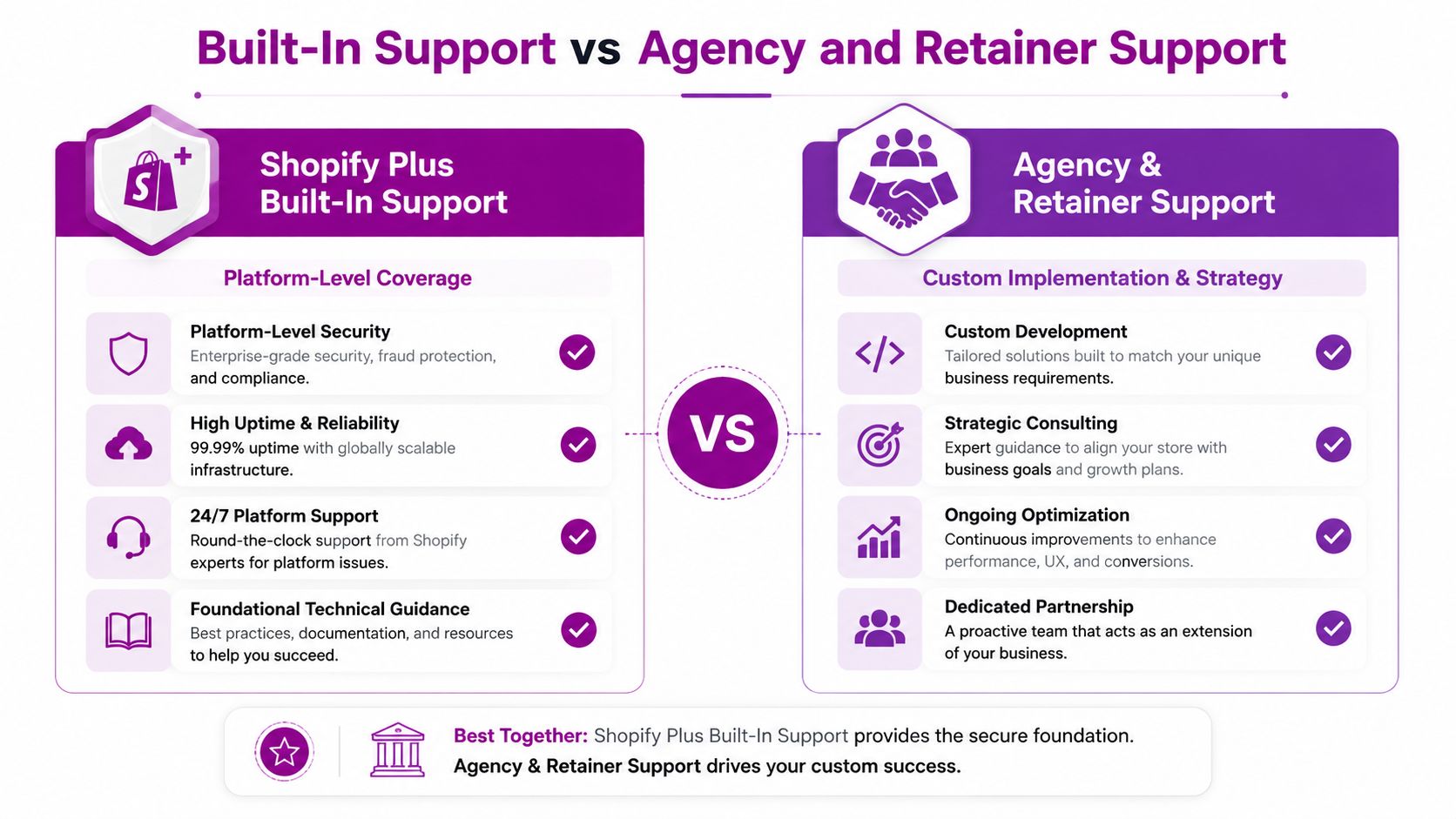
A platform ticket is appropriate when checkout behavior appears inconsistent with Shopify's documented functionality, billing needs correction, or a native feature isn't behaving as expected. An agency engagement is appropriate when the issue involves a custom theme, app configuration, headless frontend, ERP connection, customer-data flow, or a conversion hypothesis that needs implementation.
Compare the operating models
| Area | Shopify Plus built-in support | Agency or retainer support |
|---|---|---|
| Primary responsibility | Shopify platform health and native functionality | Merchant-specific code, integrations, workflows, and optimization |
| Typical access model | Chat, phone, and email support | Dedicated project channel, account contact, or embedded delivery team |
| Technical scope | Platform configuration and Shopify feature guidance | Theme work, APIs, apps, checkout extensions, testing, and release management |
| Strategic scope | Platform adoption and merchant guidance | Roadmaps, CRO, operational planning, and technical prioritization |
| Best use | Questions about Shopify itself | Questions about everything your business has built around Shopify |
The common mistake is assuming the Plus subscription covers the complete technology stack. It doesn't. A merchant running several regional storefronts, a customized checkout, subscription billing, warehouse integrations, and a headless content layer needs someone who can coordinate those dependencies. Shopify can explain the platform's behavior. The agency must usually diagnose how the merchant's systems interact with it.
The strongest operating model is hybrid: Shopify supports the foundation, while a capable partner supports the implementation and the commercial layer.
Retainers become useful when the merchant needs continuity rather than isolated answers. A dedicated team remembers why a workaround exists, which app owns a data field, how a promotion was tested, and which release paths are safe. Project work remains the better choice for a defined migration or redesign with a clear acceptance date. The decision should follow operational risk, not the prestige of the Plus plan.
Core Service Components of Shopify Plus Support
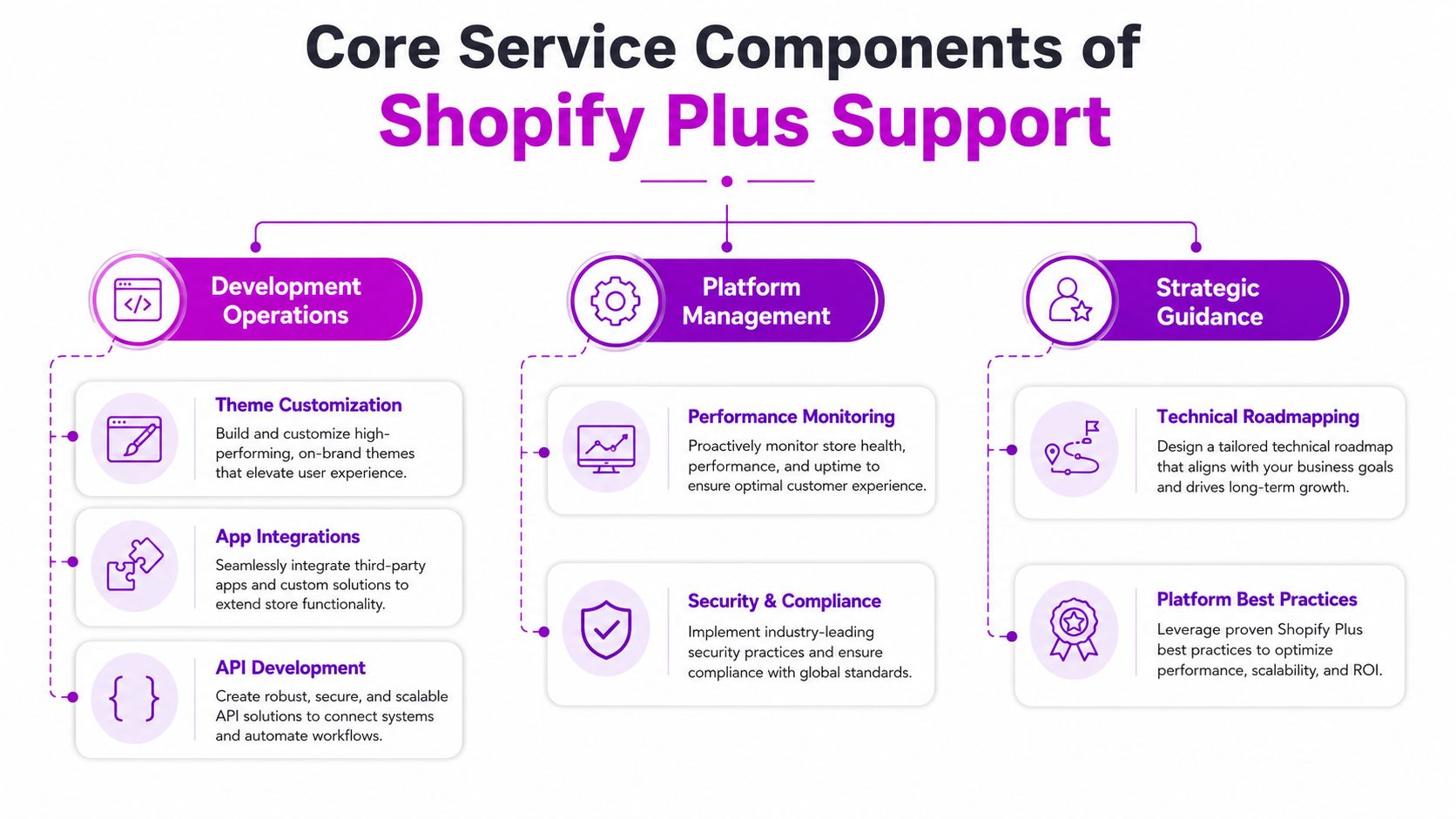
A serious Shopify Plus support engagement is an operating system for the storefront, not a list of disconnected tasks. The provider should understand what has been built, how it changes, and which business process depends on it.
Development operations
Development operations keeps the customer-facing experience aligned with the commercial roadmap. That commonly includes:
- Theme customization: Maintain Liquid, sections, templates, and storefront components without introducing avoidable regressions.
- App integrations: Configure and troubleshoot connections for reviews, subscriptions, search, loyalty, merchandising, and customer data.
- API development: Build and maintain integrations between Shopify, enterprise resource planning systems, warehouses, marketplaces, and internal tools.
- Checkout extensibility: Use Shopify Extensions, blocks, pixels, and Functions for supported checkout customization. Shopify's guidance emphasizes an app-based, upgrade-safe approach rather than continued dependence on legacy checkout customization, as explained in its checkout extensibility update.
Support should include a release process, code review, staging validation, and rollback planning. Without those controls, a monthly support plan can become a queue of urgent fixes rather than a dependable engineering function.
Platform management
Performance work starts with evidence. A provider should examine storefront rendering, script load, app impact, image delivery, and Core Web Vitals before recommending changes. Security and compliance work should include permission reviews, app governance, incident procedures, and careful handling of customer data.
Migration support deserves separate attention. A platform move can affect product data, customer records, URL structures, metadata, redirects, analytics, and internal workflows. The provider should document the source and destination models, validate imports, test redirects, and monitor the post-launch experience. Search visibility and operational data must be treated as launch requirements, not cleanup tasks.
For teams trying to reduce avoidable customer demand, the CartBoss guide to support tickets offers useful context for connecting storefront improvements with service operations.
Strategic guidance
The strongest engagements turn recurring incidents into roadmap decisions. That means identifying whether an app should be replaced, whether a workflow belongs in Shopify Flow, whether a custom Function is safer than a workaround, and whether a regional store structure remains manageable.
This video can provide additional context for teams reviewing their Shopify support approach:
Standard retainers often cover maintenance, small enhancements, troubleshooting, and planning. Premium arrangements may add dedicated specialists, deeper architecture work, emergency response, migration ownership, or continuous CRO. The contract should state those boundaries explicitly.
How to Evaluate a Shopify Plus Support Provider
Choose a provider by testing how it thinks under pressure, not by reading a polished service page. Ask the team to explain how it would investigate a checkout incident involving a custom extension, a payment app, and a recent deployment. The answer should show a sequence, ownership model, communication path, and escalation threshold.
Technical credentials matter, but they're only the starting point. Look for demonstrated Shopify Plus work involving checkout extensibility, Shopify Functions, multi-market storefronts, custom applications, migrations, and complex integrations. Ask who will perform the work and whether the people presenting the strategy will remain involved after launch.
A useful scoring matrix
| Criteria Category | Key Questions | Weight | Red Flags |
|---|---|---|---|
| Technical depth | Can the team explain its work with Functions, extensions, APIs, apps, and multi-store architecture? | High | Generic Shopify claims without Plus-specific implementation detail |
| Reliability | What response path exists for urgent incidents, and who can escalate outside normal delivery? | High | Vague SLAs, unclear ownership, or support limited to an unmonitored inbox |
| Strategic value | Can the provider connect technical work to conversion, merchandising, operations, and roadmap priorities? | Medium | A ticket factory that only waits for fully specified tasks |
| Delivery continuity | Will the team that builds the solution support it afterward? | High | Frequent handoffs, undocumented code, or separate post-launch ownership |
| Communication | How are priorities, approvals, releases, and reporting handled? | Medium | No project management system, cadence, or decision log |
| Cultural fit | Does the provider challenge weak requirements and communicate directly? | Medium | Overpromising, evasive answers, or discomfort discussing trade-offs |
Before signing, request references from merchants with similar operational complexity. Ask those references how the partner handled a failed release, an urgent integration problem, and a disagreement over scope. Those answers reveal more than a portfolio screenshot.
You should also distinguish business-hours availability from genuine emergency coverage. “Fast response” is not a useful promise unless the contract defines the channel, acknowledgement process, escalation route, and what counts as an incident.
For a broader partner-selection perspective, compare the capabilities described in this guide to Shopify Plus agencies. Then ask each finalist to review a real backlog item and explain what it would prioritize, defer, or reject.
Choosing the Right Subscription or Package Model
The right support model follows the shape of your work. Don't buy a retainer because Shopify Plus sounds enterprise-grade. Don't force every need into a project if your team faces recurring incidents, frequent releases, and an active optimization roadmap.
Project-based support
Choose project-based delivery for a defined initiative with a clear beginning and end. Typical examples include a platform migration, theme redesign, regional storefront rollout, checkout extension, or integration rebuild. This model works well when the existing store is stable and your internal team can manage ordinary operations between initiatives.
The contract should define deliverables, dependencies, testing responsibilities, acceptance criteria, and post-launch support. A short warranty or stabilization period is more useful than vague promises of ongoing availability.
Monthly retainers
A retainer fits a merchant that needs continuous improvement and fast access to context. The provider can handle maintenance, bug triage, small enhancements, release support, analytics fixes, CRO experiments, and roadmap planning without restarting discovery for every request.
Retainers work best when they include:
- A defined capacity: State the hours, roles, or delivery capacity available during each billing period.
- A priority system: Separate incidents, planned improvements, and strategic work.
- Clear rollover rules: Decide whether unused capacity expires, rolls forward, or converts into a project.
- A communication protocol: Name the primary channel, meeting cadence, reporting format, and escalation owner.
- An exit clause: Make it possible to leave with reasonable notice and receive documentation, credentials, and code context.
Dedicated teams and hybrid models
A hybrid model is usually the strongest fit for a complex merchant. Keep a baseline retainer for operational continuity, then commission separate project sprints for migrations, redesigns, or major architecture work. A dedicated team makes sense when multiple storefronts, integrations, and internal stakeholders require sustained coordination.
Avoid relying on rigid hour bands or unsupported market pricing. Providers structure retainers differently, and the meaningful comparison is the capability you receive per commitment. Evaluate who is assigned, what work is included, how urgent issues are handled, and whether strategic planning is part of the engagement or billed separately.
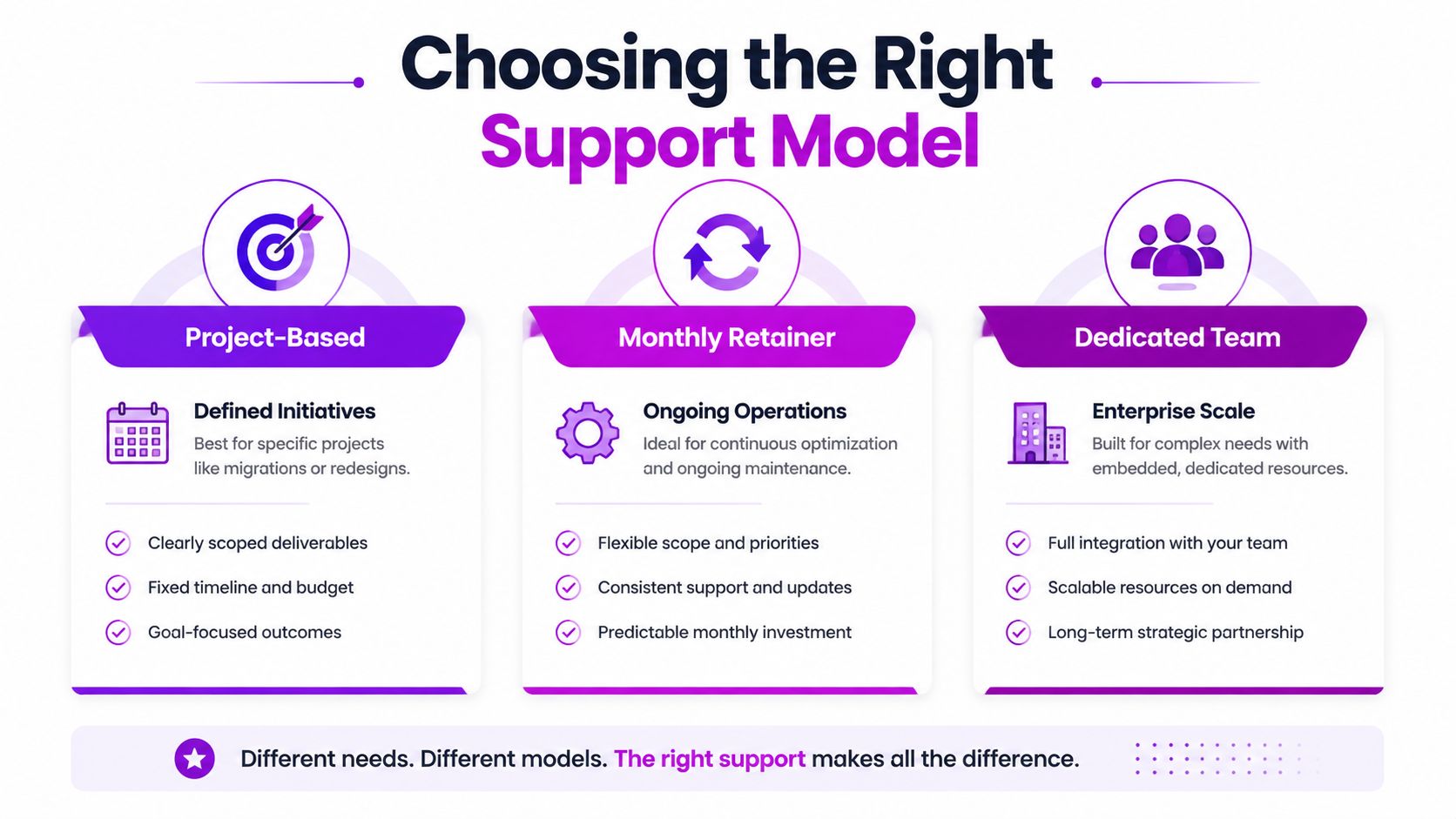
My recommendation is direct. Use project support for contained change, a retainer for recurring operational demand, and a hybrid or embedded team when your storefront has become critical infrastructure.
Common Misconceptions About Shopify Plus Support
Shopify Plus support is powerful, but several assumptions lead merchants to buy the wrong coverage.
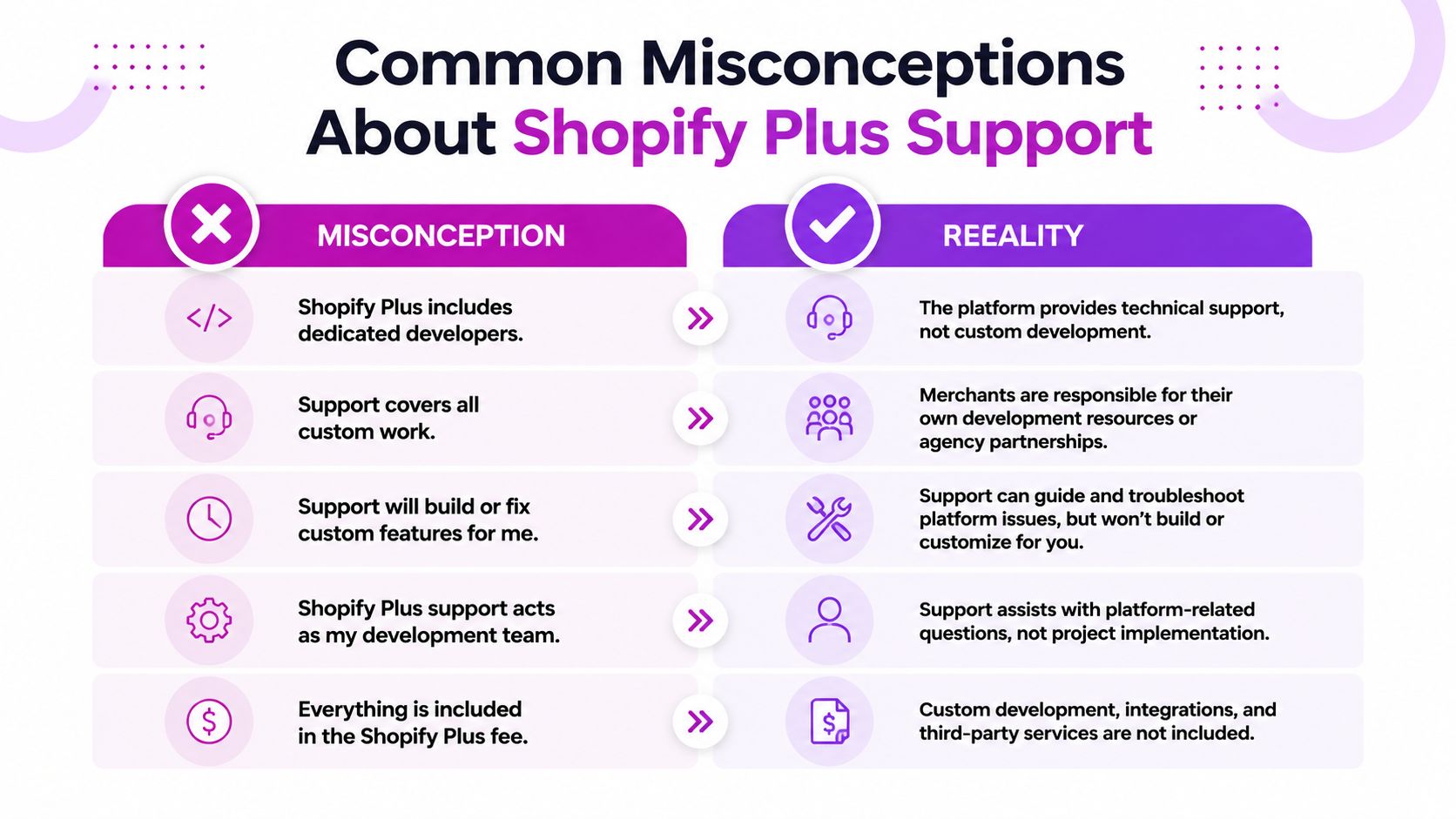
Misconception one: Plus includes dedicated developers. Shopify provides platform support and guidance. Your merchant team or agency still owns custom themes, bespoke integrations, app implementations, data pipelines, and release execution.
Misconception two: A priority plan resolves every issue faster. Priority routing helps when Shopify itself needs to investigate a platform matter. It doesn't make a third-party app vendor respond, repair custom code, or determine why an internal workflow produced the wrong result.
Misconception three: Any Shopify partner can provide Plus-level support. Plus operations often involve multi-store governance, checkout extensibility, regional configurations, integration architecture, and high-stakes release management. A partner who handles simple theme edits may not have the depth to operate that environment safely.
Misconception four: Retainers are only for very large enterprises. A rapidly scaling merchant can need proactive technical ownership before its internal team has enough capacity to provide it. Waiting until every incident becomes revenue-critical is an expensive way to discover the gap.
Support is a revenue-protection decision. The cheapest plan is the wrong plan if nobody owns the code during a launch incident.
Review your current support map. Mark each responsibility as Shopify-owned, internally owned, agency-owned, or unassigned. Any unassigned item involving checkout, integrations, data, or release management deserves attention before the next major campaign.
ECORN provides Shopify Plus development, design, conversion optimization, and flexible monthly support for merchants that need ongoing access to Shopify specialists. Review ECORN to discuss a project-based initiative, a recurring support package, or a hybrid model for your storefront.


Ecommerce Conversion Tracking: The Complete How-To Guide

Shopify Design Agency: How to Pick the Right Partner
Mastering Multi Store Management on Shopify
Scale Shopify Store
10 Shopify App Ideas Worth Building in 2026
Conversion Rate Optimization for Landing Pages: The Playbook
Shopify Plus Automation: A Guide for 2026
10 Social Selling Platforms for Shopify Merchants

Shopify Website Design Examples: 7 Stores Worth Studying
7 Ecommerce Newsletter Examples for Shopify Brands
One Product Shopify Store: Build and Scale

Mobile Pop Up Strategy for Shopify Stores That Converts
Sitemap for Shopify: How to Find, Optimize, and Submit It

7 Single Product Websites Worth Emulating
Product Variants Shopify: The Complete 2026 Guide

Ecommerce Analytics Consulting for Growth
What Is AI Integration for eCommerce
How to Choose the Right eCommerce Website Development Firm
E Business Strategy Implementation
Conversion Tracking Setup for Shopify Stores
BigCommerce vs Shopify Plus Which Enterprise Wins in 2026
Shopify Theme Kit: Setup, Commands, and Migration Guide
Shopify Extension Development: A Practical 2026 Guide
Shopify Speed Score Explained and How to Improve It
Shopify Mobile Optimization: The 2026 Playbook

How to Add Subcategory in Shopify for Better UX
How to Implement Structured Data for Ecommerce in 2026
SEO App Mobile: Shopify Store Optimization Guide

Google Ads for Shopify: The Complete 2026 Playbook

Shopify New York: How to Find and Hire the Right Agency
Google Search Console for Shopify: The Complete Setup
First Party Data Collection for eCommerce Growth
FAQ Online Store Guide: Build and Measure It Right
Do FB Ads Work for eCommerce in 2026?
One Page Checkout for Shopify: Design and Implementation
Shopify GraphQL vs REST: The 2026 Developer Decision
Shopify Ecommerce Consulting: Strategy, Pricing &

Are Reddit Ads Worth It for eCommerce Brands
Shopify Title and Meta Description: A Practical 2026 Guide

Product Video Best Practices for Shopify Brands
Real-Time Inventory Management: A 2026 Guide
AI Chatbot Integration for Shopify Stores
Affiliate Program Management: A Shopify Guide
10 Best Performance Monitoring Tools for Shopify in 2026
Digital Asset Management for eCommerce Brands in 2026

Every Type of Facebook Ads Explained for eCommerce Growth
Product Information Management Explained for Shopify Brands
Support Ticket System: A Guide for Shopify Stores

10 Best Customer Service Tools for Shopify in 2026

Can I Start a Business with No Money? a 2026 Blueprint

What Sells Good on Etsy: Best Niches for 2026

Shopify Add to Cart Button: A Practical 2026 Guide

Customer Feedback Automation: A Practical eCommerce Guide
Critical Rendering Path: A Guide for Shopify Stores

How to Promote on TikTok for eCommerce in 2026

B2B eCommerce Consulting That Drives Real Revenue
10 Best Practices for Site Navigation in 2026
Return vs Refund for Shopify Stores: A Practical Guide

What Is Customer Lifetime Value and Why It Matters
What Is Voice of Customer Research for eCommerce

SMS Marketing for Ecommerce That Actually Converts

Master How to Improve Email Deliverability in 2026

Top 7 eCommerce Partners NYC for Shopify Brands in 2026

Machine Learning for Ecommerce: Boost Your Shopify Store

Beauty Market Research: Your 2026 Growth Guide

Shopify International Expansion: A 2026 Roadmap

What Does CRO Stand for in Business: Understanding CRO

Shopify Visual Merchandising: A Playbook for Higher Sales

Shopify Landing Page Design: Master Conversion in 2026
10 Best AI SEO Optimization Tools for Shopify in 2026

Agentic AI for Ecommerce: Boost Your Sales in 2026
Mastering Email Marketing Data for eCommerce Growth

Conversion Rate Optimisation Australia: Boost Your Sales
Conversion Rate Optimization AI: Your Shopify Store Guide

10 Product Bundling Strategies for Shopify in 2026

How to Increase Customer Lifetime Value: A Shopify Playbook
AI Customer Service Automation: Shopify Guide 2026

Clean Website Design: A Shopify Conversion Playbook

Omnichannel Retail Strategy: A Shopify Playbook
Product Data Enrichment: A Guide for Shopify Brands

Instagram Shopping Features a Guide for Shopify Stores
What Is Revenue Optimization: A Holistic RevOps Guide

Benefits of Conversion Rate Optimization: Boost Your
WordPress to Shopify Migration: Your 2026 Seamless Switch
Boost Sales: Ecommerce Payment Processing Guide 2026
Unified Commerce Platform: Benefits, KPIs & Shopify Guide

How to Reduce Bounce Rate eCommerce: Your 2026 Guide
Shopify API Integration: A Practical End-to-End Guide

How to Implement Data Governance: A 2026 Guide
Shopify Store Development Cost: A 2026 Breakdown
What Is Server Side Tracking: The Shopify Guide 2026
Marketing Automation Workflows: A Shopify Guide for 2026

Shopify: How to Reduce Technical Debt

Shopify UX Design Change: A Playbook for Growth
User Generated Content Strategy: Shopify Playbook
Shopify Pause and Build Plan Cost: A Complete 2026 Guide

Compare at Price on Shopify: A Complete Guide for 2026

Where Can I Sell My Prints? 10 Best Platforms for 2026
Shopify Order Management System: The Ultimate Guide 2026
What Is Marketing Attribution? an eCommerce Guide for 2026


newsletter in your inbox