

Etsy doesn't reward the broadest idea, it rewards the right demand pocket. That's why the platform's sales are so concentrated, with Home and Living alone contributing about 34% of gross merchandise sales in one marketplace analysis, while six categories together account for roughly 87% to 88% of GMS (Printful Etsy statistics). If you're trying to figure out what sells good on Etsy, the core question isn't “What category is popular?” It's “Which product, in which format, for which buyer intent, can I fulfill well?”
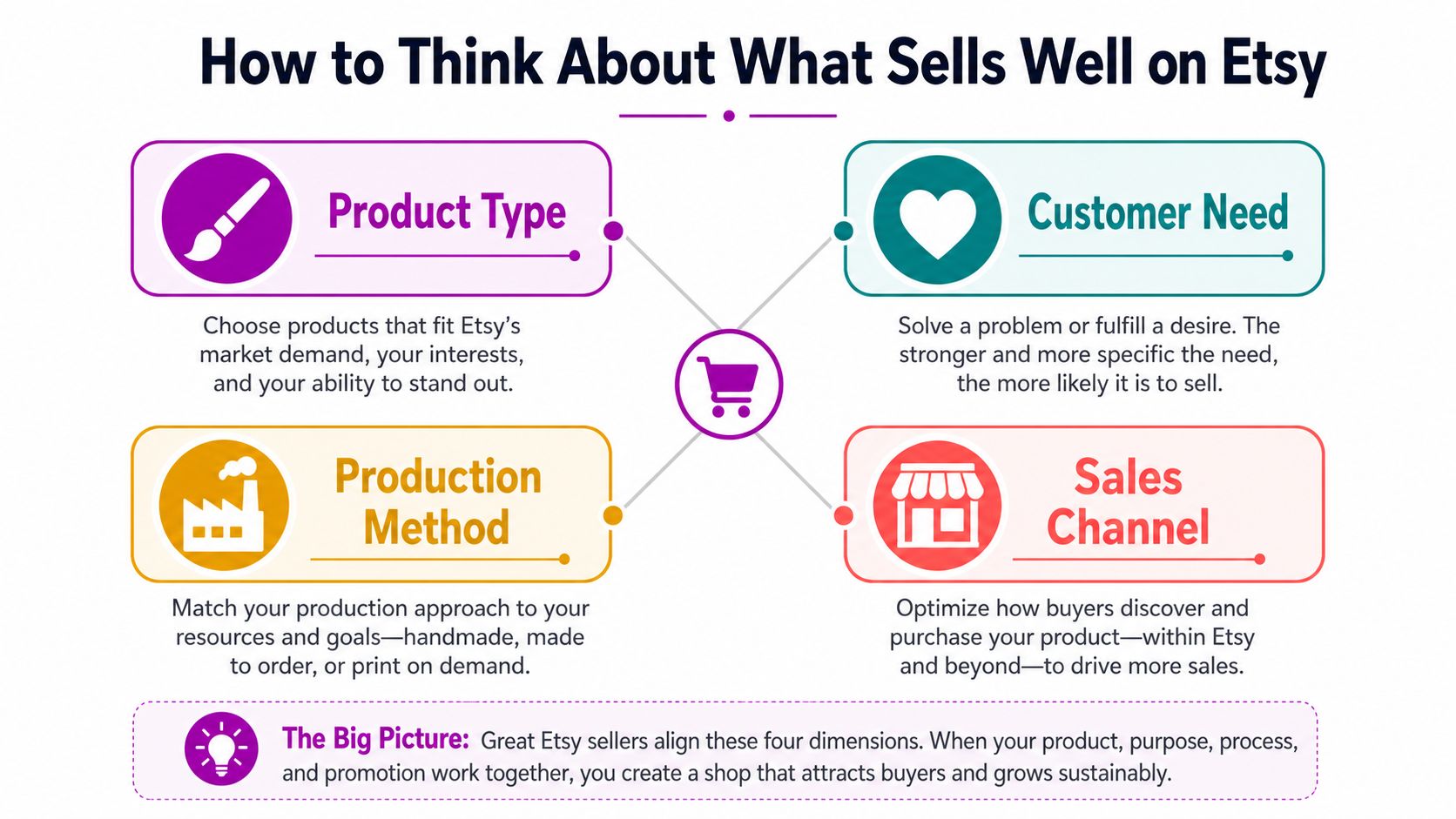
How to Think About What Sells Well on Etsy
Most new sellers start with a category name, then wonder why their idea feels vague. “Jewelry” is too broad. “Candles” is too broad. Even “prints” is too broad unless you know exactly which buyer you're serving and how they'll find you.
Think in demand pockets, not just categories
A demand pocket is a narrower cluster of buyer intent inside a bigger category. That's where Etsy gets practical, because buyers don't usually search for “gift,” they search for a very specific gift, for a specific person, at a specific moment. The platform's own structure pushes toward that kind of specificity, and seller-facing coverage repeatedly points to narrower niches like handmade journals, decorative wood crafts, natural floral arrangements, and personalized goods (what to sell on Etsy).
Practical rule: A good Etsy idea should make sense in four layers at once, category demand, product format, niche specificity, and operational fit.
Here's why that matters. A product can sit inside a strong category and still fail if the format is awkward to ship, the niche is too vague, or the product takes too long to make. The seller who sees the whole picture avoids the classic trap of choosing a trendy item they can't fulfill profitably.
| Dimension | Question to Answer | Signal to Look For |
|---|---|---|
| Product Type | What exactly am I making? | Clear use case, easy to describe in one sentence |
| Customer Need | Why would someone buy this now? | Gift, personalization, problem-solving, occasion |
| Production Method | Can I make or source it consistently? | Repeatable process, manageable workload |
| Sales Channel | How will Etsy shoppers discover it? | Searchable wording, fit with Etsy browsing behavior |
If you're comparing Etsy with another marketplace, the channel logic changes fast. This short comparison of selling on Etsy vs eBay is useful because it shows how buyer intent and product fit are different across platforms: Etsy vs eBay.
The simplest filter is this. If the category has proven demand, the format is easy to fulfill, the niche is specific, and the listing matches a real buyer search, you've got something worth testing. If one of those four is weak, keep refining before you spend on inventory.
The Six Categories That Drive Most Etsy Sales
Etsy's sales are concentrated in a few places. One source reports that six categories account for roughly 87% to 88% of GMS, with Home and Living alone contributing about 34% (Printful Etsy statistics). A separate 2024 analysis also places Home & Living at $4.2B in annual GMV, Jewelry & Accessories at $3.8B, Craft Supplies & Tools at $2.9B, Clothing & Shoes at $2.7B, and Wedding & Party at $2.1B (Printful Etsy statistics).
What the concentration actually tells you
That concentration matters because Etsy buyers are not spreading attention evenly across the marketplace. A large share of spending clusters around functional, giftable, and personalized items, which means the strongest demand sits where a product has a clear reason to exist. People buy for a room, a person, a hobby, or an occasion, and that buying logic shows up again and again.
That is why home décor, jewelry, craft-related products, apparel, and party goods keep appearing in the top demand pockets. These categories work because shoppers can search for them easily, personalize them without much effort, and picture them as gifts without needing a long explanation. A custom name necklace, a printable party sign, or a decorative wall piece gives a buyer a stronger reason to act than a generic object with no occasion attached.
Print and art products can fit this pattern too, but only if the listing is tied to a specific use case. A print that solves a decorating problem or a gifting need has a clearer path to conversion than a file presented as a vague digital asset. If you are comparing formats, where to sell prints is a useful lens because it shows why prints usually perform best when they answer a real buyer purpose.
Operator takeaway: Category gets you into the right aisle. Specificity gets you into the right cart.
The practical filter is straightforward. If your product sits inside one of those dominant categories, you are starting with the platform's strongest existing demand. If it does not, the idea is not automatically dead, but it needs a sharper niche or a stronger format to make up for the weaker category signal. On Etsy, category strength gives you a head start, but it does not replace product-market fit.
Validating a Product Idea Before You Build It
Good Etsy sellers don't fall in love with an idea first. They check whether buyers are already searching for something like it, whether competitors are visible, and whether the product can be sold without turning into a fulfillment headache.

Use a quick five-step check
Start with Etsy search itself. If you can't find obvious competitors, that can mean either opportunity or missing demand, so don't stop there. Then open the best listings and read the reviews closely, because buyers tell you what they value in their own words.
Next, compare price points and listing signals. In one marketplace analysis, beads had over 8.0 million listings, an average price of $20.00, and a 102% click-through rate, while pendants had about 5.3 million listings, an average price of $34.13, and an 83% CTR; stickers had about 3.7 million listings, an average price of $3.50, and an 82% CTR (best selling items on Etsy). Statista's 2024 analysis also found over eight million bead listings and nearly 5.3 million pendant listings in July 2024, which confirms how crowded these niches already are (best selling items on Etsy).
Here's the useful part. A crowded niche isn't dead, but it tells you the product has to win on variation, clarity, and buyer intent. Beads and pendants show enormous interest, but they also show saturation. Stickers show low-friction buying behavior, which is why they're worth testing in micro-niches rather than as generic designs.
Validation rule: If a niche is crowded, your angle has to be sharper than the listing next to it.
A solid afternoon test looks like this.
- Search direct competitors. Check whether the listing field is full of near-identical products.
- Read reviews on top sellers. Look for repeated phrases about quality, customization, giftability, or speed.
- Check price and listing density. See whether the niche is crowded but still price-supportive.
- Look for gifting or repeat use. Products tied to an event or routine usually have clearer intent.
- Test before scaling. Make a small batch, or launch a mockup and a waitlist before you commit.
For a broader trend-scouting workflow, find trending niches is useful because it helps you move from vague inspiration to actual market signals. The goal isn't to predict a perfect winner. It's to avoid building a product nobody is actively trying to buy.
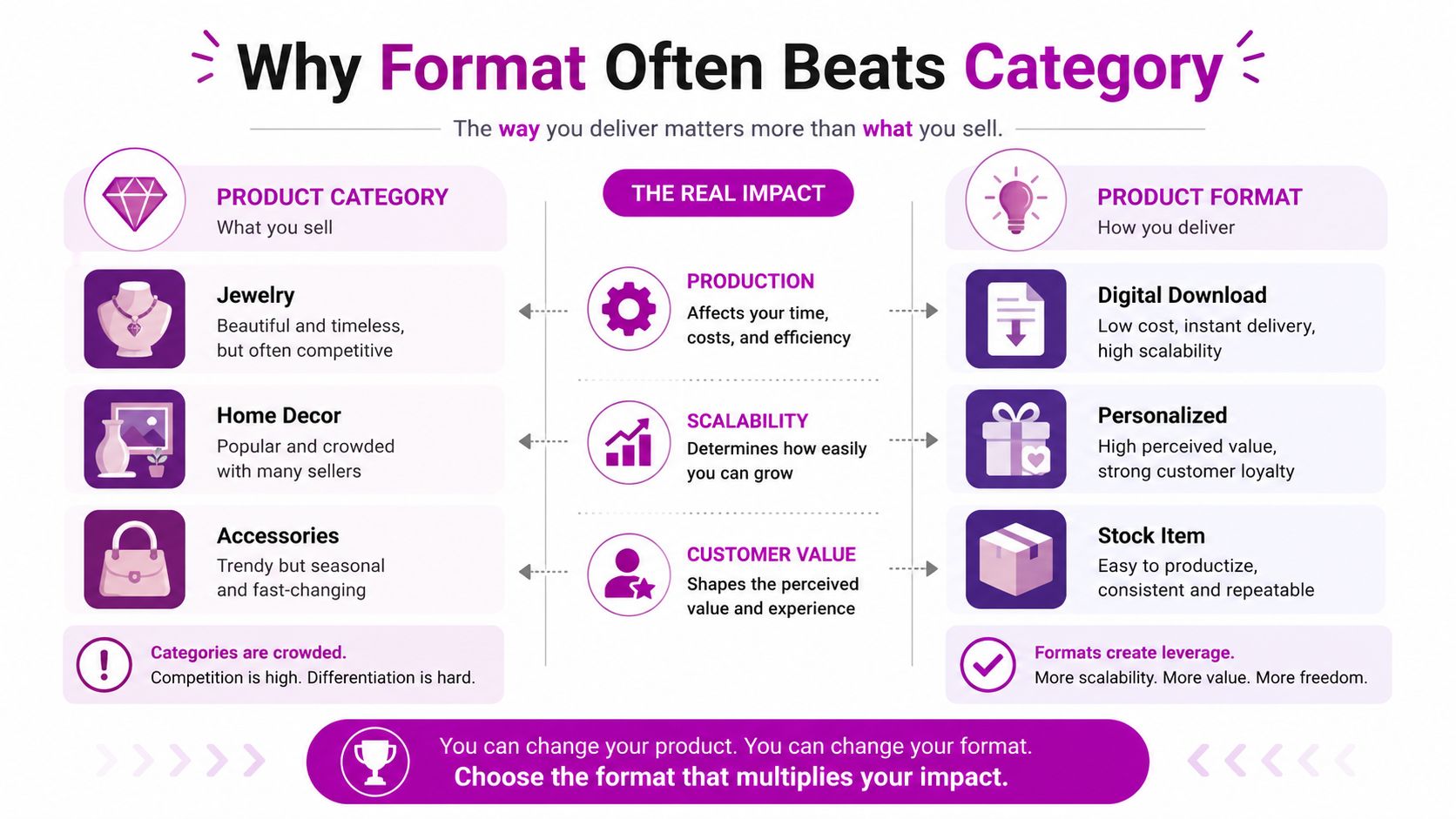
Why Format Often Beats Category
Two sellers can both operate in jewelry, and one can outsell the other because the format is easier to buy. That's the part many beginner guides miss. Category tells you where the demand lives, but format tells you how cleanly you can serve it.
Digital and personalized formats change the game
A 2026 marketplace analysis of 1.2 million listings found that digital planners and Notion templates converted at 9.8% on average, ahead of personalized pet memorial keepsakes at 8.3% and sensory tools at 7.9% (top selling Etsy items 2026). The practical lesson is hard to ignore. Low-friction products, instant delivery, and high customization tend to win because they remove shipping delays and reduce buyer hesitation.
That doesn't mean physical products can't perform. It means the format has to earn its place. A personalized keepsake works because the buyer is already emotionally committed. A digital planner works because the customer can solve a problem immediately. A sensory tool works because the use case is concrete and personal.
Match the format to the buyer's urgency
If you sell physical goods, ask whether the format creates extra friction, packaging cost, or damage risk. If you sell digital goods, ask whether the buyer can understand the file instantly and use it without confusion. If you sell personalized goods, ask whether the customization feels like part of the value, not an expensive afterthought.
For physical sellers who are building out a shipping system, reduce courier damage claims is a useful reference point because packaging quality can protect both reputation and margin. That matters on Etsy, where a single broken item can wipe out the goodwill you worked to build.
Practical rule: If two products look equally good on paper, pick the one that is easier to deliver cleanly.
Format is also where many sellers make a smart pivot without changing their whole niche. A jewelry idea can become a digital charm guide, a printable gift card insert, or a personalized physical piece. A home décor idea can become a printable, a made-to-order item, or a curated bundle. The winning move is often not changing the category, it's choosing the format with the least friction and the most perceived value.
Micro-Niches With High Intent and Low Competition
A broad list of “best Etsy products” only gets you so far. The opening often sits one layer deeper, where the buyer already knows the exact problem they want solved and is not browsing casually. Micro-niches do the heavy lifting there.
The best micro-niches solve a sharp problem
A handmade journal is not just stationery. It can be a grief journal, a wedding planner, an ADHD-friendly organization tool, or a therapy companion. Decorative wood crafts are not just decor. They can become name signs, nursery pieces, memorial pieces, or culturally specific event signs.
Natural floral arrangements can serve weddings, sympathy gestures, seasonal gifting, or small-business décor. The same pattern shows up in grief and memorial gifts, ADHD organization tools, adaptive and sensory-friendly products, and culturally specific event decor. These are buyer problems with emotional weight, practical urgency, or identity relevance. That is why they often convert better than generic products made from the same materials.
The key is not the material. It is the reason someone is searching.
Three signals that a micro-niche is worth chasing
First, look for clear search intent. If a buyer can describe the need in a plain phrase, the niche is usually searchable. Second, look for a painful or emotional problem. Grief support, sensory needs, and event-specific decor fit that pattern well. Third, look for a willingness to pay a premium. Buyers with urgency do not compare listings the same way casual browsers do.
Some Etsy products sell because they are cute. The better ones sell because they feel necessary.
That is why broad category charts can mislead new sellers. They point at popular themes, but they do not show the small pockets where demand is more specific and competition is less crowded. The opportunity is often in the sub-niche, where the seller understands a specific buyer moment better than the general market does.
A useful way to spot those pockets is to find trending niches, then compare the buyer language, the product format, and the level of competition before you commit. That keeps you from chasing noisy ideas that look busy but do not convert.
A strong micro-niche usually feels narrow to the seller and obvious to the buyer. That is the sweet spot.
Pricing, Margins, and Personalization as a Premium Lever
A product can sell well and still fail as a business if the numbers do not work. Etsy rewards items that feel special, but it does not erase your costs, and it will not protect a listing priced without a clear margin.
Price for value, not just materials
Pricing only from materials is the first mistake. That approach misses the parts buyers pay for, convenience, personalization, emotional fit, and presentation. A buyer choosing a gift, a custom file, or a made-to-order item is not comparing raw inputs. They are paying for the way the product fits the moment.
Start with your costs, then price against the value the buyer receives. For a physical product, that means materials, packaging, fees, and time. For a digital product, it includes design time, support, and the value of immediate delivery. For print-on-demand, the margin sits inside someone else's production system, so the platform's cost structure has to be part of the calculation from the start.
Use personalization as a value signal
Personalization works best when it feels like the reason the product exists. A name, date, color choice, or custom message can make the item feel made for one buyer instead of many. That changes how the listing is judged, because it is harder to compare against a generic alternative line by line.
Bundling helps as well. Instead of creating ten nearly identical listings, group variations in a way that lifts average order value without creating extra work for every order. A planner can be sold as a single file, a bundle, or a themed set. A physical gift can include a card, wrapping option, or matching accessory. The offer stays easier to manage, and the buyer sees a fuller package.
Packaging matters for more than appearance if you ship physical goods. Better protection lowers breakage, reduces complaints, and protects margin by avoiding remakes. It also helps to reduce courier damage claims, which is especially useful for fragile items and gift-led products.
Profit rule: If personalization raises the price but also creates more support work, the premium has to cover both.
Healthy Etsy pricing starts with clarity. Buyers should understand what is included, why it costs what it costs, and what makes it different from a cheaper option. If that cannot be explained in one clean sentence, the listing usually needs more work before launch.
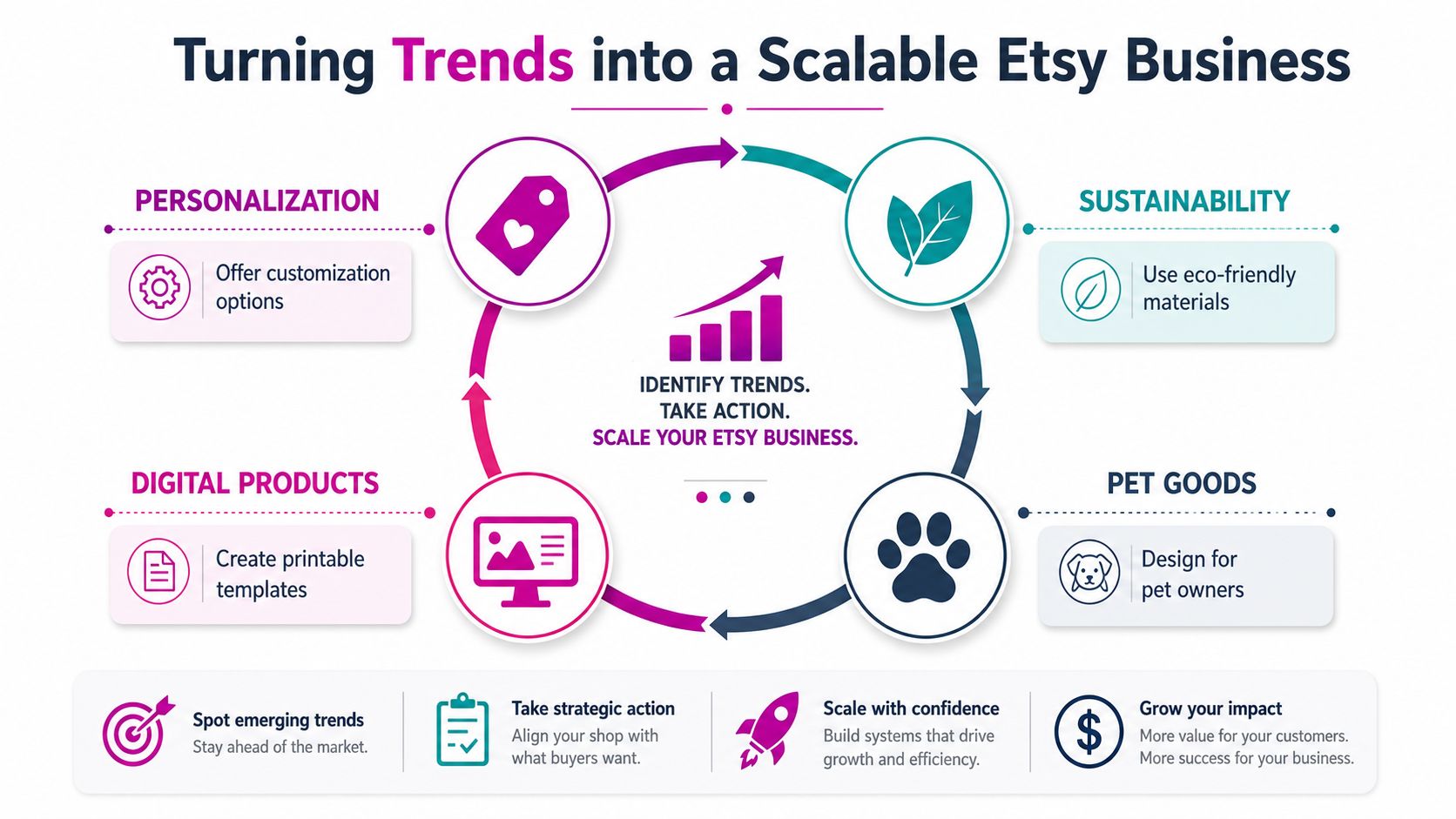
Turning Trends into a Scalable Etsy Business
Trends are easy to name and hard to operationalize. Personalization, sustainability, digital products, and pet goods all sound attractive, but they only become a business when the seller turns them into repeatable workflows.
Turn a trend into a production decision
Personalization means you need a clean customization flow. Sustainability means you need sourcing that matches the promise you're making. Digital products mean you need file clarity and fast delivery. Pet goods mean you need messaging that speaks to pet owners without becoming generic.
Those choices affect batch size, packaging, listing copy, and customer service. A seller who offers custom items has to manage inputs and proofing carefully. A seller who sells digital products has to reduce confusion at checkout. A seller who leans into eco-friendly materials has to make the sustainability story concrete and believable.
Scale the winner, not the whole catalog
The best way to scale on Etsy is to find one idea that already sells and expand around it with variations. One core design can become multiple colors, occasions, recipients, or formats. One strong keyword theme can support a small family of listings. That gives Etsy more data and gives buyers more reasons to enter your shop.
Don't treat every new idea equally. Look at which listings bring the right traffic, which ones convert, and which ones generate repeat attention. Then double down on the pattern that's already working instead of chasing the next shiny idea.
A shop grows faster when the seller stops thinking like a one-product maker and starts thinking like a system builder. That means consistent photography, consistent messaging, and a catalog that makes sense to a stranger in five seconds. If your next product doesn't fit the same operational logic as the last one, it may be a distraction rather than a growth lever.
SEO, Listings, and a 90-Day Launch Plan to Scale
Once you've chosen the product, the shop still has to do the work of getting found and converting. Etsy SEO starts with buyer language, not clever branding. Titles, tags, and first images need to match the exact phrases people type, not the phrases you wish they typed.
Make the listing do the selling
Your title should lead with the strongest search phrase, then clarify the product type and buyer use case. Use the full tag space with phrases that reflect occasion, recipient, material, and intent. If you want a helpful reference for listing structure and search alignment, how to optimize Etsy listings is worth reading because it frames optimization as a conversion problem, not just a keyword game.
Photos matter just as much. Show the product clearly, show scale, show detail, and show use. Buyers need to understand what they're getting in a quick scroll, and vague imagery kills that confidence. If it's digital, make the deliverable obvious. If it's physical, show the finish and the size.
Follow a simple launch calendar
Weeks one and two are for validation and sourcing. Tighten the niche, confirm demand, and get the product ready without overbuilding. Weeks three to six are for launch, with three to five listings that all support the same buyer intent. Weeks seven to ten are for testing, where you watch which titles, photos, and variations pull attention. Weeks eleven and twelve are for scaling what's working and cutting what isn't.
That pace keeps you from doing too much too soon. It also gives Etsy enough data to compare one listing against another without spreading your effort across too many experiments. A small, focused shop usually learns faster than a bloated one.
The sellers who win on Etsy don't guess once and hope. They validate, launch, measure, and refine until the shop starts to look obvious to the buyer. That's the difference between a nice idea and a business.
If you want help turning a promising Etsy idea into a shop that converts, ECORN works with brands on eCommerce strategy, design, and conversion rate optimization. Visit ECORN if you want a sharper listing strategy, a cleaner storefront, and a practical growth plan for your next launch.


Shopify Mobile Optimization: The 2026 Playbook
How to Add Subcategory in Shopify for Better UX
How to Implement Structured Data for Ecommerce in 2026
SEO App Mobile: Shopify Store Optimization Guide
Shopify Plus Support: What It Includes and How to Choose

Google Ads for Shopify: The Complete 2026 Playbook
Shopify New York: How to Find and Hire the Right Agency

Google Search Console for Shopify: The Complete Setup
First Party Data Collection for eCommerce Growth
FAQ Online Store Guide: Build and Measure It Right
Do FB Ads Work for eCommerce in 2026?
One Page Checkout for Shopify: Design and Implementation
Shopify GraphQL vs REST: The 2026 Developer Decision
Shopify Ecommerce Consulting: Strategy, Pricing &

Are Reddit Ads Worth It for eCommerce Brands
Shopify Title and Meta Description: A Practical 2026 Guide
Product Video Best Practices for Shopify Brands
Real-Time Inventory Management: A 2026 Guide

AI Chatbot Integration for Shopify Stores
Affiliate Program Management: A Shopify Guide
10 Best Performance Monitoring Tools for Shopify in 2026
Digital Asset Management for eCommerce Brands in 2026
Every Type of Facebook Ads Explained for eCommerce Growth
Product Information Management Explained for Shopify Brands
Support Ticket System: A Guide for Shopify Stores

10 Best Customer Service Tools for Shopify in 2026

Can I Start a Business with No Money? a 2026 Blueprint

Shopify Add to Cart Button: A Practical 2026 Guide

Customer Feedback Automation: A Practical eCommerce Guide
Critical Rendering Path: A Guide for Shopify Stores

How to Promote on TikTok for eCommerce in 2026

B2B eCommerce Consulting That Drives Real Revenue

10 Best Practices for Site Navigation in 2026
Return vs Refund for Shopify Stores: A Practical Guide
What Is Customer Lifetime Value and Why It Matters
What Is Voice of Customer Research for eCommerce

SMS Marketing for Ecommerce That Actually Converts

Master How to Improve Email Deliverability in 2026

Top 7 eCommerce Partners NYC for Shopify Brands in 2026
Machine Learning for Ecommerce: Boost Your Shopify Store
Beauty Market Research: Your 2026 Growth Guide

Shopify International Expansion: A 2026 Roadmap
What Does CRO Stand for in Business: Understanding CRO
Shopify Visual Merchandising: A Playbook for Higher Sales

Shopify Landing Page Design: Master Conversion in 2026

10 Best AI SEO Optimization Tools for Shopify in 2026

Agentic AI for Ecommerce: Boost Your Sales in 2026
Mastering Email Marketing Data for eCommerce Growth

Conversion Rate Optimisation Australia: Boost Your Sales
Conversion Rate Optimization AI: Your Shopify Store Guide

10 Product Bundling Strategies for Shopify in 2026
How to Increase Customer Lifetime Value: A Shopify Playbook
AI Customer Service Automation: Shopify Guide 2026

Clean Website Design: A Shopify Conversion Playbook

Omnichannel Retail Strategy: A Shopify Playbook
Product Data Enrichment: A Guide for Shopify Brands
Instagram Shopping Features a Guide for Shopify Stores

What Is Revenue Optimization: A Holistic RevOps Guide

Benefits of Conversion Rate Optimization: Boost Your
WordPress to Shopify Migration: Your 2026 Seamless Switch
Boost Sales: Ecommerce Payment Processing Guide 2026
Unified Commerce Platform: Benefits, KPIs & Shopify Guide
How to Reduce Bounce Rate eCommerce: Your 2026 Guide
Shopify API Integration: A Practical End-to-End Guide

How to Implement Data Governance: A 2026 Guide
Shopify Store Development Cost: A 2026 Breakdown
What Is Server Side Tracking: The Shopify Guide 2026
Marketing Automation Workflows: A Shopify Guide for 2026
Shopify: How to Reduce Technical Debt

Shopify UX Design Change: A Playbook for Growth
User Generated Content Strategy: Shopify Playbook
Shopify Pause and Build Plan Cost: A Complete 2026 Guide
Compare at Price on Shopify: A Complete Guide for 2026
Where Can I Sell My Prints? 10 Best Platforms for 2026
Shopify Order Management System: The Ultimate Guide 2026
What Is Marketing Attribution? an eCommerce Guide for 2026
10 Best Black Friday Sales Sheets for 2026

Discover the Top Social Media Marketing Agencies For
Consumer Confidence Definition for eCommerce in 2026
What Is Social Commerce? Your 2026 Guide to Boosting Sales
A Social Ad Campaign Playbook for eCommerce Growth

7 Best FAQ Page Examples for SaaS & eCommerce

Market Research in Fashion Industry: A Guide for Shopify
Shopify Migration Services: Expert Guide for 2026
Mastering FB Retargeting Ads for Shopify in 2026
What Is Omnichannel Ecommerce
Master Your Shopify Plus Migration: The 2026 Guide
Shopify Integration Services: A Merchant's 2026 Guide
Shopify Collection Description: A Guide to SEO & Sales
Shopify Plus Contact: Reach Sales & Support Effectively

Top Luxury Shopify Stores: Design & UX Strategies
How to Improve Customer Experience: A Shopify Roadmap
Creative Facebook Ads: 10 Examples for Shopify Brands

Remarketing with Facebook Ads: A Shopify Guide for 2026

SEO Linking Strategies for Shopify Stores
Top 7 Statistics YouTube Channels for eCommerce in 2026

Hiring Shopify Plus Designers: A Founder's Guide
Shopify Product Variation: Master Your Variants for 2026

Leverage Ai Solutions Brands: Your 2026 Shopify Growth Guide
Filters in Shopify: A Guide for Growing Brands


newsletter in your inbox