


About one in four U.S. entrepreneurs launch with less than $5,000, and 30.1% of nonemployer firms use zero startup capital. So yes, you can start a business with no money, but only if you treat it like a runway problem, not a fantasy about free success.
The wrong question is often asked. The focus should be on whether you can endure the initial period before any income arrives. The founders who succeed with minimal or zero capital typically aren't magical; they are disciplined about cashflow, blunt about what they can sell quickly, and ruthless about omitting any activity that doesn't lead to a client or a paycheck.
Rethinking What No Money Really Means for Your Business
The stats make the answer plain. About one in four U.S. entrepreneurs launch with less than $5,000, more than half of employer startups, 50.9%, begin with less than $25,000 in funding, and 30.1% of nonemployer firms report using zero startup capital (Mesa Community College entrepreneurial facts). That doesn't mean every business is cheap. It means bootstrapping is normal, especially for freelancers, consultants, and other service-based founders.

The real constraint is personal runway
A lot of “no money” advice pretends startup cash is the whole story. It isn't. If you can't pay your rent, buy food, and handle basics while you're hunting for clients, the business will pressure you long before the market does. That's why mainstream guidance keeps circling back to keeping a paycheck while you build, because the key constraint is often cashflow security, not just startup capital (PNC insights on starting with little or no money).
Practical rule: if your business needs you to be desperate on day one, the model is wrong.
There's also a strong historical precedent for lean launches. 69% of U.S. entrepreneurs start their businesses at home, which strips out rent, utilities, and commuting costs (Mesa Community College entrepreneurial facts). The home-based path isn't glamorous, but it's cheap, fast, and realistic.
Do a blunt self-check before you start
Ask yourself four questions. Do I have a sellable skill? Do I have enough time to prospect consistently? Can I tolerate rejection without spiraling? Do I have personal runway, or do I need a side job while I build? If the answer to the last one is “no runway,” don't quit your job and call it courage. Call it poor planning.
That's the key filter. Cash is one problem. Survival is the bigger one. If you understand that, you're already ahead of the people chasing logo design before they've earned a single client.
The old-school funding playbook still matters once you're ready to scale, and a practical overview like the PledgeBox funding guide for startups can help you think past the launch stage without confusing funding with validation.
Picking a Business Model You Can Actually Start for Free
The cheapest business to start is the one that sells your existing skill, not one that needs inventory, a warehouse, or a fancy storefront. Service-first models win here because they let you start with a laptop, a phone, and a clear offer. If you can help someone save time, make money, or solve a painful problem, you've got something that can be sold before anything is built.
Start where cash and friction are lowest
Freelancing, micro-consulting, and agency services are the obvious no-money choices. They're fast to launch because you're selling labor or expertise, not physical goods. Content-led businesses and digital products also fit, but only if you already know how to produce something useful without paying a team to do it.
A better filter is this, not “What sounds exciting?” but “What can I sell this week?” If you can draft landing pages, edit videos, set up email flows, manage social accounts, or advise on a niche topic, that can become a business before you register a domain. The mistake is choosing a model that looks free on paper but demands cash, like inventory-heavy retail or equipment-heavy food service.
Start with the offer you can fulfill from your apartment, not the brand you want to brag about.
Home-based launches make sense for a reason. They keep the fixed costs low and let you test demand before committing to anything expensive (Mesa Community College entrepreneurial facts).
Match the model to the business you actually want
If you want speed, choose a service. If you want to scale, build a digital product after the service starts producing clients. If you want eCommerce, avoid the temptation to jump straight into a huge catalog. The internal logic of a lean store matters more than the platform itself, and this guide to starting an eCommerce business is useful once you're past the idea stage and need a practical build plan.
Don't romanticize dropshipping or print-on-demand as “no work” businesses. They may lower inventory risk, but they still need positioning, traffic, and customer support. That's why I push people toward service-first validation first. It gives you cash, language from real buyers, and proof that a market exists.
If you're serious, choose one model with one clear buyer. Then stop browsing business ideas and start selling.
Validating Your Idea and Landing First Clients Before You Build Anything
A no-money business lives or dies on validation. If you can't convince someone to pay before you've built the full thing, you don't have a business, you have a hobby with a logo. The fastest path is a service-first validation loop, where you sell the outcome first and build the system later.
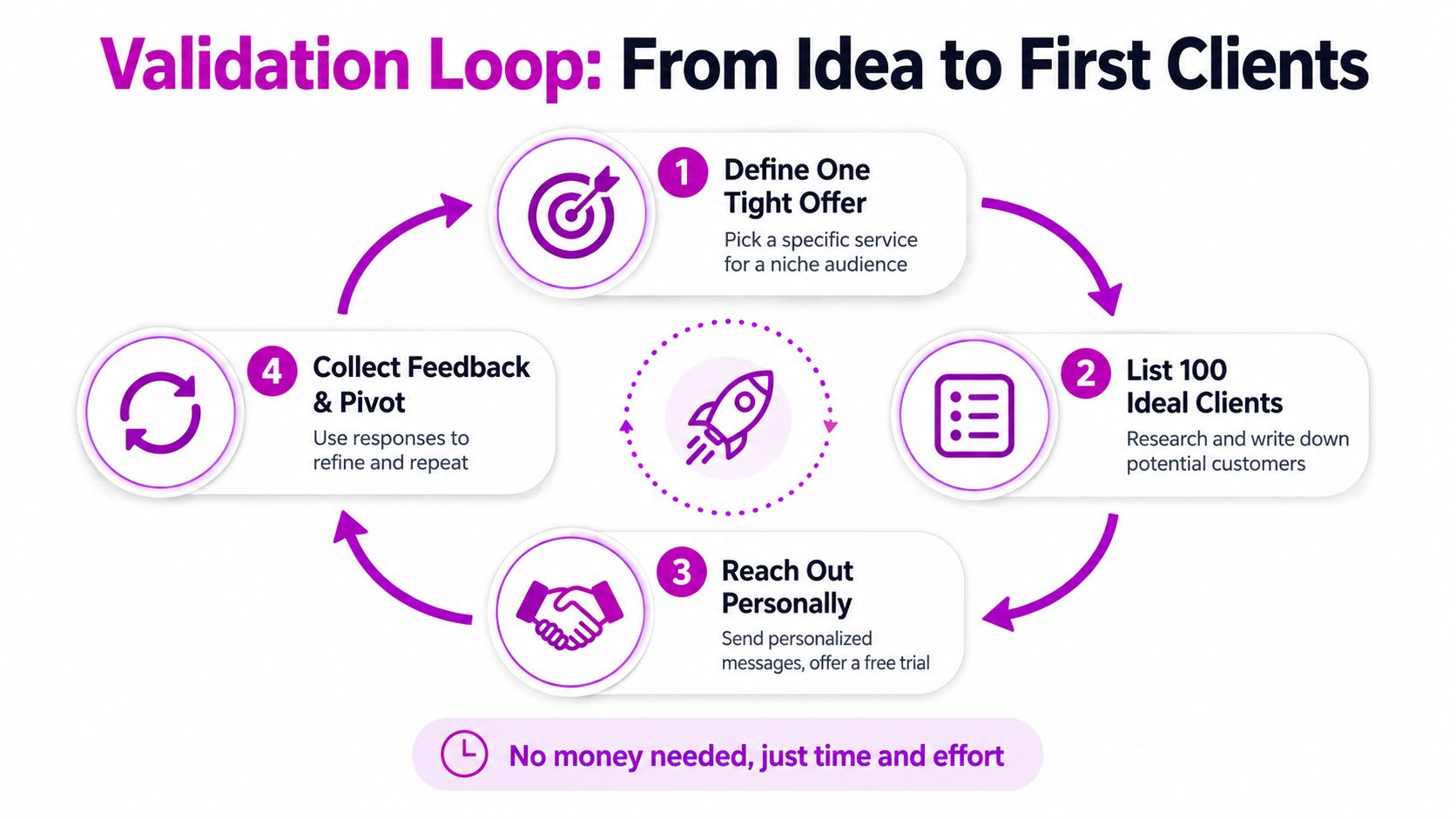
Sell one tight offer to one specific audience
Stop trying to be everything. Pick one service, one niche, and one outcome. A vague pitch like “I help businesses grow” gets ignored. A tight pitch like “I write onboarding emails for small Shopify brands” gives prospects a reason to care.
From there, build a prospect list and reach out like a professional, not a fan. The zero-capital playbook that works is simple, 60 outbound touches in week 2, 10 booked calls, and 3 paid clients by week 3 (IdeaProof zero-capital playbook). Those are not magic numbers, they're a discipline check. If you're not speaking to buyers, you're hiding.
The first sale is your market research. Everything else is theory.
Price for an outcome, not your insecurity
When you have no track record, don't underprice yourself into weakness. Research what comparable services do, then frame your offer around the result you're delivering. A buyer is paying for fewer headaches, more leads, better content, cleaner ops, or a faster launch. They're not paying for your fear.
Your first message should be short and direct. State who you help, what problem you solve, and why it matters now. Then ask for a conversation or a trial. Don't bury the ask under a biography.
Use the first three clients as your product lab
The first paid projects should sharpen the offer, not force you to build a giant system. Ask what worked, what didn't, and what they'd buy again. Collect testimonials, turn common requests into templates, and ask for referrals before the work goes cold. That's how the business compounds without you spending on infrastructure first.
If you want a demonstration of how a founder can turn a simple offer into real demand, the embedded video below is worth watching for the logic, not the polish.
Building Your MVP With Free and Freemium Tools
Once validation starts producing real signals, build the smallest thing that can take money and deliver value. A minimum viable product is not a branding exercise. It's a working sales and delivery system that lets you serve clients without chaos. Free and freemium tools are enough for that if you stay disciplined.
Use tools that remove friction, not tools that create busywork
For a service business or simple online offer, a basic stack is enough. A simple site can live on Carrd or a trial on Shopify, design work can happen in Canva, email can run through Mailchimp or Brevo, and scheduling can sit on Calendly. Operations can stay in Notion, Trello, and Google Workspace until revenue justifies more.
Here's a clean way to think about the stack:
| Business Function | Free Tool | Freemium Option | When to Upgrade |
|---|---|---|---|
| Website | Carrd | Shopify trial | When you need custom branding or more pages |
| Design | Canva | Canva Pro | When you produce assets regularly |
| Brevo | Mailchimp | When lists and automations grow | |
| Scheduling | Calendly | Calendly paid tiers | When team scheduling becomes messy |
| Operations | Notion | Trello | When workflows need deeper structure |
| Payments | Stripe | PayPal | When volume and payout preferences change |
For eCommerce, platform choices matter, but you don't need to overbuild. WooCommerce and Ecwid keep things flexible, while Shopify works fine if you start with the free trial and use free themes before buying apps or premium design. A practical resource like the free startup tools from Shopstar can help you avoid paying for software you don't need yet. And if you're looking at Shopify specifically, this guide to the best free themes on Shopify is a smart place to narrow your options.
Build enough to sell, not enough to impress
A polished brand that can't accept payment is useless. A plain storefront that answers questions, takes money, and delivers the promise is enough. That's the difference between movement and theater. Spend your time on checkout, clarity, and delivery, not on making the site look like a funded startup.
Rule of thumb: if a tool doesn't help you sell, deliver, or follow up, cut it.
The right stack changes as the business grows. Early on, your advantage is simplicity. Keep the system lean until the business itself tells you what needs to be upgraded.
Lean Legal and Operational Setup on a Zero Budget
Legal setup doesn't have to be expensive, but it does have to be clean. The easiest path for a solo founder is usually a sole proprietorship to start, then better structure later if revenue and risk justify it. Don't let paperwork become an excuse for stalling, but don't fake professionalism either.
Cover the basics in one afternoon
Start by getting a free EIN through the IRS, then open a separate business checking account so personal and business money don't get mixed together. Draft a one-page service agreement from a free template, even if it's basic. That agreement should spell out scope, payment timing, and what happens if the client changes the brief halfway through.
You also need to know when the simple setup stops being enough. Sales tax obligations, local business licenses, and entity changes like an LLC can matter once your activity grows or your risk profile changes. Don't overcomplicate that too early, but don't ignore it either.
Make the home office look intentional
Since 69% of U.S. entrepreneurs start at home (Mesa Community College entrepreneurial facts), your launch space should look like a working business, not a kitchen table disaster. A dedicated corner, consistent files, a clean calendar, and a business email address all help clients take you seriously. If the work requires client calls, borrow confidence from your setup, not from empty branding.
Clients forgive a small business. They don't forgive confusion.
You don't need a fake office address to look legitimate. You need responsiveness, clear terms, and a consistent process. If your service touches clients in person or you handle sensitive work, basic liability protection is worth checking before you take on more risk. The point is to eliminate the stupid problems now so they don't show up after your first good month.
Guerrilla Marketing and Sales Tactics That Cost Time Not Cash
When your budget is zero, your marketing budget is your calendar. That's not a limitation, it's a filter. The founders who move fastest are the ones who sell in public, talk to real people, and use free channels like grown-ups instead of waiting for a perfect brand launch.

Lead with channels that build trust fast
Organic content on LinkedIn, X, and TikTok works because it shows your thinking before the sale. Community engagement in Reddit, Discord, and niche forums works because it puts you where buyers already ask questions. Referral asks work because satisfied clients are often willing to introduce you to the next one.
Use partnerships too. Adjacent service providers already have the audience you want, and a simple cross-promotion can put your offer in front of people who already trust someone else. Podcast guesting can do the same if you can speak clearly about a specific problem. The common mistake is hiding behind a logo and waiting for inbound demand that never comes.
Use content as proof, not decoration
If you're in a visual or product-heavy niche, content doesn't have to be expensive to work. A practical walkthrough of an affordable AI product video workflow like the one described in ImagineVid AI's guide can help you make a useful demo without hiring a production team. That matters because prospects buy faster when they can see the offer in motion.
| Channel | Best Use | Trade-off |
|---|---|---|
| Organic social | Positioning and proof | Slow at first, but compounding |
| Community forums | Direct feedback and leads | Needs patience and real contribution |
| Referral asks | Warm lead generation | Depends on delivery quality |
| Partnerships | Borrowed trust | Requires clear fit |
| Podcast guesting | Authority building | Needs good talking points |
| Email outreach | Targeted prospecting | Fails if it sounds generic |
The sequence matters. Use content to show competence, communities to learn language, outreach to book calls, and referrals to keep the pipeline moving. That's revenue-first growth. Not hype, not fundraising theater, just steady selling.
Your 90-Day Plan, Common Pitfalls, and What Comes Next
The first 90 days should feel narrow and uncomfortable. That's good. Wide, vague, and “brand-building” at this stage usually means you're avoiding the market. Run the business like a sequence of proof points, not a personal development project.
A practical 90-day sequence
Days 1 to 30: choose one offer, one niche, one buyer type, then prospect hard and book calls. Your job is validation, not perfection. If you aren't getting responses, the message is wrong or the market is wrong.
Days 31 to 60: build the minimum viable site, set up your payment flow, and handle the legal basics. Only add what helps you sell and deliver. Keep the process tight enough that a client can understand it without a call.
Days 61 to 90: systematize outreach, ask for referrals, and reinvest early revenue into the next bottleneck. That may be better branding, better copy, or better delivery systems. Don't spend on vanity upgrades.
The five traps that kill lean founders
- Underpricing: if the price scares you more than the workload, raise it.
- Hiding behind preparation: endless setup is just fear with a calendar.
- Ignoring personal runway: if your own finances are shaky, keep income coming in.
- Skipping contracts: a friendly client can still create an ugly payment dispute.
- Chasing investors too early: funding doesn't fix a model that hasn't sold.
Once the service starts working, the path widens. You can add Shopify-led eCommerce, layer in ads, or bring in a specialist for design, development, and conversion work when revenue justifies it. If you want help turning a lean launch into a conversion-focused storefront, ECORN works on Shopify store setup, store design and development, CRO, and email flow setup, which fits the moment when you're ready to turn proof into a more scalable system.
If you want a straight answer, this is it, yes, you can start a business with no money, but only if you protect your personal runway and sell before you build. If you want help turning that idea into a real Shopify plan, ECORN can help you map the store, the conversion path, and the first revenue system without wasting budget on fluff.


Shopify Extension Development: A Practical 2026 Guide
Shopify Speed Score Explained and How to Improve It
Shopify Mobile Optimization: The 2026 Playbook
How to Add Subcategory in Shopify for Better UX
How to Implement Structured Data for Ecommerce in 2026
SEO App Mobile: Shopify Store Optimization Guide
Shopify Plus Support: What It Includes and How to Choose
Google Ads for Shopify: The Complete 2026 Playbook
Shopify New York: How to Find and Hire the Right Agency
Google Search Console for Shopify: The Complete Setup
First Party Data Collection for eCommerce Growth
FAQ Online Store Guide: Build and Measure It Right
Do FB Ads Work for eCommerce in 2026?
One Page Checkout for Shopify: Design and Implementation
Shopify GraphQL vs REST: The 2026 Developer Decision
Shopify Ecommerce Consulting: Strategy, Pricing &
Are Reddit Ads Worth It for eCommerce Brands
Shopify Title and Meta Description: A Practical 2026 Guide
Product Video Best Practices for Shopify Brands
Real-Time Inventory Management: A 2026 Guide
AI Chatbot Integration for Shopify Stores
Affiliate Program Management: A Shopify Guide
10 Best Performance Monitoring Tools for Shopify in 2026
Digital Asset Management for eCommerce Brands in 2026
Every Type of Facebook Ads Explained for eCommerce Growth
Product Information Management Explained for Shopify Brands
Support Ticket System: A Guide for Shopify Stores

10 Best Customer Service Tools for Shopify in 2026
What Sells Good on Etsy: Best Niches for 2026

Shopify Add to Cart Button: A Practical 2026 Guide

Customer Feedback Automation: A Practical eCommerce Guide
Critical Rendering Path: A Guide for Shopify Stores

How to Promote on TikTok for eCommerce in 2026

B2B eCommerce Consulting That Drives Real Revenue
10 Best Practices for Site Navigation in 2026
Return vs Refund for Shopify Stores: A Practical Guide
What Is Customer Lifetime Value and Why It Matters
What Is Voice of Customer Research for eCommerce

SMS Marketing for Ecommerce That Actually Converts

Master How to Improve Email Deliverability in 2026
Top 7 eCommerce Partners NYC for Shopify Brands in 2026
Machine Learning for Ecommerce: Boost Your Shopify Store

Beauty Market Research: Your 2026 Growth Guide

Shopify International Expansion: A 2026 Roadmap
What Does CRO Stand for in Business: Understanding CRO

Shopify Visual Merchandising: A Playbook for Higher Sales
Shopify Landing Page Design: Master Conversion in 2026
10 Best AI SEO Optimization Tools for Shopify in 2026

Agentic AI for Ecommerce: Boost Your Sales in 2026
Mastering Email Marketing Data for eCommerce Growth

Conversion Rate Optimisation Australia: Boost Your Sales
Conversion Rate Optimization AI: Your Shopify Store Guide

10 Product Bundling Strategies for Shopify in 2026
How to Increase Customer Lifetime Value: A Shopify Playbook
AI Customer Service Automation: Shopify Guide 2026
Clean Website Design: A Shopify Conversion Playbook

Omnichannel Retail Strategy: A Shopify Playbook
Product Data Enrichment: A Guide for Shopify Brands
Instagram Shopping Features a Guide for Shopify Stores
What Is Revenue Optimization: A Holistic RevOps Guide

Benefits of Conversion Rate Optimization: Boost Your
WordPress to Shopify Migration: Your 2026 Seamless Switch
Boost Sales: Ecommerce Payment Processing Guide 2026
Unified Commerce Platform: Benefits, KPIs & Shopify Guide
How to Reduce Bounce Rate eCommerce: Your 2026 Guide
Shopify API Integration: A Practical End-to-End Guide
How to Implement Data Governance: A 2026 Guide
Shopify Store Development Cost: A 2026 Breakdown
What Is Server Side Tracking: The Shopify Guide 2026
Marketing Automation Workflows: A Shopify Guide for 2026
Shopify: How to Reduce Technical Debt

Shopify UX Design Change: A Playbook for Growth
User Generated Content Strategy: Shopify Playbook
Shopify Pause and Build Plan Cost: A Complete 2026 Guide
Compare at Price on Shopify: A Complete Guide for 2026
Where Can I Sell My Prints? 10 Best Platforms for 2026
Shopify Order Management System: The Ultimate Guide 2026
What Is Marketing Attribution? an eCommerce Guide for 2026
10 Best Black Friday Sales Sheets for 2026

Discover the Top Social Media Marketing Agencies For
Consumer Confidence Definition for eCommerce in 2026
What Is Social Commerce? Your 2026 Guide to Boosting Sales
A Social Ad Campaign Playbook for eCommerce Growth
7 Best FAQ Page Examples for SaaS & eCommerce

Market Research in Fashion Industry: A Guide for Shopify
Shopify Migration Services: Expert Guide for 2026
Mastering FB Retargeting Ads for Shopify in 2026
What Is Omnichannel Ecommerce
Master Your Shopify Plus Migration: The 2026 Guide
Shopify Integration Services: A Merchant's 2026 Guide
Shopify Collection Description: A Guide to SEO & Sales
Shopify Plus Contact: Reach Sales & Support Effectively

Top Luxury Shopify Stores: Design & UX Strategies
How to Improve Customer Experience: A Shopify Roadmap
Creative Facebook Ads: 10 Examples for Shopify Brands

Remarketing with Facebook Ads: A Shopify Guide for 2026

SEO Linking Strategies for Shopify Stores
Top 7 Statistics YouTube Channels for eCommerce in 2026

Hiring Shopify Plus Designers: A Founder's Guide
Shopify Product Variation: Master Your Variants for 2026


newsletter in your inbox