

You're probably in one of two situations right now. Either your social ads are spending money but not producing enough profitable orders, or your acquisition is working in bursts and then falling apart when you try to scale.
In both cases, the ad account usually gets blamed first. However, the underlying issue is often the system around it. A profitable social ad campaign on Shopify isn't just a matter of targeting settings, prettier creatives, or a higher budget. It's the connection between audience, offer, landing page, tracking, merchandising, and post-click conversion.
That matters because social has become too large to treat casually. There were 5.22 billion social media users worldwide in 2024, and global social ad spend is projected to reach $276.7 billion in 2025 according to industry statistics on social media marketing. The same source notes that 58% of consumers discover new businesses through social media. For Shopify brands, that makes paid social a growth channel, not a side experiment.
The practical question isn't whether to run a social ad campaign. It's how to build one that turns attention into margin.
Laying the Foundation for a Profitable Campaign
Most wasted spend starts before launch. Teams mix awareness and conversion goals into one campaign, chase too many metrics at once, and build audiences that are too broad or too vague to learn from.
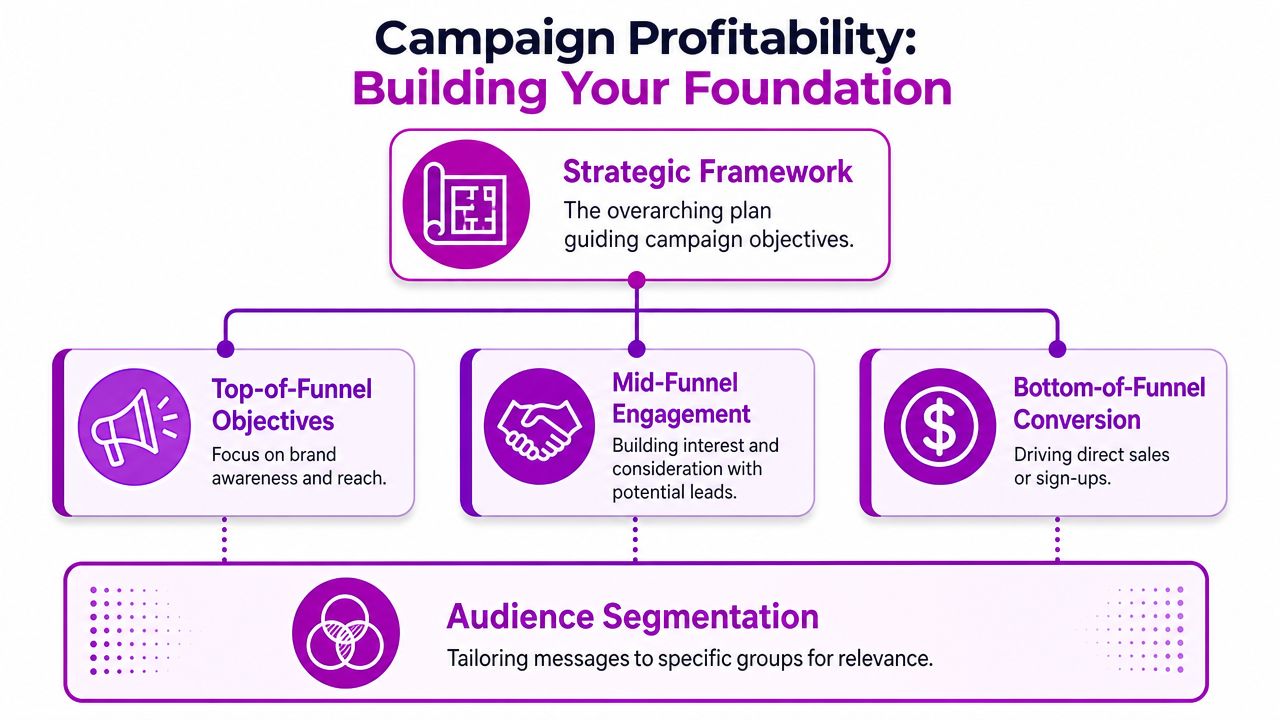
The cleaner approach is simple. Separate campaigns by funnel stage, assign one primary KPI to each, and build audience segments from your Shopify data and platform signals. That workflow reduces attribution confusion and makes optimization possible, as outlined in this campaign planning guidance.
Define the job of each funnel stage
A social ad campaign should never ask one ad set to educate, persuade, and convert at the same time. Those are different jobs.
| Funnel stage | Primary objective | Primary KPI | Audience example |
|---|---|---|---|
| Top of funnel | Introduce the brand and product category | Reach or qualified traffic | Broad interest audience based on category fit |
| Mid funnel | Build consideration | Click-through rate or landing page engagement | Product viewers, content viewers, email subscribers who haven't purchased |
| Bottom of funnel | Drive purchase | ROAS or conversion rate | Cart abandoners, checkout starters, repeat customer cross-sell audiences |
This structure keeps each campaign honest. If a top-of-funnel campaign generates attention but weak purchase efficiency, that doesn't mean it failed. It means it did an awareness job, not a conversion job.
Use Shopify data first
Shopify gives you your most useful input for paid social. Order history, average order behavior, product affinity, first-time versus repeat customer status, and geographic concentration all help you build stronger audiences than interest targeting alone.
Start with segments that reflect buying behavior, not just demographic assumptions:
- Recent purchasers: Use them for exclusions in acquisition campaigns and for upsell or replenishment flows.
- High-intent visitors: Build pools from product viewers, collection viewers, cart users, and checkout starters.
- Category buyers: If someone bought running shoes, they don't need the same ad as someone who only viewed casual sneakers.
- Lapsed customers: Message them with a different hook than you'd use for new customer acquisition.
Practical rule: If your audience strategy can't be explained in one sentence tied to a buying behavior, it's probably too loose.
Get the measurement layer right before launch
The technical setup needs to be boring and precise. Install the Meta Pixel or TikTok Pixel correctly, verify the key events you care about, connect your product catalog, and make sure Shopify order values pass through cleanly. If that foundation is shaky, every optimization decision after launch becomes guesswork.
A working pre-launch checklist usually includes:
- Pixel validation: Confirm page views, add-to-cart, checkout, and purchase events are firing as expected.
- Campaign naming: Use a naming system that identifies funnel stage, audience, offer, and creative angle.
- Primary KPI selection: One campaign, one main success metric.
- Landing page alignment: Every ad should have a page built for that message, not a generic destination.
What works is focus. What doesn't is running one blended campaign, reporting on everything, and not knowing what moved sales. A profitable social ad campaign starts as an operating model, not a media buy.
Choosing Platforms and Crafting Your Creative Blueprint
A Shopify brand can spend the same budget on Meta, TikTok, and Pinterest and get three completely different outcomes. The difference usually is not the platform itself. It is whether the product, message, and destination fit how people shop on that platform.
Platform choice should follow buying behavior. Creative should follow platform context. If those two decisions are off, the click gets more expensive and the traffic gets weaker before it ever reaches the product page.
Compare the platforms by shopping behavior
| Platform | What it's strong at | Best format fit | Common mistake |
|---|---|---|---|
| Meta | Retargeting depth, broad prospecting, demand capture | Video, carousels, product-led statics | Running flat catalog ads with no clear angle |
| TikTok | Discovery, fast pattern interruption, impulse-led interest | Founder-style video, UGC-style demos, quick hooks | Producing polished brand ads that feel out of place in-feed |
| Planning behavior, visual search, intent-led browsing | Lifestyle imagery, idea-led creative, collections | Using the same ad structure that works on Meta |
Meta is still the default base for many Shopify brands because it handles both prospecting and retargeting well. TikTok tends to work fastest for products with an obvious visual payoff, a simple demo, or a strong point of view. Pinterest often performs better for products people compare, save, and revisit before buying, especially in categories like interiors, beauty, gifting, and fashion.
The trade-off is speed versus control. TikTok can create demand quickly, but volatility is higher and creative fatigue hits faster. Meta usually gives better optimization depth once event quality and landing page alignment are in place. Pinterest often needs more patience, but the traffic can arrive with clearer consideration intent.
Build creative around persuasion, not brand mood
Creative briefs fail when they stop at visual direction. Performance creative needs a sales argument.
For a shoe brand, a useful brief might look like this:
- Audience: New customer acquisition for shoppers looking for everyday trainers
- Problem: Stylish casual shoes often get uncomfortable after a few hours
- Angle: Clean design with all-day comfort
- Proof: Midsole construction, material close-ups, on-foot clips, customer review lines
- CTA: Shop the everyday pair
That gives a designer, editor, or media buyer something specific to build and test. It also gives the Shopify team a clear path for the post-click experience, because the product page or campaign landing page needs to carry the same argument.
A practical creative checklist:
- Lead with the buying trigger: Start with the problem, desired result, or visual change in the first second.
- Show the product in use: Demonstration beats description, especially for paid social.
- Keep one message per asset: Comfort, durability, style, and price each deserve their own test.
- Respect platform behavior: TikTok needs native pacing and voice. Meta can handle a more direct sales structure. Pinterest rewards clarity, aspiration, and search-friendly visuals.
- Build testable variants: Change hooks, opening frames, proof points, and offers without changing the core product truth.
This is also where many brands waste money. They brief creative for reach, then send traffic to a Shopify page that answers a different question. A strong ad does not just get attention. It pre-qualifies the click, sets the expectation for the landing experience, and improves conversion rate once the visitor arrives.
If your team needs fresh product visuals across multiple audience segments, tools like ai generated models can reduce production bottlenecks and give you more variation to test by angle, audience, and platform.
If you need more angle development before production starts, this roundup of social media advertising ideas for eCommerce testing is a useful input for building a sharper creative matrix.
Good creative earns the click. Great creative makes the Shopify session more likely to convert.
Building Your High-Converting Landing Experience
The homepage is usually the wrong destination for paid traffic. It asks visitors to do too much work. They have to re-orient, find their way, search, compare, and then decide whether they're in the right place. Most won't bother.
Paid social traffic needs a tighter path. The ad makes a promise. The landing page should continue that exact promise with no detour. That continuity is what keeps intent alive.
Stop sending campaign traffic to a generic homepage
A homepage is built for many visitor types at once. A campaign landing page is built for one buyer, one angle, and one next step.
That difference matters even more on mobile. 98% to 99% of social media users access platforms via mobile devices, and over 80% of social ad revenue comes from mobile campaigns, according to mobile-first social advertising data. If your social ad campaign sends people to a desktop-minded page with weak hierarchy and slow decision paths, the funnel breaks after the click.
The better approach on Shopify is to build dedicated destinations around the ad set itself. That can be a product page template, a custom landing page, or a tightly merchandised collection page, as long as it follows the ad message cleanly.
What a campaign landing page needs
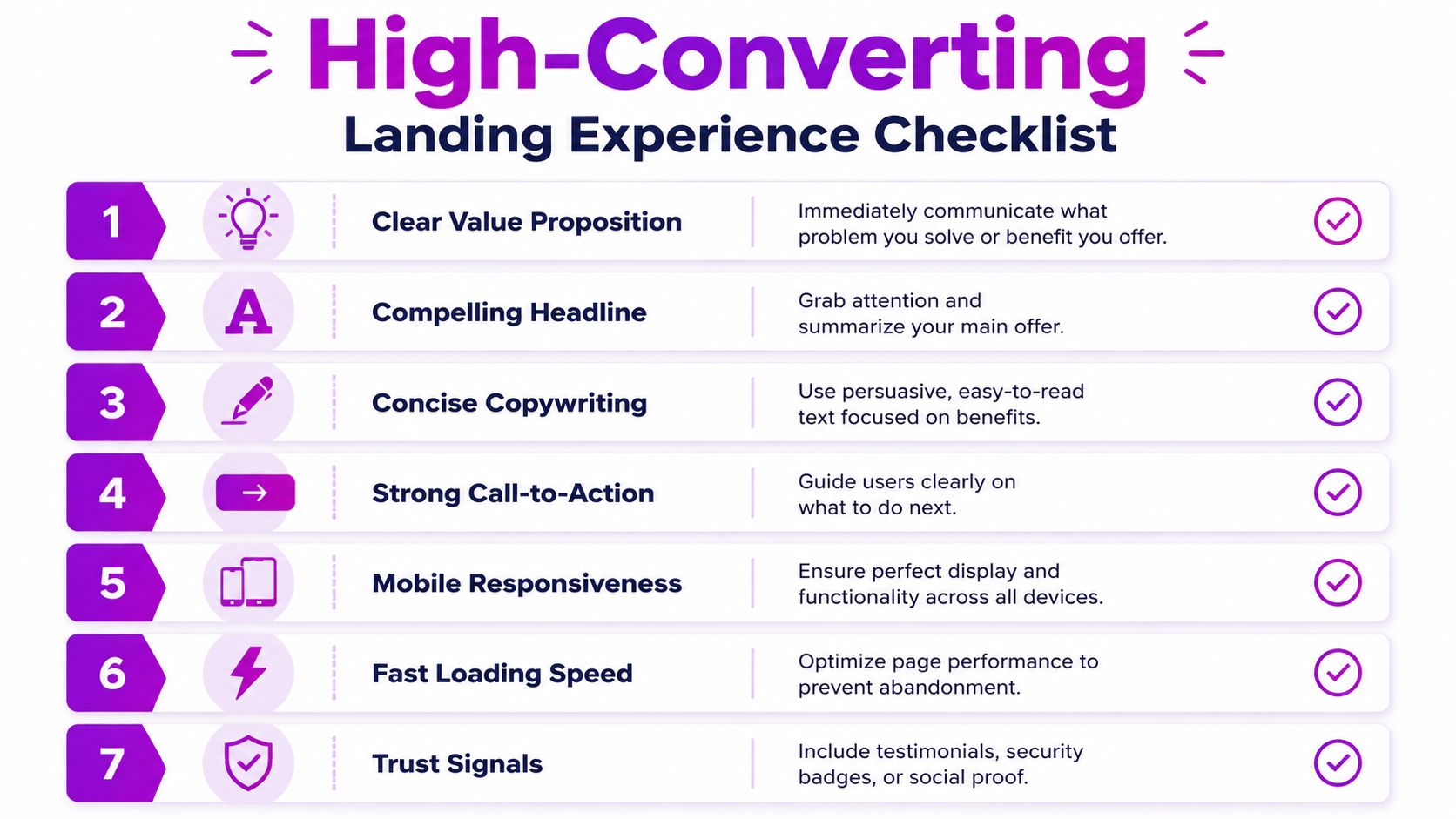
A high-converting page usually has these elements in this order:
A headline that matches the ad angle
If the ad sells all-day comfort, the page headline shouldn't pivot to a broad brand statement.A clear value proposition near the top
State what the product is, who it's for, and why it's different.Visual proof
Use images or video that continue the ad's story. If the ad was a performance demo, the page should show the same product behavior.Trust signals
Reviews, UGC, guarantees, shipping clarity, and any purchase reassurance belong near the decision point.A friction-light call to action
Make add-to-cart easy. Don't bury sizing help, delivery information, or variant selection.
Here's a useful visual checklist for the page structure:
Build for ad scent, not just page beauty
The strongest landing pages preserve what direct-response teams call ad scent. The visitor should feel they landed exactly where the ad suggested they would.
That means:
- Same offer language: Don't mention a bundle in the ad and hide it on the page.
- Same product framing: If the ad targets first-time buyers, don't land them on a page built for returning customers.
- Same visual cues: Reuse the same product angle, model style, or use-case imagery when possible.
- Same intent path: Don't interrupt with unnecessary navigation or unrelated categories.
A beautiful page can still lose money if it forces the user to think too hard.
On Shopify, this often means customizing templates around campaign traffic instead of relying on theme defaults. Product page blocks, sticky add-to-cart modules, bundled sections, review placement, mobile media order, and checkout handoff all affect paid traffic efficiency. That's where CRO work matters. You're not polishing pages for aesthetics. You're removing hesitation at the exact moment ad spend has already done the expensive part.
Managing Budgets Bidding and A B Testing
Campaign teams often don't kill performance with one terrible decision. They chip away at it. They cut budget too early, scale too fast after a good day, or call a winner before the platform has enough data to stabilize.
The fix is disciplined campaign management. Budgeting, bidding, and testing need rules. Not complicated rules. Just rules that stop emotional optimization.
Budget for learning before you budget for scale
Social platforms need enough conversion data to learn. If you launch with underfunded campaigns, you can end up judging a setup that never had a fair chance to stabilize.
Expert guidance on social performance optimization recommends funding campaigns sufficiently to exit the learning phase, then increasing budgets gradually by about 15 to 20% per adjustment rather than making large jumps that can reset optimization, as explained in this guide to effective social media advertising strategies.
That has two immediate implications:
- Don't split budget across too many audiences at launch. Concentration beats fragmentation early on.
- Don't scale based on one strong day. Add budget in controlled steps and watch whether efficiency holds.
Keep bidding simple unless you have a reason not to
For Shopify brands, bidding usually works best when it matches the maturity of the account.
| Situation | Practical bidding approach | Why it fits |
|---|---|---|
| New campaign with limited data | Highest volume style delivery | Gives the platform room to find conversions |
| Stable campaign with efficient CPA or ROAS behavior | Controlled scaling with clear thresholds | Protects a working setup from abrupt resets |
| Mature account with reliable conversion signal | Goal-based bidding with caution | Useful only when the account already has enough signal quality |
A lot of brands jump to advanced controls too early because they want more certainty. In practice, that often reduces delivery before it improves efficiency.
Run tests that answer one question
Most ad tests are messy because they compare too many variables at once. A real A/B test needs one hypothesis, one control, one variant, and one success metric.
Use this framework:
State the hypothesis
Example: A problem-first hook will outperform a product-first hook for cold traffic.Define the control and variant
Keep the audience, landing page, and offer stable if you're testing creative.Set the review cadence
Don't check results every hour and react. Review on a fixed schedule.Choose the success metric before launch
Pick the metric that fits the stage. CTR for engagement tests. Conversion rate or ROAS for purchase campaigns.
Testing rule: If you can't explain what changed and why it might matter, you're not running a test. You're just rotating assets.
Attribution windows matter too. Guidance on measurement suggests shorter windows can fit impulse purchases, while longer windows are better for products with more consideration. Align the window with the buying cycle, or you'll misread campaign impact.
What works is patience with structure. What doesn't is daily budget whiplash, broad guesses, and declaring winners on noisy data.
Decoding Campaign Attribution and Analytics
A platform can report strong ROAS while the business still struggles to grow profitably. That disconnect usually comes from measurement, not just media performance.
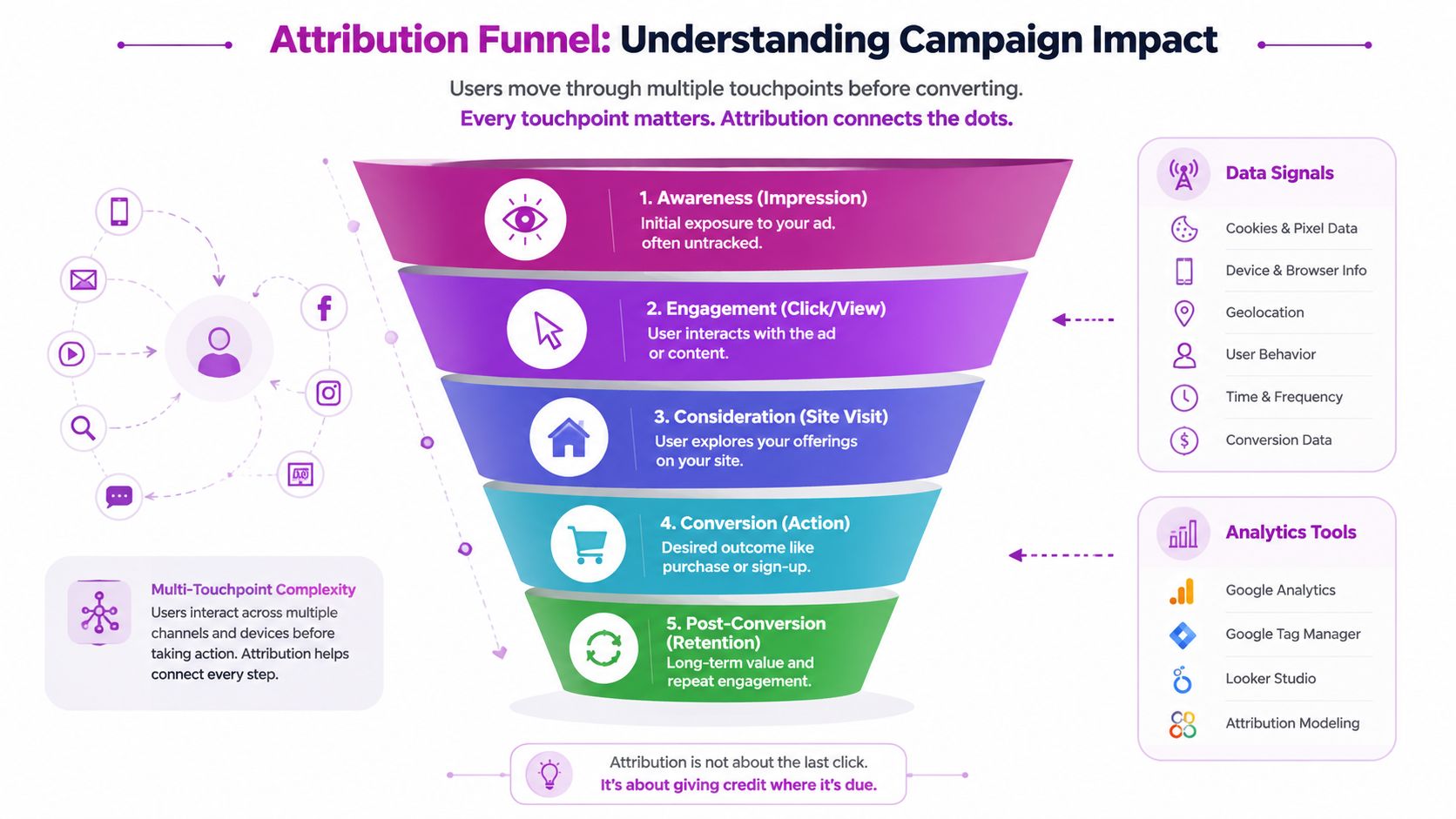
The ad platform sees a slice of the journey. Shopify sees orders. Analytics tools capture behavior. None of them, alone, tell the full story. If you only read last-click numbers from the ad account, you'll usually over-credit bottom-funnel activity and under-value the campaigns that introduced or warmed up the buyer.
Last-click is tidy, but it's often misleading
A typical Shopify customer journey can include multiple ad views, a site visit from Instagram, a return through branded search, and then a direct checkout later. Last-click gives most of the credit to the final step. That's convenient for reporting and weak for strategy.
A better measurement setup compares multiple views of the same journey:
- Platform reporting: Useful for in-platform optimization and creative decisions
- Shopify order data: Useful for validating revenue, product mix, and new versus returning customer behavior
- Site analytics: Useful for understanding landing page quality, navigation patterns, and drop-off points
When these don't line up, don't immediately assume one source is wrong. They're often measuring different parts of the same path.
Look for business impact, not just reported efficiency
The highest-rigor view is incrementality. Instead of asking which click got credit, ask a harder question. Would those orders have happened without the campaign?
Guidance for social campaign measurement recommends using geo-splits, holdouts, or lift studies to understand incrementality because last-click attribution alone can overstate ad impact. That matters when you're deciding whether a campaign is creating new demand or just harvesting existing intent.
A practical reporting stack often includes:
| Layer | What it answers |
|---|---|
| Ad platform data | Which audience, creative, and placement is winning inside the platform |
| Shopify data | Whether the campaign is producing profitable orders and healthy customer mix |
| Incrementality testing | Whether the campaign caused incremental revenue rather than just captured it |
Analytics also need audience nuance
Standard dashboards flatten people into averages. That becomes a problem when you're trying to reach groups with different media habits, language preferences, and trust dynamics.
Practitioner research on engaging underserved communities through digital media makes this point clearly. Reaching underserved audiences often requires studying the media they use, along with language preference, mobile-first behavior, and community trust patterns. If you only judge campaign reach through broad-market reporting, you can miss where the message is failing to connect.
That insight changes analytics practice. Don't just break performance down by age and gender. Break it down by landing page language, creative framing, community-specific placements, and audience context when relevant.
Some campaigns look average in aggregate and excellent within the right segment. Aggregated reporting hides that.
A strong social ad campaign doesn't stop at reporting attributed revenue. It asks whether the campaign changed demand, who it influenced, and whether that influence translated into profitable customer acquisition on Shopify.
Scaling Your Success with AI and Automation
Once a campaign works, manual management becomes the bottleneck. Teams spend too much time rebuilding reports, rotating obvious creative variants, checking pacing, and making small operational decisions that software can handle faster.
That's where AI becomes useful. Not as a replacement for strategy, but as a layer on top of a working system.
Know when a campaign is ready to scale
You don't scale because one ad had a good weekend. You scale when the system is repeatable.
That usually means:
- The offer is clear: Buyers understand the value fast.
- The landing path holds up: Traffic converts without depending on a narrow audience pocket.
- Creative variation exists: You have multiple usable hooks, not one tired winner.
- Measurement is stable: Shopify revenue, platform trends, and post-click behavior tell a coherent story.
If one of those pieces is missing, automation won't fix the weakness. It will just accelerate spend into it.
Use AI across the funnel, not just in ad copy
Most brands first use AI for headline ideas, image generation, or script drafts. That's fine, but it's the shallow end of the pool.
The better use case is full-funnel support:
| Funnel layer | Useful AI role |
|---|---|
| Audience discovery | Surface patterns in customer cohorts and product affinity |
| Creative production | Generate variants, edit hooks, localize messaging, repurpose winning formats |
| Media buying | Support automated targeting, placement allocation, and budget distribution |
| Landing page optimization | Personalize copy blocks, product emphasis, and merchandising logic |
| Reporting | Summarize change drivers and flag anomalies faster than manual review |
Platform-native tools such as Meta's automation features can help with targeting and delivery. The strategic work still belongs to the team. Someone still has to decide what message to push, which customer segment matters most, and whether the growth is profitable after product margin, discounting, and retention are considered.
For brands exploring a broader operational layer, these AI solutions for ecommerce show how automation can connect merchandising, customer experience, and acquisition rather than sitting in one isolated workflow.
Automation should remove friction, not judgment
The strongest operating model is hybrid. Let automation handle repetition. Keep human control over positioning, offer strategy, creative direction, and financial guardrails.
That means using AI to:
- draft more variants than your team could manually produce
- route traffic toward better-performing combinations faster
- identify post-click friction on Shopify pages
- support faster reporting cycles across campaign, landing page, and store data
It doesn't mean letting the machine decide what your brand stands for or which customer segments are worth acquiring.
A mature social ad campaign looks less like a set of ad sets and more like a connected revenue engine. Paid social creates demand. Shopify pages convert it. Analytics validate it. AI removes execution drag so the team can spend more time on the parts that still need judgment.
If your Shopify store is getting traffic but not enough profitable growth, ECORN can help connect the pieces that usually sit in separate silos: paid social inputs, CRO-driven landing pages, Shopify experience design, and the operational layer needed to scale campaigns without losing efficiency.


How to Cross Sell on Shopify Without Friction
Best Shopify Theme for Custom Products Compared
Multi Store Inventory Management: A Practical Guide

SEO Consulting for Ecommerce: A Practical Guide
Shopify Theme Updater App: A Safe Update Playbook
Shopify Git Integration: A Developer's Guide to 2026
Headless Ecommerce Development Services Explained

How to Build a Shopify Clothing Website That Converts
How to Launch a Box Subscription Business in 2026

Luxury Skincare Branding Playbook That Converters
10 Best Podcast Ecommerce Shows for Store Growth in 2026
Shopify Developer Hourly Rate: What to Pay in 2026
Critical Shopify Setup Errors That Are Secretly Sabotaging Your Store
Ecommerce Conversion Tracking: The Complete How-To Guide
Shopify Design Agency: How to Pick the Right Partner
Mastering Multi Store Management on Shopify
Scale Shopify Store
10 Shopify App Ideas Worth Building in 2026
Conversion Rate Optimization for Landing Pages: The Playbook
Shopify Plus Automation: A Guide for 2026
10 Social Selling Platforms for Shopify Merchants

Shopify Website Design Examples: 7 Stores Worth Studying
7 Ecommerce Newsletter Examples for Shopify Brands
One Product Shopify Store: Build and Scale
Mobile Pop Up Strategy for Shopify Stores That Converts
Sitemap for Shopify: How to Find, Optimize, and Submit It
7 Single Product Websites Worth Emulating
Product Variants Shopify: The Complete 2026 Guide
Ecommerce Analytics Consulting for Growth
What Is AI Integration for eCommerce
How to Choose the Right eCommerce Website Development Firm
E Business Strategy Implementation
Conversion Tracking Setup for Shopify Stores
BigCommerce vs Shopify Plus Which Enterprise Wins in 2026
Shopify Theme Kit: Setup, Commands, and Migration Guide
Shopify Extension Development: A Practical 2026 Guide
Shopify Speed Score Explained and How to Improve It
Shopify Mobile Optimization: The 2026 Playbook
How to Add Subcategory in Shopify for Better UX
How to Implement Structured Data for Ecommerce in 2026
SEO App Mobile: Shopify Store Optimization Guide
Shopify Plus Support: What It Includes and How to Choose
Google Ads for Shopify: The Complete 2026 Playbook
Shopify New York: How to Find and Hire the Right Agency
Google Search Console for Shopify: The Complete Setup
First Party Data Collection for eCommerce Growth
FAQ Online Store Guide: Build and Measure It Right
Do FB Ads Work for eCommerce in 2026?
One Page Checkout for Shopify: Design and Implementation
Shopify GraphQL vs REST: The 2026 Developer Decision
Shopify Ecommerce Consulting: Strategy, Pricing &
Are Reddit Ads Worth It for eCommerce Brands
Shopify Title and Meta Description: A Practical 2026 Guide
Product Video Best Practices for Shopify Brands
Real-Time Inventory Management: A 2026 Guide
AI Chatbot Integration for Shopify Stores
Affiliate Program Management: A Shopify Guide
10 Best Performance Monitoring Tools for Shopify in 2026
Digital Asset Management for eCommerce Brands in 2026
Every Type of Facebook Ads Explained for eCommerce Growth
Product Information Management Explained for Shopify Brands
Support Ticket System: A Guide for Shopify Stores

10 Best Customer Service Tools for Shopify in 2026

Can I Start a Business with No Money? a 2026 Blueprint
What Sells Good on Etsy: Best Niches for 2026

Shopify Add to Cart Button: A Practical 2026 Guide

Customer Feedback Automation: A Practical eCommerce Guide
Critical Rendering Path: A Guide for Shopify Stores

How to Promote on TikTok for eCommerce in 2026

B2B eCommerce Consulting That Drives Real Revenue
10 Best Practices for Site Navigation in 2026
Return vs Refund for Shopify Stores: A Practical Guide
What Is Customer Lifetime Value and Why It Matters
What Is Voice of Customer Research for eCommerce

SMS Marketing for Ecommerce That Actually Converts

Master How to Improve Email Deliverability in 2026

Top 8 eCommerce Partners NYC for Shopify Brands in 2026
Machine Learning for Ecommerce: Boost Your Shopify Store

Beauty Market Research: Your 2026 Growth Guide
Shopify International Expansion: A 2026 Roadmap
What Does CRO Stand for in Business: Understanding CRO

Shopify Visual Merchandising: A Playbook for Higher Sales
Shopify Landing Page Design: Master Conversion in 2026
10 Best AI SEO Optimization Tools for Shopify in 2026

Agentic AI for Ecommerce: Boost Your Sales in 2026
Mastering Email Marketing Data for eCommerce Growth
Conversion Rate Optimisation Australia: Boost Your Sales
Conversion Rate Optimization AI: Your Shopify Store Guide

10 Product Bundling Strategies for Shopify in 2026
How to Increase Customer Lifetime Value: A Shopify Playbook
AI Customer Service Automation: Shopify Guide 2026
Clean Website Design: A Shopify Conversion Playbook

Omnichannel Retail Strategy: A Shopify Playbook
Product Data Enrichment: A Guide for Shopify Brands
Instagram Shopping Features a Guide for Shopify Stores
What Is Revenue Optimization: A Holistic RevOps Guide
Benefits of Conversion Rate Optimization: Boost Your
WordPress to Shopify Migration: Your 2026 Seamless Switch
Boost Sales: Ecommerce Payment Processing Guide 2026
Unified Commerce Platform: Benefits, KPIs & Shopify Guide


newsletter in your inbox