

You're halfway through a Shopify Plus app build when the question stops being theoretical. The product sync works through REST, your existing webhook handlers depend on familiar resources, and the next sprint needs catalog support that Shopify now expects developers to build through GraphQL. Rewriting everything feels risky. Continuing with REST feels worse.
That's Shopify GraphQL vs REST in 2026. It's no longer a neutral argument about query syntax or developer preference. Shopify officially marked the Admin REST API as legacy on October 1, 2024, and required all new public apps submitted to the Shopify App Store to use GraphQL exclusively from April 1, 2025, as documented in Shopify's GraphQL app development guidance.
This guide takes the position of a migration advisor. It focuses on what to build next, what to leave temporarily, and how to avoid creating a permanent parallel stack.
The Choice Every Shopify Developer Is Facing in 2026
A Shopify Plus agency has an established order management app. Its first version uses REST because the team already knows the endpoints, the integration has predictable payloads, and the original scope was modest. The client now wants richer product configuration, more variants, and a dashboard that combines products, inventory, metafields, and fulfillment data.
The team has two options for the next sprint. They can extend the REST integration and accept more legacy code, or they can introduce GraphQL beside it and begin moving the highest-value workflows. The second option takes planning, but the first creates technical debt at exactly the point where Shopify is moving new capabilities elsewhere.
Practical rule: Keep REST where it protects a working legacy workflow. Don't use it as the foundation for new Shopify Admin features.
The comparison below gives the decision in operational terms.
| Decision area | REST Admin API | GraphQL Admin API |
|---|---|---|
| Shopify's current direction | Legacy compatibility layer | Preferred path for new Admin development |
| New public App Store submissions | Not sufficient for new submissions after the policy change | Required for new public apps |
| Response model | Endpoint-defined JSON resource | Client-selected fields from a query |
| Rate limiting | Request-count model | Calculated query-cost model |
| Complex product data | Increasingly constrained by deprecated resources | Newer catalog capabilities are placed here |
| Best 2026 use | Existing integrations and narrow legacy maintenance | New features, complex reads, and scalable catalog work |
The purpose here isn't to declare REST useless. REST still has a place when an integration is stable, narrow, and expensive to disturb. The purpose is to help you decide whether the next piece of code should reinforce that old path or start the migration.
If you're planning a new public app, the answer is straightforward. Build GraphQL. If you're maintaining an existing private app, make the decision by workflow, not by ideology. Start with the endpoints tied to new Shopify capabilities, high-volume catalog operations, and the parts of the codebase that already require awkward batching.
What Shopify's REST and GraphQL APIs Actually Are
The Admin API is the back-office interface. Your app uses it to work with products, orders, inventory, customers, metafields, and other merchant data. Shopify offers both REST and GraphQL Admin APIs, but they no longer provide symmetrical access to the platform's evolving capabilities.
REST organizes operations around resource URLs and HTTP methods. A request might look like this:
`GET
The server decides the response shape for that endpoint. You can often understand and debug the call with ordinary HTTP tools, inspect the JSON response, and make a follow-up request to another resource. That simplicity remains useful for older scripts and tightly scoped integrations.
GraphQL uses a single endpoint and sends a query or mutation in a POST request:
`POST
The request body specifies the fields the client needs:
{ products(first: 10) { nodes { id title } } }
The response follows the shape of the query. If the interface only needs product IDs and titles, the client doesn't need to request every available product field. That makes GraphQL useful for screens and services that combine related commerce objects.
Admin and Storefront are different surfaces
Don't confuse the GraphQL Admin API with the Storefront API. The Admin API runs privileged back-office operations, subject to app permissions and shop authorization. The Storefront API supports customer-facing experiences such as product discovery, carts, and headless commerce interfaces.
A headless storefront might use Storefront GraphQL to request products, collections, prices, and media in a shape suited to its components. An internal merchandising tool would typically use the Admin API instead. The two surfaces solve different problems, even though both can use GraphQL.
Queries read, mutations change
GraphQL separates reads from writes through queries and mutations. A query retrieves selected fields. A mutation expresses an operation such as updating a product or changing inventory, then returns the result and any user errors in the response.
REST expresses similar intent through methods and resource endpoints, such as GET, POST, or PUT. GraphQL's mutation model is more structured for compound operations, but it also requires developers to understand Shopify's schema, input types, user error fields, and operation-specific behavior.
For a developer moving from REST, the mental shift is simple. REST asks, “Which endpoint represents this resource?” GraphQL asks, “Which operation and fields represent the result this workflow needs?”
Performance and Rate Limits Side by Side
Request economics determine whether an integration remains easy to operate. A catalog workflow that reads products, variants, inventory, and metafields can spend more time coordinating API calls than executing business logic, especially under REST's endpoint-based model.
Shopify documents REST Admin API throttling at 40 requests per app per store per minute in its REST Admin API documentation. REST still fits a narrow, stable workflow. Request-heavy synchronization becomes harder to scale when the client needs several resources or updates records individually.
GraphQL uses a calculated cost bucket. Shopify documents 100 points per second for standard shops, 200 for Advanced, 1000 for Shopify Plus, and 2000 for Commerce Components in its GraphQL usage limits documentation. A single object fetch typically costs about 1 point, while mutations typically cost about 10 points.
| Dimension | REST Admin API | GraphQL Admin API |
|---|---|---|
| Throttling model | Requests per app per store per minute | Calculated query cost |
| Documented baseline | 40 requests per minute | 100 points per second for standard shops |
| Shopify Plus limit | Uses the documented REST request model | 1000 points per second |
| Read behavior | Endpoint-defined response | Client selects fields |
| Mutation economics | Each HTTP operation counts as a request | Mutations typically cost about 10 points |
| Main planning concern | Number of round trips | Query cost, nesting, batching, and retries |
GraphQL is not automatically faster. Its advantage is request consolidation. One deliberate query can retrieve related records and omit fields the client never uses, which reduces application-side stitching for products, variants, and other connected commerce objects.
The important catalog shift arrived with Shopify's 2024-04 API release. GraphQL product types expanded support from the historical maximum of 100 variants per product to up to 2048 variants. Shopify also deprecated the corresponding REST product and variant resources, as explained in its 2024-04 API release notes.
Plan GraphQL around cost, not request count alone. Nested queries consume more budget than focused reads, and mutation-heavy jobs need retries that account for cost restoration and partial failures. For broader planning, the Shopify API integration guidance from ECORN provides useful context. Your query-cost logs should decide whether a workflow needs batching, narrower selections, or a different execution schedule.
Where Each API Fits by Use Case
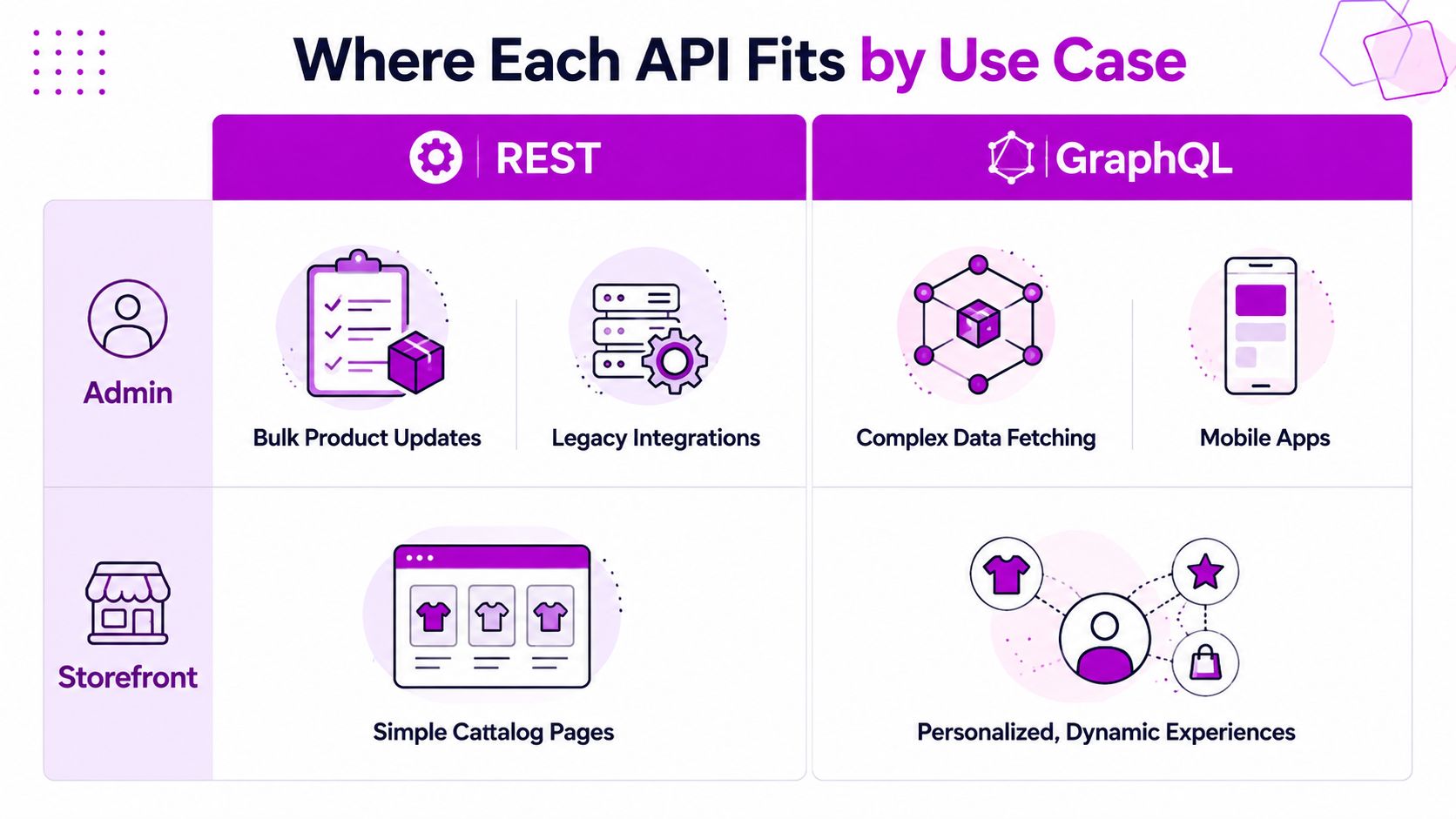
In 2026, the choice is usually an operational migration decision. Shopify has marked REST as legacy, and new public apps must use GraphQL. REST still has a place, but mainly where an existing workflow is stable, narrow, and expensive to replace.
Admin workflows
Choose GraphQL for new product operations, complex inventory views, metafield-heavy tools, and catalog features built on Shopify's newer schema. The client can request the fields the workflow needs, while the team builds against Shopify's active development direction.
GraphQL also fits dashboards that combine products, variants, inventory, and other related objects. The query can reflect the interface instead of forcing the application to coordinate a chain of endpoint responses.
REST remains justified in narrower cases:
- Existing integrations: Keep a stable REST connector when it performs a limited job and the application has no immediate feature or approval requirement.
- Legacy scripts: Scheduled jobs, internal utilities, and older middleware may not justify a rewrite during the current delivery cycle.
- Known payloads: A simple resource fetch can be easier to operate when its response already matches the workflow.
- Compatibility maintenance: REST can act as a temporary bridge while the application introduces GraphQL in controlled stages.
Treat webhooks as a separate decision. The receiver accepts an event, then follow-up Admin API calls retrieve or change Shopify data. Keep the receiver stable, and evaluate those subsequent calls independently. A webhook-driven workflow does not automatically require REST.
For teams building a new app, the Shopify app development guidance from ECORN places API selection within the app's implementation scope. That distinction matters because merchant operations may use Admin APIs, while buyer-facing features use Storefront APIs, with separate permissions, schemas, and testing requirements.
Storefront workflows
Headless product pages, cart operations, and other customer-facing features usually belong on Storefront GraphQL. Each frontend component can request the fields it renders, creating a clearer contract between the storefront and commerce data.
A simple catalog page can remain on a stable existing data layer when there is no operational reason to change it. New Storefront work should start with Shopify's Storefront API model, not the Admin REST API.
The practical matrix is direct: new Admin capability means GraphQL. Stable legacy maintenance may justify REST. Customer-facing headless work usually starts with Storefront GraphQL.
Migrating a Real Workflow from REST to GraphQL
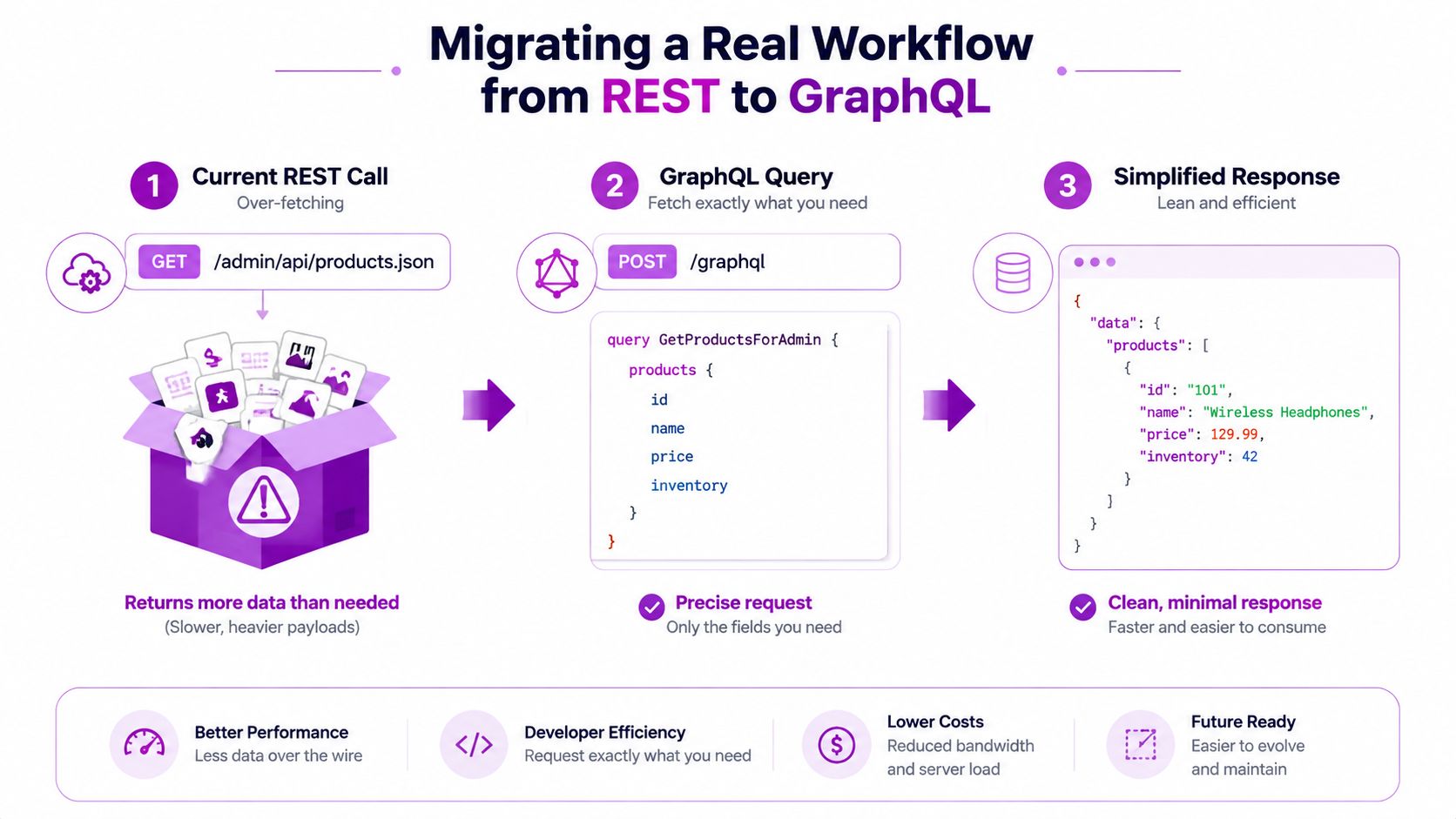
Take a common internal workflow. A merchandising dashboard lists products, shows a small set of fields, and lets an operator update selected product data.
The REST version might begin with:
GET /admin/api/{version}/products.json
That endpoint returns the resource representation defined by Shopify. If the dashboard needs only an ID, title, handle, and status, the application may still receive fields it doesn't display. The client then makes additional requests when it needs related variants or inventory data.
The GraphQL rewrite starts with the interface's actual requirements:
query { products(first: 20) { nodes { id title handle status } } }
The query is more explicit. The team can add the precise connections needed by the screen, then inspect the calculated query cost before shipping the endpoint.
Translate the write operation, not just the URL
A REST update often maps to a resource-specific PUT request. The application prepares a payload, sends the request, checks the status, and repeats the process for other records.
GraphQL uses a mutation with typed input:
mutation { productUpdate(input: { id: "...", title: "Updated title" }) { product { id title } userErrors { field message } } }
The exact operation and input shape depend on the Shopify API version and the object being changed. The important design change is that the mutation returns the fields the workflow needs and exposes structured user errors alongside the result.
A safe migration sequence looks like this:
- Inventory the REST surface. Record every endpoint, field, pagination rule, write operation, webhook follow-up, and retry path.
- Map intent to GraphQL operations. Don't perform a mechanical URL conversion. Identify the business action, then select the matching query or mutation.
- Reduce the response shape. Request only fields used by the application, especially in list screens and synchronization jobs.
- Add cost telemetry. Log query cost, response errors, throttling signals, and operation duration.
- Run comparison tests. Feed equivalent shop data through both implementations and compare normalized business output.
- Switch by workflow. Move one synchronization or dashboard path at a time, rather than changing every API call in one deployment.
Teams managing products with more than 100 variants have a stronger reason to prioritize the rewrite. Shopify's 2024-04 release moved the expanded 2048-variant product capability into GraphQL and deprecated the corresponding REST product and variant resources. That isn't a performance optimization. It's a data-model constraint that changes which API can support the workflow.
Where GraphQL Is Actually Harder Than REST
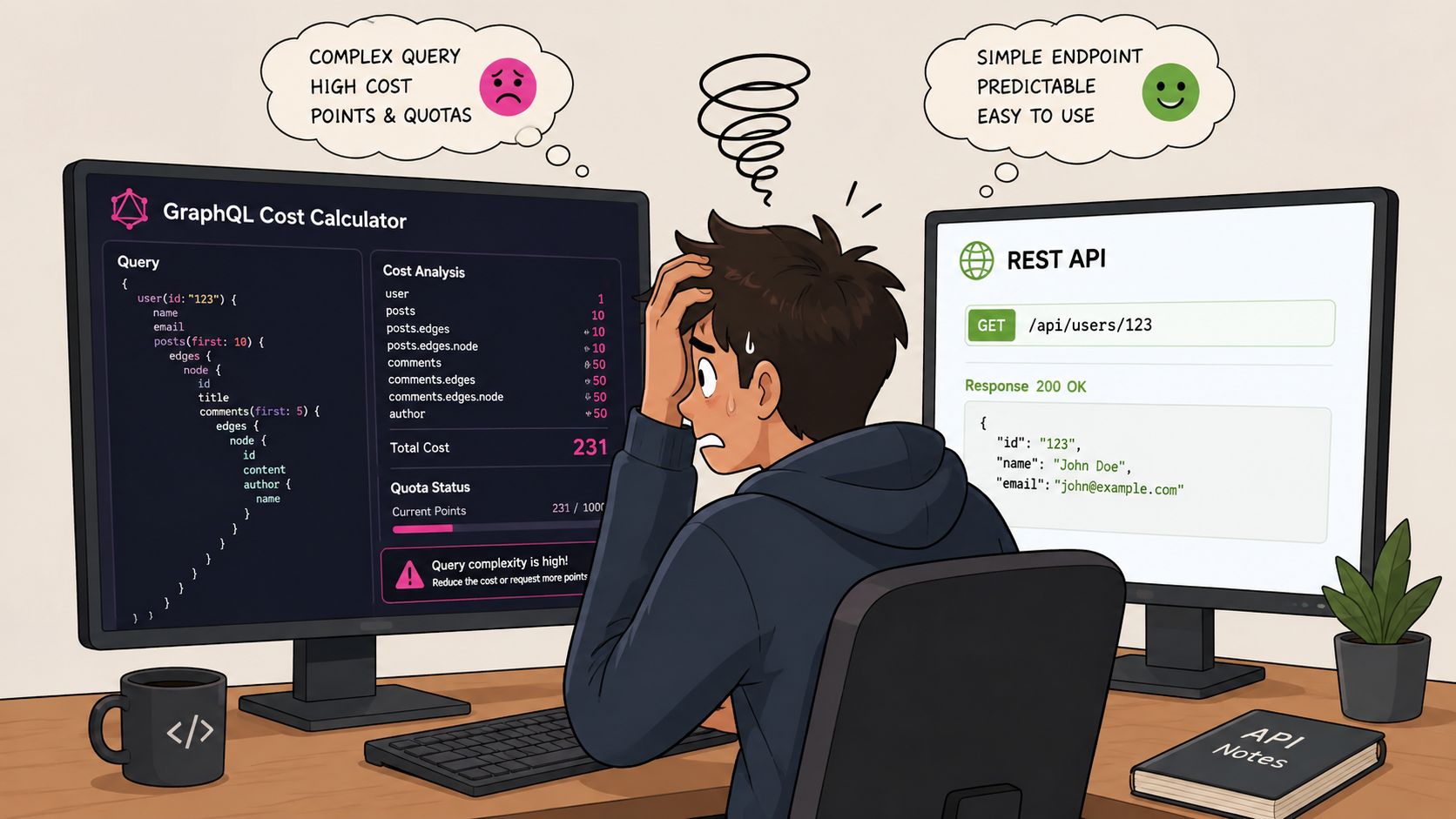
GraphQL's flexibility creates a new class of operator problems. REST's request-count model is blunt, but the team can usually understand the cost of one call. GraphQL asks the team to reason about the fields, connections, nesting, pagination, and mutations inside each operation.
A query that looks efficient at the top level can become expensive through nested connections. Fragments can make this harder to spot because the final field selection is distributed across reusable pieces. A developer may add a relation for one screen, reuse the fragment elsewhere, and increase the cost of a previously safe query.
Cost planning replaces request counting
On Shopify Plus, GraphQL has a documented budget of 1000 points per second, while standard shops have 100 points per second, as described in Shopify's usage limits reference. The larger Plus budget helps, but it doesn't remove the need for query planning.
Use separate operation classes:
- Focused reads should request a narrow field set and avoid unnecessary nested connections.
- Catalog reads should use deliberate pagination and selection sets rather than reproducing a full REST resource.
- Mutations should be grouped only when the operation semantics and failure handling support it.
- High-churn jobs should record cost and throttle signals so the worker can slow down before repeated retries make the queue worse.
Error handling also changes. GraphQL can return a response with data and user errors together, so the application must decide whether to accept partial output, retry a specific item, or mark the entire job for review. REST integrations often build around an HTTP status and a single resource response, which can feel simpler even when the workflow requires more calls.
Migration warning: Fewer network round trips don't guarantee simpler operations. GraphQL reduces transport overhead, but it increases the importance of query design, cost observability, and idempotent retries.
REST may still be the better short-term choice for a tiny, low-change internal utility where the endpoint is stable and the team has no GraphQL infrastructure. That's a maintenance decision, not an argument that REST is the right foundation for new Shopify development.
Which API to Choose for Your Next Shopify Project
In 2026, treat the choice as a migration decision, not a preference between query styles. Shopify has marked REST as legacy, and new public apps must use GraphQL. For new work, GraphQL is the default. REST remains a controlled compatibility option for stable systems that have a clear reason to avoid immediate migration.
For a brand-new public app, choose GraphQL. Shopify requires new public apps submitted to the Shopify App Store after April 1, 2025 to use it exclusively, according to the Shopify GraphQL development documentation. Starting a new public feature in REST creates a submission risk before it creates a technical benefit.
Use this decision rule for existing private apps and custom integrations:
| Situation | Recommendation |
|---|---|
| New Admin feature | GraphQL |
| Product workflow requiring more than 100 variants | GraphQL migration |
| Feature available only through newer GraphQL capabilities | Migrate before expanding scope |
| Stable legacy script with low change frequency | Keep REST temporarily |
| High-volume catalog synchronization | Redesign around GraphQL and cost-aware workers |
| New headless storefront experience | Use Storefront GraphQL |
| Existing REST connector with no immediate roadmap pressure | Isolate and schedule migration |
A migration plan that survives production
Audit the dependency surface first. Inventory REST resources, API versions, pagination behavior, authentication assumptions, webhook-triggered reads, and writes. Flag calls tied to deprecated product resources or catalog requirements that REST cannot support cleanly.
Prioritize capability risk. Product and variant workflows belong near the top of the queue, especially when the catalog exceeds the historical 100-variant ceiling. GraphQL supports up to 2048 variants, as Shopify documented in its 2024-04 release notes. Treat that gap as a planning constraint, not a future enhancement.
Isolate high-volume calls. Build a GraphQL client module with query files, typed variables, cost logging, error normalization, and retry behavior. Keep raw GraphQL strings out of controllers, webhook handlers, and scheduled workers.
Run a controlled parallel period. Keep the existing REST path active while GraphQL serves a selected tenant, job type, or read-only screen. Compare business results, data completeness, and failure handling, not only HTTP responses. After the new path proves reliable, remove REST calls from that workflow. Do not maintain two implementations without a removal date.
ECORN offers Shopify API integration and development services for teams scoping an Admin API migration alongside storefront and app work. The planning decision should be explicit: use GraphQL for new development, retain REST only as an isolated compatibility layer, and schedule migration for legacy workflows that limit catalog capability or raise maintenance costs.
Common Questions About Shopify GraphQL vs REST
Does an existing private app need to migrate immediately?
Not necessarily. Shopify's policy shift primarily affects new public App Store submissions, while an existing private integration may continue using REST for a period. Treat that window as migration time, not a reason to expand REST indefinitely. Put new features on GraphQL, then schedule legacy workflow migration according to capability gaps, operational risk, and maintenance cost.
Does the Storefront API still use REST?
The Storefront API is separate from the Admin API and serves buyer-facing experiences. Build new headless storefronts around Storefront GraphQL when the frontend needs flexible product, cart, or checkout data. An Admin API decision should not determine the customer-facing API.
How should a team estimate GraphQL cost?
Measure Shopify's calculated query cost during development, then test the actual selection set with realistic nesting and pagination. Log cost, throttling responses, partial errors, and retry behavior before enabling a high-volume worker. Shopify documents these limits in its usage guidance.
Which plan provides more GraphQL headroom?
Shopify documents different request capacity for standard shops, Advanced, Shopify Plus, and Commerce Components. Plan around the operation mix, not the shop tier alone, because mutations and nested reads consume cost differently. Keep cost monitoring in production so traffic changes do not turn into unexplained throttling.
ECORN helps Shopify teams plan API integrations, custom app development, Shopify Plus builds, and storefront improvements with GraphQL migration in mind. Review the REST dependency map, select the next workflow that needs GraphQL, and visit ECORN to discuss implementation.



7 Ecommerce Newsletter Examples for Shopify Brands
One Product Shopify Store: Build and Scale

Mobile Pop Up Strategy for Shopify Stores That Converts

Sitemap for Shopify: How to Find, Optimize, and Submit It

7 Single Product Websites Worth Emulating
Product Variants Shopify: The Complete 2026 Guide
Ecommerce Analytics Consulting for Growth

What Is AI Integration for eCommerce

How to Choose the Right eCommerce Website Development Firm
E Business Strategy Implementation
Conversion Tracking Setup for Shopify Stores
BigCommerce vs Shopify Plus Which Enterprise Wins in 2026
Shopify Theme Kit: Setup, Commands, and Migration Guide

Shopify Extension Development: A Practical 2026 Guide
Shopify Speed Score Explained and How to Improve It
Shopify Mobile Optimization: The 2026 Playbook

How to Add Subcategory in Shopify for Better UX
How to Implement Structured Data for Ecommerce in 2026

SEO App Mobile: Shopify Store Optimization Guide

Shopify Plus Support: What It Includes and How to Choose

Google Ads for Shopify: The Complete 2026 Playbook

Shopify New York: How to Find and Hire the Right Agency

Google Search Console for Shopify: The Complete Setup
First Party Data Collection for eCommerce Growth
FAQ Online Store Guide: Build and Measure It Right

Do FB Ads Work for eCommerce in 2026?

One Page Checkout for Shopify: Design and Implementation
Shopify Ecommerce Consulting: Strategy, Pricing &

Are Reddit Ads Worth It for eCommerce Brands

Shopify Title and Meta Description: A Practical 2026 Guide

Product Video Best Practices for Shopify Brands
Real-Time Inventory Management: A 2026 Guide

AI Chatbot Integration for Shopify Stores
Affiliate Program Management: A Shopify Guide
10 Best Performance Monitoring Tools for Shopify in 2026
Digital Asset Management for eCommerce Brands in 2026

Every Type of Facebook Ads Explained for eCommerce Growth
Product Information Management Explained for Shopify Brands
Support Ticket System: A Guide for Shopify Stores

10 Best Customer Service Tools for Shopify in 2026

Can I Start a Business with No Money? a 2026 Blueprint

What Sells Good on Etsy: Best Niches for 2026

Shopify Add to Cart Button: A Practical 2026 Guide

Customer Feedback Automation: A Practical eCommerce Guide

Critical Rendering Path: A Guide for Shopify Stores

How to Promote on TikTok for eCommerce in 2026

B2B eCommerce Consulting That Drives Real Revenue

10 Best Practices for Site Navigation in 2026
Return vs Refund for Shopify Stores: A Practical Guide
What Is Customer Lifetime Value and Why It Matters
What Is Voice of Customer Research for eCommerce

SMS Marketing for Ecommerce That Actually Converts

Master How to Improve Email Deliverability in 2026

Top 7 eCommerce Partners NYC for Shopify Brands in 2026

Machine Learning for Ecommerce: Boost Your Shopify Store

Beauty Market Research: Your 2026 Growth Guide

Shopify International Expansion: A 2026 Roadmap

What Does CRO Stand for in Business: Understanding CRO

Shopify Visual Merchandising: A Playbook for Higher Sales

Shopify Landing Page Design: Master Conversion in 2026
10 Best AI SEO Optimization Tools for Shopify in 2026

Agentic AI for Ecommerce: Boost Your Sales in 2026
Mastering Email Marketing Data for eCommerce Growth

Conversion Rate Optimisation Australia: Boost Your Sales
Conversion Rate Optimization AI: Your Shopify Store Guide

10 Product Bundling Strategies for Shopify in 2026

How to Increase Customer Lifetime Value: A Shopify Playbook
AI Customer Service Automation: Shopify Guide 2026

Clean Website Design: A Shopify Conversion Playbook

Omnichannel Retail Strategy: A Shopify Playbook
Product Data Enrichment: A Guide for Shopify Brands

Instagram Shopping Features a Guide for Shopify Stores
What Is Revenue Optimization: A Holistic RevOps Guide

Benefits of Conversion Rate Optimization: Boost Your
WordPress to Shopify Migration: Your 2026 Seamless Switch
Boost Sales: Ecommerce Payment Processing Guide 2026
Unified Commerce Platform: Benefits, KPIs & Shopify Guide

How to Reduce Bounce Rate eCommerce: Your 2026 Guide
Shopify API Integration: A Practical End-to-End Guide

How to Implement Data Governance: A 2026 Guide
Shopify Store Development Cost: A 2026 Breakdown
What Is Server Side Tracking: The Shopify Guide 2026
Marketing Automation Workflows: A Shopify Guide for 2026

Shopify: How to Reduce Technical Debt

Shopify UX Design Change: A Playbook for Growth
User Generated Content Strategy: Shopify Playbook

Shopify Pause and Build Plan Cost: A Complete 2026 Guide

Compare at Price on Shopify: A Complete Guide for 2026

Where Can I Sell My Prints? 10 Best Platforms for 2026
Shopify Order Management System: The Ultimate Guide 2026
What Is Marketing Attribution? an eCommerce Guide for 2026

10 Best Black Friday Sales Sheets for 2026

Discover the Top Social Media Marketing Agencies For

Consumer Confidence Definition for eCommerce in 2026

What Is Social Commerce? Your 2026 Guide to Boosting Sales

A Social Ad Campaign Playbook for eCommerce Growth

7 Best FAQ Page Examples for SaaS & eCommerce

Market Research in Fashion Industry: A Guide for Shopify
Shopify Migration Services: Expert Guide for 2026

Mastering FB Retargeting Ads for Shopify in 2026


newsletter in your inbox