

The popular advice is to hire a Shopify consultant for an audit, redesign the theme, and wait for conversion rates to rise. That model is too narrow for a growing brand. Most operators already know their obvious problems: the storefront is slow, the app stack is messy, international expansion keeps slipping, and the team can't turn a backlog into safe production releases.
Shopify ecommerce consulting creates value when it closes that gap between knowing and doing. The consultant's job isn't merely to deliver recommendations. It's to connect commercial priorities with architecture, people, budgets, measurement, and a repeatable shipping process.
Why Most Brands Misunderstand Shopify Consulting
A store audit is useful, but it isn't a consulting strategy. An audit can identify a weak product page, excessive scripts, an unclear navigation path, or a problematic checkout interaction. It can't, on its own, decide which issue deserves engineering time this week, who owns the change, how the team will test it, or what gets postponed when the budget is constrained.
Growing brands usually don't suffer from a lack of ideas. They suffer from execution friction. Marketing wants new landing pages, merchandising wants richer collection filters, finance wants cleaner reporting, developers want to reduce technical debt, and leadership wants international revenue. Each request may be reasonable, yet the organization still ships slowly because nobody has converted the requests into a sequenced operating plan.
Consulting is an operating system
The strongest engagements establish a practical loop:
- Diagnose the commercial constraint. Is the priority acquisition efficiency, product discovery, checkout confidence, operational scale, or market expansion?
- Map the dependencies. A seemingly simple conversion change may involve Liquid templates, app scripts, analytics events, product data, inventory logic, and localization.
- Prioritize against capacity. A team with limited development time can't treat every recommendation as urgent.
- Release safely. Changes need acceptance criteria, staging checks, performance review, and a rollback path.
- Measure and learn. The next sprint should reflect what happened in production, not what looked persuasive in a workshop.
Practical rule: If a recommendation doesn't have an owner, a delivery path, and a measurement method, it isn't yet an execution plan.
Shopify's own enterprise guidance on digital transformation challenges highlights the strategy-execution disconnect, along with legacy systems, disconnected tools, skills gaps, and unpredictable costs. That context matters for brands moving toward Shopify Plus. The question changes from “What should we improve?” to “How do we deliver improvements continuously without destabilizing the store?”
This is why a theme redesign often disappoints. A new interface can remove visible friction while leaving slow scripts, weak product data, unclear ownership, and an overloaded release process untouched. Effective Shopify ecommerce consulting builds the coordination layer that lets a brand make better decisions and ship them repeatedly.
The Measurable Impact of Specialized Shopify Expertise
Shopify's scale explains why platform-specific expertise has become a serious commercial discipline. By early 2026, Shopify said it powered over 1 million merchants, and its global economic impact report stated that businesses built on Shopify supported $183 billion in global economic activity from 2016 through 2018. The same report described economic activity above $100 million in more than 40 countries, above $1 billion in 12 countries, and support for over 1.4 million full-time jobs worldwide.
Those figures don't prove that every store needs an agency. They do show why a generalist approach can become expensive. Shopify work may involve Plus organization design, Markets, payments, subscriptions, ERP or warehouse connections, app governance, Liquid, APIs, analytics, CRO, and storefront performance. A consultant who understands how those pieces interact can prevent a brand from solving one problem by creating another.
Shopify's commercial momentum reinforces the point. In its Q1 2026 results, Shopify reported $100.7 billion in gross merchandise volume, up 35% year over year, and $3.17 billion in revenue, up 34% year over year. Shopify also said that 875 million or more unique online shoppers purchased from Shopify merchants in 2024, while international revenue grew 33% in the quarter. As the merchant ecosystem becomes more complex and international, specialized implementation knowledge becomes more valuable.
Performance is a commercial decision
Theme selection illustrates the risk of treating technical work as cosmetic. Shopify's theme performance data table shows that the median share of shops passing Largest Contentful Paint is 94.5%, while the median share passing all Core Web Vitals is 86.1%. Across themes, the minimum share passing all Core Web Vitals falls to 19.6%.
The implication is straightforward. Two themes can look similarly attractive in a design review while creating very different performance conditions once apps, merchandising blocks, filters, swatches, and tracking scripts are added. A specialist evaluates the complete implementation, not just the demo storefront.
The return from expertise usually comes through compounding operational gains:
- Faster delivery: Clear architecture and acceptance criteria reduce rework.
- Lower technical debt: App duplication, abandoned snippets, and brittle customizations get addressed before they block growth.
- Better conversion work: CRO experiments run against reliable analytics and stable templates.
- Safer expansion: Markets, currencies, languages, catalogs, and fulfillment rules are designed together rather than added as disconnected patches.
A consultant doesn't create value by producing more documents. They create value by helping the team make fewer expensive mistakes and release useful changes with greater confidence.
Retainer vs Project-Based Consulting Models
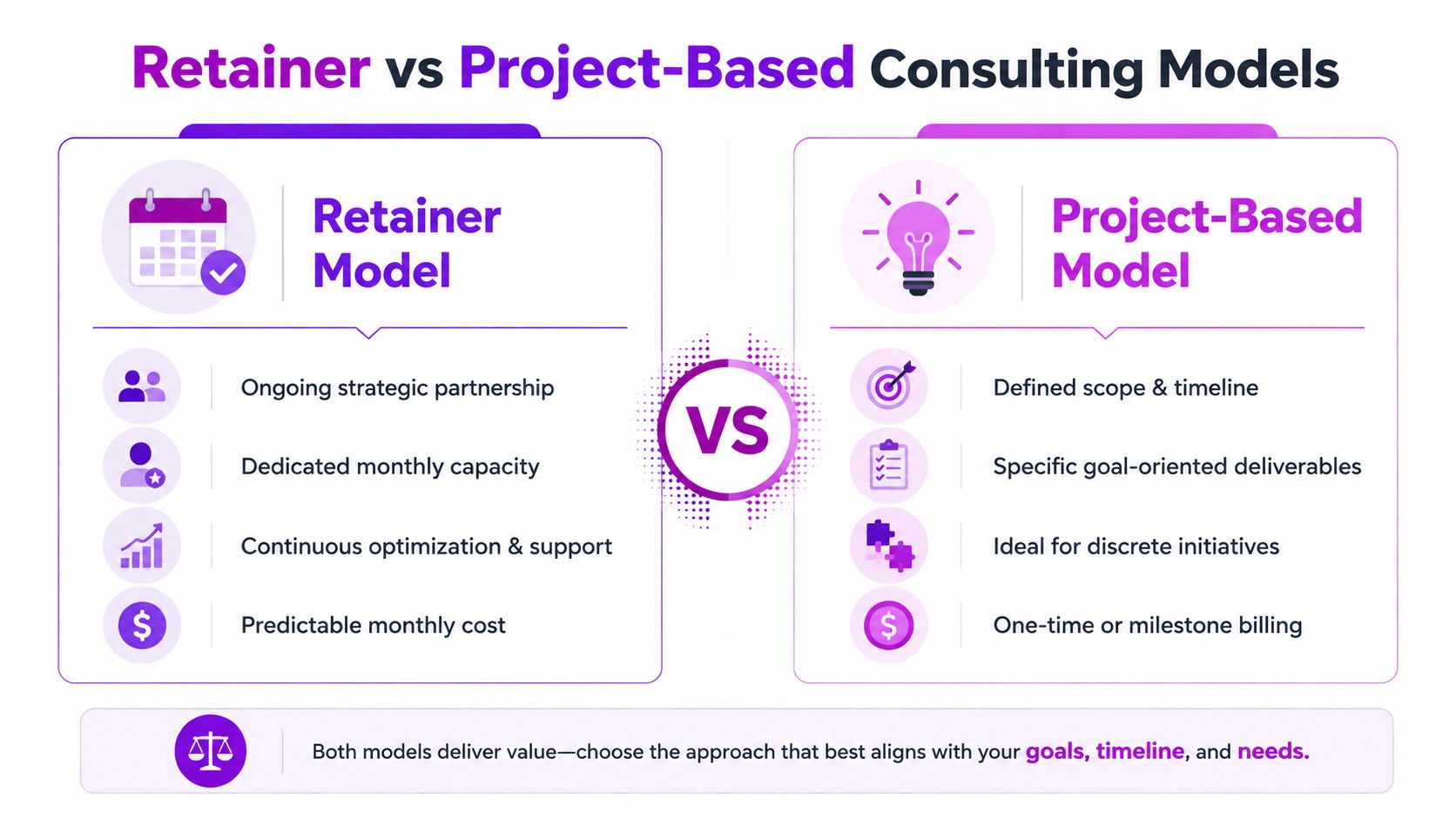
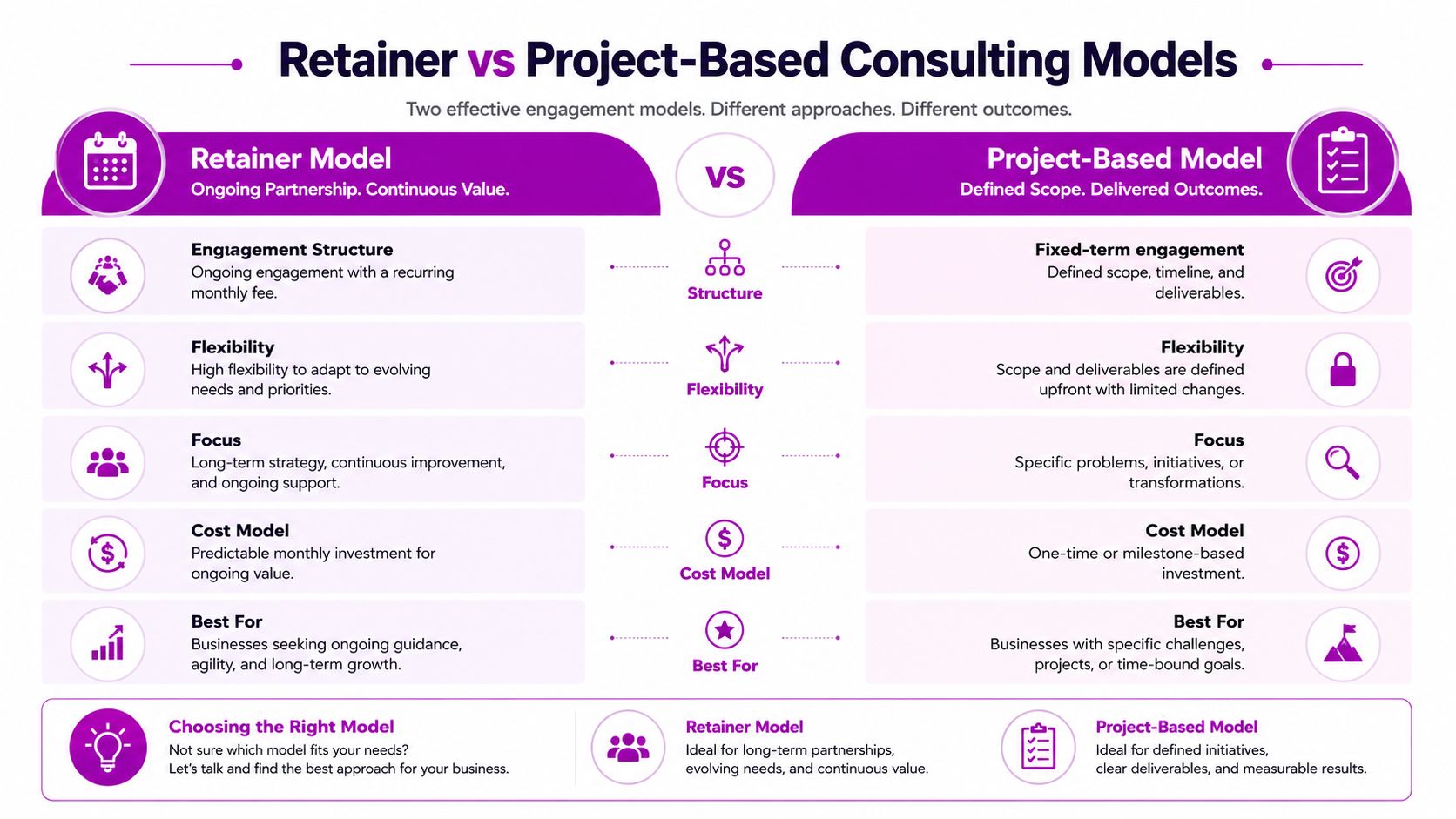
The right engagement model depends less on a consultant's preference than on the type of uncertainty your brand faces. A migration has a defined destination and a natural completion point. Continuous optimization, multi-storefront governance, and AI-readiness don't end after a single deliverable.
Choose project-based work when the destination is clear
A project engagement fits a discrete initiative with a defined scope, such as:
- Shopify migration: Discovery, data mapping, integrations, redirects, theme implementation, quality assurance, and launch support.
- Theme rebuild: A new design system, improved templates, and a controlled component library.
- Technical implementation: A specific ERP connection, subscription setup, custom app, or checkout requirement.
- Market launch: Localization, catalog preparation, payment configuration, and operational readiness for a new region.
Project work makes accountability visible. The brief should define what is included, what isn't, who approves decisions, how change requests are handled, and which post-launch support is available. It works particularly well when the internal team can own the store after handover.
For planning context, brands should also separate consulting fees from the broader investment required to build and operate a store. ECORN's guide to the cost of a Shopify store can help frame that wider budget conversation.
Choose a retainer when priorities keep moving
A retainer is better suited to a brand with a live optimization backlog and limited internal capacity. The value comes from reserved access to strategy, design, development, QA, analytics, and decision support rather than from one large launch.
Retainers make sense when:
- The store changes weekly: Campaigns, merchandising, experiments, and technical fixes compete for the same delivery capacity.
- Several storefronts share a platform: A change in one market may affect templates, translations, feeds, or reporting elsewhere.
- The brand is scaling into complexity: Shopify Plus architecture, app governance, B2B requirements, and international operations need ongoing oversight.
- Leadership needs prioritization: The consultant helps decide what not to build, not just what to build next.
The trade-off is commitment. A retainer can become wasteful when the partner has no meaningful backlog, no agreed capacity plan, or no measurable operating rhythm. Project work can become wasteful when every new requirement requires a fresh procurement cycle.
A useful decision test is simple: if your next major objective has a clear finish line, start with a project. If the business expects continuous change and can't reliably staff it internally, a retainer is usually the more honest model.
How to Evaluate and Select a Shopify Consulting Partner
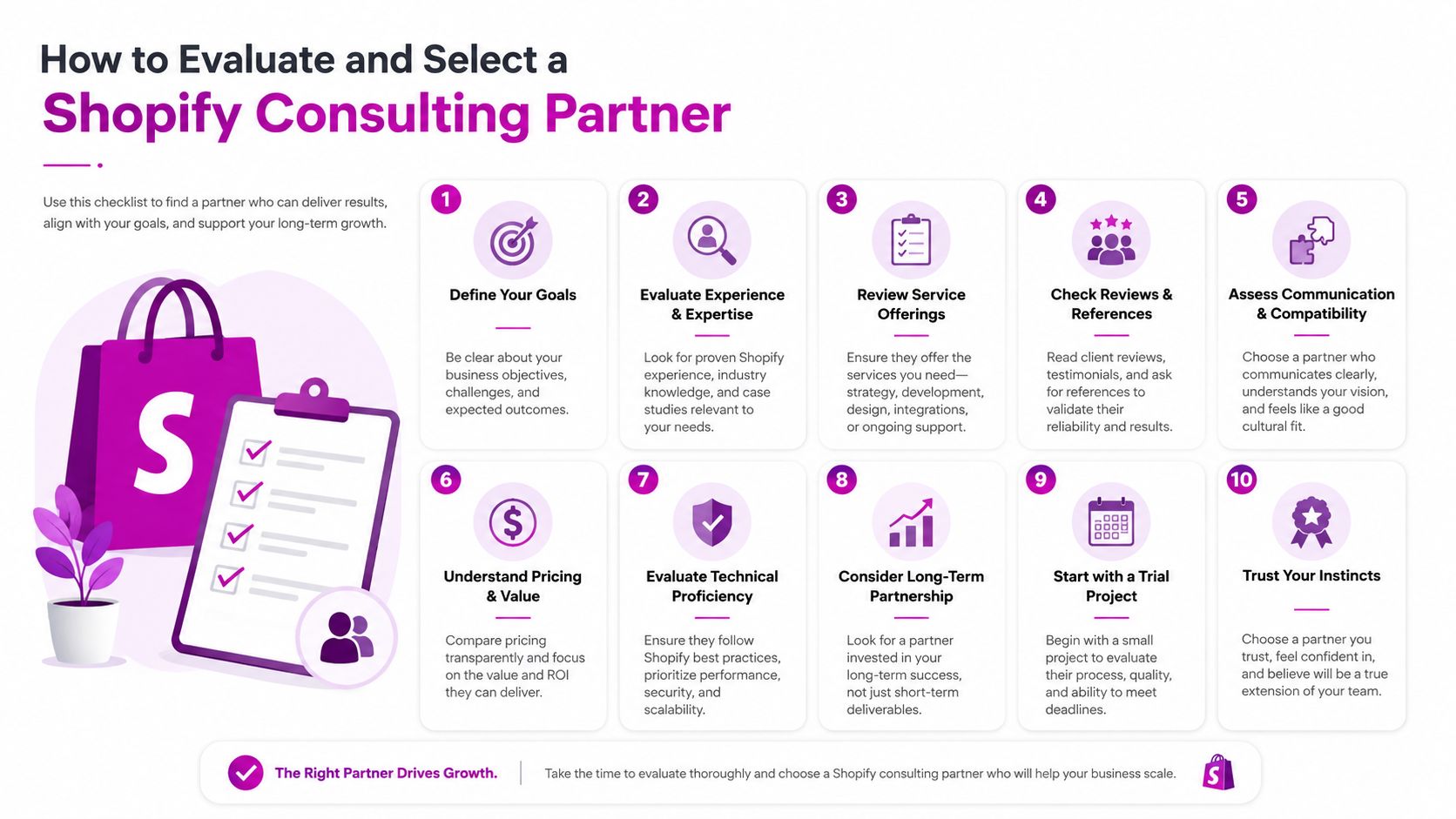
A polished pitch tells you little about delivery. Selection should test whether the partner can translate commercial priorities into technical work, then manage that work through release and measurement.
Start with evidence, not promises
Ask for examples that resemble your situation, not merely attractive screenshots. Relevant evidence might include a migration with complex data dependencies, a multi-market storefront, a Plus implementation, a performance remediation program, or an app and integration cleanup.
Then ask who performed the work. A senior strategist may lead discovery while junior staff handle implementation, which isn't automatically a problem. It becomes a problem when the staffing model is vague and the person who sold the engagement disappears after kickoff.
Use a scorecard that covers:
- Platform depth: Shopify Plus, Liquid, APIs, Markets, payments, app architecture, and theme development.
- Commercial reasoning: Ability to connect a technical recommendation to margin, conversion, retention, merchandising, or operational risk.
- Delivery discipline: Backlog management, sprint planning, QA, release notes, and transparent reporting.
- Measurement quality: Event tracking, experiment design, attribution limits, and post-release review.
- Team fit: Availability, communication style, decision speed, and willingness to work inside your existing processes.
If your discovery process includes AI visibility, an external e-commerce site AI score can provide one additional perspective. Treat it as an input for questions, not as a substitute for a technical review.
Ask questions that expose operating habits
Ask, “What would you refuse to change before reviewing the data?” Strong partners won't prescribe a redesign before understanding customer behavior, catalog structure, technical constraints, and the team's capacity.
Ask how they handle a failed release, a disputed priority, an app conflict, or a requirement that arrives after scope approval. Their answer reveals more than a portfolio. Red flags include guaranteed outcomes without baseline access, vague deliverables, no named delivery owner, heavy reliance on manual reporting, and a reluctance to explain trade-offs.
The ecommerce consulting firms guide can help expand your shortlist, but the final decision should rest on working evidence. Request a sample roadmap, a proposed meeting cadence, and an explanation of what your team will own after the engagement.
A short introductory video can also help teams assess how a consultant frames the problem before a formal discovery process.
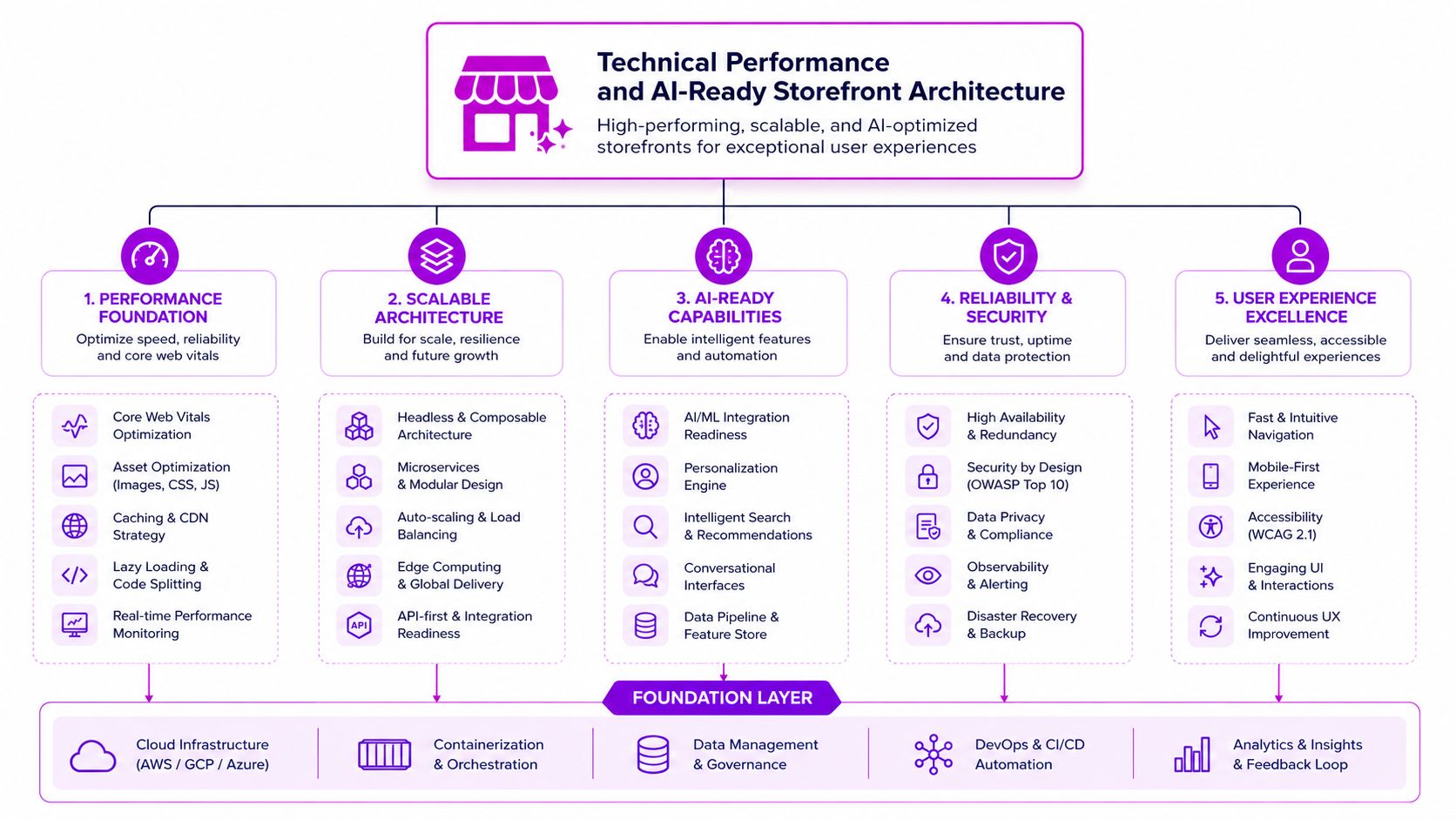
Technical Performance and AI-Ready Storefront Architecture
Performance, AI discovery, and international expansion are often assigned to different teams. That separation creates avoidable work because all three depend on the same foundation: clean storefront architecture, reliable product data, clear taxonomy, and disciplined governance.
Shopify's web-performance guidance treats Core Web Vitals as an operating benchmark. Google's good thresholds are LCP at 2.5 seconds or faster, INP at 200 milliseconds or faster, and CLS at 0.1 or lower, as documented in Shopify's web-performance reports guidance. These are not abstract engineering targets. They give a consulting team a shared way to prioritize what shoppers experience on real devices.
Fix the storefront in the right order
Homepage and collection templates often degrade first because teams keep adding app scripts, filters, product swatches, recommendation modules, infinite scroll, and campaign content. The right response isn't to remove every feature. It is to identify which components contribute to discovery or revenue, then control when and where they load.
A practical sequence looks like this:
- Establish template baselines. Review real-user performance by homepage, product, and collection template.
- Trace script ownership. Identify which app or custom feature injects each script and whether the feature is still needed.
- Reduce rendering work. Defer nonessential widgets, simplify collection interactions, compress media, and avoid loading every merchandising element everywhere.
- Retest after each meaningful change. A performance project needs release-level validation, not a single before-and-after screenshot.
Forms deserve the same discipline. A carefully selected Shopify form builder tool can support lead capture or customer research, but every added form app should be evaluated for script weight, data flow, accessibility, and usefulness.
Prepare product data for machine discovery
AI assistants and answer engines need structured, consistent information. Product attributes, reviews, availability, variant relationships, shipping information, and descriptive content should be clear to both shoppers and machines. Clean architecture also makes international work easier because localized content and market-specific data have defined homes instead of scattered overrides.
Shopify's recent guidance describes AI traffic as a channel merchants can filter as a referrer in analytics, compare with organic search, and use through agentic storefront distribution across major AI platforms. That changes the consulting brief. Teams need to monitor AI-referred sessions and revenue where their analytics setup supports it, inspect which products receive machine visibility, and improve the underlying data rather than chasing vague “AI optimization” tactics.
The key is sequencing. Fix brittle templates and incomplete product data before adding another discovery surface. Otherwise, the brand may distribute the same inconsistencies across more channels and markets.
Real Engagement Workflows for Growing Brands
Consider a mid-market brand preparing to move to Shopify Plus. The initial request may be “rebuild the store,” but discovery usually reveals a broader problem: inconsistent product data, undocumented integrations, fragile promotions, and no agreed owner for launch decisions.
The engagement starts with a dependency map and a risk register. The consulting team separates must-have migration requirements from desirable improvements, maps data and integrations, defines acceptance tests, and creates a cutover plan. Implementation then runs in controlled sprints, with the internal team reviewing catalog behavior, fulfillment flows, analytics, and customer service scenarios before launch.
Shipping rule: A migration isn't complete when the new theme looks finished. It's complete when the business can operate the new system under real trading conditions.
An established brand with several storefronts needs a different workflow. Its problem may not be a lack of features, but inconsistent conversion behavior across markets and duplicated customizations that make every release risky. The team begins by comparing template patterns, analytics events, merchandising rules, and market-specific content.
The backlog might contain product-page experiments, navigation changes, search improvements, and script reduction. Each item receives a hypothesis, an owner, a QA path, and a release decision. The consultant also reserves capacity for technical debt, because a backlog containing only visible growth features eventually becomes difficult to maintain.
A growing brand entering international markets faces operational uncertainty rather than a simple translation task. The consulting team clarifies target-market priorities, product eligibility, pricing logic, duties, payments, fulfillment, customer support, and localized content. It then launches the smallest coherent operating model, rather than cloning the domestic store and hoping local teams repair it later.
Across all three situations, the pattern is consistent:
- Discovery creates shared facts.
- Prioritization protects scarce capacity.
- Sprints turn decisions into releases.
- QA protects trading operations.
- Measurement informs the next decision.
- Documentation transfers capability to the internal team.
That sequence is what turns Shopify ecommerce consulting from an external service into an operating habit.
Building Sustainable Growth Through Reduced Friction
The highest-value consulting outcome isn't a single page improvement. It is a store that becomes easier to change without making every change a crisis.
Reduced friction has several forms. A marketing manager can request a campaign component without bypassing developers. A developer can remove an app without breaking analytics. A merchandiser can localize a market without editing scattered template logic. Leadership can see why one initiative outranks another.
Technical debt matters because it consumes the same capacity brands need for growth. Unused apps, duplicated integrations, hard-coded market rules, inconsistent event tracking, and undocumented customizations make future work slower and riskier. A consultant should therefore track debt reduction beside commercial delivery, not treat it as an optional cleanup project.
Measure the operating system
Revenue remains important, but it shouldn't be the only indicator of consulting performance. Useful operational measures include:
- Release reliability: Whether changes pass QA and reach production as planned.
- Decision speed: How quickly the team moves from a validated problem to an approved action.
- Backlog health: Whether priorities are clear and tied to commercial objectives.
- Performance stability: Whether Core Web Vitals remain healthy as merchandising and apps evolve.
- Data completeness: Whether products, markets, events, and referrals are represented consistently.
- Capability transfer: Whether internal staff can maintain the system after the consultant steps back.
A project can deliver its stated feature and still fail if the team can't maintain it. A retainer can deliver many tasks and still fail if it creates dependency without improving internal judgment. The engagement should include documentation, training, reusable patterns, and a clear handover path.
Brands with a defined initiative should begin with a scoped project and a measurable release plan. Brands with constant prioritization pressure should consider ongoing capacity, provided the partner can show what will be delivered and reviewed. In both cases, select the consultant who reduces organizational friction, not the one who promises the most dramatic redesign.
ECORN helps Shopify brands turn strategy into shippable work across consulting, development, design, CRO, Shopify Plus, and storefront optimization. If your team knows what needs fixing but needs a practical system for prioritization and delivery, visit ECORN to discuss a focused project or ongoing engagement.



Mobile Pop Up Strategy for Shopify Stores That Converts

Sitemap for Shopify: How to Find, Optimize, and Submit It

7 Single Product Websites Worth Emulating
Product Variants Shopify: The Complete 2026 Guide
Ecommerce Analytics Consulting for Growth
What Is AI Integration for eCommerce
How to Choose the Right eCommerce Website Development Firm
E Business Strategy Implementation
Conversion Tracking Setup for Shopify Stores
BigCommerce vs Shopify Plus Which Enterprise Wins in 2026
Shopify Theme Kit: Setup, Commands, and Migration Guide
Shopify Extension Development: A Practical 2026 Guide
Shopify Speed Score Explained and How to Improve It
Shopify Mobile Optimization: The 2026 Playbook
How to Add Subcategory in Shopify for Better UX
How to Implement Structured Data for Ecommerce in 2026

SEO App Mobile: Shopify Store Optimization Guide

Shopify Plus Support: What It Includes and How to Choose

Google Ads for Shopify: The Complete 2026 Playbook

Shopify New York: How to Find and Hire the Right Agency

Google Search Console for Shopify: The Complete Setup
First Party Data Collection for eCommerce Growth
FAQ Online Store Guide: Build and Measure It Right
Do FB Ads Work for eCommerce in 2026?
One Page Checkout for Shopify: Design and Implementation
Shopify GraphQL vs REST: The 2026 Developer Decision

Are Reddit Ads Worth It for eCommerce Brands

Shopify Title and Meta Description: A Practical 2026 Guide

Product Video Best Practices for Shopify Brands
Real-Time Inventory Management: A 2026 Guide
AI Chatbot Integration for Shopify Stores
Affiliate Program Management: A Shopify Guide
10 Best Performance Monitoring Tools for Shopify in 2026
Digital Asset Management for eCommerce Brands in 2026
Every Type of Facebook Ads Explained for eCommerce Growth
Product Information Management Explained for Shopify Brands
Support Ticket System: A Guide for Shopify Stores

10 Best Customer Service Tools for Shopify in 2026

Can I Start a Business with No Money? a 2026 Blueprint

What Sells Good on Etsy: Best Niches for 2026

Shopify Add to Cart Button: A Practical 2026 Guide

Customer Feedback Automation: A Practical eCommerce Guide
Critical Rendering Path: A Guide for Shopify Stores

How to Promote on TikTok for eCommerce in 2026

B2B eCommerce Consulting That Drives Real Revenue
10 Best Practices for Site Navigation in 2026
Return vs Refund for Shopify Stores: A Practical Guide

What Is Customer Lifetime Value and Why It Matters
What Is Voice of Customer Research for eCommerce

SMS Marketing for Ecommerce That Actually Converts

Master How to Improve Email Deliverability in 2026

Top 7 eCommerce Partners NYC for Shopify Brands in 2026

Machine Learning for Ecommerce: Boost Your Shopify Store

Beauty Market Research: Your 2026 Growth Guide
Shopify International Expansion: A 2026 Roadmap
What Does CRO Stand for in Business: Understanding CRO

Shopify Visual Merchandising: A Playbook for Higher Sales
Shopify Landing Page Design: Master Conversion in 2026
10 Best AI SEO Optimization Tools for Shopify in 2026

Agentic AI for Ecommerce: Boost Your Sales in 2026
Mastering Email Marketing Data for eCommerce Growth

Conversion Rate Optimisation Australia: Boost Your Sales
Conversion Rate Optimization AI: Your Shopify Store Guide

10 Product Bundling Strategies for Shopify in 2026

How to Increase Customer Lifetime Value: A Shopify Playbook
AI Customer Service Automation: Shopify Guide 2026

Clean Website Design: A Shopify Conversion Playbook

Omnichannel Retail Strategy: A Shopify Playbook
Product Data Enrichment: A Guide for Shopify Brands

Instagram Shopping Features a Guide for Shopify Stores
What Is Revenue Optimization: A Holistic RevOps Guide

Benefits of Conversion Rate Optimization: Boost Your
WordPress to Shopify Migration: Your 2026 Seamless Switch
Boost Sales: Ecommerce Payment Processing Guide 2026
Unified Commerce Platform: Benefits, KPIs & Shopify Guide

How to Reduce Bounce Rate eCommerce: Your 2026 Guide
Shopify API Integration: A Practical End-to-End Guide
How to Implement Data Governance: A 2026 Guide
Shopify Store Development Cost: A 2026 Breakdown
What Is Server Side Tracking: The Shopify Guide 2026
Marketing Automation Workflows: A Shopify Guide for 2026

Shopify: How to Reduce Technical Debt

Shopify UX Design Change: A Playbook for Growth
User Generated Content Strategy: Shopify Playbook
Shopify Pause and Build Plan Cost: A Complete 2026 Guide

Compare at Price on Shopify: A Complete Guide for 2026

Where Can I Sell My Prints? 10 Best Platforms for 2026
Shopify Order Management System: The Ultimate Guide 2026
What Is Marketing Attribution? an eCommerce Guide for 2026

10 Best Black Friday Sales Sheets for 2026

Discover the Top Social Media Marketing Agencies For
Consumer Confidence Definition for eCommerce in 2026

What Is Social Commerce? Your 2026 Guide to Boosting Sales
A Social Ad Campaign Playbook for eCommerce Growth

7 Best FAQ Page Examples for SaaS & eCommerce

Market Research in Fashion Industry: A Guide for Shopify
Shopify Migration Services: Expert Guide for 2026
Mastering FB Retargeting Ads for Shopify in 2026
What Is Omnichannel Ecommerce

Master Your Shopify Plus Migration: The 2026 Guide


newsletter in your inbox