


You're already feeling the pressure if the inbox is full of quote requests, sales is still living in spreadsheets, and IT keeps saying the storefront can't touch the ERP until “next quarter.” The brand is growing, the buying process is getting messier, and every small workaround now looks like a future fire. That's usually the moment a serious B2B eCommerce consulting conversation starts.

A lot of founders think they need a prettier homepage. They usually need a cleaner operating model, a faster quote path, and a system that stops forcing people back into email. If you're trying to understand where the friction sits, it's smart to find a conversion rate expert, but in B2B the answer often goes beyond page-level optimization.
The Moment a B2B Brand Realizes It Needs Outside Help
The signal is usually operational before it is visible in the browser. Sales is quoting from a spreadsheet, finance wants one set of terms, operations wants another, and the storefront cannot reflect customer-specific pricing without manual work. Then an order lands with the wrong SKU, or the ERP rejects it, and the blame lands on the platform even though the process is what broke.
That is the point where outside help stops being optional. The business is not buying a prettier site. It is buying a way to make commerce, sales, finance, and operations behave like one system instead of separate teams improvising around each other.
The trigger is usually operational, not visual
The clearest sign is friction that keeps showing up in revenue-critical workflows. A launch stalls because IT and marketing cannot agree on scope. A migration drags because no one owns data quality. A portal exists, but customers still order by phone because the digital path does not match how they buy.
Practical rule: if your team keeps describing the problem as “the site,” the problem is probably deeper than the site.
A serious consultant walks into that mess and starts with structure, not cosmetics. The work is to identify where account logic breaks, where data breaks, and where internal ownership breaks. That is the difference between a contractor and a real B2B eCommerce consulting partner.
What the buyer is paying for
They are paying for decision-making under constraints. Platform selection matters, but so do integrations, approval logic, and support for technical buyers who need specs before they ever reach checkout. The work is about removing revenue blockers, not decorating a storefront.
If you want a good external benchmark for best practices and operating choices, this guide to B2B ecommerce best practices and strategies is a useful companion read. A capable firm such as NiKa Consulting services will usually frame the engagement around business processes first, because that is where the money is won or lost.
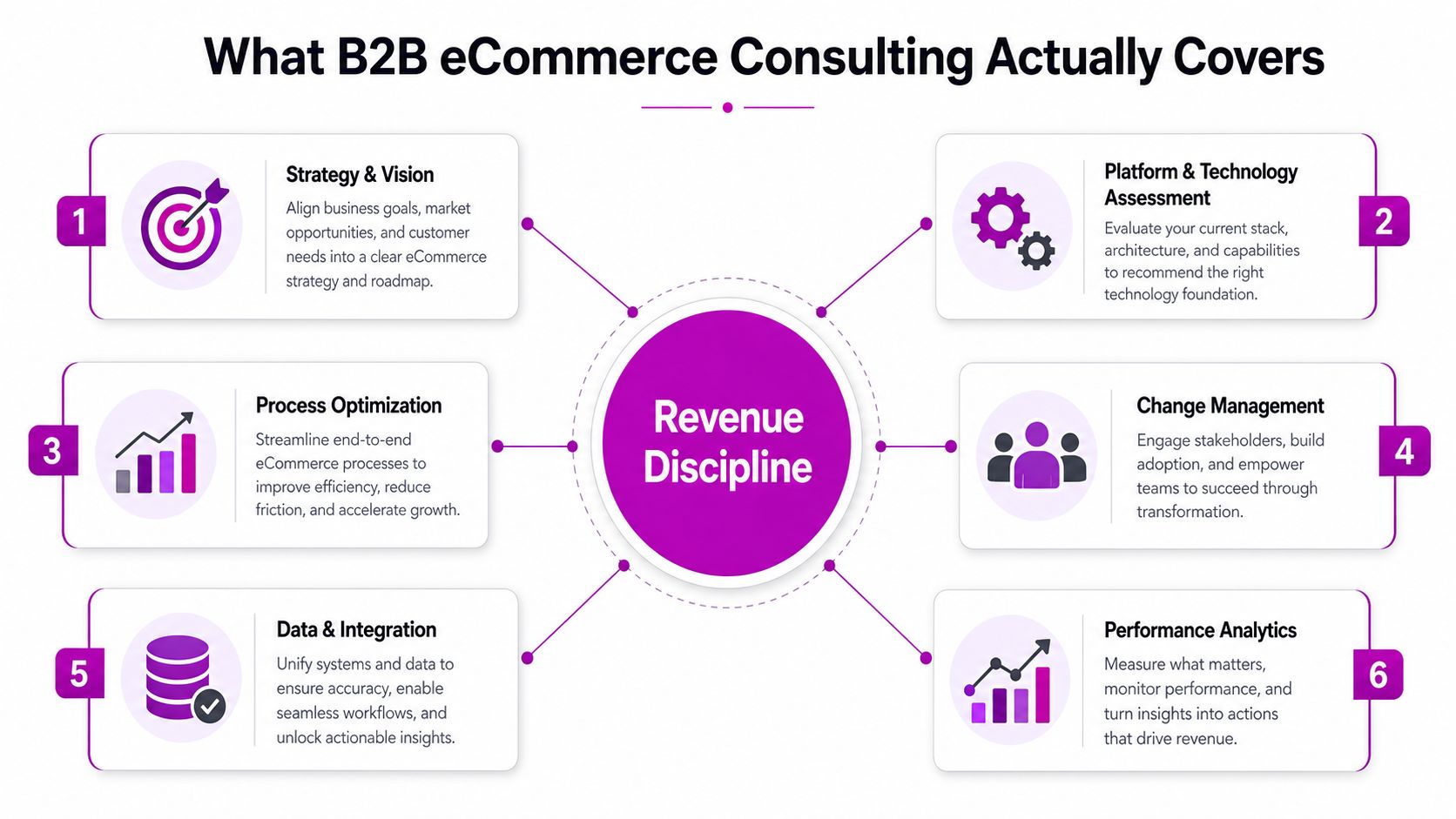
What B2B eCommerce Consulting Covers
Good consulting is a revenue discipline. Bad consulting is a slide deck about themes, plugins, and launch dates. The difference matters because B2B buying is a systems problem, and the storefront is only one visible layer of it.
Strategy, platform, and implementation
The first job is platform strategy and selection. A consultant helps you decide whether Shopify Plus, another commerce platform, or a more layered architecture fits your operating model. A Shopify Plus implementation is not just a site launch, it is a decision about how your catalog, pricing, accounts, and checkout logic will behave at scale.
That line between storefront and ERP needs to be clear from the start. If your team cannot say which system owns pricing, inventory, approvals, and customer data, the project gets expensive fast.
Conversion, UX, and information architecture
Conversion rate optimization is the second pillar, but in B2B it is not about headline tests and button colors. It is about reducing friction in quote approval, account login, reorder paths, and product discovery. The best consultants look at the journey from the buyer's point of view and from the sales ops point of view at the same time.
The spec-driven buyer changes the brief again. Engineers, architects, and technical procurement teams do not buy like casual browsing users. They need drawings, cut sheets, compatibility details, and enough structure to validate the purchase before anyone talks about cart optimization.
Data, integration, and automation
The third pillar is systems integration with ERP, CRM, and PIM. A lot of projects succeed or fail here, because the storefront cannot compensate for unreliable pricing, inventory, or product data. Clean integrations are not back-office housekeeping. They are the plumbing that keeps revenue from leaking into manual work.
AI-enabled personalization and automation sit on top of that foundation. They are useful only when the underlying data is trustworthy. If they are bolted onto a broken system, they just make the wrong answer faster.
Bottom line: the value of B2B eCommerce consulting is not the advice itself. It is the way that advice aligns platform choice, data quality, buyer experience, and operating ownership.
For a practical planning lens, a comprehensive guide to B2B ecommerce best practices and strategies is worth comparing against your shortlist because it shows how consulting is often tied to Shopify work, conversion research, and launch support in real projects. A firm like NiKa Consulting services will usually start from business processes first, because that is where the money is won or lost.
Why Consulting Became a Growth Function, Not a Tech Project
The market changed, and the consulting brief changed with it. Independent research estimates the global B2B e-commerce market was worth USD 24.08 trillion in 2025 and could reach USD 105.85 trillion by 2033, with a 20.9% CAGR from 2026 to 2033, while other summaries place it around USD 36.16 trillion in 2026. Statista's market study also put the market at US$20.4 trillion in 2022, already more than five times the size of B2C e-commerce, which tells you how large and operationally important this category has become. Grand View Research's market overview
That scale matters because it changes expectations. If digital buying is where revenue lives, then consulting isn't a one-time implementation expense. It's revenue infrastructure.
By 2025, about 80% of B2B sales interactions were expected to happen through digital platforms, up from 13% in 2019, and digital channels were projected to generate 56% of B2B organizations' revenue by 2025, compared with 32% in 2020. Industry reporting on B2B eCommerce statistics makes the shift hard to ignore. Once the buyer journey moves there, teams need more than a storefront. They need account logic, pricing governance, content structure, and analytics that support the revenue model.
The budget conversation has changed
A founder used to ask whether a site could launch on time. A founder now needs to ask whether the business can support digital selling without breaking the sales motion, the ERP, or the customer experience. That's why consulting has moved from implementation support into strategy, and why the smartest money is spent before the architecture hardens.
Practical rule: if digital revenue is becoming the default path, the consultant's job is to protect margin, reduce manual effort, and make buying easier without turning the sales team into order clerks.
That is the reason consulting got more strategic. The work moved closer to the core of the business.
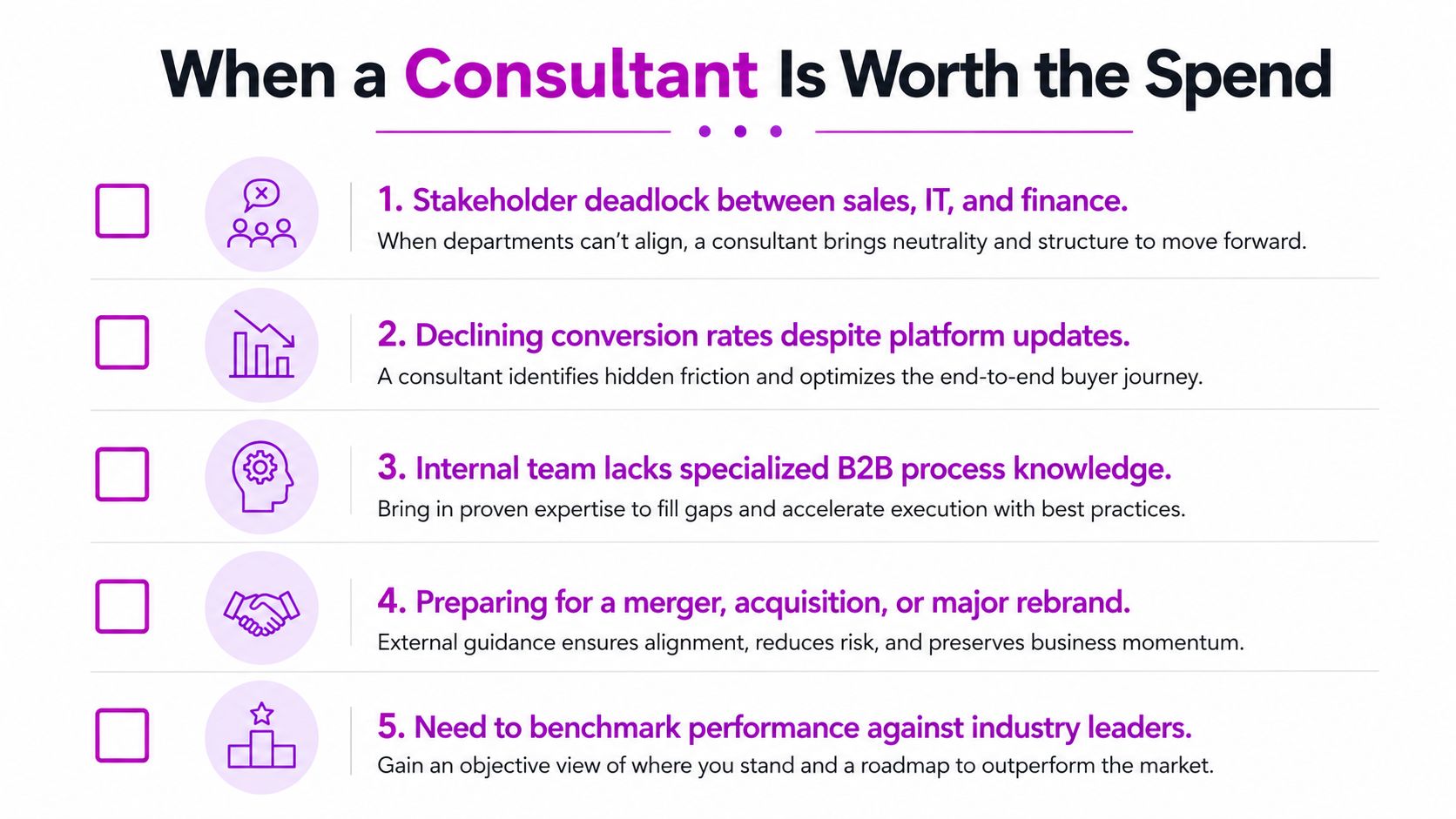
When a Consultant Is Worth the Spend
Not every project deserves outside help. A theme refresh, a small landing page build, or a one-off marketing campaign usually doesn't need a heavyweight engagement. But if the business is stuck on architecture, ownership, or process, trying to wing it internally is how teams burn quarters.
Hire outside help when the decision is expensive
If you're choosing a platform, redesigning account flows, or deciding how ERP, CRM, and PIM should talk to each other, the cost of being wrong is high. That's especially true when sales, finance, operations, and IT all have different definitions of success. In those cases, a consultant is there to force trade-offs into the open before you pay for them in code.
The same is true when growth has stalled and the easy wins are gone. If you've already fixed the obvious UX issues and the team still can't move quote-to-order performance, the bottleneck is probably operational. A consultant should be able to identify that quickly.
Hire outside help when internal ownership is fragmented
Deadlock is the clearest signal. If everyone agrees the store needs work but nobody agrees who owns the roadmap, the business needs an external referee. That's not a soft problem. It's a governance problem, and governance problems don't get solved by more Jira tickets.
The earlier section on technical buyer personas matters here too. If your products require drawings, cut sheets, or other spec-first content, the consulting work isn't just about storefront conversion. It's about making the digital experience usable for the people who approve the purchase.
Pricing Models, Timelines, and Realistic ROI
Money questions should be answered plainly. B2B eCommerce consulting usually comes in four models, and each one fits a different level of risk and ambiguity. A monthly retainer works when you need ongoing strategy, CRO, and optimization after launch. Project-based pricing fits a platform assessment or implementation with clear scope. Subscription packages are useful when you want a steady cadence of improvements without rebuilding the team every quarter. Success-based pricing sounds attractive, but it only works when both sides can agree on measurement and have enough data discipline to trust the numbers.
| Pricing Model | Typical Price Band | Best For | Watch Out For |
|---|---|---|---|
| Monthly retainer | Ongoing, scope-based | CRO, optimization, and advisory support | You can drift into vague deliverables if the work isn't measured tightly |
| Project-based | Defined by scope | Platform assessment, migration, implementation | Scope creep can quietly destroy the budget |
| Subscription package | Rolling monthly services | Teams that want continuous improvements and fast execution | You need clear priorities or the queue gets messy |
| Success-based | Tied to agreed outcomes | Mature teams with clean attribution and strong internal ownership | Bad data makes this model frustrating for everyone |
A platform assessment for a mid-market firm is often discussed in the roughly $25,000 to $80,000 range depending on scope, according to WebSolutions NYC's consulting guidance. That's the kind of investment that makes sense before platform selection or when teams are deadlocked. It's far cheaper than discovering six months later that the ERP logic, product data, or approval flows were wrong from the start.
What realistic timelines look like
A Shopify Plus build with ERP integration is not a weekend project. If the data model is messy, the timeline stretches because the team has to clean catalog structure, pricing logic, and sync rules before launch. That's not delay for delay's sake, it's the work.
ROI should be measured through quote-to-order conversion, self-service revenue, repeat-order behavior, and onboarding speed, not vanity traffic. One benchmark framework says 2% to 4% overall conversion is common in B2B ecommerce, while self-service digital revenue often represents 20% to 35% of revenue in scaling businesses. Elogic's B2B ecommerce statistics page also points buyers toward the right operating KPIs, and that's exactly the right direction.
Practical rule: if the consultant talks first about traffic, ask them to talk again. In B2B, the revenue lift usually comes from fewer failed orders, faster reorders, and cleaner quote-to-cash flow.
Real-World Scenarios That Show What Good Looks Like
The strongest consulting work is usually boring in the best way. It clears blockers, simplifies decision-making, and gives the internal team a structure they can run. Two common scenarios make that obvious.
Industrial brand moving to Shopify Plus
An industrial manufacturer with legacy ordering processes usually starts with a mess of account-specific pricing, email-based reorders, and data spread across ERP and PIM. The consulting job here is to define the architecture first, then decide what belongs in Shopify Plus and what stays in the backend systems. The team needs account hierarchies, net terms, and product data logic that won't collapse under scale.
A good engagement would sequence the work carefully, because the problem is rarely “build faster.” It's “stop the system from disagreeing with itself.” That means integration planning, cleaner product records, and a checkout flow that respects how the customer buys. When that work is done well, the sales team stops acting like a manual order-entry desk and starts selling again.
DTC brand adding a wholesale portal
A scaling DTC brand usually has a different problem. Consumer experience is already polished, but wholesale buyers need separate pricing, order rules, and account logic without wrecking the existing site. The consultant's job is to protect the consumer experience while standing up a B2B path that doesn't feel bolted on.
That often means using a phased rollout, not a big-bang launch. The brand can test wholesale workflows with a smaller group of buyers, tighten the information architecture, and then expand. If the team handles it well, the result is cleaner channel separation and less chaos for operations.
The point of both scenarios is simple. Good consulting changes how the business runs, not just how the website looks.
Your Evaluation Checklist and Decision Framework
Start with four questions. Does the partner have industry-specific case studies, named technical expertise, and real integration experience with your ERP or PIM? Can they explain how they choose KPIs, and can they tell you what happens after launch? If they can't answer those questions directly, keep looking.
Then match the engagement to the bottleneck. If you are pre-platform-selection, buy an assessment. If you are already live and the problem is conversion or reorders, buy ongoing optimization. If your team keeps arguing about roadmap ownership, hire a consulting partner who can drive alignment across sales, ops, and IT, not just fill a ticket queue.
For a clean benchmark on agency fit and service structure, ECORN's overview of ecommerce consulting firms is worth using as a sanity check on what you are being sold.
Decision rule: if the consultant cannot explain how data, process, and buyer behavior connect, they are selling activity, not outcomes.
Buy the help that fits the bottleneck. That is the whole game.
If you need a partner who can connect Shopify Plus execution, conversion work, and the operational reality behind B2B selling, ECORN can help you turn the roadmap into something your sales, ops, and technical teams can use. Visit ECORN to talk through your stack, your blockers, and the fastest path to real revenue.


Shopify Plans Comparison for Every Business Stage
How to Improve User Experience for eCommerce Growth

Shopify Checkout Optimization That Converts More
Shopify Inventory Sync: A Practical Setup Guide
Shopify App Integration Playbook That Scales
Shopify CMS Integration: Your 2026 Guide to Options

Shopify Store Audit: Find Hidden Conversion Leaks

Shopify Plus Experts: How to Hire the Right Team
Chargeback Protection Shopify: A Practical 2026 Guide
8 Examples of Conversion Rate Optimization
How to Conversion Rate Optimization for Shopify Stores

Shopify Design Essentials Every Store Owner Needs
Ecommerce Terms of Service: How to Draft and Implement
How to Implement Structured Data for Ecommerce in 2026

SEO App Mobile: Shopify Store Optimization Guide

Shopify Plus Support: What It Includes and How to Choose

Google Ads for Shopify: The Complete 2026 Playbook

Shopify New York: How to Find and Hire the Right Agency
Google Search Console for Shopify: The Complete Setup
First Party Data Collection for eCommerce Growth
FAQ Online Store Guide: Build and Measure It Right
Do FB Ads Work for eCommerce in 2026?
One Page Checkout for Shopify: Design and Implementation
Shopify GraphQL vs REST: The 2026 Developer Decision
Shopify Ecommerce Consulting: Strategy, Pricing &

Are Reddit Ads Worth It for eCommerce Brands

Shopify Title and Meta Description: A Practical 2026 Guide

Product Video Best Practices for Shopify Brands
Real-Time Inventory Management: A 2026 Guide

AI Chatbot Integration for Shopify Stores
Affiliate Program Management: A Shopify Guide
10 Best Performance Monitoring Tools for Shopify in 2026
Digital Asset Management for eCommerce Brands in 2026
Every Type of Facebook Ads Explained for eCommerce Growth
Product Information Management Explained for Shopify Brands
Support Ticket System: A Guide for Shopify Stores

10 Best Customer Service Tools for Shopify in 2026

Can I Start a Business with No Money? a 2026 Blueprint

What Sells Good on Etsy: Best Niches for 2026

Shopify Add to Cart Button: A Practical 2026 Guide

Customer Feedback Automation: A Practical eCommerce Guide
Critical Rendering Path: A Guide for Shopify Stores

How to Promote on TikTok for eCommerce in 2026
10 Best Practices for Site Navigation in 2026
Return vs Refund for Shopify Stores: A Practical Guide
What Is Customer Lifetime Value and Why It Matters
What Is Voice of Customer Research for eCommerce

SMS Marketing for Ecommerce That Actually Converts

Master How to Improve Email Deliverability in 2026

Top 7 eCommerce Partners NYC for Shopify Brands in 2026

Machine Learning for Ecommerce: Boost Your Shopify Store

Beauty Market Research: Your 2026 Growth Guide

Shopify International Expansion: A 2026 Roadmap
What Does CRO Stand for in Business: Understanding CRO

Shopify Visual Merchandising: A Playbook for Higher Sales

Shopify Landing Page Design: Master Conversion in 2026

10 Best AI SEO Optimization Tools for Shopify in 2026

Agentic AI for Ecommerce: Boost Your Sales in 2026
Mastering Email Marketing Data for eCommerce Growth

Conversion Rate Optimisation Australia: Boost Your Sales
Conversion Rate Optimization AI: Your Shopify Store Guide

10 Product Bundling Strategies for Shopify in 2026

How to Increase Customer Lifetime Value: A Shopify Playbook
AI Customer Service Automation: Shopify Guide 2026

Clean Website Design: A Shopify Conversion Playbook

Omnichannel Retail Strategy: A Shopify Playbook
Product Data Enrichment: A Guide for Shopify Brands

Instagram Shopping Features a Guide for Shopify Stores
What Is Revenue Optimization: A Holistic RevOps Guide

Benefits of Conversion Rate Optimization: Boost Your
WordPress to Shopify Migration: Your 2026 Seamless Switch
Boost Sales: Ecommerce Payment Processing Guide 2026
Unified Commerce Platform: Benefits, KPIs & Shopify Guide

How to Reduce Bounce Rate eCommerce: Your 2026 Guide
Shopify API Integration: A Practical End-to-End Guide
How to Implement Data Governance: A 2026 Guide
Shopify Store Development Cost: A 2026 Breakdown
What Is Server Side Tracking: The Shopify Guide 2026
Marketing Automation Workflows: A Shopify Guide for 2026

Shopify: How to Reduce Technical Debt

Shopify UX Design Change: A Playbook for Growth

User Generated Content Strategy: Shopify Playbook

Shopify Pause and Build Plan Cost: A Complete 2026 Guide

Compare at Price on Shopify: A Complete Guide for 2026

Where Can I Sell My Prints? 10 Best Platforms for 2026
Shopify Order Management System: The Ultimate Guide 2026
What Is Marketing Attribution? an eCommerce Guide for 2026

10 Best Black Friday Sales Sheets for 2026

Discover the Top Social Media Marketing Agencies For
Consumer Confidence Definition for eCommerce in 2026
What Is Social Commerce? Your 2026 Guide to Boosting Sales

A Social Ad Campaign Playbook for eCommerce Growth

7 Best FAQ Page Examples for SaaS & eCommerce

Market Research in Fashion Industry: A Guide for Shopify
Shopify Migration Services: Expert Guide for 2026

Mastering FB Retargeting Ads for Shopify in 2026
What Is Omnichannel Ecommerce

Master Your Shopify Plus Migration: The 2026 Guide
Shopify Integration Services: A Merchant's 2026 Guide
Shopify Collection Description: A Guide to SEO & Sales


newsletter in your inbox