


You've hired a Shopify developer, approved a polished redesign, and watched the launch date move twice. Then someone mentions that your checkout logic relies on a deprecated feature, your international setup needs a different architecture, and nobody on the team owns post-launch support. The store may look ready, but the operating model isn't.
That's the risk most brands miss when they search for Shopify Plus experts. The decision isn't only about finding someone who can build a storefront. It's about securing the technical judgment, staffing continuity, and migration discipline required to protect revenue while the platform and your business keep changing.
What Shopify Plus Experts Actually Do
A growing brand usually reaches the Plus conversation after a familiar sequence. The existing store works, then campaign traffic exposes performance weaknesses, new markets create operational friction, and custom checkout requirements outgrow the original implementation. A general Shopify developer may solve an isolated theme issue. A real Plus specialist has to understand the entire commercial system around the store.
Shopify Plus launched on February 4, 2014, as Shopify's enterprise-ready solution for high-volume merchants, according to Shopify's launch announcement. By 2026, independent trackers estimated more than 60,268 websites associated with Shopify Plus, including live and historical sites, while another estimate placed live usage at 84,110 websites. Those figures come from different tracking methods, so they shouldn't be treated as a single authoritative count. They do show why specialized implementation knowledge matters in a globally distributed ecosystem. Industry data on Shopify Plus adoption also describes major usage across the United States, Canada, the United Kingdom, Australia, Germany, and France.
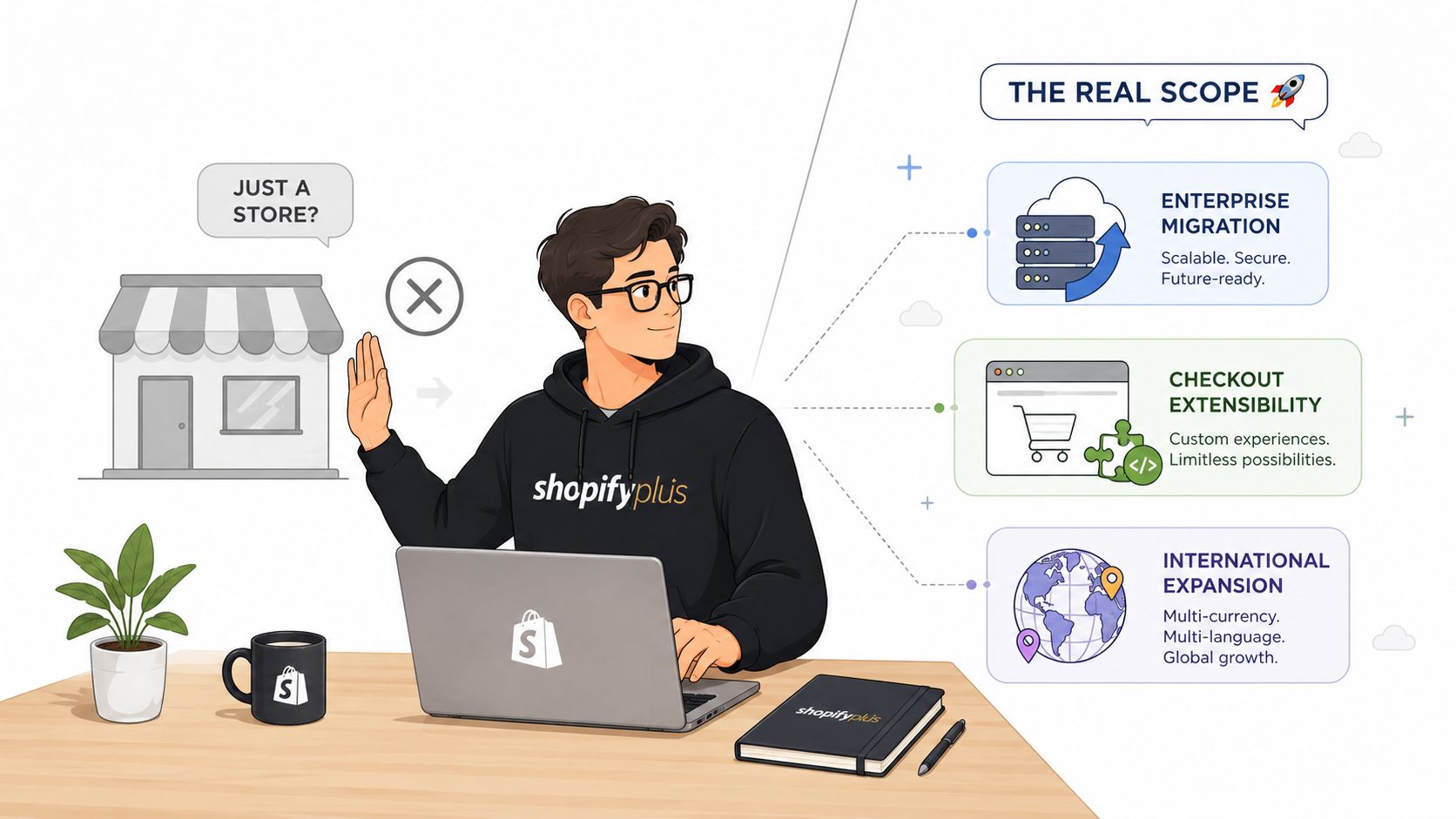
The work extends far beyond theme development
A capable Plus team usually owns several connected responsibilities:
- Enterprise migration: Moving catalog, customer, order, content, redirects, and integrations without losing operational continuity or search visibility.
- Checkout extensibility: Replacing brittle customizations with supported extension patterns and Shopify Functions.
- International architecture: Designing markets, currencies, languages, regional catalogs, tax workflows, and fulfillment connections as one system.
- Performance at scale: Auditing scripts, apps, theme code, third-party calls, and mobile experiences instead of treating speed as a cosmetic concern.
- Conversion optimization: Separating cart-to-checkout performance from checkout-to-purchase performance so the team fixes the actual bottleneck.
- Integration governance: Connecting ERP, CRM, subscription, fulfillment, analytics, and customer service systems without creating an unmanageable app stack.
- AI and automation planning: Identifying useful applications for merchandising, support, content operations, and analysis without adding tools that duplicate existing functions.
Shopify positions Plus for merchants with reported annual sales ranging from $1 million to $500 million, and its platform materials include capacity claims of up to 10,000 checkouts per minute. Those figures explain the operating context, but they don't make every Plus store identical. A smaller enterprise merchant may need migration governance and B2B architecture, while a high-volume retailer may need sharper checkout resilience and release management.
Practical rule: If a candidate talks only about Liquid, themes, and visual polish, you're interviewing a Shopify developer, not necessarily a Shopify Plus operator.
The difference shows up during change
The strongest experts make decisions with future platform changes in mind. Shopify Scripts stopped running in July 2026, with remaining logic moving to Shopify Functions, while checkout.liquid was fully deprecated in August 2025 and automatic upgrades began in January 2026, according to industry commentary on Shopify Plus staffing and migration risks. A team that treats deprecated logic as a last-minute coding task is already creating risk.
That's why you should assess capacity as carefully as technical skill. Senior Plus engineers are expensive and difficult to hire quickly, and project-based staffing can leave brands without continuity between launches. If your internal team can't maintain that capacity, remote staffing services may help you build a more consistent delivery model without making every specialist a full-time hire.
For a focused view of the role, review this guide to a Shopify Plus developer. The key question isn't whether someone can produce a working store. It's whether they can keep the store adaptable, measurable, and supportable after launch.
Critical Skills and Red Flags to Watch For
The fastest way to separate genuine Shopify Plus expertise from confident generalism is to ask about platform transitions. Anyone can describe a custom checkout in broad terms. A senior practitioner should explain what belongs in checkout extensibility, what belongs in Shopify Functions, how the implementation will be tested, and how the team will handle future platform updates.
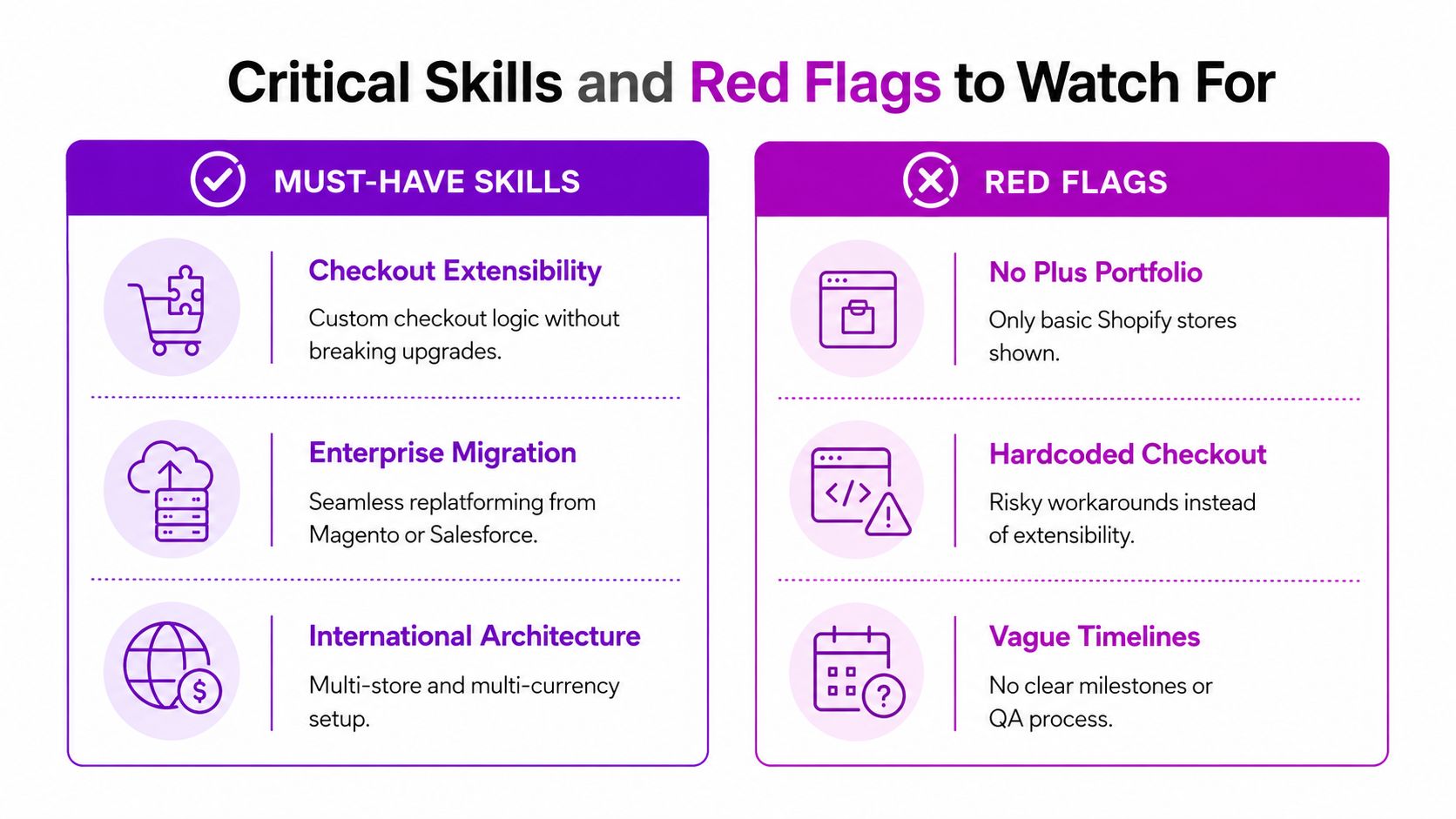
Technical skills that should be non-negotiable
Checkout extensibility is the first filter. Ask the candidate to describe a checkout requirement they implemented, the extension point they selected, and how they avoided unsupported workarounds. A vague answer about “custom checkout code” is a warning, especially when the platform has already moved away from older customization paths.
Shopify Functions should be familiar territory, not a new research assignment. Your team should understand how functions support logic such as discounts, delivery, payment customization, and validation, while also knowing where Shopify's supported boundaries apply.
Migration engineering matters just as much as new-build ability. Ask how the team maps legacy data, handles redirects, validates customer and order records, reconciles integrations, and runs a cutover rehearsal. A portfolio full of attractive storefronts tells you little if it contains no evidence of replatforming.
International architecture requires more than installing a currency app. The expert should be able to discuss markets, localized content, regional pricing, tax handling, inventory implications, and the relationship between one storefront and multiple regional experiences.
Headless judgment matters because headless isn't automatically more advanced. A good specialist can explain when a custom frontend is justified, what operational cost it introduces, and whether the brand's team can support it.
Commercial and analytical capability
Technical implementation without measurement creates expensive activity. Shopify CRO work should begin with the formula transactions divided by visitors or sessions, multiplied by 100, with benchmarking performed at the session level. Shopify checkout conversion benchmarks recommend using at least 30 days of data, with 90 days preferred for lower-traffic stores, and separating cart-to-checkout from checkout-to-purchase.
The same benchmark source places the Shopify average near 1.4%, the top 20% at 3.2% or higher, and the top 10% at 4.7% or higher. Use those figures as directional context, not as a universal target. Vertical, average order value, traffic quality, device mix, seasonality, and product category can make global comparisons misleading.
Ask candidates:
- Which funnel stages do you measure first, and why?
- How do you distinguish a traffic problem from a checkout problem?
- How do you decide whether an app should be removed, replaced, or retained?
- How do you protect mobile performance while adding merchandising or personalization tools?
- What does your release and rollback process look like?
A strong answer connects technical choices to customer behavior and operating cost. A weak one promises “higher conversions” without describing the baseline, measurement window, test design, or ownership of implementation.
Hiring Checklist and Interview Questions
Treat hiring as a controlled evaluation, not a beauty contest between agency websites. The team with the most attractive portfolio may still lack migration discipline, release management, or post-launch ownership. Your process should force every candidate to demonstrate how they think under enterprise constraints.
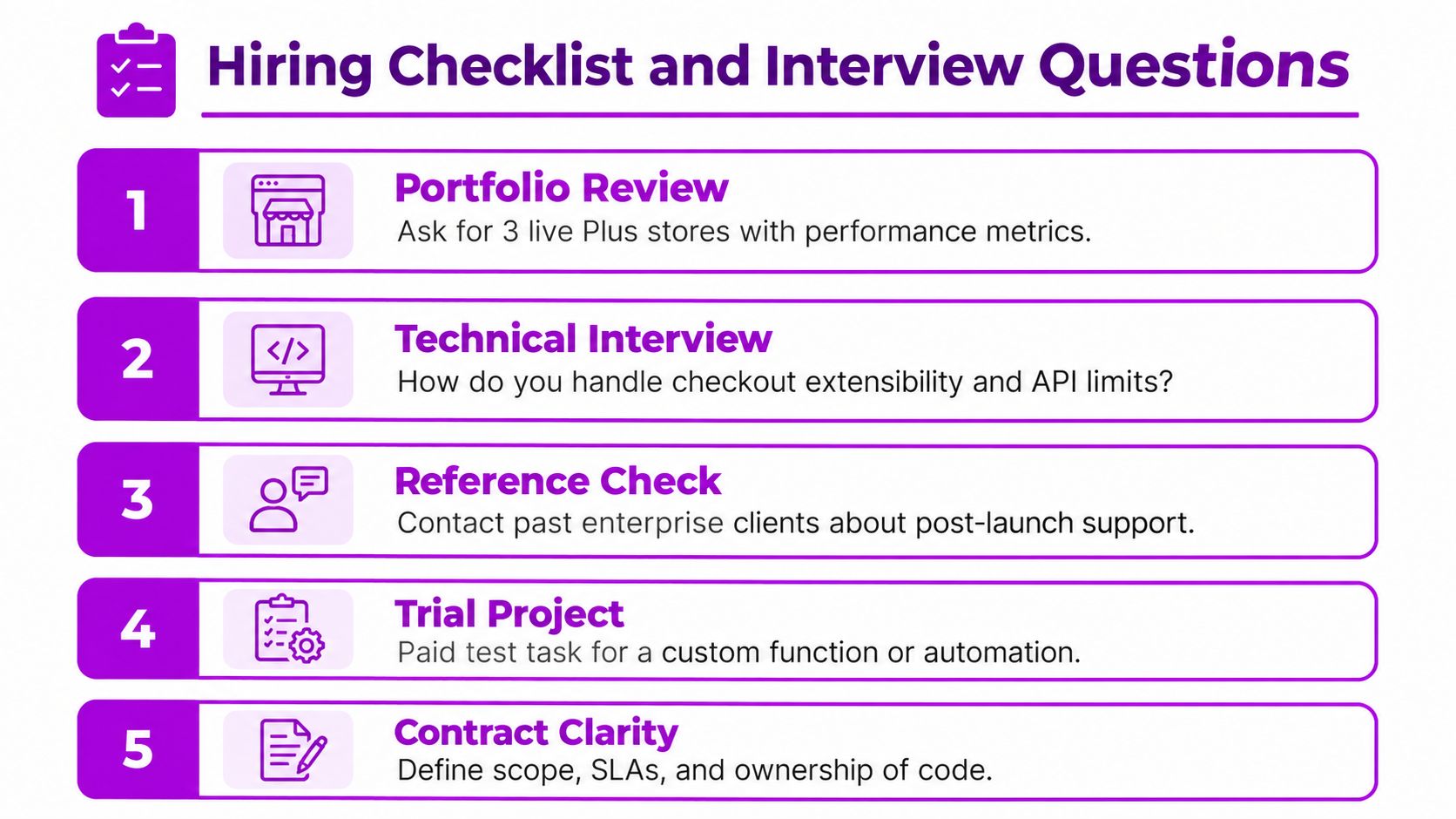
Start with evidence, not claims
Request three live Plus stores that reflect the type of work you need. Don't accept screenshots alone. Ask what the team owned, which systems it integrated, what changed after launch, and who still supports the implementation.
Then review the proposed team, not just the agency brand. You need the names and roles of the people who'll handle architecture, project management, QA, analytics, and support. If the salesperson is highly experienced but the delivery team is anonymous, assume the handoff will create friction.
Use a paid trial project when the work is complex enough to justify it. A useful test might ask a candidate to outline a Shopify Function, review a checkout requirement, map a migration risk, or audit an app stack. The exercise should test reasoning and communication, not demand unpaid production work.
Interview for failure modes
Ask direct questions:
- “Which deprecated Shopify features have you recently replaced?” Look for a specific migration path, testing method, and explanation of tradeoffs.
- “Show me how you'd plan a cutover.” Strong candidates will discuss data validation, redirects, integrations, permissions, rollback planning, and launch monitoring.
- “What would make you reject a headless build?” This reveals whether the person can control scope or sells complexity.
- “What belongs in the first optimization roadmap?” The answer should connect business goals to baseline data, not list fashionable tactics.
- “Who owns the code and documentation after launch?” Ambiguity here becomes a future staffing problem.
- “What happens if the assigned senior engineer leaves?” You're testing continuity, documentation, and bench strength.
For broader questions about evaluating e-commerce consultants, Next Point Digital hiring tips provide useful context. Still, apply the advice to your actual Shopify Plus risks rather than copying a generic agency scorecard.
Check references for the unglamorous details
Ask previous clients whether the team met its commitments, communicated bad news early, maintained the store after launch, and documented the work. Ask whether the client had to repeatedly explain the same business context to new team members.
The most revealing reference question is simple: “What did you wish you had clarified before signing?” If several references mention unclear ownership, weak QA, or disappearing post-launch support, believe the pattern.
Pricing Models and Engagement Structures
The cheapest quote rarely represents the lowest total cost. A migration that leaves broken redirects, an app stack that slows the storefront, or a checkout implementation that needs urgent rework can erase the apparent saving. Choose the engagement structure based on the type of uncertainty you need the team to manage.
| Model | Best For | Typical Cost | Pros | Cons |
|---|---|---|---|---|
| Project-based | Defined migrations, redesigns, or specific integrations | Varies by scope and team | Clear deliverables and an easier approval process | Capacity often disappears after launch, and change requests can become contentious |
| Retainer | Ongoing CRO, maintenance, and strategic support | Varies by reserved capacity | Better continuity, faster context, and predictable access | You may pay for unused time if priorities aren't managed |
| Subscription | Brands that need flexible recurring Shopify capability | Varies by package and scope | Scales support without a full-time hire and can combine development with CRO | Requires disciplined prioritization and clear limits |
Project engagements suit bounded risk
Use a project model when the outcome can be described clearly. Examples include a migration workstream, a defined international market rollout, or a specific checkout extension. Insist on milestones for architecture, implementation, QA, user acceptance testing, launch, and post-launch monitoring.
Don't confuse a fixed scope with a fixed business outcome. A team can deliver every agreed screen while leaving the underlying conversion issue untouched. Define acceptance criteria around functionality, data integrity, performance checks, documentation, and ownership.
Retainers protect knowledge, but only with active management
A retainer makes sense when your store needs regular releases, CRO analysis, app governance, and technical support. The benefit isn't just access to developers. It's the accumulated understanding of your catalog, systems, customers, and internal decision process.
The danger is passive capacity. If nobody maintains a prioritized backlog, reserved hours can turn into low-value tickets. Require a recurring planning meeting, a visible queue, decision deadlines, and a monthly summary of work completed, risks identified, and next priorities.
Subscriptions address continuity differently
A subscription can work well for brands that need recurring specialist capacity but don't want a large permanent team. It also gives a business a way to test collaboration through a contained initiative before expanding the relationship.
Budget for costs beyond the expert's fee. App licenses, external integrations, data cleanup, QA, analytics configuration, support coverage, and internal stakeholder time all affect the total investment. The Shopify Plus partners guide is useful when you're comparing partner capabilities, but your contract should still define the actual people, hours, deliverables, service levels, and code ownership involved.
Onboarding and Setting KPIs for Success
A strong hire can still fail inside a badly run engagement. Give the team access without context, change priorities every few days, and measure only revenue after launch, and you'll create confusion that no technical specialist can fix.
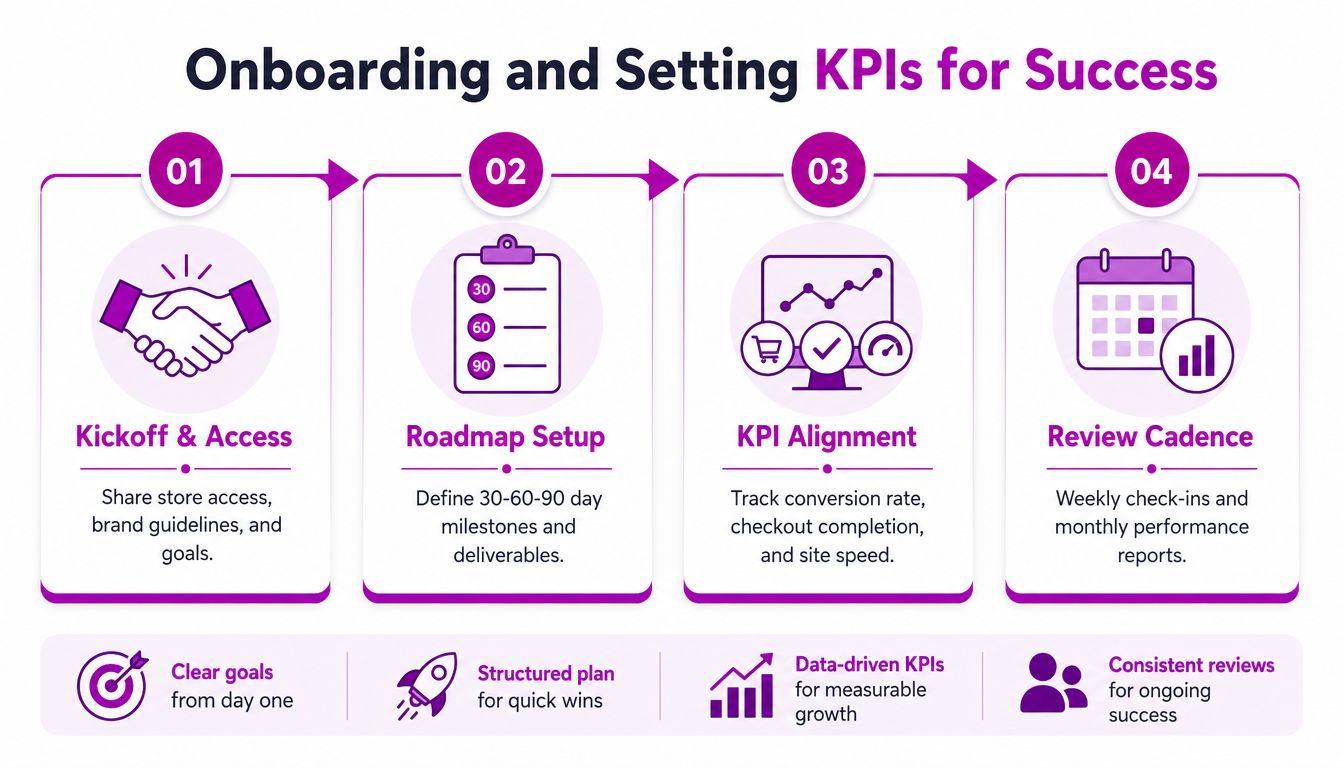
Start with a written operating brief. It should include business goals, customer segments, market priorities, brand constraints, current architecture, known platform risks, active experiments, and internal owners. List every critical integration and identify who can approve changes to each system.
Establish the baseline before changing the store
For conversion work, calculate the rate consistently as transactions divided by visitors or sessions multiplied by 100. Use sessions as the primary benchmark unit, then split the funnel into cart-to-checkout and checkout-to-purchase. The benchmark methodology outlined for Shopify checkout performance also recommends analyzing a meaningful data window, at least 30 days, and extending to 90 days for lower-traffic stores.
Track a focused dashboard rather than every available metric:
- Conversion rate: Overall and segmented by device, market, channel, and landing experience.
- Cart-to-checkout rate: Identifies product, cart, shipping, and trust friction.
- Checkout-to-purchase rate: Highlights payment, delivery, validation, and checkout issues.
- Mobile performance: Monitor load behavior and interaction quality because speed delays can directly hurt buying intent.
- Release quality: Record defects, rollback events, and unresolved technical debt.
- Commercial outcomes: Connect experiments to margin, average order value, retention, or operational efficiency where relevant.
Build a practical operating rhythm
The first phase should confirm access, documentation, analytics integrity, app ownership, and the technical backlog. The next phase should prioritize low-risk fixes and expose larger architecture decisions. Later work can address broader experiments, international expansion, automation, or deeper integration changes.
Use weekly delivery meetings for blockers and decisions, with a separate monthly performance review for KPI trends and roadmap changes. Define escalation rules before an incident occurs. A checkout defect, failed integration, or data discrepancy needs a named owner, a communication path, and a rollback decision process.
Measurement rule: Don't reward an expert for shipping more tickets. Reward the team for improving the agreed commercial and operational indicators without creating avoidable technical debt.
ECORN's Flexible Subscription Packages
The staffing problem is straightforward. Brands need senior Shopify Plus judgment, but they often don't need a full-time senior specialist every day of the year. Project freelancers create another problem, because the people who understand the architecture may disappear once the launch invoice is paid. That gap leaves internal teams carrying undocumented decisions and urgent maintenance work.
A flexible subscription model can address that mismatch when it includes real delivery ownership. The useful version isn't an open-ended bucket of hours. It combines defined capacity, a named team, a prioritized backlog, technical documentation, and a clear process for scaling work up or down.
What the model should cover
ECORN offers Shopify expertise across design, Shopify development, and conversion rate optimization, with flexible subscription packages for different e-commerce needs. Businesses can start with a single project initiative, then move into recurring support when the working relationship and delivery requirements are clear. The model is designed to provide access to dedicated Shopify specialists without requiring every brand to build a large internal team.
That structure fits several situations:
- A migration team needs continuity through architecture, implementation, QA, launch, and stabilization.
- A growing brand needs regular development and CRO support but has uneven demand.
- A Plus merchant needs an ongoing partner for checkout changes, integrations, app rationalization, and performance work.
- An internal e-commerce team needs extra senior capacity for specialist tasks without surrendering technical ownership.
ECORN reports a track record of supporting over 100 brands, which is relevant when you're evaluating whether a team has operated across different store conditions and delivery requirements. It also incorporates modern applications such as AI into its e-commerce work, but the decision should remain practical. Ask which workflow the technology improves, who owns it, how it will be measured, and whether it adds another dependency to your stack.
Where brands still need discipline
A subscription doesn't remove the need for governance. Before signing, define the assigned specialists, response expectations, working hours, deliverables, backlog process, reporting format, documentation standards, and code ownership. Clarify how unused capacity is handled and how the relationship changes when the brand enters a migration, peak trading period, or international rollout.
Ask ECORN to map the package to your immediate operational risk. If deprecated checkout logic is the priority, the first deliverables should focus on inventorying existing customizations, classifying replacement paths, and testing the new implementation. If CRO is the priority, start with baseline integrity, funnel segmentation, and a ranked experiment backlog rather than a generic redesign.
The right Shopify Plus experts won't just keep tickets moving. They'll help you maintain implementation capacity, reduce migration exposure, and connect technical work to measurable commercial decisions. A subscription is worthwhile when it creates that continuity with enough flexibility to match your actual workload.
ECORN provides Shopify Plus development, design, and CRO support through flexible packages, including single-project initiatives and ongoing specialist capacity. If you need a team to manage complex implementation work while maintaining a practical optimization roadmap, visit ECORN and discuss your store's requirements.



Chargeback Protection Shopify: A Practical 2026 Guide

8 Examples of Conversion Rate Optimization
How to Conversion Rate Optimization for Shopify Stores

Shopify Design Essentials Every Store Owner Needs
Ecommerce Terms of Service: How to Draft and Implement
How to Implement Structured Data for Ecommerce in 2026

SEO App Mobile: Shopify Store Optimization Guide

Shopify Plus Support: What It Includes and How to Choose

Google Ads for Shopify: The Complete 2026 Playbook

Shopify New York: How to Find and Hire the Right Agency

Google Search Console for Shopify: The Complete Setup

First Party Data Collection for eCommerce Growth
FAQ Online Store Guide: Build and Measure It Right
Do FB Ads Work for eCommerce in 2026?

One Page Checkout for Shopify: Design and Implementation
Shopify GraphQL vs REST: The 2026 Developer Decision
Shopify Ecommerce Consulting: Strategy, Pricing &

Are Reddit Ads Worth It for eCommerce Brands

Shopify Title and Meta Description: A Practical 2026 Guide

Product Video Best Practices for Shopify Brands
Real-Time Inventory Management: A 2026 Guide

AI Chatbot Integration for Shopify Stores
Affiliate Program Management: A Shopify Guide
10 Best Performance Monitoring Tools for Shopify in 2026
Digital Asset Management for eCommerce Brands in 2026

Every Type of Facebook Ads Explained for eCommerce Growth
Product Information Management Explained for Shopify Brands
Support Ticket System: A Guide for Shopify Stores

10 Best Customer Service Tools for Shopify in 2026

Can I Start a Business with No Money? a 2026 Blueprint

What Sells Good on Etsy: Best Niches for 2026

Shopify Add to Cart Button: A Practical 2026 Guide

Customer Feedback Automation: A Practical eCommerce Guide

Critical Rendering Path: A Guide for Shopify Stores

How to Promote on TikTok for eCommerce in 2026

B2B eCommerce Consulting That Drives Real Revenue
10 Best Practices for Site Navigation in 2026
Return vs Refund for Shopify Stores: A Practical Guide

What Is Customer Lifetime Value and Why It Matters
What Is Voice of Customer Research for eCommerce

SMS Marketing for Ecommerce That Actually Converts

Master How to Improve Email Deliverability in 2026

Top 7 eCommerce Partners NYC for Shopify Brands in 2026

Machine Learning for Ecommerce: Boost Your Shopify Store

Beauty Market Research: Your 2026 Growth Guide

Shopify International Expansion: A 2026 Roadmap

What Does CRO Stand for in Business: Understanding CRO

Shopify Visual Merchandising: A Playbook for Higher Sales

Shopify Landing Page Design: Master Conversion in 2026
10 Best AI SEO Optimization Tools for Shopify in 2026

Agentic AI for Ecommerce: Boost Your Sales in 2026
Mastering Email Marketing Data for eCommerce Growth

Conversion Rate Optimisation Australia: Boost Your Sales
Conversion Rate Optimization AI: Your Shopify Store Guide

10 Product Bundling Strategies for Shopify in 2026

How to Increase Customer Lifetime Value: A Shopify Playbook
AI Customer Service Automation: Shopify Guide 2026

Clean Website Design: A Shopify Conversion Playbook

Omnichannel Retail Strategy: A Shopify Playbook

Product Data Enrichment: A Guide for Shopify Brands

Instagram Shopping Features a Guide for Shopify Stores

What Is Revenue Optimization: A Holistic RevOps Guide

Benefits of Conversion Rate Optimization: Boost Your
WordPress to Shopify Migration: Your 2026 Seamless Switch
Boost Sales: Ecommerce Payment Processing Guide 2026
Unified Commerce Platform: Benefits, KPIs & Shopify Guide

How to Reduce Bounce Rate eCommerce: Your 2026 Guide
Shopify API Integration: A Practical End-to-End Guide

How to Implement Data Governance: A 2026 Guide
Shopify Store Development Cost: A 2026 Breakdown
What Is Server Side Tracking: The Shopify Guide 2026
Marketing Automation Workflows: A Shopify Guide for 2026

Shopify: How to Reduce Technical Debt

Shopify UX Design Change: A Playbook for Growth
User Generated Content Strategy: Shopify Playbook

Shopify Pause and Build Plan Cost: A Complete 2026 Guide

Compare at Price on Shopify: A Complete Guide for 2026

Where Can I Sell My Prints? 10 Best Platforms for 2026
Shopify Order Management System: The Ultimate Guide 2026
What Is Marketing Attribution? an eCommerce Guide for 2026

10 Best Black Friday Sales Sheets for 2026

Discover the Top Social Media Marketing Agencies For
Consumer Confidence Definition for eCommerce in 2026

What Is Social Commerce? Your 2026 Guide to Boosting Sales

A Social Ad Campaign Playbook for eCommerce Growth

7 Best FAQ Page Examples for SaaS & eCommerce

Market Research in Fashion Industry: A Guide for Shopify
Shopify Migration Services: Expert Guide for 2026
Mastering FB Retargeting Ads for Shopify in 2026
What Is Omnichannel Ecommerce

Master Your Shopify Plus Migration: The 2026 Guide
Shopify Integration Services: A Merchant's 2026 Guide

Shopify Collection Description: A Guide to SEO & Sales

Shopify Plus Contact: Reach Sales & Support Effectively

Top Luxury Shopify Stores: Design & UX Strategies
How to Improve Customer Experience: A Shopify Roadmap

Creative Facebook Ads: 10 Examples for Shopify Brands

Remarketing with Facebook Ads: A Shopify Guide for 2026

SEO Linking Strategies for Shopify Stores
Top 7 Statistics YouTube Channels for eCommerce in 2026


newsletter in your inbox