

You're probably seeing the same pattern a lot of growing eCommerce brands hit. Ad spend climbs. Sessions go up. The dashboard looks active. But when the month closes, profit hasn't moved the way it should.
That gap is usually not a traffic problem. It's a conversion problem.
A founder will often tell me, “We need more volume.” Sometimes that's true. More often, the site is leaking money at every step. Product pages don't resolve objections. Navigation sends people in circles. The cart introduces friction at the exact moment a buyer is ready. Mobile pages load just slowly enough to break intent. None of those issues show up as loudly as a failed ad campaign, but they drain margin every day.
That's why the benefits of conversion rate optimization go far beyond making a button prettier or rewriting a headline. CRO plugs the leak in the funnel you already paid to fill. It helps you get more revenue from the same traffic, makes paid acquisition less fragile, and gives you a clearer read on what customers need to buy.
The biggest shift is mental. Stop treating your website like a brochure that supports marketing. Start treating it like the sales floor, checkout counter, and customer research lab for the entire business.
Introduction The Profit Leak in Your Funnel
A familiar scenario plays out like this. You launch new paid campaigns, push harder on Meta or Google, maybe add influencer spend, and traffic rises. Your team feels momentum. Then finance looks at contribution margin and asks the uncomfortable question: why are we buying so much attention without getting enough value back?
That's the profit leak.
Most brands try to solve it by pouring more visitors into the funnel. That works for a while, until rising acquisition costs turn growth into a treadmill. You can stay busy and still get less efficient every quarter. A lot of founders don't notice the shift until they realize they're funding growth with optimism instead of operational discipline.
CRO changes the game because it focuses on the visitors you already have. Not abstract traffic. Real people who clicked, landed, browsed, hesitated, and left clues about what stopped them from buying.
Most eCommerce teams don't have a traffic ceiling first. They have a clarity and friction problem first.
When you treat conversion work seriously, you stop asking only, “How do we get more clicks?” You start asking better questions. Which pages create doubt? Which devices underperform? Which product messages pull a shopper forward, and which ones create hesitation? Which objections belong on the page instead of buried in support tickets?
That's why CRO is such an impactful activity. It improves immediate revenue, but it also sharpens the business. Better pages produce better data. Better data produces better decisions. And better decisions compound across acquisition, retention, product positioning, and sales.
What Is Conversion Rate Optimization Really
Conversion rate optimization is the discipline of improving how many visitors complete a meaningful action on your site, usually a purchase, signup, lead form, or add-to-cart progression. But the useful definition isn't the formula. The useful definition is this: CRO is a structured way to remove friction and increase buyer confidence.
Think about your site like a physical store.
If customers walk in and can't find the category they want, that's a navigation issue. If they pick up a product and still don't understand why it's worth the price, that's a messaging issue. If they get to checkout and the line is confusing, slow, or asks for too much, that's a process issue. In retail, nobody would call those “small UX tweaks.” They're sales issues. Online, they're the same thing.
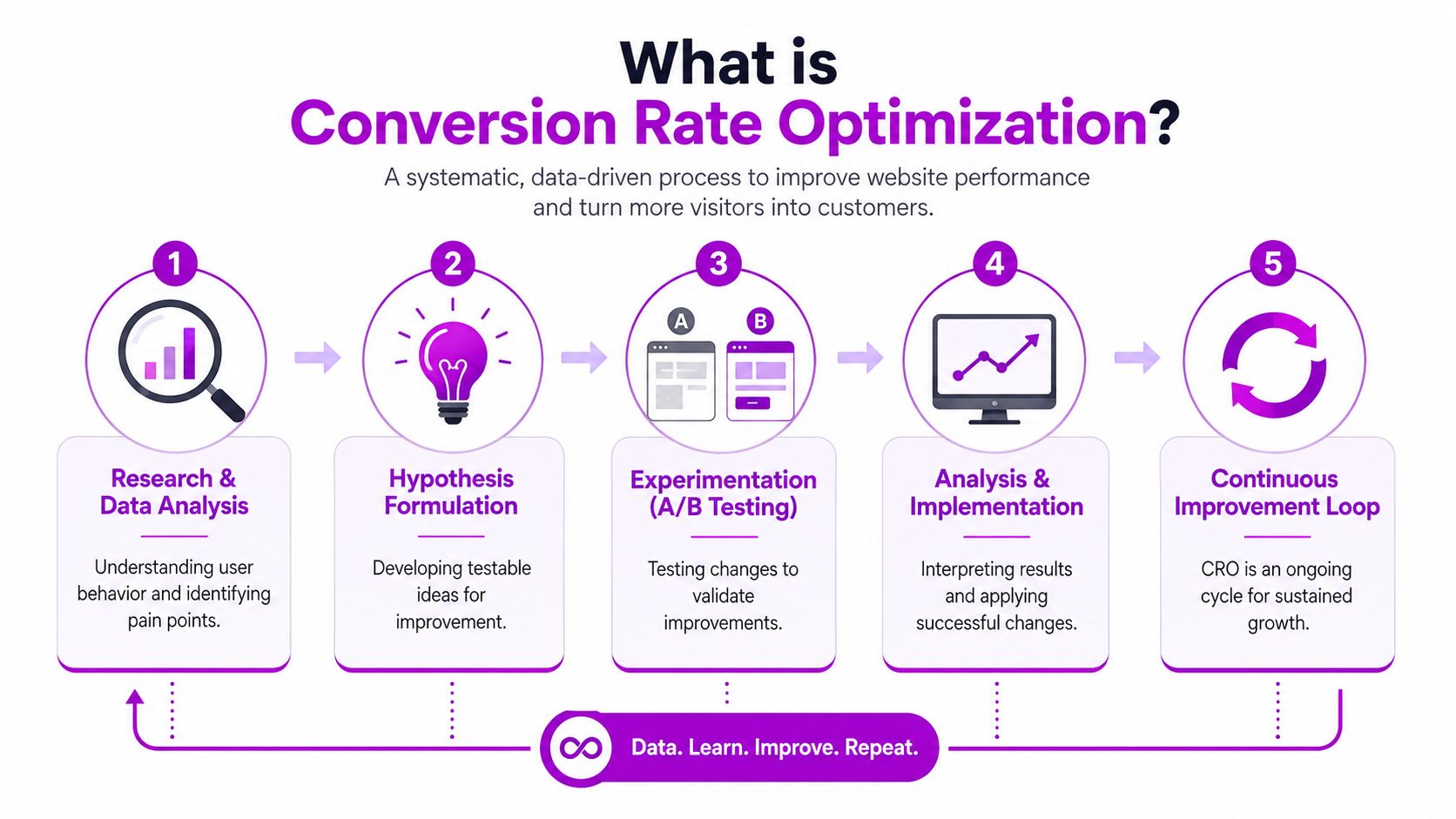
CRO is a system, not a one-off fix
The teams that get value from CRO don't guess their way through it. They run a cycle:
Research the behavior
Look at analytics, heatmaps, session recordings, checkout behavior, and support friction. Find where intent drops.Form a hypothesis
Don't say, “Let's test a new banner.” Say, “Buyers hesitate because the value proposition is vague above the fold.”Run an experiment
A/B tests, landing page variants, revised page layouts, reordered PDP sections, simplified cart flows.Analyze the result
Did the change improve purchase behavior, click-through, or progression through checkout? Did it help mobile more than desktop?Apply and repeat
Good CRO never really ends because customer expectations, channels, and merchandising change.
If you want a practical breakdown of the process from a Shopify angle, Yassine Malti on boosting Shopify sales is a useful companion read. For a more foundational explanation of the concept itself, ECORN's guide to conversion rate optimisation definition is also worth reviewing.
What CRO is not
A lot of wasted effort comes from confusing CRO with random website tinkering.
It isn't:
- Blind A/B testing without a strong hypothesis
- Design drift where pages change because the team is bored with them
- Button-color theater where low-impact elements get all the attention
- A marketing-only function detached from merchandising, support, and sales
Practical rule: If a test doesn't connect to a specific friction point or buying objection, it probably isn't a serious CRO test.
The strongest programs treat the website like a living commercial system. They observe behavior, make targeted changes, and learn something every cycle. That learning is where the long-term value starts.
The Direct Financial Benefits of CRO
The fastest way to understand the benefits of conversion rate optimization is to look at where the money moves. CRO affects revenue, acquisition efficiency, margin protection, and the return you get from every paid and organic visit.
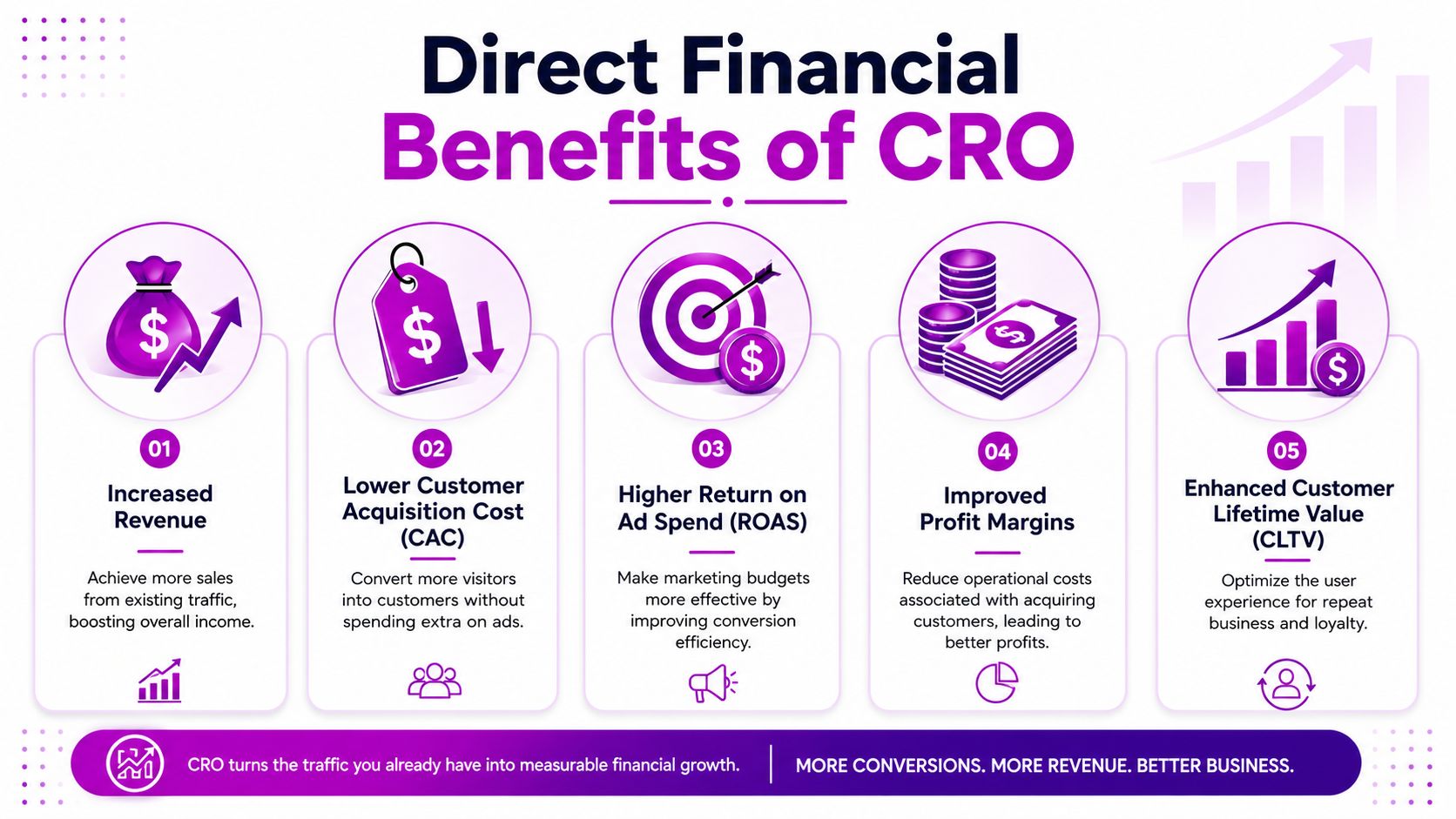
More revenue from the same traffic
This is the headline benefit because it changes your growth math immediately.
Businesses using CRO tools report an average ROI of 223%, and adding a video to a landing page can increase conversion rates by up to 80%, according to Glassbox's CRO analysis. That matters because it means you don't need to buy more sessions to generate more revenue. You make the sessions you already paid for work harder.
That's a much healthier model than relying on constant acquisition expansion. If your paid traffic gets more expensive next quarter, a better-converting site protects the business. If your media buying gets more efficient at the same time, the gains stack.
Lower acquisition cost without cutting spend
Founders usually think of customer acquisition cost as a media problem. It's partly a site problem.
If more visitors convert from the same traffic base, your cost per acquired customer drops because the denominator improves. The traffic bill doesn't have to change. The site just does a better job finishing the sale.
That's why CRO often has a stronger effect on profitability than launching another ad test. You've already paid for the click. The site is where that investment either compounds or dies.
A useful way to think about it is this:
| Financial lever | What CRO changes | Business effect |
|---|---|---|
| Revenue efficiency | More visitors complete the desired action | More sales from existing demand |
| Acquisition cost | The same traffic produces more customers | Lower cost per acquisition |
| Ad spend productivity | Traffic converts at a higher rate | Better return on spend |
| Margin quality | Less reliance on blunt discounting | Healthier contribution margin |
Better economics at the page level
Some of the strongest CRO gains come from very specific page improvements.
- Landing page quality often improves when teams sharpen the offer, align message and traffic source, and reduce distraction.
- Checkout simplification removes hesitation at the most sensitive step.
- Media upgrades such as product video can help shoppers resolve uncertainty without leaving the page.
- Exit-intent capture can recover buyers who were about to leave if the offer or message fits the moment.
If you want a tactical companion on that side of the work, this framework for boosting online revenue is a useful reference.
The biggest mistake I see here is treating CRO as a cost center because it sits near design, UX, or experimentation. In practice, it behaves more like a capital allocation decision. You're improving the efficiency of an asset you already own: your traffic.
Strategic Advantages Beyond a Single Sale
The strongest CRO programs don't stop at conversion lift. They give the company a better operating system for understanding buyers, improving experience, and making smarter commercial decisions.

Better experience creates better retention conditions
CRO improves user experience by removing friction. That sounds simple, but it has broader consequences than a single sale.
When the journey feels clear, trustworthy, and easy to complete, customers are more likely to leave with confidence in the brand. Landbase notes that CRO-driven UX improvements materially raise conversion rates, and that 70% of marketers use CRO experiment outcomes to inform broader marketing decisions. That's the key strategic point. The learning doesn't stay trapped inside one landing page. It spreads.
A cleaner post-click experience often reveals what matters most to buyers:
- Trust signals that reduce hesitation
- Privacy and reassurance cues that matter in sensitive or regulated journeys
- Category framing that helps shoppers self-select quickly
- Message sequencing that answers objections in the right order
Those lessons improve retention because they create a more coherent customer experience from first click through post-purchase communication.
CRO creates a test-and-learn culture
Most companies say they value experimentation. Few operationalize it.
CRO forces teams to stop debating in the abstract. Instead of a senior person deciding what “feels premium,” the business tests what helps customers act. That habit has spillover value across product, merchandising, lifecycle marketing, and even offer strategy.
A mature CRO program turns opinions into hypotheses and hypotheses into operating knowledge.
That's one reason I view CRO as a strategic capability, not just a website service. It creates a repeatable mechanism for discovering what buyers respond to. Over time, that makes the company faster and less political. Teams stop fighting over preferences and start comparing evidence.
The hidden upside for product and sales
This angle gets missed in most articles.
Conversion data can reveal what customers struggle to understand, what language they trust, where pricing creates friction, and which use cases drive action. That's useful to marketers, but it's just as useful to product and sales teams.
For product teams, CRO findings can expose confusing feature positioning, weak assortment logic, or gaps in merchandising. For sales teams, especially in higher-consideration or assisted-sale environments, CRO surfaces the objections buyers need resolved before they're ready to talk.
Gravity Global points to this under-discussed connection in its piece on the role of conversion optimization for sales teams. The important takeaway isn't a vanity metric. It's that conversion work produces customer insight that other teams can use to close deals more effectively and align messaging with real buyer motivation.
Measuring the ROI of Your CRO Program
If you can't measure CRO correctly, you'll either stop too early or congratulate yourself for noise. Good measurement keeps the program honest.
Start with the core business metrics
A founder doesn't need a dashboard full of vanity numbers. Start with a short stack of metrics that tie directly to commercial performance:
- Conversion rate as the headline indicator
- Revenue per visitor because it blends conversion efficiency with order quality
- Average order value to catch whether changes improve basket quality
- Bounce rate and checkout progression to identify where friction remains
The benchmark question matters too. Tenet reports that well-optimized landing pages can achieve conversion rates of up to 11.45% or more, compared with a global average of 2.35%, and that improved UX can increase conversions by up to 400%. Don't use that as a promise. Use it as proof that strong performance is usually built, not stumbled into.
Track tests by decision quality, not excitement
A lot of teams measure the wrong thing. They celebrate a visual refresh or a launch date instead of the commercial impact of the change.
Use a simple review structure after every experiment:
| Test Area | Common Test | Potential Uplift Range |
|---|---|---|
| Product page | Value proposition clarity, image order, trust signal placement | Qualitative, varies by brand and traffic quality |
| Cart and checkout | Field reduction, shipping clarity, error handling | Qualitative, often meaningful when friction is high |
| Landing page | Hero copy, CTA framing, page structure, video placement | Qualitative, can be substantial when intent-match is weak |
| Collection pages | Filter logic, sorting defaults, merchandising emphasis | Qualitative, depends on catalog complexity |
| Mobile UX | Sticky CTA, thumb-friendly layout, speed improvements | Qualitative, often strong for mobile-heavy stores |
That table is intentionally qualitative. Test outcomes vary wildly by traffic source, product category, and the severity of the original friction. Anyone promising a fixed uplift by test type is usually selling fantasy.
Don't skip validity
The most expensive CRO mistake isn't a failed test. It's a false positive.
Use an A/B testing platform that helps you separate real movement from random fluctuation. Keep a written hypothesis before launch. Define the primary metric in advance. And don't end the test just because one version looks better after a short burst of traffic.
The point of measurement isn't to prove you were right. It's to find out what the market actually prefers.
When you measure this way, ROI becomes clearer. You can connect design and UX changes to revenue efficiency instead of treating them as subjective improvements.
Shopify CRO Quick Wins and Case Examples
Shopify brands usually don't need a total rebuild to improve conversion. They need a sharper diagnosis and a cleaner order of operations.
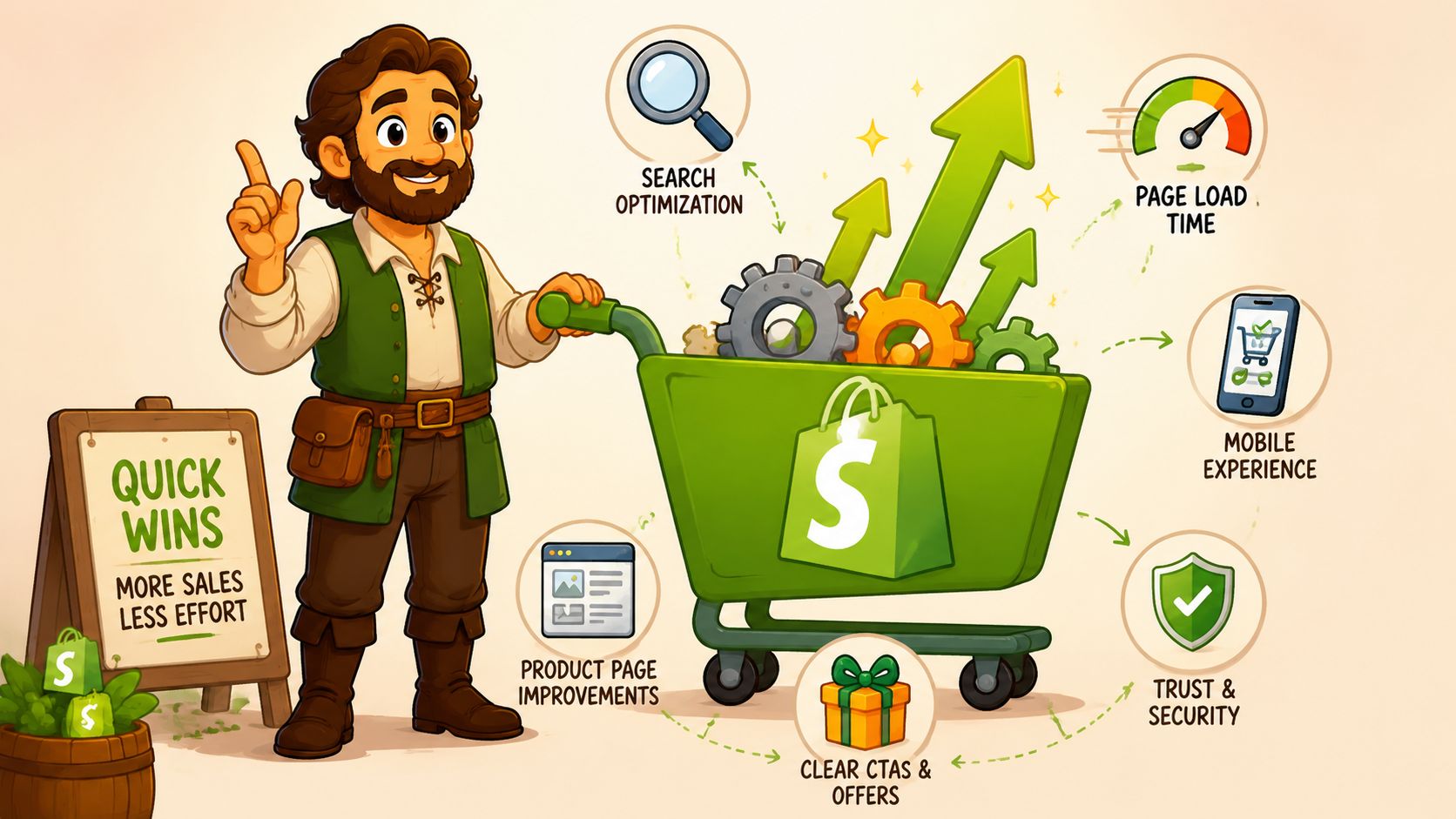
Quick wins that usually matter first
On Shopify, I'd look at these before touching cosmetic details:
Product page trust
Add delivery clarity, returns reassurance, reviews, and concise FAQ content close to the add-to-cart area. Buyers shouldn't have to hunt for basic confidence signals.Variant and bundle clarity
If shoppers can't easily understand sizes, materials, or what goes together, they stall. Clean variant logic and relevant product pairing often beat generic recommendation blocks.Mobile purchase flow
Sticky add-to-cart bars, tighter spacing, and better thumb reach can matter far more than desktop-perfect visuals.Cart friction
Shipping surprises, discount code distractions, or muddy totals create last-minute drop-off. Keep the cart focused on completion.Merchandising logic
Collection pages should help shoppers narrow choices fast. Smart filters and better category descriptions can remove a lot of uncertainty.
For practical implementation ideas, this guide to conversion optimization best practices is a solid starting point for Shopify teams reviewing their current store experience.
A realistic case pattern
A typical Shopify situation looks like this: the brand has decent traffic, strong products, and healthy add-to-cart behavior, but checkout completion lags. The first instinct is usually to push more urgency or launch another discount. That often treats the symptom, not the cause.
In many stores, the fundamental issue is that the site asks for trust before it earns it. Product pages don't answer obvious questions. The cart introduces uncertainty around shipping or returns. Mobile buyers hit minor usability snags that are easy to ignore in a desktop review and costly in real sessions.
A better response is operational:
- tighten the PDP message
- improve trust placement
- simplify cart communication
- review mobile-first interactions
- test one change set at a time
Later in the process, video can help teams think through the page more critically. This walkthrough is a useful example:
Tools and execution
Shopify makes experimentation easier than many custom stacks, but the stack still matters. Depending on the problem, teams often combine analytics, heatmaps, session recordings, product review tools, survey tools, landing page builders, and A/B testing software.
For brands that want outside support, ECORN is one option that works on Shopify design, development, and CRO execution. The important part isn't the vendor name. It's having a team that can connect customer behavior, page changes, and commercial outcomes without turning optimization into endless redesign cycles.
Common CRO Pitfalls to Avoid in 2026
The worst CRO programs don't fail because the idea is wrong. They fail because the execution is sloppy.
Running weak tests and calling it science
Teams stop tests too early. They chase novelty instead of impact. They test tiny interface details while major friction stays untouched. This creates activity without progress.
If the hypothesis is weak, the result won't teach you much. If the sample is premature, the result may be misleading. And if the team never documents what it learned, every quarter starts from zero again.
Treating AI as a shortcut instead of a tool
AI is useful in CRO, but it has a trust ceiling.
Recent guidance from Lucky Orange notes that AI-driven personalization can lift conversion rates by up to 15%, but only when paired with transparent UX and human oversight. The warning matters just as much as the upside. Over-automated chatbots or form flows without clear error handling can frustrate users and increase drop-off.
If personalization feels invasive, confusing, or robotic, it stops behaving like optimization and starts behaving like friction.
That issue gets worse in higher-trust categories. If a buyer needs clarity, reassurance, or accessibility, clever automation won't save a poor experience.
The practical rule for 2026 is simple. Use AI to accelerate insight and execution. Don't let it replace judgment, transparency, or human review.
Conclusion Your Engine for Sustainable Growth
CRO isn't a side project for when the ads are working. It's what makes the ads worth buying in the first place.
The clearest benefits of conversion rate optimization show up in profit. You generate more value from existing traffic, reduce wasted acquisition spend, and build a site that converts with less force. But the deeper value is strategic. CRO gives you a better read on buyer intent, stronger product and sales insight, and a more disciplined way to improve the business over time.
That's why I'd rank it above most growth initiatives for established eCommerce brands. Paid media rents attention. CRO improves the asset that captures it.
A high-converting site does more than sell. It teaches. It reveals friction. It sharpens positioning. It helps every visitor count for more.
If your growth has started to feel expensive, uneven, or harder than it should, the answer usually isn't to buy more traffic first. It's to fix the system that turns traffic into revenue.
If you want a partner to audit the funnel, identify the biggest conversion leaks, and turn those insights into practical Shopify improvements, ECORN can help.


Mobile Pop Up Strategy for Shopify Stores That Converts
Sitemap for Shopify: How to Find, Optimize, and Submit It
7 Single Product Websites Worth Emulating
Product Variants Shopify: The Complete 2026 Guide
Ecommerce Analytics Consulting for Growth
What Is AI Integration for eCommerce
How to Choose the Right eCommerce Website Development Firm
E Business Strategy Implementation
Conversion Tracking Setup for Shopify Stores
BigCommerce vs Shopify Plus Which Enterprise Wins in 2026
Shopify Theme Kit: Setup, Commands, and Migration Guide
Shopify Extension Development: A Practical 2026 Guide
Shopify Speed Score Explained and How to Improve It
Shopify Mobile Optimization: The 2026 Playbook
How to Add Subcategory in Shopify for Better UX
How to Implement Structured Data for Ecommerce in 2026
SEO App Mobile: Shopify Store Optimization Guide
Shopify Plus Support: What It Includes and How to Choose
Google Ads for Shopify: The Complete 2026 Playbook
Shopify New York: How to Find and Hire the Right Agency
Google Search Console for Shopify: The Complete Setup
First Party Data Collection for eCommerce Growth
FAQ Online Store Guide: Build and Measure It Right
Do FB Ads Work for eCommerce in 2026?
One Page Checkout for Shopify: Design and Implementation
Shopify GraphQL vs REST: The 2026 Developer Decision
Shopify Ecommerce Consulting: Strategy, Pricing &
Are Reddit Ads Worth It for eCommerce Brands
Shopify Title and Meta Description: A Practical 2026 Guide
Product Video Best Practices for Shopify Brands
Real-Time Inventory Management: A 2026 Guide
AI Chatbot Integration for Shopify Stores
Affiliate Program Management: A Shopify Guide
10 Best Performance Monitoring Tools for Shopify in 2026
Digital Asset Management for eCommerce Brands in 2026
Every Type of Facebook Ads Explained for eCommerce Growth
Product Information Management Explained for Shopify Brands
Support Ticket System: A Guide for Shopify Stores

10 Best Customer Service Tools for Shopify in 2026

Can I Start a Business with No Money? a 2026 Blueprint

What Sells Good on Etsy: Best Niches for 2026

Shopify Add to Cart Button: A Practical 2026 Guide

Customer Feedback Automation: A Practical eCommerce Guide
Critical Rendering Path: A Guide for Shopify Stores

How to Promote on TikTok for eCommerce in 2026

B2B eCommerce Consulting That Drives Real Revenue
10 Best Practices for Site Navigation in 2026
Return vs Refund for Shopify Stores: A Practical Guide
What Is Customer Lifetime Value and Why It Matters
What Is Voice of Customer Research for eCommerce

SMS Marketing for Ecommerce That Actually Converts

Master How to Improve Email Deliverability in 2026

Top 7 eCommerce Partners NYC for Shopify Brands in 2026
Machine Learning for Ecommerce: Boost Your Shopify Store

Beauty Market Research: Your 2026 Growth Guide
Shopify International Expansion: A 2026 Roadmap
What Does CRO Stand for in Business: Understanding CRO

Shopify Visual Merchandising: A Playbook for Higher Sales

Shopify Landing Page Design: Master Conversion in 2026
10 Best AI SEO Optimization Tools for Shopify in 2026

Agentic AI for Ecommerce: Boost Your Sales in 2026
Mastering Email Marketing Data for eCommerce Growth
Conversion Rate Optimisation Australia: Boost Your Sales
Conversion Rate Optimization AI: Your Shopify Store Guide

10 Product Bundling Strategies for Shopify in 2026
How to Increase Customer Lifetime Value: A Shopify Playbook
AI Customer Service Automation: Shopify Guide 2026
Clean Website Design: A Shopify Conversion Playbook

Omnichannel Retail Strategy: A Shopify Playbook
Product Data Enrichment: A Guide for Shopify Brands
Instagram Shopping Features a Guide for Shopify Stores
What Is Revenue Optimization: A Holistic RevOps Guide
WordPress to Shopify Migration: Your 2026 Seamless Switch
Boost Sales: Ecommerce Payment Processing Guide 2026
Unified Commerce Platform: Benefits, KPIs & Shopify Guide
How to Reduce Bounce Rate eCommerce: Your 2026 Guide
Shopify API Integration: A Practical End-to-End Guide

How to Implement Data Governance: A 2026 Guide
Shopify Store Development Cost: A 2026 Breakdown
What Is Server Side Tracking: The Shopify Guide 2026
Marketing Automation Workflows: A Shopify Guide for 2026
Shopify: How to Reduce Technical Debt

Shopify UX Design Change: A Playbook for Growth
User Generated Content Strategy: Shopify Playbook

Shopify Pause and Build Plan Cost: A Complete 2026 Guide
Compare at Price on Shopify: A Complete Guide for 2026
Where Can I Sell My Prints? 10 Best Platforms for 2026
Shopify Order Management System: The Ultimate Guide 2026
What Is Marketing Attribution? an eCommerce Guide for 2026

10 Best Black Friday Sales Sheets for 2026

Discover the Top Social Media Marketing Agencies For
Consumer Confidence Definition for eCommerce in 2026
What Is Social Commerce? Your 2026 Guide to Boosting Sales
A Social Ad Campaign Playbook for eCommerce Growth
7 Best FAQ Page Examples for SaaS & eCommerce

Market Research in Fashion Industry: A Guide for Shopify
Shopify Migration Services: Expert Guide for 2026
Mastering FB Retargeting Ads for Shopify in 2026
What Is Omnichannel Ecommerce

Master Your Shopify Plus Migration: The 2026 Guide


newsletter in your inbox