

By 2026, 71% of brands were growing or planning to grow their first-party datasets, compared with 41% two years earlier, according to Digiday's reporting on the shift away from third-party cookies. That change says more about eCommerce operations than marketing fashion. Shopify brands can no longer treat browser tracking as the dependable source of truth for attribution, personalization, or customer lifetime value.
The practical response isn't to add another pixel. It's to build a consent-gated, server-owned first party data collection system that captures known customer signals, connects them across Shopify Plus and the rest of the stack, and gives teams a controlled way to activate what they collect.
Why First Party Data Collection Matters Now
Third-party tracking once filled gaps in customer knowledge with browser-level signals. That model relied on identifiers merchants did not control, privacy settings that differed by platform, and attribution windows that could vanish as browsers changed their rules. In March 2024, Google began phasing out third-party cookies for about 1% of Chrome users, making the direction clear even as the wider transition remained uneven.
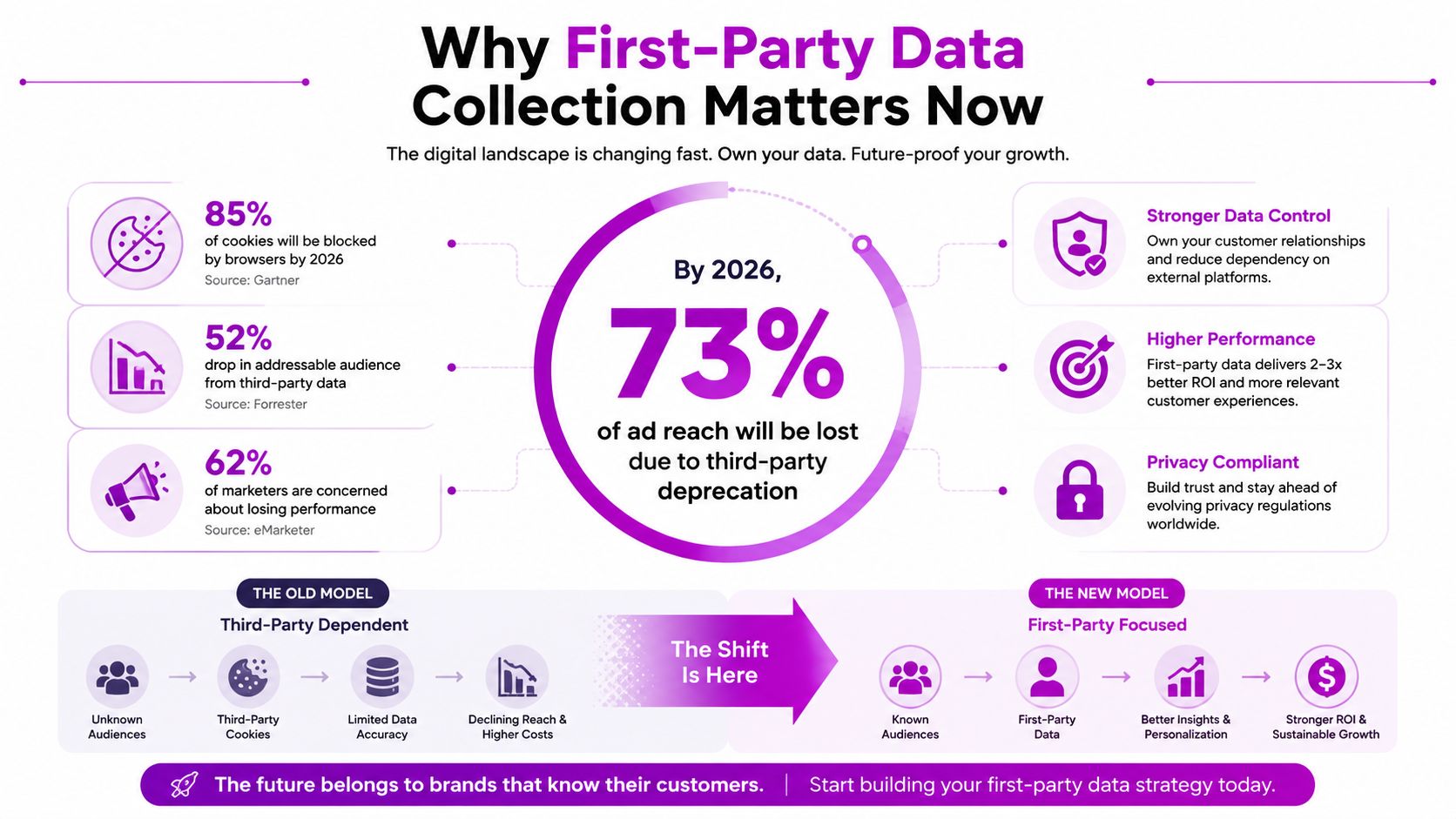
A Shopify operator sees the effect across an ordinary buying journey. A customer browses on a phone, returns on a laptop, and completes the order after receiving an email. Fragile browser identifiers can split that journey into unrelated sessions. An ad platform may report one outcome, analytics another, while Shopify holds the dependable conversion record.
The operating model has changed
First party data collection puts responsibility back with the merchant. The store gathers information through Shopify checkout, customer accounts, email subscriptions, loyalty programs, app interactions, and CRM activity. The brand can define what it collects, the purpose for collection, retention periods, and which systems can use each signal.
Operational maturity now determines how much value that data creates. A consent banner and a customer table do not form an activation system by themselves. Shopify Plus brands need identity rules, event definitions, server-side routing, and consent gates that keep collection aligned with permission. Their CDP or connected customer platform must also turn approved profiles into usable audiences for retention, merchandising, analytics, and paid media.
Industry adoption has therefore moved beyond marketing teams. Reporting found that 81% of organizations had adopted privacy-first measurement strategies in 2026, while 88% were projected to rely primarily on first-party data by 2027. Those figures describe a foundational shift in digital measurement, not a temporary response to cookie loss.
Practical rule: Treat cookie loss as an architecture problem. Rebuild the source of truth around consent, identity, events, and server-side activation rather than preserving every browser signal.
The strongest programs do not collect more fields. They connect a customer's permission to the data captured, the profile resolved, and the action taken. That gives a retention manager a usable segment, a CRO team a trustworthy test audience, and finance a way to reconcile marketing reports with actual Shopify orders.
What First Party Data Collection Means
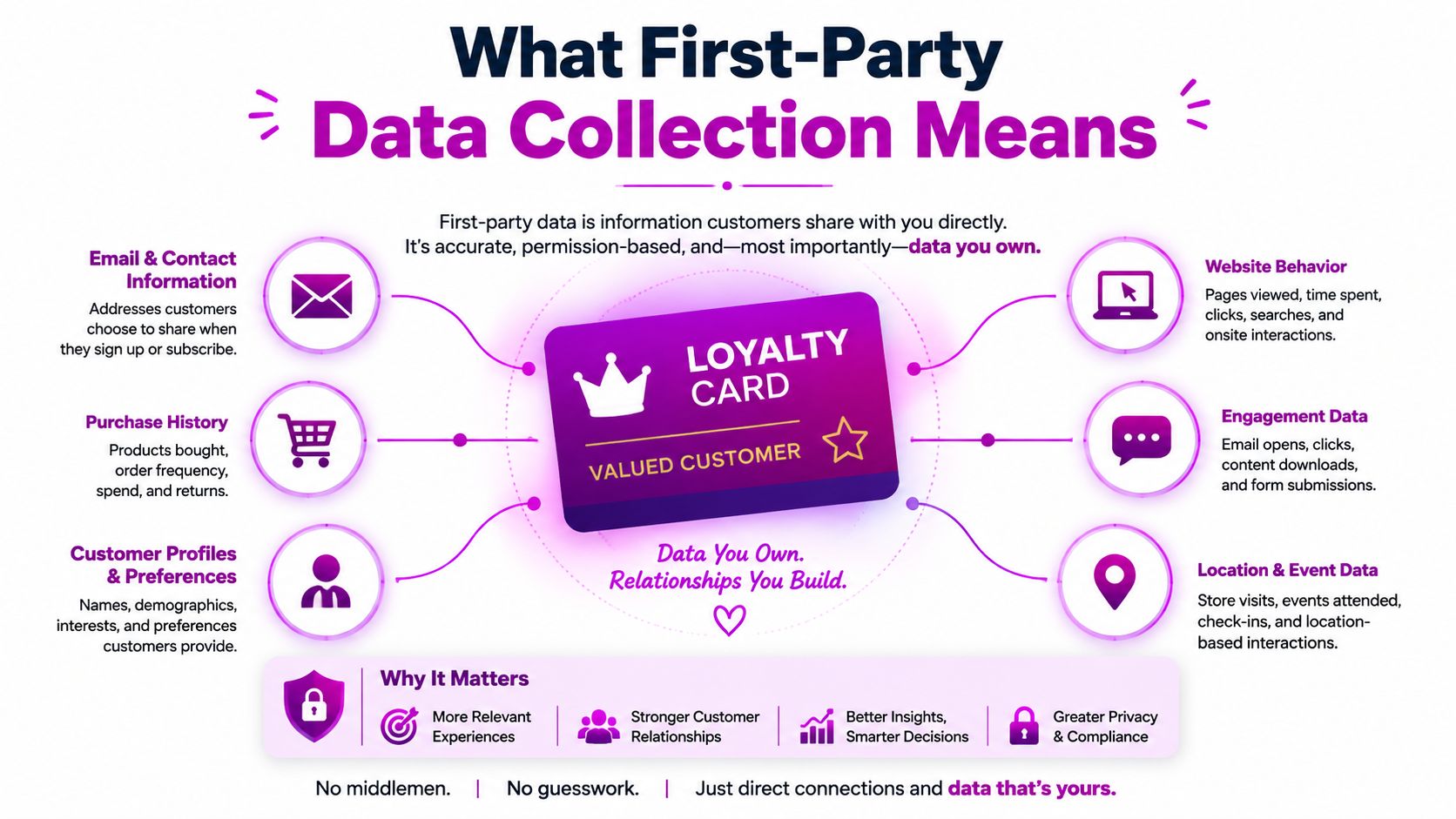
A loyalty card illustrates the principle of first-party data collection. When a customer chooses to use it, a physical retailer can connect a purchase to a known relationship instead of guessing who bought the product from a signal acquired elsewhere. The customer identifies themselves within a channel the retailer operates, usually in exchange for convenience, rewards, order history, or more relevant communication.
A Shopify store applies the same principle through its own customer touchpoints. A shopper enters an email address at checkout, creates an account, joins a loyalty program, subscribes to product updates, or completes a preference form. The information becomes useful because the customer shares it directly with the brand. Activation still depends on the merchant's operating model, including identity rules, event definitions, consent gates, and the systems that can use each approved signal.
What belongs in the owned relationship
First party data collection can include several signal types:
- Identity signals: An email address, phone number, customer ID, account ID, or loyalty identifier that connects activity to a known profile.
- Transactional signals: Orders, returns, subscriptions, product quantities, purchase history, and checkout outcomes stored through Shopify or connected systems.
- Behavioral signals: Products viewed, searches, clicks, cart additions, and sessions on the store's owned website or app.
- Declared preferences: Information customers provide through surveys, account fields, quizzes, preference centers, and feedback forms.
- Engagement signals: Email interactions, app usage, customer service conversations, and loyalty activity.
The distinction from third-party data is the direct relationship. Third-party providers infer or aggregate information from outside interactions, while first-party data comes from a person's engagement with your brand. That origin does not remove privacy obligations. It gives the merchant greater control over the collection context and the customer's expectations.
Consent is part of the data, not an afterthought
A newsletter signup does not automatically authorize every marketing use. The collection experience should state what the brand wants to collect, why it needs the information, and how the customer can withdraw permission or opt out. Privacy guidance from IAPP outlines the importance of legal basis, purpose disclosure, withdrawal handling, and technical safeguards.
The loyalty-card analogy fails when a retailer copies every interaction into unrelated systems. Sound first party data collection keeps the exchange visible and proportionate, then passes only approved data into the Shopify Plus CDP or connected platforms for permitted activation.
Business and Privacy Value for eCommerce
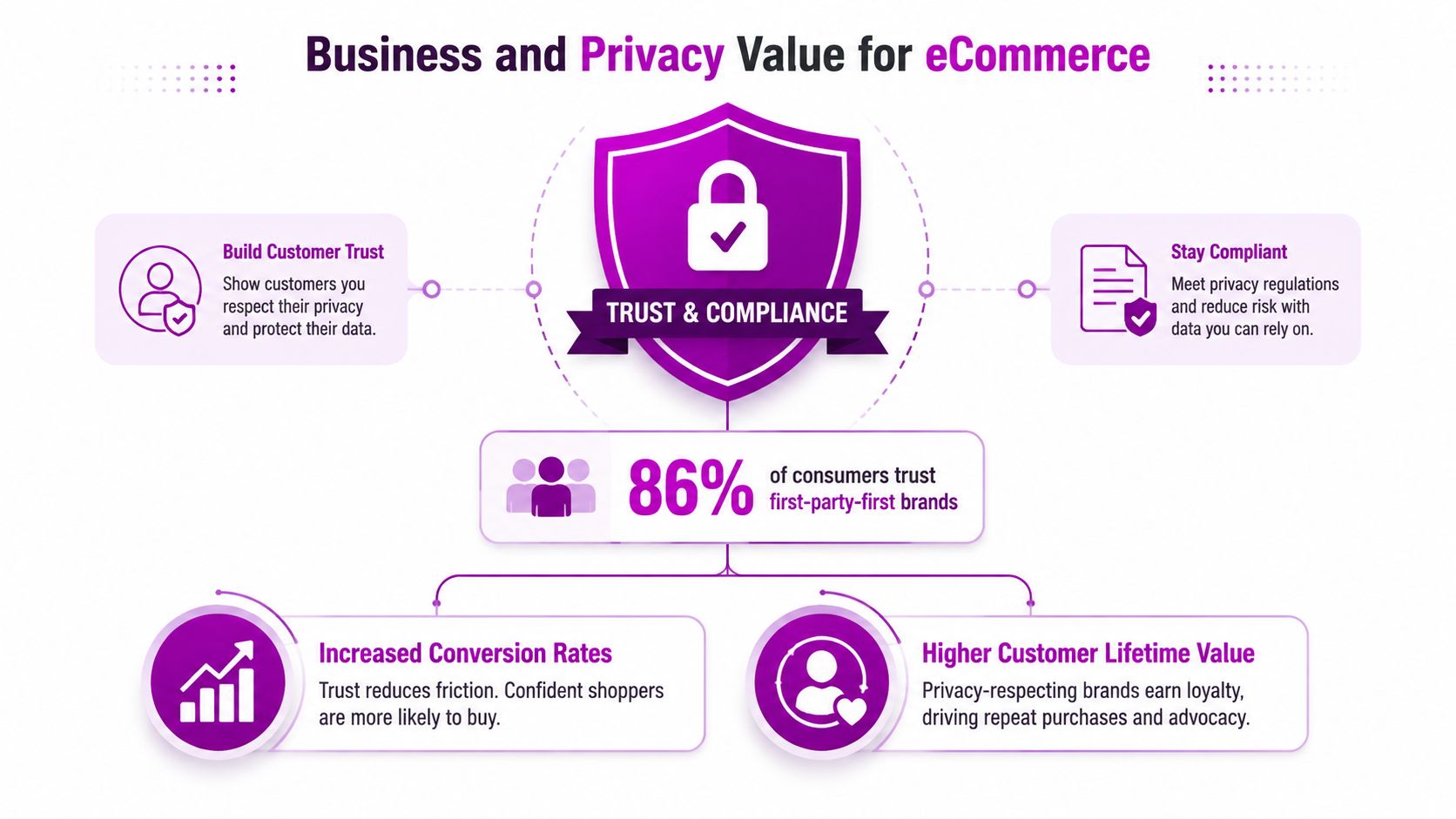
Trust affects revenue, retention, and the willingness to share information. A 2023 consumer survey found that 86% of consumers expressed higher trust in companies that rely primarily on first-party data, as summarized by Omnibound's first-party data statistics. Shoppers may not use the term “first-party data,” but they recognize the difference between sharing details with a store they use and being tracked by unfamiliar companies across the web.
A clear exchange gives customers a reason to identify themselves. They may provide an email address for order updates, join a loyalty program for easier repeat purchases, or share preferences to improve recommendations. The merchant receives a more reliable customer record, while the shopper sees the purpose and benefit of the interaction.
Why measurement becomes more stable
Browser-side tracking has a limited technical lifespan. Safari's Intelligent Tracking Prevention can restrict JavaScript-set first-party cookies to seven days, creating a serious limitation for brands with longer consideration cycles or repeat-purchase journeys. Consent choices also reduce the events a merchant can legally observe and activate.
A server-owned event stream provides a more controlled measurement foundation. The browser can submit an interaction, while the merchant's server or managed data layer checks permission, normalizes the event, and assigns it to an approved customer profile. Account creation or checkout can connect that activity to a deterministic identifier instead of relying on a browser signal that may disappear.
This supports more useful operational questions:
- Which marketing interaction preceded an order?
- Did the same customer return on another device?
- Which products appear in repeat-purchase patterns?
- Does a loyalty segment behave differently from a new-customer segment?
The answers still depend on attribution design. First-party data cannot make every channel fully measurable, and consent can reduce observable activity. It does give the merchant a more defensible internal record than third-party-only tracking, especially when a Shopify Plus CDP turns approved events into usable segments and journeys.
Privacy failures damage the business case
Collecting more data carries legal and trust costs that can outweigh marginal gains. Excessive fields, unclear consent language, and uncontrolled access make the collection experience harder to defend and can reduce participation. Teams diagnosing attribution gaps should also examine the wider tracking environment, including PPC tracking issues on Amazon, because platform reporting problems expose how heavily measurement depends on external systems.
Practical Collection Methods and Architecture
A durable Shopify Plus setup treats the browser as an input stream and the server as the source of truth. The storefront can detect an interaction, but the event should pass a consent check before leaving the stack. Server-side services then validate, enrich, match identity, and deliver approved data to downstream systems.
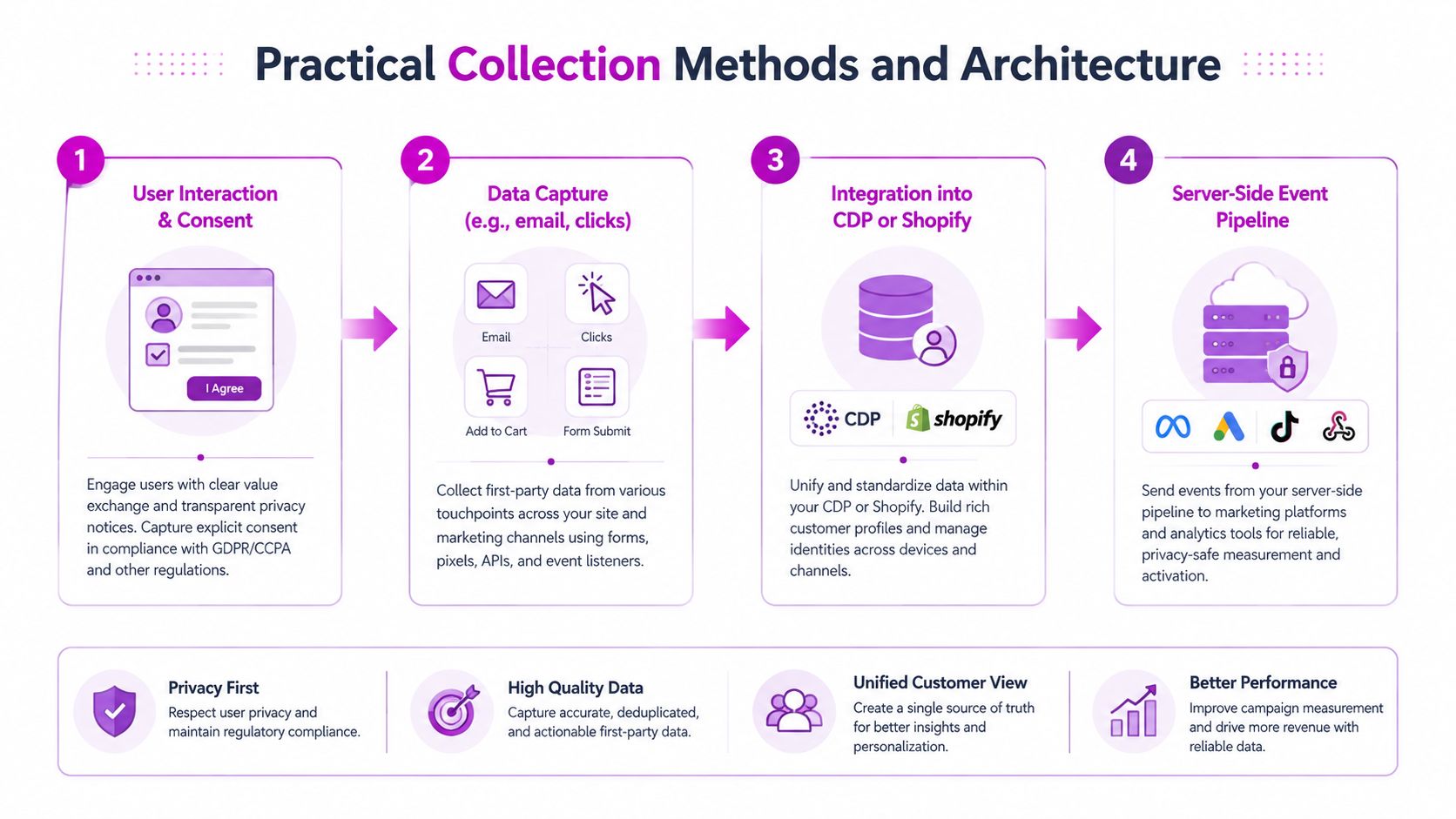
A workable Shopify Plus flow
Ask for permission in context. A checkout email field supports order fulfillment, but marketing permission requires suitable disclosure and a consent mechanism. Apply the same discipline to newsletter forms, SMS capture, quizzes, and loyalty enrollment.
Capture identity at the strongest moment. Account creation, checkout, lead submission, and loyalty signup can provide a known identifier. Store the email, phone, account ID, purchase history, and consent state with clear purpose metadata.
Route events through a controlled layer. Shopify webhooks, server-side APIs, app integrations, and a CDP can move order and customer events into owned infrastructure. Normalize event names, timestamps, product IDs, consent status, and source information before activation.
Enforce access and deletion. Role-based access, retention rules, opt-out propagation, and deletion handling belong in the operating design. A CDP can unify profiles, but it should not become an ungoverned warehouse that every tool can query.
A typical stack may include Shopify, a CRM, an email platform, and a CDP. The CDP can resolve profiles and create audiences, while Shopify remains authoritative for orders and customer account data. A data warehouse may retain historical events for analysis. Activation systems should receive only the fields and audiences required for an approved use case.
Don't confuse capture with activation
A signup event stored in Shopify is only an input. The team still needs a defined action after capture. An opted-in customer who purchased a replenishable product may enter a lifecycle segment. A customer who opted out of marketing can remain eligible for necessary service communication while staying excluded from promotional campaigns.
A customer data integration solution for eCommerce can help map these relationships across the storefront, CRM, CDP, email, analytics, and advertising destinations. Document field ownership and failure handling, especially when a customer changes an email address, withdraws consent, or places an order while an integration is unavailable.
Before an audience reaches a campaign or ad destination, verify four points:
- The identity key matches the system of record.
- Consent is current for the intended channel and purpose.
- The event schema contains the fields the destination requires.
- Retries, opt-outs, and deletion requests have a defined owner.
This checkpoint catches the operational gap between collecting a profile and activating it safely.
The trade-off is complexity. Server-side collection requires engineering support, monitoring, schema discipline, and careful testing. It may also produce less raw activity than an unrestricted client-side tracker. That reduction can be useful because it removes unconsented or poorly understood signals, leaving the business with data it can explain, govern, and activate through a Shopify Plus CDP.
Best Practices for Activation and Trust
The maturity gap is now more important than the collection gap. A 2025 industry summary reported that 91% of B2B marketers collect first-party data, yet about half described their strategy as exploratory or developing. The Content Marketing Institute summary provides that adoption and maturity context.
eCommerce teams face the same operational trap. They may have Shopify customer records, Klaviyo profiles, Meta audiences, support tickets, and loyalty data, but no agreed definition of a repeat buyer or an approved workflow for using that segment. More records don't solve disconnected ownership.
Build around decisions, not fields
Start with the action a team needs to take. A retention manager may need a segment of customers approaching replenishment. A merchandising team may need product-interest audiences. A CRO team may need to suppress recent purchasers from an acquisition landing-page test.
For each use case, document:
- Purpose: What business decision will this data support?
- Minimum fields: Which identity, behavior, or transaction signals are necessary?
- Permission: What consent or legal basis allows the use?
- Owner: Which team maintains the definition and resolves errors?
- Destination: Where will the approved audience or event be activated?
- Exit condition: When should the profile leave the segment or stop receiving the treatment?
This prevents the common mistake of collecting every possible click before deciding whether anyone can use it responsibly.
Make the value exchange visible
Customers share more willingly when the benefit is understandable. Faster checkout, accurate order updates, loyalty rewards, saved preferences, and relevant product information are concrete benefits. A vague promise of a “better experience” is weaker, especially when the form asks for sensitive or unnecessary details.
Zero-party data can strengthen this model because customers state preferences directly, but explicit answers still require careful purpose limitation. A preference quiz should improve recommendations, not become permission for unrelated advertising.
Trust is built at the collection moment and tested at the activation moment. A clear consent form cannot compensate for irrelevant messages or unexplained personalization.
Govern the lifecycle
Set rules for correction, deletion, opt-out synchronization, and access reviews. Test whether a withdrawal made in one system reaches the CDP and advertising destinations. Check whether profile merges create accidental cross-customer contamination.
The strongest programs also create a shared vocabulary. “Known customer,” “consented subscriber,” “active buyer,” and “high-value segment” should mean the same thing to marketing, analytics, engineering, and customer service. Integration, governance, and cross-team use are the main bottlenecks, not the number of fields captured.
Migrating From Third Party Strategies
Migration works best when the team compares signals by operational role rather than treating all tracking as interchangeable. A third-party cookie may help with broad reach, but it doesn't provide the same ownership or durability as an email-linked order record. A first-party event may be more constrained by consent, yet it gives the merchant a clearer basis for internal reconciliation.
Third Party vs First Party Signals
| Signal Type | Third Party | First Party |
|---|---|---|
| Identity | Inferred across external sites or platforms | Captured through an owned interaction, such as account creation or checkout |
| Purchase connection | Dependent on platform matching and browser availability | Connected to Shopify orders, customer IDs, CRM records, or server events |
| Cross-session continuity | Vulnerable to browser restrictions and blocked identifiers | More durable when tied to a consented, known customer profile |
| Ownership | Controlled by an external provider or platform | Stored and governed in systems controlled by the merchant |
| Consent context | Often difficult for the customer to understand across providers | Explained directly through the brand's collection experience |
| Activation | Useful for external reach, but exposed to policy and platform changes | Suitable for lifecycle segmentation, personalization, measurement, and approved audience delivery |
| Deprecation risk | High dependence on browser and platform policy | Lower dependence on third-party cookies, though consent and legal duties remain |
The comparison doesn't mean every external signal must disappear. Paid media platforms still matter, but they should receive approved conversions and audiences from a governed first-party foundation rather than defining the merchant's customer truth.
For Shopify Plus brands, the migration sequence usually starts with an event audit. List every client-side tag, identify what it captures, record whether consent gates it, and compare platform conversions with Shopify order data. Then prioritize known-user moments, especially checkout and account creation, because identity matching is strongest there.
Teams that need a deeper technical explanation can use this guide to understand server-side tracking. The architectural goal is straightforward: preserve useful measurement while reducing the number of systems that independently collect, interpret, and store customer signals.
The trade-off is that migration may expose unattributed activity that the old setup claimed. That isn't necessarily a performance decline. It can be a measurement correction, and it gives operators a more honest basis for budget decisions.
Real eCommerce Use Cases
A growing Shopify brand often discovers the problem during a repeat-purchase analysis. The store has order records, email engagement, and advertising reports, but the same customer appears as several anonymous visitors before checkout. The retention team can send campaigns, yet the analytics team can't reliably connect earlier product research to the eventual order.
A first-party design changes the sequence. The store captures the email or account ID at the first known interaction, records consent separately from the identifier, and links later Shopify events to the customer profile. The CDP can then build a segment based on actual purchases and product interests, while the order system remains the authority for completed transactions.
That supports practical workflows:
- A customer who buys a consumable product can receive a replenishment journey based on purchase history rather than an inferred browsing audience.
- A recent purchaser can be excluded from acquisition-focused onsite tests and shown relevant cross-sell content instead.
- A shopper who abandoned checkout can be recognized when they return, subject to the applicable consent and messaging rules.
- A support agent can see order and interaction context without asking the customer to repeat information.
Where CRO benefits appear
The conversion-rate opportunity usually comes from reducing irrelevant experiences, not from collecting more attributes. A Shopify Plus store can use known customer status to change merchandising logic, suppress duplicate signup prompts, preserve preferences, or surface products related to prior purchases.
The same architecture also improves test interpretation. If the CRO team can distinguish new visitors, known subscribers, recent purchasers, and returning customers using governed identifiers, it can avoid mixing materially different audiences into one conclusion.
This doesn't guarantee a lift in conversion or attribution. It gives the team better inputs and cleaner audience definitions, which makes experimentation and lifecycle work more defensible. The implementation succeeds when marketers can use the data without bypassing consent or creating a second, conflicting customer record.
Measuring Success and Next Steps
First-party data maturity should be measured through signal quality, operational reliability, and useful activation, not collection volume alone. A Shopify Plus team can review whether known-user events reach the server, whether consent states propagate correctly, and whether internal orders reconcile with downstream conversion reporting.
Useful checks include:
- Identity match quality: Can the team connect checkout, account, CRM, and order events to the right profile?
- Consent integrity: Do opt-outs and withdrawals stop prohibited activation across connected destinations?
- Event completeness: Are key actions, such as checkout, purchase, refund, and subscription events, consistently available?
- Audience usability: Can lifecycle, merchandising, CRO, and paid media teams activate approved segments without manual exports?
- Measurement reconciliation: Can marketing reporting be compared with Shopify order data and documented attribution rules?
The recommendation is to start with an audit, not a platform replacement. Map collection points, consent decisions, identifiers, data owners, and destinations. Then move the most important conversion and customer events to a server-side pipeline, beginning with known-user moments where matching accuracy matters most.
ECORN can support Shopify Plus brands with Shopify development, CDP-oriented customer data integration, CRO, and eCommerce consulting. Visit ECORN to discuss an audit or implementation plan that turns first party data collection into governed activation.
Talk with ECORN about auditing your consent flow, Shopify event model, and CDP integrations before adding more tracking tools. Visit ECORN to plan a server-side first-party data architecture that your marketing, analytics, and engineering teams can actually use.


10 Shopify App Ideas Worth Building in 2026
Conversion Rate Optimization for Landing Pages: The Playbook
Shopify Plus Automation: A Guide for 2026
10 Social Selling Platforms for Shopify Merchants

Shopify Website Design Examples: 7 Stores Worth Studying
7 Ecommerce Newsletter Examples for Shopify Brands
One Product Shopify Store: Build and Scale

Mobile Pop Up Strategy for Shopify Stores That Converts

Sitemap for Shopify: How to Find, Optimize, and Submit It
7 Single Product Websites Worth Emulating
Product Variants Shopify: The Complete 2026 Guide
Ecommerce Analytics Consulting for Growth
What Is AI Integration for eCommerce

How to Choose the Right eCommerce Website Development Firm
E Business Strategy Implementation
Conversion Tracking Setup for Shopify Stores
BigCommerce vs Shopify Plus Which Enterprise Wins in 2026
Shopify Theme Kit: Setup, Commands, and Migration Guide

Shopify Extension Development: A Practical 2026 Guide
Shopify Speed Score Explained and How to Improve It
Shopify Mobile Optimization: The 2026 Playbook

How to Add Subcategory in Shopify for Better UX
How to Implement Structured Data for Ecommerce in 2026
SEO App Mobile: Shopify Store Optimization Guide
Shopify Plus Support: What It Includes and How to Choose
Google Ads for Shopify: The Complete 2026 Playbook

Shopify New York: How to Find and Hire the Right Agency
Google Search Console for Shopify: The Complete Setup
FAQ Online Store Guide: Build and Measure It Right
Do FB Ads Work for eCommerce in 2026?

One Page Checkout for Shopify: Design and Implementation
Shopify GraphQL vs REST: The 2026 Developer Decision
Shopify Ecommerce Consulting: Strategy, Pricing &

Are Reddit Ads Worth It for eCommerce Brands
Shopify Title and Meta Description: A Practical 2026 Guide

Product Video Best Practices for Shopify Brands
Real-Time Inventory Management: A 2026 Guide
AI Chatbot Integration for Shopify Stores
Affiliate Program Management: A Shopify Guide
10 Best Performance Monitoring Tools for Shopify in 2026
Digital Asset Management for eCommerce Brands in 2026
Every Type of Facebook Ads Explained for eCommerce Growth
Product Information Management Explained for Shopify Brands
Support Ticket System: A Guide for Shopify Stores

10 Best Customer Service Tools for Shopify in 2026

Can I Start a Business with No Money? a 2026 Blueprint

What Sells Good on Etsy: Best Niches for 2026

Shopify Add to Cart Button: A Practical 2026 Guide

Customer Feedback Automation: A Practical eCommerce Guide
Critical Rendering Path: A Guide for Shopify Stores

How to Promote on TikTok for eCommerce in 2026

B2B eCommerce Consulting That Drives Real Revenue
10 Best Practices for Site Navigation in 2026
Return vs Refund for Shopify Stores: A Practical Guide

What Is Customer Lifetime Value and Why It Matters
What Is Voice of Customer Research for eCommerce

SMS Marketing for Ecommerce That Actually Converts

Master How to Improve Email Deliverability in 2026

Top 7 eCommerce Partners NYC for Shopify Brands in 2026

Machine Learning for Ecommerce: Boost Your Shopify Store

Beauty Market Research: Your 2026 Growth Guide

Shopify International Expansion: A 2026 Roadmap

What Does CRO Stand for in Business: Understanding CRO

Shopify Visual Merchandising: A Playbook for Higher Sales

Shopify Landing Page Design: Master Conversion in 2026
10 Best AI SEO Optimization Tools for Shopify in 2026

Agentic AI for Ecommerce: Boost Your Sales in 2026
Mastering Email Marketing Data for eCommerce Growth

Conversion Rate Optimisation Australia: Boost Your Sales
Conversion Rate Optimization AI: Your Shopify Store Guide

10 Product Bundling Strategies for Shopify in 2026
How to Increase Customer Lifetime Value: A Shopify Playbook
AI Customer Service Automation: Shopify Guide 2026

Clean Website Design: A Shopify Conversion Playbook

Omnichannel Retail Strategy: A Shopify Playbook
Product Data Enrichment: A Guide for Shopify Brands

Instagram Shopping Features a Guide for Shopify Stores
What Is Revenue Optimization: A Holistic RevOps Guide

Benefits of Conversion Rate Optimization: Boost Your
WordPress to Shopify Migration: Your 2026 Seamless Switch
Boost Sales: Ecommerce Payment Processing Guide 2026
Unified Commerce Platform: Benefits, KPIs & Shopify Guide

How to Reduce Bounce Rate eCommerce: Your 2026 Guide
Shopify API Integration: A Practical End-to-End Guide

How to Implement Data Governance: A 2026 Guide
Shopify Store Development Cost: A 2026 Breakdown
What Is Server Side Tracking: The Shopify Guide 2026
Marketing Automation Workflows: A Shopify Guide for 2026

Shopify: How to Reduce Technical Debt

Shopify UX Design Change: A Playbook for Growth
User Generated Content Strategy: Shopify Playbook

Shopify Pause and Build Plan Cost: A Complete 2026 Guide

Compare at Price on Shopify: A Complete Guide for 2026

Where Can I Sell My Prints? 10 Best Platforms for 2026
Shopify Order Management System: The Ultimate Guide 2026
What Is Marketing Attribution? an eCommerce Guide for 2026

10 Best Black Friday Sales Sheets for 2026

Discover the Top Social Media Marketing Agencies For
Consumer Confidence Definition for eCommerce in 2026
What Is Social Commerce? Your 2026 Guide to Boosting Sales


newsletter in your inbox