

You have the artwork ready, the files exported, and a few pieces that already get strong reactions. Then the critical business decision starts. Where can you sell prints in a way that fits your margins, your workflow, and the kind of brand you want to build?
The answer shapes almost everything downstream. It affects how much you keep per sale, whether you own the customer relationship, how much packing and shipping you handle yourself, and whether your catalog can grow without creating operational drag.
The market has also changed. Artists are no longer limited to local fairs, gallery relationships, or a self-built store from day one. Online marketplaces, print-on-demand platforms, and artist-focused networks give you several viable routes to market, each with different trade-offs in control, reach, and effort.
That shift means you can start with a platform that matches your current stage instead of overbuilding too early. A marketplace can help test demand. A branded store can improve margins and customer retention once a few designs prove they can sell. If you are comparing both routes, this ecommerce platform comparison guide helps clarify what you gain and what you give up with each setup.
Use that lens throughout this guide:
- Best for: the type of artist or seller the platform suits
- Fees: listing costs, commissions, subscriptions, and hidden margin pressure
- Fulfillment: self-ship, print on demand, or platform-managed production
- Business trade-off: discovery versus control, or convenience versus profit
- Quick-start fit: whether it makes sense for validation, scale, premium positioning, or passive income
That framework makes comparison easier. Etsy, for example, is often a demand-capture play. Shopify with Printful is stronger when brand control and repeat purchase potential matter more. Marketplaces such as Redbubble or Society6 reduce operating work, but they usually limit customer ownership and pricing power.
If you are deciding where to start, do not ask which platform is best in general. Ask which one serves your current goal with the least friction and the clearest path to profit.
1. Etsy
A common starting point looks like this. An artist has a few strong pieces, no email list, and no interest in building a full store before the first sale. Etsy fits that situation well because it gives you access to buyers who are already searching for art prints, personalized gifts, and home decor.
Etsy works best as a testing and demand-capture channel. You can list a small set of prints, compare size options, test framed versus unframed versions, and see which subjects get clicks and favorites before you invest more time or money.
Best for
Etsy is a strong fit for:
- artists validating demand
- sellers offering open editions or small limited runs
- print businesses selling giftable, searchable wall art
- entrepreneurs who want marketplace traffic before building their own storefront
If you expect Etsy to function like a passive gallery wall, it usually disappoints. The sellers who do well treat it like a search-driven retail channel.
Fees and fulfillment
The business model is straightforward, but margin pressure adds up fast. You need to account for listing fees, transaction fees, payment processing, shipping costs, packaging, and any ad spend you choose to run. That makes Etsy attractive for validation, but less attractive if you need strong margins from day one.
You also have two very different fulfillment paths:
- Self-fulfillment: better quality control, more hands-on work, more shipping complexity
- Print on demand: lower operational load, lower control over packaging and print consistency, thinner margins
That choice affects the whole business. If you hand-pack orders, you can create a better brand experience. If you use print on demand, you can test more designs with less operational drag.
Pros
- Built-in traffic: Buyers are already searching for prints and wall art.
- Fast to launch: You can get listings live without building a standalone site.
- Good for product testing: Titles, thumbnails, sizes, and bundles are easy to compare.
- Flexible offer structure: Personalized prints, sets, seasonal designs, and framed upgrades all work well.
Cons
- Competition is intense: Strong artwork still needs strong listing SEO and strong thumbnails.
- Margins can get tight: Fees, ads, and fulfillment costs can reduce profit quickly.
- Brand ownership is limited: Etsy owns much of the shopping experience, and repeat buyers may remember Etsy before they remember your name.
- Platform dependence is real: Search visibility can shift, and that can affect sales even if your product quality stays the same.
Business trade-off
Etsy gives you reach faster than a standalone store. In exchange, you give up part of the customer relationship and part of your margin.
That trade-off is acceptable early on. It is less attractive once you know which prints sell and want more control over pricing, presentation, and repeat purchase behavior.
Quick-start checklist
Use Etsy first if these boxes are true:
- You need a low-friction way to test demand.
- You do not have an established audience yet.
- You can produce strong mockups and product photos.
- You are willing to research keywords and improve listings regularly.
- You have a clear pricing model that accounts for fees and fulfillment.
If you are already thinking beyond a marketplace, it helps to understand how to create an ecommerce website for your own branded store. That gives you a cleaner next step once Etsy proves which products deserve a bigger brand home.
Practical rule: Use Etsy to identify winners, refine pricing, and learn what customers buy. Then decide whether those winning prints belong on Etsy long term or inside a store you control more directly.
2. Shopify store + Printful

A buyer finds your work, likes three pieces, signs up for your email list, and comes back later for a larger order. That sale path is much easier to build on Shopify than on a marketplace. Shopify gives you the storefront and customer ownership. Printful supplies the print-on-demand production and shipping.
For artists who want to build a real art business, not just list products, this setup changes the economics. You set pricing, control the presentation, collect customer emails, and decide how repeat purchases happen. The trade-off is simple. You gain control, but you also take responsibility for traffic, conversion, and retention.
Best for
Shopify plus Printful fits artists and print sellers who want to:
- build a branded direct-to-consumer store
- own customer data instead of relying on marketplace traffic
- test and expand a catalog without buying inventory upfront
- create collections, bundles, and launch campaigns around specific themes
It is a weaker fit if you need immediate built-in demand. A standalone store usually works best after you already have some audience, some proven products, or a plan to drive traffic consistently.
Fulfillment model
Printful handles production after the order is placed. That reduces inventory risk and keeps operations light in the early stage.
The practical cost is margin. Print-on-demand is convenient, but convenience is not cheap. If your pricing is too low, paid traffic becomes hard to justify and wholesale is usually off the table. Artists often underestimate that problem at launch.
Fee structure and business implications
The cost stack is broader than many sellers expect:
- Shopify monthly subscription
- payment processing fees
- Printful base product and shipping costs
- app costs if you add email, upsells, reviews, or subscriptions
- ad spend or content production if you need traffic
That does not make the model bad. It means pricing discipline matters from day one. Before launch, calculate your margin on best sellers, not just your cheapest print size. Include shipping, discounts, and the cost of getting a customer in the first place.
Pros
- Full brand control: Product pages, merchandising, packaging choices, and post-purchase experience stay under your control.
- Customer ownership: You can build an email list, run retargeting, and bring past buyers back without a marketplace standing in the middle.
- Better long-term economics: A strong store can improve repeat purchase rates and average order value over time.
- Catalog flexibility: You can test limited drops, framed options, bundles, and seasonal collections more easily than on most marketplaces.
Cons
- No built-in traffic: Sales depend on your ability to attract visitors through content, ads, SEO, partnerships, or an existing audience.
- More operational decisions: Store setup, apps, shipping logic, returns policy, and conversion tracking all need attention.
- Margins can get tight: POD costs and software spend can erode profit if pricing is based on guesswork.
- More room for mistakes: A weak storefront can waste good art. Bad navigation, poor mockups, or slow pages reduce conversion fast.
Quick-start checklist
Choose Shopify plus Printful if these boxes are true:
- You want customers to remember your brand, not the marketplace.
- You are ready to handle store setup and basic ecommerce operations.
- You have enough audience traction, or a realistic traffic plan.
- You want to keep testing products without holding inventory.
- You understand your gross margin before spending on ads.
Store structure matters early. Collections, product naming, mobile layout, and email capture are easier to set up properly before the catalog grows. If you are planning your own branded shop, review this guide on how to create an ecommerce website for a direct-to-consumer art store before launch.
Practical rule: Use Shopify plus Printful when your goal is to build a customer asset, not just process individual orders.
3. Redbubble
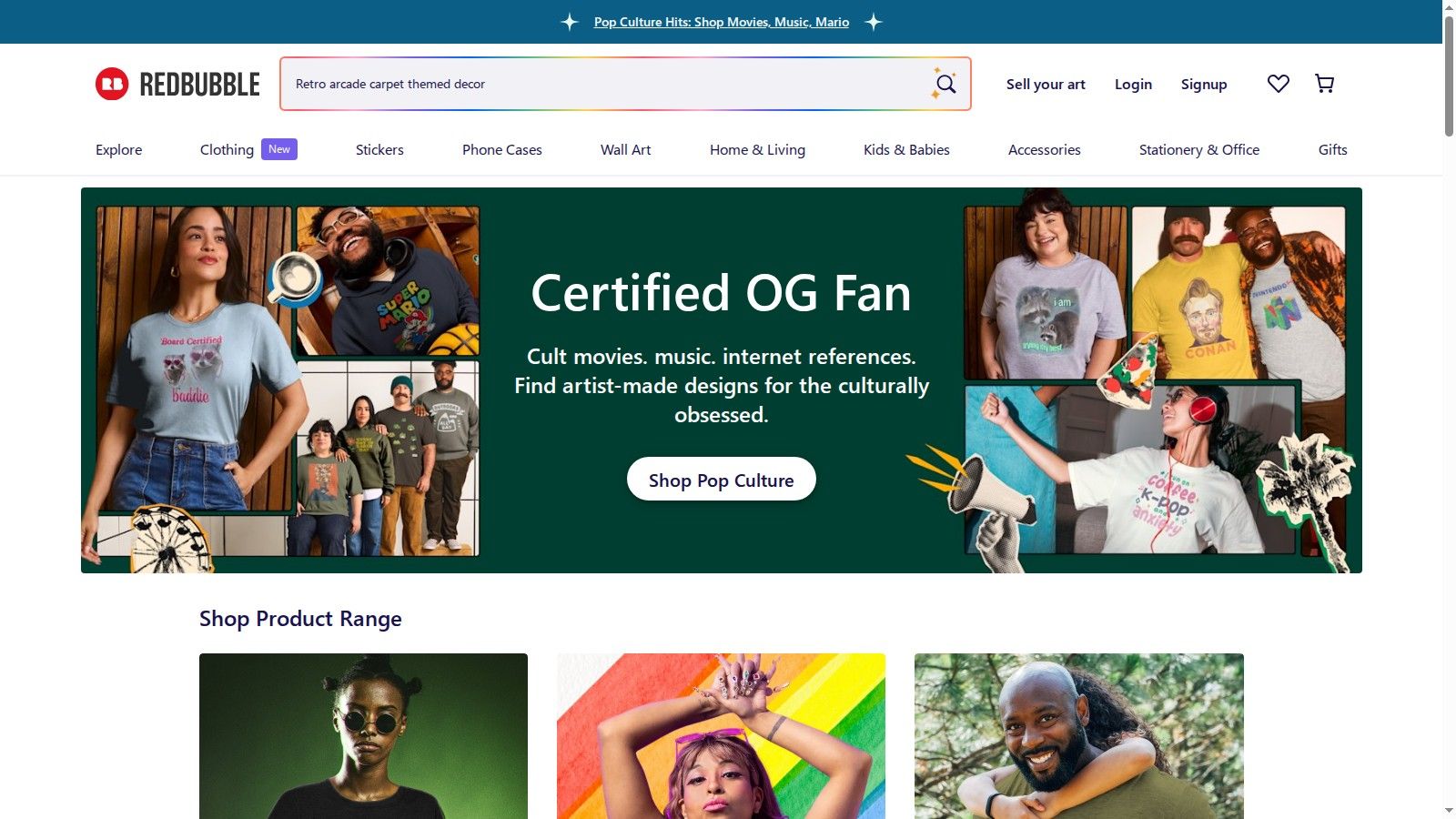
Redbubble is a volume-and-catalog play. It suits artists who can publish consistently, tag carefully, and let a broad range of designs work over time. If your art spans niches, fandom-adjacent styles, graphic motifs, or repeatable visual themes, Redbubble can generate long-tail sales without requiring you to manage production or shipping.
It's not the best place for a premium studio presentation. It is useful for reach, product breadth, and low-friction testing. Uploading is simple, and once the work is live, Redbubble handles manufacturing and fulfillment across multiple wall-art and product categories.
The practical reality
Redbubble works when you think like a catalog merchant. One hero print won't do much. A structured body of work often does better because the platform rewards breadth, relevance, and activity.
What works
- Consistent uploading: Fresh listings give the account more chances to surface.
- Niche targeting: Specific themes are easier to position than broad “modern wall art.”
- Keyword discipline: Good tagging matters because the platform search experience drives discovery.
What doesn't
- Passive optimism: Uploading once and disappearing rarely produces meaningful traction.
- Premium pricing assumptions: Buyer expectations on Redbubble usually lean more commercial than collector-focused.
- Overdependence on one design: Breadth matters more than perfection here.
For artists asking where can I sell my prints with almost no operational burden, Redbubble is a valid answer. But treat it like a testing field, not your whole business. The strongest use case is simple: publish a lot, watch what themes sell, then move proven winners into a stronger channel later.
4. Society6

Society6 sits in a slightly more curated corner of print-on-demand. It has long been associated with wall art and home decor, so it tends to make more sense for artists whose work translates well into framed prints, canvas formats, and interior-friendly styling. If your work belongs in a design-conscious room rather than a broad novelty catalog, Society6 is worth a look.
Its appeal is obvious. You upload the work, Society6 handles production, framing, shipping, and customer service, and you avoid the logistics headache that usually slows artists down.
When Society6 makes sense
Society6 is strongest for artists who care about wall-art presentation but don't want to manage fulfillment. It's weaker if your strategy depends on aggressive margin control or close ownership of the customer relationship.
Pros
- Hands-off operations: The platform manages production, logistics, and returns.
- Wall-art alignment: It fits artists whose prints are the main product, not just one SKU among many.
- Global reach: You can sell internationally without building your own infrastructure.
Cons
- Limited control outside your storefront page: Brand-building is restricted compared with Shopify.
- Royalty constraints on some categories: Not every product gives you meaningful pricing flexibility.
- Platform dependence: Catalog or policy changes can affect visibility and earnings.
One common mistake is treating Society6 like a portfolio site. It's still a commerce environment. Strong mockups, cohesive collections, and a clear visual point of view matter. If your work feels scattered, the shop usually underperforms.
Curated-feeling marketplaces reward coherence. A tight series usually sells better than a random mix of unrelated pieces.
5. Saatchi Art
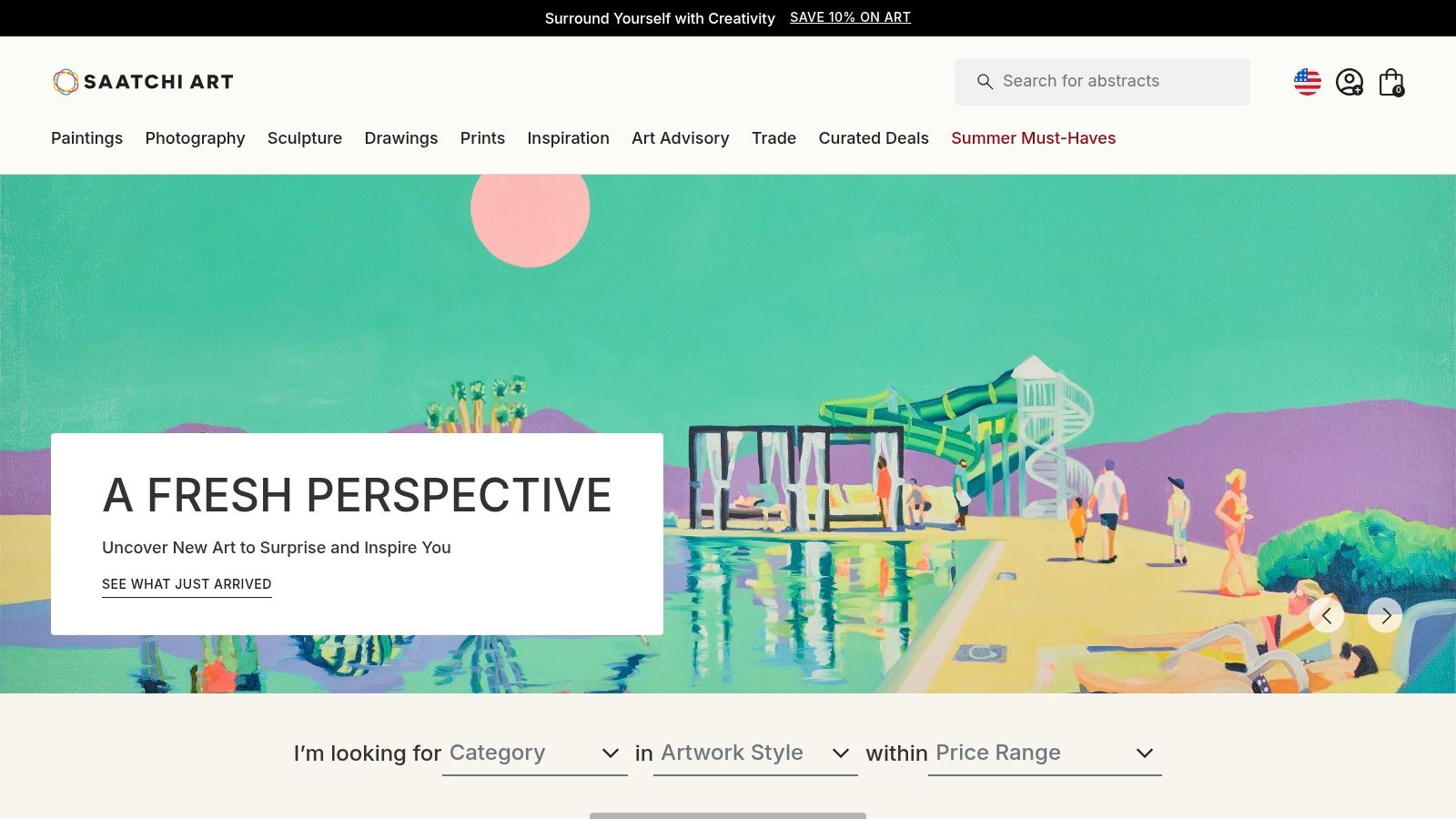
Saatchi Art is the platform to consider when you want to position prints closer to fine art than general wall decor. The audience is more collector-oriented, and that changes how you should present the work. Your images, artwork descriptions, biography, and overall polish matter more here than they do on broad gift marketplaces.
This platform suits photographers, painters, and illustrators whose work can support a higher-end presentation. It also helps if your originals and your prints live in the same artistic universe, because buyers on Saatchi often care about the artist practice, not just the product image.
Collector audience, stricter expectations
Saatchi Art can be a strong channel for perceived value, but it isn't forgiving. Weak images, generic titles, or inconsistent bodies of work stand out quickly.
Pros
- Higher-end context: The platform attracts buyers looking for art, not just decor.
- Fulfillment handled: Saatchi manages print production and logistics for eligible print sales.
- International exposure: Good for artists who want access to buyers beyond local markets.
Cons
- Competitive curation: Better presentation is required to compete.
- Reduced take-home earnings: Commission affects margins.
- Slower feedback loop: Sales cycles can be less immediate than on gift-oriented platforms.
Use Saatchi when your work benefits from being seen in a fine-art environment. Don't use it if your edge is speed, personalization, or trend-driven volume. Those strengths usually convert better elsewhere.
6. INPRNT
INPRNT has a strong reputation among illustrators and fine-art print buyers because the platform is selective and quality-focused. That smaller, more curated feel can be an advantage. Your work isn't sitting inside the same kind of giant marketplace clutter you get on mass POD platforms.
It's especially attractive if print quality is part of your positioning. Buyers who shop on INPRNT generally expect gallery-style output, and artists often choose it because the platform feels closer to an art marketplace than a novelty-product engine.
Why artists like it
INPRNT handles printing, shipping, and customer service, while keeping the storefront centered on the artwork itself. That simplicity is part of the appeal. You don't need to become a logistics operator to sell polished fine-art prints online.
Pros
- Artist-friendly reputation: The platform is known for quality and a more serious print presentation.
- Less marketplace clutter: It's easier to maintain a strong visual identity.
- Good fit for illustrators and fine-art styles: Especially if buyers care about print finish and presentation.
Cons
- Access barrier: You need approval or an invitation to open a shop.
- Smaller audience than the biggest marketplaces: Discovery potential is narrower.
- Less flexible than a standalone store: Branding and customer ownership are still limited.
INPRNT is a good middle ground between premium positioning and operational simplicity. If Etsy feels too craft-market and Redbubble feels too broad, INPRNT is often the cleaner fit.
7. Fine Art America / Pixels
Upload 100 images to Fine Art America and you can turn that archive into paper prints, framed pieces, canvas, metal, acrylic, and a long list of home products without setting up production yourself. That scale is the main reason to use it.
Fine Art America works best for artists who want catalog breadth more than tight brand control. The platform handles printing, framing, shipping, and customer service. You set your markup on top of the base price. Pixels adds a hosted storefront option, which helps if you want a cleaner shop front without building your own ecommerce stack.
Who it's best for
This platform is a practical fit for photographers, artists specializing in outdoor scenes, digital artists, and anyone with a large body of work that can sell across multiple formats. It is less effective for artists whose sales depend on a highly curated brand story, collector relationships, or a premium presentation that feels fully their own.
Fulfillment and fee model
The business model is straightforward. Fine Art America produces and fulfills the order, then pays you the markup you set. That keeps operations light, but it also means your pricing room is constrained by the platform's base costs. If your audience is price-sensitive, retail prices can climb faster than expected once framing or larger formats are added.
Pros
- Wide product and print range: Strong fit for artists who want to monetize the same image in many formats.
- Low operational burden: Production, packing, shipping, and support are handled for you.
- Flexible markup system: You control your margin instead of working from a fixed royalty only.
- Useful for large catalogs: Easier to scale breadth than on a handcrafted, one-listing-at-a-time platform.
Cons
- Search competition is heavy: Discovery inside the marketplace can be inconsistent.
- Brand ownership is limited: Buyers often remember the platform experience more than the artist.
- Pricing needs discipline: Base product costs can squeeze conversion if your markup is too aggressive.
- Customer data is limited: That reduces your ability to build a long-term repeat-buyer channel.
Fine Art America is usually strongest as a distribution channel, not the center of the business. Artists get the best results when they send traffic from Instagram, Pinterest, email, or their own website instead of relying on marketplace discovery alone.
Quick-start checklist
- Upload a cohesive group of best-selling or search-friendly images first.
- Review base prices before setting markups.
- Test a few product types instead of enabling everything at once.
- Use clear titles, keywords, and room-style mockups where available.
- Track which subjects sell as prints versus decor products.
- Treat Pixels as a support storefront, not a substitute for owned brand assets.
8. Amazon Handmade
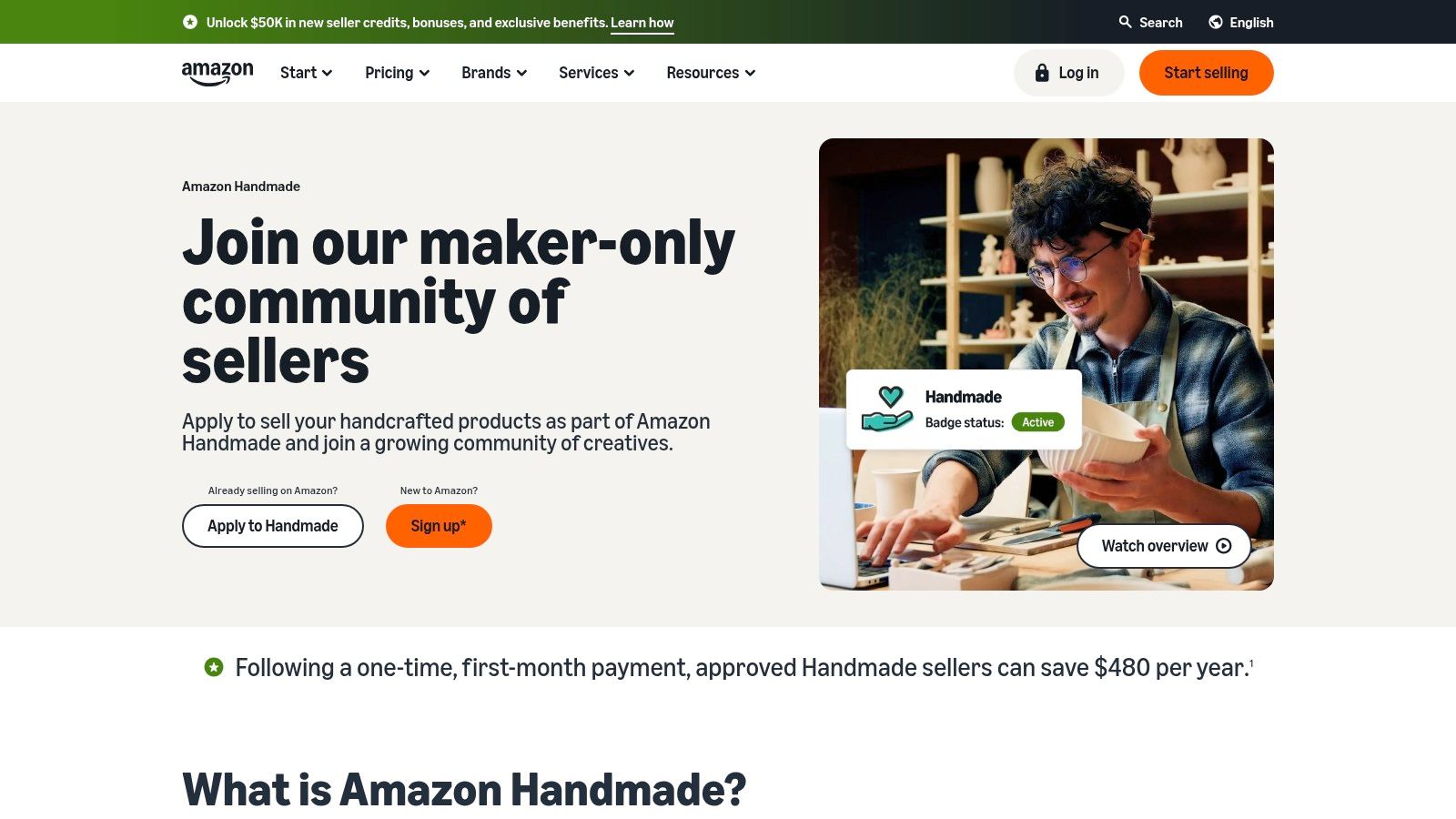
A buyer searches for a personalized wedding print on Amazon, compares three listings in under a minute, and picks the one with clear sizing, fast delivery, and reviews. That is the Amazon Handmade environment. It rewards prints that sell on search intent and operational reliability more than artist narrative.
Amazon Handmade is usually best for artists selling giftable prints, personalized designs, name art, family prints, nursery pieces, and other products with obvious use cases. It is a weaker fit for limited editions, slower custom workflows, or studio brands that depend on a premium presentation.
Best for search-driven print sales
The main business advantage is demand. Amazon already has the customer, the checkout trust, and the buying habit. The trade-off is margin pressure and stricter execution. You need strong listing copy, accurate production times, and a process you can repeat consistently.
Pros
- High purchase intent: Buyers often arrive ready to order, not browse.
- Strong fit for occasion-based prints: Good for weddings, anniversaries, birthdays, baby gifts, and home personalization.
- Built-in marketplace trust: Conversion can be easier than on a standalone store, especially for newer brands.
Cons
- Fee pressure: Amazon Handmade charges a referral fee. See the current details on the Amazon Handmade fee schedule.
- Strict service expectations: Delays, packaging issues, and listing errors can turn into poor reviews or account friction.
- Limited brand ownership: The customer experience belongs to Amazon first and your studio second.
For comparison, Amazon Handmade works best as a sales channel, not as the center of your brand. Artists who do well here usually treat it as a focused catalog for products with clear search demand.
Quick-start checklist
- Start with your clearest giftable or personalized print concepts.
- Write titles around buyer intent, not portfolio language.
- Set production times you can hit consistently.
- Use clean mockups that make size, framing, and customization options easy to understand.
- Price with fees and shipping costs in mind before you publish.
- Monitor reviews and fulfillment issues early, because small operational problems can affect visibility fast.
9. Zazzle
Zazzle is often overlooked in print conversations because people associate it more with customizable products than with art prints. That's exactly why some sellers do well there. If your work can be adapted into giftable, customizable, or occasion-specific wall art, Zazzle gives you more pricing flexibility than many creators expect.
It's also useful if you like the idea of earning not only from product sales but also from the traffic you drive through referrals or ambassador-style activity. That makes it more appealing to creators who already have content channels or niche communities.
Flexible royalties, mixed visibility
Zazzle lets creators set royalties across physical products, which gives you room to test how aggressively you want to price. But royalty control doesn't automatically solve discoverability. You still need clear product targeting.
Pros
- Royalty flexibility: Useful if you want to experiment with pricing strategy.
- Customization-friendly environment: Good for names, dates, gifts, and event-linked products.
- Extra earning paths: Helpful if you actively drive your own audience.
Cons
- Visibility can be difficult: Organic discovery isn't guaranteed.
- Fee adjustments can complicate margins: You need to watch the final economics.
- Less premium positioning: The buying context leans commercial and customizable.
Zazzle makes the most sense when your art overlaps with utility, gifting, or personalization. If your prints are purely gallery-driven, other platforms usually present them better.
10. Threadless Artist Shops
Threadless Artist Shops sit somewhere between a marketplace and a lightweight branded store. You get your own shop presence, Threadless handles production and shipping, and you can expand beyond prints into apparel, accessories, and home goods without rebuilding the operation from scratch.
That makes Threadless a strong option for artists with a recognizable visual identity and a community willing to buy into the broader brand. It isn't just about selling a single print. It's about building a merch-capable creative storefront.
Better branding than many POD marketplaces
Threadless gives more storefront personality than broad POD marketplaces, which can help if you already have social traffic or an audience from content, comics, design, or illustration work. The limitation is obvious. You still need to bring a lot of that traffic yourself.
Pros
- Brandable shop experience: More identity than many marketplace product pages.
- No listing ceiling pressure: Good for broad catalogs and experimentation.
- Easy category expansion: Prints can sit alongside other products naturally.
Cons
- Traffic responsibility sits with you: Consistent sales usually need active promotion.
- Margins depend on your retail strategy: Poor pricing leaves little room.
- Less collector-oriented: Better for fan communities and branded art businesses than fine-art positioning.
If you've built an audience around your style and not just around individual artworks, Threadless can work well. If you need built-in discovery first, Etsy or a larger marketplace will usually get you there faster.
Top 10 Platforms to Sell Prints, Comparison
| Platform | Core features | UX & Quality ★ | Value & Pricing 💰 | Target Audience 👥 | Unique Selling Points ✨ |
|---|---|---|---|---|---|
| Etsy | Marketplace listings, POD integrations, personalization | ★★★★, strong search & gift intent | 💰 Predictable fees; ads can add up | 👥 Gift buyers, indie print sellers | ✨ Built-in demand, flexible listings |
| Shopify + Printful | Branded DTC store, full control, POD fulfillment | ★★★★★, best with CRO & marketing | 💰 Monthly + app & POD costs, higher margins | 👥 Brands wanting control & scale | ✨ Own data, A/B tests, Shopify Plus-ready |
| Redbubble | Open POD marketplace, upload-to-sell model | ★★★, long-tail passive sales | 💰 No upfront costs; platform fees reduce pay | 👥 Passive creators, niche designers | ✨ Quick to publish, global fulfillment |
| Society6 | Curated POD marketplace, home & wall art focus | ★★★★, solid print & framing quality | 💰 Hands-off logistics, lower royalties on non-wall items | 👥 Home-decor buyers, quality-focused artists | ✨ Reputation for framed/wall-art quality |
| Saatchi Art | Fine-art marketplace, originals + prints option | ★★★★, collector audience, high AOV | 💰 Commissioned sales; higher AOV offsets fees | 👥 Collectors, gallery-focused artists | ✨ Curated exposure, advisory boosts |
| INPRNT | Artist-run giclée print studio & marketplace | ★★★★★, gallery-quality prints | 💰 ~50% on fine-art prints; artist-friendly split | 👥 Professional artists, collectors | ✨ Invite/application curation, quality-first |
| Fine Art America / Pixels | Large POD network, many materials & framing | ★★★, mature catalog, variable quality | 💰 Base prices can be high; markup control | 👥 Artists needing broad SKUs & storefronts | ✨ Wide catalog, white-label storefronts |
| Amazon Handmade | Amazon storefront, Prime audience, handmade category | ★★★★, massive reach & checkout trust | 💰 ~15% referral fees; strict SLAs | 👥 Sellers targeting Prime/gift shoppers | ✨ Unmatched reach, trusted checkout |
| Zazzle | POD with royalty controls & referral programs | ★★★, customizable product focus | 💰 Royalties 5–50%; fees/adjustments apply | 👥 Creators of customizable gifts & merch | ✨ Fine-grained royalties, ambassador payouts |
| Threadless Artist Shops | Free branded POD shop, set retail prices | ★★★, brandable storefront, promo access | 💰 Free to open; margins = retail − base cost | 👥 Artists who want a branded shop | ✨ Free branded URL, optional managed promos |
Your Next Step: Choosing a Platform That Serves Your Art
You have ten tabs open, every platform looks usable, and each one promises reach. The key decision is simpler. Choose the platform model that matches the business you want to run.
That decision usually comes down to four filters: demand source, margin, fulfillment, and brand control. If a platform brings the customer, you trade away some control and margin for faster exposure. If you run your own store, you keep more control but take on traffic, conversion, and retention yourself. Artists who get this right usually choose based on operating model first, not popularity.
Use this framework:
- Best for: your current stage, product style, and buyer
- Fee structure: listing fees, commissions, referral fees, or base-cost margins
- Fulfillment model: marketplace-managed, print-on-demand, or self-managed
- Quick-start test: the fastest way to validate whether the channel fits
A few patterns are consistent across print businesses. Marketplace platforms are useful for early demand validation because shoppers are already there. A branded store is usually stronger once a few designs prove they can sell, because repeat purchases, upsells, and email capture matter more over time. That is why many artists start on one marketplace, then add Shopify once they know which prints, sizes, and themes deserve more focused merchandising.
Product type matters just as much. A high-end limited edition print belongs in a different sales environment than a personalized family print, a dorm-wall poster, or a giftable quote design. Price point, framing expectations, packaging standards, and buyer intent all change by channel. Local selling can still be a smart first test if you need direct feedback on what people pick up, ask about, and pay for.
If you need a practical starting point, use this checklist:
- Choose Etsy if you need proof of demand and can handle competition and listing work.
- Choose Shopify + Printful if you want brand control, better long-term retention, and room to improve margins.
- Choose Redbubble or Society6 if low-touch distribution matters more than owning the customer relationship.
- Choose Saatchi Art or INPRNT if your work sells better in a fine-art context with higher presentation standards.
- Choose Amazon Handmade, Zazzle, or Threadless if your prints are giftable, customizable, or tied to a broader product line.
Do not launch on five platforms at once. That usually creates weak listings, inconsistent pricing, and messy fulfillment. Start with one primary channel and one clear goal. Validate demand, learn which images and sizes move, then expand with evidence instead of guesswork.
If you're building on Shopify or moving from a marketplace to a branded store, ECORN is a strong partner to bring in. Their team focuses on Shopify design, development, and CRO, which is exactly where many print businesses get stuck after the first phase of traction. They can help turn a basic print shop into a storefront that converts, scales, and gives you more control over margins and customer retention.


How to Implement Structured Data for Ecommerce in 2026
SEO App Mobile: Shopify Store Optimization Guide

Shopify Plus Support: What It Includes and How to Choose
Google Ads for Shopify: The Complete 2026 Playbook

Shopify New York: How to Find and Hire the Right Agency

Google Search Console for Shopify: The Complete Setup
First Party Data Collection for eCommerce Growth
FAQ Online Store Guide: Build and Measure It Right
Do FB Ads Work for eCommerce in 2026?
One Page Checkout for Shopify: Design and Implementation
Shopify GraphQL vs REST: The 2026 Developer Decision
Shopify Ecommerce Consulting: Strategy, Pricing &
Are Reddit Ads Worth It for eCommerce Brands
Shopify Title and Meta Description: A Practical 2026 Guide

Product Video Best Practices for Shopify Brands

Real-Time Inventory Management: A 2026 Guide
AI Chatbot Integration for Shopify Stores
Affiliate Program Management: A Shopify Guide
10 Best Performance Monitoring Tools for Shopify in 2026
Digital Asset Management for eCommerce Brands in 2026
Every Type of Facebook Ads Explained for eCommerce Growth
Product Information Management Explained for Shopify Brands

Support Ticket System: A Guide for Shopify Stores

10 Best Customer Service Tools for Shopify in 2026

Can I Start a Business with No Money? a 2026 Blueprint

What Sells Good on Etsy: Best Niches for 2026

Shopify Add to Cart Button: A Practical 2026 Guide

Customer Feedback Automation: A Practical eCommerce Guide
Critical Rendering Path: A Guide for Shopify Stores

How to Promote on TikTok for eCommerce in 2026

B2B eCommerce Consulting That Drives Real Revenue
10 Best Practices for Site Navigation in 2026
Return vs Refund for Shopify Stores: A Practical Guide
What Is Customer Lifetime Value and Why It Matters
What Is Voice of Customer Research for eCommerce

SMS Marketing for Ecommerce That Actually Converts

Master How to Improve Email Deliverability in 2026

Top 7 eCommerce Partners NYC for Shopify Brands in 2026
Machine Learning for Ecommerce: Boost Your Shopify Store

Beauty Market Research: Your 2026 Growth Guide

Shopify International Expansion: A 2026 Roadmap

What Does CRO Stand for in Business: Understanding CRO

Shopify Visual Merchandising: A Playbook for Higher Sales

Shopify Landing Page Design: Master Conversion in 2026

10 Best AI SEO Optimization Tools for Shopify in 2026

Agentic AI for Ecommerce: Boost Your Sales in 2026
Mastering Email Marketing Data for eCommerce Growth

Conversion Rate Optimisation Australia: Boost Your Sales
Conversion Rate Optimization AI: Your Shopify Store Guide

10 Product Bundling Strategies for Shopify in 2026

How to Increase Customer Lifetime Value: A Shopify Playbook
AI Customer Service Automation: Shopify Guide 2026

Clean Website Design: A Shopify Conversion Playbook

Omnichannel Retail Strategy: A Shopify Playbook

Product Data Enrichment: A Guide for Shopify Brands
Instagram Shopping Features a Guide for Shopify Stores

What Is Revenue Optimization: A Holistic RevOps Guide

Benefits of Conversion Rate Optimization: Boost Your
WordPress to Shopify Migration: Your 2026 Seamless Switch
Boost Sales: Ecommerce Payment Processing Guide 2026
Unified Commerce Platform: Benefits, KPIs & Shopify Guide

How to Reduce Bounce Rate eCommerce: Your 2026 Guide
Shopify API Integration: A Practical End-to-End Guide

How to Implement Data Governance: A 2026 Guide
Shopify Store Development Cost: A 2026 Breakdown
What Is Server Side Tracking: The Shopify Guide 2026
Marketing Automation Workflows: A Shopify Guide for 2026

Shopify: How to Reduce Technical Debt

Shopify UX Design Change: A Playbook for Growth

User Generated Content Strategy: Shopify Playbook

Shopify Pause and Build Plan Cost: A Complete 2026 Guide
Compare at Price on Shopify: A Complete Guide for 2026
Shopify Order Management System: The Ultimate Guide 2026
What Is Marketing Attribution? an eCommerce Guide for 2026

10 Best Black Friday Sales Sheets for 2026

Discover the Top Social Media Marketing Agencies For
Consumer Confidence Definition for eCommerce in 2026
What Is Social Commerce? Your 2026 Guide to Boosting Sales
A Social Ad Campaign Playbook for eCommerce Growth

7 Best FAQ Page Examples for SaaS & eCommerce

Market Research in Fashion Industry: A Guide for Shopify
Shopify Migration Services: Expert Guide for 2026
Mastering FB Retargeting Ads for Shopify in 2026
What Is Omnichannel Ecommerce

Master Your Shopify Plus Migration: The 2026 Guide
Shopify Integration Services: A Merchant's 2026 Guide
Shopify Collection Description: A Guide to SEO & Sales

Shopify Plus Contact: Reach Sales & Support Effectively

Top Luxury Shopify Stores: Design & UX Strategies

How to Improve Customer Experience: A Shopify Roadmap

Creative Facebook Ads: 10 Examples for Shopify Brands

Remarketing with Facebook Ads: A Shopify Guide for 2026

SEO Linking Strategies for Shopify Stores
Top 7 Statistics YouTube Channels for eCommerce in 2026

Hiring Shopify Plus Designers: A Founder's Guide
Shopify Product Variation: Master Your Variants for 2026

Leverage Ai Solutions Brands: Your 2026 Shopify Growth Guide
Filters in Shopify: A Guide for Growing Brands

Shopify Plus Developer: A Guide for Growing Brands

When Does Black Friday Online Start? A 2026 Guide


newsletter in your inbox